The 25-7-2 workout is 25 minutes on the StairMaster at level 7, 2 times a week, without holding the rails. What's real: your glutes fire roughly one and a half times harder climbing stairs than walking on flat ground, and 25–30 minutes burns around 200–270 calories with zero impact. What isn't: no cardio "reveals" abs — that's body fat and diet — and 50 minutes a week is only a third of the recommended weekly dose, not all of it.
Every gym has that one machine that stood in the corner for twenty years without a line — and suddenly you need to book a slot. The stepmill, better known by its most famous brand name StairMaster, got a second life thanks to three numbers from TikTok: 25-7-2. Twenty-five minutes, level 7, twice a week — and the feed filled up with "my abs after eight weeks" videos. Let's take it apart without hype and without snobbery: what the machine actually is, what the trend genuinely delivers, and where the marketing ends and physiology begins.
What is the 25-7-2 workout?
The formula is almost embarrassingly simple: 25 minutes on the stair climber, level 7, 2 times a week, hands off the rails.
It was coined by TikTok creator Camilla Dilan Akbas, who climbed the StairMaster twice a week while preparing for a pageant and posted a video about how her abs "showed up in eight weeks." Then the magic of simple formulas kicked in: the trend's hashtag racked up over 280 million views, and everyone from Marie Claire to the Cleveland Clinic weighed in.
It's not hard to see why it exploded. The formula removes cardio's biggest barrier: decision-making. Not "exercise enough" but exactly 25 minutes; not "find the right intensity" but level 7; not "be consistent" but twice a week. Add the fact that almost every gym has a stair climber — and until the trend, it was always free.
As for the "abs in eight weeks" part — we'll be honest about that in section 06.
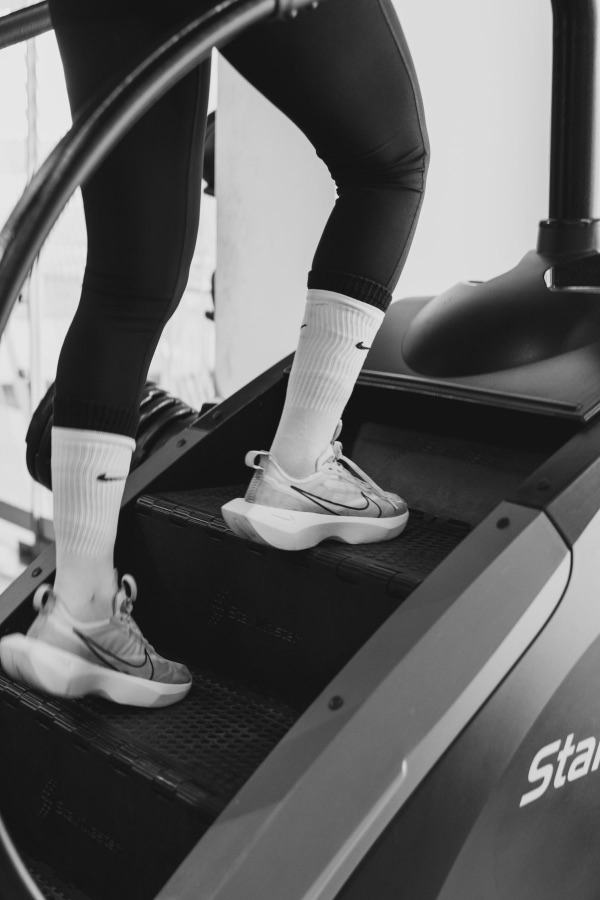
What is a StairMaster, exactly?
A StairMaster — generically a stepmill, stair climber, or "endless staircase" — is a machine with real rotating steps that come at you while you climb at a set pace, going nowhere. Essentially an escalator running against you.
A quick naming cleanup, so you don't buy or book the wrong thing:
| Machine | What it is | Main load |
|---|---|---|
| Stepmill (StairMaster) | Real rotating stairs | Glutes, quads, calves |
| Mini stepper | Two pedals rocking up and down | Mostly quads, short range of motion |
| Vertical climber | Arms-and-legs climbing (VersaClimber type) | Full body |
This article is about the first one — and it has quite a backstory. The StairMaster was invented in 1983 in Oklahoma; company lore says the founder got the idea during his service years in Italy, living in a fourth-floor walk-up with no elevator. A machine that makes you climb stairs but spares you the descent — the part your knees hate most.
What muscles does the StairMaster work?
Climbing stairs is a rare kind of cardio that seriously loads the posterior chain.
- Glutes are the main beneficiaries: in a muscle-activity study (Himmelreich et al., 2008), the gluteus maximus worked roughly one and a half times harder during stair climbing than during level walking. Every step up is a loaded hip extension — close to a lunge.
- Quads lift you onto each step, with deeper knee flexion than walking.
- Calves drive the push-off from the ball of your foot.
- Core keeps your torso upright, especially with your hands off the rails.
That's why the StairMaster keeps coming up in "grow your glutes with cardio" advice. The honest caveat: cardio strengthens and tones, but it builds shape slowly — resistance training does that job much faster, and we have a full guide on how to grow your glutes. The stepmill is a great addition to lifting, not a replacement for it.
One underrated bonus: stair climbing is weight-bearing exercise, and weight-bearing work strengthens bone — real osteoporosis prevention, especially relevant for women past 40.
How many calories does the StairMaster burn?
Ballpark figures from clinical sources:
- 25–30 minutes at a moderate pace burns roughly 200–270 calories, depending on your weight and the level;
- that's about double what walking at a moderate pace burns in the same time;
- among cardio machines, the stair climber trails only the treadmill in calorie burn — at the same perceived effort.
The secret is physics: you're constantly lifting your own body weight vertically instead of rolling it along horizontally. And you get it without running's impact: your foot lands softly on a rising step, and the descent — the most punishing phase of real stairs — doesn't exist here at all.
For weight loss, the arithmetic is the usual kind: sessions add up to a weekly burn that only matters inside a calorie deficit. Two 25-minute sessions come to 400–550 calories a week — a pleasant contribution, not a free pass.
Is level 7 hard? Where to start
Here's the trend's first real problem: levels aren't standardized. On a typical StairMaster, level 7 means roughly 65–75 steps per minute — a brisk pace where you can only talk in short phrases. On another brand's machine, "seven" might be a stroll or a sprint.
So calibrate by your breathing, not the number:
- Beginners — start at levels 3–5 for 10–15 minutes. If you can hold a conversation, the pace is yours; if you're gasping by minute three, drop a level.
- Progression: first stretch the duration to 25 minutes, then raise the level by one every week or two.
- If you're already fit, 25 minutes at level 7 is honest moderate-intensity work — the same logic as zone 2 cardio: a conversational pace builds endurance more reliably than sprints.
Make your first session shorter and easier than you think you need — 10 minutes at level 4. The stair climber has a sneaky signature: the first five minutes feel easy, and around minute fifteen your legs suddenly fill with concrete. Better to step off thinking "I had more in me" than to crawl off and never come back.
- 1First session10 minutes
Level 3–4. Leave feeling like you had more — stair legs hit suddenly.
- 2Duration2–3 weeks
Build to 25 minutes at a comfortable level. Pace: "short sentences only".
- 3Intensityafter that
Raise the level by one every week or two. Breathing beats the number on the console.
- 4The full formula~6 weeks in
25 minutes, level 7 or your equivalent, twice a week — plus two strength days.
Rails, knees, and the honest critique
This wouldn't be our blog if we retold a trend without stress-testing it. Here's what trainers and clinicians actually say:
"No rails" is a rule with an asterisk. The point is that leaning on your arms offloads part of your body weight, cutting both the muscle work and the calorie burn. But for a beginner, balancing on moving stairs is a genuine fall risk. The fix is simple: a light fingertip touch for balance is fine for everyone; draping yourself over the rails just means cheating yourself.
"Abs in eight weeks" is marketing. Visible abs are decided by body-fat percentage and diet, not by which cardio machine you pick. The StairMaster helps create a deficit — like any cardio — but it's the kitchen that does the revealing.
50 minutes a week is a third of the dose, not the dose. The WHO recommends 150 minutes of moderate cardio per week. 25-7-2 is an excellent low-barrier start, but stopping there means under-dosing. The Cleveland Clinic puts it politely: the workout is "not better than many others" — its value is consistency, not magic numbers.
Knees. Climbing stairs puts noticeable pressure on the kneecap. The good news: the stepmill has no descent — the phase knees complain about most, and part of why the machine is gentler than real stairs or running. Still, with a knee-pain flare-up or arthritis, start with a doctor, not with level 7.
Without strength training — a plateau. Give your body a couple of months of the identical stimulus and progress stalls; adaptation is the whole point of physiology. The combination that works: the stepmill as cardio plus two strength sessions a week — how much total training makes sense is covered in how many workouts per week you really need.
No StairMaster? Here's what to do instead
- An actual staircase — free and effective: we have a whole article on stair climbing as a workout. The catch is the descent, which loads the knees eccentrically — the one thing the stepmill spares you. The hack: climb on foot, ride the elevator down.
- A mini stepper — compact and cheap, but the range of motion is short: your glutes do noticeably less, and the quads take most of the work. Fine for home, not a full substitute.
- Incline treadmill walking — the closest match in calorie burn, also impact-free; you lose the full hip extension of a real step, but you can dial intensity much more precisely.
The 25-7-2 formula transfers to any of these: 25 minutes, "short-phrases" pace, twice a week. Your physiology won't notice the brand swap.
Frequently asked questions
What is the stair machine at the gym called?
A stepmill, stair climber, or — after the best-known brand — a StairMaster. Don't confuse it with the mini stepper (two pedals) or the vertical climber (arms-and-legs climbing).
Is the 25-7-2 workout legit — does it actually work?
As regular moderate-intensity cardio, yes: 200–270 calories per session, stronger glutes, better endurance. As an "abs in eight weeks" shortcut, no: definition comes from a calorie deficit and diet. The formula's real strength is that it's easy to stick to — not that the numbers are magic.
Stepmill vs stair stepper — which is better?
The stepmill: full-size steps mean a bigger range of motion, harder-working glutes, and a higher burn. The mini stepper only wins on price and apartment floor space.
How many calories does the StairMaster burn in 30 minutes?
Roughly 200–270 calories at a moderate pace, depending on your weight and the level. About double a walk and close to a run — without the impact.
Can I do the StairMaster every day?
At moderate intensity, you can — it's low-impact. But there's no prize for daily grinding: 3–4 quality sessions plus strength training beat seven joyless climbs in a row.
Is the StairMaster bad for your knees?
It's easier on them than running and than walking down real stairs. But climbing does pressure the kneecap, so with arthritis or an active flare-up, see a doctor first, then pick a level.
The bottom line
- The StairMaster (stepmill) is an "endless staircase": real steps, all climb and no descent, load without impact.
- The 25-7-2 trend (25 minutes, level 7, twice a week) hit 280+ million views because it removed cardio's biggest barrier — having to make decisions.
- What's real: glutes work about one and a half times harder than in walking, 200–270 calories per session, stronger bones.
- What's marketing: "abs in eight weeks" — definition comes from diet, and 50 minutes a week is a third of the WHO's 150, a starting dose rather than a target.
- Level 7 isn't standardized: go by your breathing; beginners start at levels 3–5 for 10–15 minutes and progress from there.
- The best version of the trend: the stepmill twice a week plus two strength sessions — and far more than abs will show up.
Sources
- Cleveland Clinic. Stairmaster Benefits and Workouts, 2023–2024.
- TODAY. What is 25-7-2? The viral StairMaster workout, 2024; Prevention, 2023; Marie Claire UK, 2023; Bustle, 2023 — trend coverage with commentary from certified trainers.
- Smithsonian Magazine. The History of the StairMaster, 2020.
- Himmelreich H. et al. Gluteal muscle recruitment during level, incline and stair ambulation. Journal of Back and Musculoskeletal Rehabilitation, 2008;21(3).
- Systematic review and meta-analysis: stair climbing and cardiovascular risk. European Journal of Preventive Cardiology, 2024 (ESC Preventive Cardiology presentation).
- WHO. Physical activity guidelines: 150 minutes of moderate-intensity activity per week.
This article is for informational purposes and does not replace medical advice.