a hip thrust is a loaded hip extension — barbell across your hips, upper back on a bench, drive the hips up. In Bret Contreras's study (Journal of Applied Biomechanics, 2015), trained women's gluteus maximus averaged 70–87% of maximum in the hip thrust versus 29–45% in the back squat. And in a 2023 experiment (Frontiers in Physiology), nine weeks of hip thrusts grew the glutes exactly as much as nine weeks of squats — the squat just also loaded the quads and knees.Start with the empty bar, 20 kg (45 lb), and do your first two sessions with no bar at all. The working scheme is 3–4 sets of 8–12 twice a week with a pause at the top. How the hip thrust differs from the glute bridge, and which to pick, we covered separately — this article is form, weight and mistakes only.
Fifteen years ago this exercise didn't exist in gyms. Now there are dedicated machines for it and a bar pad next to every rack. The reason is simple: it's the only compound movement where the glutes work at their limit while the knees and lower back stay out of it.
What is a hip thrust and what does it do?
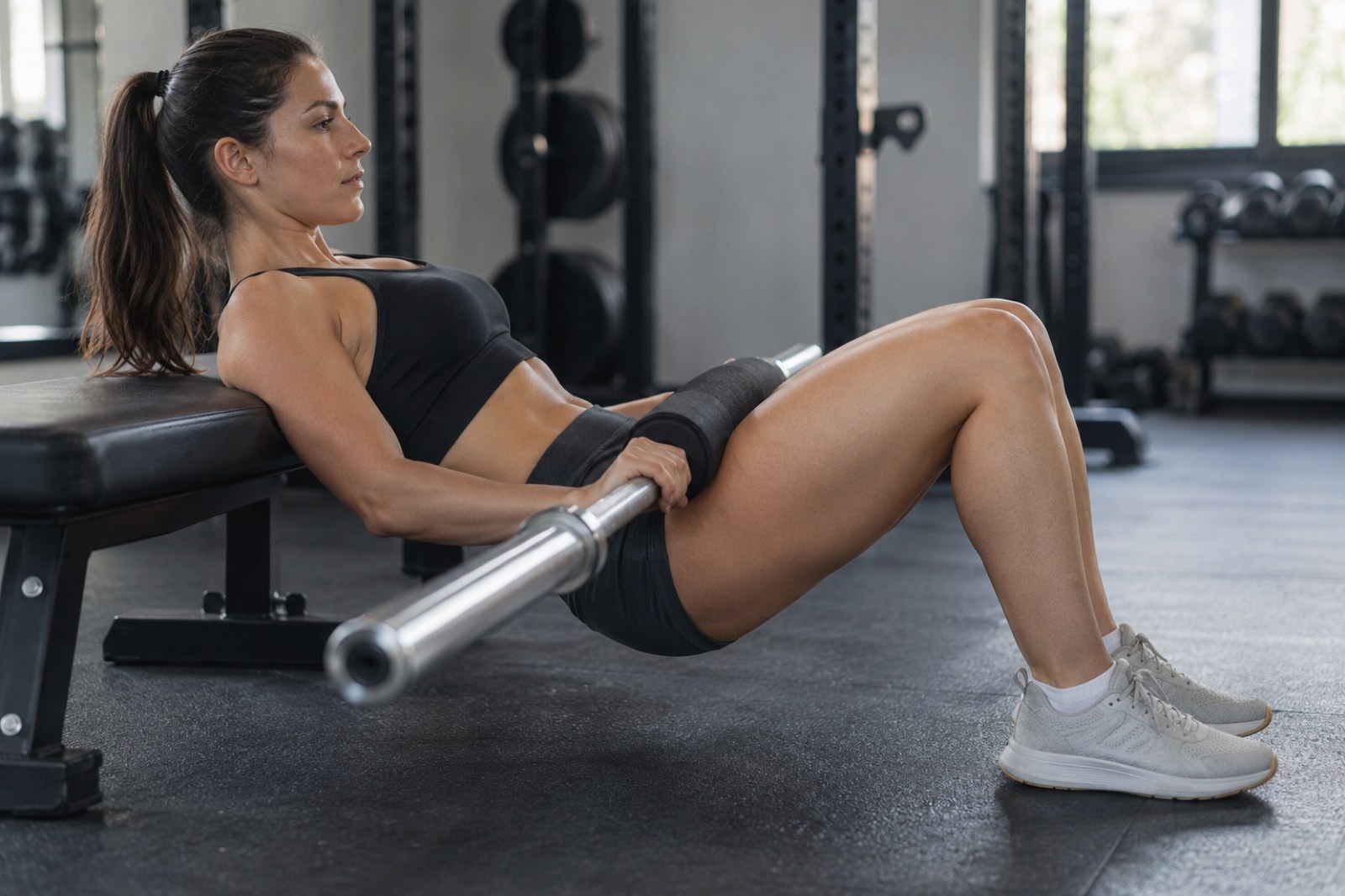
A hip thrust is hip extension against external load. You sit on the floor with your shoulder blades on the edge of a bench, a barbell across the crease of your hips, feet flat. From there you drive the hips up until torso and thighs form a straight line, then lower back down.
The key difference from squats and deadlifts is where the load peaks. In a squat the glutes work hardest at the bottom, where you're weakest. In a hip thrust they work hardest at the top, in full extension, where you're strongest. That's why you can load it far heavier than a squat and still target the glutes.
Numbers rather than feelings. In 2015 Bret Contreras and colleagues measured muscle electrical activity in 13 trained women working at a 10-rep-max load. In the hip thrust, the upper gluteus maximus averaged 69.5% of maximal voluntary contraction and the lower portion 86.8%. In the back squat: 29.4% and 45.4%. Peak values in the hip thrust reached 172–216%.
But activation isn't growth. In 2023, Daniel Plotkin's group — with Contreras as co-author — tested this directly: 34 untrained college students trained for nine weeks doing either only hip thrusts or only squats, with matched volume. Gluteal cross-sectional area on MRI grew equally in both groups. The difference lay elsewhere: squats also grew the quadriceps and adductors; hip thrusts didn't. The practical takeaway: both build glutes, but the hip thrust does it without knee loading and with less overall fatigue.
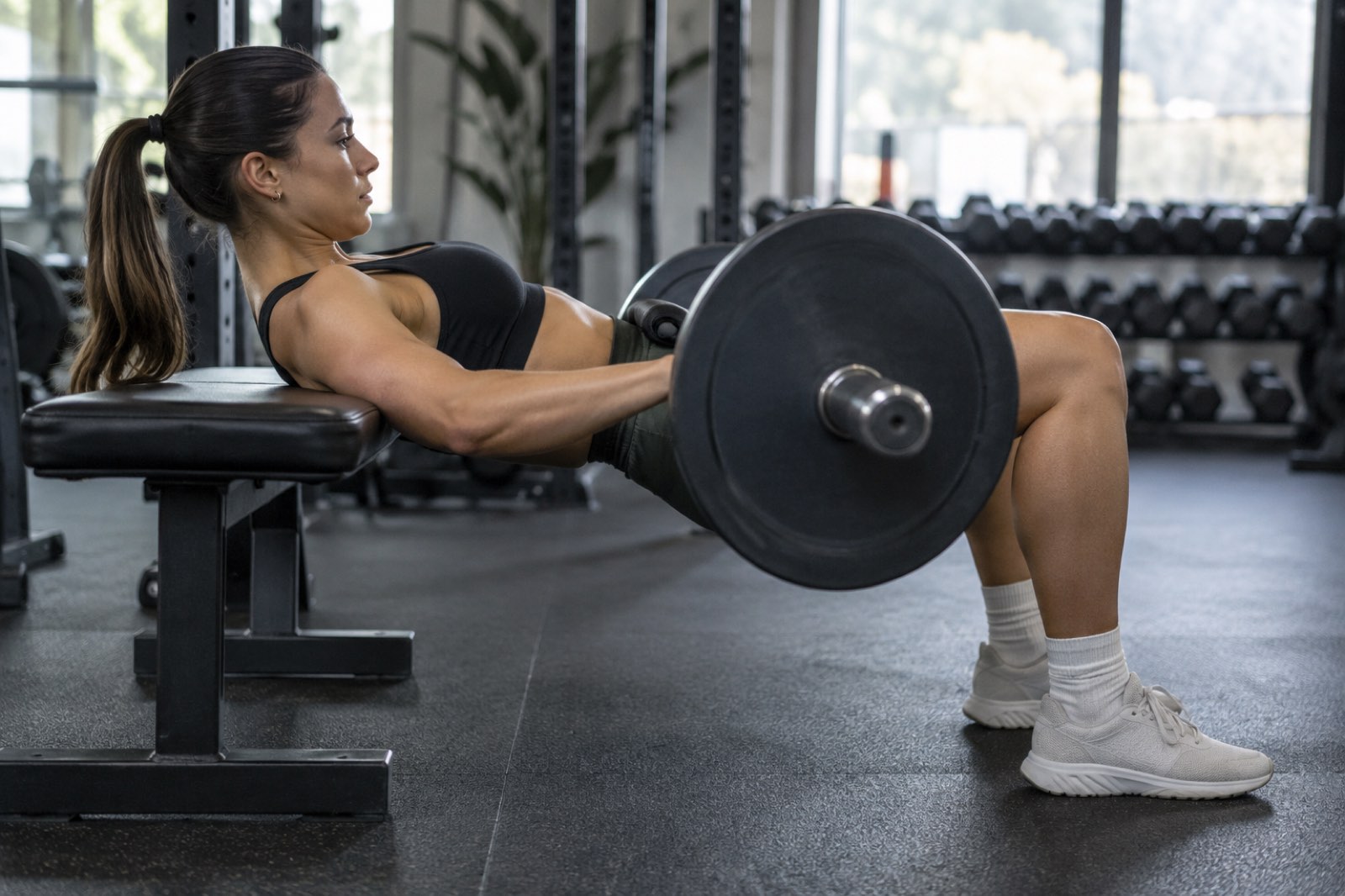
How to do a barbell hip thrust: step by step
- The bench. Knee height, roughly 40–45 cm (16–18 in). Too high forces a lower-back arch; too low cuts your range of motion.
- Back position. Sit on the floor with your back to the bench. The bench edge sits at your shoulder-blade line, just below the bottom corner of the blades. Not on your lower back, not on your neck.
- The bar. Roll it into the crease of your hips, where the pelvis meets the thighs. A pad is non-negotiable: without one the bar digs into your hip bones and you'll think about pain instead of glutes.
- Feet. Hip-width apart, toes slightly out. Distance from the hips: whatever makes your shins vertical at the top. Easy check — if your knees travel past your toes at lockout, bring the feet in; if the shins angle back toward you, move them out.
- Head and chest. Chin tucked, eyes forward and slightly down, ribs pulled down. This protects the lower back from hyperextension.
- The drive. Push through your heels and drive the hips up. At the top: a straight line from shoulders to knees, glutes squeezed, pelvis tilted slightly under. Not higher — an arch in the lower back means the glutes have stopped working.
- The pause. One full second at the top with a deliberate squeeze. That's half the exercise.
- The descent. Controlled, about 2 seconds, until the hips lightly touch the floor, with no rest at the bottom.
What weight should you start with?
The first two sessions: no bar at all. Your job is to find your bench and foot positions and feel the glutes fire. Do 15 reps with a pause at the top; if your glutes burn afterwards rather than your thighs or lower back, the form is there.
Then the empty bar, 20 kg (45 lb). It feels light, but the pad, the balance and the range take some getting used to. From there add 5 kg (10 lb) per session for as long as every rep still gets its pause.
Here's the trajectory most people follow with consistent training:
| Stage | Bar weight | What should be happening |
|---|---|---|
| Sessions 1–2 | no load | 3×15 with a pause, only the glutes burn |
| Weeks 1–2 | empty bar, 20 kg / 45 lb | 3×12 with no lower-back arch |
| Month 1 | 30–40 kg / 65–90 lb | 3×10, weight is real, form holds |
| Months 2–3 | 50–70 kg / 110–155 lb | 4×8–10, the top pause survives |
| Six months and beyond | 80–120 kg / 175–265 lb and up | working sets, progress slows |
These aren't standards, just a typical path at two sessions a week. Don't rush it: the hip thrust tolerates heavy loads more forgivingly than the squat, which is exactly why it's easy to skip past your technique. The weight at which you stop pausing at the top is already too much.
How many sets and reps?
For glute growth, the working range is 8–12 reps per set, 3–4 sets, twice a week. The last two reps of each set should be hard but still hold the pause at the top.
Every 2–3 weeks, rotate the emphasis:
- Heavy day: 4×6–8 with more weight, 1-second pause.
- Volume day: 3×12–15 with less weight, 2-second pause.
The hip thrust sits well either first in a leg session, when the glutes are fresh, or last as a finisher after squats and deadlifts. Between them is usually worse: it steals from your deadlift, and after squats the form is already sloppy. For how to keep adding load so muscle actually grows, see our guide to progressive overload.
Mistakes: where you feel it → what to fix
The hip thrust is unusual in that your body tells you what's wrong. A troubleshooting table by sensation:
| Where you feel it | What's wrong | The fix |
|---|---|---|
| Front of the thighs | Feet too close to the hips | Move the feet out until shins are vertical at the top |
| Back of the thighs | Feet too far away | Bring the feet in by 5–10 cm (2–4 in) |
| Lower back | Hyperextending at the top, head thrown back | Chin down, ribs down, tuck the pelvis, stop at the straight line |
| Neck | Bench hitting the neck instead of the shoulder blades | Sit lower — bench edge under the shoulder blades |
| Hip bones, bruising | No pad or a thin one | Thick pad or a rolled-up mat |
| Knees caving in | Weak abductors, narrow stance | Wider feet, knees out; add a band above the knees |
| Feeling nothing | No pause, short range | Slow down, add a 1–2 second squeeze at the top |
The most common beginner error is thrusting with the lower back: the hips travel above the straight line, the lumbar spine arches, and the load shifts from the glutes to the spinal erectors. One rule: at the top, torso and thighs form a line, not an arc.
film yourself from the side for the first three or four sessions. You can't see your own pelvis in a hip thrust, and the "too high, arching" error feels exactly like "great squeeze." On video it's obvious from the first rep.
Variations: at home, in the Smith machine, single-leg
At home without a barbell. A couch edge for the bench, a dumbbell or a backpack full of books across the hips. Or no load but one leg: the other bent and lifted. The single-leg bodyweight version loads each glute roughly like the two-leg version with half your body weight on the bar — enough for the first months.
In the Smith machine. The bar runs on rails, so there's nothing to balance — convenient for beginners and for anyone worried about the bar rolling. The downside: the path is strictly vertical while the hips move in an arc, so set the feet slightly further out than you would with a free bar.
The hip thrust machine. A recent addition to most gyms: a platform, a back pad, a loaded lever. It removes the bench-and-pad fuss, though some models cut the range shorter than a barbell allows.
With a band. A loop above the knees forces them outward and brings in the gluteus medius. A good addition, not a barbell replacement.
If your goal is glute size specifically, pair the hip thrust with squats or lunges: per that same 2023 study, squats add quad and adductor growth, and the combination covers everything. For building a full programme around it, see how to grow your glutes.
Who should skip the hip thrust — and when to see a doctor
The hip thrust is one of the gentlest strength exercises for knees and spine, but not for everyone and not always.
- Acute lower-back pain, a fresh disc herniation or protrusion. In the acute phase, no loaded hip extension at all. Once the pain settles, come back with bodyweight only and a full stop at the straight line, no arch.
- Hip joint pain, clicking, or a "pinch" in the groin at lockout. That can be impingement or inflammation: doctor first, exercise second.
- Pregnancy. Discuss the bench-supported lying position with your doctor; in the second and third trimesters the hip thrust is usually swapped for a short-range glute bridge or standing variations.
- The first weeks after abdominal, pelvic or spinal surgery — only with your surgeon's clearance.
- Tailbone or hip-bone pain from the bar is not a contraindication — it's a signal to get a thicker pad.
See a doctor rather than a coach if the pain radiates down the leg, there is numbness or weakness in the foot, the pain doesn't ease after two or three days of rest, or it appeared suddenly with a click mid-set.
FAQ
Do men need hip thrusts?
Yes — and not for "shape". The glutes are the main hip extensor: they drive sprinting, jumping and the finish of a deadlift. In the 2023 study, the hip-thrust-only group improved their deadlift as much as the squat group did — the exercise transfers to strength, not just size. For men it's a way to build the glutes without extra load on the knees and lower back.
Hip thrust or squat — which is better for glutes?
For glute growth over nine weeks: equal, per the 2023 experiment. The difference is that the squat also grows the quads and loads the knees; the hip thrust doesn't. For a beginner with sore knees or a cranky back, the hip thrust is the safer choice; for whole-leg development you want both.
Why does my lower back hurt after hip thrusts?
Because your hips go above the straight line at the top and you finish the rep with an arch. Chin down, ribs down, stop at the line — and drop the weight.
Can I hip thrust every day?
No point. The glutes need 48–72 hours to recover from heavy work. Two, at most three times a week.
What kind of pad do I need?
Anything thick: a purpose-made foam bar pad, a rolled yoga mat, a folded towel. Without one, most people can't reach a working weight because of hip-bone pain.
How long until I see results?
In the 2023 study, measurable glute growth on MRI appeared at nine weeks with two or three sessions a week. Visible shape change tends to arrive around month three. Without enough protein and total calories, nothing grows — we broke that down in the four conditions for muscle growth.
The bottom line
A hip thrust is a loaded hip extension with your shoulder blades on a bench. Your glutes work at 70–87% of maximum in it versus 29–45% in a squat (Contreras, 2015), and over nine weeks they grow just as much as from squatting, without the knee loading (Plotkin, 2023). Start with no load, then the empty bar, adding 5 kg per session. Run 3–4 sets of 8–12 twice a week with a pause at the top. At lockout, torso and thighs make a straight line, not an arc — arching the lower back is the one mistake that makes the exercise useless.
Sources
- Contreras B., Vigotsky A.D., Schoenfeld B.J., Beardsley C., Cronin J. A Comparison of Gluteus Maximus, Biceps Femoris, and Vastus Lateralis Electromyographic Activity in the Back Squat and Barbell Hip Thrust Exercises. Journal of Applied Biomechanics, 2015, 31(6). — 13 trained women at a 10RM load; gluteus maximus activation of 69.5% and 86.8% in the hip thrust versus 29.4% and 45.4% in the squat.
- Plotkin D.L., Rodas M.A., Vigotsky A.D., McIntosh M.C., Breeze E., Ubrik R., Robitzsch C., Agyin-Birikorang A., Mattingly M.L., Michel J.M., Kontos N.J., Lennon S., Frugé A.D., Wilburn C.M., Weimar W.H., Bashir A., Beyers R.J., Henselmans M., Contreras B.M., Roberts M.D. Hip thrust and back squat training elicit similar gluteus muscle hypertrophy and transfer similarly to the deadlift. Frontiers in Physiology, 2023. — 34 untrained participants, 9 weeks, 15–17 sessions; gluteal cross-sectional area on MRI grew equally, quads and adductors grew more with squats.
This article is for informational purposes and doesn't replace medical advice. With lower-back pain, disc problems, hip joint issues or after surgery, choose your load and range of motion with a doctor or coach, not from a table in an article.