for strength, rest 3–5 minutes — the one thing the research agrees on: in trained lifters, longer rest wins on both bar weight and muscle size (Schoenfeld, 2016; Grgic's 2018 review of 23 studies). For muscle growth, rest is secondary: with total volume equated, 1 and 3 minutes produce the same growth (Longo, 2022), and beyond 90 seconds no difference shows up (Singer's 2024 meta-analysis). The catch is the word "equated": with one-minute rests you lose 15–55% of your reps by the third set (Ratamess, 2007), and that missing volume has to be made up with extra sets. If you don't make it up, your coach was wrong. Beginners are fine with 1–2 minutes for anything.
Ask three coaches how long to rest between sets and you'll get three answers: "a minute, keep the burn going", "three minutes, recover fully", and "doesn't matter, just hit your volume". The frustrating part is that each of them can point to a study. Below is what those studies actually say, where the schools genuinely disagree, and where they're simply answering different questions.
What happens in the muscle during a minute of rest
A hard set lasts 20–40 seconds, and nearly all of that work runs on phosphocreatine — a fast energy store that lasts almost exactly that long. During the pause it refills: roughly half comes back in the first 30 seconds, nearly all of it within 3–4 minutes. That's the whole debate in one sentence: rest a minute and you start the next set on half a tank; rest three and the tank is close to full.
You can see it in the reps without any lab. In Ratamess (2007), eight trained men did five sets of bench press at 75% and 85% of their max, changing only the pause. With 30 seconds or 1 minute of rest, volume dropped 15–55% from set to set. With 2 minutes, the first two sets held completely and sets three to five lost 8–29%. With 3 minutes the drop only arrived at sets four and five — about 21%. At 5 minutes, no loss.
Remember that staircase; it explains all three schools at once. Short rest isn't a "different stimulus" first and foremost — it's fewer reps at the same weight.

School one: "60 seconds and a pump" — where it came from and what failed
In the 1990s and 2000s bodybuilding believed in metabolic stress: a short pause meant more burn and more pump, a bigger post-workout spike of growth hormone and testosterone, and therefore more muscle. This wasn't a fringe idea — the American College of Sports Medicine's 2009 position stand recommended 1–2 minutes of rest for hypertrophy and 2–3 for strength.
The hormonal half of the theory didn't survive testing. West and Phillips (2012) trained 56 young men for twelve weeks, measured their post-exercise spikes in growth hormone, free testosterone and IGF-1, and compared them with gains in muscle and strength. No correlation: the men whose hormones spiked most didn't grow more. The spike is real; the construction isn't.
The pump itself has been partly rehabilitated, with a caveat. Fink (2018) compared two volume-matched schemes: 30 seconds of rest with a light 20-rep load versus 3 minutes with a heavy 8-rep load. Arm growth was the same — metabolic stress worked as a stimulus. But in a related study by the same group on heavy compound movements, the thigh grew more with long rest. School one in its modern form: short rest is fine on isolation and machine work, where you lose few reps, and a poor fit for squats and presses.
School two: "rest three minutes" — the strength camp
Powerlifters and weightlifters never rested a minute, and the science sided with them. The key experiment is Schoenfeld (2016): 21 trained men, 8 weeks, three full-body sessions a week, 7 exercises for 3 sets of 8–12 reps. The only difference between groups was the pause: 1 minute versus 3. The three-minute group gained more strength in both the squat and the bench press, and their anterior thigh thickness grew more. The mechanism is transparent: with the longer pause they kept the weight and did more reps — more volume from the same number of sets.
Grgic and colleagues' 2018 review pooled 23 studies and 491 participants. Two-layer conclusion: robust strength gains are possible even with rests under a minute, but to maximize strength in trained individuals you need pauses longer than 2 minutes; untrained people do fine with 60–120 seconds. For heavy compound lifts that's the final word — longer rest is better, argument over.

School three: "rest is secondary — count your volume"
This is the position your coach most likely gave you, and it has a strong evidence base. Longo (2022) trained 28 people for ten weeks on the leg extension, and each of a participant's legs got its own protocol: long rest, short rest, and — crucially — short rest with volume equated to the long-rest leg, and vice versa. The result: when total volume is the same, rest length does not affect muscle growth. It does affect strength, because strength requires keeping the load heavy rather than making up reps with a lighter one.
Singer's 2024 meta-analysis, 9 studies and 19 measurements: a small benefit from resting longer than 60 seconds, "perhaps mediated by preserving volume load", and no appreciable difference once you rest longer than 90 seconds. Trained lifters get slightly more out of longer pauses; beginners get the same either way.
What your coach means by "doesn't matter": if you make up the volume, rest length genuinely doesn't decide muscle growth. What they're probably not saying out loud: without making it up, a one-minute rest is just less work done (see the Ratamess staircase above). The difference isn't in the pause — it's in whether you added sets four and five or not. How to count that volume and when to add to it is covered in our guide to progressive overload.
When rest doesn't matter — and when it decides
The three schools answer different questions, so there's little to actually argue about. Let's line it up.
Rest doesn't matter when:
- your goal is muscle growth and you equate volume with sets: 4 sets on 3 minutes ≈ 5–6 sets on 1 minute;
- the exercise is isolation or machine work — curls, extensions, cable rows — where rep loss is small;
- you're in your first few months of training: everything grows from everything, and 1–2 minutes is plenty (Grgic, 2018);
- you're training endurance or doing circuits — the short pause is the training goal itself.
Rest decides when:
- your goal is strength: 1–5 heavy reps need near-full recovery, or the weight drops and the stimulus with it;
- the exercise is a heavy compound — squat, press, deadlift — which is exactly where Schoenfeld and Fink found the advantage for long pauses;
- you've been training for more than a year: the heavier your working weights, the more every under-recovered second costs;
- you do few sets and don't want to add more — then the only way to protect volume is to rest longer.
Table: goal → rest → the price of cutting it short
| Goal and format | Rest | Why that long | If you rest less |
|---|---|---|---|
| Maximal strength, 1–5 reps, compound lifts | 3–5 min | Near-full recovery of energy stores and the nervous system | Bar weight drops — the main strength stimulus (Grgic, 2018) |
| Muscle growth, 6–12 reps, compound lifts | 2–3 min | Reps and load hold → more volume from the same sets (Schoenfeld, 2016) | 15–55% fewer reps by set three; compensate with 1–2 extra sets |
| Muscle growth, isolation and machines | 1–1.5 min | Rep loss is small and metabolic stress works (Fink, 2018) | Almost nothing — as long as you make up the volume |
| Power: jumps, cleans, throws | 2–5 min | It's speed and technique that break down, not the muscle | Slower, sloppier, higher injury risk |
| Endurance, circuits, "cutting" workouts | 30–60 s | The short pause is the point of the session | That's not "less rest", that's the format |
| Beginner, first 3–6 months | 1–2 min | Loads are still light and recovery is fast; longer isn't needed (Grgic, 2018) | Nothing bad, as long as your form holds |
Notice there's no "for fat loss" row. Fat loss comes from a calorie deficit, not from pause length; training during a diet follows the same table — pick "strength" or "muscle" to protect what you have.
By sport: where each school is right
Powerlifting and weightlifting. School two, no caveats: 3–5 minutes between heavy sets, up to 5–8 before maximal attempts. Short rest here is a straight loss.
Bodybuilding and "mass" training. A hybrid: 2–3 minutes on the compound lifts early in the session, 1–1.5 on isolation work at the end. Nearly every modern hypertrophy coach programs it this way, and it matches Schoenfeld's and Fink's data exactly.
CrossFit, HIIT, functional circuits. School one in its pure form — but for conditioning and energy expenditure, not for muscle growth. Short rest here isn't a mistake, it's the format: we broke down how it works in our guide to HIIT workouts. Just don't expect strength records from it.
Runners, cyclists, team-sport athletes. Strength work is supplementary, and it should be done as strength work: 2–3 minutes, heavy loads, few sets. Trying to "combine" strength and cardio with one-minute pauses gets you the average of both.
Over 40, or coming back after a break. Recovery between sets slows down along with recovery between sessions. Add 30–60 seconds to any number in the table and watch that your reps don't fall.
When you're short on time: supersets and rest-pause
The main argument against long pauses isn't physiology, it's the clock. Four compound exercises for 4 sets with three-minute rests is almost an hour of pure pausing. Iversen's 2021 review in Sports Medicine showed the way out: supersets (two exercises for different muscles back to back), drop sets and rest-pause roughly halve session time at the same volume. The authors' caveat: these methods work better for size than for strength — which lines up perfectly with the three-school logic.
The practical scheme: in a press + row superset you rest 60–90 seconds between exercises, but each muscle gets its own 2.5–3 minutes while the antagonist works. Long rest for the muscle, short rest for the clock.
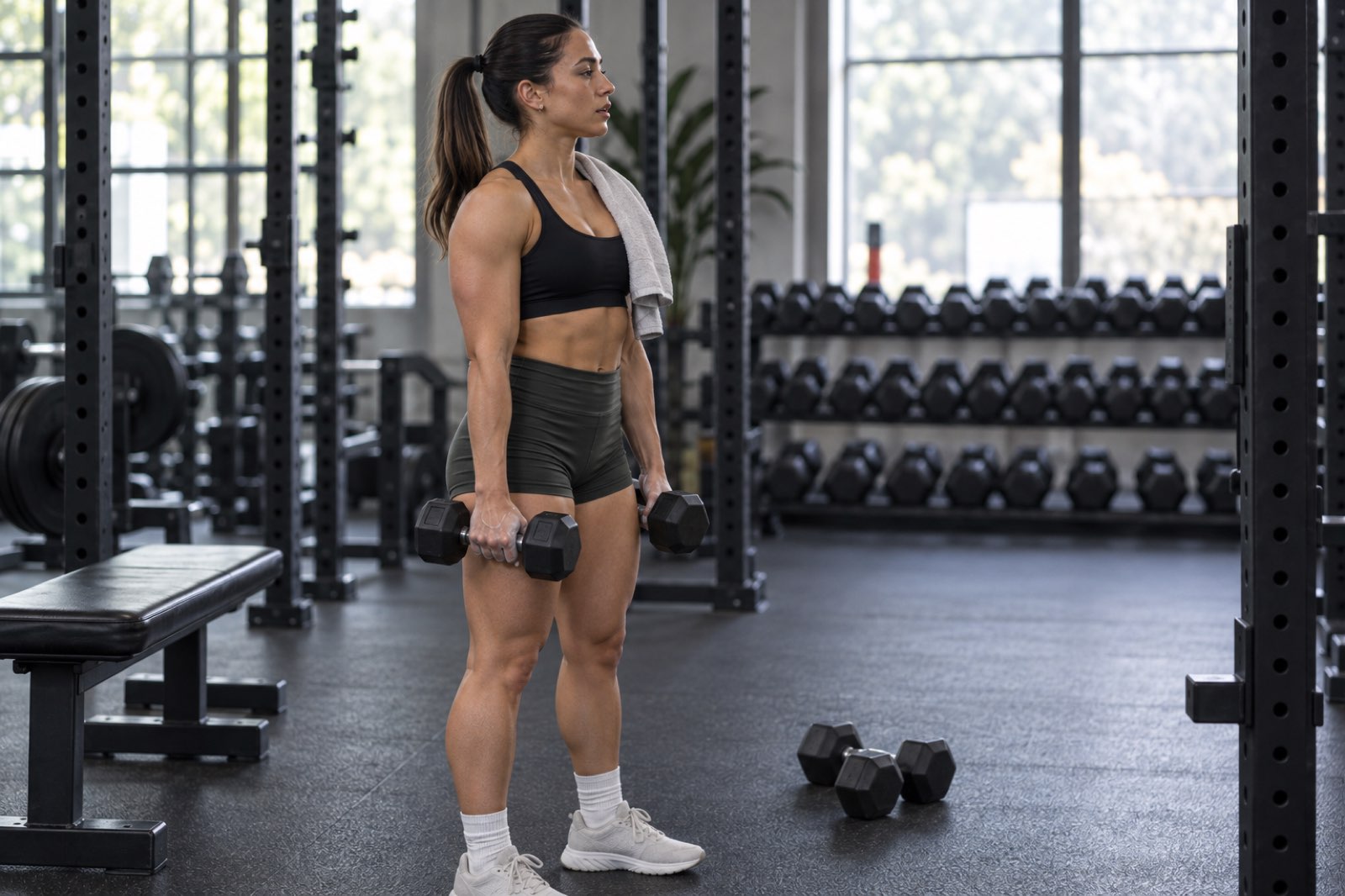
Resting in practice: a timer, not a feeling
The feeling of "ready" arrives before readiness does: your breathing settles in 40–60 seconds, and phosphocreatine is only half restored by then. So:
- Set a timer for every pause. 3 minutes under heavy sets, 2 under moderate ones, 1 for isolation. Not "roughly" — by the clock: when people rest by feel, the spread runs from 45 seconds to 4 minutes.
- Track reps, not seconds. If your third set at the same weight came in 3 reps short of your first, the pause is too short for that goal. It's the most honest indicator there is.
- Rest actively, not athletically. Walk, breathe, don't sit on your phone for five minutes: heart rate should come down, muscles shouldn't go cold.
- Change the pause with the goal. Strength block — long, accumulation block — medium, a "cut" with circuits — short. It's a program variable just like load and set count, and it should be planned with them — as in our guide to how many sets and reps to do.
log the pause in your training diary alongside weight and reps. A month in, you'll see which sets "sagged" — and almost always they'll be the ones where you rushed, not the ones where you ran out of strength.
FAQ
Is one minute of rest between sets enough?
For muscle growth — yes, provided you compensate for lost reps with extra sets and aren't working near your max (Longo, 2022). For strength — no: trained lifters need more than 2 minutes (Grgic, 2018). A beginner is fine with 60–90 seconds for almost everything.
Two minutes or three?
For compound lifts at 6–12 reps there is a difference, but a modest one: per Ratamess (2007), two minutes keeps the first two sets full, three minutes keeps the first three. Doing 3 sets — two minutes is enough; doing 4–5 — take three.
Isn't five minutes too long?
For maximal strength sets it's normal — athletes rest even longer. For muscle growth it's excessive: the meta-analysis finds no difference beyond 90 seconds (Singer, 2024), and your session doubles in length.
How long to rest between sets of push-ups and pull-ups?
Bodyweight push-ups are an endurance-and-volume exercise: 60–90 seconds. Pull-ups, for most people, are a strength exercise where every rep is heavy: 2–3 minutes, or your reps collapse by the second set.
How long to rest between exercises?
The same as between sets in that block, plus setup time: usually 2–3 minutes. Going from heavy squats to bench press after 30 seconds means giving away your first set of bench.
Should rest be shorter for fat loss?
No. Fat loss is decided by the calorie deficit, and training during a diet exists to keep your muscle — so take your rest from the table by the "muscle" or "strength" goal. Short pauses make the workout harder, not more effective at burning fat.
Sit or walk between sets?
Walk and breathe. Sitting is fine before maximal sets to bring your heart rate down, but don't disappear into your phone: a three-minute pause quietly becomes seven, and the muscles cool off.
The bottom line
Rest between sets is a program variable, not a ritual. For strength it decides: 3–5 minutes, and for trained lifters more than 2 minutes is non-negotiable (Grgic, 2018; Schoenfeld, 2016). For muscle growth it's secondary on one condition — equal volume: 1 and 3 minutes give the same result if the missing reps are made up with sets (Longo, 2022), and beyond 90 seconds there's no difference (Singer, 2024). The hormonal explanation for short rest didn't hold up (West & Phillips, 2012). In practice: a timer on every pause, control by reps rather than feel, and supersets when the clock is tight.
Sources
- Schoenfeld B.J., Pope Z.K., Benik F.M., Hester G.M., Sellers J., Nooner J.L., Schnaiter J.A., Bond-Williams K.E., Carter A.S., Ross C.L., Just B.L., Henselmans M., Krieger J.W. Longer Interset Rest Periods Enhance Muscle Strength and Hypertrophy in Resistance-Trained Men. Journal of Strength and Conditioning Research, 2016, 30(7). — 21 trained men, 8 weeks, 1 vs 3 minutes; longer rest produced greater strength and thigh growth.
- Longo A.R., Silva-Batista C., Pedroso K., de Salles Painelli V., Lasevicius T., Schoenfeld B.J., Aihara A.Y., de Almeida Peres B., Tricoli V., Teixeira E.L. Volume Load Rather Than Resting Interval Influences Muscle Hypertrophy During High-Intensity Resistance Training. Journal of Strength and Conditioning Research, 2022, 36(6). — 28 participants, 10 weeks; with volume equated, rest interval did not influence hypertrophy.
- Singer A., Wolf M., Generoso L., Arias E., Delcastillo K., Echevarria E., Martinez A., Androulakis Korakakis P., Refalo M.C., Swinton P.A., Schoenfeld B.J. Give it a rest: a systematic review with Bayesian meta-analysis on the effect of inter-set rest interval duration on muscle hypertrophy. Frontiers in Sports and Active Living, 2024. — 9 studies; small benefit beyond 60 s, no difference beyond 90 s.
- Grgic J., Schoenfeld B.J., Skrepnik M., Davies T.B., Mikulic P. Effects of Rest Interval Duration in Resistance Training on Measures of Muscular Strength: A Systematic Review. Sports Medicine, 2018, 48(1). — 23 studies, 491 participants; trained lifters need >2 min to maximize strength, untrained 60–120 s.
- American College of Sports Medicine. Position Stand: Progression Models in Resistance Training for Healthy Adults. Medicine & Science in Sports & Exercise, 2009, 41(3). — the historical guidelines: hypertrophy 1–2 min, strength and power 2–3 min, endurance <90 s.
- West D.W.D., Phillips S.M. Associations of exercise-induced hormone profiles and gains in strength and hypertrophy in a large cohort after weight training. European Journal of Applied Physiology, 2012, 112(7). — 56 men, 12 weeks; hormone spikes unrelated to gains in muscle or strength.
- Fink J., Schoenfeld B.J., Kikuchi N., Nakazato K. Effects of rest intervals and training loads on metabolic stress and muscle hypertrophy. Clinical Physiology and Functional Imaging, 2018, 38(2). — 30 s light load vs 3 min heavy load at equal volume; arm growth was the same.
- Iversen V.M., Norum M., Schoenfeld B.J., Fimland M.S. No Time to Lift? Designing Time-Efficient Training Programs for Strength and Hypertrophy: A Narrative Review. Sports Medicine, 2021, 51(10). — supersets, drop sets and rest-pause roughly halve training time at the same volume.
- Ratamess N.A., Falvo M.J., Mangine G.T., Hoffman J.R., Faigenbaum A.D., Kang J. The effect of rest interval length on metabolic responses to the bench press exercise. European Journal of Applied Physiology, 2007, 100(1). — 5 sets of bench press with 30 s to 5 min rest; volume losses of 15–55% with short pauses.
This article is for informational purposes only and doesn't replace advice from a doctor or coach. If you have cardiovascular conditions, hypertension, or are returning from injury, choose rest periods and working loads with a professional.