

breathing calms you when it's slow and the exhale is long, because your pulse slows on every exhale. If stress hits right now, do a physiological sigh. It takes 30 seconds. For background anxiety, inhale for 4 counts and exhale for 6, for 5 minutes. Before a big moment, use box breathing (4-4-4-4). In bed, use 4-7-8. Relief often comes within 1–2 minutes. For a lasting effect, do 5 minutes a day for a month, as people did in a 2023 study.No breath holds while driving or in water. Feeling dizzy? Breathe normally. Chest pain, or "panic" for the first time in your life? Call 911 or your local emergency number first.
Breathing exercises for stress are short patterns of slow breathing, most often with a long exhale. Your heart beats a little slower on every exhale, so this rhythm calms you down in 1–5 minutes. If stress hits right now, do a physiological sigh: two inhales through your nose, one right after the other, then a long exhale through your mouth. Repeat 1–3 times. It takes about 30 seconds. As a daily habit, 5 minutes is enough: in a 2023 study, repeating that sigh for 5 minutes a day for a month improved mood more than the same amount of meditation.
Which technique to choose: a quick guide by situation
When stress hits, there's no time to weigh options. Find your situation in the left column and do what that row says.
| Situation | Technique | How to breathe | How long | Where |
|---|---|---|---|---|
| Stress just hit: an argument, an email, a phone call | Physiological sigh | Two inhales through the nose, one right after the other, then a long exhale through the mouth | 1–3 times, about 30 seconds | Anywhere, no one will notice |
| Anxious all day, in the background | Longer exhale | Inhale for 4 counts, exhale for 6 | 5 minutes | Office, commute, behind the wheel |
| Before a presentation, an exam, a heavy set | Box breathing | Inhale 4, hold 4, exhale 4, hold 4 | 1–3 minutes | Sitting or standing, not while driving |
| Can't fall asleep | 4-7-8 | Inhale 4, hold 7, exhale 8 | 4 cycles, over time up to 8 | In bed |
| After a workout, to switch off | Long exhale lying down, calves on a bench or couch | Inhale 4, exhale 6–8 | 3 minutes | Gym, home |
| A daily skill | Cyclic sighing: the same sigh repeated over and over | Like the first row, no pauses | 5 minutes a day for 4 weeks | Home |
| Heart pounding, can't get enough air, scared | Don't gulp air | A soft, long exhale, no deep inhales and no holds | Until it passes | First time ever, or with chest pain: call 911 first |
Not sure where to start? Go with the second row. It works for almost everyone and has no breath holds.
Why breathing calms you down, in plain English
Stress gets your body ready for action. Your heart beats faster, your muscles tense up and your breathing gets quick and moves up into your chest. An email from your boss flips the same switch. For how this ties into hormones and your progress in the gym, see our article on stress and cortisol.
You can't order your heart to slow down. But you can control your breathing anytime. Your heart speeds up a little on the inhale and slows down on the exhale. Try it: put your fingers on your wrist and breathe slowly. On a long exhale, the beats get a little farther apart. The vagus nerve, the nerve that slows your heart, does this braking. The longer the exhale, the longer the brake stays on.
In research, breathing counts as slow when it's under 10 breaths a minute. The longer-exhale technique gives you 6 breaths a minute, and box breathing and 4-7-8 are slower still.
There's a flip side. Breathe too fast or too deep, and you get dizzy, your fingers and lips tingle and it feels like you can't get enough air. You actually have plenty of oxygen. You're just breathing out too much carbon dioxide, and the blood vessels in your brain narrow a little. So there's one rule: breathe slowly, but don't push.
The physiological sigh: calm down in 30 seconds
This is the fastest technique. You can do it in a meeting or in line at the store, and no one will notice.
- Breathe in calmly through your nose until your lungs are almost full.
- Without breathing out, top it off with a second short inhale through your nose.
- Breathe out slowly through your mouth until the air runs out. The exhale should be clearly longer than both inhales combined.
- Repeat 1–3 times, then go back to normal breathing.
The second inhale fully opens your lungs, but the long exhale does the real work. Don't pull air in hard. If you feel dizzy, make the inhales softer.
You can also repeat the sigh for 5 minutes straight with no pauses. This is called cyclic sighing. In a 2023 Stanford study, 108 people spent a month doing 5 minutes a day of one of three breathing patterns or the same amount of meditation. Cyclic sighing improved mood the most, and breathing rate dropped more in the breathing groups than in the meditation group. Anxiety dropped equally in every group. The study's weak spots: small groups and unsupervised practice at home.
The longer exhale: an everyday go-to you can do even while driving
This is the main technique for daily use. It has no breath holds, so it's safe almost anywhere and works for almost everyone: women and men, younger and older adults alike.
- Breathe in through your nose for 4 counts. Your belly rises gently, and your shoulders stay put.
- Breathe out for 6 counts through your nose or through slightly closed lips, as if blowing on hot tea.
- Start the next inhale right away, with no pause.
If each count is about a second, one cycle takes 10 seconds. That's 6 breaths a minute and 30 cycles in 5 minutes. If 4 and 6 feel hard, start with 3 and 5. The exact numbers don't matter. What matters is that the exhale is longer than the inhale.
While driving, keep your eyes open and your attention on the road. The breathing runs in the background.
don't wait for stress to remember your breathing. Tie 5 minutes of practice to something you already do every day: your morning coffee, opening your laptop, pulling into your driveway. A skill you practice while calm is the one that kicks in on a hard day.
Box breathing (4-4-4-4): steady yourself before a big moment
Box breathing evens out your breath and keeps your mind busy counting. It helps before a presentation, an exam, a hard conversation or a heavy set.
- Calmly breathe out all your air.
- Breathe in through your nose for 4 counts.
- Hold your breath for 4 counts. Don't lock your throat; just pause.
- Breathe out for 4 counts.
- Pause again for 4 counts, this time with empty lungs.
Picture a square and trace its sides with your eyes: inhale up, hold to the right, exhale down, hold to the left. While counting takes up your attention, there's less room to worry about what's coming.
1–3 minutes is enough. If 4-count holds feel too long, do a 3-3-3-3 box. If you feel dizzy, shorten the holds or switch to the longer exhale. Because of the holds, don't do box breathing while driving or in water.
4-7-8 breathing: how to do it to fall asleep
Do this technique in bed when your thoughts won't let you sleep.
- Breathe out all your air through your mouth.
- Close your mouth and breathe in through your nose for 4 counts.
- Hold your breath for 7 counts.
- Breathe out through your mouth for 8 counts, with a "whoosh" sound.
- That's one cycle. Do 4 cycles. Over time you can work up to 8.
If holding for 7 counts feels hard, count faster but keep the ratio: the exhale is twice as long as the inhale. You may feel a little dizzy in the first few days. If so, breathe normally, and do fewer cycles next time.
Because of the long hold, don't do 4-7-8 while driving. For more ways to fall asleep, including the 20-minute rule, see how to fall asleep fast.
Belly breathing: how to check you're doing it right
In every technique, breathe with your belly, not your chest. Under stress, breathing moves up: your shoulders rise and your neck tenses. When you breathe with your belly, your diaphragm does the work. It's the main breathing muscle, sitting under your ribs. The inhale gets deeper without effort, and slowing down gets easier.
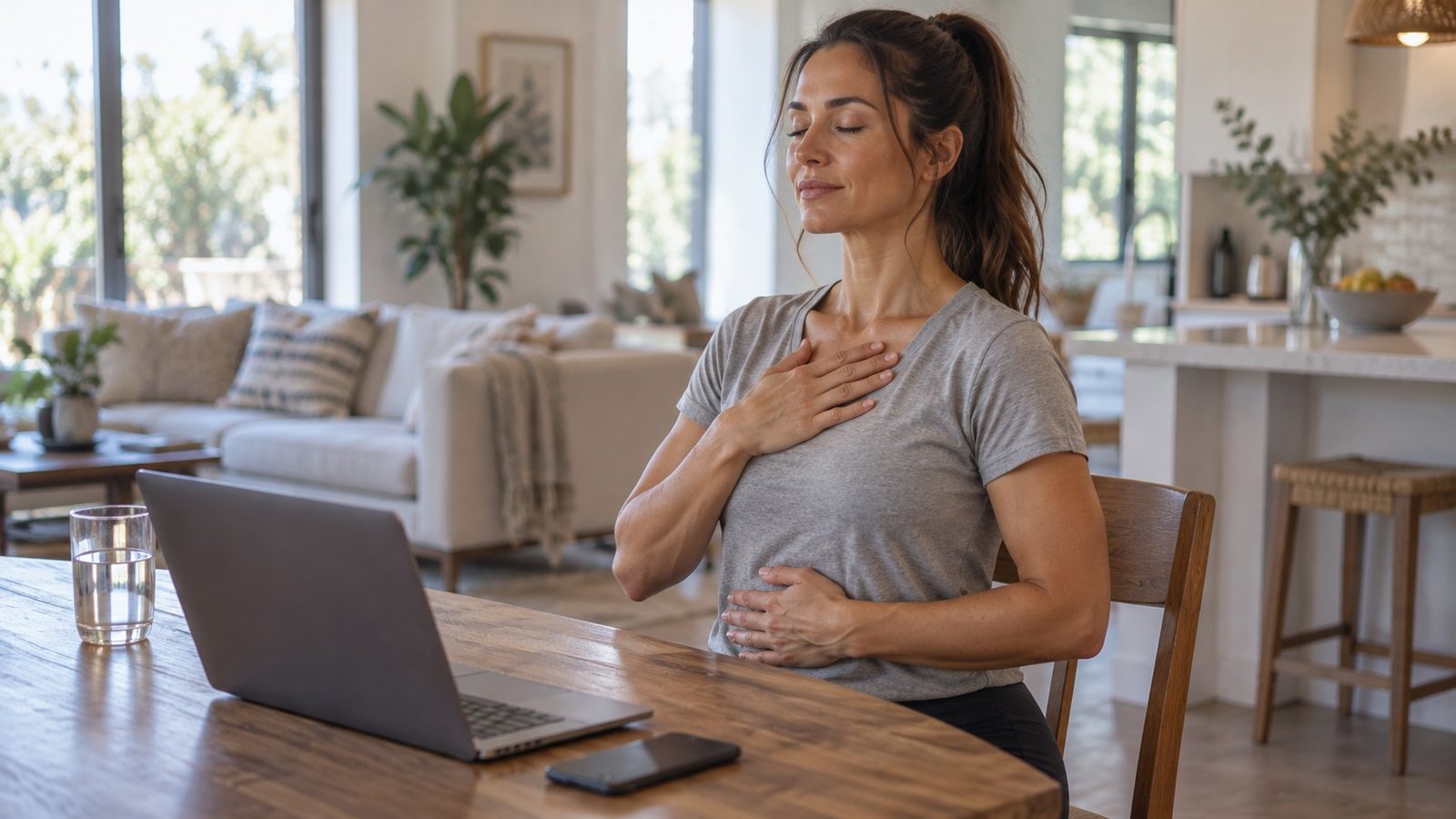
The hands check. Sit up straight. Put one hand on your chest and the other on your belly, just above your navel. On the inhale, the lower hand rises and the upper hand barely moves.
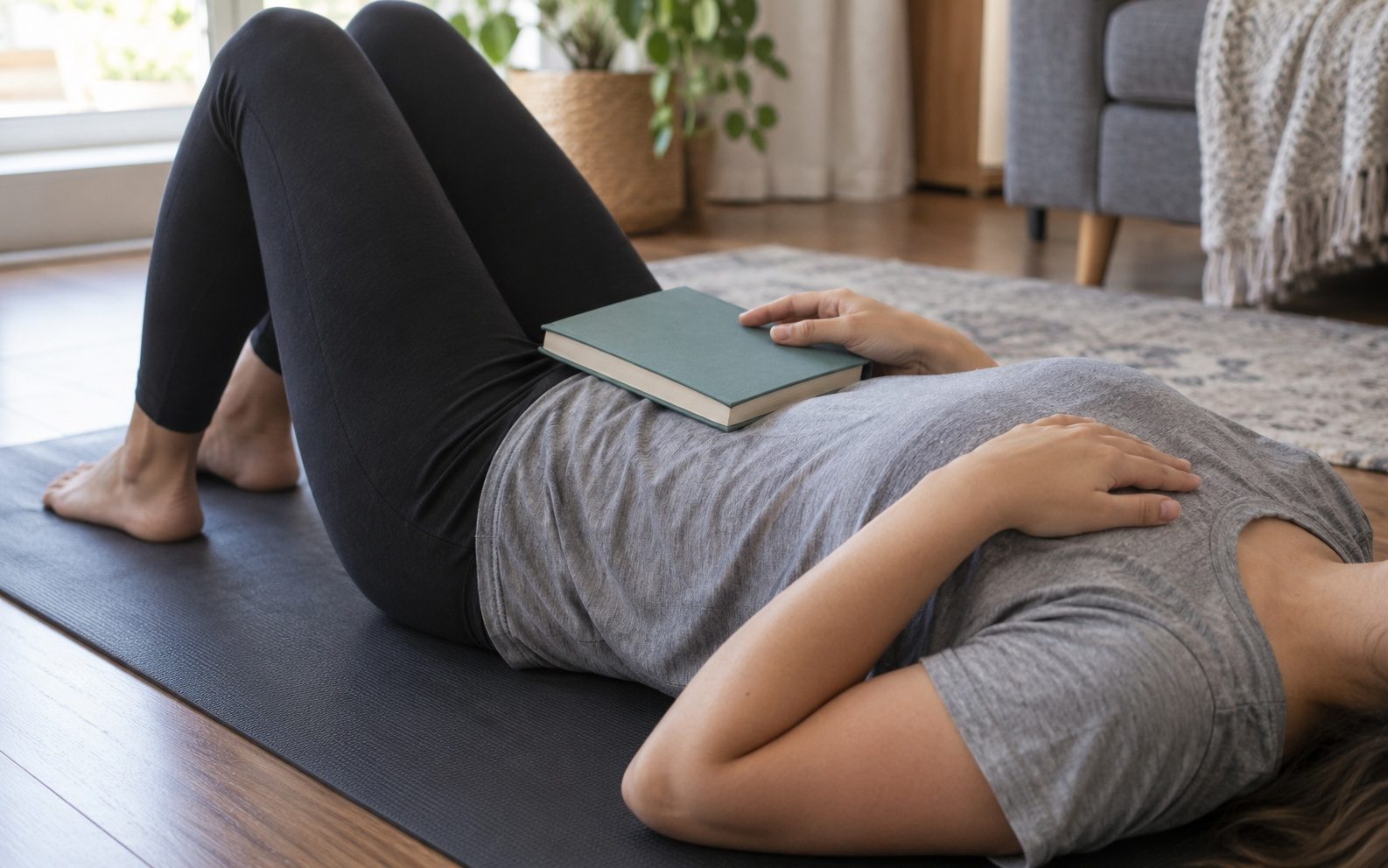
The book check. Lie on your back with your knees bent and feet on the floor. Put a small book on your belly. On the inhale the book rises, on the exhale it lowers, and your chest stays still.
Three common mistakes:
- Raising your shoulders on the inhale. That means you're breathing with your chest. Drop your shoulders and start the inhale from your belly.
- Breathing in as hard as you can. If you want to breathe out right after the inhale and your neck feels tight, you've overdone it.
- Adding pauses that aren't there. The longer exhale has no holds. If you freeze between the inhale and the exhale, you're trying too hard.
Test it on yourself: pulse and tension before and after
Don't take our word for it. Test it on your own numbers. One week is enough.
Pulse. Sit quietly for a minute. Place your index and middle fingers on the inside of your wrist, at the base of your thumb. Count the beats for 30 seconds and multiply by 2.
Tension. Rate it from 0 to 10, where 0 is total calm and 10 is as bad as it gets. Go with the first number that comes to mind.
First measure your pulse and tension, then breathe for 5 minutes, then measure both again. Write it down for 7 days in a row.
| Day | Technique | Pulse before | Pulse after | Tension before | Tension after |
|---|---|---|---|---|---|
| 1 | Longer exhale | ||||
| 2 | |||||
| 3 | |||||
| 4 | |||||
| 5 | |||||
| 6 | |||||
| 7 |
No one can tell you in advance how much the numbers should drop: everyone responds differently. Measure under similar conditions: the same time of day, sitting down, not right after coffee. If your numbers are usually lower after the technique than before, it works for you. No difference all week? Try another row from the table at the top.
How well does it work? The honest numbers
Breathing does have an effect, but a moderate one. Here's what the research found.
| What was tested | How many people | What happened | What it means for you |
|---|---|---|---|
| A pooled analysis of 12 studies of breathing practices for stress, 2023 | 785 adults | Stress was lower than in control groups, a small to medium effect. Similar results for anxiety (20 studies) and low mood (18) | It works, but moderately |
| 5 minutes a day for a month: three breathing patterns vs. meditation, 2023 | 108 people | Cyclic sighing improved mood the most; anxiety dropped in all groups | 5 minutes a day is enough to make a difference |
| A review of slow breathing, under 10 breaths a minute, 2018 | 15 studies | More calm and alertness, less anxiety and anger, the heart responds more flexibly to inhale and exhale | A slow rhythm is the key part of any technique |
| One session of slow, deep breathing, 2021 | 47 people, young and older | In-the-moment anxiety dropped in both groups | Can help from the very first session, at any age |
| 8 weeks of belly breathing training, 2017 | 40 people, half of them trained | Fewer negative feelings, better attention, lower levels of the stress hormone cortisol in saliva | Regular practice changes both how you feel and your stress hormone levels |
The weak spots are the same across the board: small groups, and people rate how they feel themselves. The authors of the 2023 pooled analysis openly urge caution so the hype around breathwork doesn't outrun the evidence.
The takeaway is simple. Breathing doesn't treat an anxiety disorder. But as a 5-minute daily habit, it gives a noticeable, measurable effect, in the same range as a meditation course.
Breathing or meditation: what to choose as a beginner
Both reduce stress. The difference is how easy they are to start.
| Breathing exercises | Meditation | |
|---|---|---|
| How hard to start | Easy: you count inhales and exhales | Harder: you hold your attention with no count to lean on |
| How many minutes | 1–5 is enough | You can also start with 5, as people did in the 2023 study |
| When you feel the first effect | Often within the first few minutes | Programs run for weeks, and results are usually measured at 8 weeks |
| What it trains | Calming your body in the moment | Attention and letting thoughts go |
| Who it suits | People who need results today and find it hard to sit still | People ready to practice regularly for a long-term effect |
A 2014 pooled analysis (47 studies, 3,515 people) found that after 8 weeks, mindfulness meditation programs reduce anxiety, with a small to moderate effect. And in the 2023 study, 5 minutes of breathing beat 5 minutes of meditation on mood.
Breathing is the easiest way into meditation: 5 minutes of following your exhale is already a simple attention practice. Start with breathing, and once the habit sticks, add meditation. For why it matters if you train, see meditation for athletes.
Breathing and training: before a set, after and in the evening
Before a heavy set. Don't pump yourself full of air before a squat: you can get dizzy right under the bar. Instead, do 2–3 calm cycles of box breathing. During the set itself, the rule is different: breathe out on the effort. The details are in how to breathe during exercise.
After a workout. Lie on your back with your calves resting on a bench or couch, knees bent at a right angle, hands on your belly. Inhale for 4 counts, exhale for 6–8, for 3 minutes. These 3 minutes fit nicely at the end of your cool-down after a workout.
After an evening workout. If you can't fall asleep, do 4 cycles of 4-7-8 in bed.
5 minutes of movement when your nerves are shot. Sometimes your body wants to move, and movement itself releases tension. More on that in exercise and mood. Here are four exercises from our app's library, each with its own breathing rule.
- Joint warm-up. Inhale as you raise your arms out to the sides and up, exhale as you lower them. Then circle your shoulders, hips and knees. 2–3 minutes.
- Dead bug. Lie on your back with your lower back pressed into the floor. On the exhale, slowly lower the opposite arm and leg; on the inhale, bring them back. 2 sets of 8–10 per side.
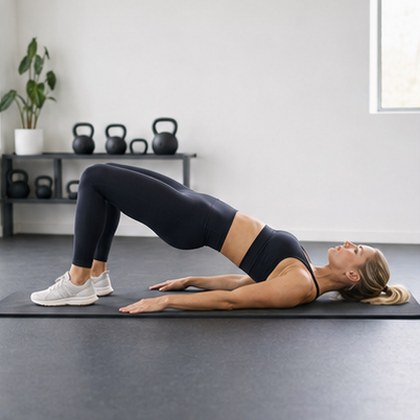
- Glute bridge. Lie on your back with your feet on the floor. Lift your hips on the exhale, lower them on the inhale. 2 sets of 10–12.
- Stomach vacuum. Standing or on all fours, breathe out completely and pull your belly in toward your spine for 10–20 seconds, then breathe in. 3–5 reps on an empty stomach. Skip it if you're pregnant.
The vacuum strengthens your deep core muscles, but it doesn't burn belly fat.
 Glute bridge
When breathing isn't enough: warning signs and when to see a doctor
Breathing is a form of first aid and prevention, not treatment.
Stop and breathe normally if you feel dizzy, your fingers or lips tingle or it feels like you can't get enough air. It means you're breathing too fast or too deep. It usually passes after a minute of normal breathing. Then continue, but breathe more gently.
Safety rules:
- Never hold your breath or breathe fast and deep while driving or in water, whether that's a pool, a bathtub or the sea. You can pass out.
- If you're pregnant, have epilepsy or heart or lung disease, or had surgery recently, skip the techniques with holds and fast breathing, and check the rest with your doctor.
See your doctor or a therapist if:
- anxiety or insomnia lasts for weeks and gets in the way of work, school or sleep;
- panic attacks keep coming back;
- you've lost interest in things you used to enjoy.
Call 911 or your local emergency number right away if:
- you have chest pain or pressure that spreads to your arm, neck or jaw;
- you've fainted;
- shortness of breath doesn't go away at rest;
- it's your first "panic attack" ever, especially if you're over 40 or have chest pain. A heart attack can feel like a panic attack.
If you know for sure it's a panic attack, because it's happened before and a doctor has checked your heart, don't gulp air. Deep breaths and holds only add to the dizziness. Breathe out softly and slowly through closed lips, and keep the inhale small. Tell yourself: "This is an anxiety attack. It will pass."
If stress wrecks your workout plan
Hard day, no energy to train? Don't cross the workout off. If you track training in the Sportygram app, move today's workout to tomorrow in your workout log. The workout isn't lost; it just moves to another day.
Want to move, just not much? Do the joint warm-up from section 11 and add it to today's workout in your log. Right after it, add 5 minutes of breathing. That way the habit gets tied to something already in your plan.
FAQ
What is the best breathing exercise for stress?
For an acute moment, the physiological sigh: two inhales through your nose, one right after the other, and a long exhale through your mouth, 1–3 times. For every day, the longer exhale: inhale for 4 counts, exhale for 6, for 5 minutes. In a 2023 study, cyclic sighing improved mood the most. But the best breathing exercise is the one you actually do every day.
How do you do 4-7-8 breathing, and how many times?
Breathe out all your air through your mouth. Breathe in through your nose for 4 counts, hold for 7, breathe out through your mouth for 8 with a "whoosh" sound. That's one cycle. Start with 4 cycles, and over time you can work up to 8. Do it lying down or sitting, not while driving and not in water. If the hold feels hard, count faster and keep the ratio.
What is box breathing, and how is it different from 4-7-8?
Box breathing, or 4-4-4-4, is an inhale, a hold, an exhale and another hold, each lasting 4 counts. The phases are equal, so it evens out your breathing and sharpens your focus before a big moment. In 4-7-8, the exhale is twice as long as the inhale and the hold is long. People do 4-7-8 in bed at night to fall asleep.
How many minutes a day should you do breathing exercises, and when will they work?
The first relief often comes within 1–2 minutes. As a habit, 5 minutes a day works: that's how long people breathed in the 2023 study, every day for a month, and the mood boost grew the more days they practiced. The best time for breathing exercises is whenever you can easily tie them to something you already do: your morning coffee, lunch or your evening shower.
Can breathing help during a panic attack?
It can help keep the attack from spiraling. During panic, you're already breathing fast, so skip deep inhales and holds. Breathe out softly and slowly through closed lips. If attacks keep coming back, see a doctor: breathing doesn't replace treatment. If it's your first "panic attack" ever or your chest hurts, call 911 or your local emergency number first.
Can breathing exercises help you lose weight or belly fat?
No. Breathing doesn't burn fat, no matter how many minutes you do it. Belly breathing exercises like the stomach vacuum strengthen your deep core muscles. But your waist gets smaller when you eat a bit less than you burn and train regularly. If you tend to stress-eat, try breathing for 5 minutes first, then decide whether you're really hungry.
Does Wim Hof breathing calm you down?
It's a different technique: a series of fast, deep breaths followed by a breath hold. It's more energizing than calming and doesn't suit acute stress. The fast breathing and holds can make you pass out, so never do it in water or while driving. If you're pregnant or have epilepsy or heart disease, it's best to skip it altogether.
Which is better for stress, breathing or meditation?
Both work. Breathing is easier to start: you don't have to hold your attention, you just count inhales and exhales. In the 2023 study, 5 minutes of breathing a day improved mood more than 5 minutes of meditation, and anxiety dropped equally. Start with breathing, and once the habit sticks, add meditation.
Breathing exercises for beginners: where do you start?
Start with even breathing: inhale and exhale for 3–5 seconds each, for one minute. Once that feels easy, move to the longer exhale: inhale for 4, exhale for 6, for 5 minutes a day. Add box breathing and 4-7-8, with their holds, after a week. At home, it's easiest to learn lying down with a book on your belly.
The bottom line
- Breathing exercises for stress work through a slow rhythm and a long exhale: your pulse slows and you calm down.
- In an acute moment, a 30-second physiological sigh helps. For every day, use the longer exhale for 5 minutes. Before a big moment, try box breathing (4-4-4-4), and in bed, 4-7-8.
- Research shows a real but moderate effect. Five minutes a day for a month is enough to make a difference.
- Breathe slowly, but don't push. If you feel dizzy, breathe normally. Don't hold your breath while driving or in water.
- Breathing doesn't treat an anxiety disorder. If anxiety lasts for weeks, see a doctor. If you have chest pain, or "panic" for the first time in your life, call 911.
Checklist: 5 minutes a day for 4 weeks
- Pick one technique. Not sure which? The longer exhale: inhale for 4, exhale for 6.
- Tie it to something you do every day: coffee, your laptop, a shower.
- Breathe with your belly for 5 minutes a day, counting or with a timer.
- For the first 7 days, write down your pulse and tension (0 to 10) before and after.
- Never do techniques with holds while driving or in water.
- Dizzy or tingling fingers? Stop, breathe normally for a minute, then continue more gently.
- After 4 weeks, compare your numbers and decide whether to keep the technique or try another.
Sources
- Balban M. Y. et al. Brief structured respiration practices enhance mood and reduce physiological arousal. Cell Reports Medicine, 2023. — 108 people, 5 minutes a day for a month: cyclic sighing improved mood and lowered breathing rate more than meditation; anxiety dropped in all groups.
- Fincham G. W. et al. Effect of breathwork on stress and mental health: a meta-analysis of randomised-controlled trials. Scientific Reports, 2023. — 12 studies, 785 adults: lower stress, a small to medium effect; similar for anxiety and low mood.
- Zaccaro A. et al. How Breath-Control Can Change Your Life: A Systematic Review on Psycho-Physiological Correlates of Slow Breathing. Frontiers in Human Neuroscience, 2018. — 15 studies of breathing under 10 breaths a minute: more calm, less anxiety.
- Magnon V., Dutheil F., Vallet G. T. Benefits from one session of deep and slow breathing on vagal tone and anxiety in young and older adults. Scientific Reports, 2021. — One session lowered anxiety in 25 young and 22 older participants.
- Ma X. et al. The Effect of Diaphragmatic Breathing on Attention, Negative Affect and Stress in Healthy Adults. Frontiers in Psychology, 2017. — 40 people, half of whom trained belly breathing for 8 weeks: fewer negative feelings, better attention, lower cortisol.
- Goyal M. et al. Meditation programs for psychological stress and well-being: a systematic review and meta-analysis. JAMA Internal Medicine, 2014. — 47 studies, 3,515 people: mindfulness meditation programs reduce anxiety after 8 weeks, with a small to moderate effect.
This material is for informational purposes and does not replace medical advice.