

in a 2026 study (Kinoshita, Maeo and colleagues), 12 weeks of leg press training grew the gluteus maximus by 15.4%, the adductor magnus by 6.2% and the quadriceps by 4.9%, while the rectus femoris barely changed (+1.1%).Feet higher on the platform shift the work toward your glutes, feet lower shift it toward your quads — stance width and toe angle barely move the needle in the research. On a 45-degree machine, about 71% of the sled-and-plate weight actually presses into you, so numbers from different gyms aren't comparable. For muscle growth, aim for 3–5 sets of 8–12 reps twice a week, and exhale on the way up. How the leg press differs from the squat is covered in section 11.
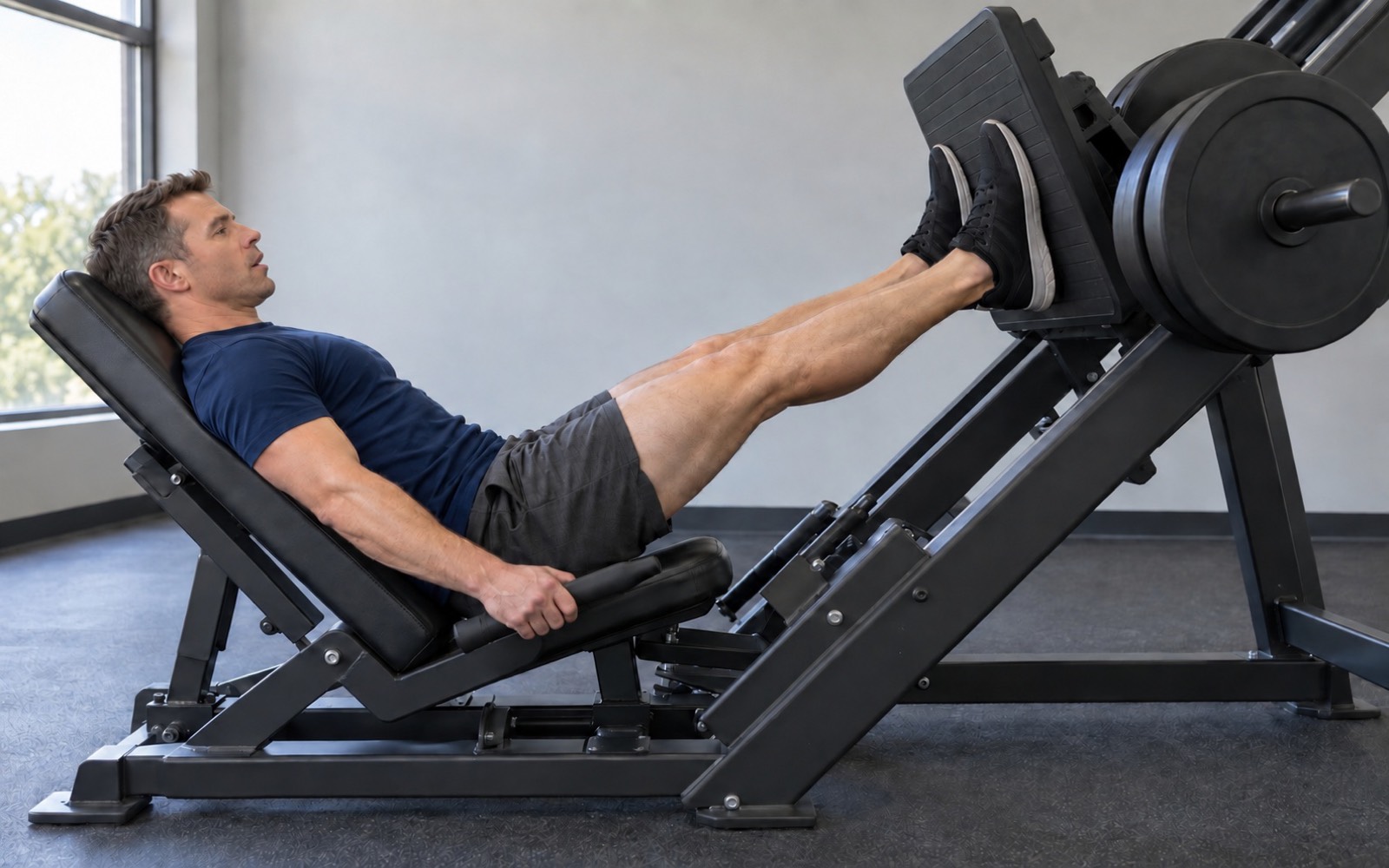
The leg press is a machine exercise where you sit or recline and push a weighted platform away with your legs while your back and hips stay supported. The heaviest work falls on your quadriceps, gluteus maximus and adductor magnus. The technique comes down to three rules: feet hip-width apart in the middle of the platform or higher, lower until your knees hit about 90°, and press through your whole foot as you exhale, without locking your knees at the top. A beginner can start with 2–3 sets of 10 reps, twice a week.
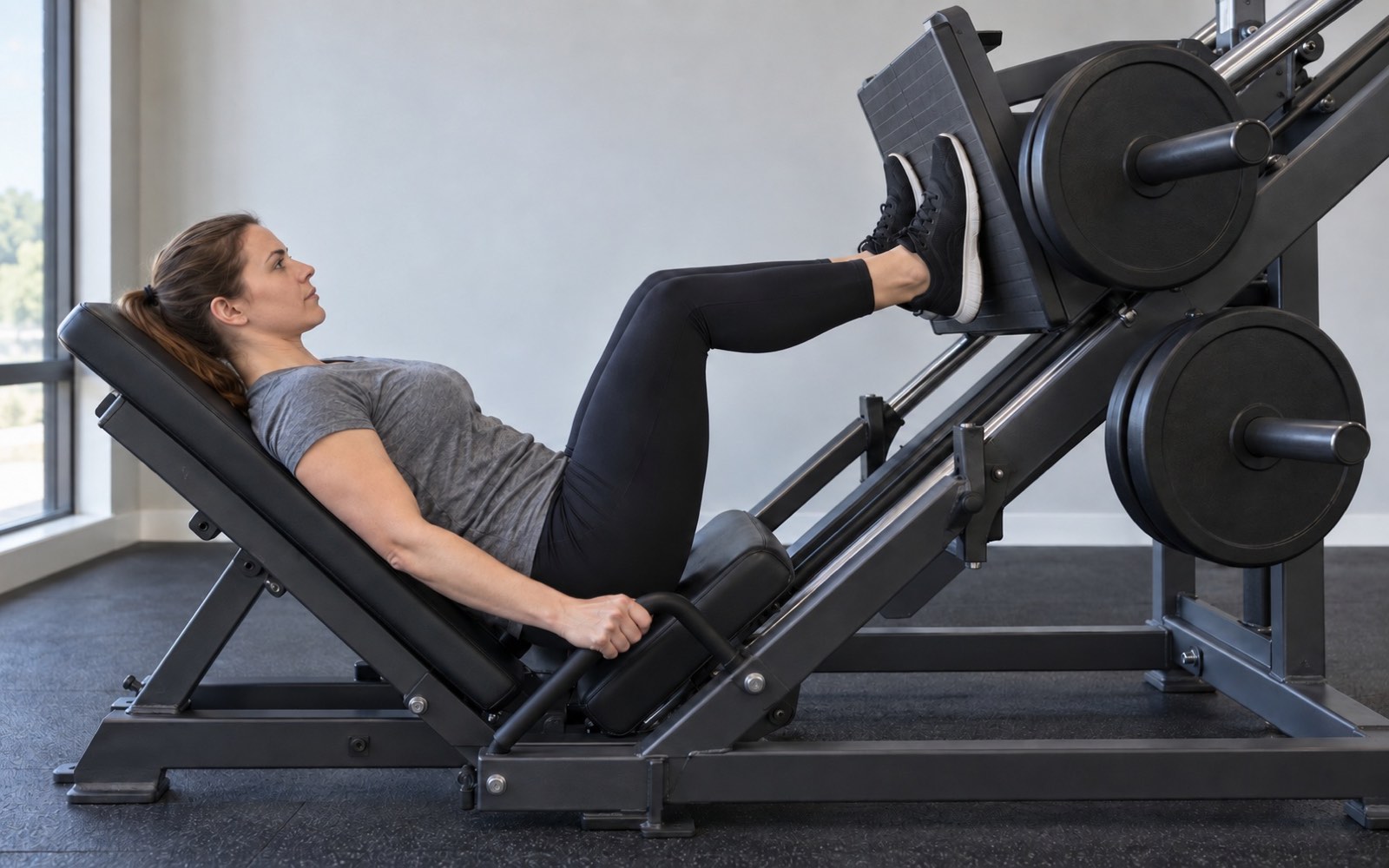
What is the leg press and what muscles does it work?
The leg press is knee and hip extension against a loaded platform while your back and hips rest on a support pad. The main work falls on the quadriceps, gluteus maximus and adductor magnus, with the hamstrings and calves helping out.
The most precise numbers come from a 2026 study by Kinoshita, Maeo and colleagues in Medicine & Science in Sports & Exercise. Seventeen untrained adults (11 men and 6 women) trained one leg with the leg press and the other with leg extensions for 12 weeks — 5 sets of 10 reps at 70% of their max, twice a week — and muscle size was measured on MRI. The leg-press leg grew the gluteus maximus by 15.4%, the adductor magnus by 6.2%, and the quadriceps overall by 4.9%. The rectus femoris gained just 1.1%, too small to call significant. The leg-extension leg grew that same muscle by 13.2%.
The reason is anatomy. The rectus femoris is the only one of the four quadriceps heads that crosses two joints — it attaches at both the shin and the pelvis, so it extends the knee and flexes the hip. In the leg press, the hip is extending, which works against that half of its job, and the nervous system recruits it less. On electromyography — a recording of a muscle's electrical activity — it worked at 21.7% of its maximum during the leg press versus 38.0% during leg extensions. The authors' conclusion: leg extensions are hard to skip if you want that muscle to grow.
| Muscle | Role in the leg press | What the research found |
|---|---|---|
| Vasti (the other three quad heads) | prime mover, extends the knee | most active of all, more so with depth (Martín-Fuentes, 2020); +4.4–6.2% over 12 weeks (Kinoshita, 2026) |
| Rectus femoris | extends the knee, flexes the hip | +1.1% versus +13.2% from leg extensions (Kinoshita, 2026) |
| Gluteus maximus | extends the hip from the bottom position | +15.4%; 41.2% of max activation versus 8.8% in leg extensions (Kinoshita, 2026) |
| Adductor magnus | assists hip extension | +6.2% (Kinoshita, 2026) |
| Hamstrings and calves | assist, stabilize the foot | more active closer to lockout (Martín-Fuentes, 2020) |
A useful detail from Martín-Fuentes and colleagues' 2020 review: at full knee extension, quad activity tails off, so there's no point grinding your knees all the way straight. Because your back rests on a pad, your legs can handle a heavy load without your torso having to brace under it — your core barely works here, so train it with other exercises.
Machine types: 45-degree, horizontal and vertical
Most gyms have a 45-degree leg press, where you sit back at an incline and push a plate-loaded sled. Some also have a horizontal (seated) version, where you push a platform straight out, and a vertical version, where the platform travels straight up above you.
| Machine | Body position | Loaded with | Best for |
|---|---|---|---|
| 45-degree ("sled", "plate-loaded") | reclined, sled travels on an incline | sled plus plates | the standard choice |
| Horizontal ("seated", "selectorized") | sitting upright, push straight out | usually a weight stack | beginners: weight changes with a pin |
| Vertical | lying on your back, platform overhead | plates | confident lifters: hips tuck under easily at the bottom |
Gym-goers often just call whichever version their gym has "the leg press," but the 45-degree machine is the default picture. "Seated leg press" and "selectorized leg press" both mean the upright version. The real differences between them are comfort and how you count the weight — more on that in section 06.
How to do the leg press: step by step
Sit so your lower back and hips are pressed into the pad, put your feet in the middle of the platform at hip width, lower the platform over about 2 seconds until your knees hit roughly 90°, then press without locking your knees at the top. We're measuring the knee angle as: 0° is a straight leg, 90° is thigh and shin at a right angle.
- The back pad. If it adjusts, pick an angle where your hips stay pressed into it at the bottom. The more upright the pad, the sooner your hips lift off.
- Your position. Lower back and hips flat against the pad and seat, head resting on the pad.
- Your feet. The whole foot on the platform, hip-width apart, toes turned out slightly. Start in the middle of the platform.
- Your hands. Hold the side handles. Hands on your knees means you're helping the lift, and the weight is too heavy.
- The safety catches. Press the platform up slightly and release the safeties, usually levers on the sides.
- The descent. Lower over 2 seconds, knees tracking over your toes. Inhale on the way down.
- Depth. Stop around 90° of knee flexion, or sooner if your hips start lifting off the pad.
- The press. Drive through your whole foot, heels staying down. Exhale on the way up.
- At the top. Knees nearly straight but soft, no lockout click.
- Ending a set. Reset the safety catches before you take your feet off the platform.
On tempo: in the Kinoshita study, both phases took 2 seconds on a metronome, and the muscles still grew. Martín-Fuentes and colleagues measured in 2022 that pressing as fast as possible increases muscle activity. So lower with control, and press hard — just don't slam into lockout.
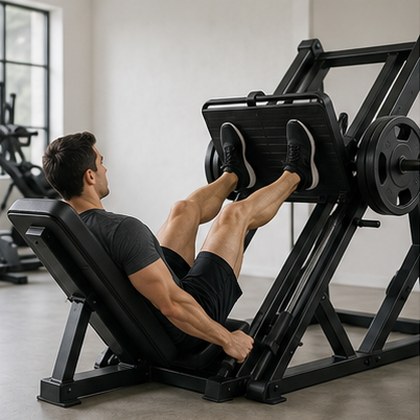 Leg press, men’s set
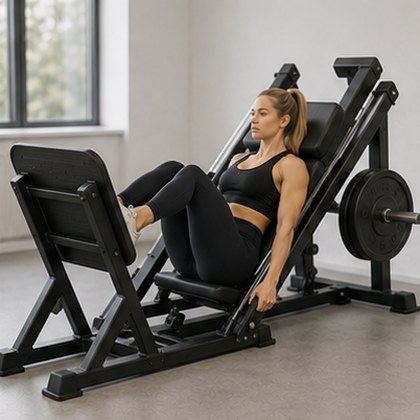 Leg press, women’s set
Foot placement: for glutes, quads and inner thighs
Feet higher on the platform work the glutes harder; feet lower work the quads harder. Stance width and toe angle barely move the needle in the research, so pick them for what's comfortable on your knees. We checked the usual gym advice against four studies.
| What people usually say | What the research found | Verdict |
|---|---|---|
| Feet higher = more glutes | At 80% of max, the glutes were more active in the high-foot position (da Silva, 2008); with toes near the top edge, the glutes grew 15.4% over 12 weeks (Kinoshita, 2026) | Holds up |
| Feet lower = more quads | At 80% of max, the quads were more active in the low-foot position (da Silva, 2008); knee forces didn't differ between high and low placement (Escamilla, 2001) | Holds up, no extra knee stress |
| Wide = hamstrings and inner thigh | A wide, high stance produced more hamstring activity (Escamilla, 2001); 150% of hip width versus 100% made no difference (Martín-Fuentes, 2022) | Mixed, the effect is small |
| Narrow = "outer quad" | Stance width made no difference to muscle activity (Martín-Fuentes, 2022); a narrow stance increased compressive force on the knee and kneecap (Escamilla, 2001) | Not supported, and harder on the knee |
| Toes out = inner thigh | A 30° toe-out didn't change muscle activity or knee force (Escamilla, 2001); neither did 45° (Martín-Fuentes, 2022) | Not supported |
| Deeper = more muscle activity | Quad activity rises with depth (Martín-Fuentes, 2020); full range of motion builds more muscle (Pallarés, 2021); knee forces rise too (Escamilla, 2001) | Holds up, until your hips lift off |
A caveat from the 2020 review: research on foot placement is limited and doesn't always agree. The table shows direction, not exact percentages "for the glutes." Da Silva's study included 14 women, so the high-versus-low finding is specifically confirmed in women.
- For glutes: feet near the top edge, hip-width apart, full depth while your hips stay pressed to the pad. That's how the feet were placed in the Kinoshita study.
- For quads: feet below center, but not so low that your heels lift at the bottom.
- Wide with toes out: fine if it's more comfortable for your hips and knees. Widening your stance specifically for "inner thigh" isn't worth chasing.
Martín-Fuentes' 2022 advice is to place your feet wherever feels natural to you. If glutes specifically are the goal, add hip thrusts — an exercise built entirely around hip extension, which is the glutes' main job.
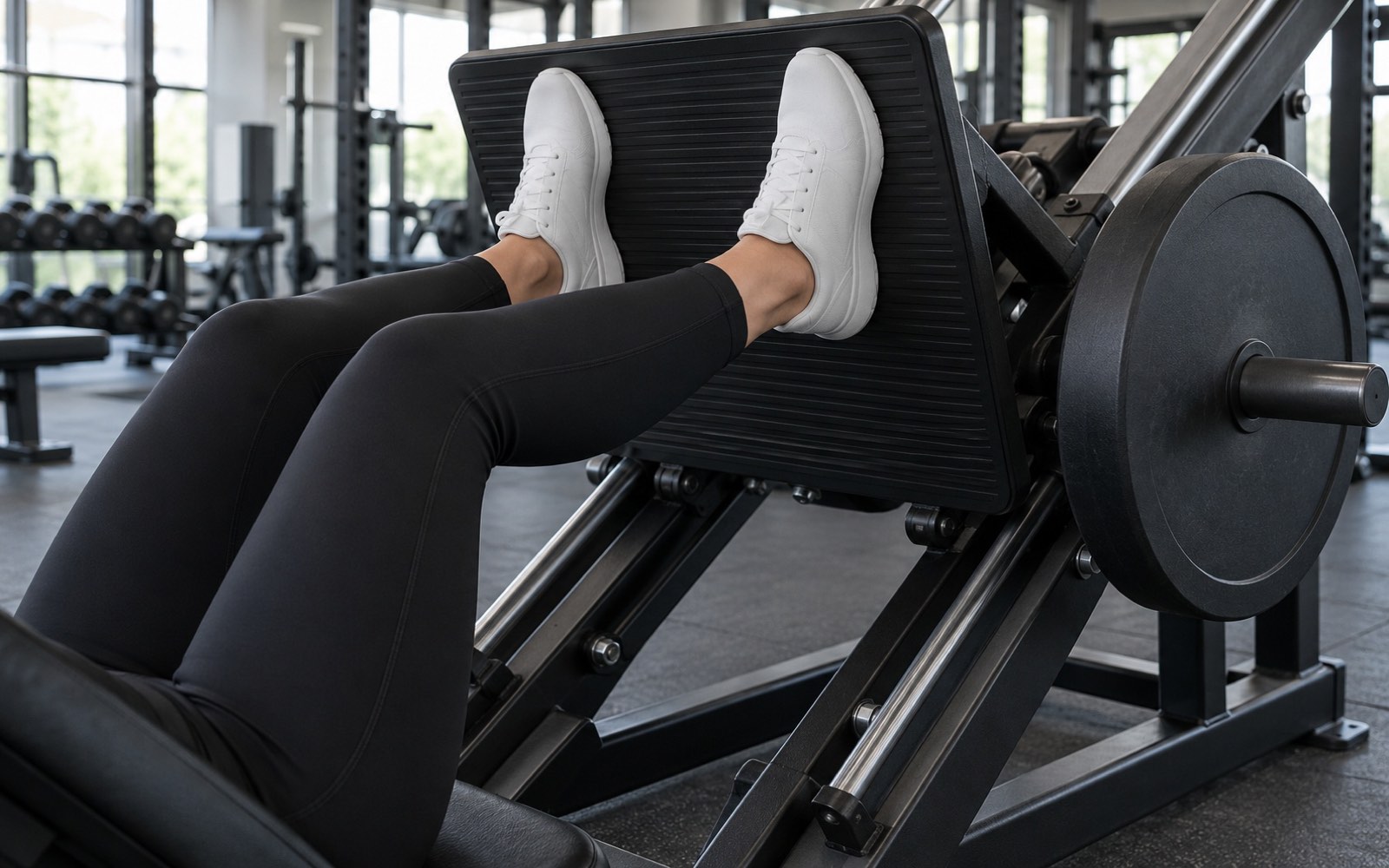
How deep should you go?
Lower to about 90° of knee flexion, or stop higher if your hips start lifting off the pad.
In a 2021 meta-analysis by Pallarés and colleagues covering 16 studies, full range of motion beat partial range for both strength (effect size 0.56) and leg muscle growth (0.88). On Cohen's scale, 0.5 is a medium effect and 0.8 is large. So a huge weight that barely moves the platform loses to a moderate weight through a full range.
Your hips set the lower limit. Once your hip joint runs out of flexion, your pelvis tucks under, your tailbone lifts off the seat, and your lower back rounds under load. That point is different for everyone, and the easiest way to find it is on video from the side.
The second limit is your knees. Per Escamilla's 2001 data, every force acting on the knee increases with more flexion, which is why 0–50° is the gentler range. Steinkamp and colleagues compared pressure under the kneecap in the leg press versus leg extensions in 20 healthy people back in 1993.
| Knee angle | What happens | Source |
|---|---|---|
| 0–30° | kneecap pressure is lower than in leg extensions | Steinkamp, 1993 |
| around 48° | pressure in both exercises evens out | Steinkamp, 1993 |
| 0–50° | knee forces stay minimal | Escamilla, 2001 |
| 60–90° | kneecap pressure is higher than in leg extensions; the quads work harder | Steinkamp, 1993; Martín-Fuentes, 2020 |
| beyond 90° | many people's hips start tucking and the lower back rounds | pelvic mechanics, see above |
For a healthy knee, full depth to about 90° with your hips pressed to the pad is a plus. If it aches under the kneecap, work in the 0–50° range with a light weight — more in section 09.
What weight should you use, and how much does the sled actually weigh?
Start with a weight where you have about 3 reps left in the tank after 10. On a 45-degree machine, roughly 71% of the sled-and-plate weight actually presses into you, so the number stamped on the plates overstates the real load.
Do your first set on the empty sled and add a plate at a time until you find that weight. The rule is the same for women and men.
The spec sheet for a common machine, the Hammer Strength Plate-Loaded Linear Leg Press, lists a 45-degree angle and "starting resistance" of 118 lb (53 kg). The manufacturer doesn't say whether that's the literal sled weight or an effort figure that already accounts for the incline; like most gyms do, we're treating it as sled weight. Because the sled travels on an incline, the share of that weight pressing into your legs equals the sine of 45°, about 0.71. We're not counting rail friction — this model runs on sealed ball-bearing rails.
| Plates added | Total with the sled | What actually presses into you (× 0.71) |
|---|---|---|
| none | 118 lb (53 kg) | ≈83 lb (37 kg) |
| 45 lb (20 kg) | 163 lb (73 kg) | ≈115 lb (52 kg) |
| 90 lb (40 kg) | 208 lb (93 kg) | ≈147 lb (66 kg) |
| 135 lb (60 kg) | 253 lb (113 kg) | ≈179 lb (80 kg) |
| 180 lb (80 kg) | 298 lb (133 kg) | ≈211 lb (94 kg) |
| 225 lb (100 kg) | 343 lb (153 kg) | ≈243 lb (108 kg) |
| 315 lb (140 kg) | 433 lb (193 kg) | ≈306 lb (136 kg) |
| 405 lb (180 kg) | 523 lb (233 kg) | ≈370 lb (165 kg) |
That share depends on the angle: at 30° about 50% of the weight presses into you, at 40° it's 64%, at 45° it's 71%, and on a vertical machine it's the full 100%. The math doesn't apply to a horizontal, selectorized machine — the number on the stack depends on its levers and pulleys, not a simple angle.
- Adding 45 lb (20 kg) of plates on a 45-degree machine adds about 32 lb (14 kg) of real load.
- On other machines, the number stamped on the frame can mean either the sled's own weight or a load already adjusted for angle. Check your specific machine's plate.
That's why "I leg press 350" doesn't translate into a squat number. In a squat you're lifting a barbell plus most of your own body weight; on the machine, your torso rests on the pad. Two gyms aren't comparable either — different angle, different sled, different levers. There's no universal leg press standard: compare yourself to yourself, on the same machine.
Add weight once every set is completed in full. In the Kinoshita study, load went up by 5% of the max as soon as a participant finished all sets unassisted, starting from the third session. For how to plan that progression, see our guide to progressive overload.
find the plate on the machine's frame that lists the sled weight, and remember which machine you leg press on. In the Sportygram training diary, the leg press is one of 142 exercises with photos, and it keeps a weight history for each one.
Sets, reps and how often
For muscle growth, do 3–5 sets of 8–12 reps twice a week, so that combined with your other leg work you hit at least 10 working sets a week.
Those numbers come from the American College of Sports Medicine's (ACSM) 2026 position stand: 137 systematic reviews, over 30,000 participants, updating its 2009 position. For muscle growth, it recommends at least 10 sets per week per muscle group. For strength: 80%+ of your max, full range of motion, 2–3 sets, at least 2 sessions a week. Training to failure isn't required — it didn't produce a consistent extra benefit.
The studies themselves used these schemes: Kinoshita's group — 5 sets of 10 at 70% of max; Rossi and Schoenfeld's 2018 study — 6 sets of 8–12 with 90–120 seconds of rest; both twice a week.
| Goal | Sets × reps | Times a week | Basis |
|---|---|---|---|
| Learning the movement | 2–3 × 10, about 3 reps in reserve | 2 | weight selection from section 06 |
| Muscle growth | 3–5 × 8–12, not to failure | 2 | ACSM, 2026; Kinoshita, 2026; Rossi, 2018 |
| Strength | 2–3 sets at 80%+ of max, done first | 2+ | ACSM, 2026 |
| Knee pain, cleared by a doctor | light weight, knee angle to 50° | 2 | Escamilla, 2001; Cochrane, 2024 |
If your session includes squats, leg press them afterward. If there's no squat in the session, leg press can go first.
Mistakes: where you feel it → what to fix
Almost every mistake shows up as one of three signs: your hips lift off the pad, your knees cave in, or your knees lock out at the top.
| What you see or feel | Why | The fix |
|---|---|---|
| Hips lift off at the bottom, lower back rounds | too deep, or feet placed too low | stop higher, move your feet up |
| Knees cave inward | weight too heavy, stance too narrow | drop the weight, track knees over toes |
| Heels lift off | feet too low, or going too deep | move feet up, press through the whole foot |
| Knee clicks at the top | locking out, load shifts to the ligaments | stop short of full extension |
| Face flushes, ears pound | holding your breath | inhale on the way down, exhale on the way up |
| Ache under the kneecap | too deep for your knee | limit depth to 50°, see a doctor if it repeats |
| Sled barely travels | too short a range | drop the weight, go down to 90° |
Locking your knees under heavy load is genuinely dangerous. In 2019, Barnds and colleagues described a case in JBJS Case Connector: a 44-year-old recreational lifter tried to press roughly 1,100 lb (about 500 kg) and locked both knees. Both dislocated, and he needed emergency reduction, external fixation and several ligament surgeries. Per the authors, a locked knee hyperextends by 5–10°, and the load shifts onto the anterior cruciate ligament. It's a single case report, but the takeaway is simple: don't lock or hyperextend your knees on the leg press or the squat.
film yourself from the side for your first few sessions. You can barely feel your hips lifting off from the inside, but on video from the side it's obvious from the first rep. Note the depth where your hips are still pressed down, and stick to it.
Knees, lower back and blood pressure: who it's safe for, and when to see a doctor
The leg press is gentle on the anterior cruciate ligament, and your back rests on a support the whole time. Limit depth if your knee hurts. If your blood pressure runs high, exhale on the press and don't hold your breath.
Knees. Escamilla and colleagues compared the squat and the leg press in 10 experienced athletes in 2001. Neither exercise loaded the anterior cruciate ligament. Overall knee compression was higher in the squat than in the leg press. If it aches under the kneecap, work to 50° of knee flexion. Per Steinkamp's 1993 data, up to 30° the leg press loads the kneecap even less than leg extensions do.
Exercise helps with knee osteoarthritis. In a 2024 Cochrane review by Lawford and colleagues (139 studies, 12,468 people), exercise reduced knee pain by an average of 13 points out of 100 and improved knee function by 12.5 points, compared with no treatment. The authors found no meaningful difference between types of exercise. How much of that benefit shows up in daily life is, in their words, still an open question. A gentle-range leg press can fit into a program like that — build it with a doctor.
Lower back. Your back rests on a pad and only takes strain when your hips lift off it at the bottom. Hence the rule: go only as deep as your hips stay pressed down. Skip the leg press with acute back pain or a disc herniation in its acute phase. Come back once the pain settles and a doctor has cleared you, starting with shallow depth and a light weight.
Blood pressure. MacDougall and colleagues used an arterial catheter to measure blood pressure in five experienced bodybuilders back in 1985. Pressing with both legs to failure pushed it to an average of 320/250 mmHg, and over 480/350 in one participant. Part of that spike comes from breath-holding under strain — the Valsalva maneuver.
Narloch and Brandstater tested 10 athletes leg pressing at 100% of their max in 1995. Holding their breath, average pressure was 311/284; exhaling slowly on the press, it was 198/175. Systolic pressure dropped by 113 mmHg — more than a third. If your blood pressure runs high, see our guide to training with high blood pressure.
Over 40 and in older age. Age doesn't rule out the leg press. In a 2009 Cochrane review by Liu and Latham (121 studies, 6,700 older adults), progressive resistance training produced large strength gains and made it easier for people to stand up from a chair. Serious adverse events were rare and not clearly linked to the exercise itself.
Talk to a doctor first if you have: pregnancy, a recent knee, hip, abdominal or spinal surgery, painful varicose veins with swelling, or uncontrolled blood pressure.
See a doctor if:
- your knee swells, clicks with pain, or "locks up";
- pain radiates down your leg, or your foot goes numb or weak;
- you get a headache or see spots after a heavy set.
Leg press variations and alternatives: at the gym, with dumbbells, at home
No machine free, or none at your gym? Goblet squats, lunges, step-ups and split squats load your legs just as well.
At the gym:
- Single-leg press brings up a lagging leg. In the Kinoshita study, legs were trained one at a time, and both grew.
- The horizontal machine is the same movement, but don't compare its weight to a 45-degree machine.
- Hack squat is a different exercise: you stand with your back against an angled pad, shoulders under the pads, and your torso does more work.
- Leg extensions complement the leg press: of the two, only leg extensions build the rectus femoris well (Kinoshita, 2026).
With dumbbells:
- Goblet squats: one dumbbell held vertically at your chest, heels down, knees tracking over your toes.
- Lunges with dumbbells load each leg individually and train balance.
- Step-ups onto a box about knee height: drive up with the working leg, without pushing off the trailing one.
- Split squats: rear foot up on a bench, front leg does the squatting.
At home: the same squats, lunges and step-ups onto a sturdy chair, with no load or a backpack full of books. Once the last few reps stop feeling hard, move to single-leg versions.
Leg press or squats: which to choose, and how to combine them
Both exercises build your leg muscles well. The squat carries over better to squat strength itself; the leg press is easier to learn, and your back stays supported the whole time.
In 2018, Rossi, Schoenfeld and colleagues trained three groups for 10 weeks: squat only, leg press only, and both. The squat group improved most on their squat max; on jump height and balance, there was no statistically significant difference between groups. The authors' conclusion: both machines and free weights work, and which one transfers best depends on your goal. ACSM's 2026 position stand says the same — equipment type consistently didn't affect the outcome.
- Leg press is a good pick when you need to protect your back, or you're just starting out with resistance training.
- Squat teaches you to brace your torso under a free weight.
- Both together: squat first, leg press later in the same session or on a different day.
If you're training off a plan in the Sportygram app, tell your virtual coach Alex in the chat something like "add the leg press on Thursday" or "move leg day to Saturday." He'll add the exercise through a "Yes, add it" confirmation card, and move the session right away if the target day is free.
Questions and answers
How much does the leg press sled weigh?
It depends on the machine. On a common 45-degree Hammer Strength model, the spec sheet lists 118 lb (53 kg) of "starting resistance." If that's the sled's own weight, about 83 lb (37 kg) actually presses into your legs, because the sled travels on an incline. On other machines, look for a plate on the frame.
What's a normal leg press weight?
There's no universal standard — different angles and sleds mean different real loads. Compare yourself to yourself on the same machine, and add weight once you complete every rep of every set. The same rule applies to women.
Can you do the leg press with bad knees?
Yes, with a shallow range: keep it to 50° of knee flexion (Escamilla, 2001), feet at hip width, light weight. For knee osteoarthritis, exercise cuts pain by an average of 13 points out of 100 (Cochrane, 2024). Swelling, a painful click, or your knee "locking up" are reasons to see a doctor first.
Why does my lower back hurt after leg press?
Almost always because your hips lift off the pad at the bottom — you're going deeper than your hip joint allows. Stop higher and raise your foot position. If the pain shoots down your leg, see a doctor.
Can you lock your knees out at the top?
Almost straight, softly, is fine. Locking out with a click under heavy load isn't. Quad activity drops off at full extension anyway (Martín-Fuentes, 2020). The extreme case of that risk: both knees dislocating from an attempt at roughly 1,100 lb (Barnds, 2019).
Leg press or squats: which is better for glutes?
The leg press has a direct measurement: with a high foot placement, the glutes grew 15.4% over 12 weeks (Kinoshita, 2026). The squat also loads the glutes and carries over better to squat strength itself (Rossi, 2018). If glutes specifically are the goal, add hip thrusts — an exercise built around hip extension.
Why do a single-leg press?
To bring up a lagging leg. Start light and compare sides by how many reps each does. In the 2026 study, legs trained one at a time still grew.
What can you do instead of the leg press if the machine's taken or your gym doesn't have one?
Goblet squats, lunges, step-ups and split squats, or at home, the same moves with no load or a loaded backpack (section 10).
The bottom line
- The leg press grows your glutes and thighs: gluteus maximus +15.4%, adductors +6.2%, quads +4.9% over 12 weeks (Kinoshita, 2026). The rectus femoris needs leg extensions to grow well.
- Feet higher work the glutes more, feet lower work the quads more. Pick stance width and toe angle for what's comfortable on your knees.
- Lower to about 90° of knee flexion while your hips stay pressed down: full range of motion builds more muscle than a partial one.
- On a 45-degree machine, about 71% of the sled-and-plate weight actually presses into you — compare weights only on the same machine.
- For muscle growth: 3–5 sets of 8–12 reps twice a week, at least 10 sets on your legs per week.
- Exhale on the press, keep your knees soft at the top. Ache under the kneecap: limit depth to 50°. Swelling or seeing spots: see a doctor.
Checklist: leg press without the mistakes
- You know where the safety-catch levers are.
- The back pad is set so your hips stay pressed down at the bottom.
- Whole foot on the platform, hip-width apart: higher for glutes, lower for quads.
- Hands on the handles, knees tracking over your toes.
- Down over 2 seconds, until your hips stay pressed and your knees hit about 90°.
- Inhale on the way down, exhale on the way up.
- Knees soft at the top, no locking click.
- Safety catches reset after the set.
- Weight logged, and you remember which machine.
Sources
- Kinoshita M., Maeo S. et al. Hypertrophic Effects of Single- versus Multi-Joint Exercise: A Direct Comparison between Knee Extension and Leg Press. Medicine & Science in Sports & Exercise, 2026. — 12 weeks, MRI: glutes +15.4%, adductors +6.2%, quads +4.9%, rectus femoris +1.1%.
- Martín-Fuentes I., Oliva-Lozano J.M., Muyor J.M. Evaluation of the Lower Limb Muscles' Electromyographic Activity during the Leg Press Exercise and Its Variants: A Systematic Review. International Journal of Environmental Research and Public Health, 2020. — Quad activity rises with depth and tails off at full extension; foot-placement data is limited.
- Martín-Fuentes I., Oliva-Lozano J.M., Muyor J.M. Influence of Feet Position and Execution Velocity on Muscle Activation and Kinematic Parameters During the Inclined Leg Press Exercise. Sports Health, 2022. — Stance width and toe angle didn't change muscle activation.
- Da Silva E.M. et al. Analysis of muscle activation during different leg press exercises at submaximum effort levels. Journal of Strength and Conditioning Research, 2008. — 14 women: low foot placement activated the quads more, high placement activated the glutes more.
- Escamilla R.F. et al. Effects of technique variations on knee biomechanics during the squat and leg press. Medicine & Science in Sports & Exercise, 2001. — Toe angle didn't change knee forces, neither exercise loaded the ACL, the gentle range is 0–50°.
- Steinkamp L.A. et al. Biomechanical considerations in patellofemoral joint rehabilitation. American Journal of Sports Medicine, 1993. — Kneecap pressure is higher in leg extensions below 30° and higher in the leg press at 60–90°, crossing over near 48°.
- Pallarés J.G. et al. Effects of range of motion on resistance training adaptations: A systematic review and meta-analysis. Scandinavian Journal of Medicine & Science in Sports, 2021. — 16 studies: full range of motion beats partial for strength (0.56) and leg muscle growth (0.88).
- MacDougall J.D. et al. Arterial blood pressure response to heavy resistance exercise. Journal of Applied Physiology, 1985. — Two-leg press to failure: average 320/250 mmHg, over 480/350 in one participant.
- Narloch J.A., Brandstater M.E. Influence of breathing technique on arterial blood pressure during heavy weight lifting. Archives of Physical Medicine and Rehabilitation, 1995. — Leg press at 100% of max: 311/284 mmHg with breath-holding, 198/175 with a slow exhale.
- Rossi F.E., Schoenfeld B.J. et al. Strength, body composition, and functional outcomes in the squat versus leg press exercises. Journal of Sports Medicine and Physical Fitness, 2018. — Both machines and free weights build muscle; transfer depends on the goal.
- Currier B.S. et al. American College of Sports Medicine Position Stand. Resistance Training Prescription for Muscle Function, Hypertrophy, and Physical Performance in Healthy Adults: An Overview of Reviews. Medicine & Science in Sports & Exercise, 2026. — 137 reviews: at least 10 sets a week per muscle group for growth; equipment type and training to failure didn't consistently matter.
- Lawford B.J. et al. Exercise for osteoarthritis of the knee. Cochrane Database of Systematic Reviews, 2024. — 139 studies: exercise cuts knee osteoarthritis pain by 13 points out of 100, with no difference between exercise types.
- Liu C.J., Latham N.K. Progressive resistance strength training for improving physical function in older adults. Cochrane Database of Systematic Reviews, 2009. — Large strength gains in older adults, serious adverse events rare.
- Barnds B. et al. Simultaneous Bilateral Knee Dislocation During Weight Training: A Case Report and Review of the Literature. JBJS Case Connector, 2019. — Bilateral knee dislocation from locking out; the roughly 1,100 lb attempt and the 5–10° hyperextension figure are in the OrthoBuzz writeup.
- Life Fitness. Hammer Strength Plate-Loaded Linear Leg Press. Machine spec sheet. — 45-degree angle, 118 lb (53 kg) starting resistance, sealed ball-bearing rails.
This article is for informational purposes only and is not a substitute for medical advice.