

the WHO advises adults to eat less than 5 g of salt a day, which is less than 2,000 mg of sodium and just under a teaspoon. US guidelines set the line a little higher, at 2,300 mg of sodium, about 5.75 g of salt. Your body needs about 1,300 mg of sodium, roughly 3.3 g of salt. Americans average about 3,400 mg of sodium a day, around 8.5 g of salt, and in Russia people eat 11 to 15 g. Most of it comes from processed meat, bread, cheese and restaurant food.A sandwich made with two slices of bread, bologna-style sausage and cheese already holds 2.6 g of salt. A typical hour in the gym costs you 0.6–2.6 g of salt in sweat, so extra salt only makes sense for long sessions in the heat. In trials where people ate an average of 4.4 g less salt a day for a month or longer, systolic blood pressure in people with hypertension dropped by an average of 5.4 mm Hg.
An adult can eat up to 5 g of salt a day. That's less than 2,000 mg of sodium and just under a teaspoon, and those 5 g cover all the salt you eat in a day: the salt already baked into bread, sausage and cheese plus whatever you shake on from the salt shaker. You can't live without salt, because sodium keeps your nerves, muscles and blood working. The trouble is that most people eat far more than the limit, often twice as much, and most of the extra comes from ready-made food. Below: the limit in grams and teaspoons, how much salt sits in everyday portions, how much salt you lose in sweat during a workout and how to eat less of it without your food turning bland.
How much salt per day is safe for an adult
An adult can eat up to 5 g of salt a day. That's less than 2,000 mg of sodium and just under a teaspoon, and it counts every source of salt in your day: bread, sausage, cheese, sauces and the salt shaker combined.
That upper limit comes from the World Health Organization, in its fact sheet on salt updated in May 2026. The European Food Safety Authority (EFSA) arrived at the same number on its own in 2019: it named 2 g of sodium a day a safe and adequate intake for adults.
In the United States, the FDA uses a Daily Value of less than 2,300 mg of sodium, which works out to about 5.75 g of salt. The FDA describes that as "about 1 teaspoon of table salt". The Russian Society for the Prevention of Noncommunicable Diseases (ROPNIZ), in its 2021 guidelines, also advises under 5 g and notes that the UK and the US use a softer guide of 6 g.
The floor comes from Russia's national nutrition standards. In the Rospotrebnadzor guidelines MR 2.3.1.0253-21, an adult's physiological need for sodium is 1,300 mg a day, about 3.3 g of salt. That's how much your body needs to hold blood volume steady, send nerve signals and contract muscles. The ceiling in the same document matches the WHO: no more than 2 g of sodium a day from food.
| Who | Sodium per day | Salt per day | What it means |
|---|---|---|---|
| WHO, 2026 | less than 2,000 mg | less than 5 g | upper limit for adults, "just under a teaspoon" |
| EFSA, 2019 | 2,000 mg | 5 g | safe and adequate, including during pregnancy and breastfeeding |
| FDA, USA, 2024 | less than 2,300 mg | about 5.75 g | "about 1 teaspoon" |
| Rospotrebnadzor, MR 2.3.1.0253-21 | 1,300 mg, but no more than 2,000 mg | 3.3 to 5 g | 1,300 mg is the body's need, 2,000 mg is the ceiling |
| ROPNIZ, 2021 | — | no more than 5 g | "one level teaspoon", to protect the heart and blood vessels |
| USA in reality | about 3,400 mg | about 8.5 g | about 1.5 times the US limit |
| Russia in reality | — | 11.35 g (Rosstat, 2018), 14.87 g (2023 review) | two to three times the limit |
That gives you a working range of 3.3 to 5 g of salt a day. The lower number is what your body needs, and the upper number is how much is still safe. If you follow the US figure, your ceiling sits slightly higher, at about 5.75 g.
Women and men have the same limit: neither the WHO nor EFSA splits it by sex. For pregnancy and breastfeeding, EFSA considers the same 2 g of sodium adequate. After 50 the limit stays the same too, though cutting back on salt pays off more, as you'll see in the section on blood pressure.
Salt vs sodium: how to convert them and how many teaspoons that is
To turn sodium into salt, multiply it by 2.5: 2,000 mg of sodium is 5 g of salt, and 400 mg of sodium on a label is already 1 g of salt.
Table salt is sodium chloride, and about 40% of its weight is sodium, with chloride making up the rest. For health, what counts is the sodium, which is why the WHO and the FDA write their limits in milligrams of sodium. US and UK labels list sodium or salt depending on the country, and Russia's "Traffic Light" labeling guidelines from Rospotrebnadzor convert one into the other using the same factor of 2.5.
A cheat sheet for labels:
- 100 mg of sodium is 0.25 g of salt;
- 400 mg of sodium is 1 g of salt;
- 1,300 mg of sodium is about 3.3 g of salt, the daily need;
- 2,000 mg of sodium is 5 g of salt, the WHO limit;
- 2,300 mg of sodium is about 5.75 g of salt, the FDA limit.
Going the other way is just as easy: multiply salt by 0.4 to get sodium. There are 2 g of sodium in 5 g of salt.
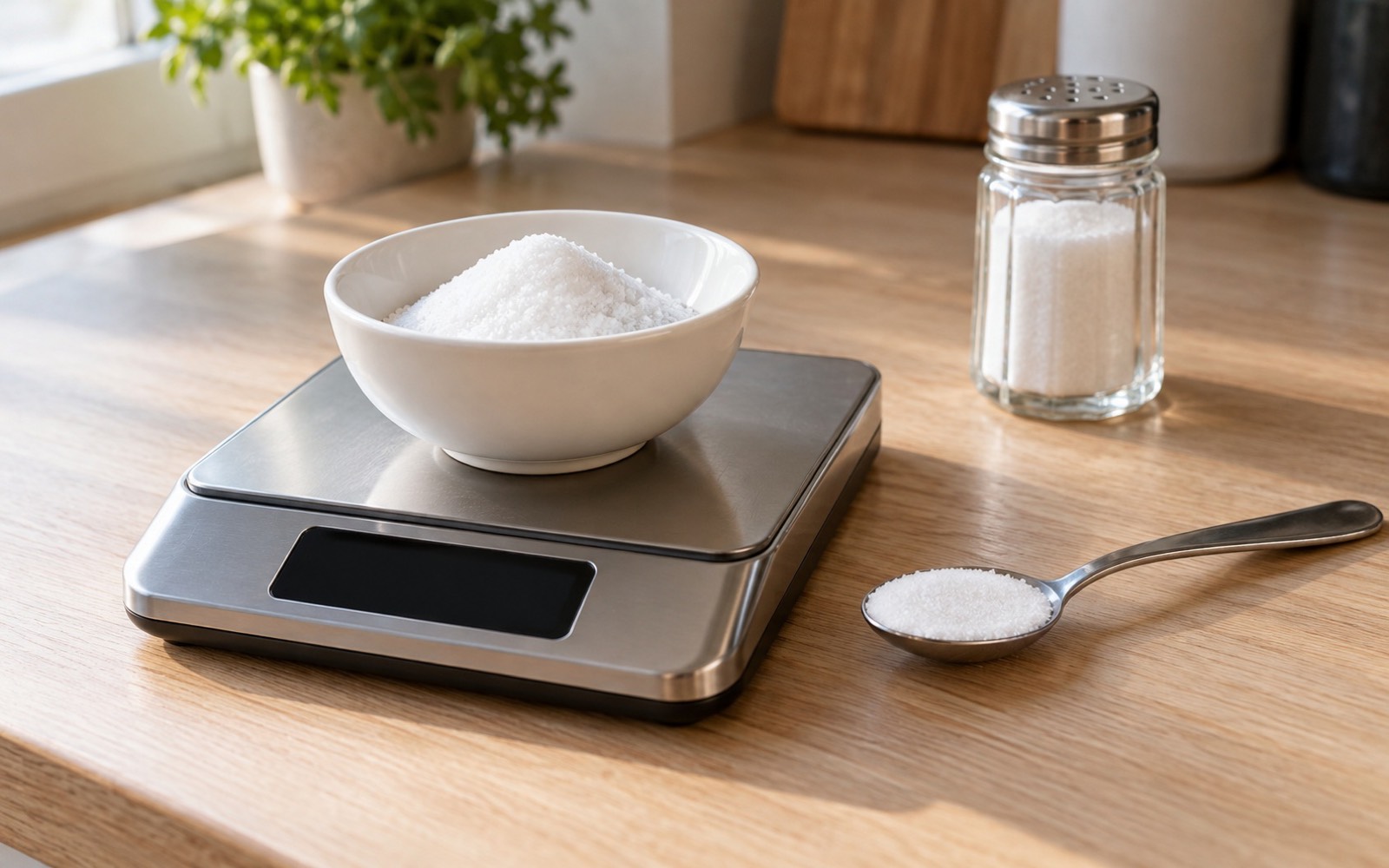
How many teaspoons that is. The WHO describes 5 g of salt as "just under a teaspoon", and the FDA calls 2,300 mg of sodium, roughly 5.75 g of salt, "about 1 teaspoon". The gap makes sense: spoons vary, fine salt packs more densely than coarse salt, and a heaped spoon adds a lot. So weigh your own spoon once on a kitchen scale: fill it level and remember the number. After that, you'll know how many grams go into a pot of soup and can divide them by the number of servings.
How much salt people actually eat, and where it comes from
Most people eat far more than the limit: Americans average about 3,400 mg of sodium a day, according to the FDA, which is about 8.5 g of salt. In Russia, Rosstat data for 2018 put intake at 11.35 g of salt a day, and that doesn't include salt added at the table.
For comparison, the WHO estimates that the world average in 2021 was 4,278 mg of sodium a day, about 11 g of salt.
The Russian figure comes from Drapkina and colleagues in the 2021 ROPNIZ guidelines. They also report that 40.5% of Russians add salt to food that's already cooked, so real intake is higher still. A 2023 systematic review by Kwong and colleagues covering the WHO European Region lists 14.87 g for Russia. Different studies estimate intake in different ways, so the fair range is 11 to 15 g.
In the same 2023 review, salt intake was above 5 g in 52 of the 53 countries of the WHO European Region, and men ate more of it than women in 52 countries. The highest numbers were in Eastern Europe and Central Asia.
People eat a little less salt as they get older. According to Rosstat data for 2013, cited by ROPNIZ, Russians ate about 10 g of salt a day on average: about 11 g at ages 25–64 and 9.6 g over 65. People who described themselves as vegetarian came out at 6.7 g.
Where the salt comes from. In Russia, data from the Federal Research Center of Nutrition and Biotechnology, cited by ROPNIZ and by Rospotrebnadzor's "Traffic Light" guidelines, splits dietary salt across food groups like this:
- meat products: 35%;
- bread and baked goods: 27%;
- dairy products: 14%;
- fish products: 14%;
- canned vegetables and fruit, and juices: 10%.
More than half comes from meat products and bread: sausage, hot dogs, ham and sliced white bread. Many of these don't taste salty at all.
How much the salt shaker really adds. An American study by Harnack and colleagues from 2017 shows this well. Researchers collected and weighed all the salt that 450 adults added while cooking and at the table. The shaker supplied only 10.5% of their sodium: 5.6% from home cooking and 4.9% at the table. Another 14.2% was sodium that occurs naturally in foods, and 70.9% came from food prepared outside the home: in factories, cafés and restaurants. The FDA puts it the same way: over 70% of the sodium Americans eat comes from packaged and prepared foods.
For Russia, ROPNIZ gives a similar breakdown based on the Federal Research Center of Nutrition data: 75% of daily salt is hidden in processed foods, 10–12% occurs naturally in whole foods, and about 15% is added during cooking and at the table. The conclusion matches the American study: if you want to eat less salt, start with sausage, bread and cheese, and only then deal with the salt shaker.
Where salt hides: how much is in a normal serving
The saltiest foods are salted fish, sausages, hot dogs and dumplings: 50 g (1.8 oz) of medium-salted herring holds 6 g of salt, more than a whole day's limit.
The numbers below come from the database "Chemical composition of foods used in the Russian Federation" run by the Federal Research Center of Nutrition and Biotechnology. The database lists sodium per 100 g. We multiplied it by 2.5 and recalculated it for a typical serving. The serving size is our assumption and is shown in the table. These are reference values for standard recipes: a specific brand of sausage or bread can differ, and US or UK versions of similar foods can differ more, so check the label.
| Food | Salt per 100 g | Serving | Salt per serving | Share of 5 g |
|---|---|---|---|---|
| Atlantic herring, medium-salted | 12.0 g | 50 g (1.8 oz), 2–3 pieces | 6.0 g | 120% |
| Salted pink salmon | 13.4 g | 30 g (1 oz), for a sandwich | 4.0 g | 80% |
| Pelmeni (meat dumplings), boiled | 1.4 g | 200 g (7 oz), a plate | 2.8 g | 55% |
| Solyanka (mixed meat soup) | 0.8 g | 300 g (10.6 oz), a bowl | 2.5 g | 50% |
| Sauerkraut | 2.3 g | 100 g (3.5 oz) | 2.3 g | 47% |
| Semi-dry smoked sausage (Lyubitelskaya) | 3.9 g | 60 g (2.1 oz), 6 slices | 2.3 g | 46% |
| Milk hot dogs | 2.0 g | 100 g (3.5 oz), 2 hot dogs | 2.0 g | 40% |
| Borscht with potatoes | 0.65 g | 300 g (10.6 oz), a bowl | 1.95 g | 39% |
| Canned olives | 5.6 g | 30 g (1 oz), 8–10 olives | 1.7 g | 34% |
| Cervelat (dry sausage) | 5.6 g | 30 g (1 oz), 6 thin slices | 1.7 g | 33% |
| Brynza (brined cow's-milk cheese, like feta) | 3.0 g | 50 g (1.8 oz) | 1.5 g | 30% |
| Cooked sausage (Lyubitelskaya, bologna-style) | 2.25 g | 60 g (2.1 oz), 3 rounds | 1.35 g | 27% |
| Doktorskaya sausage (bologna-style) | 2.1 g | 60 g (2.1 oz), 3 rounds | 1.2 g | 25% |
| Ham | 2.4 g | 50 g (1.8 oz) | 1.2 g | 24% |
| Pink salmon roe | 5.6 g | 20 g (0.7 oz), a tablespoon | 1.1 g | 22% |
| White wheat bread, pan loaf | 1.25 g | 60 g (2.1 oz), 2 slices | 0.75 g | 15% |
| Rossiysky semi-hard cheese (similar to Gouda) | 2.0 g | 30 g (1 oz), 2 slices | 0.6 g | 12% |
| Sliced white loaf | 1.1 g | 50 g (1.8 oz), 2 slices | 0.5 g | 11% |
| Borodinsky rye bread | 0.6 g | 60 g (2.1 oz), 2 slices | 0.4 g | 7% |
| Eggs | 0.34 g | 2 eggs, 110 g (3.9 oz) | 0.4 g | 7% |
| Kefir, 2.5% fat | 0.12 g | 250 g (8.8 oz), a glass | 0.3 g | 6% |
| Cottage cheese, 9% fat | 0.1 g | 200 g (7 oz) | 0.2 g | 4% |
| Raw cod | 0.14 g | 150 g (5.3 oz) | 0.2 g | 4% |
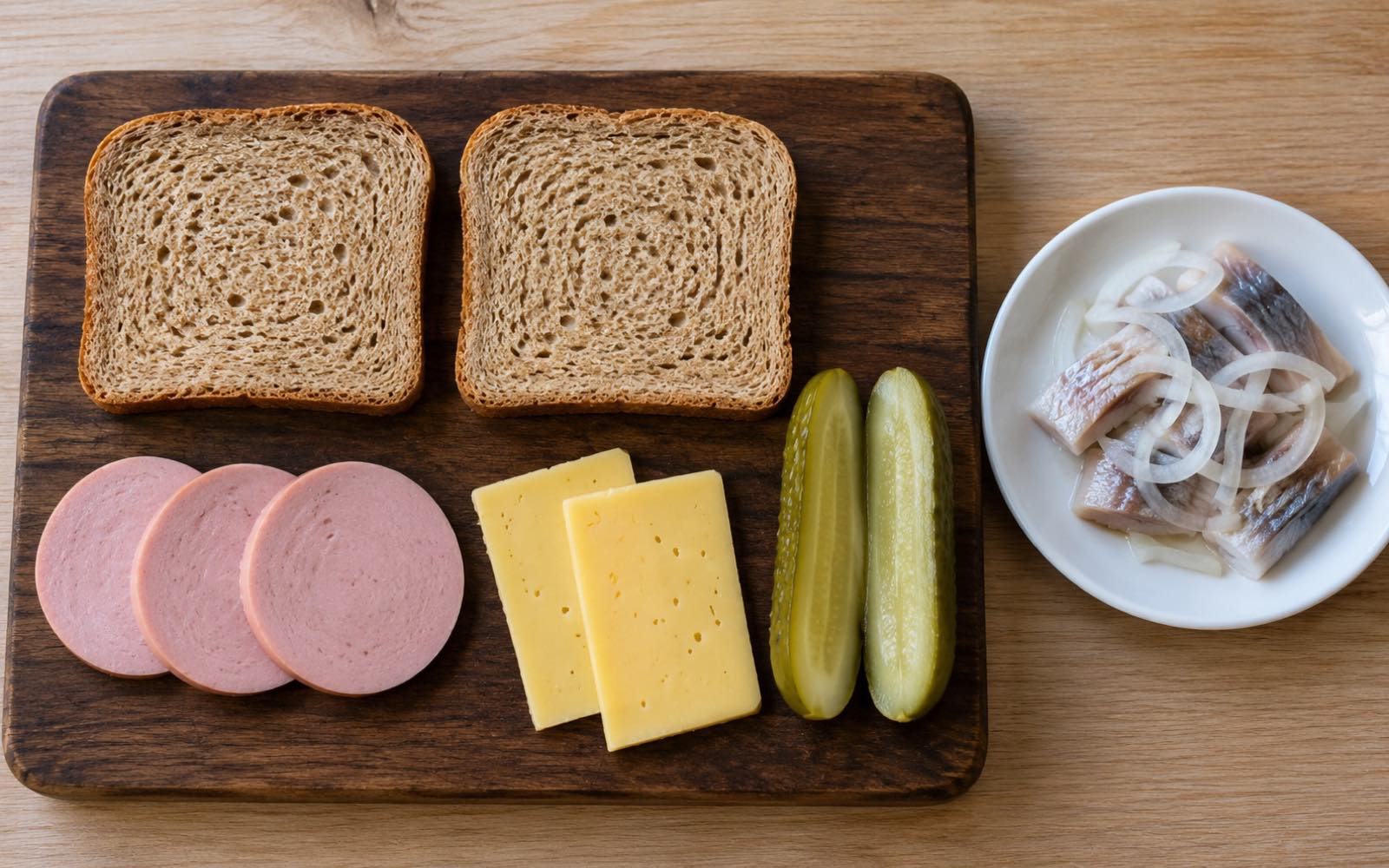
An everyday sandwich. Two slices of white bread, three rounds of Doktorskaya sausage and two slices of cheese come to 0.75 + 1.24 + 0.61 = 2.6 g of salt, more than half the daily limit. And you haven't even picked up the salt shaker.
A normal day without the salt shaker. Using the same table, we put together a day that many people will recognize:
- breakfast: 2 eggs, 2 slices of bread and 2 slices of cheese: 1.7 g;
- lunch: a bowl of borscht and 2 slices of bread: 2.7 g;
- snack: two milk hot dogs: 2.0 g;
- dinner: a plate of pelmeni with a tablespoon of mayonnaise, about 15 g: 2.9 g.
That's about 9.4 g in total, nearly double the 5 g limit, without a single pinch from the shaker. Our estimate lines up well with the 11.35 g reported by Rosstat.
Where there's little salt. Fresh, simple foods: cottage cheese, kefir, eggs, fresh fish, grains and potatoes, as long as you haven't salted them while cooking. Raw potatoes, according to the Federal Research Center's database, have just 5 mg of sodium per 100 g, about 0.01 g of salt. The WHO specifically lists sauces and seasonings, such as soy sauce and fish sauce, among the main sources of sodium, so dressings count too.
The more packaged sausages, ready meals and snacks you eat, the more salt piles up without you noticing. How to spot these foods from the ingredient list in a few seconds is covered in our guide to ultra-processed food.
How to tell from the label whether a food is high in salt
High salt means 1.75 g or more per 100 g of food, low salt means up to 0.3 g, and for bread the cut-offs are 1.2 g and 0.5 g.
These are the thresholds of Russia's "Traffic Light" guidelines, Rospotrebnadzor's MR 2.3.0122-18 on color-coded food labels, adopted in 2018. They're calculated per 100 g or 100 ml, so you can compare products regardless of the serving size printed on the pack. Even if you shop in the US or the UK, they make a handy yardstick:
- green zone, low salt: up to 0.3 g of salt or up to 0.12 g of sodium per 100 g;
- amber zone, medium: 0.3 to 1.75 g of salt or 0.12 to 0.7 g of sodium;
- red zone, high salt: from 1.75 g of salt or from 0.7 g of sodium;
- bread has its own cut-offs: green up to 0.5 g of salt, red from 1.2 g.
If the pack lists sodium, multiply it by 2.5. For example, "sodium 0.8 g per 100 g" on a pack of hot dogs means 2 g of salt, which puts it in the red zone.
Plain white pan bread, according to the Federal Research Center's database, has 1.25 g of salt per 100 g. For bread, that's already in the red zone. It doesn't taste salty, but people eat it every day and in large amounts, and according to the Federal Research Center of Nutrition, bread supplies 27% of Russians' salt. Borodinsky rye bread, at 0.6 g per 100 g, lands in the amber zone with half the salt.
On US packaged food, sodium is also shown as a percentage of the Daily Value. Under the FDA's rule of thumb, 5% DV or less per serving is low and 20% DV or more is high. Keep in mind that the percentage is per serving, and serving sizes on US labels can be smaller than what you actually eat.
look at salt per 100 g, because serving sizes on packs can be anything. Treat everything above 1.75 g as a guest food: a couple of times a week instead of a daily sandwich. Anything under 0.3 g you don't need to count at all. It takes a couple of seconds at the shelf, and it puts you in control of the part of your salt intake that's the biggest for most people.
How salt affects blood pressure
When you eat less salt, your blood pressure goes down, and this has been tested in randomized trials: people ate an average of 4.4 g less salt a day for a month or longer, and systolic pressure in people with hypertension fell by an average of 5.4 mm Hg.
The mechanism is simple. Sodium holds on to water: the more sodium in your blood, the more fluid your body keeps and the harder your blood presses on your vessel walls. Over time, high blood pressure strains the heart, the blood vessels in the brain and the kidneys. The WHO links excess sodium to 1.7 million deaths a year, based on its estimate for 2023.
The 2013 Cochrane review. He, Li and MacGregor pooled 34 randomized trials with 3,230 participants in which salt was cut for at least 4 weeks. On average, people ate 4.4 g less salt a day, and systolic pressure fell by 4.2 mm Hg and diastolic by 2.1. The effect was stronger in people with hypertension: minus 5.4 and 2.8 mm Hg. In people with normal blood pressure it was weaker: minus 2.4 and 1.0. Every 6 g of salt a day removed from the diet brought systolic pressure down by 5.8 mm Hg. The drop was clear in both men and women.
The more you cut, the bigger the effect. A 2020 meta-analysis by Huang and colleagues looked at how the benefit depends on the dose. It included 133 studies and 12,197 people, and salt intake was measured with 24-hour urine collection, the most accurate method. Every 50 mmol less sodium, about 2.9 g of salt, lowered systolic pressure by 1.1 mm Hg. With the same reduction, blood pressure fell more in older people and in people who started with higher pressure.
The same analysis holds a detail that's useful in practice. In trials lasting up to 15 days, systolic pressure dropped by 1.05 mm Hg, less than half the effect seen in longer trials (2.13 mm Hg). If you cut salt for a week and saw no difference on your blood pressure monitor, that's normal: you need a month or more.
What this means after 40 and 50. The limit stays at 5 g, but you get more out of cutting salt, because blood pressure in older people responds to salt more strongly. If your blood pressure is already high and you train, what you can do in the gym and what's better to avoid is covered in our guide to exercising with high blood pressure.
Puffiness and jumps on the scale. After a salty dinner your body holds on to water, and in the morning the scale reads higher than usual. That's water, and it goes away in a day or two. Why this happens and how to weigh yourself properly is explained in why your weight fluctuates.
Salt during workouts and in the heat: how much you lose in sweat
In an hour of training you lose anywhere from 0.6 to 8 g of salt in sweat. It all depends on how much you sweat and how salty your sweat is.
Athletes usually sweat 0.5–2 L (17–68 fl oz) an hour, and more than 3 L is rare, seen in about 2% of athletes. Sodium in whole-body sweat usually runs from 10 to 70 mmol per liter. Lindsay Baker gave these ranges in a 2017 review. Spanish researchers led by Lara split marathon runners into three groups in 2017: "low-salt" sweat under 30 mmol/L, typical sweat at 30–60 and "salty" sweat at 60 or above. We took one number for each group and worked out how much salt leaves in an hour.
Here's the math: liters of sweat × mmol of sodium per liter × 23 mg = milligrams of sodium, then × 2.5 = grams of salt. In brackets is the share of the 5 g daily limit.
| Sweat per hour | Low-salt sweat, ~20 mmol/L | Typical sweat, ~45 mmol/L | Salty sweat, ~70 mmol/L |
|---|---|---|---|
| 0.5 L (17 fl oz): an easy session in a cool gym | 0.6 g (12%) | 1.3 g (26%) | 2.0 g (40%) |
| 1.0 L (34 fl oz): running or a team game, how marathoners sweated at 24 °C (75 °F) | 1.2 g (23%) | 2.6 g (52%) | 4.0 g (80%) |
| 1.5 L (51 fl oz): hard training in the heat | 1.7 g (35%) | 3.9 g (78%) | 6.0 g (121%) |
| 2.0 L (68 fl oz): top of the normal range | 2.3 g (46%) | 5.2 g (104%) | 8.1 g (161%) |
How to find your row. Weigh yourself without clothes before and after a workout and add whatever you drank in between: 1 kg (2.2 lb) of lost weight is roughly 1 L of sweat. If your dark T-shirt has white streaks after training, that's salt from your sweat, and your sweat is probably on the salty side.
By sport. Barnes and colleagues in 2019 gathered data from 1,303 athletes tested between 2000 and 2017 and calculated how much sweat and sodium they lose per hour. We converted the sodium into salt:
| Sport | Sweat, L/h | Sodium, mg/h | Salt, g/h | Salt in 90 minutes | Share of 5 g |
|---|---|---|---|---|---|
| Endurance: running, cycling, triathlon | 1.28 | 1,189 | 3.0 | 4.5 g | 89% |
| American football | 1.51 | 1,286 | 3.2 | 4.8 g | 96% |
| Soccer | 0.94 | 796 | 2.0 | 3.0 g | 60% |
| Basketball | 0.95 | 794 | 2.0 | 3.0 g | 60% |
| Baseball | 0.83 | 626 | 1.6 | 2.3 g | 47% |
Salty sweat does show up in the blood. In Lara's study, marathoners with salty sweat had lower blood sodium after the finish than the others: 140.8 versus 142.5 mmol/L. It didn't drop to a dangerous level in anyone, so there's no reason to panic, but on long races these people need salt more than others do.
What this means for you. A typical hour in the gym costs you about 0.6–2.6 g of salt. If you eat like most people, 8–11 g a day or more, you don't need to add anything: your next meal will cover the losses with room to spare. The table shows that by the 90-minute mark, many people's losses get close to a whole day's limit. So it's worth replacing salt on purpose if:
- your session lasts longer than 60–90 minutes in the heat: a long run, a bike ride, a soccer match, a hike;
- you train twice a day;
- your sweat is salty and leaves white streaks on your clothes;
- you live or train in a hot climate;
- you follow a strict low-salt diet and sweat a lot.
Drinking liters of plain water during that kind of session is also a bad idea, because it dilutes the sodium in your blood. How much to drink and how not to overdo it is covered in how much water to drink a day. A simple drink made from water, salt, sugar and lemon is in our homemade electrolyte drink recipe.
If you log your food in the Sportygram diary at go.sportygram.com (the interface is in Russian for now), you can track water there on hot days alongside calories, protein, fat and carbs. If it's too hot outside for a planned run, Alex, the virtual trainer in the app's chat, can move the workout to another day; he also speaks only Russian. The diary doesn't count salt or sodium yet, so estimate your salt with the tables in this article.
Can you cut out salt completely?
You can't live without sodium at all, but almost nobody eats dangerously little of it: your body needs about 1,300 mg of sodium a day, which is 3.3 g of salt, and ordinary food covers that even without a salt shaker.
Look at the normal day from section 04: without a single pinch from the shaker, it came to 9.4 g of salt. Even if you stop salting food altogether, bread, cheese, dairy and sausage will bring in their share. EFSA in 2019 named 2 g of sodium a day a safe and adequate intake, and the WHO advises no more than that.
Can too little salt hurt you? This is debated because of a large observational study called PURE. O'Donnell and colleagues in 2014 estimated sodium intake in 101,945 people from 17 countries using a single morning urine sample. The average came out at 4.93 g of sodium a day. Deaths and cardiovascular events were lowest in people getting 3–6 g of sodium (7.5–15 g of salt). Risk was higher both at 7 g of sodium or more and below 3 g.
Draw conclusions from this carefully. It was an observational study with no experiment, and a single urine sample says little about how much a person usually eats. A study like this can't prove cause and effect, and the WHO recommendation in 2026 stayed the same: less than 2 g of sodium a day. The blood pressure trials from section 06, where salt was deliberately cut, show a benefit.
Who shouldn't cut salt sharply. People who train for long stretches in the heat and sweat heavily, especially with salty sweat (section 07). And people whose doctor has set a specific plan for medical reasons: that plan comes before general guidelines.
How to eat less salt without suffering
The easiest way to drop 2–3 g of salt a day is through ready-made food: less sausage, fewer hot dogs and less salted fish, more home cooking and salt added at the end.
Here's what simple swaps give you, based on the table in section 04:
- a morning sandwich with Doktorskaya sausage and cheese (2.6 g) swapped for 200 g (7 oz) of cottage cheese with berries (0.2 g): minus 2.4 g;
- two milk hot dogs (2.0 g) swapped for two eggs (0.4 g): minus 1.6 g;
- two slices of white wheat bread (0.75 g) swapped for two slices of Borodinsky rye (0.4 g): minus 0.35 g;
- 50 g (1.8 oz) of salted herring (6.0 g) swapped for 150 g (5.3 oz) of fresh cod (0.2 g): minus 5.8 g.
One or two swaps like these a day move you from 9–11 g toward 5 g, and you don't have to weigh anything.
Steps that work without counting:
- Red zone foods aren't for every day. Keep sausages, hot dogs, salted fish, pickles and store-bought dumplings on the menu a couple of times a week.
- Count your bread. Two slices of white wheat bread hold 0.75 g of salt, and if bread shows up three times a day, that's more than 2 g.
- Salt at the end. Taste the dish before you salt it and add salt at the end of cooking: that makes it easier not to overdo it.
- Take the shaker off the table. In Russia, 40.5% of people add salt to cooked food, and that salt doesn't even show up in the national statistics.
- Sauces are salt too. The WHO lists soy sauce and fish sauce among the main sources of sodium, so pour them sparingly.
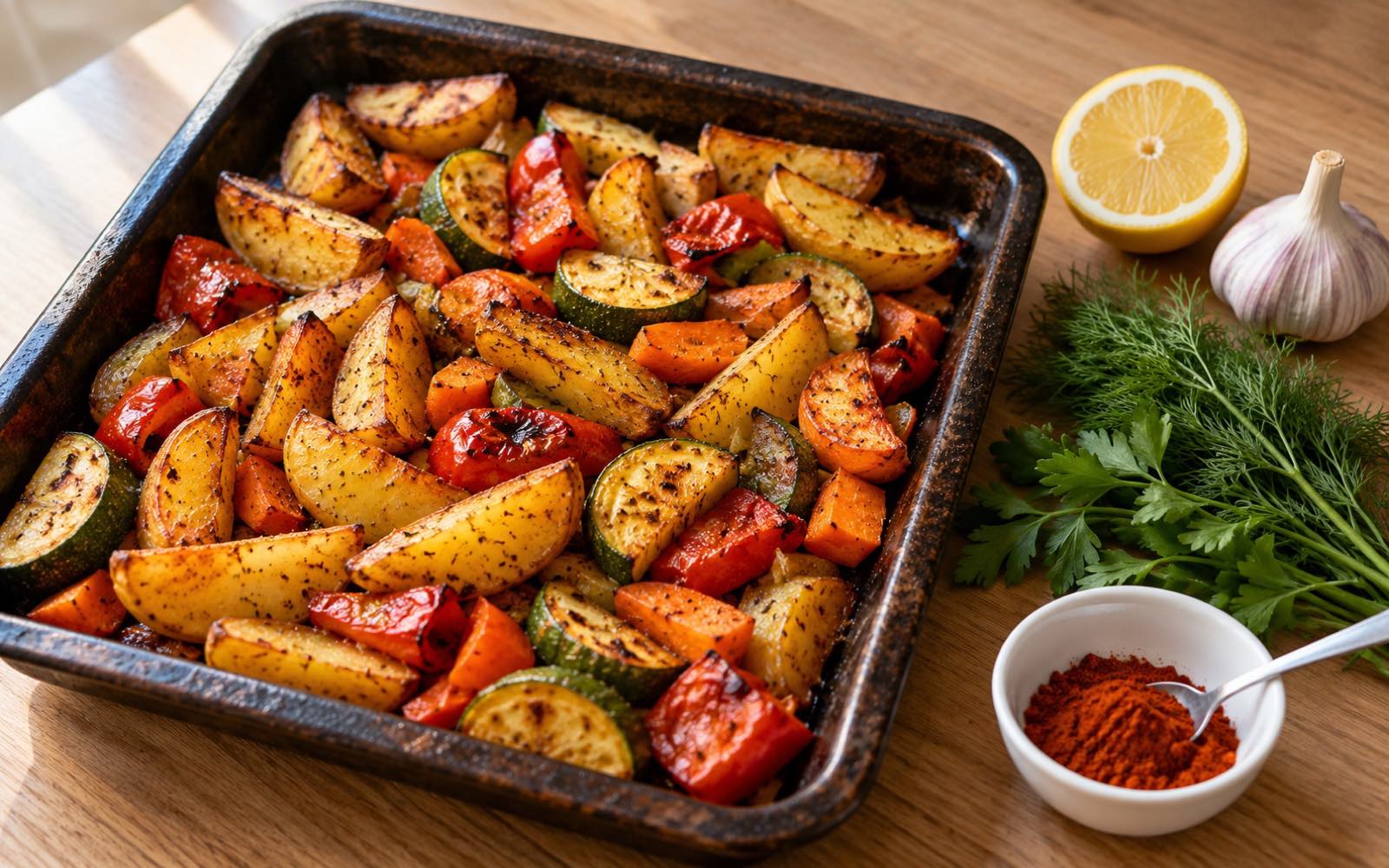
- Get flavor elsewhere. Lemon, vinegar, garlic, fresh herbs, black pepper and smoked paprika give food a bright taste, and you need less salt.
Your taste adjusts, but not right away. In a 1982 experiment by Bertino, Beauchamp and Engelman, young adults ate a low-salt diet for five months. Gradually, crackers started to taste saltier to them, and the level of saltiness they liked most in soup and crackers went down. In the control group, which ate as usual, nothing changed. The experiment ran for months, so don't expect a shift within a week. But it does come, and food that used to seem normal eventually starts to taste oversalted.
Potassium as a counterweight. Russia's nutrition standards MR 2.3.1.0253-21 set adult potassium intake at 3,500 mg a day and note that this level is good for blood pressure. There's plenty of potassium in vegetables, potatoes, beans, fruit and leafy greens. A side of baked potatoes or beans instead of dumplings helps twice: it takes out salt and adds potassium.
Potassium salt substitutes. In January 2025 the WHO issued a separate guideline: if you salt your food, you can replace regular salt with a lower-sodium salt in which part of the sodium is swapped for potassium. The recommendation is conditional, which means the WHO suggests it without insisting. It's based on 26 randomized trials with 34,961 adults.
The largest trial of this kind of salt is SSaSS, published by Neal and colleagues in 2021. It included 20,995 people from 600 villages in China who had either had a stroke or were over 60 with high blood pressure. The villages were randomly split into two groups, and one group was given salt made of 75% sodium chloride and 25% potassium chloride. Over 4.7 years, that group had 14% fewer strokes, 13% fewer major cardiovascular events and 12% fewer deaths from any cause. Dangerously high blood potassium didn't become more common: 3.35 versus 3.30 cases per 1,000 person-years.
Potassium salt isn't for everyone. The WHO explicitly excludes pregnant women, children and people with kidney disease or other conditions in which the body struggles to clear potassium. If you take blood pressure or heart medication, talk to your doctor before switching.
Make your salt iodized. The WHO says all salt people eat should be iodized, because iodine is needed for brain development. ROPNIZ has a slogan for it: "Less salt, but iodized salt!" Less salt and iodine don't get in each other's way: just make the salt you do add iodized.
When your doctor should set your salt intake
If you have kidney disease, heart failure, high blood pressure treated with medication, or you're pregnant, your doctor decides how much salt you should eat and whether a potassium substitute is OK.
- Kidney disease. Your kidneys may clear potassium less well, so the WHO guideline on potassium salt doesn't apply. How much sodium is OK depends on the stage of the disease.
- High blood pressure. ROPNIZ advises no more than 5 g of salt and more potassium. The specific target, and how it fits with your medication, is something to discuss at an appointment.
- Pregnancy and breastfeeding. According to EFSA, the same 2 g of sodium as other adults is enough. The WHO guideline on potassium salt doesn't cover pregnancy.
- Children. The WHO advises reducing the adult limit for children aged 2–15 in proportion to their energy needs; the numbers by age are in the questions below.
See a doctor if you get swelling every day, if your home blood pressure readings come out higher than usual several times in a row, or if you feel weak and dizzy after cutting salt sharply. Your doctor will work out what's going on and tell you how much salt is right for you.
Questions and answers
How many grams of salt are in a teaspoon?
The WHO describes 5 g of salt as "just under a teaspoon", and ROPNIZ calls it one level teaspoon. The FDA says 2,300 mg of sodium, about 5.75 g of salt, is "about 1 teaspoon". The exact number depends on the spoon, the grind and whether the spoon is heaped: fine salt packs more densely than coarse salt. The most reliable way is to weigh your own spoon once on a kitchen scale, so you know how many grams actually go into the pot.
How much salt can women and men have?
The limit is the same: up to 5 g of salt a day, less than 2,000 mg of sodium. Neither the WHO nor EFSA splits it by sex. In practice, men eat more salt almost everywhere: in the 2023 review by Kwong and colleagues, that was true in 52 of the 53 countries of the WHO European Region. For women who are pregnant or breastfeeding, EFSA recommends the same 2 g of sodium.
How much salt is OK after 40 or 50, and for older adults?
The limit is still 5 g. The difference is that cutting back pays off more with age: in the 2020 meta-analysis by Huang and colleagues, the same reduction in salt lowered blood pressure more in older people. According to ROPNIZ, Russians over 65 eat about 9.6 g of salt a day, so almost everyone has room to cut. If your blood pressure is already high or you take medication, agree on a specific target with your doctor.
How much salt can you have with high blood pressure?
No more than 5 g a day, and within that limit, less is better for your blood pressure: that's the advice of ROPNIZ in its 2021 guidelines and of the WHO. Huang's 2020 meta-analysis showed that blood pressure drops more the more salt you remove. ROPNIZ also recommends more potassium for people with hypertension. If you take blood pressure medication, use potassium salt only after talking to your doctor.
Are sea salt and pink Himalayan salt healthier than regular salt? What about the "pink salt trick"?
Essentially, they're the same sodium chloride. Fayet-Moore and colleagues in 2020 tested 31 samples of pink salt: to get a meaningful amount of minerals from it, you'd have to eat more than 30 g a day, six times the daily limit. One sample had more lead than the permitted level. The "pink salt trick" that went viral on social media is a glass of water with that salt and lemon on an empty stomach. There's no evidence it helps you lose weight, and the salt in it counts toward the same 5 g.
Should you add salt to your food if you train a lot?
Usually not. An hour in the gym costs you about 0.6–2.6 g of salt, while people eat 8–11 g or more on average, so ordinary food covers the losses. Adding salt and drinking salted water makes sense for sessions longer than an hour and a half in the heat, for twice-a-day training and if your sweat is salty. The tables in section 07 will help you estimate your own losses.
Why do you get thirsty and puffy after salty food?
After a salty dinner your body holds on to water, so your face may look puffy in the morning and the scale may read higher than usual. That's water, and it's gone in a day or two. In a long experiment by Rakova and colleagues from 2017, ten men lived through two simulated space flights lasting 105 and 205 days, and adding 6 g of salt a day actually made them drink less: their bodies conserved water and produced more concentrated urine. You may feel thirsty after salty food, but over the longer run your body holds on to water by itself. If you get swelling every day, especially in your legs by evening, see a doctor.
How much salt should a child have?
The WHO advises reducing the adult limit for children aged 2–15 in proportion to their energy needs. EFSA in 2019 set safe and adequate sodium intakes for children, which in salt terms are: about 2.75 g at ages 1–3, about 3.25 g at ages 4–6, about 4.25 g at ages 7–10, and 5 g at ages 11–17, the same as adults. Two milk hot dogs hold 2 g of salt, almost three quarters of that amount for a three-year-old.
The bottom line
- An adult can eat up to 5 g of salt a day, which is less than 2,000 mg of sodium and just under a teaspoon. US guidelines allow up to 2,300 mg of sodium, about 5.75 g of salt. Your body needs about 3.3 g.
- To turn sodium on a label into salt, multiply it by 2.5.
- Americans eat about 8.5 g of salt a day and Russians 11–15 g. Most of it comes from processed meat, bread, dairy, fish products and restaurant food, and the salt shaker supplies the smaller share.
- Under Russia's "Traffic Light" guidelines, high salt means 1.75 g or more per 100 g and low salt means up to 0.3 g; for bread, 1.2 g and 0.5 g. On US labels, 20% DV of sodium or more per serving is high.
- Eating 4.4 g less salt a day lowers systolic blood pressure in people with hypertension by an average of 5.4 mm Hg, and the effect grows with age.
- A typical hour of training costs 0.6–2.6 g of salt; adding salt makes sense for sessions longer than an hour and a half in the heat and if your sweat is salty.
- Your taste gets used to less salt over months; acid, spices and potassium help. The WHO suggests potassium salt for adults, except pregnant women and people with kidney disease.
Checklist: a week of eating less salt
- Weigh a teaspoon of your salt on a kitchen scale.
- Add up one normal day using the table in section 04.
- Replace one daily red zone food: swap the sausage sandwich for cottage cheese or eggs.
- Salt at the end of cooking and take the shaker off the table.
- Eat vegetables, potatoes, beans or fruit every day for potassium.
- Buy iodized salt.
- In hot weather, weigh yourself before and after a long workout to find out how much you lose.
- If your blood pressure is high, measure it for a week before making changes and again a month later: short experiments underestimate the effect.
Sources
- WHO. Sodium reduction (fact sheet), 2026. — Less than 2,000 mg of sodium (5 g of salt) a day; a global average of 4,278 mg; 1.7 million deaths in 2023; sources of sodium; iodized salt; limits for children.
- Rospotrebnadzor. MR 2.3.1.0253-21 "Norms of physiological requirements for energy and nutrients for various population groups of the Russian Federation", 2021 (in Russian). — Adult need for sodium 1,300 mg and for potassium 3,500 mg a day; no more than 2 g of sodium a day from food.
- Rospotrebnadzor. MR 2.3.0122-18 "Color coding on food labels to inform consumers", 2018 (in Russian). — Thresholds per 100 g: green zone up to 0.3 g of salt, red from 1.75 g; for bread 0.5 g and 1.2 g; less than 5 g of salt a day; shares of salt by food group.
- Drapkina O. M., Karamnova N. S., Kontsevaya A. V. et al. Diet-related risk factors for chronic noncommunicable diseases and eating habits: dietary correction within preventive counseling. Guidelines. Cardiovascular Therapy and Prevention, 2021 (in Russian). — No more than 5 g of salt a day, one level teaspoon; Russians ate about 10 g in 2013 and 11.35 g in 2018 (Rosstat) not counting salt added at the table, 40.5% add salt to cooked food; sources of salt; 75% of salt hidden in processed foods; the UK and US use a 6 g guide.
- Federal Research Center of Nutrition and Biotechnology. Database "Chemical composition of foods used in the Russian Federation" (in Russian). — Sodium per 100 g of food (values taken on September 24, 2026); the basis for our serving table and sample day.
- Kwong E. J. L., Whiting S., Bunge A. C. et al. Population-level salt intake in the WHO European Region in 2022: a systematic review. Public Health Nutrition, 2023. — Salt above 5 g in 52 of 53 countries, men eat more than women, highest in Eastern Europe and Central Asia; 14.87 g a day for Russia.
- Harnack L. J., Cogswell M. E., Shikany J. M. et al. Sources of Sodium in US Adults From 3 Geographic Regions. Circulation, 2017. — 450 adults: the salt shaker supplied 10.5% of sodium, food prepared outside the home 70.9%.
- He F. J., Li J., MacGregor G. A. Effect of longer term modest salt reduction on blood pressure: Cochrane systematic review and meta-analysis of randomised trials. BMJ, 2013. — 34 trials, 3,230 people: 4.4 g less salt a day lowers blood pressure, by 5.4/2.8 mm Hg in people with hypertension.
- Huang L., Trieu K., Yoshimura S. et al. Effect of dose and duration of reduction in dietary sodium on blood pressure levels: systematic review and meta-analysis of randomised trials. BMJ, 2020. — 133 studies, 12,197 people: the more salt removed, the lower the blood pressure, with bigger effects in older people and those with high blood pressure.
- EFSA Panel on Nutrition, Novel Foods and Food Allergens. Dietary reference values for sodium. EFSA Journal, 2019. — 2 g of sodium a day is safe and adequate for adults, including during pregnancy and breastfeeding; values for children by age.
- FDA. Sodium in Your Diet, 2024. — Less than 2,300 mg of sodium a day, "about 1 teaspoon of table salt"; Americans average about 3,400 mg; over 70% comes from packaged and prepared foods; 5% DV per serving is low, 20% is high.
- Baker L. B. Sweating Rate and Sweat Sodium Concentration in Athletes: A Review of Methodology and Intra/Interindividual Variability. Sports Medicine, 2017. — Sweat rates usually 0.5–2 L an hour, whole-body sweat sodium 10–70 mmol/L.
- Barnes K. A., Anderson M. L., Stofan J. R. et al. Normative data for sweating rate, sweat sodium concentration, and sweat sodium loss in athletes: An update and analysis by sport. Journal of Sports Sciences, 2019. — 1,303 athletes: sweat and sodium losses per hour by sport.
- Lara B., Salinero J. J., Areces F. et al. Sweat sodium loss influences serum sodium concentration in a marathon. Scandinavian Journal of Medicine & Science in Sports, 2017. — 51 marathoners at 24.4 °C: low-salt, typical and salty sweat; the salty sweaters had lower blood sodium after the finish.
- O'Donnell M., Mente A., Rangarajan S. et al. Urinary sodium and potassium excretion, mortality, and cardiovascular events. New England Journal of Medicine, 2014. — The PURE observational study, 101,945 people: higher risk at both very high and low sodium; cause and effect not proven.
- Bertino M., Beauchamp G. K., Engelman K. Long-term reduction in dietary sodium alters the taste of salt. American Journal of Clinical Nutrition, 1982. — After 5 months of low-salt eating, the most-liked level of saltiness went down.
- WHO. Use of lower-sodium salt substitutes: WHO guideline, 2025. — A conditional recommendation to replace regular salt with potassium salt; not for pregnant women, children or people with kidney disease; 26 trials, 34,961 adults.
- Neal B., Wu Y., Feng X. et al. Effect of Salt Substitution on Cardiovascular Events and Death. New England Journal of Medicine, 2021. — SSaSS, 20,995 people: salt with 25% potassium chloride led to 14% fewer strokes and 12% fewer deaths over 4.7 years.
- Rakova N., Kitada K., Lerchl K. et al. Increased salt consumption induces body water conservation and decreases fluid intake. Journal of Clinical Investigation, 2017. — 10 men in simulated flights of 105 and 205 days: 6 g more salt a day reduced drinking as the body conserved water.
- Fayet-Moore F., Wibisono C., Carr P. et al. An Analysis of the Mineral Composition of Pink Salt Available in Australia. Foods, 2020. — 31 samples: pink salt's minerals only matter at 30 g a day or more; one sample had lead above the permitted level.
This article is for informational purposes only and is not a substitute for medical advice.