

lean meat, poultry and fish give the most protein per serving: 150 g (5.3 oz) of roasted chicken breast has 46.5 g. You get 20 g of protein from 65 g of roasted chicken breast, 120 g of 5% farmer's cheese, 115 g of firm tofu or 220 g of cooked lentils. Dry beans and grains show 2–3.5 times more protein per 100 g than cooked ones, so compare foods in the form you actually eat them.Active adults need 1.2–1.6 g of protein per kilogram of body weight a day, and 1.6–2.2 g (0.7–1 g per pound) with strength training or weight loss. At 70 kg (154 lb), that's 84–154 g. To work out your own number, see how much protein per day.
Meat, poultry, fish and hard cheese have the most protein: 19–36 g per 100 g (3.5 oz) of food as you eat it. Farmer's cheese has 15–16.5 g, hard-boiled eggs 12.6 g, cooked lentils, beans and chickpeas 8–9 g, cooked grains and pasta 3–6 g. But 100 g isn't a serving. That's why the charts below also show protein in a typical serving, the calories in that serving and protein per 100 calories, so you can see which foods give you protein without a lot of extra calories. At the end, you'll find three sample days with 100 g of protein.
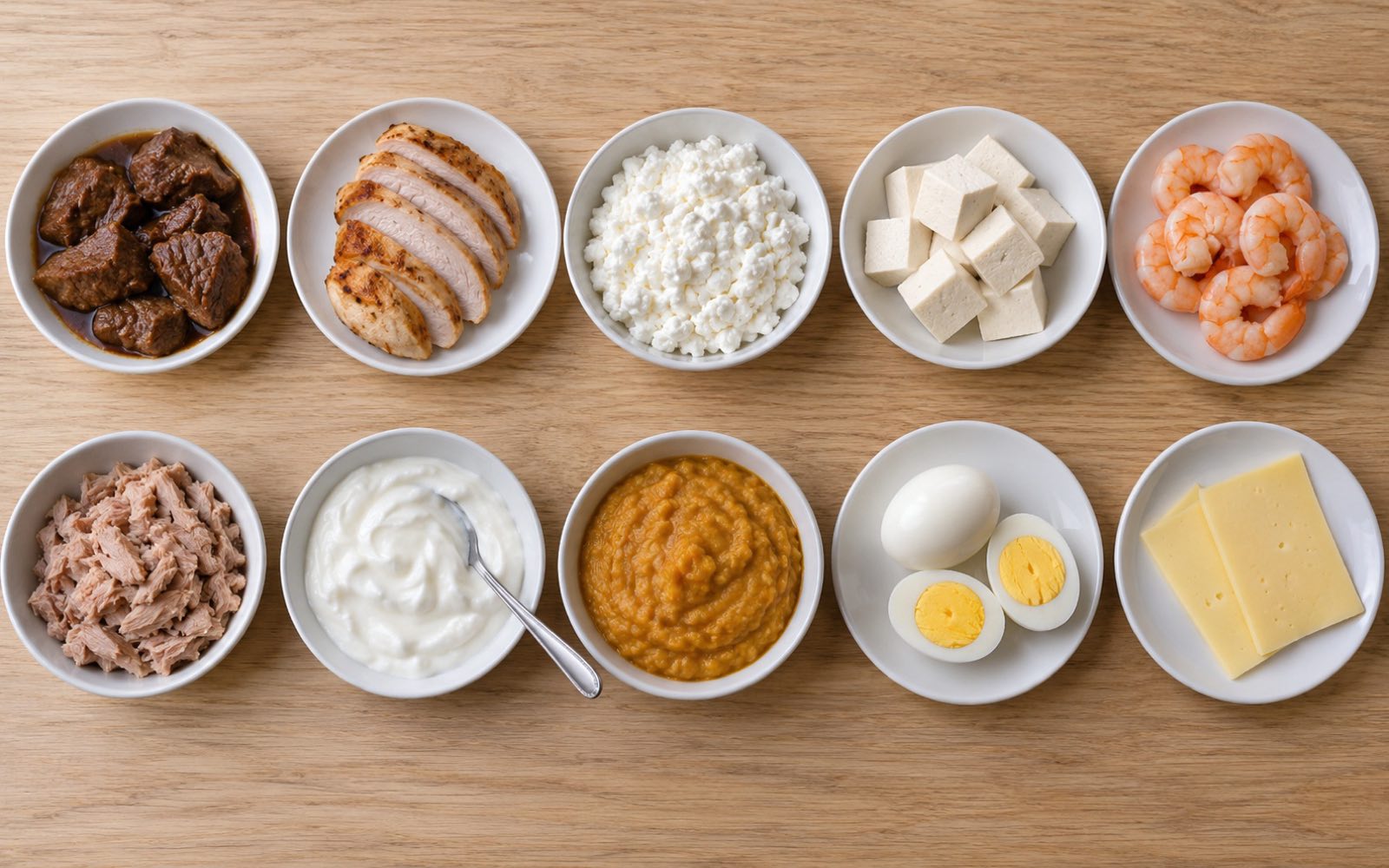
Ten common foods ranked by protein per typical serving:
| Food | Serving | Protein per serving | Calories per serving | Protein per 100 g |
|---|---|---|---|---|
| Lean beef, braised | 150 g (5.3 oz) | 52.1 g | 321 | 34.7 g |
| Skinless chicken breast, roasted | 150 g (5.3 oz) | 46.5 g | 248 | 31 g |
| Farmer's cheese (tvorog), 5% fat (Savushkin Khutorok) | 180 g (6.3 oz) pack | 29.7 g | 211 | 16.5 g |
| Firm tofu | 150 g (5.3 oz) | 25.9 g | 216 | 17.3 g |
| Shrimp, cooked, peeled | 100 g (3.5 oz) | 24 g | 99 | 24 g |
| Canned tuna, no oil (Fortuna) | half a can, 90 g (3.2 oz) | 21.7 g | 94 | 24.1 g |
| Greek yogurt, 0.1% fat (Venn's) | 210 g (7.4 oz) cup | 21 g | 116 | 10 g |
| Lentils, cooked | 200 g (7 oz) | 18 g | 232 | 9 g |
| Eggs, hard-boiled | 2 eggs, 100 g (3.5 oz) without shells | 12.6 g | 155 | 12.6 g |
| Semi-hard cheese, 50% fat in dry matter (Belebeevsky) | 2 slices, 30 g (1 oz) | 7.3 g | 106 | 24.5 g |
How to read the charts: per 100 g, per serving and per 100 calories
Each food-group chart has four number columns: protein per 100 g, protein per typical serving, calories per serving and protein per 100 calories. The last column is the most useful: the higher the number, the fewer calories come along with the protein.
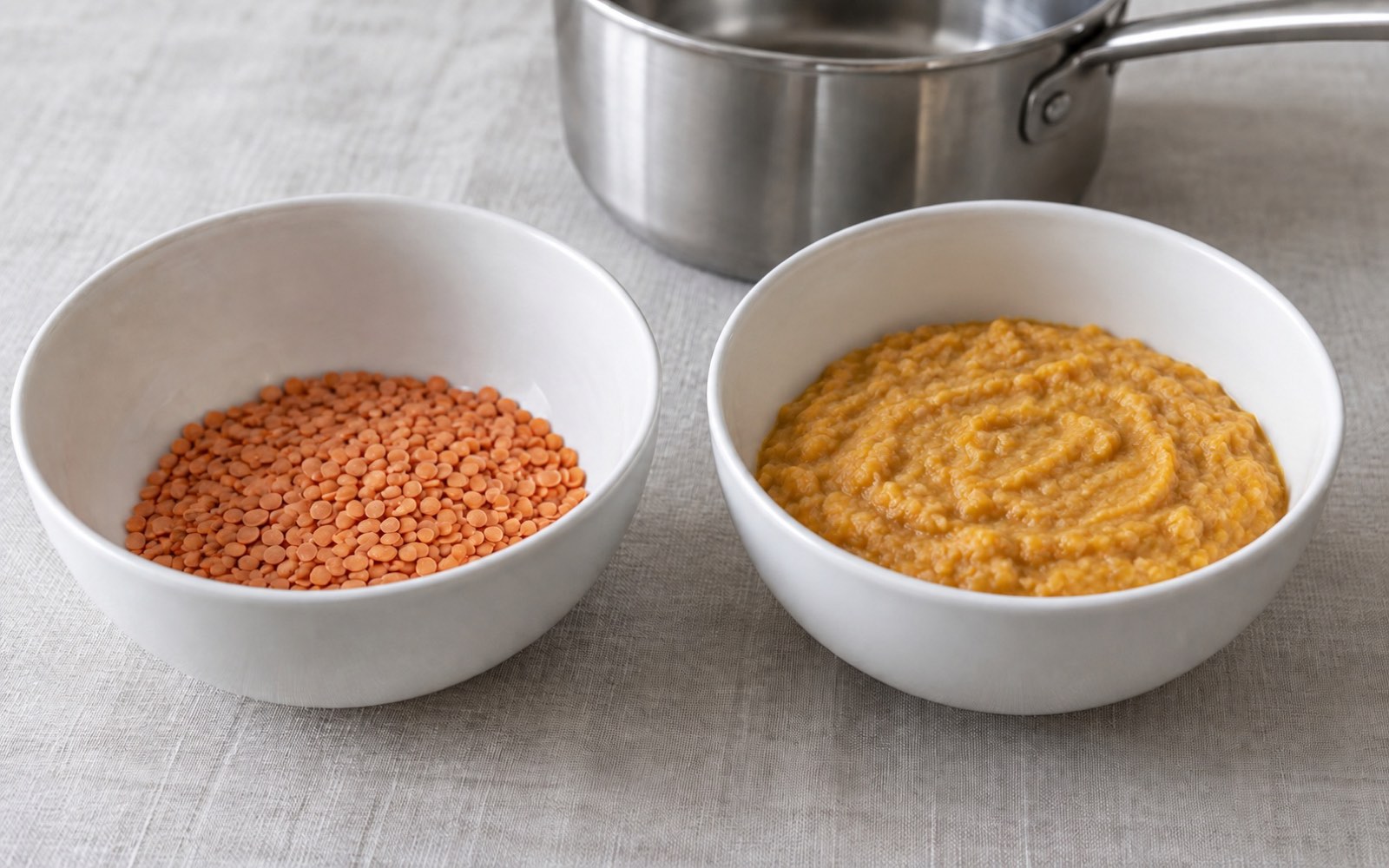
The biggest trap in protein charts is that they mix dry and cooked foods. Dry lentils have 24.6 g of protein per 100 g, and cooked lentils have 9 g. As they cook, lentils soak up water and get about 2.7 times heavier, but they don't gain any protein. Buckwheat has 11.7 g dry and 3.4 g cooked. Popular charts often put soy protein isolate and powdered egg at the top with 80–88 g of protein, but you can't make dinner out of them. In our charts, every row says whether the food is raw, dry or cooked.
Meat works the other way: it loses water as it cooks, so roasted chicken breast has more protein per 100 g than raw, 31 g versus 22.5 g. Weigh food in the same form as the number you're using.
Nuts show why the per-100-calories column matters. Roasted peanuts have 24.4 g of protein per 100 g, almost as much as chicken. But per 100 calories, peanuts give just 4.2 g, compared with 18.8 g for roasted chicken breast.
You can work out what protein costs right in the store: package price × 20 ÷ protein in the whole package. A 180 g pack of 5% farmer's cheese has 29.7 g of protein. If the pack costs, say, $3, then 20 g of protein costs 3 × 20 ÷ 29.7 ≈ $2.02. To build an affordable diet overall, see healthy eating on a budget.
Where the numbers come from. Basic foods come from the U.S. Department of Agriculture's food composition database. Rows with a brand in parentheses come from package labels in the Sportygram food diary database, which covers products sold in Russia. Restaurant dishes come from the chains' own nutrition data. Your package may show different numbers, so check the label.
Meat and poultry: how much protein is in chicken, beef and liver
All numbers, except the one raw chicken breast row, are for cooked meat without skin or visible fat.
| Food | Protein per 100 g | Serving | Protein per serving | Calories per serving | Protein per 100 calories |
|---|---|---|---|---|---|
| Skinless chicken breast, roasted | 31 g | 150 g (5.3 oz) | 46.5 g | 248 | 18.8 g |
| Skinless chicken breast, raw | 22.5 g | 200 g (7 oz), ≈ 145 g cooked | 45 g | 240 | 18.8 g |
| Skinless turkey breast, roasted | 30.1 g | 150 g (5.3 oz) | 45.1 g | 220 | 20.5 g |
| Skinless chicken thigh, roasted | 24.8 g | 150 g (5.3 oz) | 37.2 g | 268 | 13.9 g |
| Lean beef, braised | 34.7 g | 150 g (5.3 oz) | 52.1 g | 321 | 16.2 g |
| Ground beef, 90% lean, pan-browned | 28.4 g | 150 g (5.3 oz) | 42.6 g | 345 | 12.3 g |
| Pork tenderloin, roasted | 26.2 g | 150 g (5.3 oz) | 39.3 g | 214 | 18.3 g |
| Leg of lamb, lean only, roasted | 28.2 g | 150 g (5.3 oz) | 42.3 g | 270 | 15.7 g |
| Beef liver, braised | 29.1 g | 100 g (3.5 oz) | 29.1 g | 191 | 15.2 g |
| Chicken hearts, simmered | 26.4 g | 100 g (3.5 oz) | 26.4 g | 185 | 14.3 g |
| Chicken liver, simmered | 24.5 g | 100 g (3.5 oz) | 24.5 g | 167 | 14.7 g |
Per 100 calories, turkey (20.5 g), chicken breast (18.8 g) and pork tenderloin (18.3 g) come out on top. Thighs and ground beef give less protein for the same calories because they have more fat. That doesn't make them bad; if you're in a calorie deficit, just eat a slightly smaller serving.
Organ meats are underrated. Beef liver has 29.1 g of protein per 100 g, and chicken hearts have 26.4 g, no less than regular meat.
Fish and seafood: the most protein per calorie
Fish, shrimp and mussels give as much protein as meat, and lean fish beats even chicken breast on protein per 100 calories.
| Food | Protein per 100 g | Serving | Protein per serving | Calories per serving | Protein per 100 calories |
|---|---|---|---|---|---|
| Fresh tuna, baked | 29.2 g | 150 g (5.3 oz) | 43.8 g | 195 | 22.5 g |
| Pink salmon, baked | 24.6 g | 150 g (5.3 oz) | 36.9 g | 230 | 16.1 g |
| Shrimp, cooked, peeled | 24 g | 100 g (3.5 oz) | 24 g | 99 | 24.2 g |
| Trout, baked | 23.8 g | 150 g (5.3 oz) | 35.7 g | 252 | 14.2 g |
| Mackerel, baked | 23.8 g | 150 g (5.3 oz) | 35.7 g | 393 | 9.1 g |
| Mussels, cooked | 23.8 g | 100 g (3.5 oz) | 23.8 g | 172 | 13.8 g |
| Cod, baked | 22.8 g | 150 g (5.3 oz) | 34.2 g | 158 | 21.7 g |
| Sardines canned in oil, drained | 24.6 g | 100 g (3.5 oz) | 24.6 g | 208 | 11.8 g |
| Farmed salmon, baked | 22.1 g | 150 g (5.3 oz) | 33.1 g | 309 | 10.7 g |
| Alaska pollock, cooked | 19.4 g | 150 g (5.3 oz) | 29.1 g | 130 | 22.4 g |
Shrimp (24.2 g of protein per 100 calories), tuna (22.5 g), pollock (22.4 g) and cod (21.7 g) top this chart. A serving of pollock has 29 g of protein and only 130 calories.
Mackerel and farmed salmon give almost as much protein, but a serving has two to three times the calories of cod or pollock. That's the fat. There's no need to skip fatty fish; just log it in your food diary at its real weight.
Eggs and dairy: farmer's cheese, yogurt and cheese
Dairy products that look alike can have very different amounts of protein.
| Food | Protein per 100 g | Serving | Protein per serving | Calories per serving | Protein per 100 calories |
|---|---|---|---|---|---|
| Farmer's cheese (tvorog), 5% fat (Savushkin Khutorok) | 16.5 g | 180 g (6.3 oz) pack | 29.7 g | 211 | 14.1 g |
| Farmer's cheese (tvorog), 0.5% fat (Vkusnoteevo) | 15 g | 180 g (6.3 oz) | 27 g | 131 | 20.5 g |
| Greek yogurt, 0.1% fat (Venn's) | 10 g | 210 g (7.4 oz) cup | 21 g | 116 | 18.2 g |
| Skyr, 1.5% fat (Isey Skyr) | 11 g | 150 g (5.3 oz) cup | 16.5 g | 108 | 15.3 g |
| Greek yogurt, 2% fat (Teos) | 8 g | 140 g (4.9 oz) cup | 11.2 g | 94 | 11.9 g |
| Hard-boiled egg | 12.6 g | 1 egg without shell, 50 g | 6.3 g | 78 | 8.1 g |
| Egg white | 10.9 g | white of 1 egg, 33 g | 3.6 g | 17 | 21 g |
| Semi-hard cheese, 50% fat in dry matter (Belebeevsky) | 24.5 g | 2 slices, 30 g (1 oz) | 7.3 g | 106 | 6.9 g |
| Parmesan | 35.8 g | 20 g (0.7 oz) | 7.2 g | 78 | 9.1 g |
| Kefir, 1% fat (Korovka iz Korenovki) | 3 g | 250 g (1 cup) | 7.5 g | 90 | 8.3 g |
| Milk, 2.5% fat (Selo Zelyonoe) | 3 g | 250 ml (1 cup) | 7.5 g | 138 | 5.5 g |
A 180 g pack of farmer's cheese gives almost 30 g of protein, about as much as five eggs. But 5% farmer's cheese varies by brand: our food diary database has packs with 12 g of protein per 100 g and packs with 18 g. Regular American cottage cheese is wetter and has about 10–12 g per 100 g, roughly a third less.
One 50 g egg without the shell has 6.3 g of protein, and three eggs have almost 19 g. Skip the yolk, and you're left with 3.6 g of protein and 17 calories: almost half of an egg's protein is in the yolk. For how many eggs a day is fine, see how many eggs you can eat a day.
"Greek" on a yogurt label guarantees nothing: our database has both "Greek" yogurts with 10 g of protein per 100 g and ones with 2.8 g. Cheese is rich in protein but has even more fat, so semi-hard cheese gives only 6.9 g per 100 calories.
Plant protein: soy, beans, lentils, nuts and grains
If you don't eat meat, build your meals on soy, beans, lentils and seitan. Nuts, seeds, bread and grains fill in the rest.
| Food | Protein per 100 g | Serving | Protein per serving | Calories per serving | Protein per 100 calories |
|---|---|---|---|---|---|
| Soybeans, cooked | 18.2 g | 150 g (5.3 oz) | 27.3 g | 258 | 10.6 g |
| Firm tofu | 17.3 g | 150 g (5.3 oz) | 25.9 g | 216 | 12 g |
| Tempeh, cooked | 19.9 g | 100 g (3.5 oz) | 19.9 g | 195 | 10.2 g |
| Edamame (young soybeans), cooked | 11.9 g | 150 g (5.3 oz) | 17.9 g | 182 | 9.8 g |
| Seitan "Vega Chicken," ready to eat (Vysshiy Vkus) | 17.1 g | 100 g (3.5 oz) | 17.1 g | 222 | 7.7 g |
| Lentils, cooked | 9 g | 200 g (7 oz) | 18 g | 232 | 7.8 g |
| Chickpeas, cooked | 8.9 g | 200 g (7 oz) | 17.7 g | 328 | 5.4 g |
| Red kidney beans, cooked | 8.7 g | 200 g (7 oz) | 17.3 g | 254 | 6.8 g |
| Split peas, cooked | 8.3 g | 200 g (7 oz) | 16.7 g | 236 | 7.1 g |
| Pumpkin seeds, shelled | 30.2 g | a handful, 30 g (1 oz) | 9.1 g | 168 | 5.4 g |
| Peanuts, roasted | 24.4 g | a handful, 30 g (1 oz) | 7.3 g | 176 | 4.2 g |
| Almonds | 21.2 g | a handful, 30 g (1 oz) | 6.4 g | 174 | 3.7 g |
| Peanut butter | 22.2 g | 1 tablespoon, 16 g | 3.6 g | 96 | 3.7 g |
| Hummus | 7.8 g | 50 g (1.8 oz) | 3.9 g | 118 | 3.3 g |
| Soy milk | 3.3 g | 250 ml (1 cup) | 8.2 g | 135 | 6.1 g |
| Whole-grain bread | 12.4 g | 2 slices, 60 g | 7.4 g | 151 | 4.9 g |
| Rolled oats, dry | 13.2 g | 50 g (1.8 oz) | 6.6 g | 190 | 3.5 g |
| Pasta, cooked | 5.8 g | 200 g (7 oz) | 11.6 g | 316 | 3.7 g |
| Quinoa, cooked | 4.4 g | 200 g (7 oz) | 8.8 g | 240 | 3.7 g |
| Buckwheat, cooked | 3.4 g | 200 g (7 oz) | 6.8 g | 184 | 3.7 g |
| White rice, cooked | 2.7 g | 200 g (7 oz) | 5.4 g | 260 | 2.1 g |
Soybeans, tofu and tempeh lead with 20–27 g of protein per serving. Tofu varies a lot: our food diary database has both tofu with 8.7 g of protein per 100 g and tofu with 23 g. Soft tofu has less and firm tofu has more, so go by the number on the package.
Seitan is made from wheat gluten, so skip it if you can't eat gluten. Nuts and peanut butter are an add-on, not a base: a tablespoon of peanut butter has 3.6 g of protein and 96 calories.
The idea that plant protein is "incomplete" is a myth if you eat a varied diet. Grains are lower in some amino acids and beans in others, but your body puts them together from everything you eat over the day. You don't need to combine foods on one plate. And in a review of nine studies, soy protein paired with strength training produced the same gains in strength and muscle as whey and other animal proteins.
On a fully plant-based diet, you need vitamin B12: plants contain practically none. Get it from fortified foods or a supplement, and ask your doctor about the dose.
Packaged foods: how much protein you really get
A "protein" or "high protein" label doesn't mean the food is high in protein.
| Food | Protein per 100 g | Serving | Protein per serving | Calories per serving | Protein per 100 calories |
|---|---|---|---|---|---|
| Canned tuna chunks, no oil (Fortuna, 185 g can) | 24.1 g | half a can, 90 g (3.2 oz) | 21.7 g | 94 | 23.2 g |
| Canned pink salmon, no oil (Ultramarin, 240 g can) | 21 g | half a can, 120 g (4.2 oz) | 25.2 g | 166 | 15.2 g |
| Smoked cooked chicken breast (Magnit store brand) | 20 g | 100 g (3.5 oz) | 20 g | 118 | 16.9 g |
| Chopped chicken patty (Freshclub, 160 g) | 22 g | 1 pack, 160 g (5.6 oz) | 35.2 g | 496 | 7.1 g |
| High Protein pudding, 1.5% fat (Hyper, 200 g) | 10 g | 200 g (7 oz) cup | 20 g | 160 | 12.5 g |
| Strawberry protein bar (Bombbar, 60 g) | 33.3 g | 1 bar, 60 g | 20 g | 163 | 12.2 g |
| Champ banana protein bar (Leovit, 45 g) | 16.7 g | 1 bar, 45 g | 7.5 g | 160 | 4.7 g |
| Protein milk, 0.5% fat (Neo) | 5.3 g | 250 ml (1 cup) | 13.2 g | 112 | 11.8 g |
| Vienna hot dogs (Starodvorye) | 11 g | 100 g (3.5 oz) | 11 g | 170 | 6.5 g |
| Doktorskaya bologna-style sausage (Miratorg) | 12 g | 3 slices, 50 g | 6 g | 114 | 5.3 g |
| Imitation crab sticks (Vici, 220 g) | 6.6 g | 100 g (3.5 oz) | 6.6 g | 95 | 6.9 g |
Tuna canned without oil is the champion of the grocery aisle: 23.2 g of protein per 100 calories, almost as much as cooked shrimp. Canned pink salmon and smoked cooked chicken breast are good too, but with smoked meats, watch the salt.
A ready-made chicken patty gives 35 g of protein, but almost 500 calories come with it: it has 23 g of fat per 100 g. "Chicken" doesn't mean "light."
Two bars labeled "protein" are almost equal in calories and far apart in protein: 20 g versus 7.5 g. The second one is closer to candy: it has three times as many carbs as protein. To make sense of a protein bar label, see are protein bars good for you.
Imitation crab sticks have only 6.6 g of protein per 100 g, and 2.4 times as many carbs. Hot dogs and bologna have more fat than protein.
Restaurants and delivery: how much protein is in a dish
Restaurant chains in Russia list the weight of their dishes, so you don't have to guess the serving size. The dishes below come from those chains via our food diary database, sorted by protein per 100 calories.
| Dish | Serving | Protein per serving | Calories per serving | Protein per 100 calories |
|---|---|---|---|---|
| Chicken breast with lemon yogurt sauce (Coffeemania) | 270 g (9.5 oz) | 32.1 g | 224 | 14.3 g |
| Steamed salmon (Coffeemania) | 160 g (5.6 oz) | 32 g | 258 | 12.4 g |
| Assorted sashimi (Tanuki) | 230 g (8.1 oz) | 50.6 g | 446 | 11.3 g |
| Grilled chicken with roasted vegetables (Bushe) | 260 g (9.2 oz) | 33.8 g | 312 | 10.8 g |
| Protein shake with milk, large (Cofix) | 400 ml (13.5 fl oz) | 32.4 g | 304 | 10.7 g |
| Original chicken strips, 5 pieces (Rostic's) | 170 g (6 oz) | 35.9 g | 372 | 9.6 g |
| Braised beef with buckwheat and vegetables (Milti) | 350 g (12.3 oz) | 38.5 g | 420 | 9.2 g |
| Syrniki (farmer's cheese pancakes), 3 pieces (Drinkit) | 150 g (5.3 oz) | 20.1 g | 286 | 7 g |
| Omelet with tomatoes, ham and cheese (Teremok) | 190 g (6.7 oz) | 19.2 g | 300 | 6.4 g |
| Grand burger (Vkusno i Tochka) | 193 g (6.8 oz) | 29.9 g | 479 | 6.2 g |
| Pelmeni (meat dumplings), double serving (Teremok) | 300 g (10.6 oz) | 28.2 g | 591 | 4.8 g |
| Chicken Caesar salad (Tanuki) | 205 g (7.2 oz) | 28.7 g | 740 | 3.9 g |
The chicken breast at Coffeemania and the Caesar salad at Tanuki have almost the same protein: 32 g and 29 g. But the Caesar has 3.3 times the calories. It's all in the dressing, the croutons and the cheese.
The restaurant rule is simple. Order grilled or steamed meat, poultry or fish, or sashimi at a Japanese place, with vegetables or grains on the side. Breading, rich sauces and dough add calories without adding protein. More tips in eating out on a diet.
Chain menus change, so check the nutrition info at the restaurant before you order.
What 30 g of protein looks like on a plate
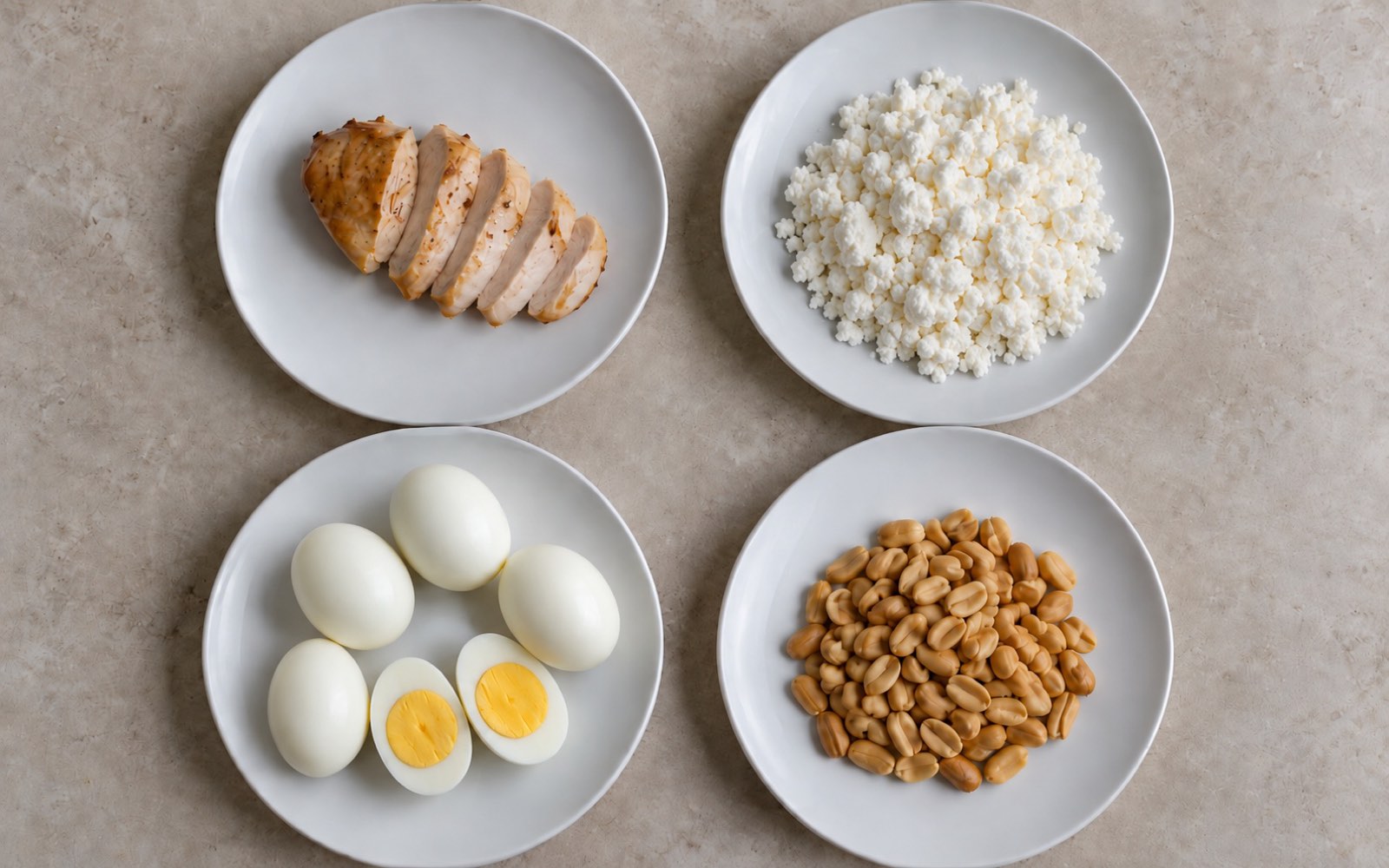
Thirty grams of protein is a good amount for one meal. Here's how different it can look:
- 100 g (3.5 oz) of roasted chicken breast: 31 g of protein, 165 calories.
- A 180 g pack of 5% farmer's cheese: 29.7 g of protein, 211 calories.
- 5 hard-boiled eggs: 31.5 g of protein, 388 calories.
- 120 g of firm tofu and 100 g of cooked lentils: 29.8 g of protein, 289 calories.
- 330 g of cooked lentils: 29.8 g of protein, 383 calories.
- 123 g of roasted peanuts: 30 g of protein, 722 calories.
- Almost 900 g (2 lb) of cooked buckwheat: 30 g of protein and more than 800 calories.
For the same protein, calories can differ almost fivefold. So build each plate around one food from the top of the charts, then add sides, bread or nuts.
keep a pack of farmer's cheese and a can of tuna at home. The whole pack plus half the can gives you 51 g of protein (29.7 g plus 21.7 g) with no cooking at all.
How to get 100 g of protein a day: three sample menus
For muscle growth with strength training, the key target is about 1.6 g per kilogram of body weight (about 0.7 g per pound): in a review of 49 studies, eating more protein than that didn't speed up muscle gains. For someone who weighs about 62 kg (137 lb), that's right around 100 g a day. Here are three days with about 100 g of protein, built from the numbers in the charts.
Day 1. Everyday food: 104.9 g of protein, 1,063 calories.
- Breakfast: 2 hard-boiled eggs and 2 slices of whole-grain bread, 20 g of protein.
- Lunch: 150 g of roasted chicken thigh and 200 g of cooked buckwheat, 44 g.
- Snack: a 140 g cup of 2% Greek yogurt, 11.2 g.
- Dinner: a 180 g pack of 5% farmer's cheese, 29.7 g.
Day 2. Fully plant-based: 107.4 g of protein, 1,672 calories.
- Breakfast: oatmeal made with 50 g of rolled oats and a cup of soy milk, plus a tablespoon of peanut butter, 18.4 g.
- Lunch: 200 g of cooked lentils, 2 slices of whole-grain bread and 50 g of hummus, 29.3 g.
- Snack: 150 g of edamame and a 30 g handful of pumpkin seeds, 27 g.
- Dinner: 150 g of firm tofu and 200 g of cooked buckwheat, 32.7 g.
Day 3. No cooking, all from the store: 107.8 g of protein, 978 calories.
- Breakfast: a 150 g cup of skyr, 2 slices of whole-grain bread and 2 slices of cheese, 31.2 g.
- Lunch: half a can of tuna with no oil and 2 slices of whole-grain bread, 29.1 g.
- Snack: a 200 g protein pudding, 20 g.
- Dinner: 100 g of smoked cooked chicken breast and a cup of 1% kefir, 27.5 g.
The calories here are below a full day's needs because only foods from the charts are counted. Add vegetables, fruit and oil to match your calorie target. To turn this into a shopping list, see your daily protein basket.
FAQ
What foods have the most protein?
Leaving out powders and bars, the top foods per 100 g are Parmesan (35.8 g), braised lean beef (34.7 g), roasted chicken breast (31 g), pumpkin seeds (30.2 g) and turkey (30.1 g). But you'll eat 20–30 g of cheese or seeds at a time, versus 150 g of meat. So per serving, meat, poultry and fish come out ahead.
How much protein is in 100 g of chicken, cottage cheese and eggs?
Roasted chicken breast has 31 g; raw has 22.5 g. Farmer's cheese (tvorog) with 5% fat has 15–16.5 g, and the label gives the exact number. Regular American cottage cheese has about 10–12 g. A hard-boiled egg has 12.6 g per 100 g, and one 50 g egg without the shell gives 6.3 g. A 180 g pack of farmer's cheese has almost as much protein as five eggs.
Why does one chart say lentils have 24 g of protein and another 9 g?
The first number is for dry lentils, the second for cooked. As lentils cook, they soak up water and get about 2.7 times heavier, but they don't gain protein. The same happens with chickpeas, beans and grains. Compare foods in the form you put them on your plate.
Does raw or cooked chicken breast have more protein?
Per 100 g, cooked has more: 31 g versus 22.5 g. But cooking doesn't create protein. The meat just loses water. About 200 g of raw fillet cooks down to roughly 145 g, and both hold about 45 g of protein. Log the weight in the same form as the number you use.
How do you calculate the cost of 20 g of protein?
First find the protein in the whole package: multiply protein per 100 g by the package weight in grams and divide by 100. Then multiply the package price by 20 and divide by that number. This compares foods fairly, not by price per pound. Prices vary from city to city, so use your own receipt.
Is animal or plant protein better?
For muscle, what matters most is how much protein you eat in a day. In a 2025 review, soy protein built the same muscle mass as milk protein, while rice, oat and potato proteins built less muscle than animal protein. The type of protein made no difference to strength. If you don't eat meat, rely on soy and a variety of beans and lentils.
Does protein from sausages and deli meat count?
It counts: grams are grams. But bologna and hot dogs have only 11–12 g of protein per 100 g, and more fat than protein. Per 100 calories, that's 5–6.5 g of protein versus 18.8 g for chicken breast. Deli meat works in a pinch when you're traveling, but don't make it the base of your diet.
Is a protein bar better than cottage cheese?
Not always. A 60 g Bombbar has 20 g of protein and 163 calories, and a 180 g pack of 5% farmer's cheese has 29.7 g of protein and 211 calories. Per 100 calories, the farmer's cheese gives more: 14.1 g versus 12.2 g. And the Champ bar, labeled "protein," gives only 7.5 g of protein. Read the label.
The bottom line
- Meat, poultry, fish and cheese have the most protein: 19–36 g per 100 g. Farmer's cheese has 15–16.5 g, eggs 12.6 g, cooked lentils, beans and chickpeas 8–9 g.
- Look at the serving, not only at 100 g. A 150 g serving of chicken breast gives 46.5 g of protein, a pack of farmer's cheese 29.7 g and one egg 6.3 g.
- In charts, dry beans and grains show 2–3.5 times more protein per 100 g than cooked ones. Use the number for the form you eat.
- Shrimp, tuna, cod, pollock, turkey and chicken breast give you protein with the fewest extra calories: 19–24 g per 100 calories. Nuts and cheese give 3.7–9 g.
- The words "protein" and "Greek" on a package guarantee nothing. The protein number on the label is what counts.
- What's next: track your meals in the Sportygram app. You can find foods by name or scan a package barcode, and your protein for the day adds up on its own.
Checklist: four questions at the shelf
- How much protein is in the serving I'll actually eat, and how much per 100 calories?
- What does 20 g of protein from this food cost? Use the formula: price × 20 ÷ protein in the package.
- What comes along with the protein? Fiber is a plus. Lots of salt, fat and added sugar are minuses.
- Will I eat it regularly? If not, the other three answers don't matter.
Sources
- U.S. Department of Agriculture, Agricultural Research Service. FoodData Central. — Composition of basic foods in raw, dry and cooked form (SR Legacy): every chart row without a brand.
- Morton R. W. et al. A systematic review, meta-analysis and meta-regression of the effect of protein supplementation on resistance training-induced gains in muscle mass and strength in healthy adults. British Journal of Sports Medicine, 2018. — 49 studies: above about 1.6 g of protein per kilogram of body weight a day, muscle gains from strength training didn't increase any further.
- Reid-McCann R. J. et al. Effect of Plant Versus Animal Protein on Muscle Mass, Strength, Physical Performance, and Sarcopenia: A Systematic Review and Meta-analysis of Randomized Controlled Trials. Nutrition Reviews, 2025. — 43 trials: soy protein matched milk protein for muscle mass, other plant proteins (rice, oat, potato, chia) and plant-based diets came out behind animal protein, and there was no difference in strength.
- Messina M., Lynch H., Dickinson J. M., Reed K. E. No Difference Between the Effects of Supplementing With Soy Protein Versus Animal Protein on Gains in Muscle Mass and Strength in Response to Resistance Exercise. International Journal of Sport Nutrition and Exercise Metabolism, 2018. — 9 studies: with strength training, soy protein produced the same gains in strength and muscle as whey and other animal proteins.
- Melina V., Craig W., Levin S. Position of the Academy of Nutrition and Dietetics: Vegetarian Diets. Journal of the Academy of Nutrition and Dietetics, 2016. — Well-planned vegetarian and vegan diets are nutritionally adequate, including for athletes; vegans need a reliable source of vitamin B12.
- Sportygram food diary database. — Nutrition facts from the labels of packaged foods sold in Russia and dishes from restaurant chains in Russia with serving weights, September 2026.
This article is for informational purposes and does not replace medical advice. If you have kidney disease, a food allergy or gluten intolerance, work out your protein target and the right foods with your doctor.