

0.8 g of protein per kilogram of body weight is the minimum for health if you don't exercise. 1.2–1.6 g/kg is for an active lifestyle. 1.6–2.2 g/kg is for building muscle and losing fat. Above 2.2 g/kg, studies show no extra muscle gain.If you have a lot of weight to lose, base your target on your goal weight. Split your daily total into 3–4 meals of 20–40 g. You don't need protein powder: regular food can cover your target.
An adult who doesn't exercise needs at least 0.8 g of protein per kilogram of body weight a day (0.36 g per pound). If you move a lot or work out 2–3 times a week, aim for 1.2–1.6 g/kg. To build muscle or lose fat, aim for 1.6–2.2 g/kg (about 0.7–1 g per pound). At 70 kg (154 lb), that's 56 g at minimum, 84–112 g for an active lifestyle and 112–154 g for muscle gain or fat loss. What to do: find your number in the chart below and split it into 3–4 meals of 20–40 g each. Build every meal around a protein food: cottage cheese, eggs, chicken, fish, beans or tofu.
How much protein per day: a chart by weight and goal
The formula is simple: multiply your weight in kilograms by the multiplier for your goal. Use 0.8 if you don't exercise, 1.2–1.6 if you're active and 1.6–2.2 if you're losing fat or building muscle. Working in pounds? Divide your weight by 2.2 first, or skip the math and find your row.
| Weight | Minimum, no exercise, 0.8 g/kg | Active lifestyle, 1.2–1.6 g/kg | Fat loss or muscle gain, 1.6–2.2 g/kg |
|---|---|---|---|
| 50 kg (110 lb) | 40 g | 60–80 g | 80–110 g |
| 60 kg (132 lb) | 48 g | 72–96 g | 96–132 g |
| 70 kg (154 lb) | 56 g | 84–112 g | 112–154 g |
| 80 kg (176 lb) | 64 g | 96–128 g | 128–176 g |
| 90 kg (198 lb) | 72 g | 108–144 g | 144–198 g |
| 100 kg (220 lb) | 80 g | 120–160 g | 160–220 g |
| 110 kg (243 lb) | 88 g | 132–176 g | 176–242 g |
| A lot of weight to lose | Use your goal weight | Example: 100 kg now, goal 80 kg | 80 × 1.6–2.2 = 128–176 g |
Look at the last column: the top number is almost exactly your weight in pounds. That's because 2.2 g/kg equals 1 g per pound, the classic gym rule. So "1 gram per pound" sits at the very top of the useful range, not at the bottom.
How do you pick a number within the range? If you're building muscle and eating slightly more than you burn, the lower half is enough: 1.6–1.8 g/kg. If you're losing fat, go closer to the top: 1.8–2.2 g/kg. In a calorie deficit, protein keeps you full and helps you hold on to muscle, so you raise your target instead of cutting it.
Now, about extra weight. Per-kilogram targets assume a typical amount of body fat. Fat tissue needs almost no protein. So if you weigh 100 kg (220 lb) and your goal is 80 kg (176 lb), calculate from 80: that's 128–176 g a day, not an intimidating 160–220 g based on your current weight. That's a number you can actually eat every day.
How much protein do women and men need? The per-kilogram target is the same, and the difference in grams comes only from body weight. A 60 kg (132 lb) woman who is losing weight and lifting needs 96–132 g a day. An 80 kg (176 lb) man with the same goal needs 128–176 g.
Why every site gives a different number: 0.8, 1.6 and 2.2
One article says 1 g per kilogram and not a gram more. Another tells you to eat 3 g per kilogram "on a cut." The confusion comes from mixing numbers meant for different people and different goals. They're easy to sort into tiers.
| Tier | g per kg of body weight | Who it's for | Example at 70 kg |
|---|---|---|---|
| Minimum | 0.8 | Adults who don't exercise: the floor that covers nearly everyone's needs | 56 g |
| Active lifestyle | 1.2–1.6 | You walk a lot or work out 2–3 times a week | 84–112 g |
| Working range | 1.6–2.2 | Building muscle, or losing fat while keeping muscle | 112–154 g |
| Above | more than 2.2 | Studies no longer show extra muscle gain | more than 154 g |
0.8 g/kg is the baseline in international guidelines for adults who don't exercise. In the US, it's the RDA (Recommended Dietary Allowance). People often mistake it for the ideal amount, but it's a floor that covers nearly everyone's needs. Medical websites usually build on this floor, which is why their numbers tend to be modest.
The higher numbers come from research. A large review pooled 49 strength-training studies with 1,863 participants. It looked for the point where extra protein stops adding muscle, and that point came out at about 1.6 g/kg a day. People vary, so the authors suggest a margin up to 2.2 g/kg. The International Society of Sports Nutrition (ISSN) gives a similar range: 1.4–2.0 g/kg is enough for most people who exercise.
So where does 3 g come from? The ISSN allows 2.3–3.1 g/kg for trained people in a calorie deficit who want to keep as much muscle as possible. Most people don't need that much. Extra protein pushes training carbs, fiber and healthy fats off your plate, and your grocery bill goes up.
Another common scenario: you eat 2 g per kilogram and still aren't building muscle. Usually protein isn't the problem. Muscles need a training load that increases week to week, enough calories and 7–9 hours of sleep. Without those, protein won't turn into muscle on its own. More in our guide to the four conditions for muscle growth.
Protein for weight loss: what it does and what it doesn't
Protein doesn't burn fat. You lose fat only when you eat less than you burn. What protein does is make that deficit easier to stick with. Here are three reasons.
- Fullness. After cottage cheese with berries, it's easier to make it to lunch than after cookies with the same calories. In a deficit, this matters a lot: people usually cave because they're hungry, not because they lack willpower.
- Calories burned digesting it. Your body uses more energy to digest protein than carbs or fat. Over a day, that adds up to a few dozen calories: a nice bonus, not fat burning.
- Muscle protection. In a deficit, your body loses muscle along with fat. Plenty of protein plus strength training helps you keep that muscle, so most of what you lose is fat.
The biggest trap is adding a protein shake on top of your usual diet. You eat the same as before, plus 150–300 extra calories. Weight comes off slower, not faster. Protein helps you lose weight when it replaces less filling food, not when it's added on top.
The second trap is "protein" sweets. A 220-calorie bar is still dessert, even with "20 g protein" in big letters on the wrapper. Compare it with a tub of cottage cheese: it often has as much protein or more, and less sugar.
How much to eat when losing weight: 1.6–2.2 g/kg, or based on your goal weight if you have a lot to lose. To set up the deficit itself without crash dieting, see how to calculate a calorie deficit.
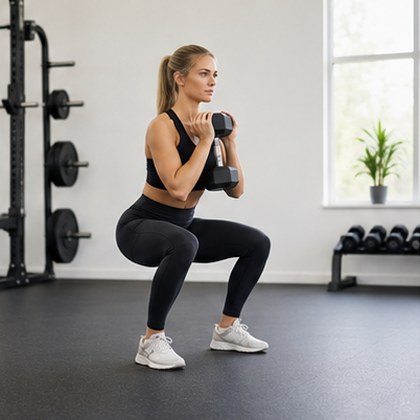 Goblet squat, women
 Goblet squat, men
Protein per serving, not per 100 grams
Lists of "protein per 100 g" don't help much, because nobody eats in 100-gram units. People eat servings. Here's the protein in the servings that actually end up on your plate.
| Serving | Protein | Calories |
|---|---|---|
| 150 g (5 oz) cooked chicken or turkey breast | 35–45 g | 200–250 |
| 200 g (7 oz) farmer's cheese (tvorog), 2–5% fat | 32–36 g | 200–250 |
| 150 g (5 oz) white fish: cod, pollock | 25–35 g | 120–160 |
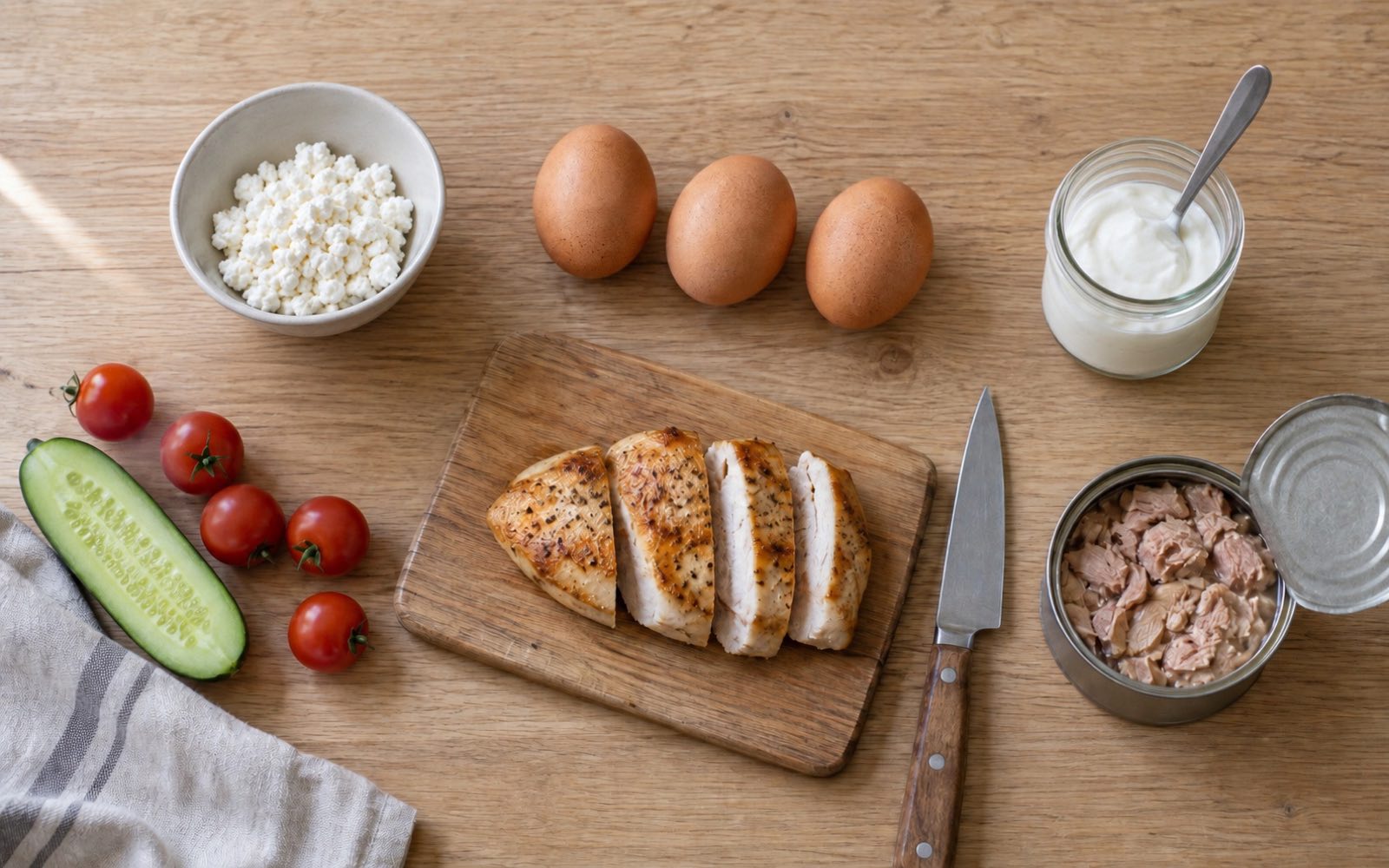
| A can of tuna in water, about 130 g (4.5 oz) drained | 25–30 g | 120–150 |
| 200 g (7 oz) tofu | 16–30 g, depending on how firm it is | 150–290 |
| A scoop of protein powder, 30 g | 20–25 g | 110–130 |
| 3 eggs | 18–21 g | 210–260 |
| 200 g (1 cup) cooked lentils | 16–20 g | 220–240 |
| 200 g (7 oz) Greek yogurt, 2–5% fat | 16–20 g | 130–200 |
| A glass of 2% milk, 250 ml (1 cup) | 7–8 g | 120–140 |
These are ballpark numbers: protein varies by a couple of grams between brands, so check the label. Regular American cottage cheese is wetter than farmer's cheese and has about a third less protein: roughly 22–25 g per 200 g. Side dishes add protein too: rice, pasta and bread add another 10–20 g over a day.
For a detailed per-100-gram chart and which sources are better, see how to choose protein sources.
keep a few quick protein staples at home: eggs, a can of tuna, a tub of cottage cheese, a can of beans or lentils. On nights when you don't feel like cooking, that's 25–30 g of protein in five minutes instead of takeout.
A day's worth of protein: two food baskets that add up to 120 g
120 g is a typical target for someone who weighs 70–75 kg (154–165 lb) and works out. Here's how it adds up from the servings above. The first set is standard, and the second has no meat or fish.
| Meal | Standard set | Protein | No meat or fish | Protein |
|---|---|---|---|---|
| Breakfast | 3-egg omelet + 100 g farmer's cheese | about 36 g | 3 eggs + 200 g Greek yogurt | about 37 g |
| Lunch | 150 g chicken with rice | about 40 g | 200 g firm tofu with rice | about 28 g |
| Snack | 200 g Greek yogurt | about 18 g | 200 g farmer's cheese | about 34 g |
| Dinner | A can of tuna with vegetables | about 28 g | 200 g lentils + a glass of milk | about 25 g |
| Total | about 122 g, 750–1,000 calories | about 124 g, 1,150–1,350 calories |
The protein and calories in the table count only the protein foods, without sides, vegetables or oil. The meat-free set comes out higher in calories: firm tofu and dairy bring more fat along with their protein, and lentils bring carbs. If you're losing weight, pick lower-fat farmer's cheese and yogurt. Using regular cottage cheese instead of farmer's cheese? Take about 1.5 times as much to get the same protein.
None of these servings takes heroic effort. It's regular food, with a protein base in every meal. Swap foods around however you like: the daily total is what counts.
Mixed dishes work better than plain chicken and broccoli. Tuna pasta, lentils with meat, an omelet with vegetables and cheese, tofu with rice: they give you protein, energy and a meal you actually enjoy. Without enjoyment, a diet rarely lasts more than a couple of weeks.
How to split your target across meals
Your body absorbs protein from a serving of any size. But your muscles do better with a steady supply: 3–4 meals of 20–40 g each beat eating almost nothing until evening and then a huge dinner.
| Daily target | 3 meals | 4 meals |
|---|---|---|
| 90 g | 30 g each | 22–23 g each |
| 120 g | 40 g each | 30 g each |
| 150 g | 50 g each | 37–38 g each |
If your target is 150 g or more, 4 meals are easier: 37–38 g at a time goes down more easily than 50.
A review of how much protein your muscles can use in one meal gives a simple guideline: about 0.4 g per kilogram of body weight per meal, at least four meals a day. At 70 kg, that's about 28 g four times. It's not a hard ceiling, just a handy target.
The 30-gram myth. The rule "your body can't absorb more than 30 g at once" is wrong. You absorb all of it. Your body uses part of a large serving for energy and other jobs, and part still goes to your muscles. So 50 g at dinner isn't wasted. Still, 3–4 even servings of 20–40 g suit your muscles better.
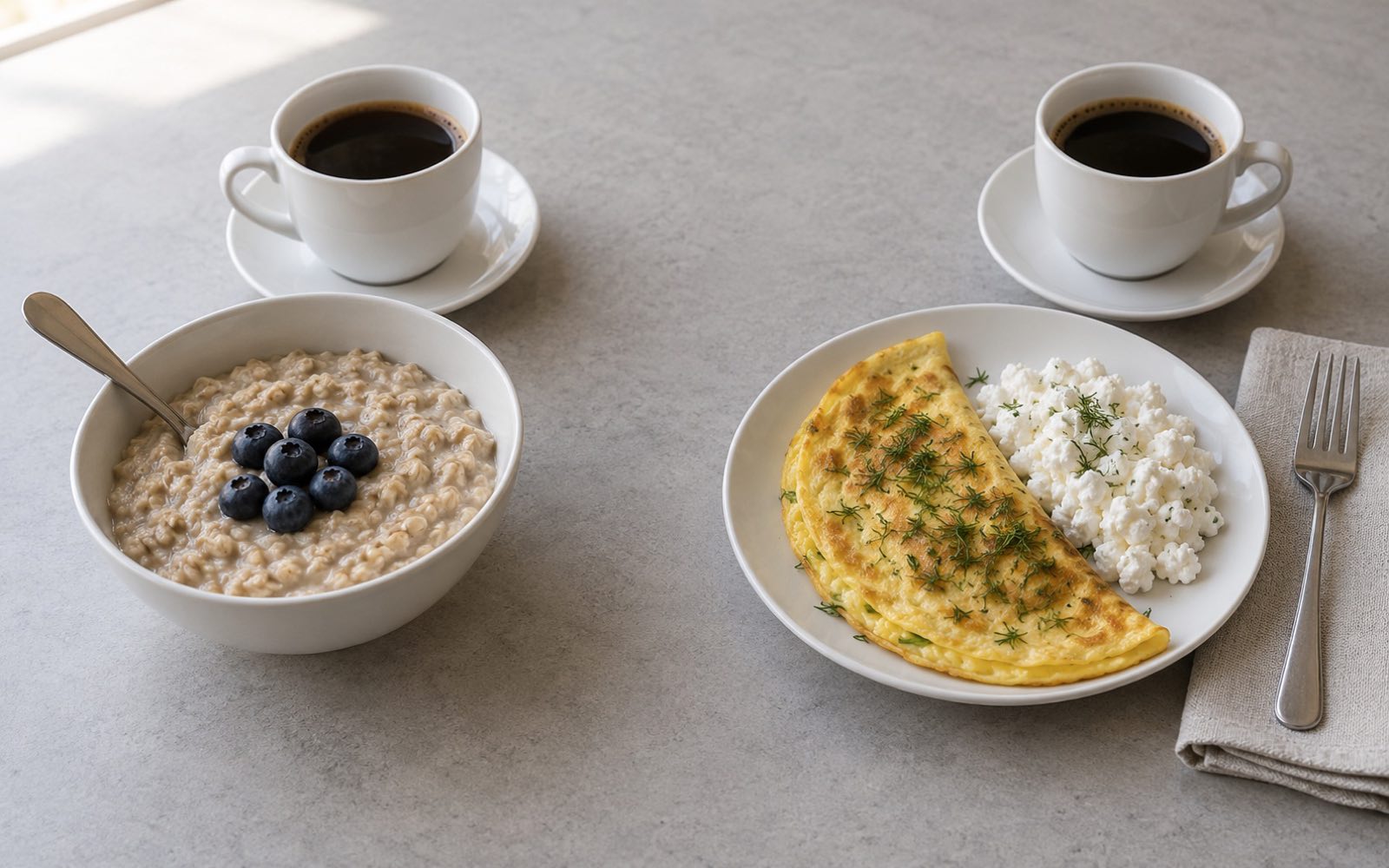
Breakfast is the weak spot. Oatmeal and coffee give you 5–8 g of protein. Add 3 eggs or a serving of farmer's cheese, and your day starts with 25–30 g. For ideas, see our high-protein breakfasts guide.
No need to rush after a workout. The "anabolic window," the idea that you must eat protein within 30 minutes of training, is overrated. If you ate a protein meal 2–3 hours before the gym, a shake in the locker room changes nothing. A normal meal within a couple of hours after training is enough. Your daily total matters more than exact timing.
Protein before bed is fine too. A 30–40 g serving of slow-digesting protein in the evening, like 200 g of farmer's cheese or about 300 g of cottage cheese, helps your muscles recover overnight. Studies haven't found that this snack stops your body from burning fat while you sleep.
When the usual numbers don't apply: over 65, pregnancy, kidneys, no meat
The targets above are for healthy adults. In these cases, the rules change.
| Situation | What to do |
|---|---|
| Over 65 | At least 1.0–1.2 g/kg, and 1.2 g/kg or more if you exercise. With age, muscles respond less to protein, so you need bigger servings than at 30. If you have a chronic condition, discuss your target with your doctor |
| Pregnancy and breastfeeding | Your doctor sets the target. Don't apply the sports numbers from this article to yourself |
| Kidney disease | Your doctor sets the target. Don't raise protein on your own: with severe kidney disease, it's often restricted instead |
| You don't eat meat | Same target. Combine different sources: beans and lentils, tofu, cottage cheese, eggs. Aim for the upper part of your range |
| A lot of weight to lose | Calculate from your goal weight, not your current weight |
After 65, protein isn't just about the gym. It helps you stay strong and hold on to muscle as you age. What happens to muscle after 30 and how to slow it down is covered in our guide to sarcopenia.
If you have kidney disease or diabetes, or a doctor has found problems in your kidney tests, talk to your doctor about protein first. Only then raise it to sports-level numbers.
Do you need protein powder?
No, you can do without it. Protein powder is protein from milk, eggs or plants in powder form: regular food in a convenient format. You can get your whole target from food, which also gives you fiber, iron, calcium and healthy fats.
Powder comes in handy in three situations. You don't have time for a proper meal during the day. You're 20–30 g short in the evening and don't feel like eating. You need a lot of protein on few calories. A scoop gives you 20–25 g of protein for about 120 calories.
Whether to buy it comes down to convenience and budget, not the myth that muscles won't grow without it. Who actually benefits from powder and how to choose one is in do you need protein powder.
How to check if you're getting enough protein
It's easy to overestimate or underestimate protein by eye. There's one reliable way: write down everything you eat for at least a week. Weigh your portions at first. After a while, you'll learn to eyeball them.
You don't have to do the math by hand. If you track meals in the Sportygram app, the food log calculates your protein target from the weight and goal in your profile and shows how much you've eaten today against it.
If you see in the evening that you're 30 g short, grab one of the quick staples from section 04. A can of tuna, or 3 eggs with a glass of milk, gets you about 25–30 g in five minutes.
Look at your weekly total, not a single day. If you hit your protein target 5 days out of 7, you're doing fine.
FAQ
How much protein do you need per day if you don't work out?
The minimum is 0.8 g per kilogram of body weight: about 50 g at 60 kg (132 lb) and about 65 g at 80 kg (176 lb). That's the floor that covers nearly everyone's needs, not the optimum. If you move a lot, go for 1.2–1.6 g/kg. Over 65, eat at least 1.0–1.2 g/kg. The easiest way to get there is to add a protein food to every meal.
How much protein do you need to build muscle?
A reliable target is 1.6 g per kilogram of body weight a day, with a working range of 1.6–2.2 g/kg. At 75 kg (165 lb), that's 120–165 g. Above 2.2 g/kg, studies show no faster muscle growth. If you eat enough protein and still don't grow, check your program: the load should increase week to week. Also check your calories and whether you sleep 7–9 hours.
Do you need more protein when losing weight?
Yes. In a calorie deficit, eat 1.6–2.2 g/kg, closer to the top. Protein keeps you full and helps you keep muscle while you lose fat. But protein on its own doesn't burn fat: you lose weight only in a calorie deficit. A protein shake added on top of your usual diet adds calories and slows weight loss unless you cut something else.
If you're overweight, do you calculate protein from your current weight or goal weight?
From your goal weight. At 100 kg (220 lb) with a goal of 80 kg (176 lb), the fat-loss target is 80 × 1.6–2.2 = 128–176 g a day, not 160–220 g based on your current weight. Fat tissue needs almost no protein, so calculating from your full weight inflates the number. No goal yet? Use a weight at which you felt good.
Is it true your body can only absorb 30 g of protein at once?
No, that's a myth. You absorb all the protein in a serving. With a large serving, part of it goes to energy instead of muscle. For muscle, a handy guideline is about 0.4 g per kilogram of body weight per meal, which is 28 g at 70 kg, at least four times a day. But a dinner with 50 g of protein isn't wasted either.
Is protein bad for your kidneys?
Not in healthy people. A review of 28 studies compared high-protein diets, from 1.5 g/kg or from 100 g a day, with normal ones. Kidney function changed the same way on both. If you already have kidney disease, it's a different story: your doctor sets your protein target. In that case, don't raise it on your own, even for training.
Do you need protein powder to hit your protein target?
No. Protein powder is convenient food in powder form, not a required supplement. You can hit your target with cottage cheese, eggs, chicken, fish, beans and tofu. Powder helps when you have no time to eat or you're 20–30 g short by evening. One scoop gives you 20–25 g of protein for about 120 calories.
Can you get enough protein without meat?
Yes. Eggs, farmer's cheese or cottage cheese, Greek yogurt, tofu, lentils and beans easily cover 120 g a day, as the meat-free basket in section 05 shows. If you skip dairy and eggs too, combine different legumes with grains and soy. Plant foods have less protein per serving, so aim for the upper part of your range.
The bottom line
- The minimum is 0.8 g of protein per kilogram of body weight. For an active lifestyle, eat 1.2–1.6 g/kg; for muscle gain and fat loss, 1.6–2.2 g/kg. Studies show no extra gain above 2.2 g/kg.
- If you have a lot of weight to lose, calculate your target from your goal weight.
- Women and men need the same protein per kilogram. The difference in grams comes only from body weight.
- Split your daily total into 3–4 meals of 20–40 g. The "no more than 30 g at once" rule is a myth, and the post-workout "window" is overrated.
- Protein doesn't burn fat, but it helps you stick to a deficit and keep muscle.
- Protein powder is optional: 120 g a day is easy to get from regular food. With kidney disease or during pregnancy, your doctor sets the target.
Checklist: are you getting enough protein?
- I know my target in grams: my weight × the multiplier for my goal.
- If I have a lot of weight to lose, I calculate from my goal weight.
- Every main meal has a palm-sized serving of protein food.
- Breakfast gives me at least 20 g of protein.
- I eat 3–4 protein meals a day.
- In a calorie deficit, I raise my protein instead of cutting it.
- A protein shake replaces food instead of adding to my diet.
- I look at the weekly total: I hit my protein target at least 5 days out of 7.
Sources
- Jäger R., Kerksick C. M., Campbell B. I. et al. International Society of Sports Nutrition Position Stand: protein and exercise. Journal of the International Society of Sports Nutrition, 2017. — The position of the International Society of Sports Nutrition: 1.4–2.0 g of protein per kg a day is enough for most people who exercise; trained people in a calorie deficit may need 2.3–3.1 g/kg; servings of 0.25 g/kg or 20–40 g every 3–4 hours; the target can be met with food; 30–40 g of slow-digesting protein before sleep raises overnight muscle protein synthesis.
- Morton R. W., Murphy K. T., McKellar S. R. et al. A systematic review, meta-analysis and meta-regression of the effect of protein supplementation on resistance training-induced gains in muscle mass and strength in healthy adults. British Journal of Sports Medicine, 2018. — A meta-analysis of 49 studies with 1,863 participants: protein above about 1.6 g/kg a day added no further muscle gain with strength training; allowing for differences between people, the upper limit is about 2.2 g/kg.
- Schoenfeld B. J., Aragon A. A. How much protein can the body use in a single meal for muscle-building? Implications for daily protein distribution. Journal of the International Society of Sports Nutrition, 2018. — Servings above 20 g are partly used for energy, but part still goes to building muscle; the guideline is 0.4 g/kg per meal, at least four times a day.
- Aragon A. A., Schoenfeld B. J. Nutrient timing revisited: is there a post-exercise anabolic window?. Journal of the International Society of Sports Nutrition, 2013. — A review of the "anabolic window": how much it matters depends on when you ate before training; there is no strict half-hour after exercise.
- Bauer J., Biolo G., Cederholm T. et al. Evidence-based recommendations for optimal dietary protein intake in older people: a position paper from the PROT-AGE Study Group. Journal of the American Medical Directors Association, 2013. — People over 65 need at least 1.0–1.2 g of protein per kg a day, and active people 1.2 g/kg or more; the exception is severe kidney disease without dialysis, where protein may need to be restricted.
- Devries M. C., Sithamparapillai A., Brimble K. S. et al. Changes in kidney function do not differ between healthy adults consuming higher- compared with lower- or normal-protein diets: a systematic review and meta-analysis. The Journal of Nutrition, 2018. — A meta-analysis of 28 studies with 1,358 participants: high-protein diets (from 1.5 g/kg, from 20% of calories or from 100 g a day) did not worsen kidney function in healthy adults.
This material is for informational purposes and does not replace medical advice. If you have kidney disease or diabetes, or you're pregnant or breastfeeding, work out your protein target together with your doctor.