

after 30, you lose roughly 3–8% of your muscle per decade, faster after 60, and strength drops 2–5 times faster than mass. Sarcopenia affects 10–27% of people over 60.Five chair stands without your hands taking longer than 15 seconds, 4 meters (13 feet) at your usual pace taking longer than 5 seconds, or a calf circumference under 31 cm (12.2 inches) are all reasons to see your doctor. Sarcopenia is treated with strength training at least twice a week and 25–30 g of protein three times a day. There is no pill for it. Russia's national clinical guidelines, published in July 2026, go as far as recommending a grip strength test for every patient from age 60.
Sarcopenia is the loss of muscle strength and mass with age that makes it hard to get up from a chair, walk briskly and carry heavy things. It doesn't hurt, and it barely shows on the scale. The grocery bags just feel a little heavier every year, and more and more often you push off with your hands to get out of a chair. Still, muscle responds to training at any age. Below: when muscle loss starts, how to check yourself at home in 10 minutes, when to see a doctor and what helps bring strength back.
What is sarcopenia in simple terms?
Sarcopenia is a condition in which you have so little muscle and muscle strength that everyday tasks suffer: standing up, walking, lifting, carrying. The word comes from the Greek for "flesh" and "poverty."
For a long time, losing muscle was treated as a normal part of aging, like gray hair. Today it's recognized as a muscle disease with its own diagnosis code. Since October 1, 2016, it has had one in the US version of the International Classification of Diseases, ICD-10-CM (M62.84), as Stefan Anker and colleagues reported in 2016. Russian guidelines use the code M62.8.
In 2019, the European Working Group on Sarcopenia in Older People released its updated consensus, known as EWGSOP2, and made low strength the main sign. Strength goes before mass, and it predicts bad outcomes better: falls, fractures and losing your independence. The diagnosis is made in steps:
- low strength means sarcopenia is probable;
- low strength plus low muscle mass confirms the diagnosis;
- slow walking on top of that means sarcopenia is severe.
On July 2, 2026, Russia's Ministry of Health published the country's first national clinical guidelines on sarcopenia in older adults. They were prepared by Russia's associations of rheumatologists, gerontologists and geriatricians, nutrition specialists and experts in rehabilitation.
Sarcopenia and frailty. Frailty is the broader idea: it includes weakness, getting tired quickly, unintended weight loss, slow walking and falls. Sarcopenia describes only the muscles, and it's common in people who are frail.
Sarcopenia and weight loss. Your weight may not change at all with sarcopenia: there's less muscle and more fat. When there's a lot of fat, doctors call it sarcopenic obesity. The person looks heavy, yet their arms and legs are weak. Home smart scales are bad at catching these shifts, and we explain why in our piece on how accurate smart scales are. For a diagnosis, muscle is measured with a DXA scan (dual-energy X-ray absorptiometry) or a medical-grade bioimpedance analyzer.
At what age does muscle loss start, and how fast?
Muscle loss starts after 30, at roughly 3–8% per decade, and speeds up after 60. That estimate comes from a 2004 review by Elena Volpi and colleagues.
Strength goes even faster. In a 2012 review by Mitchell and colleagues, typical muscle loss was 0.47% a year in men and 0.37% in women, and in studies that measured both, strength dropped 2–5 times faster than mass. So the first thing you'll notice is weakness, and the mirror will catch up later. The more muscle you build by 60, the longer it will last you for everyday life, so it pays to start strength training long before retirement.
How many people have sarcopenia. A 2022 meta-analysis by Petermann-Rocha and colleagues pooled 151 studies and 692,056 people. Sarcopenia was found in 10–27% of people over 60 and severe sarcopenia in 2–9%, with the range depending on which criteria were used. According to the 2026 Russian guidelines, 57.2% of people aged 90 and older have sarcopenia.
Can young people get sarcopenia? Yes. EWGSOP2 states outright that it can begin earlier in life. In your 30s and 40s, muscle can waste away after a long illness, bed rest or an injury, with a sedentary life or poor nutrition. This is called secondary sarcopenia: it has a cause beyond age.
Why do you lose muscle? The main causes of sarcopenia
You lose muscle when it gets too little work and too little protein, and when illness or bed rest speed up its breakdown.
- Age. Older muscle responds more weakly to protein from food, as the PROT-AGE study group wrote in 2013. The Russian guidelines call this anabolic resistance: to get the same effect, an older person needs a bigger serving of protein than a young one.
- Too little movement. Your body shrinks muscles that aren't being used. Walking around the house and to the store isn't enough for your legs and back.
- Chronic disease. EWGSOP2 lists chronic inflammation, cancer, and heart, lung, liver or kidney failure.
- Undereating and strict diets. When there isn't enough food and protein, the body takes building material from muscle. If you lose weight without strength training, muscle goes along with the fat.
Ten days in bed. In a study by Kortebein and colleagues, published in JAMA in 2007, 12 healthy people with an average age of 67 spent 10 days on bed rest. They lost an average of 0.95 kg (2.1 lb) of lean mass from their legs, and muscle protein synthesis dropped by 30%. For comparison, people around 38 lost less than 0.4 kg (0.9 lb) over 28 days in bed.
What to do after a hospital stay. Get up and walk as soon as your doctor allows, even if it's just down the hospital hallway. Ask about rehabilitation and physical therapy, and go back to strength training once your doctor clears you. For people who are ill, PROT-AGE advises 1.2–1.5 g of protein per kg of body weight a day, unless there's severe kidney disease.
Symptoms of sarcopenia: how to tell you're losing muscle
The first signs of sarcopenia are trouble getting up from a chair without your hands, walking more slowly, struggling to open jars and carry bags, and tripping more often. Strength goes before mass, so watch your everyday tasks.
Pay attention if, over the past year, you've started to:
- push off with your hands to get up from a chair or couch;
- strain to open jars and stop to rest while carrying grocery bags;
- pause on the landing when you climb stairs;
- run out of time crossing the street before the light changes;
- trip or fall on flat ground;
- notice your arms and legs getting thinner while your weight stays the same.
Why doctors look at grip strength. In the PURE study, published by Darryl Leong and colleagues in The Lancet in 2015, grip strength was measured in 139,691 people aged 35–70 across 17 countries. Every 5 kg (11 lb) drop in grip strength came with a 16% higher risk of death, and grip strength predicted death better than systolic blood pressure.
The SARC-F questionnaire. Five questions, one minute. Both the European EWGSOP2 consensus and the Asian Working Group for Sarcopenia (AWGS), in its 2019 update, recommend it as a first check.
| Question | 0 points | 1 point | 2 points |
|---|---|---|---|
| How hard is it to lift and carry 10 lb (4.5 kg)? | not hard | a little | very hard or can't |
| How hard is it to walk across a room? | not hard | a little | very hard, need support or can't |
| How hard is it to move from a chair or bed? | not hard | a little | very hard or only with help |
| How hard is it to climb 10 stairs? | not hard | a little | very hard or can't |
| How many times have you fallen in the past year? | none | 1–3 times | 4 times or more |
A score of 4 or more means sarcopenia is likely, so see your doctor. Ten pounds is about a gallon of milk plus a couple of cans of soup.
At-home tests: chair stands, walking speed, calf size and grip strength
You can check your muscles at home in 10 minutes. You need a chair without armrests, a tape measure, a soft sewing tape, the stopwatch on your phone and someone to help.
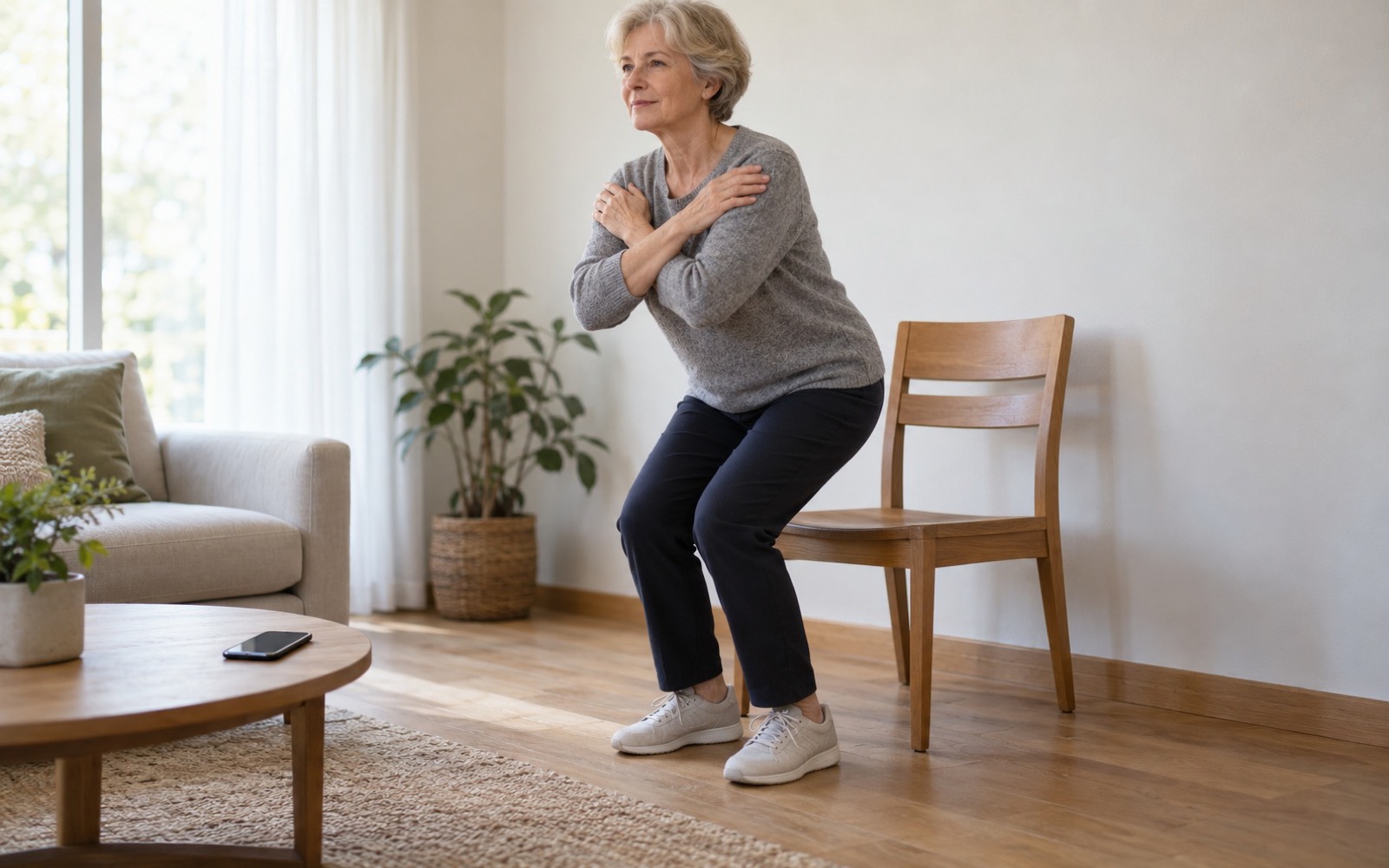
Five chair stands. Put the chair with its back against a wall, sit near the front edge and cross your arms over your chest. On "go," stand up all the way and sit back down, five times in a row, as fast as you can without losing your balance. Time it from "go" to the fifth time you stand up. If you can't stand up without your hands, that's a result to tell your doctor too.
Walking speed. Measure 4 meters (13 feet) in a hallway and mark the start and finish with tape. Stand with your toes at the start line, and on "go," walk at your usual pace without slowing down before the finish. Time it from your first step until your foot crosses the finish line, and take the better of two tries. For a different distance, time equals distance divided by speed. At 0.8 m/s, that's 3 meters (10 feet) in 3.75 seconds or 6 meters (20 feet) in 7.5 seconds. At 1 m/s, it's 3 meters in 3 seconds or 6 meters in 6 seconds.
Calf circumference. Sit with your foot flat on the floor and your knee at a right angle. Wrap the sewing tape around the widest part of your calf without pressing it into the skin. Measure both legs and write down the larger number. If your legs swell, the result will come out too high, so tell your doctor about that.
Grip strength. You need a hand dynamometer. Your primary care doctor, a physical therapist or a geriatrician usually has one, and home models are sold online. It's measured sitting down with your elbow bent at a right angle. Under the Russian guidelines, you squeeze as hard as you can three times with each hand, resting about a minute in between, and take the best result from your stronger hand.
We put the cutoffs from three guidelines into one table and turned walking speed into seconds over 4 meters.
Checking your muscles at home in 10 minutes: cutoffs from three guidelines in seconds and centimeters
| Test | EWGSOP2, 2019: warning result | AWGS, 2019: early signal | Russian guidelines, 2026 |
|---|---|---|---|
| 5 chair stands without hands | longer than 15 s | 12 s or longer | test included, no cutoff in seconds |
| 4 m (13 ft) at usual pace | 5.0 s or longer (0.8 m/s or slower) | longer than 4.0 s (slower than 1 m/s; AWGS uses 6 m, so longer than 6.0 s) | longer than 5.0 s is a bad sign, 4.0 s or faster is the goal |
| Calf circumference | under 31 cm (12.2 in), if muscle can't be measured another way | under 34 cm (13.4 in) for men, 33 cm (13 in) for women | under 31 cm (12.2 in) for everyone |
| Grip strength, dynamometer | under 27 kg (60 lb) for men, 16 kg (35 lb) for women | under 28 kg (62 lb) for men, 18 kg (40 lb) for women | under 27 kg (60 lb) for men, 16 kg (35 lb) for women |
| Questionnaire | SARC-F: 4 points or more | SARC-F: 4 points or more | Russia's "Age Is No Barrier" screener: 5 points or more means see a geriatrician |
The Asian cutoffs are stricter: AWGS introduced the idea of "possible sarcopenia" so people start exercising sooner. That gives you a simple rule:
- all results better than the Asian cutoffs: keep moving and repeat the tests in a year;
- a result between the cutoffs, for example 12–15 seconds for five chair stands: start the strength exercises in section 08 and recheck in 3 months;
- at least one result worse than the European or Russian cutoff: make an appointment with your doctor.
Home tests can't diagnose sarcopenia. A doctor does that with a dynamometer, a muscle measurement and blood work.
write down your results with the date: seconds on the chair, seconds over 4 meters, calf circumference, SARC-F score. After 3 months of training, repeat the tests under the same conditions: same chair, same hallway, same time of day. Your chair stand time changes long before the difference shows in the mirror.
When to see a doctor, and which doctor treats sarcopenia
If even one home test is worse than the cutoff, your SARC-F score is 4 or more, or you're losing weight without dieting, see your primary care doctor (your GP in the UK). If needed, they'll refer you to a geriatrician, a doctor who specializes in older adults.
The 2026 Russian guidelines say every patient from age 60 should have their grip strength measured with a dynamometer, and their height, weight, body mass index, calf and upper arm circumference checked at every visit. They also describe the Short Physical Performance Battery (SPPB): balance stands, a 4-meter walk and chair stands. A score of 7 or lower on the SPPB, or 5 or more on the "Age Is No Barrier" screener, is a reason to see a geriatrician, especially if you also have falls, trouble walking or osteoporosis. If your doctor hasn't done these checks, you can ask for them.
Muscle mass is measured with a DXA scan or bioimpedance. By EWGSOP2 standards, low means an arm and leg muscle mass (appendicular skeletal muscle mass) under 20 kg (44 lb) for men and 15 kg (33 lb) for women.
Blood tests. The Russian guidelines list hemoglobin, iron and ferritin, total protein and albumin, glucose, ALT, AST and bilirubin, creatinine and cystatin C, C-reactive protein, TSH (thyroid-stimulating hormone), vitamin B12 and vitamin D. These help find other causes of weakness and check your kidneys before you raise your protein. Your doctor decides which tests you actually need.
Don't put off a visit if:
- you've fallen more than once in the past year;
- your weakness is getting noticeably worse over a few weeks;
- you're losing weight without dieting or an obvious reason;
- you can't get back to your usual activities after a hospital stay.
If an arm or leg on one side suddenly goes weak, your face goes numb or your speech becomes slurred, call emergency services (911 in the US, 999 in the UK): this can be the start of a stroke.
Sarcopenia treatment: what helps and how strong the evidence is
The foundation of sarcopenia treatment is strength training and enough protein. There are no drugs that bring muscle back, and the 2026 Russian guidelines specifically advise against prescribing anabolic drugs.
| Treatment | What guidelines and studies say | What it means for you |
|---|---|---|
| Strength training | International ICFSR guidelines, 2018: strong recommendation; Russian guidelines: at least twice a week; Cochrane 2009: strength goes up, standing up gets easier, walking gets faster by 0.08 m/s | The main treatment |
| Protein | ICFSR 2018: conditional recommendation; Russian guidelines: 25–30 g three times a day; PROT-AGE: 1.0–1.2 g/kg after 65 | Helps muscle grow in response to training |
| Balance exercises | Cochrane 2019: 24% fewer falls, high-certainty evidence | Protect you from falls; the effect of strength training alone on falls is still unclear |
| Walking and cardio | WHO 2020: 150–300 minutes of moderate or 75–150 minutes of vigorous activity a week | Good for your heart and stamina; strength training is what brings strength back |
| Vitamin D | ICFSR 2018: no recommendation; Russian guidelines: only for a deficiency and only if a doctor prescribes it | Taking it "for your muscles" without a blood test makes no sense |
| Nutrition shake without training | Fiatarone, 1994: no effect on strength or walking | Food alone won't bring muscle back |
| Anabolic hormones and drugs | Russian guidelines: do not prescribe; ICFSR 2018: no recommendation | Not considered a treatment for sarcopenia |
Can sarcopenia be reversed? You can get strength and some muscle back even in very old age. In a 1994 study by Maria Fiatarone and colleagues in the New England Journal of Medicine, 100 nursing home residents aged 72–98, 87 on average, did leg strength training for 10 weeks. Their strength went up by 113%, compared with 3% in the group that didn't train. Walking speed improved by 11.8% and thigh muscle area by 2.7%, while the thigh muscles of those who didn't train shrank by 1.8%.
Treating sarcopenia in women. The plan is the same: strength, balance, protein. The cutoffs differ: grip strength counts as low under 16 kg (35 lb) for women and under 27 kg (60 lb) for men. Hormone therapy is a conversation to have only with a gynecologist or an endocrinologist.
Exercises for sarcopenia: how to start at home
Start with 2 strength sessions a week of 5–6 exercises for your legs, back and chest, and add balance exercises 3 days a week. The strength frequency comes from the 2026 Russian guidelines, and the balance frequency from the 2020 WHO guidelines for people over 65.
The training dose in the Russian guidelines:
- frequency: at least twice a week, with at least 48 hours between sessions, for example Monday and Thursday;
- volume: 1–3 sets of 6–12 reps, resting anywhere from a few seconds to 2 minutes between sets;
- intensity: from 40–60% up to 70–85% of your maximum. At first, use a weight you can lift 12 times comfortably. Later, use one where the last 2–3 reps out of 8–10 are a struggle. If you're very weak, the guidelines allow starting at 30–60% of your maximum.
The Russian guidelines name squats, calf raises, wall push-ups and biceps curls with dumbbells or a resistance band. Here are six exercises for home:
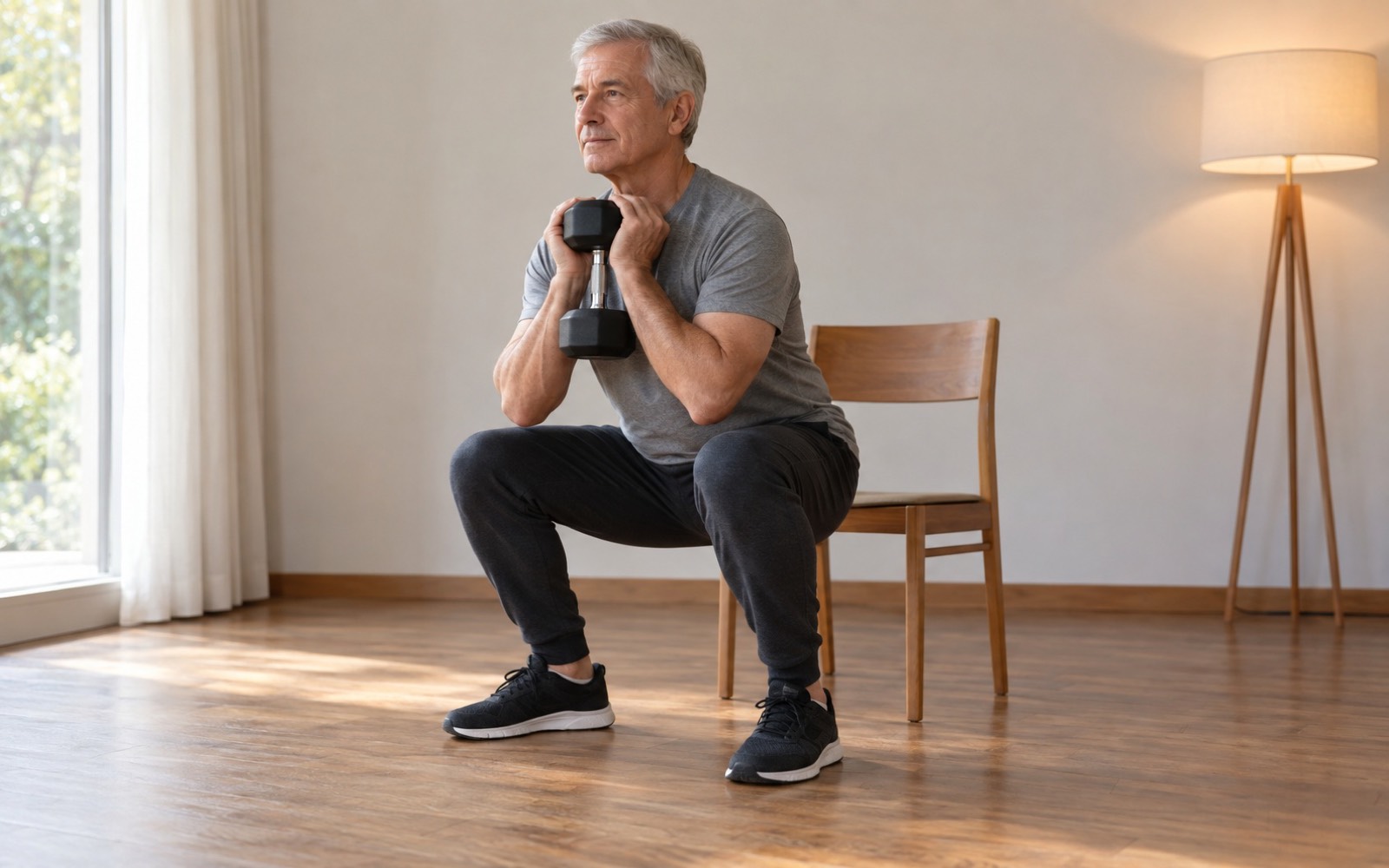
- Chair stands. This is the key exercise. Stand up without using your hands and sit down slowly, over 2–3 seconds. If you can't do it without your hands, push off your knees. Once 12 reps feel easy, hold a dumbbell or a bottle of water at your chest.
- Band rows. For your back and posture. Loop a resistance band around the leg of a heavy table and pull the ends toward your waist, squeezing your shoulder blades together.
- Wall push-ups, then table push-ups. For your chest, shoulders and arms. The lower the surface, the harder it gets.
- Calf raises holding onto support. For your calves and steadier walking.
- Glute bridge. For your glutes and the backs of your thighs. Lie on your back with your feet on the floor and lift your hips until your shoulders, hips and knees form a straight line.
- Carrying bags. For your hands, shoulders and core. Take a bag with water bottles in each hand, 2–3 kg (4–7 lb) each to start, and walk 30–40 steps around the house.
Balance. A 2019 Cochrane review by Sherrington and colleagues pooled 108 studies and 23,407 people. Balance exercises cut the rate of falls by 24%, while the effect of strength-only programs on falls remained unclear. The first three stands below are described in the Russian guidelines, and the last two are the next step. Stay next to a chair or a wall:
- feet together: start with 10 seconds, which is how long each stand is held in the SPPB;
- semi-tandem: the heel of one foot next to the middle of the other foot;
- tandem: the heel of one foot right against the toes of the other;
- standing on one leg, touching the chair with one finger;
- heel-to-toe walking along a wall.
Is it safe at 70 or 80? In a 2009 Cochrane review by Liu and Latham covering 121 studies and 6,700 people, serious complications from strength training in older adults were rare. Joint and muscle pain was more common. If a joint hurts during an exercise, shorten the range of motion or lower the weight. If you feel dizzy or get chest pain, stop and talk to your doctor.
Once 12 reps in a set feel easy, add a set or some weight. How to do that without getting hurt is covered in our guide to progressive overload. A first-month plan and what changes in the body with age are in getting in shape after 40, and for the gym, see strength training for beginners. In the Sportygram workout diary at go.sportygram.com, you can build a plan like this by day from 142 exercises with photos. The app interface is in Russian for now.
Protein for sarcopenia: how much per day and per meal
After 65, you need at least 1.0–1.2 g of protein per kg of body weight a day, from 1.2 g/kg if you train, ideally split into 25–30 g three times a day. The daily target comes from the 2013 PROT-AGE recommendations, and the serving size from the 2026 Russian guidelines. Serving size matters because of anabolic resistance: a breakfast of oatmeal and coffee, with only 5–8 g of protein, barely switches on muscle growth in an older person.
We worked out what three servings of 25–30 g, or 75–90 g a day, mean at different body weights.
Protein after 65: the daily target vs. per-meal servings
| Weight | PROT-AGE target, 1.0–1.2 g/kg | With training: from 1.2 g/kg (PROT-AGE), up to 1.5 g/kg (Russian guidelines) | 75–90 g a day equals | What to add |
|---|---|---|---|---|
| 50 kg (110 lb) | 50–60 g | from 60 g (up to 75 g) | 1.5–1.8 g/kg | target covered; the job is eating 25 g at a time |
| 60 kg (132 lb) | 60–72 g | from 72 g (up to 90 g) | 1.25–1.5 g/kg | target covered; watch your servings |
| 70 kg (154 lb) | 70–84 g | from 84 g (up to 105 g) | 1.07–1.29 g/kg | 30 g servings cover the training target too |
| 80 kg (176 lb) | 80–96 g | from 96 g (up to 120 g) | 0.94–1.13 g/kg | servings of 32–35 g or a fourth meal |
| 90 kg (198 lb) | 90–108 g | from 108 g (up to 135 g) | 0.83–1.0 g/kg | servings of 35–40 g or a fourth meal |
If you weigh up to 60 kg (132 lb), the target takes care of itself as long as every meal has 25 g of protein, and the only challenge is appetite. From 80 kg (176 lb) up, three standard servings aren't enough. With severe kidney disease, when your glomerular filtration rate is below 30 mL/min and you're not on dialysis, PROT-AGE advises against raising protein: your nephrologist sets the target.
More isn't always better. In a 2018 meta-analysis of 49 studies, Morton and colleagues found that protein on top of strength training added an average of 0.30 kg of lean mass and 2.49 kg of strength, but gains stopped growing above roughly 1.6 g per kg of body weight. Without strength training, protein won't bring muscle back: in Fiatarone's 1994 study, a nutrition supplement without training changed neither strength nor walking speed.
What a 25–30 g protein serving looks like:
- 1 cup (225 g, 8 oz) of cottage cheese: about 25 g;
- a 6-oz (170 g) cup of plain Greek yogurt and 2 eggs: about 30 g;
- 3.5–4 oz (100–120 g) of cooked chicken breast: 30–35 g;
- 5 oz (150 g) of cod or pollock: 25–35 g;
- a can of tuna in water: 25–30 g.
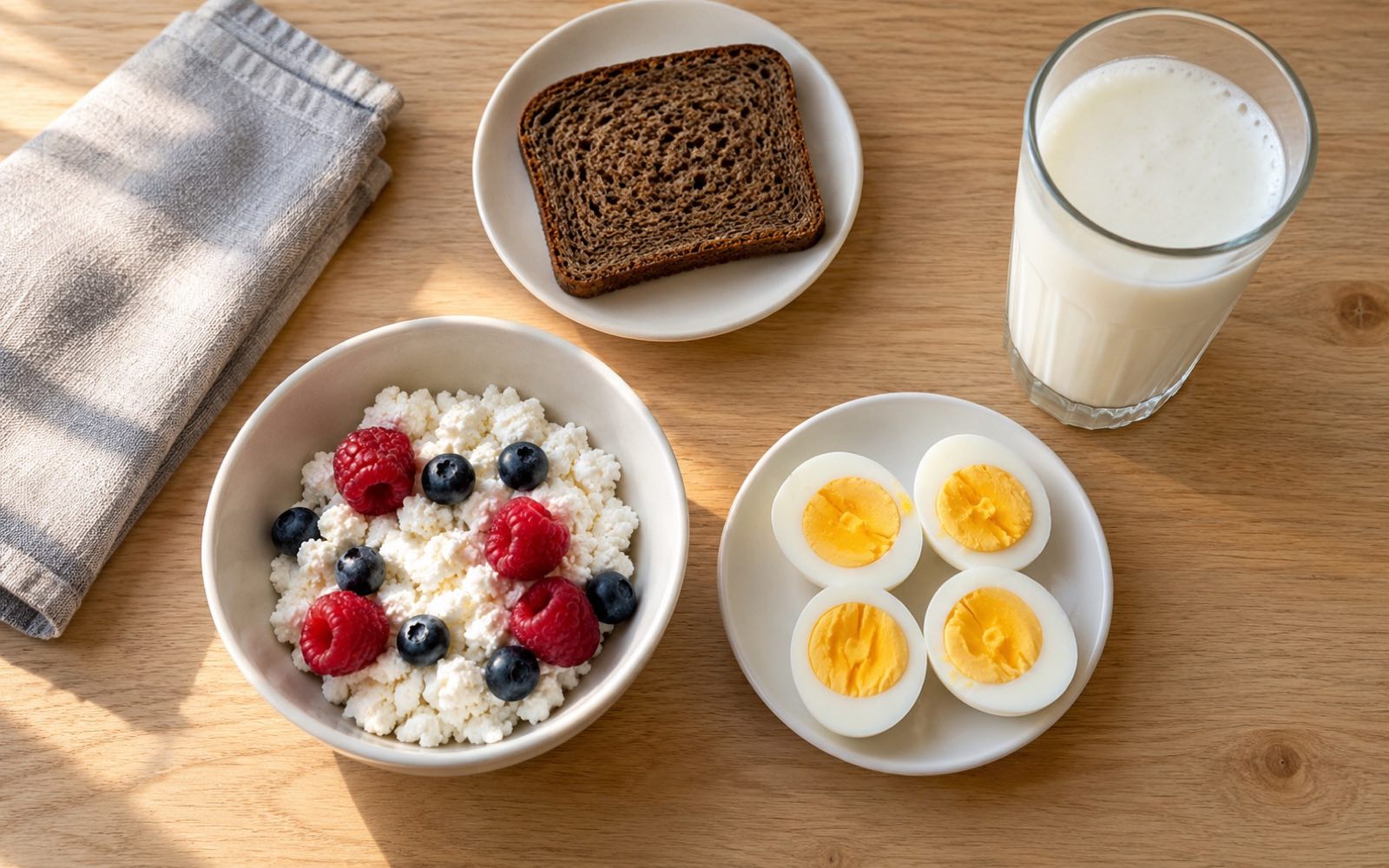
A breakfast of a cup of cottage cheese with berries, two eggs, a slice of whole-grain bread and a glass of milk gives you close to 50 g of protein. More foods are in our guide to how much protein you need per day.
start with breakfast. Oatmeal and coffee give you only 5–8 g of protein. Add 2 eggs and a 6-oz cup of Greek yogurt: that's about 30 g more, and breakfast climbs to 35–38 g of protein.
Sarcopenia in women and men: what's different
Men and women get the same plan. What differs are the cutoffs and how often each set of criteria finds sarcopenia. In the 2022 Petermann-Rocha meta-analysis, EWGSOP2 criteria found sarcopenia more often in men, 11% vs. 2%, while the International Working Group on Sarcopenia (IWGS) criteria found it more often in women, 17% vs. 12%.
For women. After menopause, bone loss adds to muscle loss, and strength training with weights works on both. Low-calorie diets without protein and strength training take muscle away along with fat.
For men. Take a look at your shape. If your belly is growing while your legs are getting thinner, that looks like sarcopenic obesity, which the scale won't show. Don't write weakness off as age: it gets checked with the same tests.
Questions and answers
Can sarcopenia be reversed, and can you rebuild muscle after 60 or 70?
Yes, you can get strength and some muscle back at any age. In nursing home residents with an average age of 87, strength went up by 113% after 10 weeks of strength training (Fiatarone, 1994). You can start at 80.
Which doctor treats sarcopenia?
Start with your primary care doctor, who can refer you to a geriatrician. Under the 2026 Russian guidelines, every patient from 60 should have their grip strength and calf circumference measured at the doctor's office. A physical therapist can help you with the exercises.
Is there a pill or injection for sarcopenia?
No. The 2026 Russian guidelines advise against prescribing anabolic drugs, and the 2018 international ICFSR guidelines found no grounds to recommend hormones. Vitamin D is prescribed only for a deficiency, based on a blood test and your doctor's decision.
Does walking help with sarcopenia?
Walking is good for your heart and stamina: after 65, the WHO recommends 150–300 minutes a week. Strength training is what brings strength back, so add it to your walking twice a week.
Can young people get sarcopenia?
Yes. According to EWGSOP2, it can begin earlier in life. The causes are a long illness, bed rest, an injury, a sedentary life or poor nutrition.
How much protein do you need with sarcopenia?
After 65, at least 1.0–1.2 g per kg of body weight a day, from 1.2 g/kg if you train, split into 25–30 g three times a day. For a person who weighs 70 kg (154 lb), that's 70–84 g. With kidney disease, your doctor sets the target.
Do you need protein powder or creatine?
Protein powder helps you get enough protein when your appetite is small: 30 g of powder gives you 20–25 g of protein. It isn't a must. Decide about creatine and other supplements together with your doctor, especially if you have kidney disease.
What should you do if you lost muscle after a hospital stay?
At 67, 10 days in bed takes 0.95 kg (2.1 lb) of muscle from your legs (Kortebein, 2007), so start recovering right away. Get up and walk as soon as your doctor allows, ask for a referral to rehabilitation or physical therapy, and eat 25–30 g of protein per meal.
The bottom line
- Sarcopenia is the loss of muscle strength and mass with age, and its main sign is low strength.
- After 30, you lose 3–8% of your muscle per decade, and strength drops 2–5 times faster than mass. After 60, sarcopenia affects 10–27% of people.
- Five chair stands taking longer than 15 seconds, 4 meters taking longer than 5 seconds, a calf under 31 cm (12.2 in) or a SARC-F score of 4 or more are reasons to see your doctor.
- Under the 2026 Russian guidelines, grip strength and calf circumference are measured for every patient from 60.
- Sarcopenia is treated with strength training at least twice a week, balance exercises and 25–30 g of protein three times a day. Anabolic drugs are not recommended.
- In people with an average age of 87, strength went up by 113% after 10 weeks of strength training.
Checklist: check and keep your muscle after 50
- Answer the 5 SARC-F questions and add up your score.
- Time 5 chair stands without your hands: aim for under 12 seconds.
- Walk 4 meters (13 feet) at your usual pace: 4 seconds or faster is good, 5 or longer means see your doctor.
- Measure your calf circumference and write it down.
- Ask your doctor to measure your grip strength with a dynamometer.
- Do strength training twice a week and balance exercises 3 days a week.
- Eat 25–30 g of protein at each of your three meals.
- After an illness, get up and walk as soon as your doctor allows.
Sources
- Cruz-Jentoft A. J., Bahat G., Bauer J. et al. Sarcopenia: revised European consensus on definition and diagnosis. Age and Ageing, 2019. — The EWGSOP2 consensus: low strength as the main sign; cutoffs for grip, chair stands, walking and muscle mass; SARC-F.
- Ministry of Health of the Russian Federation. Clinical guidelines "Sarcopenia in older and elderly patients", 2026 (in Russian). — Screening from 60, cutoffs, 25–30 g of protein per meal, strength training doses, no anabolic drugs.
- Volpi E., Nazemi R., Fujita S. Muscle tissue changes with aging. Current Opinion in Clinical Nutrition and Metabolic Care, 2004. — After 30, muscle declines by 3–8% per decade.
- Mitchell W. K. et al. Sarcopenia, dynapenia, and the impact of advancing age on human skeletal muscle size and strength; a quantitative review. Frontiers in Physiology, 2012. — Strength declines 2–5 times faster than mass.
- Petermann-Rocha F. et al. Global prevalence of sarcopenia and severe sarcopenia: a systematic review and meta-analysis. Journal of Cachexia, Sarcopenia and Muscle, 2022. — 692,056 people: sarcopenia in 10–27% of people over 60.
- Kortebein P., Ferrando A., Lombeida J., Wolfe R., Evans W. J. Effect of 10 days of bed rest on skeletal muscle in healthy older adults. JAMA, 2007. — 10 days in bed at 67: 0.95 kg of leg muscle lost.
- Leong D. P. et al. Prognostic value of grip strength: findings from the Prospective Urban Rural Epidemiology (PURE) study. The Lancet, 2015. — Every 5 kg less grip strength: 16% higher risk of death.
- Fiatarone M. A. et al. Exercise training and nutritional supplementation for physical frailty in very elderly people. New England Journal of Medicine, 1994. — At 87, strength rose by 113% in 10 weeks; a supplement without training didn't help.
- Liu C. J., Latham N. K. Progressive resistance strength training for improving physical function in older adults. Cochrane Database of Systematic Reviews, 2009. — 121 studies: strength training increases strength, serious complications are rare.
- Sherrington C. et al. Exercise for preventing falls in older people living in the community. Cochrane Database of Systematic Reviews, 2019. — Balance exercises cut the rate of falls by 24%.
- Dent E., Morley J. E., Cruz-Jentoft A. J. et al. International Clinical Practice Guidelines for Sarcopenia (ICFSR): Screening, Diagnosis and Management. The Journal of Nutrition, Health & Aging, 2018. — Strength training is a strong recommendation, protein a conditional one; no recommendation on vitamin D or hormones.
- Bauer J. et al. Evidence-based recommendations for optimal dietary protein intake in older people: a position paper from the PROT-AGE Study Group. JAMDA, 2013. — After 65: 1.0–1.2 g/kg, from 1.2 with training, 1.2–1.5 g/kg with illness.
- Morton R. W. et al. A systematic review, meta-analysis and meta-regression of the effect of protein supplementation on resistance training-induced gains in muscle mass and strength in healthy adults. British Journal of Sports Medicine, 2018. — Above roughly 1.6 g/kg, muscle gains stop growing.
- Chen L. K. et al. Asian Working Group for Sarcopenia: 2019 Consensus Update on Sarcopenia Diagnosis and Treatment. JAMDA, 2020. — AWGS cutoffs: grip 28 and 18 kg, chair stands 12 seconds, walking 1 m/s, calf 34 and 33 cm.
- Bull F. C. et al. World Health Organization 2020 guidelines on physical activity and sedentary behaviour. British Journal of Sports Medicine, 2020. — After 65: 150–300 minutes of aerobic activity, strength training on 2 or more days, balance on 3 or more days a week.
- Anker S. D., Morley J. E., von Haehling S. Welcome to the ICD-10 code for sarcopenia. Journal of Cachexia, Sarcopenia and Muscle, 2016. — Code M62.84 for sarcopenia in the US version of ICD-10 took effect on October 1, 2016.
This article is for informational purposes only and is not a substitute for medical advice.