

after 40 you need full-body strength training 2–3 times a week on non-consecutive days (NSCA, 2019) and 150–300 minutes of moderate cardio a week (WHO, 2020). In month one, work up from one set of 12–15 reps to two or three sets of 10–12, always stopping with at least 2–3 reps left in the tank.Muscle still grows past 50: in a 2011 meta-analysis by Peterson and colleagues, strength training added an average of 1.1 kg (about 2.4 lb) of lean body mass in adults over 50 over a roughly 20-week program. Metabolism barely changes from 20 to 60 (Pontzer, 2021), so it's not too late to start at 45 or 55.
Getting in shape after 40 means ordinary strength training and cardio, entered more gradually and with more care for your joints. Your body at 40, 45 and 50 still responds to training: muscle grows, strength goes up. If you haven't trained regularly in years, start with two full-body strength sessions a week and brisk walking on the other days.
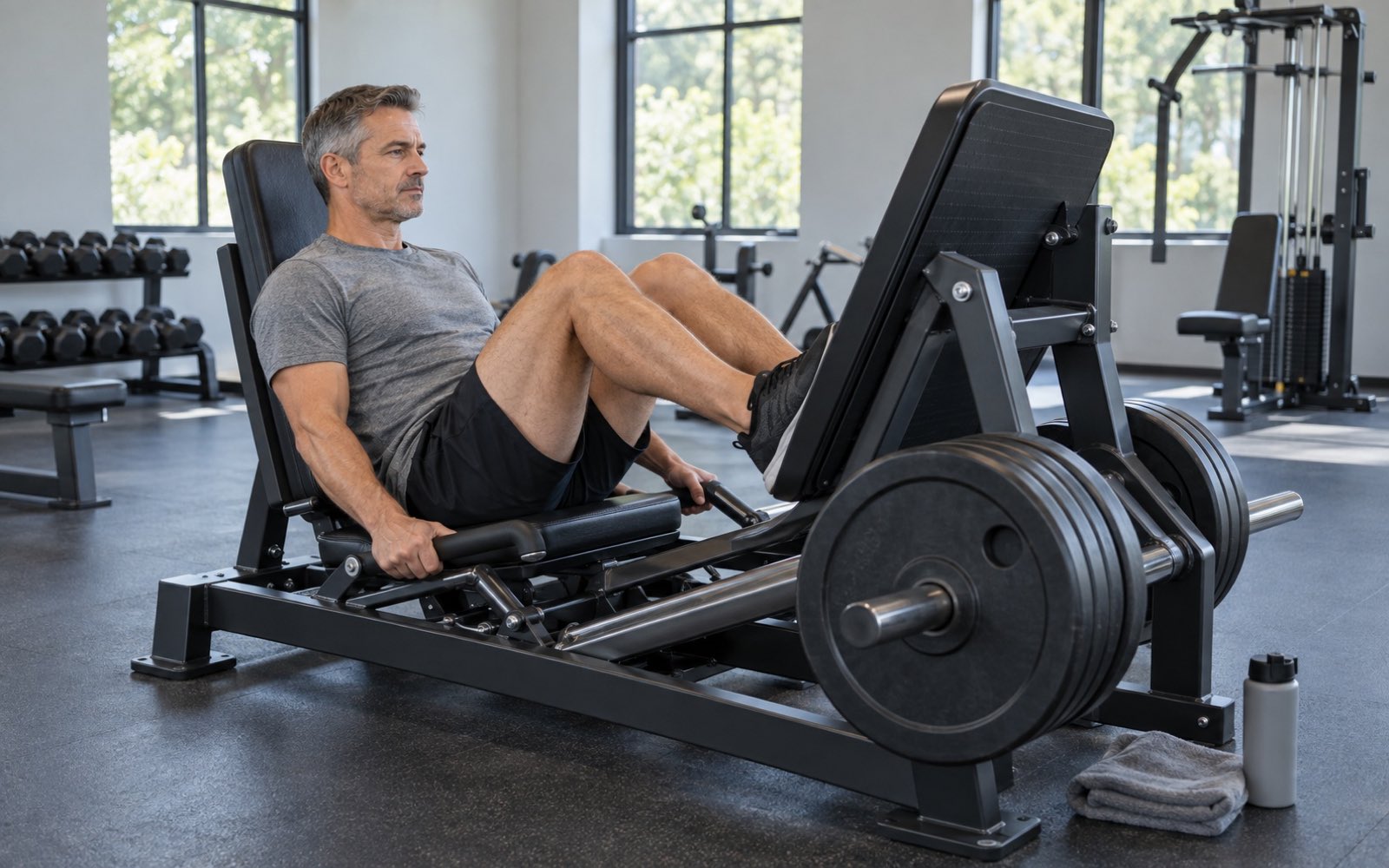
How to Start Working Out After 40 in Your First Week
Start with two full-body strength sessions of 25–40 minutes on non-consecutive days, say Monday and Thursday. On the other days, walk briskly for 20–30 minutes.
Why so little at first. The US National Strength and Conditioning Association (NSCA), in its 2019 position statement (Fragala and colleagues), advises older adults to begin with one set of 10–15 reps per exercise using a light load, and only later move up to two or three sets. The same statement says that properly designed strength training is safe for healthy older adults. The first week exists so your tendons and joints adapt to load and you can learn the technique.
What the first workout looks like:
- Warm up for 5–10 minutes. A stationary bike or brisk walking, then circle your shoulders, hips and knees.
- 5–6 full-body exercises, one set of 12–15 reps each. You'll find the gym and home lists in section 06.
- Cool down for 5 minutes. Easy walking and light stretching.
Gym or home both work. Per the NSCA, machines, bands and isometric holds suit beginners well, while free weights add extra benefit once you move confidently. The American College of Sports Medicine (ACSM), in a 2026 position statement (Currier and colleagues), pooled 137 reviews covering more than 30,000 people. Strength improved with home training and bands just as it did with machines and free weights, which delivered similar gains to each other. Pick whichever setup you'll actually show up for.
Do You Need to See a Doctor Before Training After 40
If you're healthy, have no heart-related symptoms and you're starting with moderate exercise, you don't need a doctor's note. Get checked first if you have heart, blood vessel or kidney disease, diabetes, or worrying symptoms during exertion.
Answer three questions honestly:
- How active are you right now? Have you trained at least three times a week for 30 minutes over the past three months, or have you barely moved?
- Do you have any conditions or symptoms? Heart, kidney disease or diabetes. Or chest pain with exertion, shortness of breath on light effort, fainting, leg swelling, or an irregular heartbeat.
- How hard do you plan to train? Moderate, like the plan below, or straight into something intense — running, intervals, heavy weights.
Healthy, no symptoms, moderate load — start with the plan in section 06. A condition or symptoms — see a doctor first. A condition that's under control and you're already training — keep going at a moderate pace, and discuss any move to intense training with your doctor. If you've had a joint injury or surgery, check in with an orthopedist or physical therapist first.
Blood pressure. Per the NSCA 2019 statement, strength training is safe once your blood pressure is controlled and a doctor has checked you out. Uncontrolled blood pressure above 180/110 mmHg is a contraindication until it's brought down. Blood pressure spikes least with light-to-moderate loads and no breath-holding, so exhale on the effort. For the numbers and what to hold off on, see our guide to exercise with high blood pressure.
Stop signs. Stop the workout and get medical help if you notice:
- chest pain or pressure, especially radiating into your arm, neck or jaw;
- shortness of breath that's out of proportion to the effort and doesn't ease at rest;
- dizziness, blurred vision or fainting;
- an irregular or racing heartbeat that doesn't settle after a few minutes of rest.
What Changes in Your Body After 40 — and What You Can Get Back
With age, muscle mass fades by roughly 0.4–0.5% a year on average, strength fades faster still, and your metabolism barely changes before 60.
A 2012 review by Mitchell and colleagues pooled studies comparing adults aged 18–45 with adults over 65. The median muscle loss was 0.47% a year in men and 0.37% in women. Strength drops 2–5 times faster than muscle mass, and it's weakness, the authors conclude, that's more strongly linked to disability and death than muscle size alone.
What that looks like in pounds. Say a man has 66 lb (30 kg) of skeletal muscle. Losing 0.47% a year works out to roughly 5 oz (140 g) a year and about 3 lb (1.4 kg) over a decade. A course of strength training in Peterson's 2011 meta-analysis added an average of 1.1 kg (2.4 lb) of lean mass — enough to roughly replace what age takes away over 7–8 years. It's a rough comparison, since lean mass includes more than muscle alone.
| What changes | What happens with age | What you can change |
|---|---|---|
| Muscle | −0.37%/year in women, −0.47%/year in men (Mitchell, 2012) | +1.1 kg (2.4 lb) of lean mass over 20 weeks of strength training after 50 (Peterson, 2011) |
| Strength | fades 2–5 times faster than muscle (Mitchell, 2012) | improves from 2 sessions a week, 2–3 sets each, and walking speed and balance improve with it (ACSM, 2026) |
| Metabolism | stable from 20 to 60, then about −0.7%/year from roughly 63 on (Pontzer, 2021) | energy expenditure rises with lean mass (Pontzer, 2021), and strength training builds lean mass |
| Bone in women | −7.38% of spine density over the 3 years around the final period (SWAN, 2012) | +2.9% vs. −1.2% over 8 months of supervised heavy strength training (LIFTMOR, 2018) |
| Testosterone in men | total testosterone −1.6%/year (Feldman, 2002) | 10–15% higher androgens in men with good overall health (Feldman, 2002) |
| Knees with osteoarthritis | no drug cures osteoarthritis (Cochrane, 2024) | exercise: pain −13 points out of 100, function +12.5 points (Cochrane, 2024) |
The metabolism myth. The largest study on this is Pontzer and colleagues' 2021 paper in the journal Science. Total daily energy expenditure was measured in 6,421 people across 29 countries using doubly labeled water, the most accurate method for everyday life. Adjusted for body size, expenditure was stable from age 20 to 60. It turns around near 63, after which expenditure drops about 0.7% a year.
If the scale has been creeping up since 40, look at your plate and how much you move. Your metabolism is barely the culprit.
For more on muscle loss with age, see our guide to sarcopenia.
Can You Build Muscle After 40 and 50
Yes — muscle grows at 50, and at 70. Peterson and colleagues' 2011 meta-analysis pooled 49 studies and 1,328 people aged 50 to 83. The training courses ran about 20 weeks, nearly three sessions a week on average, and added an average of 1.1 kg (2.4 lb) of lean mass. More training volume meant a bigger gain. The older the participants, the smaller the gain, which is why the authors recommend starting as early as possible.
What growth actually requires, per the ACSM's 2026 position statement:
- for muscle size — at least 10 sets a week per muscle group;
- for strength — at least 2 sessions a week, 2–3 sets per exercise, full range of motion, and, over time, loads at 80%+ of your one-rep max;
- training to failure and time under tension didn't meaningfully change results. Machines and free weights delivered the same strength gains.
That's good news if you're over 40: you don't need to grind out the last possible rep. Consistency and a slowly rising weight are enough.
Strength also carries over to daily life: per the ACSM's 2026 statement, strength training improves walking speed and balance, which makes carrying groceries and climbing stairs easier.
Can women build muscle after 40? Yes, the same way: same exercises, sets and reps — only the starting weights differ.
Can you build muscle at home? Yes, as long as the load keeps increasing. With just body weight, progress hits a ceiling fast, so resistance bands of different tensions or adjustable dumbbells are worth having.
Protein. For how much you need at your body weight, and how to spread it across meals, see our breakdown of how much protein per day.
How Many Times a Week to Train After 40
Strength: 2–3 times a week on non-consecutive days. Cardio: 150–300 minutes of moderate activity a week. By our math below, including warm-ups, that's 3 hours 20 minutes to 4.5 hours a week in total.
The WHO's 2020 guidelines (Bull and colleagues) recommend adults get 150–300 minutes of moderate or 75–150 minutes of vigorous aerobic activity a week, plus strength training for all major muscle groups on 2 or more days. For adults over 65, the WHO adds balance and strength work on 3 or more days a week.
Here's how those norms play out across a typical week:
| A. At home, month one | B. Gym, 2 sessions | C. Gym, 3 sessions, from month 2–3 | |
|---|---|---|---|
| Strength | Mon, Thu, 25 min each: 5-min warm-up + 5 exercises × 2 sets | Tue, Fri, 45 min each: 10-min bike + 6 exercises × 3 sets + 5-min cool-down | Mon, Wed, Fri, 50 min each: 10-min warm-up + 6 exercises × 3 sets + 5-min cool-down |
| Weekly sets: legs / back / chest | 8 / 4 / 4 | 12 / 12 / 6 | 18 / 18 / 9 |
| Weekly cardio | 30-min walk × 5 = 150 min | bike 2 × 10 min + 35-min walk × 4 = 160 min | warm-up 3 × 10 min + 30-min walk × 2 + a 60-min walk = 150 min |
| Total time | 200 min | 230 min | 270 min |
| WHO: 150+ min and 2+ strength days | yes | yes | yes |
| NSCA: non-consecutive days | yes | yes | yes |
| ACSM: 10+ sets per muscle | no — normal for month one | yes for legs and back, no for chest | yes for legs and back, close for chest |
How we counted. In plan A, legs get work from the squat and the glute bridge, both in section 06: 2 exercises × 2 sets × 2 days = 8. Plans B and C use the six gym exercises from section 06: two for legs, two for back, one for chest. We counted the bike warm-up toward cardio.
Even the minimal home version clears the WHO's bar. For visible muscle growth, you need plan B or C. Chest comes up short in both — if that matters to you, add push-ups.
If you can only manage two days a week, plan B still clears both the WHO norms and muscle growth for legs and back. Walking is easy to split up: walk to the train, take a lunchtime stroll.
If weekends are your only free time, move one strength session to a weeknight instead — back-to-back sessions on Saturday and Sunday leave the same muscles with no rest at all.
A First-Month Workout Plan After 40
The first-month plan is four weeks of two full-body sessions a week: work up from one set of 12–15 reps to two or three sets of 10–12, always stopping with at least 2–3 reps in reserve.
| Week | Strength | Sets × reps | Reps in reserve | Weekly cardio |
|---|---|---|---|---|
| 1 | 2 sessions, 5–6 exercises | 1 × 12–15 | 4–5 | 20-min walk × 5 = 100 min |
| 2 | 2 sessions | 2 × 12–15 | 3–4 | 25 min × 5 = 125 min |
| 3 | 2 sessions | 2 × 10–12, +1 load step if all sets had reps in reserve | 3 | 30 min × 5 = 150 min |
| 4 | 2 sessions | 2–3 × 10–12 | 2–3 | 150 min + a 45-min walk |
| 5–8 | 2–3 sessions | 3 × 8–12 | 2 | 150–200 min |
The plan's backbone is the NSCA's 2019 position statement and the WHO's 2020 cardio guidelines. The week-by-week reps-in-reserve target and load progression are our own working method.
Reps in reserve means finishing a set while you could still do 2–3 more with good form. The NSCA advises older adults not to train sets to failure, to protect the joints. The ACSM's 2026 statement found no meaningful extra benefit from training to failure, so keeping reps in reserve doesn't cost you anything.
Exercises — six movements, each with a gym and a home version:
- Legs. Gym — leg press machine. Home — chair squat.
- Hamstrings and glutes. Gym — leg curl machine or Romanian deadlift with light dumbbells. Home — glute bridge.
- Back, vertical pull. Gym — lat pulldown. No good home substitute; skip it there.
- Back, horizontal pull. Gym — seated row. Home — seated resistance band row.
- Chest. Gym — chest press machine. Home — push-ups against a table edge.
- Shoulders or core. Gym — seated dumbbell press. Home — bird dog.
The rule for adding weight. If you hit the top of your rep range on every set — say 12 out of 10–12 — with 2–3 reps still in reserve, add the smallest step next time: 2–5 lb on the dumbbells, or one plate on the machine stack. Didn't reach the bottom of the range? Stay at the same weight another week. At home, resistance rises through a firmer band or a lower chair.
for the first two weeks, pick a weight you could do 3–4 more reps with. You'll groove the technique and you won't wake up wrecked with soreness.
What's next. After the first month, move to 3 sets of 8–12 and, if you have time, three sessions a week. The NSCA recommends gradually working up to 70–85% of your one-rep max, and 6–12 reps per set for strength. From there in the gym, you can follow our 8-week beginner strength program — its 3 × 8–12 working sets pick up right where our first month leaves off, so start it from week three.
It's easy to keep your day-by-day plan in the Sportygram training diary at go.sportygram.com. It has 142 exercises with photos, so you can check your form whenever a movement is new to you.
Cardio After 40: How Much, What Kind, and Can You Run
Cardio after 40 means 150–300 minutes of moderate activity a week (WHO, 2020): brisk walking, cycling, swimming, the elliptical. Moderate means you can still talk in full sentences but couldn't sing. For vigorous activity, 75–150 minutes is enough.
The easiest place to start is brisk walking. If you're carrying significant extra weight or your knees act up, choose a stationary bike, swimming or the elliptical, which put no impact through your joints.
Running after 40 works fine if your knees don't hurt and your weight allows it. Start with a month of walking on the plan in section 06, then move to intervals: 1 minute of easy jogging and 2 minutes of walking, 6–8 rounds. If your knees ache the next day, go back to walking and build up your legs with strength training first.
Strength and cardio on the same day. The NSCA's 2019 statement recommends doing strength before cardio on those days, since it lets your strength gains hold up better. So put strength first, and save the longer walk for the end of the session or for a different day.
Joints After 40: Training With Knee or Back Pain
For knee osteoarthritis, exercise reduces pain and improves mobility, which is why it appears in essentially every current international clinical guideline. That's the conclusion from the authors of a 2024 Cochrane review by Lawford and colleagues — Cochrane reviews are considered among the most rigorous in medicine.
The review pooled 139 studies and 12,468 people with knee osteoarthritis. Compared with no treatment, exercise reduced pain by an average of 13 points out of 100 (low certainty) and improved knee function by 12.5 points (moderate certainty). Compared with a placebo, the gains were smaller: about 9 points on pain and 11 on function. Dropout rates weren't higher than in the comparison groups. The authors found no meaningful difference between types of exercise.
The benefit is modest: people typically notice a difference starting around 12 points on pain and 13 on function, and the results landed right at that threshold. Since no drug cures osteoarthritis, relief without medication is still a solid outcome.
What to do if your knees or back ache:
- Warm up for 5–10 minutes before every session.
- Machines at the start. The NSCA's 2019 statement recommends extra caution around the shoulders, knees, hips and spine in older adults.
- Pain-free range of motion. If a full squat hurts, squat to a tall chair. Once the pain is gone, go deeper — per the ACSM's 2026 statement, a full range of motion builds more strength.
- Isometric holds. A wall sit loads the muscles with almost no joint movement. The NSCA considers this kind of exercise well suited to beginners.
- Tempo. Lower the weight over 2–3 seconds, no jerking.
The pain rule. Fatigue, burning and soreness in the muscle are normal. Sharp joint pain, swelling, or pain that's worse the next day than usual is a sign to swap the exercise. If the pain repeats even with a substitute, see an orthopedist or rheumatologist.
Lower back. For a dull, aching lower back with no other symptoms, keep moving gently: walking, bird dogs, glute bridges. Hold off on heavy hinges. See a doctor urgently if the pain radiates down a leg with numbness or weakness, if you notice bladder changes, or if the pain started after a fall.
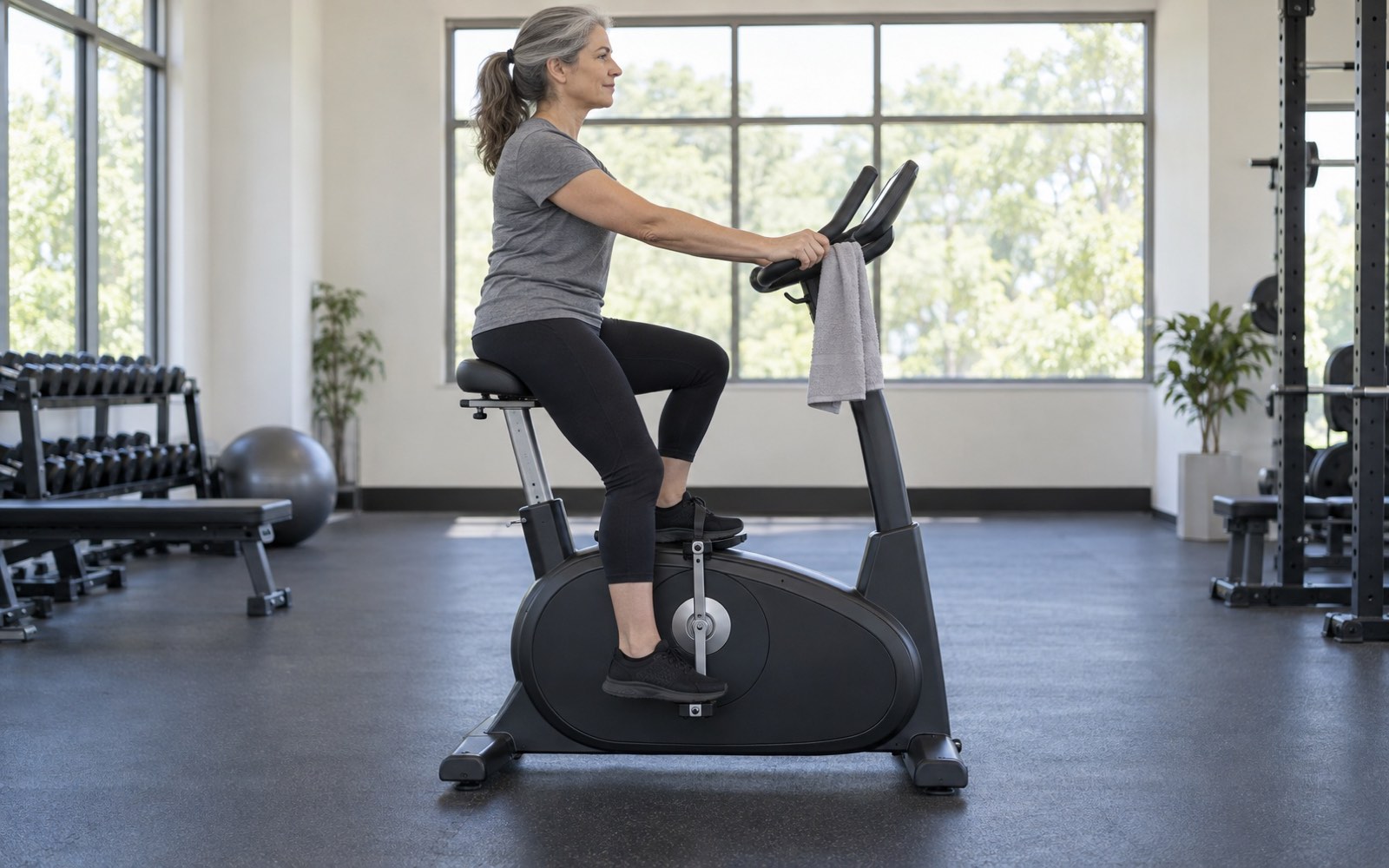
Training for Women After 40: At Home, During Menopause, for Bone Health
Women over 40 need the same strength training 2–3 times a week as men. It matters most of all in the years around your final period, when bone is lost fastest.
Bone during the menopause years. In the US SWAN study (Greendale and colleagues, 2012), researchers tracked bone in 862 women. Density loss began about a year before the final menstrual period and slowed about two years after it. Over ten years, the spine lost 10.6% of its density, and 7.38 of those percentage points happened within that three-year window. The hip's femoral neck lost 9.1% and 5.8% respectively. In other words, roughly 70% of a decade's spine bone loss is packed into about three years. That's a good reason to head into your mid-to-late 40s already in the habit of strength training.
What training does. In the Australian LIFTMOR trial (Watson and colleagues, 2018), 101 women around age 65 with low bone density took part. One group trained under supervision twice a week for 30 minutes over eight months, doing heavy strength work (5 sets of 5 reps at more than 85% of their max) plus a jumping drill with a hard landing. The other group did light exercises at home. Spine density rose 2.9% in the first group and dropped 1.2% in the second.
If you have osteoporosis, see a doctor first, then a trainer experienced with that condition. Everyone else can follow the plan in section 06.
Hot flashes. Train these years for your muscles and bones. Hot flashes, insomnia and severe fatigue are reasons to see a gynecologist.
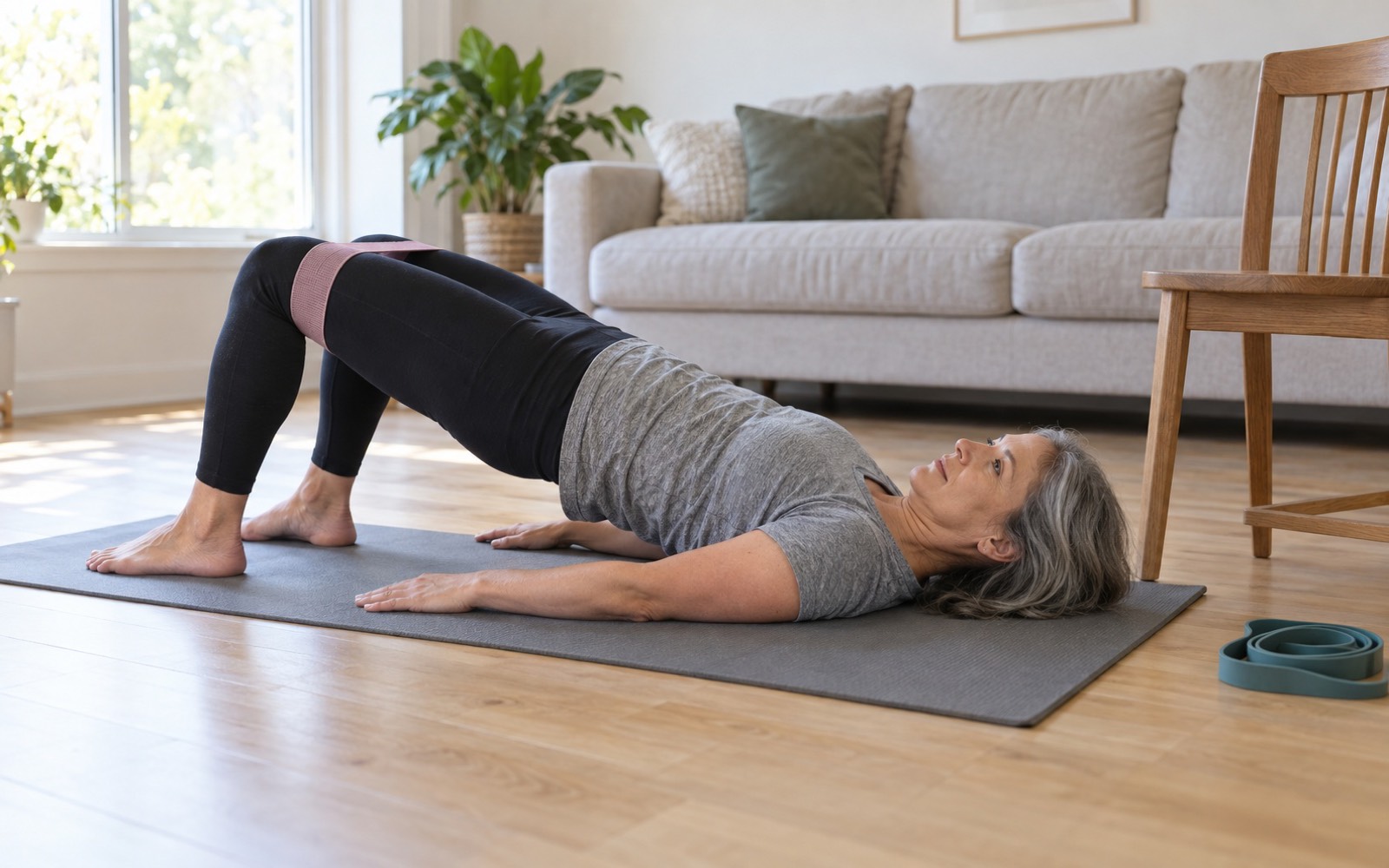
A 15-minute home workout for women over 40 is plan A from section 05 plus a wall sit. Do two circuits, resting 20–30 seconds between exercises and a minute between circuits, two or three times a week:
- Chair squat — 12–15 reps. Tap the seat and stand back up without flopping down.
- Glute bridge — 15 reps. Lying on your back, lift your hips to a straight line from shoulders to knees, pause for a second.
- Push-ups against a table edge — 8–12 reps. Keep your body straight, lower your chest toward the edge.
- Seated resistance band row — 12–15 reps. Sitting down, band under your feet, pull the ends to your waist and squeeze your shoulder blades together.
- Bird dog — 8 reps per side. On all fours, extend opposite arm and leg and hold for 2–3 seconds.
- Wall sit — 20–30 seconds. Back against the wall, knees at a right angle or higher if that's easier on them.
Once it feels easy, add a third circuit, then move to a firmer band. A light morning routine of 5, 10 or 15 minutes works well on the days you're not lifting.
If you leak urine when you cough or jump, mention it to your gynecologist and hold off on jumping until they've checked you out.
Training for Men After 40: Testosterone, Belly Fat, and Common Mistakes
The same approach works for men. The biggest mistake is walking back into the gym and reaching straight for the weights you lifted at 25. For what weight to start with after a long break and how fast your fitness comes back, see our guide to getting back into working out.
Testosterone. In the Massachusetts Male Aging Study (Feldman and colleagues, 2002), researchers followed 1,156 men aged 40–70 for 7–10 years. Over that time, the same men's total testosterone dropped an average of 1.6% a year, and bioavailable testosterone by 2–3%. By our rough math, that's about 15% over a decade. Men in good overall health — without chronic disease, obesity, prescription medications or heavy alcohol use — had androgen levels 10–15% higher. The gap between good and poor health, in other words, is comparable to a decade of aging. Weight and some chronic conditions are things training and diet can influence.
If you notice lower libido, constant fatigue, or muscle loss with no clear cause, see a urologist or endocrinologist — testosterone is checked with a blood test.
Belly fat comes off along with overall body weight, once you eat a bit less than you burn. Keep the core work in the plan anyway — the bird dog and glute bridge protect your back regardless.
Common mistakes after 40, for men and women alike:
- doing only cardio, or only ab exercises;
- pushing through sharp joint pain out of stubbornness;
- copying a young influencer's five-day-a-week program;
- cutting sleep short for early workouts;
- quitting after a missed week. A missed week breaks nothing — pick back up at the same weight, or one step down.
Questions and answers
Is it too late to start working out at 40, 45 or 50 with no experience?
No. Muscle still grows past 50 (section 04), and per the WHO's 2020 guidelines, any physical activity beats none. Start with two strength sessions of one set each and the walking plan from section 06.
Can you run after 40?
Yes, as long as your knees don't hurt and you're not carrying much extra weight. Start with a month of walking, then move to run-walk intervals following the plan in section 07.
How long does it take to recover from a workout at 40?
The NSCA's 2019 benchmark is non-consecutive days: leave at least a day of rest between strength sessions that hit the same muscles. Soreness in the first few weeks is normal and fades on its own. If it makes stairs hard to climb, last time was too much — go back to keeping 3–4 reps in reserve.
What home workout works for women over 40?
One that actually loads the muscles. A morning stretch wakes you up, but muscles and bones need a heavier stimulus. The 15-minute routine in section 09 works well: six exercises, two circuits, two or three times a week.
Is strength training safe during menopause?
Yes, and these are exactly the years it matters most. Per the SWAN study (Greendale, 2012), roughly 70% of a decade's spine bone loss happens within the three years around the final period. In the LIFTMOR trial (Watson, 2018), eight months of supervised heavy strength training raised spine density by 2.9%, while light exercise let it drop 1.2%. If you have osteoporosis, see a doctor first.
Will I lose weight after 40 just from training?
Weight comes off when you burn more calories than you eat, and food creates most of that deficit. Training adds to your energy burn and keeps your muscles working. Metabolism barely changes before 60 (Pontzer, 2021), so age isn't the main obstacle here. To start, track everything you eat for a week and compare it with your calorie target.
What's better after 40: the gym or working out at home?
Both work. The gym makes it easier to add weight steadily; home means no commute. Per the ACSM's 2026 statement, strength improves at home and with bands just as it does with machines and free weights, which deliver similar gains to each other. The NSCA's 2019 statement calls bands and machines a good fit for beginners.
Do you need vitamins or supplements to train after 40?
Not to get started: what training needs is consistency, enough protein in your diet and decent sleep. If you suspect low vitamin D or iron, those are checked with a blood test, and a doctor decides on treatment. We don't prescribe anything.
The bottom line
- Full-body strength training 2–3 times a week on non-consecutive days is the main workout after 40.
- Cardio: 150–300 minutes of moderate activity a week — for example, a 30-minute brisk walk five days a week.
- Month one: work up from one set of 12–15 reps to two or three sets of 10–12, always with at least 2–3 reps in reserve.
- Muscle still grows past 50: strength training adds an average of 1.1 kg (2.4 lb) of lean mass over roughly 20 weeks.
- Metabolism barely changes before 60, so your weight after 40 comes down to food and movement.
- For knee osteoarthritis, exercise reduces pain. Sharp joint pain is a sign to swap the exercise.
Checklist: First Month of Training After 40
- Block off two strength days on your calendar with a rest day between them.
- Answer the three questions in section 02, and see a doctor first if you need to.
- Pick 5–6 gym or home exercises from section 06.
- In week one, do one set of 12–15 reps per exercise.
- Walk briskly for 20–30 minutes on the other days.
- Warm up for 5–10 minutes before every session.
- Log your weights and reps, and only add load once every set finishes with reps in reserve.
- Missed a session? Reschedule it instead of doubling up next time. In the Sportygram app, the virtual coach Alex can move a workout to another day or mark it done for you in chat.
- Chest pain, shortness of breath out of proportion to effort, dizziness or sharp joint pain: stop and see a doctor.
Sources
- Bull F. C. et al. World Health Organization 2020 guidelines on physical activity and sedentary behaviour. British Journal of Sports Medicine, 2020. — 150–300 minutes of moderate activity and strength training on 2+ days a week.
- Fragala M. S. et al. Resistance Training for Older Adults: Position Statement From the National Strength and Conditioning Association. Journal of Strength and Conditioning Research, 2019. — Strength training is safe; 2–3 non-consecutive days, beginners start with one set of 10–15 reps, no training to failure.
- Currier B. S. et al. American College of Sports Medicine Position Stand. Resistance Training Prescription for Muscle Function, Hypertrophy, and Physical Performance in Healthy Adults: An Overview of Reviews. Medicine & Science in Sports & Exercise, 2026. — At least 10 sets a week per muscle for hypertrophy, at least 2 sessions a week for strength.
- Peterson M. D. et al. Influence of resistance exercise on lean body mass in aging adults: a meta-analysis. Medicine & Science in Sports & Exercise, 2011. — After 50, +1.1 kg (2.4 lb) of lean mass over 20 weeks.
- Mitchell W. K. et al. Sarcopenia, dynapenia, and the impact of advancing age on human skeletal muscle size and strength; a quantitative review. Frontiers in Physiology, 2012. — Muscle fades 0.47%/year in men and 0.37%/year in women; strength fades 2–5 times faster.
- Pontzer H. et al. Daily energy expenditure through the human life course. Science, 2021. — 6,421 people: energy expenditure is stable from age 20 to 60.
- Greendale G. A. et al. Bone mineral density loss in relation to the final menstrual period in a multiethnic cohort: results from the Study of Women's Health Across the Nation (SWAN). Journal of Bone and Mineral Research, 2012. — 7.38 of the 10.6 percentage points of 10-year spine bone loss occur within a 3-year window.
- Watson S. L. et al. High-Intensity Resistance and Impact Training Improves Bone Mineral Density and Physical Function in Postmenopausal Women With Osteopenia and Osteoporosis: The LIFTMOR Randomized Controlled Trial. Journal of Bone and Mineral Research, 2018. — Spine density +2.9% vs. −1.2% over 8 months.
- Lawford B. J. et al. Exercise for osteoarthritis of the knee. Cochrane Database of Systematic Reviews, 2024. — Exercise: pain −13 points out of 100, function +12.5 points.
- Feldman H. A. et al. Age trends in the level of serum testosterone and other hormones in middle-aged men: longitudinal results from the Massachusetts male aging study. Journal of Clinical Endocrinology & Metabolism, 2002. — Testosterone −1.6%/year; androgens 10–15% higher with good health.
This article is for informational purposes only and is not a substitute for medical advice.