

5–15 minutes is enough. The main routine is 10 moves in 10 minutes: a stretch, joint mobility, squats, glute bridge, cat-cow, lunges, push-ups, dead bug, marching and slow breathing.For the first hour after waking, skip deep forward bends and twists. A morning routine wakes you up, but not for long. It burns 30–50 calories in 10 minutes and doesn't replace real workouts: the WHO recommends 150–300 minutes of moderate activity a week. A habit takes about 66 days on average, and one missed day doesn't break it.
A morning exercise routine is 5–15 minutes of movement after you wake up. You wake up gently and loosen your joints, then work your big muscles with bodyweight moves, and finish by raising your heart rate a little. In the main 10-minute routine, that's 30 seconds of stretching, 2 minutes for your joints, 6 minutes for your muscles, a minute of marching and 30 seconds of slow breathing. Keep the pace easy enough that you can talk. For the first hour after you get up, skip deep forward bends: your spinal discs soak up water overnight and handle bending worse in the morning. Below you'll find the main 10-minute routine, a short 5-minute version and a longer 15-minute one. Pick yours and start tomorrow.

The 10-minute morning exercise routine
This is the main version, and it works your whole body. It starts by waking up your joints, then works your legs, glutes, back, chest and abs, and finishes by raising your heart rate a little. No equipment needed, just a mat or a rug.
Do the moves in order. Each minute includes a short breather before the next move. If a move is too hard for now, use the easier option in the last column.
| # | Exercise | How much | If it's too hard |
|---|---|---|---|
| 1 | Standing stretch and 3 deep breaths | 30 sec | Stretch lying in bed |
| 2 | Joint mobility: neck, shoulders, hips, knees, ankles | 2 min | Seated in a chair |
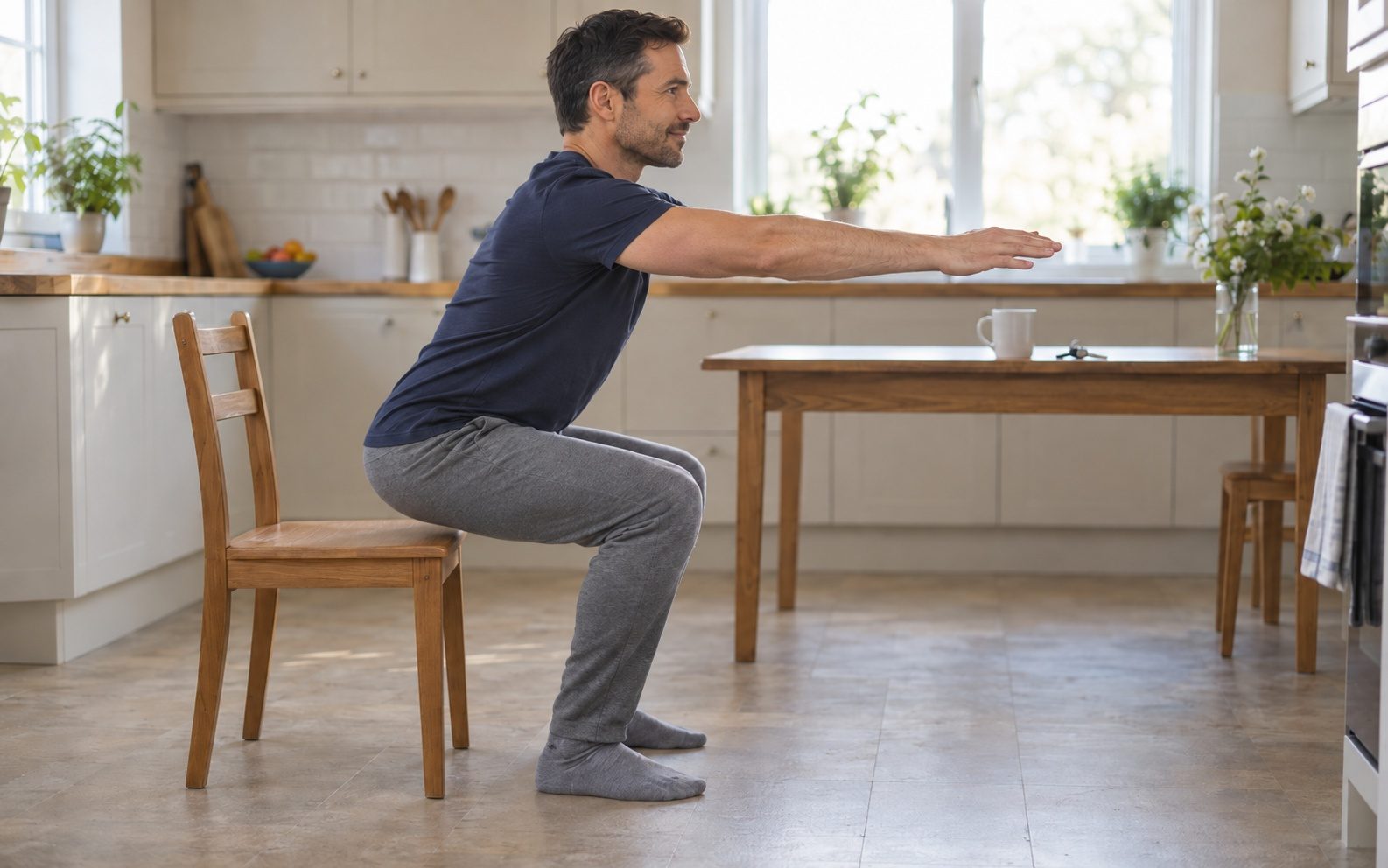
| 3 | Bodyweight squats | 12–15 reps, 1 min | Sit down onto a chair and stand back up |
| 4 | Glute bridge | 12–15 reps, 1 min | Don't lift your hips as high |
| 5 | Cat-cow on all fours, gently | 8–10 reps, 1 min | Standing, hands on a table |
| 6 | Lunges in place | 6–8 per leg, 1 min | Hold the back of a chair |
| 7 | Push-ups | 5–10 reps, 1 min | Hands on a table or a wall |
| 8 | Dead bug | 6 per side, 1 min | Move only your legs |
| 9 | High-knee march | 1 min | Regular marching in place |
| 10 | Slow breathing, standing | 30 sec | — |
If something hurts, make the move smaller or skip it. This isn't the time to set records: you should feel better when you finish than when you started.
Why no crunches? A crunch rounds your lower back, and that's exactly the movement to avoid first thing in the morning. The dead bug works the same ab muscles while your back stays flat on the floor. More on this in section 04.
5- and 15-minute versions: when you're short on time or want more
Overslept? Do the short version. Everything except the bridge is done standing. If getting down on the floor is hard, swap the bridge for calf raises while holding onto a chair.
| # | 5-minute routine | How much |
|---|---|---|
| 1 | Stretch and 3 deep breaths | 30 sec |
| 2 | Joint mobility | 1.5 min |
| 3 | Bodyweight squats | 45 sec |
| 4 | Glute bridge | 45 sec |
| 5 | High-knee march | 1 min |
| 6 | Slow breathing | 30 sec |
Have the time and energy? Do the longer version: the first nine moves of the 10-minute routine, then a second round of the strength moves and a short cardio finisher.
| # | 15-minute routine | How much |
|---|---|---|
| 1–9 | The 10-minute routine without the final breathing | 9.5 min |
| 10 | Squats, second round | 1 min |
| 11 | Glute bridge, second round | 1 min |
| 12 | Lunges in place, second round | 1 min |
| 13 | Push-ups, second round | 1 min |
| 14 | Forearm plank | 20–40 sec |
| 15 | Jumping jacks | 1 min |
| 16 | Slow breathing | 30 sec |
If your downstairs neighbors or your kids are still asleep, swap the jumping jacks for a high-knee march. It still gets your heart rate up, without the noise.
Which version should you pick? The one you'll actually do. Five minutes every day does more for you than fifteen minutes once a week.
Form guide: how to do each move and the most common mistake
How to do each move, plus the mistake people make most often.
- Joint mobility. Slowly tilt your head toward each shoulder and turn it side to side. Then circle your shoulders, hips, knees and ankles, 5–8 times each way. Common mistake: jerky movements and full neck rolls. Don't tip your head back.
- Squats. Feet shoulder-width apart, hips back as if you're sitting in a chair, heels down. Common mistake: knees caving in. Keep them pointed the same way as your toes.
- Glute bridge. Lie on your back with your feet close to your hips. Lift your hips until your knees, hips and shoulders form a straight line, and hold for a second. Common mistake: arching your lower back at the top. Drive up with your glutes, not your lower back.
- Cat-cow. On all fours, hands under your shoulders, knees under your hips. Breathe out and gently round your back, breathe in and slowly arch it. Common mistake: pushing into the deepest arch and round. In the morning, half your range is plenty.
- Lunges in place. One foot forward, one back. Lower yourself until both knees bend to about 90 degrees, torso upright. Common mistake: pushing through the toes of your front foot. Press through your whole foot.
- Push-ups. Hands a bit wider than your shoulders, body in a straight line from head to heels. Common mistake: sagging hips. If you can't hold the line, do them with your hands on a table or a wall.
- Dead bug. Lie on your back, arms up, knees bent over your hips. Slowly lower the opposite arm and leg toward the floor and bring them back. Common mistake: your lower back lifts off the floor. Make the move smaller.
- High-knee march. Bring your knees up to hip height, pump your arms and breathe evenly. Common mistake: slouching and stomping. Keep your back straight and land softly.
The plank in the 15-minute routine follows the same rule as push-ups: a straight line from head to heels. As soon as your hips sag or your lower back starts to ache, end the set.
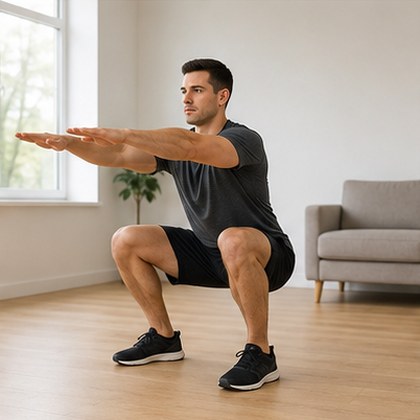 Squats
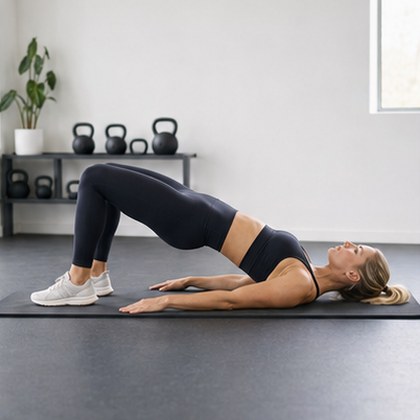 Glute bridge
 Push-ups
The first hour after waking: what to skip and why
Overnight, while you're lying down, the discs between your vertebrae soak up water. In the morning they're fuller and handle bending worse. During the day, as you walk and sit, the extra water gets squeezed out and your back becomes more flexible.
This has been measured. In a 1987 experiment, 21 volunteers could bend their lower backs 5 degrees less in the early morning than in the afternoon. The researchers then simulated a full day of loading on donated spine segments in the lab and combined the two sets of results. Their conclusion: bending forward early in the morning puts about 300% more stress on the discs than later in the day, and about 80% more on the ligaments.
A second study tested the rule in people. It included 85 adults with persistent or recurring lower back pain. One group learned to avoid bending the lower back early in the morning. The other group did six exercises already shown not to help this kind of pain. Six months later, pain in the first group had dropped by about a third, with fewer days in pain and less medication use. When the second group switched to the same rule, their pain went down too.
So here are three rules for your morning routine:
- For the first hour after you get up, don't bend all the way down to the floor, and skip seated twists.
- Do cat-cow gently and in the middle of the routine, once your body is warm.
- Train your abs with the dead bug and plank, not crunches.
You can still put on socks without bending over: sit on the bed and bring your foot up toward you, keeping your back straight.
Swaps for back pain, sore knees or trouble getting down on the floor
Find your situation below and swap the moves.
| If | Instead of | Do |
|---|---|---|
| Your lower back aches, and the pain is familiar and not sharp | Forward bends and wide-range cat-cow | Glute bridge, dead bug, marching |
| Your knees ache | Deep squats and lunges | Squat to a chair, glute bridge |
| Getting down on the floor is hard | Exercises on your back or on all fours | Squat to a chair, wall push-ups, calf raises holding onto a chair |
| Neighbors or kids are asleep | Jumping jacks | High-knee march |
| You want to start right in bed | The whole routine on the mattress | Stretching, ankle circles, knees to chest one at a time, glute bridge; strength moves on the floor |
| High blood pressure, heart disease, or you were sick recently | Any new exercise without talking to your doctor | Start after checking with your doctor, with the 5-minute routine |
| You're older or your balance is unsteady | Lunges and jumping | Everything near something to hold onto: squat to a chair, calf raises, marching in place |
When exercise isn't the answer and you need a doctor:
- Your lower back pain is sharp, shoots down your leg, or your leg or foot goes numb.
- A joint is swollen, hot, or hurts with every step.
- The pain hasn't gone away in weeks or keeps getting worse.
Warning signs for everyone to stop right away: chest pain or pressure, shortness of breath that's worse than usual for this effort, dizziness, or spots in your vision. Stop and sit down. If it doesn't pass after a few minutes of rest, call 911 or your local emergency number.
If your back hurts often, not just in the morning, see our guide to lower back pain exercises.
Benefits of morning exercise: what it really does and what it doesn't
Morning exercise comes with big promises: it revs up your metabolism, burns fat and boosts immunity. Let's check each one.
| The claim | What we know | How we know |
|---|---|---|
| More energizing than coffee | It wakes you up, but not for long. 10 minutes of easy-to-moderate stair walking energized people more than 50 mg of caffeine | 2017 study of 18 college women with chronic sleep loss (source 3) |
| Revs up your metabolism all day | The 10 minutes themselves burn about 30–50 calories. There's no proof your metabolism stays faster all day afterward | 2024 Compendium of Physical Activities (source 6) |
| Helps you lose weight | Barely, on its own. A calorie deficit is what changes your weight | Calculated from the same compendium |
| Replaces a workout | No. The WHO recommends 150–300 minutes of moderate activity a week plus strength training for all major muscle groups 2 or more days a week | WHO guidelines, 2020 (source 4) |
| Boosts immunity | No direct data on morning exercise | We found no studies on morning exercise and immunity specifically |
| A habit in 21 days | About 66 days on average, anywhere from 18 to 254. One missed day doesn't break it | 2010 habit study of 96 volunteers (source 5) |
Where does the 30–50 calorie figure come from? The compendium lists light to moderate bodyweight exercise at 2.8–3.8 times the energy you use at rest. A 154 lb (70 kg) person burns about 33–44 calories in 10 minutes of it. To see how much to cut from your diet to lose weight, work out your calorie deficit.
Here's what morning exercise does give you: less stiffness, a quick boost of energy and 35–70 minutes of light movement over a week. That's short of the WHO minimum, but it's a solid start. Best of all, it's a habit you can later build real workouts on.
Morning routine vs. warm-up vs. workout: what's the difference
People often mix these up, but each has its own job.
| Morning routine | Warm-up | Workout | |
|---|---|---|---|
| Purpose | Wake up, shake off stiffness | Get your body ready for load | Get stronger and fitter |
| When | In the morning after sleep | Right before a workout | Any time that works for you |
| How long | 5–15 minutes | 8–10 minutes | 30–60 minutes |
| Breathing | You can talk easily | A bit faster | Hard to talk at the end of a set |
| What comes next | Shower, breakfast, your day | The main part of the workout | Rest and recovery |
A morning routine doesn't prepare you for heavy weights. If you head to the gym right after it, you still need a warm-up before training with lighter warm-up sets.
Once the 15-minute routine feels easy, your body is ready for more. The next step is 2–3 full home workouts a week, 30–40 minutes each. You can keep the morning routine too: 5 minutes in the morning won't get in the way.
A 4-week plan to make it stick
The easiest way not to quit is to start small and add a little each week.
- Week 1. The 5-minute routine every day. The goal is to show up every day, not to wear yourself out.
- Week 2. 5–7 minutes: add lunges and push-ups to the short version.
- Week 3. The 10-minute routine.
- Week 4. The 10-minute routine plus one move from the 15-minute version: a plank or a second round of squats.
Four rules that keep the habit going:
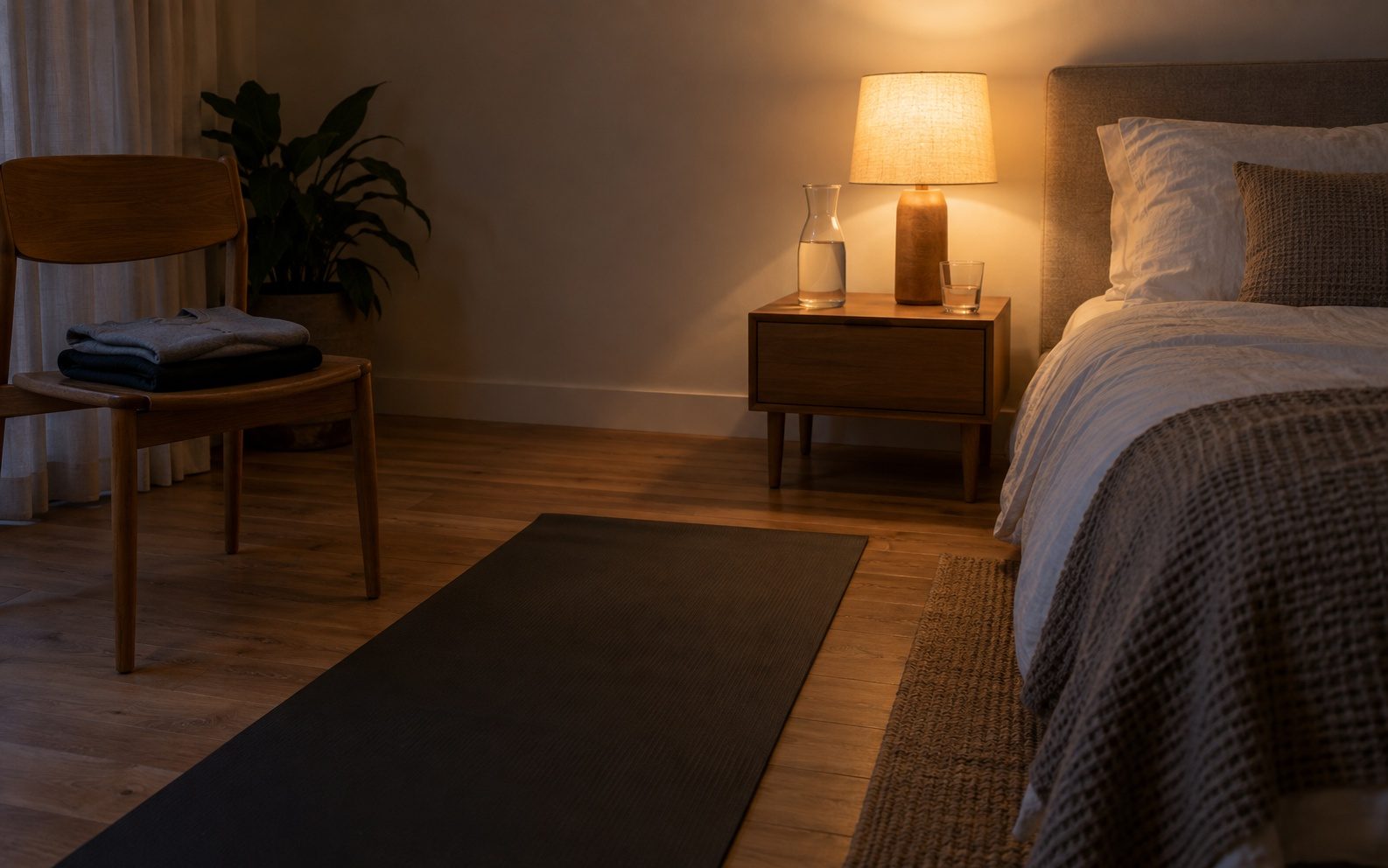
- Put the mat by your bed the night before. In the morning, your spot is ready.
- Use an anchor. Tie the routine to something you already do every morning: get up, drink a glass of water, step onto the mat. If you tend to hit snooze and roll over, put the alarm across the room.
- Have a minimum version. On a rough morning, stretch, roll your shoulders and hips and do ten squats. That's 2 minutes. What keeps a habit alive is showing up, not how long you go.
- Missed a day? Just keep going. In the habit study, one missed day didn't noticeably affect the result. Come back the next morning without trying to make up for it.
And about that timeline: the 21-day rule is a myth. Some people form a habit in under three weeks, others take eight months, and the average is about two months. If you still have to talk yourself into it in week three, you're doing fine. For more ways to keep going, see our guide on how to stay consistent with exercise.
mark every morning you do the routine, with an X on a calendar or in a workout log. You won't want to break a ten-day streak.
What's next: log the routine and build a streak
If you track your training in the Sportygram app, add tomorrow's routine to your workout log: joint mobility, squats, glute bridge and marching in place. In the morning, do the routine and mark the exercises as done.
Days with check marks add up to a streak. The app gives awards for 3, 7, 14 and 30 days in a row. When the routine feels easy, move on to the home workouts from section 07.
FAQ
What happens if you exercise every morning?
Morning stiffness eases, waking up gets easier and you get a short boost of energy. Over a week, you add up 35–70 minutes of light movement. That's short of the WHO minimum of 150 minutes, but it's a good start and a habit you can build workouts on. Just don't expect weight loss or a faster metabolism from the routine alone: 10 minutes burns only 30–50 calories.
Can you exercise right after waking up?
Yes, you can start a light routine as soon as you get up. Move gently for the first few minutes: a stretch, breathing and joint mobility. For the first hour, skip deep bends toward the floor and twists, because your spinal discs soak up water overnight and handle bending worse in the morning. Squats, glute bridges, push-ups and marching are all fine.
Should you exercise on an empty stomach or after breakfast?
A light 5–15 minute routine is fine on an empty stomach. Drinking a glass of water first is up to you. If you feel weak, shaky or dizzy without food, eat something small, like a banana or some yogurt, and wait a bit. Save a big breakfast for after: jumping and squatting on a full stomach doesn't feel good.
Do lymphatic drainage exercises help with swelling?
Routines with this name usually include light moves: marching, calf raises and ankle circles. When your calves work, they push blood and fluid up out of your legs, so movement helps if your legs swell from sitting for a long time. But swelling that lasts all day, swelling in one leg, or swelling with shortness of breath or pain is a reason to see a doctor, not to exercise.
How long should a morning exercise routine be?
5–15 minutes is enough. Five minutes is the minimum that wakes up your joints and muscles. Ten minutes gives you a full-body routine. Fifteen minutes adds a second round of strength moves. You don't need more: the routine is there to wake you up, not to train you. A short routine every day beats a long one once a week. On a rough morning, the 2-minute minimum will do.
Can you do morning exercises in bed?
You can start in bed: stretch, circle your ankles, pull your knees to your chest one at a time and do a glute bridge. It helps if getting up is really hard. Do squats, lunges, push-ups and marching on the floor, though: a mattress is too soft, your knees and feet sink and wobble, and your muscles work less. A mat next to the bed makes the switch easier.
Can you lose weight with morning exercise?
On its own, a morning routine barely affects your weight: 10 minutes of bodyweight exercise burns about 30–50 calories. You lose weight when you use more energy over the day than you get from food. The routine helps indirectly: afterward, it's easier to move more during the day and stick to a schedule. Track calories in a food log, and keep the routine for the energy and the habit.
Is it better to exercise in the morning or at night?
A wake-up routine belongs in the morning: its job is to help you wake up and shake off stiffness after sleep. In the evening, gentle stretching or a walk fits better. For full workouts, pick the time that suits your schedule. We cover this in our guide to the best time to work out. Consistency matters more than the hour.
Do women over 40 need a special morning routine?
No, the same 10-minute routine works. Put extra focus on squats, glute bridges and lunges. They strengthen the muscles that support your knees and hips and help in daily life, like getting up from a chair or climbing stairs. If your knees or back hurt, use the swaps in section 05. With high blood pressure, heart disease or after surgery, ask your doctor first what exercise is right for you.
The bottom line
- A morning exercise routine takes 5–15 minutes: wake up, loosen your joints, work your big muscles and raise your heart rate. Keep the pace conversational.
- The main 10-minute routine: a stretch, joint mobility, squats, glute bridge, cat-cow, lunges, push-ups, dead bug, marching and breathing.
- For the first hour after waking, skip deep forward bends and twists: bending forward early in the morning puts about 300% more stress on your discs than later in the day.
- A morning routine wakes you up for a short time, burns 30–50 calories in 10 minutes and doesn't replace workouts. The WHO recommends 150–300 minutes of moderate activity a week and strength training 2 or more days a week.
- A habit takes about 66 days on average. Start with 5 minutes, keep a mat by your bed and don't quit over a missed day.
Checklist: your routine for tomorrow
- The night before: mat by the bed, a glass of water nearby.
- You've picked a version: 5, 10 or 15 minutes.
- The exercises are in tomorrow's workout log or on your calendar.
- Your alarm is placed so you have to get up to turn it off.
- In the morning: no deep forward bends for the first hour, and a pace where you can talk.
- On a rough morning: the 2-minute minimum version instead of skipping.
- After the routine: mark it done in your log.
Sources
- Adams M. A., Dolan P., Hutton W. C. Diurnal variations in the stresses on the lumbar spine. Spine, 1987. — In 21 volunteers, the lower back bent 5 degrees less in the early morning than in the afternoon; experiments on cadaver spine segments showed that bending forward early in the morning puts about 300% more stress on the discs and about 80% more on the ligaments.
- Snook S. H. et al. The reduction of chronic nonspecific low back pain through the control of early morning lumbar flexion. A randomized controlled trial. Spine, 1998. — 85 people with persistent or recurring lower back pain: avoiding lower back bending early in the morning reduced pain intensity (point estimate about 33%), total days in pain and medication use.
- Randolph D. D., O'Connor P. J. Stair walking is more energizing than low dose caffeine in sleep deprived young women. Physiology & Behavior, 2017. — 18 college women sleeping less than 45 hours a week: 10 minutes of low-to-moderate intensity stair walking was more energizing than 50 mg of caffeine; the effect was temporary.
- Bull F. C. et al. World Health Organization 2020 guidelines on physical activity and sedentary behaviour. British Journal of Sports Medicine, 2020. — For adults: 150–300 minutes of moderate activity a week and muscle-strengthening activity for all major muscle groups 2 or more days a week. WHO fact sheet: who.int.
- Lally P., van Jaarsveld C. H. M., Potts H. W. W., Wardle J. How are habits formed: Modelling habit formation in the real world. European Journal of Social Psychology, 2010. — 96 volunteers repeated a new daily behavior for 12 weeks; it became automatic in about 66 days on average, ranging from 18 to 254; missing one day did not materially affect the process.
- Herrmann S. D. et al. 2024 Adult Compendium of Physical Activities: A third update of the energy costs of human activities. Journal of Sport and Health Science, 2024. — A reference of energy costs: light to moderate bodyweight calisthenics uses 2.8–3.8 times the energy of rest.
This material is for informational purposes and does not replace medical advice.