

in Campos's 2020 measurements, the seated press worked the front delt at 33.3% of maximal effort, and the bench press at 21.4%. The side delt worked at 30.3% in lateral raises, 27.9% in the seated press and only 5% in the bench press. According to Rabello's 2024 review, pull-ups and rows load the rear delt the most.For muscle growth, the 2026 ACSM position stand recommends 10 or more sets per muscle per week, and it's easiest to count them together with your presses and rows. Your traps take over less of the work in lateral raises if you lift your arms only to shoulder height and don't turn your thumb down.
Deltoid exercises are chosen for the three heads of your shoulder muscle, and each head has its own main movement. The seated dumbbell press loads the front delt hardest, lateral raises work the side delt, and the rear delt gets the most from the bent-over reverse fly, the reverse pec deck and the cable face pull. Rows and pull-ups also train the rear delt along the way, and the bench press and push-ups do the same for the front delt. To grow, your shoulders need about 10 sets per week for each head, and the easiest way to get there is across two workouts. A beginner needs only three shoulder exercises in each of them: a press, a lateral raise and one rear delt movement. Start your lateral raises light: 2 kg (4.5 lb) dumbbells for women and 4 kg (9 lb) for men.
The best deltoid exercises: a short answer for each head
The best deltoid exercises are the overhead press for the front delt, lateral raises for the side delt, and the bent-over reverse fly together with rows for the rear delt.
This choice rests on electromyography. Sensors on the skin record a muscle's electrical signal, and it's expressed as a percentage of the signal during a maximal effort. The higher the percentage at the same weight and number of reps, the more load that head is getting. Three studies give the main picture:
- In 2020, Campos and colleagues compared four exercises in 13 trained men: the seated press, lateral raises, the bench press and the flat dumbbell fly. Each was done as one set of 12 reps at 60% of the one-rep max.
- In 2020, Coratella and co-authors compared lateral raises with different arm rotations, bent-elbow lateral raises and front raises in 10 competitive bodybuilders. Every exercise was done seated, with a weight they could lift for 8 reps.
- In 2024, Rabello and colleagues pooled 33 electromyography studies in a systematic review and ranked the exercises by where each head works hardest.
| Head | Best exercises | Why, according to the measurements | At the gym | At home |
|---|---|---|---|---|
| Front | seated dumbbell press, military press, machine shoulder press | 33.3% in the seated press versus 21.4% in the bench press (Campos, 2020) | seated dumbbell press, machine press | seated dumbbell press on a chair, pike push-ups |
| Side | lateral raises with a neutral arm, cable lateral raises | 30.3% in lateral raises, 27.9% in the seated press (Campos, 2020); with a neutral arm the side delt worked harder than with the arm turned out or the elbows bent (Coratella, 2020) | dumbbell lateral raises, single-arm cable lateral raises | dumbbell or band lateral raises |
| Rear | bent-over reverse fly, reverse pec deck, cable face pull, rows, pull-ups | pull-ups and rows give the rear delt its highest activation (Rabello, 2024); on the reverse pec deck, a neutral grip works it harder (Schoenfeld, 2013) | reverse pec deck, face pull, chest-supported incline reverse fly | bent-over dumbbell reverse fly, bent-over dumbbell row, band pull-apart |
What this means for you: the bench press and rows already give your front and rear delts some of their work, while your side delt, the one that decides how wide your shoulders look, gets almost nothing from them. That's why nearly everyone needs lateral raises.
What the deltoid is made of: front, side and rear delts and what each one does
The deltoid is one muscle with three heads: the front head raises your arm forward, the side head lifts it out to the side, and the rear head pulls it back.
All three heads attach to the same bump on the outside of your upper arm bone, roughly halfway down. They start in different places: the front head on the collarbone, the side head on the acromion, the bony point at the very top of your shoulder, and the rear head on the spine of the shoulder blade. So each head pulls your arm in its own direction, and there's no single exercise that loads all three equally. Beneath the deltoid lie the rotator cuff muscles. They hold the head of the upper arm bone in the joint and turn your arm in and out, and we'll come back to them in the section on pain.
| Head | What movement it makes | Where you feel it during exercises | What it does for how you look |
|---|---|---|---|
| Front | raises the arm forward and up, helps in every press | front of the shoulder, near the collarbone | a rounded shoulder from the front |
| Side | lifts the arm out to the side | the side of the shoulder, at its very top | shoulder width when you look in a mirror from the front |
| Rear | pulls the arm back, turns it outward, helps your back in rows | back of the shoulder, above the armpit | fullness of the shoulder from the side and back |
When people say "I want wider shoulders," they almost always mean the side delt. It sticks out over the arm and makes your silhouette wider. Most people's front delts already get plenty of work, since every press from the chest and overhead loads them. The rear delt is small and gets the least attention of the three, which is why so many people end up looking for rear delt exercises specifically.
Front delt exercises: are presses enough?
In most cases, the overhead press and the bench press load your front delt enough, and separate front raises are rarely needed.
In Campos's 2020 study, the front delt worked at 33.3% of maximal effort in the seated press. That's more than in any other exercise they measured. In the bench press, lateral raises and the flat fly, the numbers were 21.4%, 21.2% and 18.8%, and they didn't differ significantly from each other. So the front delt's signal in the bench press is about a third weaker than in the overhead press, but it's still noticeable. That's why, in the count in section 07, we credit the bench press with half a set for the front delt.
Rabello's 2024 review turned up an unexpected detail. The front delt worked hardest in horizontal adduction, when you bring your arms together in front of you, and the top individual exercise was the incline dumbbell fly. That's an upper chest exercise in which the front delt helps bring your arms together. If you do it on chest day, your front delt is working there too.
Exercises for the front delt:
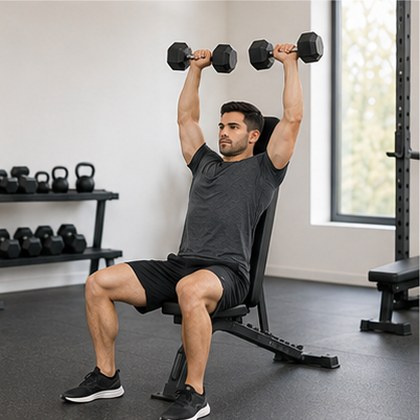
- Seated dumbbell press. Bench back set to 75–90°, the dumbbells go up from your shoulders, elbows slightly in front of your body, and you lower the dumbbells to ear level. The main mistake is arching your lower back so your pelvis slides away from the bench back. Step-by-step form, the bench angle and a weight plan are covered in our guide to the seated dumbbell shoulder press.
- Barbell military press. Standing, the bar travels from your upper chest to overhead. Your head moves back slightly to let the bar pass and comes back under it at the top. The main mistake is leaning back and finishing the rep with your lower back. Grip, bar path and a weight plan are in our overhead press guide.
- Seated machine shoulder press. The machine holds the path for you, so it's an easier place for a beginner to start in the first weeks. The main mistake is lowering the handles far below your shoulders with a heavy weight.
- Arnold press. The dumbbells start at your chin with your palms facing you, and you turn your palms forward on the way up. The main mistake is using the same weight as in a regular press: the rotation makes it harder.
- Dumbbell or plate front raise. Standing, elbows slightly bent, you lift the weight to shoulder height. In Coratella's 2020 study, the front delt worked harder in the front raise than in any lateral raise variation, and the side and rear delts worked least of all. The main mistake is swinging your body.
- Push-ups. They load the chest, triceps and front delt almost like the bench press. Pike push-ups, with your hips up, are closer to an overhead press.
Dumbbells or a barbell — go with whatever feels comfortable. The 2026 ACSM position stand found no consistent difference in results between types of equipment. In Saeterbakken's 2013 measurements in 15 men, the front delt's signal in the barbell press was about 11% lower than with dumbbells when pressing seated, and 15% lower when standing. The difference is small, and dumbbells have their own advantage: each arm works on its own, so your weaker side can't hide behind the stronger one.
Front raises make sense when your front delt is clearly lagging or when your program has no presses at all. Otherwise, they just take time away from your side and rear delts.
Side delt exercises: what makes your shoulders wider
The side delt grows best from dumbbell lateral raises with a neutral arm position and from their cable and seated variations.
A neutral position means your arm isn't rotated in or out: your palm faces the floor and your thumb points forward. In Coratella's 2020 study, the side delt worked harder in lateral raises with a neutral arm than with the arm turned out, with the elbow bent, and in the front raise. Lateral raises with the arm turned in, thumb pointing down as if you were pouring water from a jug, activated the rear delt, triceps and upper traps more than any other variation. The side delt worked about the same in them as with a neutral arm: the authors found no significant difference.
In Rabello's 2024 review, the top exercise for the side delt turned out to be exactly that raise with the arm turned in. So the "pouring jug" loads the side delt heavily, but it also gives your traps more work. The neutral position is a sensible middle ground: the side delt works just as well, and your traps stay calmer.
The overhead press helps the side delt too. In Campos's 2020 study, it worked at 30.3% in lateral raises and 27.9% in the seated press, and both numbers were significantly higher than in the bench press. So the press credits the side delt with half a set. It still doesn't replace lateral raises: the front delt takes most of the work in a press, and the side delt ends up with too few sets.
Exercises for the side delt:
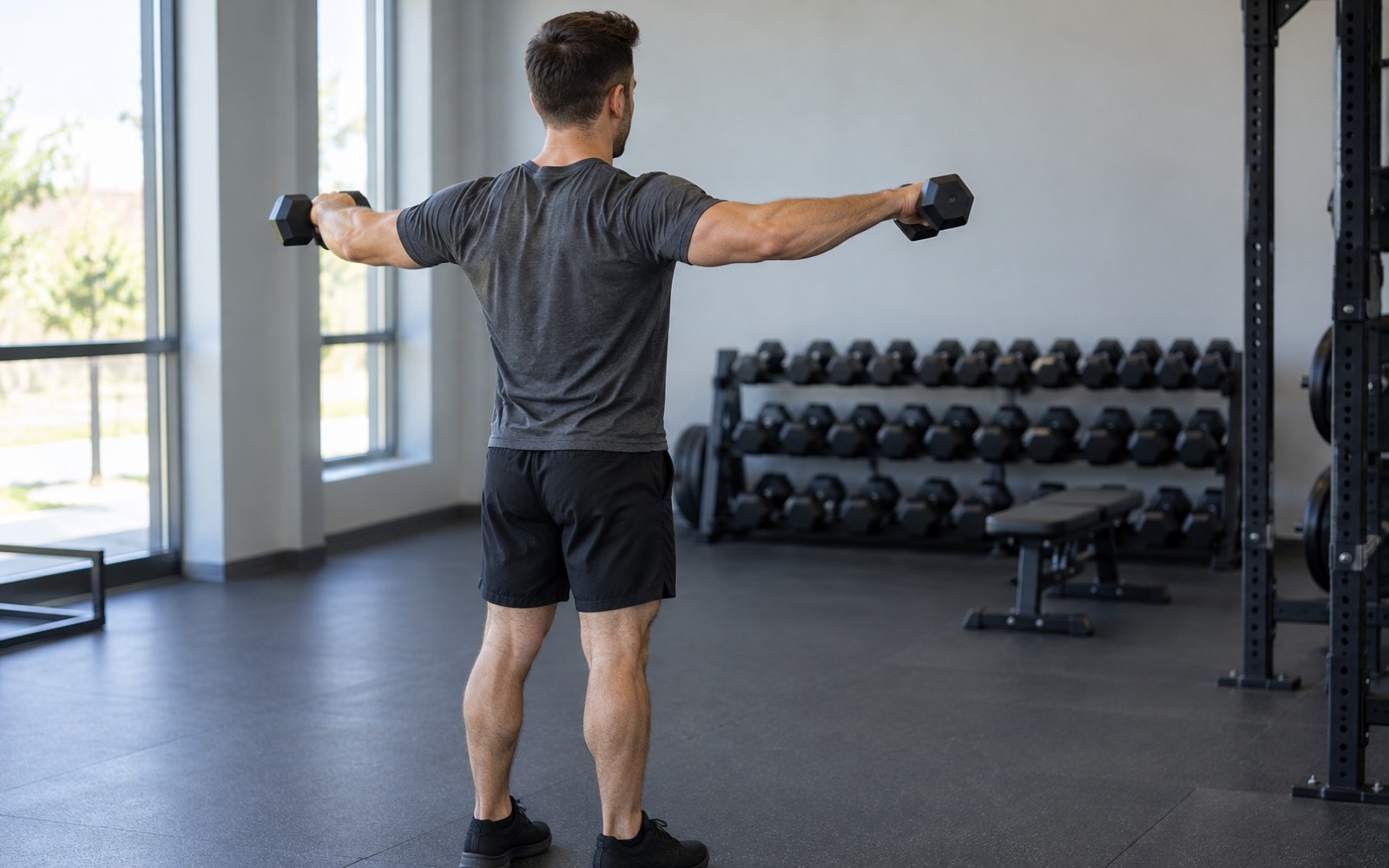
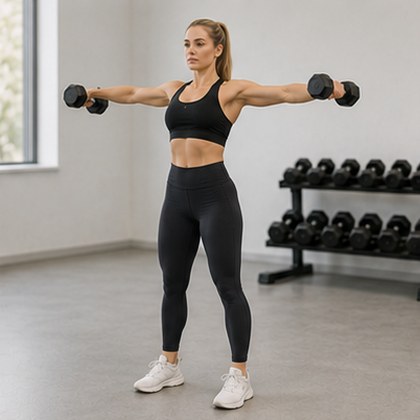
- Standing dumbbell lateral raise. Feet hip-width apart, elbows slightly bent, you raise the dumbbells out to the sides to shoulder height, with your elbow a little higher than your hand, and lower them over 2 seconds. The main mistake is jerking your body and using dumbbells that are too heavy. Lateral, bent-over and front raises are broken down step by step in our lateral raises guide.
- Seated lateral raise. You sit on the edge of a bench, so your body can't help. A good option if you tend to toss the dumbbells up when you do lateral raises standing.
- Single-arm cable lateral raise. Stand side-on to a low pulley with the handle in your far hand, and raise your arm out to the side to shoulder height. The cable keeps tension at the bottom too, where a dumbbell hardly loads your shoulder at all. It's also handy if the jump to the next dumbbell feels too big: the weight steps on a cable stack are smaller.
- Bent-elbow lateral raise. Your elbows are bent at a right angle, and you lift them out to the sides. This lets you use a heavier weight, but in Coratella's 2020 study the side delt worked less in this variation than in regular lateral raises with a neutral arm.
- Barbell upright row. Standing, the bar travels up along your body, led by your elbows. In 2013, McAllister and colleagues compared three grip widths in 16 trained men: 50%, 100% and 200% of shoulder width. The wider the grip, the harder the deltoid and traps worked and the less the biceps did. If you do upright rows, use a wide grip and raise your elbows only to shoulder height. For a beginner, cable lateral raises are an easier substitute.
Rear delt exercises: reverse flies, face pulls and why rows count too
The best rear delt exercises are the bent-over dumbbell reverse fly, the reverse pec deck and the cable face pull, while horizontal rows and pull-ups add work along the way.
Why rows count too. In Rabello's 2024 review, the rear delt worked hardest in pull-ups. The top individual exercises were regular pull-ups and the suspension trainer row, where you hang almost horizontally under the straps and pull yourself up to them. The rear delt pulls your arm back, so it helps your back in every row to your waist or chest. The main muscle in rows is still your back, so in the count in section 07, a row gives the rear delt half a set. The practical takeaway is simple: if your week has 6–8 sets of rows, you need less separate rear delt work than many programs suggest.
Lateral raises hit the rear delt too. In Campos's 2020 study, it worked at 24% in lateral raises, 11.4% in the seated press and 3.5% in the bench press. So we credit lateral raises with half a set for the rear delt, and presses with nothing.
Grip changes the load. In 2013, Schoenfeld and colleagues tested the reverse pec deck in 19 trained men using about 75% of their body weight. They compared two grips: palms down and neutral, with palms facing each other. With the neutral grip, the rear delt and the infraspinatus, one of the rotator cuff muscles, worked significantly harder. What this means for you: on the machine, use the vertical handles, and in dumbbell reverse flies keep your palms facing each other.
Exercises for the rear delt:
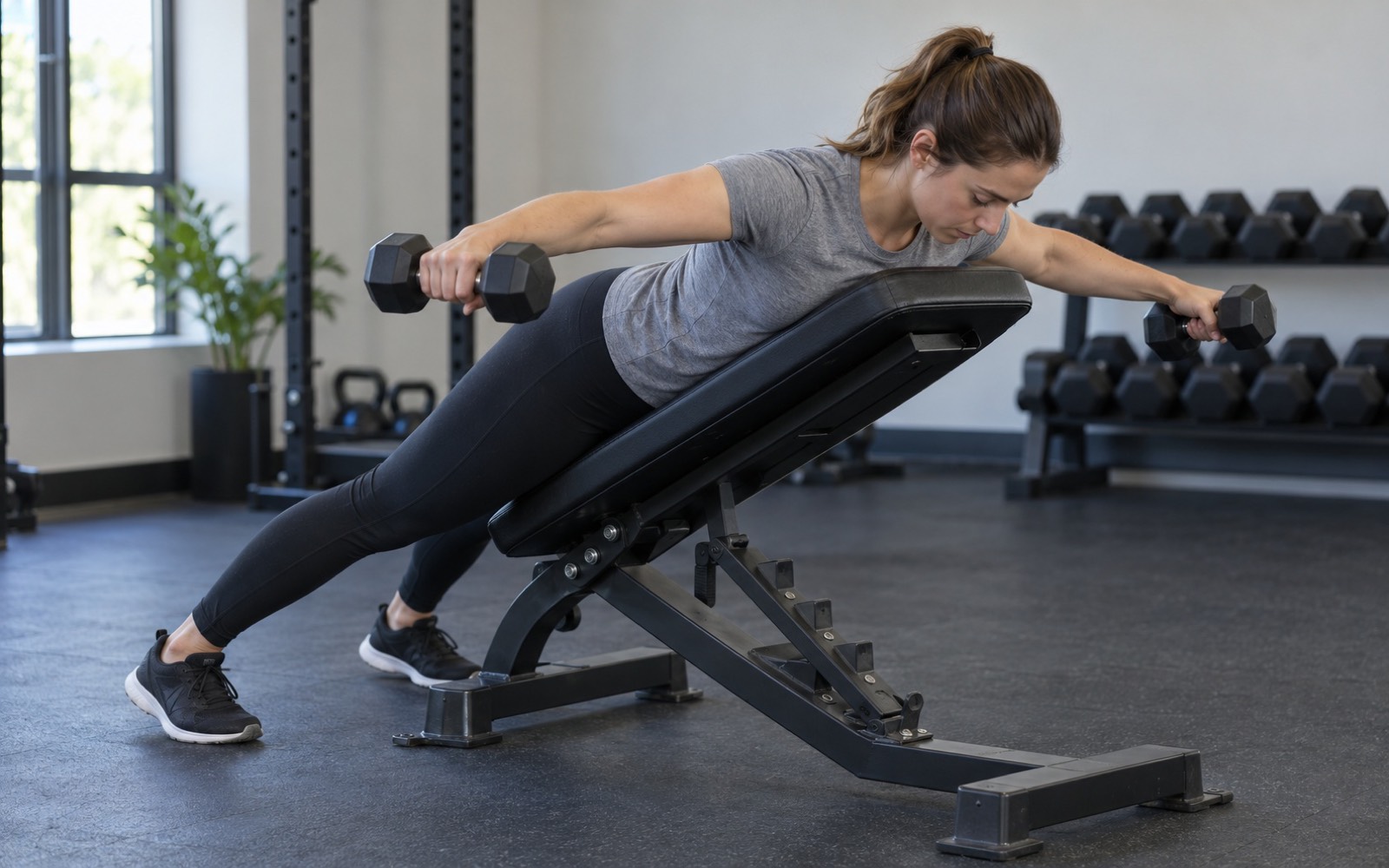
- Standing bent-over dumbbell reverse fly. Knees slightly bent, torso tilted almost parallel to the floor, back flat, dumbbells hanging under your shoulders with your palms facing each other. Spread your arms out to the sides to shoulder level, elbows slightly bent. The main mistake is squeezing your shoulder blades together and helping with your body.
- Seated bent-over reverse fly. Sit on the edge of a bench with your chest almost resting on your thighs and the dumbbells under your knees. Your body can't help, and your lower back gets a rest.
- Chest-supported incline reverse fly. Set the bench back to 30–45° and lie on it chest-down with your arms hanging. This is the best option for beginners and for anyone whose lower back gets tired: the bench supports your torso, and only your arms work.
- Reverse pec deck (also called the reverse fly machine). Sit facing the pad, take the vertical handles and spread your arms back to shoulder level. The main mistake is lifting your chest off the pad.
- Single-arm cable reverse fly. Stand facing a pulley set at shoulder height, take the cable in your opposite hand and pull your arm out to the side and back. The main mistake is rotating your body along with your arm.
- Cable face pull. With a rope on a pulley at face height, pull the ends toward your ears, elbows out to the sides at shoulder height, hands by your temples at the end. We don't give activation numbers for this exercise. In terms of movement, it's horizontal abduction with a neutral grip, and in that movement the rear delt works hard, according to Rabello 2024 and Schoenfeld 2013. The main mistake is pulling the rope down to your chest: then your biceps and lats take over.
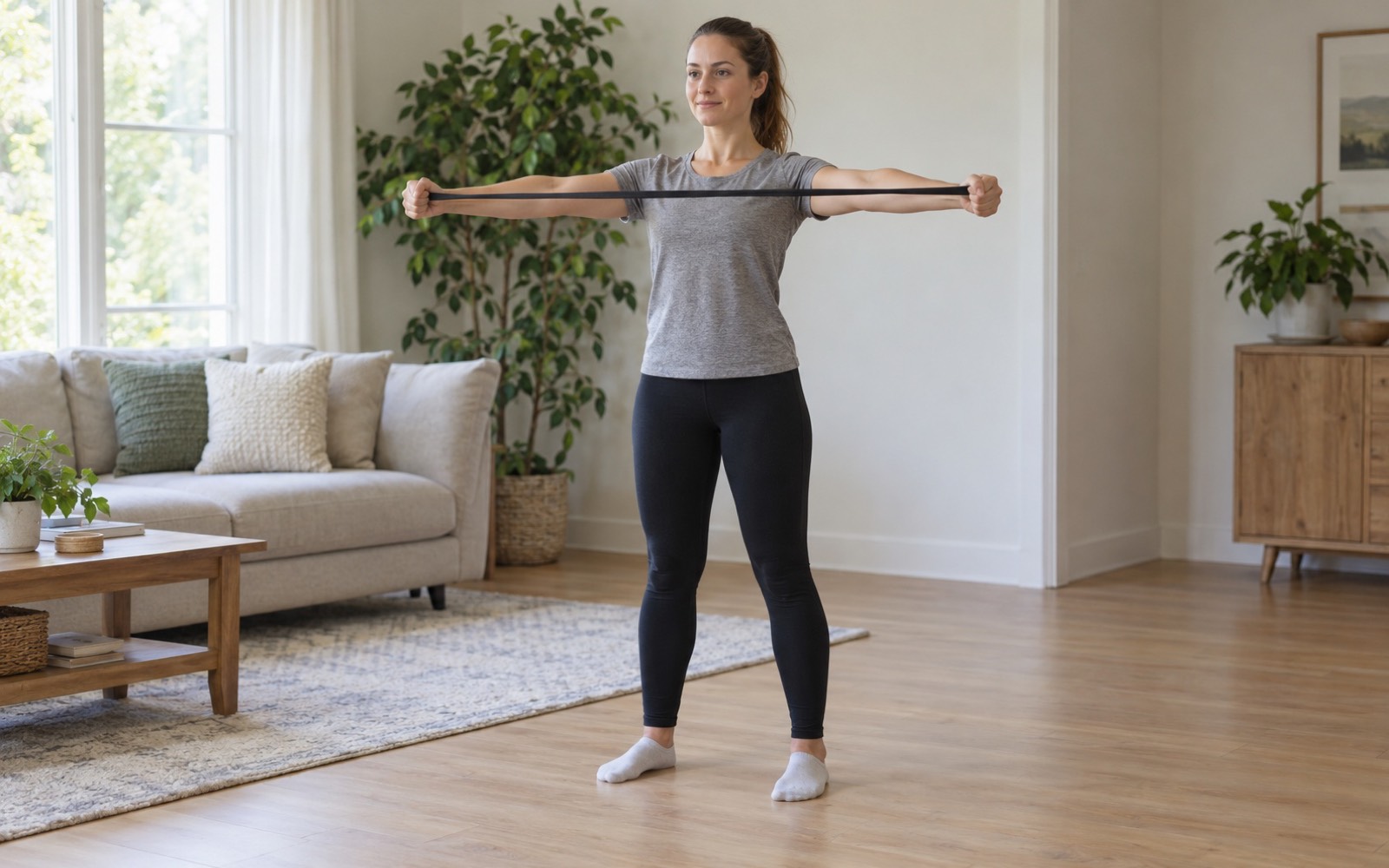
- Band pull-apart at home. Hold a band in front of you at chest height with straight arms and stretch it out to the sides to shoulder level.
The main mistake in rear delt work is squeezing your shoulder blades. When your shoulder blades slide toward your spine, the rhomboids and middle traps take over. You feel fatigue between your shoulder blades, and the rear delt barely works. Keep your shoulder blades in place and spread your arms only to shoulder level: past that point, the movement continues through your shoulder blades. The weight for rear delts is almost always lighter than you'd like. A beginner usually needs only 2–3 kg (4.5–6.5 lb) dumbbells for women and 4–6 kg (9–13 lb) for men, as in the plan in section 09.
Reverse fly or face pull. You don't have to pick one, since both are useful. With the reverse fly it's easier to control the weight, and you don't need a machine. The face pull is convenient at the gym and also loads the muscles that rotate your arm outward. A good setup is one of these exercises in each of your two weekly workouts.
Rear delts and posture. A strong rear delt is useful if you sit a lot with your shoulders rolled forward. But it won't fix slouching on its own: your posture depends on habits, furniture and how long you sit in one position.
How to train shoulders without your traps taking over
To keep your traps from taking over, raise your arms only to shoulder height, keep your thumb pointing forward or slightly up, drop your shoulders before each rep and use lighter dumbbells.
Why the traps kick in. When your arm rises to the side, your shoulder blade rotates upward with it, and your upper traps are part of that. So you can't switch your traps off completely in lateral raises, and you don't need to try. The goal is for them to help your delts without taking over the lift. If you raise your arm above shoulder height, lifting your shoulder toward your ear gets added to that rotation, and your traps get even more work. That's why lateral raises above shoulder height end up loading your neck. The second culprit is turning your arm in. In Coratella's 2020 study, thumb-down raises activated the upper traps more than any other variation. The third is heavy dumbbells: when your delt can't handle the load, you shrug the weight up.
Why stop at horizontal. In 2014, Kolber and colleagues examined 154 shoulders in 77 men. 46 of them lifted weights at least twice a week, and 31 didn't train at all. Signs of impingement, meaning tendons getting pinched under the acromion when you lift your arm, were significantly more common among the men who lifted. These signs were linked to lateral raises and upright rows above 90°. It's an observational study, so it shows a link and doesn't prove cause. The authors still advise not raising your arms above horizontal in these exercises.
What to do in lateral raises:
- Height. Arms to shoulder level, no higher. A guide: elbows at shoulder height, hands at the same level or slightly below.
- Arm position. Your thumb points forward or slightly up. If you're used to "pouring the jug," bring your arm back to neutral.
- Shoulders down. Before each rep, drop your shoulders away from your ears. Keep your neck long, as if someone is pulling you up by the top of your head.
- Arms slightly in front of your body. Raise your arms a little forward of your body line, about 30°. That way your arm moves in the plane of your shoulder blade, and your shoulder joint has more room.
- Weight. If your shoulders creep toward your ears on the last reps, the dumbbells are too heavy. Go one step lighter.
- Tempo. Lift over 1–2 seconds and lower over 2, without jerking your body.
put your phone on a shelf and film yourself from the front during a set of lateral raises. Look at the distance between your shoulder and your ear at the bottom and at the top. If it's noticeably smaller at the top, your traps are taking over. Do the next set with dumbbells 1 kg (2 lb) lighter and start every rep by dropping your shoulders. That's often enough to move the load out of your neck and into the side of your shoulder.
For women worried about a "wrestler's neck." Your traps work in lateral raises at any weight, because they rotate your shoulder blade. The real problem is when they take over the lift and your shoulders creep toward your ears. If your neck gets tired after lateral raises and your shoulders barely feel anything, the problem is your form: your arms go above shoulder height, your shoulders creep toward your ears, or the dumbbells are too heavy. Fix your form using the list above, and the load will move into your delts.
How many sets for delts per week and how to count them
To grow, your delts need about 10 sets per week for each head, and you should count them together with your presses and rows: a direct set counts in full, and an indirect set counts as half.
Where the numbers come from. The 2026 position stand from the American College of Sports Medicine (ACSM) pooled 137 systematic reviews with more than 30,000 participants. For muscle growth, it recommends 10 or more sets per muscle per week. In Schoenfeld's 2017 meta-analysis, each additional weekly set added 0.37% to muscle growth. Pelland's 2026 meta-regression of 67 studies and 2,058 participants refined the picture: muscles grow more as volume goes up, but each additional set adds less than the one before. And here's the key point for counting: the method that best predicted results was the one that counts an indirect set as half. An indirect set is a set of an exercise where the muscle works noticeably but isn't the main one. For example, the front delt in the bench press.
Set accounting. Below is our table of how much each exercise credits each head. 1 means the head is the main one in that exercise, 0.5 means it works noticeably but isn't the main one, and 0 means it barely works. These coefficients are our rounding based on Campos 2020, Coratella 2020 and Rabello 2024. No single study gives these exact numbers.
| Exercise | Front | Side | Rear | Based on |
|---|---|---|---|---|
| Seated dumbbell press, military press, machine press, Arnold press | 1 | 0.5 | 0 | Campos: 33.3 / 27.9 / 11.4% |
| Bench press, push-ups | 0.5 | 0 | 0 | Campos: 21.4 / 5 / 3.5% |
| Dumbbell, cable and seated lateral raises | 0.5 | 1 | 0.5 | Campos: 21.2 / 30.3 / 24% |
| Dumbbell or plate front raise | 1 | 0 | 0 | Coratella: highest front delt activation, lowest side and rear |
| Wide-grip upright row | 0.5 | 1 | 0 | McAllister: the deltoid as a whole; the split by head is our assumption |
| Bent-over reverse fly, reverse pec deck, face pull | 0 | 0.5 | 1 | Rabello: the side delt also works hard in horizontal abduction |
| Rows, pull-ups, lat pulldown | 0 | 0 | 0.5 | Rabello: highest rear delt activation, but the main muscle is the back |
Example: two gym workouts.
- Workout A: bench press 3 sets, seated cable row 3, seated dumbbell press 3, lateral raises 2, bent-over reverse fly 2.
- Workout B: lat pulldown 3, machine shoulder press 3, push-ups 2, cable lateral raises 2, face pulls 2.
Counting with the table:
| Head | Workout A | Workout B | Per week |
|---|---|---|---|
| Front | bench press 1.5 + seated press 3 + lateral raises 1 = 5.5 | machine press 3 + push-ups 1 + lateral raises 1 = 5 | 10.5 |
| Side | seated press 1.5 + lateral raises 2 + reverse fly 1 = 4.5 | machine press 1.5 + lateral raises 2 + face pulls 1 = 4.5 | 9 |
| Rear | cable row 1.5 + lateral raises 1 + reverse fly 2 = 4.5 | lat pulldown 1.5 + lateral raises 1 + face pulls 2 = 4.5 | 9 |
There are 14 direct shoulder sets per week here: 6 sets of presses, 4 of lateral raises and 4 for the rear delt. Yet each head gets credit for 9 to 10.5 sets. From week three of the plan in section 09, lateral raises and rear delt exercises go up to 3 sets, and the credited sets rise to 11.5–12 per head. You don't need a separate "shoulder day" for this.
What follows from this. If you bench and do rows, your front and rear delts need less separate work than your side delt. The side delt gets almost nothing from the bench press and rows, so lateral raises are a must in your program.
How often to train shoulders. Twice a week. In Schoenfeld's 2016 meta-analysis, muscles grew more with higher training frequency: an effect size of 0.49 versus 0.30. The authors recommend training major muscle groups at least twice a week. Pelland 2026 adds that at the same weekly volume, frequency barely affects muscle growth but does help strength. In practice, two workouts are convenient because you don't have to do all 10–12 sets in one go. For the same reason, training shoulders every day makes no sense: it adds almost nothing to growth, and your shoulders already work in every press and row.
How many reps and what weight: heavier presses, lighter raises
Do presses for 8–12 reps and lateral raises and reverse flies for 12–20, and end each set with 1–3 reps left before failure.
Why the ranges differ. In 2017, Schoenfeld, Grgic and colleagues pooled 21 studies that compared light loads, up to 60% of one-rep max, with heavy ones. When sets were taken to failure, muscles grew the same, while maximal strength grew more with heavy loads. So you can choose the rep range to suit the exercise. A press involves several muscles and two joints, it's easy to add weight to, and 8–12 reps work well for it. In lateral raises and reverse flies, the dumbbell hangs at the end of a nearly straight arm, and the same weight loads your shoulder much more than in a press. With heavy dumbbells, lateral raises turn into body swinging and trap work, so 12–20 reps with a light weight are better there.
Failure. You don't have to take your sets to failure. In the 2026 ACSM position stand, training to failure gave no consistent difference in results. Stop when you have 1–3 reps left and your form is still clean.
Rest. 1.5–2 minutes for presses and about a minute for lateral raises and reverse flies. This is our own practice: light single-muscle exercises need less time for the next set to be a full one.
What weight to start with. Weight per dumbbell:
| Exercise | Women | Men | Starting sets × reps |
|---|---|---|---|
| Seated dumbbell press | 4 kg (9 lb) | 8 kg (17.5 lb) | 3 × 10 |
| Lateral raises | 2 kg (4.5 lb) | 4 kg (9 lb) | 2 × 12 |
| Bent-over reverse fly | 2 kg (4.5 lb) | 4 kg (9 lb) | 2 × 12 |
| Cable lateral raises, face pulls | a weight you can do 15 clean reps with | the same | 2 × 12–15 |
Day-one test. Do one set with this weight. If every rep was clean, your arms reached shoulder height and your shoulders didn't creep toward your ears, the weight is right for you. If you had to swing your body through the last reps, go lighter: for lateral raises, 1–1.5 kg (2–3 lb) dumbbells for women and 3 kg (6.5 lb) for men. If you easily did 15 or more, go one step heavier.
For women: what changes. The exercises are the same, and only the weight changes. In Roberts's 2020 meta-analysis, relative muscle growth in men and women didn't differ: an effect size of 0.07, a non-significant difference. Women's relative upper-body strength actually grew faster than men's: an effect size of −0.60 in women's favor. What this means for you: the plan in section 09 works the same way, and the women's dumbbells in it are about half as heavy. Muscles grow slowly, so in 8 weeks your shoulders will get stronger, but they won't get bulky.
A shoulder workout for the gym: 2 sessions a week for 8 weeks
A beginner needs two workouts a week, each with a press, a lateral raise and one rear delt exercise, plus a chest press and a back row.
This is an upper-body program. Add legs and abs on the same days after the main part, or move them to a third workout. Keep at least one rest day between workouts A and B, for example Monday and Thursday.
| # | Workout A | Sets × reps | Workout B | Sets × reps |
|---|---|---|---|---|
| 1 | Bench press | 3 × 8–12 | Lat pulldown | 3 × 10–12 |
| 2 | Seated cable row | 3 × 10–12 | Seated machine shoulder press | 3 × 10–12 |
| 3 | Seated dumbbell press | 3 × 8–12 | Push-ups, from your knees if needed | 2 × stop 2–3 reps before failure |
| 4 | Dumbbell lateral raises | 2–3 × 12–15 | Single-arm cable lateral raises | 2–3 × 12–15 per arm |
| 5 | Chest-supported incline reverse fly | 2–3 × 12–15 | Cable face pull | 2–3 × 15–20 |
For the first two weeks, lateral raises and rear delt work are 2 sets each, and from week three, 3 sets. How many sets that credits to each head is worked out in section 07.
An 8-week weight plan for the three dumbbell exercises in workout A. Weight per dumbbell, every set with 1–3 reps in reserve. The seated press matches the plan in our seated dumbbell press guide. Here lateral raises are one of three shoulder exercises, so they start at two sets and top out at 15 reps. If you train lateral raises on their own, follow the plan in our lateral raise guide instead: three sets, with reps building up to 20.
| Week | Seated press, women | Lateral raises, women | Reverse fly, women | Seated press, men | Lateral raises, men | Reverse fly, men |
|---|---|---|---|---|---|---|
| 1 | 4 kg (9 lb), 3 × 10 | 2 kg (4.5 lb), 2 × 12 | 2 kg (4.5 lb), 2 × 12 | 8 kg (17.5 lb), 3 × 10 | 4 kg (9 lb), 2 × 12 | 4 kg (9 lb), 2 × 12 |
| 2 | 4 kg (9 lb), 3 × 12 | 2 kg (4.5 lb), 2 × 15 | 2 kg (4.5 lb), 2 × 15 | 8 kg (17.5 lb), 3 × 12 | 4 kg (9 lb), 2 × 15 | 4 kg (9 lb), 2 × 15 |
| 3 | 5 kg (11 lb), 3 × 8 | 2 kg (4.5 lb), 3 × 15 | 2 kg (4.5 lb), 3 × 15 | 10 kg (22 lb), 3 × 8 | 4 kg (9 lb), 3 × 15 | 4 kg (9 lb), 3 × 15 |
| 4 | 5 kg (11 lb), 3 × 10 | 3 kg (6.5 lb), 3 × 10 | 3 kg (6.5 lb), 3 × 10 | 10 kg (22 lb), 3 × 10 | 5 kg (11 lb), 3 × 10 | 5 kg (11 lb), 3 × 10 |
| 5 | 5 kg (11 lb), 3 × 12 | 3 kg (6.5 lb), 3 × 12 | 3 kg (6.5 lb), 3 × 12 | 10 kg (22 lb), 3 × 12 | 5 kg (11 lb), 3 × 12 | 5 kg (11 lb), 3 × 12 |
| 6 | 6 kg (13 lb), 3 × 8 | 3 kg (6.5 lb), 3 × 15 | 3 kg (6.5 lb), 3 × 15 | 12 kg (26.5 lb), 3 × 8 | 5 kg (11 lb), 3 × 15 | 5 kg (11 lb), 3 × 15 |
| 7 | 6 kg (13 lb), 3 × 10 | 3 kg (6.5 lb), 3 × 15 | 3 kg (6.5 lb), 3 × 15 | 12 kg (26.5 lb), 3 × 10 | 6 kg (13 lb), 3 × 10 | 6 kg (13 lb), 3 × 10 |
| 8 | 6 kg (13 lb), 3 × 12 | 4 kg (9 lb), 3 × 10 | 3–4 kg (6.5–9 lb), 3 × 10–15 | 12 kg (26.5 lb), 3 × 12 | 6 kg (13 lb), 3 × 12 | 6 kg (13 lb), 3 × 12 |
Why do women stay at the same weight longer on lateral raises and reverse flies? Going from 2 kg to 3 kg dumbbells is an instant +50%, and from 3 kg to 4 kg it's +33%. For men, the steps from 4 to 5 kg and from 5 to 6 kg are +25% and +20%. The bigger the jump, the longer you need to build up to 15 reps before you take the next dumbbell. Add weight only when you've hit the top of the rep range cleanly in every set: arms to horizontal, no swinging, shoulders down. If your gym doesn't have dumbbells in small steps of about 1 kg (2–2.5 lb), do your lateral raises and reverse flies on a cable, where the weight steps are smaller, or add a light band to the dumbbell.
Workout B uses a machine and cables. Choose the weight there by the same rules, so that you reach the top of the rep range with reps to spare. Once you've hit it in every set, add one step on the stack.
Shoulders on the same day as chest or back. That's fine, and it's convenient for a beginner. You'll sometimes hear advice not to combine shoulders with chest and back, but in a two-workout program it only makes it harder to get your sets in. The order is simple: put what matters most to you first. If your main goal is the bench press, do the shoulder press after it, and you may need dumbbells one step lighter. Lateral raises and rear delt work always go last: they're light and work well on tired muscles.
In the Sportygram app (go.sportygram.com; the interface and the coach are in Russian for now), the Shoulders group has 14 exercises with technique photos, including the seated dumbbell press, the machine press, dumbbell and cable lateral raises, the bent-over reverse fly, the reverse pec deck and the cable face pull. You keep your day-by-day plan in the workout diary and log sets and weight after each session, and the weight history shows when it's time for the next dumbbell. If you miss a workout, you can ask the virtual coach, Alex, in chat to move it to Friday, and he shifts it in your plan. Ask him to add face pulls to Thursday, and Alex shows a confirmation card; once you confirm, the exercise appears on that day.
 Seated dumbbell press
 Lateral raise
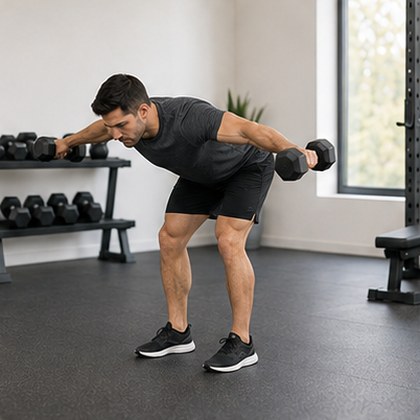 Bent-over rear delt raise
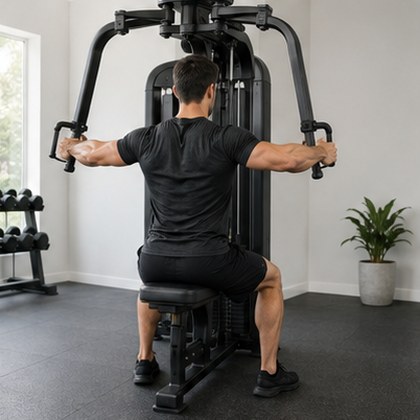 Reverse pec deck
Deltoid exercises at home: with dumbbells, bands and no equipment
At home, a pair of dumbbells or a band is enough for your delts: the seated dumbbell press on a chair, lateral raises, bent-over reverse flies, push-ups and the bent-over dumbbell row.
Bands work. In Lopes's 2019 meta-analysis of 8 studies, strength gains were the same with elastic bands and with conventional weights. In 2010, Andersen and colleagues tested lateral raises and two other shoulder and forearm exercises in 16 working women aged 26–55 with mild neck and shoulder pain, using dumbbells from 2 to 7.5 kg (4.5–16.5 lb) and elastic tubing. At a load that allowed only 3 reps, the main muscles worked at 59–87% of maximum with dumbbells and at 64–86% with the tubing. There was no significant difference between them. How to choose a band and build a full-body workout with it is covered in our resistance band workout guide.
A home shoulder workout with dumbbells. Two identical workouts a week:
| Exercise | Sets × reps | Women | Men |
|---|---|---|---|
| Seated dumbbell press on a chair with a back | 3 × 8–12 | 4–6 kg (9–13 lb) | 8–12 kg (17.5–26.5 lb) |
| Dumbbell lateral raises | 3 × 12–15 | 2–4 kg (4.5–9 lb) | 4–6 kg (9–13 lb) |
| Bent-over dumbbell reverse fly, seated on the edge of a chair | 3 × 12–15 | 2–3 kg (4.5–6.5 lb) | 4–6 kg (9–13 lb) |
| Push-ups from the floor or your knees | 3 × stop 2–3 reps before failure | body weight | body weight |
| Bent-over dumbbell row, one hand on a chair | 3 × 10–12 | 5–8 kg (11–17.5 lb) | 8–14 kg (17.5–31 lb) |
Using the table in section 07, one of these workouts credits each head with 6 sets, and two a week give 12: each head gets 3 sets from its main exercise and 3 more from the other two.
The weights in this table line up with our dumbbell workout at home, which gives women 2.5–5 kg (5.5–11 lb) and men 4–8 kg (9–17.5 lb) for lateral raises, and 5–10 kg (11–22 lb) and 8–16 kg (17.5–35 lb) for the overhead press as working weights after the first few weeks. If you're starting from zero, take the lower end.
No dumbbells. For the first weeks, these will do:
- Pike push-ups. Hands on the floor and hips raised, so your body looks like an upside-down V. Bend your arms and lower your head toward the floor between your hands. It's an overhead press with your own body weight, and it loads the front delt.
- Lateral raises with water bottles. A 1.5-liter bottle weighs about 1.5 kg (3.3 lb), which is enough for women in the first weeks of lateral raises. When 20 reps feel easy, it's time to move to dumbbells or a band.
- Band pull-aparts for the rear delt and band lateral raises, standing on the middle of the band.
- Wall angels. Stand with your back against a wall and slide your bent arms up and down along it. This is a mobility exercise for your shoulders and shoulder blades, and it builds almost no muscle. It works well as a warm-up.
Mistakes and shoulder pain: where you feel it → what to fix, and when to see a doctor
If the front or top of your shoulder hurts during lateral raises and presses, lower the range to horizontal, bring your arm back to neutral and drop the weight. If the pain doesn't go away after 7–10 days of backing off, wakes you at night, or you can no longer lift your arm, see a doctor.
How common this is. In Keogh and Winwood's 2017 review, strength sports turned out to be fairly safe. The authors collected data on athletes who compete. In bodybuilding, the closest to regular gym training, there were 0.24–1 injuries per 1,000 hours of training. In strongman it was 4.5–6.1, and in Highland games 7.5. But among the areas injured most often, the authors list the shoulder, lower back, knee, elbow and wrist. So it pays to keep your form in lateral raises and presses clean from day one.
| Where you feel it | Exercise | What's happening | What to fix |
|---|---|---|---|
| Neck and upper traps, shoulders creeping toward your ears | lateral raises | arms above shoulder height, thumb down, heavy dumbbells (Coratella, 2020) | stop at horizontal, arm neutral or thumb slightly up, lighter dumbbells, drop your shoulders before each rep |
| Front of the shoulder instead of the side | lateral raises | arms drift far forward, your hand leads | lead with your elbow, arms slightly in front of your body but not straight out in front |
| A click or pain at the front and top of the shoulder when your arm goes above shoulder height | lateral raises, upright row | range above 90° (Kolber, 2014) | no higher than horizontal; swap upright rows for cable lateral raises |
| Between your shoulder blades instead of the back of your shoulder | bent-over reverse fly, face pull | you squeeze your shoulder blades together, and the rhomboids take over | shoulder blades stay put, move only your arms, neutral grip (Schoenfeld, 2013) |
| Lower back | standing bent-over reverse fly | you hold the bent-over position for a long time | do the reverse fly chest-down on an incline bench or seated |
| Elbow and forearm | lateral raises, reverse flies | your arm is almost straight and the dumbbell is heavy | bend your elbow slightly and keep that angle, drop the weight |
| Biceps and hands instead of the rear delt | face pull | you pull the rope down to your chest | pull to your face, elbows at shoulder height, lighter weight |
| Lower back arches | seated or standing press | the weight is too heavy, your pelvis slides away from the bench back | bench back at 75–90°, pelvis pressed in, lower weight |
Shoulder warm-up. Kolber 2014 also found the reverse link: people who strengthened the muscles that rotate the arm outward had fewer signs of impingement. A simple option: before a shoulder workout, do 2 sets of 15 external rotations with a light band. Keep your elbow pinned to your side and bent at a right angle, and move your hand outward, away from your stomach. Then do one or two warm-up sets of your first exercise with a light weight.
Who should be careful. If your shoulder has ever dislocated, if you have a diagnosed rotator cuff injury, or if your joints bend noticeably more than usual, it's best to agree on your shoulder exercises and weights with a doctor or physical therapist. People in this situation usually start with bands and light dumbbells, and add overhead presses and upright rows later or not at all.
When to see a doctor. See an orthopedist or a sports medicine doctor if:
- the pain doesn't ease within 7–10 days after you've dropped the exercises that cause it;
- the pain wakes you at night or keeps you from lying on that side;
- your arm has become noticeably weaker and it's hard to lift it overhead;
- you felt a click or crunch with sharp pain during a set;
- your arm goes numb or tingles, or you feel pins and needles;
- your shoulder has changed shape or swelled up quickly.
How to tell ordinary soreness from a joint problem and what to do in the first weeks is covered in detail in our article on shoulder pain from lifting.
Questions and answers
What exercises are best for building rear delts?
The bent-over dumbbell reverse fly, the reverse pec deck and the cable face pull. On the reverse pec deck and in reverse flies, keep your palms facing each other: in Schoenfeld's 2013 study, the rear delt worked harder with a neutral grip. Rows and pull-ups count too, and according to Rabello's 2024 review, they load the rear delt the most. For a beginner, the easiest place to start is the chest-supported incline reverse fly.
How do you grow your side delts to get wider shoulders?
Do lateral raises with a neutral arm position for 12–20 reps, so that your side delt gets about 10 credited sets per week. In Coratella's 2020 study, the side delt worked harder with a neutral arm than with the arm turned out or the elbows bent, and these raises loaded the traps less than thumb-down raises. The overhead press helps: in Campos's 2020 study, the side delt worked at 27.9% in it versus 30.3% in lateral raises. But the front delt does most of the work in a press, so it doesn't replace lateral raises.
Do you need separate front delt work if you bench press?
Usually not. With the bench press and an overhead press, your front delt gets about 10 credited sets per week, as the example in section 07 shows. Add front raises only if your front delt is clearly lagging.
How many sets for delts should you do per week, and how often should you train shoulders?
About 10 sets per head per week, counting presses and rows as half a set. That's what the 2026 ACSM position stand recommends, and the counting method comes from Pelland's 2026 meta-regression. Train your shoulders twice a week so you don't have to fit 10–12 sets into one workout.
How do you train shoulders without growing your traps?
Raise your arms only to shoulder height, keep your thumb pointing forward or slightly up, drop your shoulders before every rep and use lighter dumbbells. You can't switch your traps off completely, since they help rotate your shoulder blade, but you shouldn't shrug during lateral raises. If your neck gets tired before your shoulders do, that's a sign to fix your form.
Can you build your delts at home without dumbbells?
Yes, especially with a resistance band. According to Lopes's 2019 meta-analysis, strength grows the same with bands as with conventional weights, and in Andersen's 2010 study, a band loaded the muscles as much as dumbbells did in lateral raises and two other exercises. With no equipment at all, pike push-ups and lateral raises with 1.5-liter water bottles will work, but the bottles will only last you the first few weeks.
Can you train shoulders on the same day as chest or back?
Yes, and for a beginner it's even more convenient. The bench press loads your front delt along the way, rows load your rear delt, and your shoulder sets add up faster. Put the exercise that matters most to you first, and leave lateral raises and rear delt work for the end of the workout.
Why does your shoulder hurt after deltoid exercises, and what should you do?
Three things are usually to blame: your arms go above shoulder height, your arm is turned thumb-down, or the dumbbells are too heavy. Kolber's 2014 study linked lateral raises and upright rows above 90° to signs of impingement. Lower the range to horizontal, bring your arm back to neutral and drop the weight. If the pain doesn't ease within 7–10 days, wakes you at night, or your arm gets weaker, see a doctor.
The bottom line
- The deltoid has three heads, and each has its own main exercise: the overhead press for the front delt, lateral raises for the side delt, and the bent-over reverse fly, reverse pec deck and cable face pull for the rear delt (Campos, 2020; Coratella, 2020; Rabello, 2024).
- The bench press loads your front delt along the way, and rows and pull-ups load your rear delt. The side delt gets almost nothing from them, so nearly everyone needs lateral raises.
- To grow, you need about 10 sets per week for each head (ACSM, 2026). Count indirect sets in presses and rows as half (Pelland, 2026).
- Two workouts a week with three shoulder exercises each give every head 9–12 credited sets without a separate shoulder day.
- Presses for 8–12 reps, lateral raises and reverse flies for 12–20. Start lateral raises with 2 kg (4.5 lb) dumbbells for women and 4 kg (9 lb) for men.
- Your traps stay out of lateral raises if you lift your arms only to shoulder height, don't turn your thumb down and drop your shoulders before each rep.
- If the pain doesn't go away after 7–10 days of backing off, wakes you at night, or your arm gets weaker, see a doctor.
Checklist: before a shoulder workout
- Warm up with 2 sets of 15 external rotations with a light band and a light set of your first exercise.
- In the seated press, set the bench back to 75–90° and keep your pelvis pressed against it.
- Pick lateral raise dumbbells lighter than you think: your arms should rise to shoulder height without jerking.
- In lateral raises, your thumb points forward or slightly up.
- Drop your shoulders before every rep, and make sure your neck doesn't tire before your shoulders.
- In reverse flies, keep your palms facing each other and your shoulder blades in place.
- Count your sets for each head with the table and log them in your diary.
Sources
- Campos Y.A.C., Vianna J.M., Guimarães M.P., Oliveira J.L.D., Hernández-Mosqueira C., da Silva S.F., Marchetti P.H. Different Shoulder Exercises Affect the Activation of Deltoid Portions in Resistance-Trained Individuals. Journal of Human Kinetics, 2020. — 13 trained men, 12 reps at 60% of one-rep max: front delt at 33.3% in the seated press, 21.4% in the bench press, 21.2% in lateral raises and 18.8% in the flat fly; side delt at 30.3% in lateral raises, 27.9% in the seated press and 5% in the bench press; rear delt at 24% in lateral raises, 11.4% in the seated press and 3.5% in the bench press.
- Coratella G., Tornatore G., Longo S., Esposito F., Cè E. An Electromyographic Analysis of Lateral Raise Variations and Frontal Raise in Competitive Bodybuilders. International Journal of Environmental Research and Public Health, 2020. — 10 bodybuilders, a weight for 8 reps: the side delt worked harder in lateral raises with a neutral arm than with the arm turned out, with bent elbows and in the front raise; the front delt worked hardest in the front raise; lateral raises with the arm turned in activated the rear delt, triceps and upper traps the most.
- Rabello R., Bertozzi F., Hauschild de Freitas I.L., Molinari T., Roncada C., Sforza C., Rodrigues R., Tiggemann C.L. Activation of the three deltoid muscle portions during common strengthening exercises: A systematic review. Journal of Bodywork and Movement Therapies, 2024. — 33 studies: the front delt worked hardest in horizontal adduction (top exercise: the incline dumbbell fly), the side delt in abduction and horizontal abduction (top exercise: lateral raises with the arm turned in), the rear delt in pull-ups and the suspension trainer row.
- Schoenfeld B., Sonmez R.G., Kolber M.J., Contreras B., Harris R., Ozen S. Effect of hand position on EMG activity of the posterior shoulder musculature during a horizontal abduction exercise. Journal of Strength and Conditioning Research, 2013. — 19 trained men on the reverse pec deck: with a neutral grip, the rear delt and infraspinatus worked significantly harder than with a palms-down grip.
- Kolber M.J., Cheatham S.W., Salamh P.A., Hanney W.J. Characteristics of shoulder impingement in the recreational weight-training population. Journal of Strength and Conditioning Research, 2014. — 77 men, 154 shoulders: signs of impingement were more common among those who lifted weights; they were linked to lateral raises and upright rows above 90°, while strengthening the muscles that rotate the arm outward was linked to fewer signs.
- McAllister M.J., Schilling B.K., Hammond K.G., Weiss L.W., Farney T.M. Effect of grip width on electromyographic activity during the upright row. Journal of Strength and Conditioning Research, 2013. — 16 trained men, grips at 50, 100 and 200% of shoulder width: the wider the grip, the harder the deltoid and traps worked and the less the biceps did.
- Saeterbakken A.H., Fimland M.S. Effects of body position and loading modality on muscle activity and strength in shoulder presses. Journal of Strength and Conditioning Research, 2013. — 15 men, 80% of one-rep max: the front delt's signal in the barbell press was about 11% lower than with dumbbells when seated and 15% lower when standing.
- Pelland J.C., Remmert J.F., Robinson Z.P., Hinson S.R., Zourdos M.C. The Resistance Training Dose Response: Meta-Regressions Exploring the Effects of Weekly Volume and Frequency on Muscle Hypertrophy and Strength Gains. Sports Medicine, 2026. — 67 studies, 2,058 participants: muscle and strength gains increase with weekly volume, with diminishing returns; frequency has little effect on muscle growth; a count in which an indirect set equals 0.5 predicts results best.
- Currier B.S., D'Souza A.C., Singh M.A.F. et al. American College of Sports Medicine Position Stand. Resistance Training Prescription for Muscle Function, Hypertrophy, and Physical Performance in Healthy Adults: An Overview of Reviews. Medicine & Science in Sports & Exercise, 2026. — 137 systematic reviews, more than 30,000 participants: 10 or more sets per muscle per week for muscle growth; training to failure and the type of equipment gave no consistent difference.
- Schoenfeld B.J., Ogborn D., Krieger J.W. Dose-response relationship between weekly resistance training volume and increases in muscle mass: A systematic review and meta-analysis. Journal of Sports Sciences, 2017. — 15 studies: each additional weekly set added 0.37% to muscle growth.
- Schoenfeld B.J., Ogborn D., Krieger J.W. Effects of Resistance Training Frequency on Measures of Muscle Hypertrophy: A Systematic Review and Meta-Analysis. Sports Medicine, 2016. — 10 studies: training a muscle group more often gave an effect size of 0.49 versus 0.30; the authors recommend training major muscle groups at least twice a week.
- Schoenfeld B.J., Grgic J., Ogborn D., Krieger J.W. Strength and Hypertrophy Adaptations Between Low- vs. High-Load Resistance Training: A Systematic Review and Meta-Analysis. Journal of Strength and Conditioning Research, 2017. — 21 studies: with sets taken to failure, muscle growth was the same with light and heavy loads, while maximal strength grew more with heavy loads.
- Roberts B.M., Nuckols G., Krieger J.W. Sex Differences in Resistance Training: A Systematic Review and Meta-Analysis. Journal of Strength and Conditioning Research, 2020. — relative muscle growth didn't differ between men and women (effect size 0.07), and women's relative upper-body strength grew more (effect size −0.60).
- Lopes J.S.S., Machado A.F., Micheletti J.K., de Almeida A.C., Cavina A.P., Pastre C.M. Effects of training with elastic resistance versus conventional resistance on muscular strength: A systematic review and meta-analysis. SAGE Open Medicine, 2019. — 8 studies: strength gains in the arms and legs didn't differ between elastic bands and conventional weights.
- Andersen L.L., Andersen C.H., Mortensen O.S., Poulsen O.M., Bjørnlund I.B., Zebis M.K. Muscle activation and perceived loading during rehabilitation exercises: comparison of dumbbells and elastic resistance. Physical Therapy, 2010. — 16 working women aged 26–55 with mild neck and shoulder pain, lateral raises and two other exercises: at a load for 3 reps, the main muscles worked at 59–87% with dumbbells and 64–86% with elastic tubing, with no significant difference.
- Keogh J.W., Winwood P.W. The Epidemiology of Injuries Across the Weight-Training Sports. Sports Medicine, 2017. — a review of 20 studies of competitive athletes: 0.24–1 injuries per 1,000 hours in bodybuilding, 4.5–6.1 in strongman and 7.5 in Highland games; the shoulder, lower back, knee, elbow and wrist were injured most often.
This article is for informational purposes only and is not a substitute for medical advice.