

2–3 full-body sessions a week, with 3 sets of 8–12 reps per exercise, are enough to build muscle at home. Pick a weight that makes the last 2–3 reps hard. Men need a pair of adjustable dumbbells that go up to 45–55 lb (20–25 kg) each, women a pair that goes up to 26–33 lb (12–15 kg).Light dumbbells build muscle too, as long as you take each set to failure, the point where you can't do another rep, or stop 1–2 reps short of it. Log your weights and add a little at a time.
A full-body dumbbell workout at home comes down to six core moves: the goblet squat, Romanian deadlift, reverse lunge, floor press, bent-over row and seated overhead press. You don't need a bench, just the floor and a chair. Train 3 times a week, doing 3 sets of 8–12 reps per exercise with 60–90 seconds of rest. A session takes 35–45 minutes. Starting weights for men and women are in the table below.
| # | Exercise | What it works | Sets × reps | Men, lb (kg) | Women, lb (kg) |
|---|---|---|---|---|---|
| 1 | Goblet squat | thighs, glutes | 3 × 8–12 | 18–35 (8–16), one dumbbell | 11–22 (5–10) |
| 2 | Romanian deadlift | hamstrings, glutes | 3 × 8–12 | 18–35 (8–16) | 11–22 (5–10) |
| 3 | Reverse lunge | thighs, glutes, balance | 3 × 8–10 per leg | 13–26 (6–12) | 6–17 (2.5–7.5) |
| 4 | Dumbbell floor press | chest, triceps | 3 × 8–12 | 22–44 (10–20) | 11–28 (5–12.5) |
| 5 | Bent-over dumbbell row | back, biceps | 3 × 8–12 | 18–35 (8–16) | 11–22 (5–10) |
| 6 | Seated overhead press (on a chair) | shoulders, triceps | 3 × 6–10 | 18–35 (8–16) | 11–22 (5–10) |
Weights are per dumbbell. Start at the low end: the last 2–3 reps should feel hard, but your form should hold up.
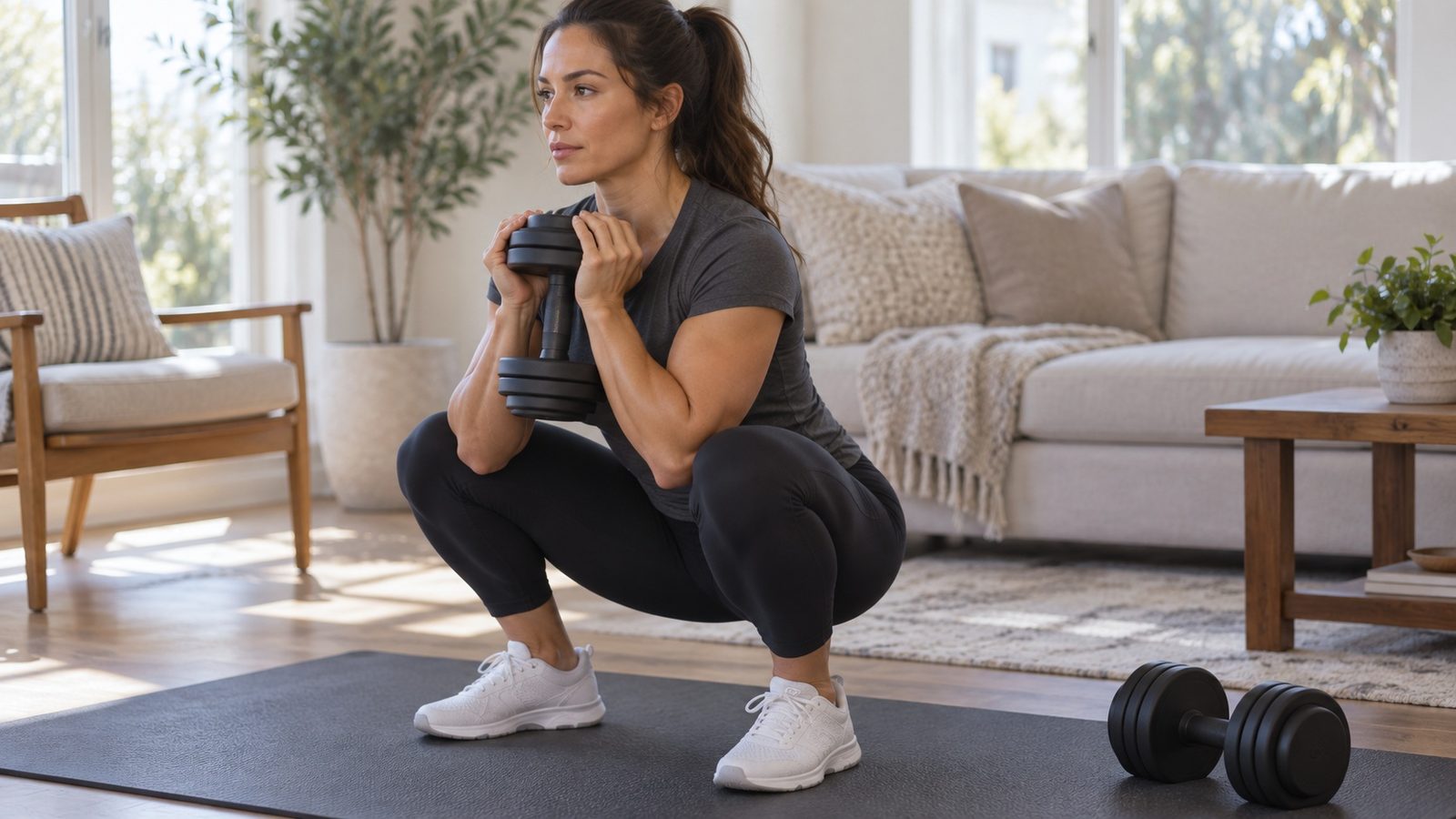
Can you build muscle at home with just dumbbells?
Yes. Your muscles don't care where you train. They grow in response to two things: sets that end close to failure (the point where you can't do another clean rep) and a load that goes up over time. A 2023 review compared free weights with machines and found no difference in muscle growth.
Light weights work too. A 2017 review found that light and heavy loads built muscle equally well, though maximal strength improved more with heavy loads. There's a catch: in those studies, every set was taken to failure, until the lifter couldn't complete another rep. Twenty easy reps that leave ten more in the tank won't do the same job.
That said, you don't have to grind out every set to absolute failure. A 2023 review found no meaningful muscle-growth advantage for training to failure over stopping a little short.
Home training does have a ceiling. For maximal strength, the kind powerlifters chase, you'll eventually need a barbell, because dumbbells don't go that heavy. For staying fit and strong in everyday life, one pair of adjustable dumbbells will last you a long time.
The World Health Organization recommends that all adults do muscle-strengthening activities for every major muscle group at least 2 days a week. In a 2022 review, people who did strength training had a 10–17% lower risk of death, cardiovascular disease, diabetes and cancer. For death, cardiovascular disease and cancer, the lowest risk showed up at 30–60 minutes of strength training a week.
What dumbbells to buy and what weight range you need
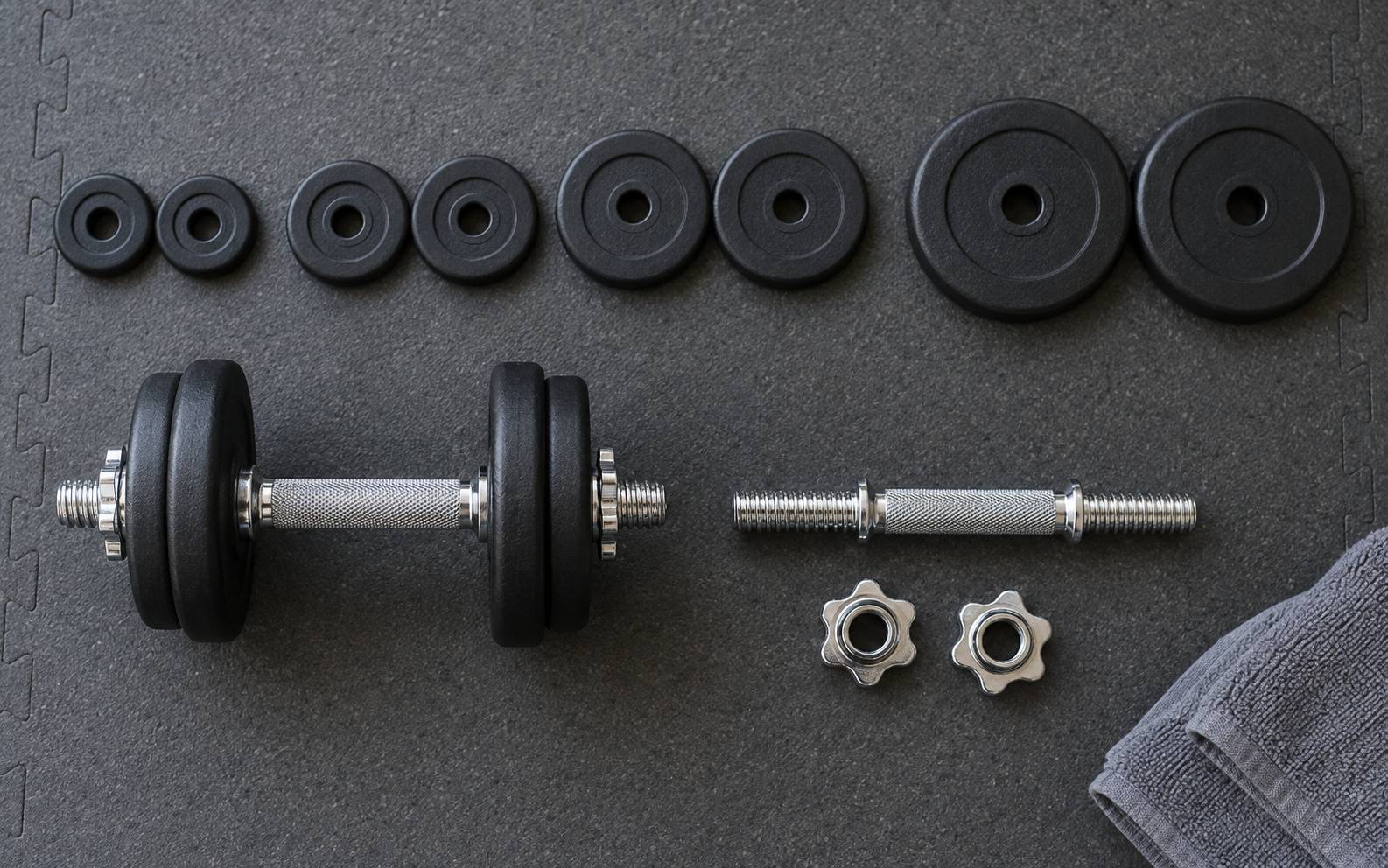
Fixed-weight dumbbells will feel light within a couple of months. For home, adjustable ones are the better buy: a single pair takes you from your first weeks all the way to serious weights.
| Type | Weight range | Pros | Cons | Best for |
|---|---|---|---|---|
| Spin-lock adjustable (threaded collars) | from 5–7 lb (2–3 kg) to 45–55 lb (20–25 kg) and up | one set for years, you choose the weight steps | 1–2 minutes to change plates | almost everyone |
| Selectorized adjustable (dial or pin) | usually up to 45–55 lb (20–25 kg) | weight changes in seconds | bulkier and pricier than spin-lock sets | people who don't want to spend time swapping plates |
| Fixed-weight dumbbells | one weight per pair | nothing to unscrew | you need a separate pair for every weight | people who already know their working weights |
| Vinyl and neoprene | 2–11 lb (1–5 kg) | soft and quiet | too light for this program | warm-ups and lateral raises in the first weeks |
What to get for the program in this article:
- for men: a pair of adjustable dumbbells that go up to 45–55 lb (20–25 kg) each;
- for women: a pair that goes up to 26–33 lb (12–15 kg) each;
- plates: in pairs of 1.25, 2.5, 5 and 10 lb (or 0.5, 1.25, 2.5 and 5 kg). Small jumps matter more than the top weight: adding 2.5–5 lb at a time is easier than jumping 10 lb at once;
- collars and plates: threaded collars hold better than quick-release clips, and rubber-coated plates are quieter;
- a mat about ½ to ¾ inch (1–2 cm) thick protects your floor and keeps the neighbors below happy.
Once goblet squats get easy, load all your plates onto one handle. On a tight budget, start with one adjustable dumbbell and train one side at a time. No dumbbells at all yet? Start with home workouts with no equipment.
How heavy to go: a weight chart for men and women
Weights are per dumbbell. Treat them as a guide for the first few weeks. After that, your own log decides.
| Exercise | Sets × reps | Men, lb (kg) | Women, lb (kg) |
|---|---|---|---|
| Goblet squat | 3 × 8–12 | 18–35 (8–16), one dumbbell | 11–22 (5–10) |
| Romanian deadlift | 3 × 8–12 | 18–35 (8–16) | 11–22 (5–10) |
| Reverse lunge | 3 × 8–10 per leg | 13–26 (6–12) | 6–17 (2.5–7.5) |
| Bulgarian split squat | 3 × 8–10 per leg | 13–26 (6–12) | 6–17 (2.5–7.5) |
| Bent-over dumbbell row | 3 × 8–12 | 18–35 (8–16) | 11–22 (5–10) |
| One-arm row with support | 3 × 10–12 per arm | 18–35 (8–16) | 11–22 (5–10) |
| Dumbbell floor press | 3 × 8–12 | 22–44 (10–20) | 11–28 (5–12.5) |
| Push-ups on dumbbells | 2–3 × up to 8–12 | bodyweight | bodyweight; from your knees is fine |
| Seated overhead press (on a chair) | 3 × 6–10 | 18–35 (8–16) | 11–22 (5–10) |
| Lateral raise | 2–3 × 12–15 | 9–18 (4–8) | 6–11 (2.5–5) |
| Hammer curl | 2–3 × 10–12 | 13–26 (6–12) | 6–17 (2.5–7.5) |
| Overhead triceps extension | 2–3 × 10–12 | 13–22 (6–10) | 6–11 (2.5–5) |
| Crunch with a dumbbell on your chest | 2 × 12–15 | 11–22 (5–10) | 6–11 (2.5–5) |
| Russian twist with a dumbbell | 2 × 10–15 per side | 11–22 (5–10) | 6–11 (2.5–5) |
The women's weights here are about 40% lower than the men's. These are beginner starting points: for women with some training experience, the gap is smaller.
Test the weight in your first session. If 12 reps feel easy, add 2.5–5 lb (1–2.5 kg). If you can't get 8 clean reps, go lighter. The right weight makes the last 2–3 reps hard while your back stays flat and your knees and elbows stay on track.
14 dumbbell exercises you can do at home, by muscle group
Form at home is the same as in the gym. Instead of a bench, use the floor, a sturdy chair with a back or a couch.
Legs and glutes
1. Goblet squat. Works your thighs and glutes. Hold one dumbbell vertically against your chest, feet a little wider than your hips. Sit down between your heels, knees tracking over your toes. Drive through your whole foot to stand up. Mistake: heels lifting off the floor, knees caving in.
2. Romanian deadlift. Works your hamstrings and glutes. Hold the dumbbells in front of your thighs, knees slightly bent. Push your hips back and let the dumbbells slide down your legs to mid-shin. Squeeze your glutes to stand back up. Mistake: rounding your back, or squatting down instead of hinging.
3. Reverse lunge. Works your thighs and glutes. Hold the dumbbells at your sides. Step back and lower until your back knee almost touches the floor. Push through your front leg to return. Mistake: front knee caving in, torso pitching forward.
4. Bulgarian split squat. Works your thighs and glutes. Rest the top of your back foot on a chair or couch and hold the dumbbells at your sides. Lower until your back knee almost touches the floor, then stand up. Mistake: standing too close to the support, so your front heel lifts.
For the glute bridge in the program, lie on your back with your knees bent, hold a dumbbell across your hips and lift them until your knees, hips and shoulders form a straight line.
Back
5. Bent-over dumbbell row. Works your lats, the muscles between your shoulder blades and your biceps. Hinge forward to about 45°, back flat, knees soft. Pull your elbows back toward your hips and squeeze your shoulder blades together. Mistake: jerking with your torso, shrugging your shoulders up to your ears.
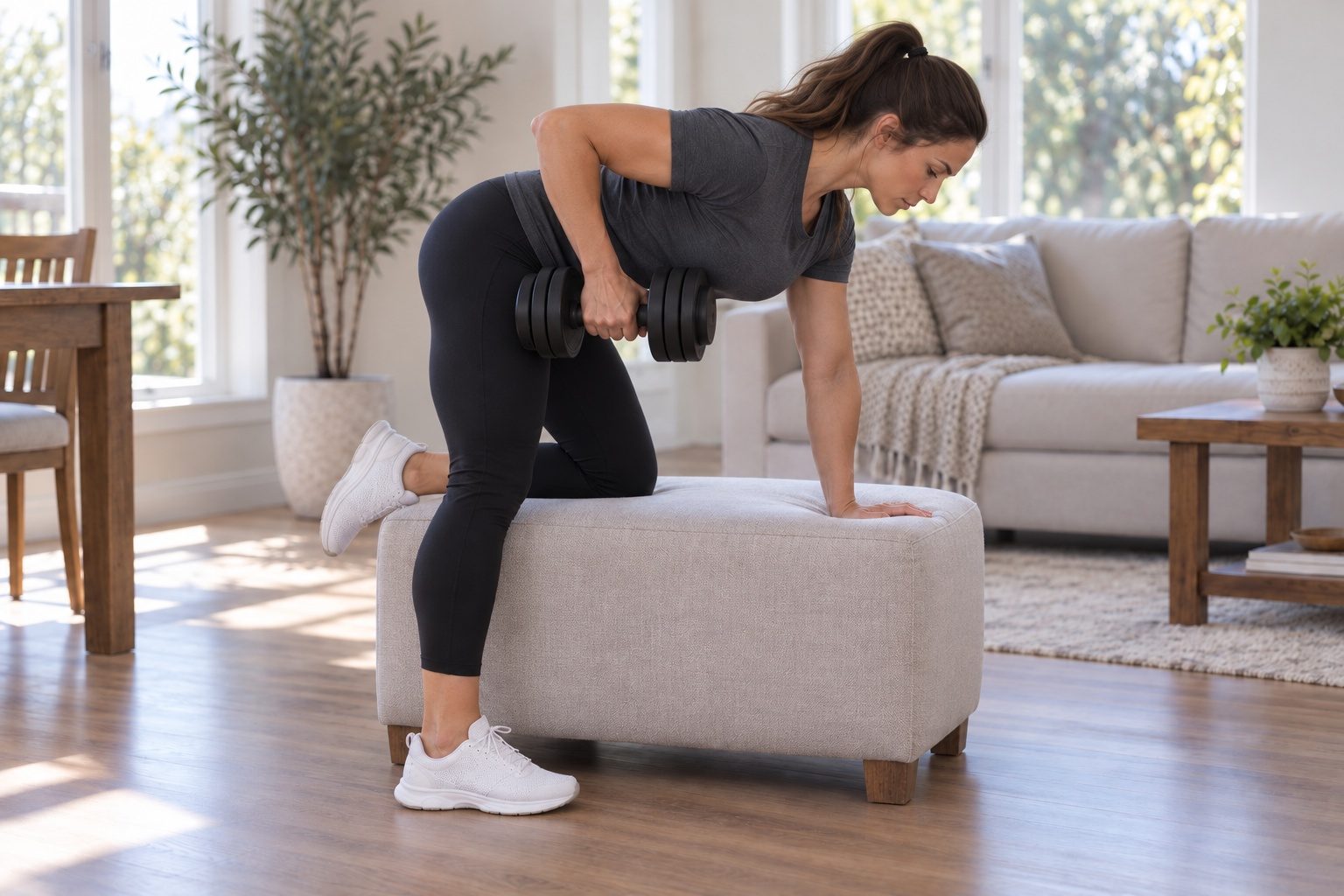
6. One-arm row with support. Works your lats and the muscles between your shoulder blades. Instead of a bench, put one hand and one knee on a sturdy backless ottoman, a solid chair or the edge of a couch, back flat. Drive your elbow along your side toward your hip, then lower the dumbbell until you feel a light stretch. Mistake: twisting your torso, pulling with your hand instead of your elbow.
Chest
7. Dumbbell floor press. The go-to chest exercise when you don't have a bench. Works your chest and triceps. Lie on a mat with your knees bent and the dumbbells over your chest. Lower until the backs of your upper arms gently touch the floor, elbows at about 45° to your body. Press back up. Mistake: flaring your elbows out to 90°, letting your arms slam into the floor.
8. Push-ups on dumbbells. Works your chest, triceps and core. Set the dumbbells shoulder-width apart and keep your wrists straight. Dumbbells with round plates can roll: if yours don't sit steady, do regular push-ups on the floor. Lower your chest toward the floor with your body in a straight line. If you can't do 8, drop to your knees. Mistake: letting your hips sag.
Shoulders
9. Seated overhead press (on a chair). Works your shoulders and triceps. Sit on a chair with a back, dumbbells at shoulder height. Press up without locking out your elbows hard, then lower to ear level. Mistake: arching your lower back, elbows drifting far behind you.
10. Lateral raise. Works your side delts, the part of the shoulder that makes it look wider. Keep a slight bend in your arms. Raise the dumbbells out to the sides to shoulder height, leading with your elbows. Take 2 seconds to lower them. Mistake: swinging your body and going too heavy.
Arms: biceps and triceps
11. Hammer curl. Works your biceps and forearms. Palms face each other, elbows stay at your sides. Curl the dumbbells up toward your shoulders and lower them all the way. Mistake: swinging, elbows drifting forward.
12. Overhead triceps extension. Works your triceps. Sitting or standing, hold a dumbbell overhead. Lower it behind your head with your elbows pointing forward. Straighten your arms. Mistake: elbows flaring out, lower back arching.
Abs
13. Crunch with a dumbbell on your chest. Works the rectus abdominis, the "six-pack" muscle. Lie down with your knees bent and a dumbbell held against your chest. Breathe out and lift your shoulder blades off the floor, then lower. Mistake: jerking up and tucking your chin into your chest.
14. Russian twist with a dumbbell. Works your obliques. Sit down, lean back, feet on the floor. Rotate your torso with the dumbbell to the right, then to the left. Mistake: moving only your arms, rounding your lower back.
Later on, you can add single-leg Romanian deadlifts, sumo squats, calf raises and bent-over reverse flyes.
A weekly plan: 2, 3 or 4 workouts
The American College of Sports Medicine recommends 2–3 full-body workouts a week for beginners. For why that beats splitting muscles across different days, see why beginners don't need a split. A 2017 review on training volume found that more sets per muscle per week meant more growth: 10 or more weekly sets produced bigger gains on average than fewer than 5.
The minimum plan: twice a week, 30 minutes. Do the same workout both days: goblet squat, Romanian deadlift, floor press, bent-over row, seated overhead press and crunches, 3 sets each. That's about 6 sets per major muscle group a week, which meets the WHO strength recommendation.
The main plan: 3 times a week, 35–45 minutes. Monday, Wednesday and Friday work well. Workouts A and B alternate: one week A–B–A, the next B–A–B.
| Workout A | Sets × reps | Workout B | Sets × reps |
|---|---|---|---|
| Goblet squat | 3 × 8–12 | Reverse lunge | 3 × 8–10 per leg |
| Romanian deadlift | 3 × 8–12 | Glute bridge with a dumbbell | 3 × 12–15 |
| Floor press | 3 × 8–12 | Seated overhead press (on a chair) | 3 × 6–10 |
| Bent-over dumbbell row | 3 × 8–12 | One-arm row with ottoman or chair support | 3 × 10–12 per arm |
| Lateral raise | 2 × 12–15 | Push-ups on dumbbells | 2 × stop 2 reps short of failure |
| Hammer curl | 2 × 10–12 | Overhead triceps extension | 2 × 10–12 |
Rest 60–90 seconds between sets, and up to 2 minutes on squats, rows and presses. Add abs at the end of any workout: 2 sets of crunches or Russian twists.
Here's how many sets each muscle group gets. Over two weeks you do workout A three times and workout B three times, so each averages 1.5 sessions a week. From week 5, the first four exercises in each workout go up to 4 sets.
| Muscle group | Weeks 3–4, sets per week | From week 5 |
|---|---|---|
| Thighs | squat 4.5 + lunges 4.5 = 9 | 12 |
| Glutes and hamstrings | Romanian deadlift 4.5 + bridge 4.5 = 9, plus lunges | 12, plus lunges |
| Back | 4.5 + 4.5 = 9 | 12 |
| Chest | floor press 4.5 + push-ups 3 = 7.5 | 9 |
| Shoulders | overhead press 4.5 + lateral raises 3 = 7.5 | 9, plus the floor press |
| Biceps and triceps | 3 direct sets each | 3 each, plus the work they do in every row and press |
In weeks 1–2 you do about a third fewer sets while you learn the movements.
Put together, your legs and back get 9–12 sets a week, your chest and shoulders 7.5–9. From week 5, your legs and back hit the "10 or more" range from the review.
The 4-day upper/lower split: after six months of consistent training. Upper body on Monday and Thursday, lower body on Tuesday and Friday. Beginners don't need this.
| Upper | Sets × reps | Lower | Sets × reps |
|---|---|---|---|
| Floor press | 4 × 8–12 | Goblet squat | 4 × 8–12 |
| Bent-over dumbbell row | 4 × 8–12 | Romanian deadlift | 4 × 8–12 |
| Seated overhead press (on a chair) | 3 × 6–10 | Bulgarian split squat | 3 × 8–10 per leg |
| One-arm row with support | 3 × 10–12 per arm | Glute bridge with a dumbbell | 3 × 12–15 |
| Push-ups on dumbbells | 3 × stop 2 reps short of failure | Crunches or Russian twists | 2 × 12–15 |
| Lateral raise | 3 × 12–15 | — | — |
That gives your chest, back, thighs and glutes 14 sets a week each, and your shoulders 12.
For men and women: what changes
The program stays the same. The weights and the focus change.
Women often want more glute work. In that case, do the glute bridge for 4 sets of 12–15 in workout B and swap regular lunges for Bulgarian split squats. Men more often want a bigger upper body: in workout A, do the floor press for 4 sets and lateral raises for 3.
Worried about getting "too bulky" from dumbbells? You won't. Muscle grows slowly, even for people who work very hard for it. More on this in our guide to strength training for women.
A 12-week plan and what to do when your dumbbells feel too light
The load has to keep going up. Here's what that looks like week by week.
- Weeks 1–2: learn the movements. 2 sets of each exercise at a controlled pace, with a weight that leaves 3–4 reps in the tank. The goal is clean form and a three-days-a-week habit.
- Weeks 3–4: settle into the work. 3 sets each, leaving 2–3 reps in the tank. After every workout, write down your weights and reps.
- Weeks 5–8: the ladder. Once you hit the top of the rep range in every set (for example, 12, or 10 on the overhead press), add 2.5–5 lb (1–2.5 kg) per dumbbell and drop back to 8 reps. Do the first four exercises of each workout for 4 sets.
- Weeks 9–12: your dumbbells start to feel light. The methods in the table below help. If fatigue builds up, take a week with half the sets. That's common coaching practice, not a research finding.
How to make the same weight harder:
| Method | How | Works best for |
|---|---|---|
| More reps, close to failure | 15–25 reps, stopping 0–2 reps short of failure | lateral raises, hammer curls, push-ups, bridges |
| Slow lowering | 3–4 seconds down, normal speed up | squats, presses, rows |
| Pause at the bottom | 2 seconds at the lowest point | goblet squat, floor press, lunges |
| One leg or one arm | Bulgarian split squats instead of lunges, single-leg Romanian deadlifts instead of the two-leg version | legs |
| 1½ reps | down, halfway up, back down, then all the way up | squat, floor press |
| All plates on one handle | one heavy dumbbell instead of two light ones | goblet squat, one-arm row, bridge |
| Shorter rest | 45–60 seconds, two exercises for different muscles back to back | arms and shoulders; don't cut rest on squats, rows and deadlifts |
How and when to add weight is covered in our guide to progressive overload. When none of these methods is enough anymore, buy more plates or add a kettlebell.
Mistakes that stall progress at home
- The same 10-lb dumbbells for months. Your muscles get no signal to grow.
- Only arms and abs. Your legs and back are your biggest muscles. Skip them and your body barely changes.
- Swinging instead of lifting. If your body helps heave the dumbbell up, the wrong muscle is doing the work.
- A rounded back on rows and deadlifts. Keep your back flat and push your hips back. If you can't, go lighter.
- No log. Memory flatters you. Numbers don't.
- The same workout every day. Give the same muscles at least a day off between sessions.
When to stop and when to see a doctor
Stop the exercise right away if:
- you feel sharp or shooting pain in a joint or your back;
- pain travels down your arm or leg, or your fingers go numb;
- you get chest pain or pressure, shortness of breath that's out of proportion to the effort, or dizziness. For chest pain, call 911 or your local emergency number.
Check with a doctor before you start lifting if you've had surgery or an injury, have a painful herniated or bulging disc, have high blood pressure that isn't under control, or are pregnant.
A dull muscle ache the next day is normal muscle soreness (DOMS), not a reason to quit. If your lower back aches, see which exercises help with lower back pain, and skip rows and deadlifts until the pain is gone.
How to log your program and stick with it
Write the program down before your first session, not after. If you track workouts in the Sportygram app, add workout A for Monday: goblet squat 3×10, Romanian deadlift 3×10, floor press 3×10, bent-over dumbbell row 3×10, lateral raise 2×12, hammer curl 2×12. The app's exercise library has no floor press, so log it as the dumbbell bench press. Then add workout B for Wednesday.
Enter the weight for every set. Until you have your own records, the workout log suggests a starting weight. After that, it shows what you lifted last time for that exercise.
log one workout at a time and add workout B as a separate entry. If a day doesn't work out, move the workout to tomorrow instead of deleting it.
FAQ
Can you build muscle at home with just dumbbells?
Yes. What your muscles need is sets close to failure and a load that goes up over time, not a particular place to train. There's one limit: for maximal strength, the kind powerlifters build, you'll eventually need a barbell. For staying fit and strong in everyday life, a pair of adjustable dumbbells that go up to 45–55 lb (20–25 kg) will last you a long time.
What weight dumbbells should a beginner use, for men and for women?
Men can start with 18–35 lb (8–16 kg) per dumbbell for squats and rows, 22–44 lb (10–20 kg) for the floor press and 9–18 lb (4–8 kg) for lateral raises. Women can start about 40% lower: 11–22 lb (5–10 kg) for squats and rows and 6–11 lb (2.5–5 kg) for lateral raises. The last 2–3 reps should be hard while your form holds.
How many times a week should you work out with dumbbells, and can you do it every day?
For beginners, 2–3 full-body workouts a week is enough. Give the same muscles a day of rest between sessions. Training every day only makes sense if you alternate upper and lower body, and that's not for beginners: even the 4-day plan in this article is meant for people with more than six months of training behind them. Hitting the same muscles every day brings more fatigue, not more results.
Can you work out with dumbbells without a bench?
Yes, none of the exercises in this program need a bench. Train your chest with the floor press: the floor limits how deep you go, which is actually easier on your shoulders. For one-arm rows, lean on a sturdy ottoman, chair or the edge of a couch; for Bulgarian split squats, use a chair or couch. Do the overhead press sitting on a chair with a back, or standing.
How do I build bigger arms with dumbbells at home?
Your arms don't grow from curls and extensions alone. Your biceps work in every row, and your triceps work in every press and push-up. So do the core exercises first, then finish with 2–3 sets of hammer curls and overhead triceps extensions, 10–12 reps each. Add weight or reps the same way you do for everything else.
Can you lose weight with dumbbell workouts at home?
Dumbbell training helps you hold on to muscle and burns a bit of extra energy. But you only lose fat when you eat less than you burn. Spot reduction doesn't work: training your belly or arms won't burn fat from just those areas. What works is the combination of a calorie deficit, strength training 2–3 times a week and more daily steps.
How long does it take to see results from dumbbell workouts?
The weights in your log start going up in the first few weeks as your body learns the movements. Changes in the mirror usually show up after 8–12 weeks of consistent training. That's a rough guide: a lot depends on sleep, food and consistency. Track your log and your measurements, not the number on the scale.
What do I do when my dumbbells get too light and I don't have heavier ones?
Make the same weight harder. Raise your reps to 15–25 and end each set close to failure. Take 3–4 seconds to lower the dumbbells, add a pause at the bottom and switch to single-leg exercises. 1½ reps and one heavy dumbbell loaded with all your plates also help. When that's no longer enough, buy more plates.
The bottom line
- The core moves without a bench: goblet squat, Romanian deadlift, lunges, floor press, bent-over row and seated overhead press.
- Three full-body workouts a week give your legs and back 9 sets a week and your chest and shoulders 7.5. From week 5, that becomes 12 and 9.
- The last 2–3 reps should be hard. Women can start with weights about 40% lower than men's.
- When every set reaches 12 reps, add 2.5–5 lb (1–2.5 kg). Nothing left to add? Use slow lowering, pauses and single-leg work.
- Log every workout. Without a log, progress stalls.
Checklist: before your first dumbbell workout at home
- Clear a space about 6.5 by 6.5 feet (2 by 2 m) and put down a mat.
- Check the collars on your dumbbells: the plates shouldn't wobble.
- Put a sturdy chair with a back next to you.
- Warm up for 5 minutes and do one light set of each exercise.
- Pick a weight from the chart that leaves 3 reps in the tank.
- Add workout A to your workout log.
- Choose three days a week and put them on your calendar.
Sources
- World Health Organization. WHO guidelines on physical activity and sedentary behaviour. 2020. — Adults should do muscle-strengthening activities for all major muscle groups on 2 or more days a week.
- Momma H., Kawakami R., Honda T., Sawada S. S. Muscle-strengthening activities are associated with lower risk and mortality in major non-communicable diseases: a systematic review and meta-analysis of cohort studies. British Journal of Sports Medicine, 2022. — Strength training is linked to a 10–17% lower risk of death, cardiovascular disease, diabetes and cancer; the lowest risk is at 30–60 minutes a week.
- Schoenfeld B. J., Ogborn D., Krieger J. W. Dose-response relationship between weekly resistance training volume and increases in muscle mass: a systematic review and meta-analysis. Journal of Sports Sciences, 2017. — More weekly sets mean more muscle growth; 10 or more sets produced bigger gains on average than fewer than 5.
- Schoenfeld B. J., Grgic J., Ogborn D., Krieger J. W. Strength and hypertrophy adaptations between low- vs. high-load resistance training: a systematic review and meta-analysis. Journal of Strength and Conditioning Research, 2017. — Light and heavy loads taken to failure build muscle equally; maximal strength grows more with heavy loads.
- Refalo M. C., Helms E. R., Trexler E. T., Hamilton D. L., Fyfe J. J. Influence of resistance training proximity-to-failure on skeletal muscle hypertrophy: a systematic review with meta-analysis. Sports Medicine, 2023. — Training to momentary failure showed no meaningful advantage for muscle growth over stopping short of it.
- Haugen M. E. et al. Effect of free-weight vs. machine-based strength training on maximal strength, hypertrophy and jump performance — a systematic review and meta-analysis. BMC Sports Science, Medicine and Rehabilitation, 2023. — Free weights and machines produce similar muscle growth.
- Ratamess N. A. et al. American College of Sports Medicine position stand. Progression models in resistance training for healthy adults. Medicine & Science in Sports & Exercise, 2009. — For beginners: 2–3 workouts a week with loads for 8–12 reps.
This material is for informational purposes and does not replace medical advice.