

DOMS is muscle pain 12–24 hours after unfamiliar exercise, caused by tiny damage to muscle fibers. Lactic acid isn't to blame: it clears from your muscles in about an hour. Soreness peaks at 24–72 hours and fades in 3–5 days, or up to 7 for beginners.You can train if the pain is dull and spread across the muscle, a 10-minute warm-up doesn't make it worse and you can do a bodyweight squat with good form. Train a different muscle group, or the same one at 30–40% of your usual weight. What helps: 20–30 minutes of light movement, 7–9 hours of sleep and 10–15 minutes of massage. Stretching barely helps. Ice baths and high doses of painkillers hold back muscle growth. Warming creams only heat the skin.
DOMS (delayed onset muscle soreness) is the ache you feel 12–24 hours after unfamiliar exercise, caused by tiny damage to muscle fibers, not lactic acid. It's the most common reason for sore muscles after a workout, and it fades on its own in 3–5 days. What to do: rule out an injury first, then keep moving instead of lying on the couch.
DOMS or injury? Check in 10 seconds
Before you treat the pain, make sure it's DOMS. DOMS is unpleasant but safe. An injury is not. See which column sounds like you.
| Sign | DOMS | Looks like an injury |
|---|---|---|
| When it started | 12–24 h after the workout | During the exercise or right after, often with a "pop" |
| Type of pain | Dull, aching, spread across the whole muscle | Sharp, shooting, in one spot |
| Where | In the muscle, on both sides if you trained both | In a joint or ligament, on one side |
| Movement | Stiff, but you can move | You can't put weight on it, straighten it or lift it |
| What you can see | Nothing, or slight swelling | Swelling, bruising, hot skin, dark urine |
| How it changes | Eases every day, gone by day 3–5 | Not easing after 3 days, or getting worse |
If even one row matches the injury column, rest that area and see a doctor. Not sure? Wait a day. DOMS will feel milder by then, and an injury won't.
A word on dark urine. If it turns the color of strong tea after a very hard workout and your muscles are too swollen to bend, that's not DOMS. Too many fibers broke down at once, and your kidneys can't keep up. Get medical help the same day.
If it is an injury, like a bruise, a rolled ankle or a pulled muscle, use cold for the first 24–48 hours: ice wrapped in a towel, 10–15 minutes at a time. Skip the heat (see section 07).
How bad is it? A 1–5 scale and what to do at each level
Advice like "train through moderate pain, rest when it's severe" doesn't help: everyone's "severe" is different. Here are five levels, each with an action. Rate yours right after you get up, when soreness is clearest.
- Level 1: you feel the muscle when you touch or stretch it. Train as planned.
- Level 2: it aches when you move but doesn't bother you in daily life. Train as planned. If the plan hits the same muscles, use 70–80% of your usual weight.
- Level 3: walking down stairs or sitting down hurts. Train a different muscle group, or do 20–30 minutes of light movement.
- Level 4: it's hard to get dressed or sleep, and you're clearly weaker. Today, stick to light movement, a warm shower and a full night's sleep. Tomorrow, run the three checks in section 03.
- Level 5: you can't straighten your arm or leg, or there's swelling or dark urine. See a doctor, not the gym.
At level 3 or 4, don't write the day off: light movement eases the pain faster than the couch. Level 5 matches the injury column.
Can you train today? Three checks
The scale shows how much it hurts. Whether you train today depends on three checks, not on how you feel.
- Is the pain dull and spread across the whole muscle, not sharp in one spot or in a joint?
- After a 10-minute warm-up, does it feel the same or better? The warm-up is the test: movement eases DOMS but makes an injury worse.
- Can you do a bodyweight squat with good form? Your knees don't cave in, and your lower back doesn't take over.
Three yeses: train. Pick a different muscle group from your plan (if your legs are sore, do back and chest), or the same muscles at 30–40% of your usual weight: 2–3 sets of 12–15 reps at an easy pace.
the most underrated way through DOMS is the same exercise with a light weight. The next day, do 2–3 sets at 30–40% of your usual weight. This sends blood to the exact muscle that needs it, and soreness fades faster than with total rest.
A no on check 2 or 3 means light movement today (section 08) and another check tomorrow. A no on check 1 sends you back to the table in section 01: if your pain matches the injury column, see a doctor.
What's happening in your muscles (and why it's not lactic acid)
An unfamiliar load (a new exercise, a heavier weight, your first session after a break) leaves tiny tears in your muscle fibers. Most come from the lowering, or eccentric, phase, when the muscle lengthens while controlling the weight: lowering the bar in a bench press, sitting down into a squat, walking down stairs. So slow lowering reps make you the sorest, and walking up stairs barely does.
Leg day hurts most for the same reason: the front of your thighs controls your body in every squat, lunge and step down. On day one, walk down stairs sideways holding the railing, and don't skip your 20–30 minute walk: it eases the pain faster than the couch.
The tears themselves don't hurt. Over the next 24–48 hours, repair cells move in, the tissue swells a little and nerve endings get more sensitive. That's the pain, and that's why it's delayed: you feel fine that evening and can barely pull on your socks the next morning.
Lactic acid (also called lactate) has nothing to do with it. It builds up during a set, causes the burn in your last reps and clears from your muscles in about an hour. A cool-down won't flush it out and prevent DOMS, though it helps for other reasons.
The tears aren't a problem: your body repairs the fibers and builds in a little extra, so the muscle comes back stronger. But DOMS is the price of novelty, not proof the workout worked. The same exercise hurts much less 2–3 weeks later, even though the muscle keeps growing. This is the repeated bout effect, and it starts after your very first workout.
The 48-hour plan, hour by hour
You can't get rid of sore muscles overnight, but you can get through DOMS faster. The clock starts when you leave the gym.
- 0–2 hours after the workout. Cool down for 5–10 minutes: an easy walk and gentle joint circles. Then eat 25–40 g of protein (cottage cheese, eggs, chicken, fish) and drink a glass or two of water. You don't need an ice bath or a pill.
- 2–12 hours. Take a warm shower and sleep 7–9 hours. Most repair happens at night, and nothing replaces it. More on how sleep builds muscle.
- 12–24 hours, the next morning. The first soreness shows up. The most common mistake is lying still. Walk for 20–30 minutes and do 5 minutes of joint mobility. By lunch you'll feel noticeably better.
- 24–36 hours, the peak. It hurts the most now. Foam roll or massage the muscles for 10–15 minutes. Apply heat for 15–20 minutes: a shower, a bath or a heating pad over a towel. Walk again. Across the day, eat 0.7–1 g of protein per pound of body weight (1.6–2.2 g per kilogram).
- 36–48 hours. Run the three checks in section 03. Three yeses: train a different muscle group, or the same one at 30–40% of your usual weight. One no: another day of light movement.
- 48–72 hours. The pain should ease a little more each day. If it doesn't, or it gets worse, that's the injury column in section 01: see a doctor.
What actually helps and what doesn't
Stretching, massage, sauna, ice and creams often get listed as equals. They aren't. Here's an honest rating: how much you need and how we know.
| Method | Effect | How much and when | How we know |
|---|---|---|---|
| Light movement | Helps. The best option, though the relief is temporary | 20–30 minutes a day, starting the first morning | 2003 review of treatments (source 1): movement eases the pain the most, but not for long; 2018 comparison of recovery methods (source 2) |
| Sleep, 7–9 hours | The foundation: nothing else works as well without it | Every night, especially the first two | A basic condition for any recovery |
| Massage and foam rolling | Moderately reduce pain. Massage is the strongest of all the methods | 10–15 minutes at the peak, 24–48 hours after the workout | Massage: 2018 comparison of recovery methods (source 2); foam rolling: 2019 review (source 6), small effect |
| Heat: shower, bath, heating pad | Eases the feeling, doesn't speed up repair | 15–20 minutes, not on bare skin, from day two | Heat widens blood vessels and relieves spasm; no evidence it speeds up recovery |
| Cold and ice baths | Dull the pain, but used regularly after strength training they slow muscle growth | For a fresh injury, yes. For DOMS, not needed | 2015 study of ice baths after strength training (source 4) |
| Stretching | Almost no effect: a few points out of 100 on a pain scale at most | Harmless, but won't help | 2011 Cochrane review of stretching (source 3) |
| Magnesium | No evidence it relieves DOMS | Helps with cramps if you're truly low on it, which is a separate topic | No studies where magnesium relieved DOMS |
| Painkillers: ibuprofen and similar | Relieve pain. High daily doses (1,200 mg for weeks) hold back muscle and strength gains | Not to push through a workout. For severe pain, a single dose, following the label and its warnings | 2018 study of ibuprofen with strength training (source 7) |
| Warming creams | Heat the skin, don't reach the muscle | Like a warm compress, nothing more | They work by irritating the skin, not by warming the muscle |
Stretching is the biggest letdown. A Cochrane review (the strictest kind of research review) pooled 12 studies with about 2,500 people. Stretching cut pain by a few points out of 100 at most. You won't feel that. Stretch if you enjoy it, but it won't save you from DOMS. Foam rolling is different: it's massage without a second person, with a smaller but real effect. Our foam roller guide shows how to use one without making the soreness worse.
Epsom salt baths and magnesium supplements are sold as a DOMS fix, with no data behind it. Magnesium helps with night cramps when you're actually low on it. Who needs magnesium is a different topic from post-gym soreness.
Now painkillers. One pill for level 4–5 pain won't hurt your muscle growth: the harm showed up with 1,200 mg of ibuprofen every day for eight weeks. Still, the label and your doctor decide, not an article. Taking painkillers so soreness "doesn't get in the way of training" backfires twice. High doses over weeks hold back growth, and you mute the very signal that tells DOMS from an injury. That's how people train their way into a real one.
Heat or ice: a cheat sheet
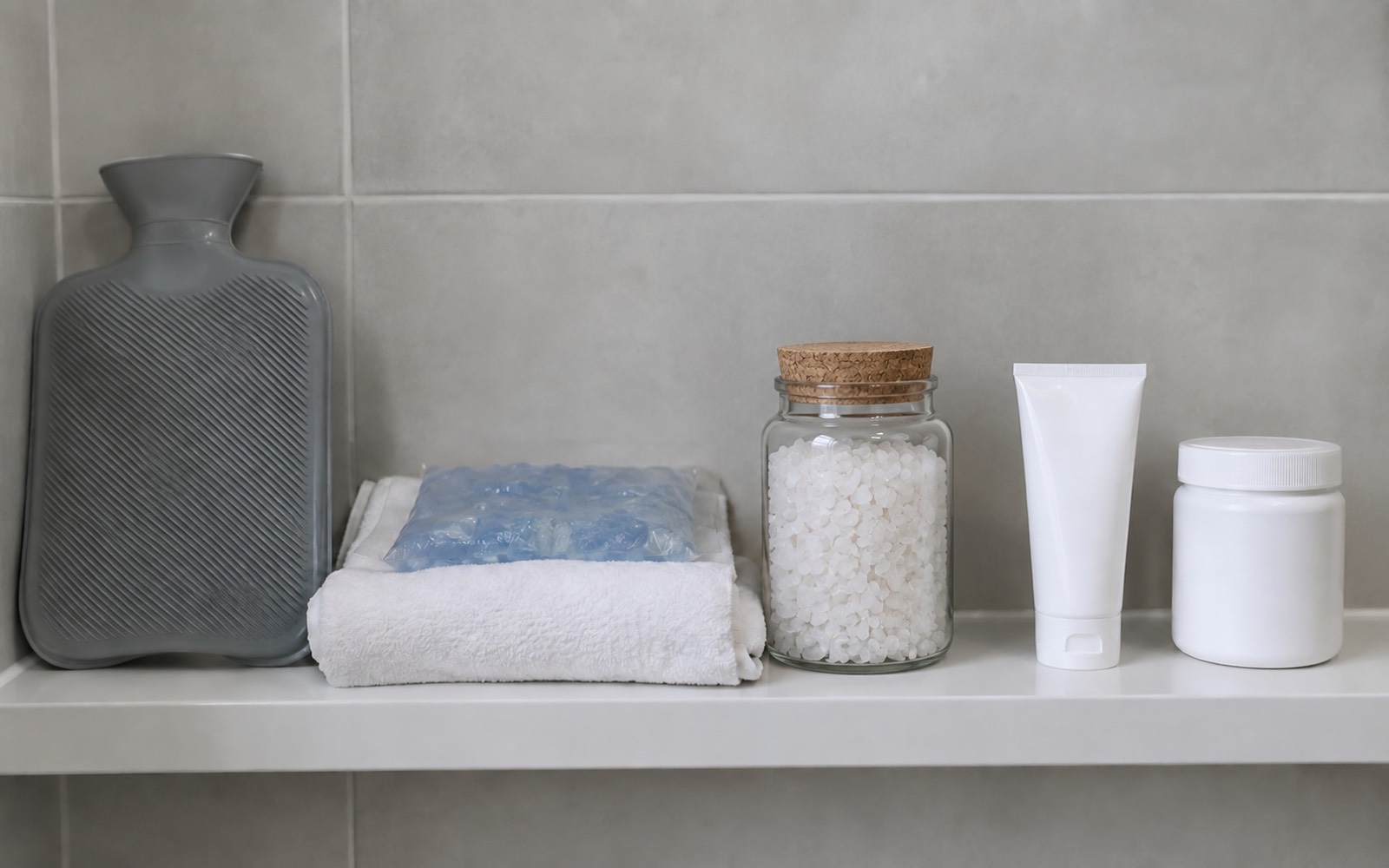
Cold narrows blood vessels and dulls pain, so it helps right after a bruise or a sprain: swelling builds more slowly. Heat widens blood vessels, relaxes the muscle and eases stiffness. So heat is good for DOMS from day two and bad for a fresh, swollen injury.
| Situation | What to use | Why |
|---|---|---|
| Rolled ankle, bruise, pulled muscle (first 24–48 h) | Cold | Limits swelling, dulls sharp pain |
| DOMS 1–2 days after a workout | Heat or light movement | Eases stiffness and pain |
| Stiff neck, lower-back spasm | Heat | Relaxes the muscle, breaks the spasm |
| Stiffness before a workout | Warm shower + warm-up | Gets your muscles ready to work |
| A very hard session the day before a competition | Cold bath, 10–15 min | Less soreness the next day |
| Long-standing, nagging back pain | Heat | Blood flow helps more than numbing |
The short version: sharp and fresh gets cold, dull and lingering gets heat.
How long to use each:
- Ice: 10–15 minutes through a towel, every 2–3 hours for the first day or two after an injury. Never over 20 minutes: it harms your skin and adds nothing.
- Cold bath: 50–59°F (10–15°C) for 10–15 minutes.
- Warm bath: 97–104°F (36–40°C) for 10–20 minutes.
- Heating pad: 15–20 minutes over a towel or clothing. Never on a fresh, swollen injury or a spot that's hot to the touch.
- Contrast shower (alternating warm and cool water): the gentle option. 1–2 minutes warm, 30–60 seconds cool, a few rounds.
Heat works best with movement: 5–10 minutes in a warm shower, then a walk. Neither one heals the muscle. Your body does the repair, and cold and heat only change how it feels.
Five light-movement exercises
"Light movement" means these five exercises from our app's library for the morning after a hard workout. It's not a workout, just a way to get blood through the sore muscle, with no weights and at an easy pace.
- Joint mobility. Circle your shoulders, hips, knees and ankles for 5 minutes, no jerky moves.
- Incline walking. A treadmill on an incline, or an elliptical. 20 minutes at a pace where you can still talk in full sentences.
- Bodyweight squats. 2–3 sets of 12–15. If it hurts a lot, squat halfway down.
- Glute bridge. 2–3 sets of 12–15, pausing a second at the top. Good after leg day and easy on your knees.
- Dead bug. On your back, extend the opposite arm and leg, one side at a time: 2–3 sets of 12–15 per side, lower back pressed into the floor.
One rule: each set should make you feel better, not worse. If it's the other way around, that's a no on check 2 in section 03, and a walk is enough today.
Skipping today? Move the workout instead of dropping it
One of the three checks came back no, and your plan says leg day. Don't delete the session and don't try to squeeze it into the evening. If you track training in the Sportygram app, move today's workout to tomorrow or the next free day in your workout log. The session stays in your week, and the plan keeps its order.
If tomorrow is another no, move it one more day. A two-day shift costs you nothing. Training through sharp pain can cost you a week.
How to make it hurt less next time
No soreness from your usual program while your weights keep going up? You're on track. These rules keep soreness from knocking you off schedule.
- Increase slowly: add no more than 10% to your weight or sets per week. Jumping your squat from about 130 to 175 lb (60 to 80 kg) will almost certainly cost you three days of pain.
- Add new exercises one at a time, and start light. Two new movements on one leg day is a sure way to get stuck at the top of the stairs.
- Warm up for 8–10 minutes to be less sore afterward. Here's how to build a warm-up before training.
- Skip slow lowering reps the day before you need to be at your best. They cause the worst DOMS.
- Train regularly. Muscles used to the work get less sore.
The first 2–3 weeks of a new program are the sorest. Then your body adapts and DOMS almost disappears. Sore all the time no matter the program, and getting weaker? That's a sign of overtraining, and the fix is rest.
When it's not typical DOMS: legs, calves, lower back
Not every ache after the gym is DOMS. These three cases need a different approach.
Your legs feel heavy and wobbly, more weak than sore. That's usually fatigue, not damaged fibers. Here's what to do about heavy legs after training.
Your calves feel tight: hard to the touch and cramping at night. They work all day while you walk, so they never get a proper rest. See our guide to tight calves.
Your lower back hurts. The muscles along your spine can get DOMS after deadlifts too: an ache across the whole lower back, on both sides, that eases within 2–3 days. Only that version is normal. If the pain sits in one spot, shoots down your leg, started during a set or isn't easing after three days, see a doctor.
FAQ
How long does DOMS last?
It starts 12–24 hours after a workout, peaks at 24–72 hours and fades in 3–5 days. For beginners, or after a very unfamiliar load, it can last up to a week, easing a little each day. If it lasts longer, isn't easing or gets worse, it isn't DOMS: see a doctor.
Should I work out with sore muscles?
Yes, if you pass the three checks in section 03: the pain is dull and spread across the muscle, a warm-up doesn't make it worse and you can squat with good form. Then train a different muscle group, or the same one at 30–40% of your usual weight. Any no: walk and do light exercises today, and check again tomorrow.
Is muscle soreness good or bad?
Neither. The tiny tears behind it aren't a problem: your body repairs the fibers, and the muscle comes back stronger. The same exercise hurts much less 2–3 weeks later, even though the muscle keeps growing. Soreness is the price of novelty, not a measure of how well the workout worked.
How do I get rid of sore muscles fast?
You can't switch DOMS off, but you can get through it faster. Do 20–30 minutes of light movement a day, sleep 7–9 hours and massage or foam roll the muscle for 10–15 minutes at the peak. Heat for 15–20 minutes eases the feeling. Stretching, ice, magnesium and creams won't speed anything up.
Heat or ice for sore muscles?
From day two, use heat and light movement: they ease stiffness and pain. Ice dulls pain too but doesn't speed up repair, and an ice bath after every strength session slows muscle growth. You don't need it for DOMS. A sauna counts as heat: 10–15 minutes from day two, then rest and water. Skip it on day one after a very hard workout and with any suspected injury.
Does no soreness mean the workout didn't work?
No. Soreness is a sign of novelty, not growth. After 2–3 weeks on the same program, your muscles almost stop hurting because they've adapted, while your weights and volume keep going up. Check your training log: if your reps and weights are going up, the workout is working, even if you feel nothing the next morning.
Do muscle creams help with DOMS?
Warming creams heat the skin but don't reach the muscle, and pain-relief gels only dull pain on the surface. Neither speeds up fiber repair. A warm shower or a heating pad over a towel for 15–20 minutes gives the same warmth. Light movement eases soreness better than anything in a tube.
The bottom line
- DOMS is a dull ache across the whole muscle 12–24 hours after unfamiliar exercise. It peaks on day one or two and fades in 3–5 days. It comes from tiny damage to muscle fibers, not lactic acid.
- An injury means sharp pain in one spot or a joint, swelling, bruising, dark urine or pain not easing after three days. One match: see a doctor. Not sure: wait a day.
- You can train if the pain is dull, the warm-up doesn't make it worse and you can squat with good form: a different muscle group, or the same one at 30–40% of your usual weight.
- What helps: light movement, 7–9 hours of sleep and massage. Heat eases the feeling. Stretching, ice, magnesium and creams won't fix it.
- To be less sore next time: add no more than 10% a week, bring in one new exercise at a time and warm up for 8–10 minutes. After 2–3 weeks, DOMS almost disappears.
Checklist: 48 hours after a hard workout
- Right after the gym: a 5–10 minute cool-down, 25–40 g of protein, a glass or two of water.
- In the evening: a warm shower and 7–9 hours of sleep.
- In the morning: check the DOMS-or-injury table. Nothing should match the injury column.
- In the morning: a 20–30 minute walk and 5 minutes of joint mobility. Don't stay in bed.
- Day two, the peak: a foam roller or self-massage for 10–15 minutes, heat for 15–20 minutes, another walk.
- Day two: 0.7–1 g of protein per pound of body weight (1.6–2.2 g per kilogram).
- Before the gym: run the three checks. Is the pain dull? Does it feel the same or better after the warm-up? Can you squat with good form? Three yeses: go. Otherwise, take one more day of light movement.
- Day three: the pain should be easing. If it isn't, or it's getting worse, see a doctor.
Sources
- Cheung K., Hume P., Maxwell L. Delayed onset muscle soreness: treatment strategies and performance factors. Sports Medicine, 2003. — A review of treatments: movement eases DOMS pain best, but only for a short time; stretching and cold don't relieve the pain; painkillers work depending on the dose; DOMS reduces strength and range of motion and changes coordination; after a hard session, lower the intensity for 1–2 days or train other muscle groups; add new exercises gradually over 1–2 weeks.
- Dupuy O., Douzi W., Theurot D., Bosquet L., Dugué B. An evidence-based approach for choosing post-exercise recovery techniques to reduce markers of muscle damage, soreness, fatigue, and inflammation: a systematic review with meta-analysis. Frontiers in Physiology, 2018. — A comparison of recovery methods across 99 studies: massage reduces soreness and fatigue the most; active recovery, compression garments, cold water immersion, contrast water therapy and cryotherapy also reduce soreness.
- Herbert R. D., de Noronha M., Kamper S. J. Stretching to prevent or reduce muscle soreness after exercise. Cochrane Database of Systematic Reviews, 2011. — A Cochrane review of 12 studies: stretching before or after exercise reduces soreness by half a point to about four points out of 100, too little to matter in practice.
- Roberts L. A. et al. Post-exercise cold water immersion attenuates acute anabolic signalling and long-term adaptations in muscle to strength training. The Journal of Physiology, 2015. — 12 weeks of strength training with a 10-minute cold water bath after every session: strength and muscle mass grew less than with active recovery.
- Hyldahl R. D., Chen T. C., Nosaka K. Mechanisms and mediators of the skeletal muscle repeated bout effect. Exercise and Sport Sciences Reviews, 2017. — The repeated bout effect: after a first unfamiliar workout, the same workout the next time causes noticeably less damage and soreness.
- Wiewelhove T. et al. A meta-analysis of the effects of foam rolling on performance and recovery. Frontiers in Physiology, 2019. — Foam rolling reduces perceived soreness after exercise by about 6%; the effect is real but small, and the authors see foam rolling as more useful as a warm-up than as a recovery tool.
- Lilja M. et al. High doses of anti-inflammatory drugs compromise muscle strength and hypertrophic adaptations to resistance training in young adults. Acta Physiologica, 2018. — 1,200 mg of ibuprofen a day during eight weeks of strength training: quadriceps volume grew 3.7% versus 7.5% in the group taking low-dose aspirin (75 mg); strength gains were also smaller in one of the two training modes.
This material is for informational purposes and does not replace medical advice. If the pain is sharp, sits in one spot or in a joint, comes with swelling, bruising or dark urine, or isn't easing after three days, get checked by a doctor instead of relying on a table.