

magnesium supports energy, muscles, nerves, heart and bones, and helps keep blood pressure and blood sugar in check. Daily needs: 400–420 mg for men, 310–320 mg for women, 350–360 mg during pregnancy. Russia's national guidelines set one number for all adults: 420 mg.A handful of pumpkin seeds and a side of buckwheat give you about 285 mg. From supplements, stay at or below 350 mg a day unless a doctor says otherwise. Cramps, fatigue and poor sleep can come from low magnesium, but more often they have other causes. Sportygram doesn't sell lab tests or supplements, so we can say it plainly: food first, supplements second.
Magnesium is a mineral your body needs to get energy from food, relax your muscles, carry nerve signals and keep your heartbeat steady. More than 300 enzymes depend on it. Men need 400–420 mg of magnesium a day, women 310–320 mg. Start with your plate: check how much magnesium you get from food before you think about a supplement. Below: how much magnesium is in a typical serving of 20 foods, which supplement forms absorb best and when magnesium won't help.

Magnesium benefits: what it does for your body
Magnesium helps enzymes do their job. Enzymes are proteins that run chemical reactions inside your cells. Here's what depends on magnesium:
- Energy. Without magnesium, your cells can't get energy from carbs and fat.
- Muscles. Calcium tells a muscle to contract, and magnesium helps it relax. That's why low magnesium is linked to twitches and cramps.
- Nerves. Magnesium helps pass the signal from a nerve to a muscle.
- Heart. A steady rhythm depends on the balance of magnesium, potassium and calcium.
- Blood pressure and blood sugar. Magnesium helps regulate both.
- Bones and protein. Magnesium is part of your bones, and your cells need it to build protein.
- Vitamin D. The enzymes that turn vitamin D into its active form also need magnesium.
An adult body holds about 25 g of magnesium. Of that, 50–60% sits in your bones, and nearly all the rest is in muscles and other tissues. Less than 1% is in your blood. That's why a blood test often misses a shortfall.
How much magnesium per day: daily needs for men and women
How much magnesium you need a day depends mostly on your sex, and a little on your age. These are the recommended amounts from the US National Institutes of Health (NIH):
| Who | Daily amount (US) |
|---|---|
| Men 19–30 | 400 mg |
| Men 31 and older | 420 mg |
| Women 19–30 | 310 mg |
| Women 31 and older | 320 mg |
| Pregnancy | 350–360 mg |
| Breastfeeding | 310–320 mg |
| Upper limit for magnesium from supplements and medicines | 350 mg |
After 30, the target goes up slightly and then stays the same. A woman over 40 or over 50 still needs 320 mg, and a man needs 420 mg. Russia's national guidelines (MR 2.3.1.0253-21 from Rospotrebnadzor, the country's public health agency) give adults a single number: 420 mg.
The 350 mg limit applies only to supplements and medicines. If your kidneys are healthy, any extra magnesium from food leaves with your urine.
Hard training makes you lose more magnesium through sweat and urine, and your needs can rise by 10–20%. For a 420 mg target, that's an extra 40–80 mg: one handful of almonds, not a bottle of pills.
Signs of magnesium deficiency and who's at risk
At first, low magnesium feels vague: you lose your appetite, feel a bit nauseous, tired and weak. As the shortfall grows, more symptoms show up:
- numbness and tingling in your hands and feet;
- muscle twitches and cramps;
- mood swings;
- an irregular heartbeat.
Every one of these signs has more common causes: poor sleep, low iron, a new or harder workout, heat, caffeine, medications. So you can't tell you're low on magnesium from symptoms alone. The section below on when magnesium won't help lists what to check first.
Your risk of a shortfall is higher if:
- you have a gut condition such as Crohn's disease or celiac disease;
- you have type 2 diabetes, which makes you lose more magnesium in urine;
- you drink alcohol regularly;
- you're older, since magnesium is absorbed less well and lost more easily with age;
- you've taken diuretics for a long time, or taken heartburn medicines that lower stomach acid (proton pump inhibitors) for more than a year;
- you're on an aggressive calorie deficit or cutting weight for a weight class.
If you train, here's a benchmark: getting less than 260 mg of magnesium a day from food if you're a man, or less than 220 mg if you're a woman, likely means you're running low.
Magnesium blood test. Your body keeps blood magnesium steady and pulls it from your bones when intake runs short. So a normal result doesn't rule out that the stores in your bones and muscles are running low. The reference range is printed on your lab report, since each lab sets its own. A doctor orders this test when there are symptoms and risk factors. Getting it "just to see" is usually a waste of money.
Foods high in magnesium: a table by serving
Your body absorbs about 30–40% of the magnesium in food, and the daily targets already account for that. The values come from food composition databases and are rounded. The last column shows how much of the food gives you 100 mg.
| Food | mg per 100 g | Typical serving | mg per serving | Amount for 100 mg |
|---|---|---|---|---|
| Pumpkin seeds, shelled | ~550 | handful, 30 g (1 oz) | ~165 | ~18 g, a heaping tablespoon |
| Cocoa powder | ~500 | 1 tbsp, 10 g | ~50 | ~20 g, 2 tbsp |
| Wheat bran | ~450 | 2 tbsp, 20 g | ~90 | ~22 g |
| Sesame seeds | ~350 | 1 tbsp, 10 g | ~35 | ~30 g |
| Chia seeds | ~335 | 1 tbsp, 15 g | ~50 | ~30 g |
| Sunflower seeds, shelled | ~325 | handful, 30 g (1 oz) | ~100 | ~30 g |
| Almonds | ~270 | handful, 30 g (1 oz) | ~80 | ~37 g, about 30 almonds |
| Cashews | ~270 | handful, 30 g (1 oz) | ~80 | ~37 g |
| Dark chocolate, 70–85% | ~230 | 4 squares, 25 g | ~57 | ~45 g, half a bar |
| Buckwheat, dry | ~200–230 | side dish: 60 g dry, about 180 g cooked | ~120 | ~45–50 g dry |
| Peanuts | ~170 | handful, 30 g (1 oz) | ~50 | ~60 g |
| Rolled oats, dry | ~135 | 50 g | ~68 | ~75 g |
| Spinach, cooked | ~87 | 100 g | ~87 | ~115 g |
| Mackerel | ~60–95 | 150 g | ~90–140 | one serving |
| Beans, cooked | ~40–70 | 150 g | ~60–100 | 150–250 g |
| Chickpeas, cooked | ~48 | 150 g | ~72 | ~200 g |
| Tofu | ~30–55 | 150 g | ~45–80 | 180–330 g |
| Potato, baked with skin | ~30–40 | 150 g | ~45–60 | 250–330 g |
| Banana | ~27 | 1 medium, 120 g | ~32 | 3 bananas |
| Kefir, 1% fat | ~14 | glass, 300 ml | ~42 | ~700 ml |
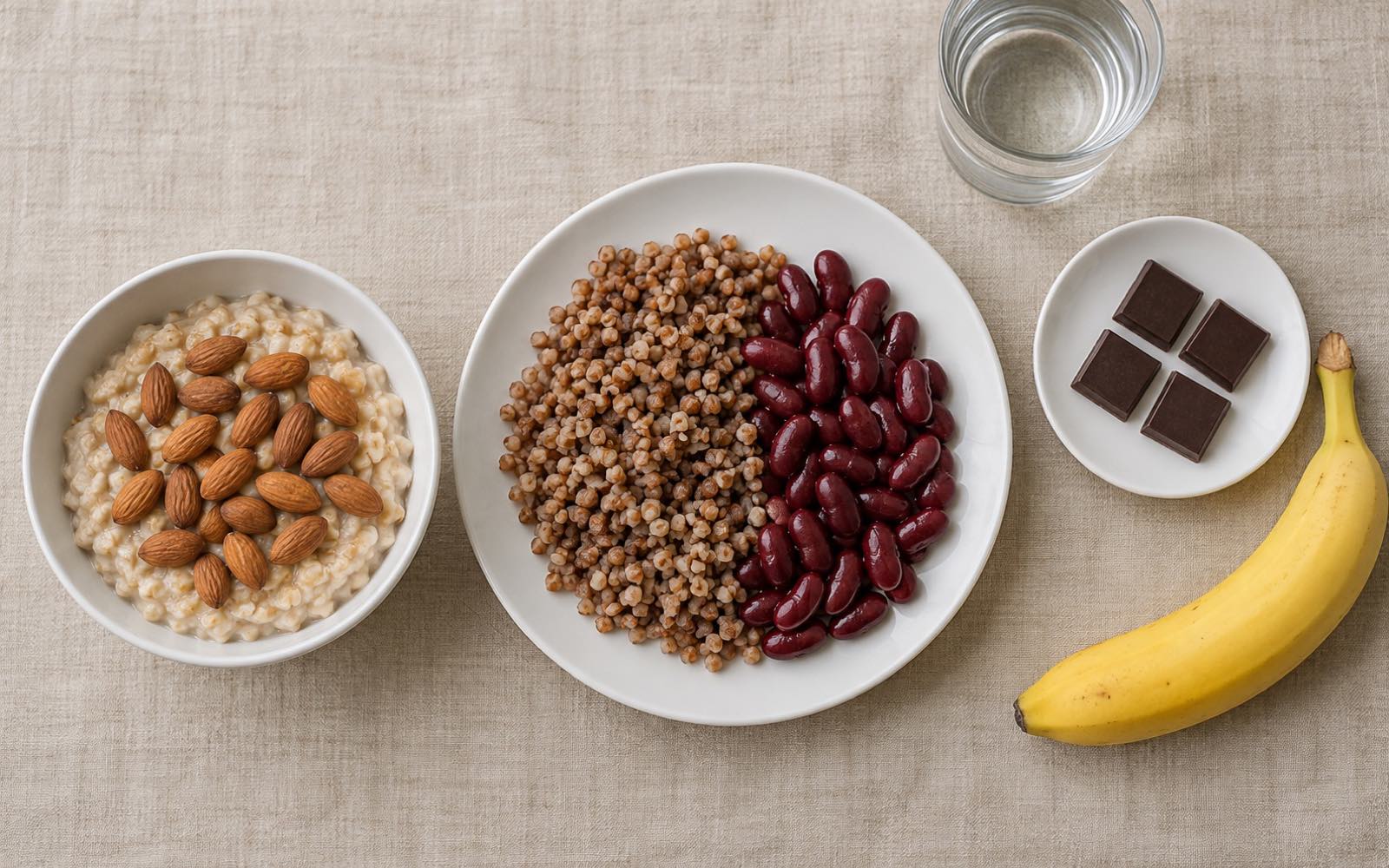
A 420 mg day without a single capsule:
- Breakfast: oatmeal made with 50 g of rolled oats and a handful of almonds, about 150 mg.
- Lunch or dinner: a side of 60 g of dry buckwheat and 150 g of cooked beans, about 190 mg.
- Snack: 4 squares of dark chocolate and a banana, about 90 mg.
That's about 430 mg in total: enough for a man, and more than enough for a woman. Alcohol makes you lose more magnesium in urine, and very high doses of zinc from supplements make it harder to absorb.
If you log meals in the Sportygram app, the food diary counts calories, protein, fat and carbs, but it doesn't track magnesium yet. A simple rule of thumb: a side of buckwheat plus a handful of seeds or nuts in one day already gives you 200–285 mg.
before you buy a supplement, spend two or three weeks getting more magnesium from food. Every day, eat a handful of pumpkin seeds or almonds and a serving of buckwheat or beans. It's cheap and covers most of your target. If nothing changes in that time, magnesium probably isn't the only issue.
Magnesium forms: citrate, glycinate, oxide, malate and magnesium B6
If you're choosing a supplement, look at two things: the dose of magnesium itself and the form.
A label that says "magnesium citrate 500 mg" doesn't mean the tablet has 500 mg of magnesium. That's the weight of the whole compound, and the actual magnesium is only a fraction of it. Look for "elemental magnesium": on a US Supplement Facts label, it's the number next to "Magnesium (as magnesium citrate)." Compare only that number.
The form affects how much magnesium reaches your blood. Magnesium oxide is 60% magnesium by weight, but in a study comparing supplements, only about 4% of it was absorbed. Chloride, lactate and aspartate were absorbed noticeably better. According to the NIH, citrate is also absorbed more completely than oxide.
| Form | Absorption | Usually taken for | What to watch |
|---|---|---|---|
| Citrate | good | all-purpose pick, the most common form | can loosen stools at high doses |
| Glycinate (bisglycinate) | good, with less data than citrate | evening use, sensitive stomach | a capsule may hold little magnesium, so check the elemental amount |
| Oxide | poor: about 4% absorbed in one comparison | cheap option, often works as a laxative or antacid | the high magnesium percentage on the label doesn't reach your blood |
| Lactate, chloride, aspartate | good, better than oxide | lactate in pharmacy tablets, chloride in liquid solutions | compare by elemental magnesium |
| Malate | little data | daytime "anti-fatigue" blends | no evidence it boosts energy; sometimes mixed with oxide |
| Magnesium B6 | depends on the salt inside | pharmacy product with added vitamin B6 | 48–100 mg of magnesium per tablet, add up your daily total |
| Taurate, L-threonate | little data in humans | promoted "for the heart" and "for the brain" | expensive, the claims aren't proven |
| Sulfate (Epsom salt) | not taken by mouth as a magnesium source | baths | magnesium isn't absorbed through the skin in any meaningful amount |
The main point: the gap between oxide and every other form is bigger than the gap between citrate and glycinate. Citrate is cheaper and better studied, and many people find glycinate gentler. We cover Epsom salt baths separately: what relaxes you there is the warm water, not the magnesium.
How to take magnesium if you decide to
A supplement doesn't cure anything. It fills a shortfall. If you have a medical condition or take medications, talk to your doctor about the dose and how long to take it.
- No more than 350 mg a day from supplements. That's the safe upper limit for adults.
- Add up every source. Magnesium shows up in multivitamins, in magnesium B6, in heartburn remedies and in laxatives.
- Timing matters less than you think. There's no evidence that morning or evening use changes the result. Many people find it easier on the stomach with food.
- If it upsets your stomach, change the plan. Split the dose in two or switch forms.
- Reassess after one to two months. If your cramps, sleep and energy haven't changed, magnesium probably isn't the cause.
Medications to be careful with:
- some antibiotics (tetracyclines and fluoroquinolones): take them at least 2 hours before magnesium or 4–6 hours after, and check the package insert or ask your pharmacist for the exact gap;
- osteoporosis drugs (bisphosphonates): keep them at least 2 hours apart from magnesium, and check with your doctor;
- diuretics and heartburn medicines change your magnesium levels, so discuss a supplement with your doctor.
Too much magnesium from supplements causes diarrhea, nausea and stomach pain. With kidney disease, extra magnesium isn't cleared and builds up in the blood, so take supplements only if your doctor recommends them.
Magnesium and training: cramps, sleep, recovery
Cramps. A 2020 Cochrane review (Cochrane reviews are among the most rigorous) pooled 11 studies with 735 people. In adults with ordinary nighttime leg cramps, mostly older adults, magnesium didn't noticeably reduce how often cramps happened compared with a placebo. For pregnancy, the results were conflicting. The review found no studies at all on cramps during exercise. If you really are low on magnesium, cramps can be one of the signs. Otherwise, go in this order:
- Water and salt. If a cramp hits during a long workout in the heat, start with fluids and salt.
- Training load. A cramp after more volume than you're used to is usually muscle fatigue. Gently stretch the muscle and cut back the volume.
- Food. For two to three weeks, get more magnesium from the foods in the table.
- Doctor. See one if the cramps don't go away or happen more than once a week.
Muscle pain the day after the gym is DOMS, and magnesium doesn't relieve it.
Sleep. In a review of three studies with 151 older adults with insomnia, magnesium helped them fall asleep 17 minutes faster on average. Total sleep time didn't change much, and the quality of the evidence is low. Magnesium isn't a sleeping pill. A steady routine and putting your phone away before bed usually do more: here's how to fall asleep fast without pills.
Performance. Even a mild shortfall hurts endurance and performance, and fixing it makes training feel easier. But if you already get enough, extra magnesium won't improve your results.
If you train, pay closer attention to magnesium if:
- you sweat a lot and train for long stretches in the heat;
- you're on an aggressive calorie deficit and eat the same few foods;
- you cut weight for a weight class;
- you take diuretics or drink alcohol regularly.
Magnesium and other electrolytes: what they are and when you need a sports drink
Electrolytes are minerals that break into charged particles in your body fluids and carry electrical signals. The main four are sodium, potassium, magnesium and calcium. Every heartbeat and every muscle contraction runs on those signals. Electrolytes also control fluid balance: water in your body follows sodium.
| Electrolyte | What it does | Daily guide | Where to get it |
|---|---|---|---|
| Sodium | fluid balance, nerve signals | most people get too much: the WHO advises no more than 5 g of salt | salt, bread, cheese, pickles |
| Potassium | blood pressure, heart and muscle function | 2.6–3.5 g | potatoes, beans, bananas, leafy greens |
| Magnesium | muscle relaxation, nerves, energy | 310–420 mg | seeds, nuts, buckwheat, spinach, dark chocolate |
| Calcium | bones, muscle contraction | about 1,000 mg | dairy, sesame seeds, sardines |
When water is enough. For a gym session under an hour, yoga or a walk, you lose little sodium in sweat, and your next meal replaces it. A 500 ml (about 17 oz) bottle of sports drink also brings 25–30 g of sugar.
When you need electrolytes:
- activity longer than 60–90 minutes: soccer, a long hike, cycling, a tournament;
- heat and high humidity;
- white salt marks on your clothes after training;
- two workouts in one day;
- vomiting or diarrhea.
You lose 0.5 to 2 liters of fluid an hour through sweat. A liter of sweat holds about 0.8 g of sodium on average, but it can vary severalfold from person to person. Weigh yourself before and after training: every kilogram (2.2 lb) you lose is about a liter of sweat. For long sessions, a drink with 400–700 mg of sodium per liter works well. That's roughly 1–1.8 g of salt.
A homemade electrolyte drink takes a couple of minutes: water, salt, lemon juice and honey. The ratios and three versions for different workouts are in our DIY electrolyte drink recipe.
The opposite danger. During hours-long activity, drinking too much is also risky. If you drink liters of plain water, the sodium in your blood gets diluted. That's hyponatremia: headache, nausea, confusion. Don't drink more than you lose in sweat, and add salt. If you weigh more after a session than before it, you drank too much.

When magnesium won't help and you need a doctor
Magnesium fixes a magnesium shortfall and nothing else. Here's what to check before you buy a bottle.
| What's bothering you | What to check first |
|---|---|
| Fatigue for no clear reason | sleep, iron and ferritin, vitamin D, thyroid, a calorie deficit that's too aggressive |
| Cramps | water and salt in the heat, unfamiliar training load, medications: diuretics, cholesterol-lowering drugs |
| Poor sleep | phone before bed, caffeine in the afternoon, late hard workouts |
Fatigue is far more often linked to iron than to magnesium, especially in women. Our guide to iron and ferritin covers it.
See a doctor instead of heading to the pharmacy if:
- your heart skips beats or races, especially with shortness of breath or dizziness: get checked the same day;
- your hands or feet go numb or tingle;
- cramps happen more than once a week or come with weakness and swelling;
- you have diabetes, a gut condition or kidney disease;
- you've taken diuretics for a long time, or heartburn medicines for more than a year;
- you're pregnant.
FAQ
Magnesium citrate or glycinate: which is better?
Both are absorbed well, and the difference between them is smaller than the difference between either one and oxide. Citrate is cheaper and better studied, but it can loosen stools at high doses. Many people find glycinate gentler. Pick the form that sits well with you, and compare doses by elemental magnesium, not by the weight of the whole compound.
How much magnesium can you take a day?
From food, there's no set limit: if your kidneys are healthy, extra magnesium from food leaves with your urine. From supplements and medicines, adults should take no more than 350 mg a day, which is the safe upper limit. Anything above that is a decision for your doctor. Add up your total, since magnesium also shows up in multivitamins, magnesium B6 and heartburn remedies.
Is it better to take magnesium in the morning or at night?
There's no solid evidence that timing changes the result. What matters more is taking it regularly and staying under 350 mg a day. Many people take magnesium with dinner: it's easier to remember and gentler on the stomach than on an empty one. If it loosens your stools, split the dose in two or switch forms, for example from oxide to citrate or glycinate.
What should you not take with magnesium?
Usually you need a gap between doses rather than a ban. Some antibiotics (tetracyclines and fluoroquinolones) are taken at least 2 hours before magnesium or 4–6 hours after. Take osteoporosis drugs at least 2 hours apart from magnesium. Check the exact gap on the package insert. Very high doses of zinc interfere with absorption. If you take diuretics or heartburn medicines, talk to your doctor about magnesium.
What is magnesium B6 and how is it different?
It's a magnesium salt, such as lactate or citrate, plus vitamin B6 in one tablet. The vitamin is added to help absorption, but the evidence for that is modest. The main difference is the dose: one tablet usually holds only 48 to 100 mg of magnesium itself. So compare it with other supplements by elemental magnesium, not by the name.
Does magnesium help with leg cramps?
If you're truly low on magnesium, cramps can be one of the signs, and fixing the shortfall makes sense. But for ordinary nighttime cramps, mostly in older adults, a Cochrane review found no noticeable benefit over a placebo. The review didn't find a single trial on cramps during workouts. Check your fluids, salt in the heat and your training volume first.
Does magnesium work for sleep?
There's an effect, but it's small. In a review of three studies of older adults with insomnia, magnesium helped them fall asleep 17 minutes faster on average, and total sleep time barely changed. The quality of that data is low. A fixed bedtime, a dark bedroom and no coffee in the afternoon usually do more than a capsule before bed.
Can you take magnesium every day, and can you overdose?
If your kidneys are healthy, you can't overdose on magnesium from food. Supplements above 350 mg a day can cause diarrhea, nausea and stomach pain, which is the first sign the dose is too high. With kidney disease, magnesium builds up in the blood, and supplements become dangerous. If you've been taking magnesium for months, ask your doctor whether you still need it.
The bottom line
- Magnesium supports energy, muscles, nerves, heart and bones. Less than 1% of it is in your blood, so a blood test often misses a shortfall.
- Daily needs: 400–420 mg for men, 310–320 mg for women. Russia's guidelines set 420 mg for all adults.
- You can hit your target with food: a day of oatmeal, almonds, buckwheat, beans, dark chocolate and a banana gives about 430 mg.
- If you need a supplement, choose citrate, glycinate or lactate over oxide, count elemental magnesium and stay within 350 mg.
- Magnesium does little for ordinary cramps and insomnia. An irregular heartbeat, numbness, frequent cramps and kidney disease are reasons to see a doctor.
Checklist: magnesium without wasting money
- Know your target: 400–420 mg for men, 310–320 mg for women, 350–360 mg during pregnancy.
- For two to three weeks, eat a handful of seeds or nuts and a serving of buckwheat or beans every day.
- Check other causes: sleep, water and salt in the heat, training load, iron.
- Buying a supplement? Look for the elemental magnesium amount and skip oxide.
- Add up all the magnesium from supplements in a day: no more than 350 mg.
- Space magnesium apart from antibiotics and osteoporosis drugs.
- For workouts longer than 60–90 minutes in the heat, drink water with salt.
- Irregular heartbeat, numbness, frequent cramps, kidney disease: see a doctor.
Sources
- NIH Office of Dietary Supplements. Magnesium: Fact Sheet for Health Professionals. — Recommended amounts, the 350 mg upper limit for supplements, absorption from food, where the body stores magnesium, signs of deficiency, risk groups, supplement forms and drug interactions.
- Rospotrebnadzor. MR 2.3.1.0253-21 "Norms of physiological requirements for energy and nutrients for various population groups of the Russian Federation", 2021 (in Russian). — Magnesium requirement for adults: 420 mg a day.
- Garrison S. R. et al. Magnesium for skeletal muscle cramps. Cochrane Database of Systematic Reviews, 2020. — 11 studies, 735 people: magnesium is unlikely to help with ordinary cramps in adults; no trials on exercise-related cramps were found.
- Mah J., Pitre T. Oral magnesium supplementation for insomnia in older adults: a systematic review and meta-analysis. BMC Complementary Medicine and Therapies, 2021. — Falling asleep 17 minutes faster, with low-quality evidence.
- Nielsen F. H., Lukaski H. C. Update on the relationship between magnesium and exercise. Magnesium Research, 2006. — Hard training raises magnesium needs by 10–20%; supplements improve performance only when you're low.
- Firoz M., Graber M. Bioavailability of US commercial magnesium preparations. Magnesium Research, 2001. — About 4% of magnesium oxide was absorbed; chloride, lactate and aspartate were absorbed better.
- American College of Sports Medicine. Exercise and fluid replacement. Medicine & Science in Sports & Exercise, 2007. — Sweat and sodium losses vary between people and are estimated by weighing; long sessions call for electrolytes, and too much water is dangerous.
This material is for informational purposes and does not replace medical advice.