

the standard adult intake is 600 IU (15 mcg) a day and 800 IU after 70 (NIH). The Russian Association of Endocrinologists suggests 800–1,000 IU for prevention, while the US Endocrine Society (2024) sees no need to go above the standard intake for healthy adults under 75. On a 25(OH)D test, below 20 ng/ml counts as deficient and 20–29 ng/ml as insufficient; the Russian guideline aims for 30–60 ng/ml, and NIH already calls 20 ng/ml adequate. Without testing, don't go above 4,000 IU a day for more than six months. Taking D3 with a fat-containing meal raised peak blood levels by 32% in a trial, and it also works on an empty stomach. In the VITAL trial of 25,871 adults, 2,000 IU a day for about 5 years didn't lower cancer, heart disease, or fracture risk.
How much vitamin D to take: for most adults, 600–1,000 IU a day of D3, every day, with any meal. Russian endocrinology guidelines advise against going above 2,000 IU a day without a specific reason, and NIH sets 4,000 IU a day as the upper limit for healthy adults. Below, you'll find how much to add based on your test result and body weight, how much vitamin D is in fish, eggs and milk, what a normal blood level looks like, and where the real overdose line sits.

Why vitamin D deficiency is so common
Vitamin D acts more like a hormone than a typical vitamin: it lets your gut absorb calcium and phosphorus, and without enough of it, bones lose density and muscles weaken. Your liver converts it to 25(OH)D, the storage form a blood test measures; your kidneys then turn that into the active hormone, calcitriol.
Low levels are the norm once you're far from the equator. Your skin makes vitamin D from UVB light, and above roughly the 35th parallel — most of the US, the UK, and northern Europe — the sun sits too low from late fall through early spring for meaningful synthesis, regardless of time spent outside (Russian Association of Endocrinologists, 2021). Sunscreen cuts synthesis by 95–98%, according to the same guideline. In the first Russian multicenter study (Suplotova et al., 2021), 72% of 996 adults from 10 regions tested below 30 ng/ml and 39% below 20 ng/ml: 84% in spring and 62% in fall. Season mattered a lot and region barely did. Men ran low more often than women (79% vs. 70%), and 54% of 18- to 25-year-olds were deficient.
Two conversions worth knowing: 1 mcg of vitamin D equals 40 IU, and 1 ng/ml on a blood test is roughly 2.5 nmol/L (NIH).

Signs of deficiency and who should actually get tested
You can't diagnose low vitamin D by how you feel: the Russian guideline (2021) notes that deficiency has no specific physical signs. Severe, long-standing deficiency can cause dull bone and muscle aches, weak thighs and shoulders, and more falls in older adults. Fatigue and hair loss often get blamed on it, but they have plenty of other causes, such as poor sleep, stress, and low iron. Check your iron and ferritin first if you're tired for no clear reason.
Neither the Endocrine Society (Demay et al., 2024) nor the Russian guideline recommends testing everyone. The Endocrine Society is stricter: it advises against routine testing even for people with obesity or darker skin. The Russian guideline suggests testing if you have:
- a BMI of 30 or higher;
- an age over 60 with a history of falls or low-trauma fractures;
- darker skin tone;
- osteoporosis, osteomalacia, or hyperparathyroidism;
- kidney disease, liver failure, Crohn's disease, celiac disease, or another malabsorption condition;
- pregnancy or breastfeeding with additional risk factors;
- long-term use of glucocorticoids, anticonvulsants, antifungals, antiretrovirals, cholestyramine, or orlistat.
What a normal 25(OH)D level looks like — and why labs disagree
Blood tests measure 25(OH)D, which has a half-life of about 15 days (NIH). The active hormone, 1,25(OH)2D, isn't useful here: it's up to 1,000 times less concentrated, lasts about 4 hours, and doesn't reflect your stores (Russian guideline). Retest with the same method, ideally the same lab.
Major guidelines don't fully agree on cutoffs, which is why lab reports can look inconsistent:
| 25(OH)D level, ng/ml (nmol/L) | NIH (US) | Russian national guidelines (RAE, 2021) | Endocrine Society (2024) |
|---|---|---|---|
| Below 10 (below 25) | deficient | severe deficiency | sets no fixed cutoff |
| 10–19 (25–49) | below 12 deficient, 12–19 inadequate | deficient | — |
| 20–29 (50–74) | adequate | insufficient | — |
| 30–60 (75–150) | adequate; above 50 possible harm | target range | — |
| 60–100 (150–250) | possible harm | adequate but above target; check blood calcium | — |
| Above 100 (above 250) | possible harm; toxicity usually above 150 | possible toxicity | — |
Lab reports often print 30–100 ng/ml as the reference range, which is the "adequate" band in the Russian guideline. Its treatment target is narrower, 30–60 ng/ml, since higher numbers show no added benefit. The Endocrine Society's 2024 guideline skips a specific target altogether — the evidence doesn't clearly favor one level for disease prevention.
The Russian guideline says to retest at 8–12 weeks after a severe deficiency or with an ongoing risk factor; everyone else should wait at least 6 months.
How much vitamin D per day: the actual numbers
The standard adult intake is 600 IU (15 mcg) a day — NIH's figure, and it matches Russia's federal nutrient guidelines (Rospotrebnadzor, MR 2.3.1.0253-21) too. After 70, NIH raises that to 800 IU (20 mcg); Russian guidelines make the same jump slightly earlier, at 65.
For prevention, the Russian guideline (2021) recommends 800–1,000 IU a day for adults and 800–2,000 IU during pregnancy and breastfeeding. The Endocrine Society (2024) is more cautious: it doesn't suggest going above the standard intake for healthy adults under 75, but it does suggest a supplement after 75. NIH sets the tolerable upper intake for healthy adults at 4,000 IU a day; the Russian guideline uses the same line for use beyond six months without testing, and 10,000 IU for people with risk factors.
- Adults under 65 (including over 40 or 50, and people who train) — 600 IU baseline, 800–1,000 IU for prevention. There's no separate "women's" or "athlete's" dose.
- Over 65 — 800 IU baseline. Older skin makes at least 3 times less vitamin D than younger skin (Russian guideline), so the sun helps less.
- Pregnant or breastfeeding — 800–2,000 IU; correcting a deficiency in the first trimester shouldn't exceed 4,000 IU a day (Russian guideline).
- BMI 30+ — correction doses run 2–3 times higher under medical guidance, with maintenance of at least 3,000–6,000 IU (Russian guideline).
For women over 40 and 50, the real question is when to get tested. The Russian guideline suggests a test with osteoporosis, and after 60 if you've had falls or fractures from minor injuries. If you're getting back into training at this age, start with our guide to fitness after 40.
D3 or D2, with food or empty stomach, morning or night
Take D3 daily, with whichever meal you're least likely to skip.
D3 vs. D2. Tripkovic et al. (2012) found D3 (cholecalciferol) raises 25(OH)D more than D2 (ergocalciferol) overall, but the gap shows up mainly with large infrequent doses and disappears with daily dosing. The Russian guideline still prefers D3 for long-term use because it holds levels steadier over time.
With food or empty stomach. Dawson-Hughes et al. (2015) gave 50 older adults 50,000 IU of D3 with breakfast: when 30% of the meal's calories came from fat, peak blood D3 was 32% higher than after a low-fat breakfast. Even so, the Russian guideline says vitamin D can be taken with food or on an empty stomach.
Morning or night, daily or weekly. Neither NIH nor the Russian guideline specifies a time of day, so take it whenever you'll remember. Russian guidelines allow 1,000–2,000 IU daily or a weekly equivalent of 6,000–14,000 IU, but not once-a-year megadoses of 300,000–500,000 IU, which didn't reduce falls or fractures in trials. For adults over 50, the Endocrine Society (2024) favors daily dosing. Drop strength varies by product: the drops listed in the Russian guideline hold about 500 IU per drop, but other brands differ, so go by the label.
How long to take it. For general prevention, the Russian guideline sets no fixed end date; how long maintenance should last isn't clearly defined yet. The period that matters most is late fall through early spring, when the sun barely contributes at northern latitudes. Treatment for a confirmed deficiency runs 8 weeks to 3 months before switching to maintenance.
keep the bottle next to something you touch every morning, like the coffee maker, and take it with breakfast — the fat on your plate helps absorption too.
Dosing by test result: how much to add to reach a normal range
As a rough rule, each 1 ng/ml of desired increase takes about 2.5 IU per kilogram of body weight per day, and each extra 100 IU a day raises 25(OH)D by less than 1 ng/ml (Russian guideline, 2021). Two independent trials back this up: Heaney et al. (2003) gave 67 men up to 250 mcg of D3 daily for 20 winter weeks and saw about a 0.7 ng/ml rise per 100 IU; Ekwaru et al. (2014), using data from 17,614 people, found roughly 4.8 ng/ml (12 nmol/L) per 1,000 IU at doses up to 1,000 IU, but only about 0.4 ng/ml (1.1 nmol/L) per 1,000 IU at 15,000–20,000 IU.
Using that formula, here's roughly how much daily vitamin D it takes to reach 30 ng/ml from a given starting point, rounded to the nearest 100 IU:
| 25(OH)D result | What it means | Gap to close | At 132 lb (60 kg) | At 176 lb (80 kg) | At 220 lb (100 kg) | What's next |
|---|---|---|---|---|---|---|
| Below 10 ng/ml | severe deficiency | 20+ | — | — | — | doctor-managed treatment: roughly 400,000 IU total, retest in 8–12 weeks |
| 10–19 ng/ml | deficient | 11–20 | 1,700–3,000 IU | 2,200–4,000 IU | 2,800–5,000 IU | see a doctor: a loading dose, then 1,000–2,000 IU maintenance |
| 20–24 ng/ml | insufficient | 6–10 | 900–1,500 IU | 1,200–2,000 IU | 1,500–2,500 IU | retest no sooner than 6 months out |
| 25–29 ng/ml | insufficient | 1–5 | 200–800 IU | 200–1,000 IU | 300–1,300 IU | a standard 800–1,000 IU/day usually closes it |
| 30–60 ng/ml | target range | 0 | — | — | — | maintain 800–1,000 IU/day; no need to retest without a reason |
| 60–100 ng/ml | above target | — | — | — | — | don't increase the dose; check blood calcium |
| Above 100 ng/ml | possible toxicity | — | — | — | — | stop the supplement and see a doctor |
These numbers are a rough estimate: individual response varies several-fold, and the lower your starting point, the bigger the jump from the same dose (Russian guideline). With obesity, the rise is about 15 ng/ml smaller. Treatment for a confirmed deficiency (in the Russian guideline, 400,000 IU over 8 weeks, and half that for insufficiency) is prescribed by a doctor.
In Ekwaru et al. (2014), people with obesity had 25(OH)D levels about 19.8 nmol/L (≈8 ng/ml) lower on the same doses, and overweight people about 8 nmol/L lower. The authors suggest 2–3 times the dose with obesity and 1.5 times with overweight; work that out with a doctor.
Vitamin D 5,000 IU and overdose: where the real line is
5,000 IU a day is above the 4,000 IU line NIH sets as the safe upper limit for healthy adults, and above the point where Russian guidelines say testing becomes necessary for extended use. Doses that high are something a doctor prescribes based on a blood test, with calcium monitoring.
- 2,000 IU a day looks safe long-term. In the VITAL trial (Manson et al., 2019), 25,871 adults — men 50+, women 55+ — took 2,000 IU for about 5.3 years, with no more hypercalcemia (excess blood calcium) than on placebo.
- 4,000 and 10,000 IU didn't help bone health. Burt et al. (2019) gave 311 healthy adults aged 55–70 either 400, 4,000, or 10,000 IU for three years. Radius bone density dropped 1.2%, 2.4%, and 3.5% respectively, with no difference in bone strength, and the Russian guideline cites the same trial: elevated urinary calcium showed up in 17%, 22%, and 31% of participants.
- Real toxicity takes a lot. NIH notes toxicity typically appears above 150 ng/ml; Russian guidelines flag possible intoxication above 80 ng/ml with elevated blood calcium. Symptoms include nausea, vomiting, muscle weakness, appetite loss, and excessive thirst (NIH). It almost always comes from long-term accidental intake of doses hundreds or thousands of times above the maximum (Russian guideline).
- Reported poisonings are dosing errors. Galior et al. (2018) reviewed 13 published cases with 25(OH)D from 150 to 1,220 ng/ml, vomiting, dehydration, pain, and appetite loss. The causes were manufacturing errors and overdosing by patients or prescribers.
- You can't overdose from sunlight — skin converts any excess into inactive forms on its own (NIH).
Sun and food: what you get without a supplement
In summer, sun alone can cover most people's needs: NIH cites roughly 5–30 minutes of midday sun on the face, arms, and legs, without sunscreen, daily or at least twice a week. Darker skin needs at least 3–5 times longer for the same effect (Russian guideline). At UK latitudes, Webb et al. (2018) found that people with brown skin needed about 25 minutes of midday sun every day from March to September, with forearms and lower legs bare in summer; hands and face alone weren't enough.
Summer stores carry you into winter: in Heaney et al. (2003), men covered more than 80% of their winter need from vitamin D their skin had built up the summer before. Even so, 62% of adults in the Russian study still tested below 30 ng/ml in autumn (Suplotova, 2021), so a city summer doesn't close the gap for everyone.
Combining NIH and Russian guideline figures, here's roughly what a serving gets you:
| Food | IU per 100 g (3.5 oz) | Typical serving | IU per serving | Amount for 600 IU |
|---|---|---|---|---|
| Cod liver oil | ~10,000 | 1 tsp | ~450 | a bit over 1 tsp |
| Rainbow trout, farmed | ~760 | 150 g (5.3 oz) | ~1,140 | ~80 g (2.8 oz) |
| Wild salmon (sockeye) | ~670 (Russian guideline: 600–1,000) | 150 g (5.3 oz) | ~1,000 | ~90 g (3.2 oz) |
| Herring | 294–1,676 | 100 g (3.5 oz) | 300–1,700 | 35–200 g (1.2–7 oz) |
| Canned sardines | 300–600 | 100 g can | 300–600 | 1–2 cans |
| Canned mackerel | ~250 | 100 g (3.5 oz) | ~250 | ~240 g (8.5 oz) |
| Farmed salmon | 100–250 | 150 g (5.3 oz) | 150–375 | 240–600 g (8.5 oz–1.3 lb) |
| Canned tuna | ~50 in water (NIH) to 236 (Russian guideline) | 100 g can | 50–236 | 250 g to 1.3 kg (9 oz–2.9 lb) |
| UV-exposed mushrooms | 450–1,000 | 100 g (3.5 oz) | 450–1,000 | 60–130 g (2–4.6 oz) |
| Regular mushrooms, not UV-exposed | 10–100 | 100 g (3.5 oz) | 10–100 | 0.6–6 kg (1.3–13 lb) |
| Beef liver | 15–45 | 100 g (3.5 oz) | 15–45 | 1.3–4 kg (2.9–8.8 lb) |
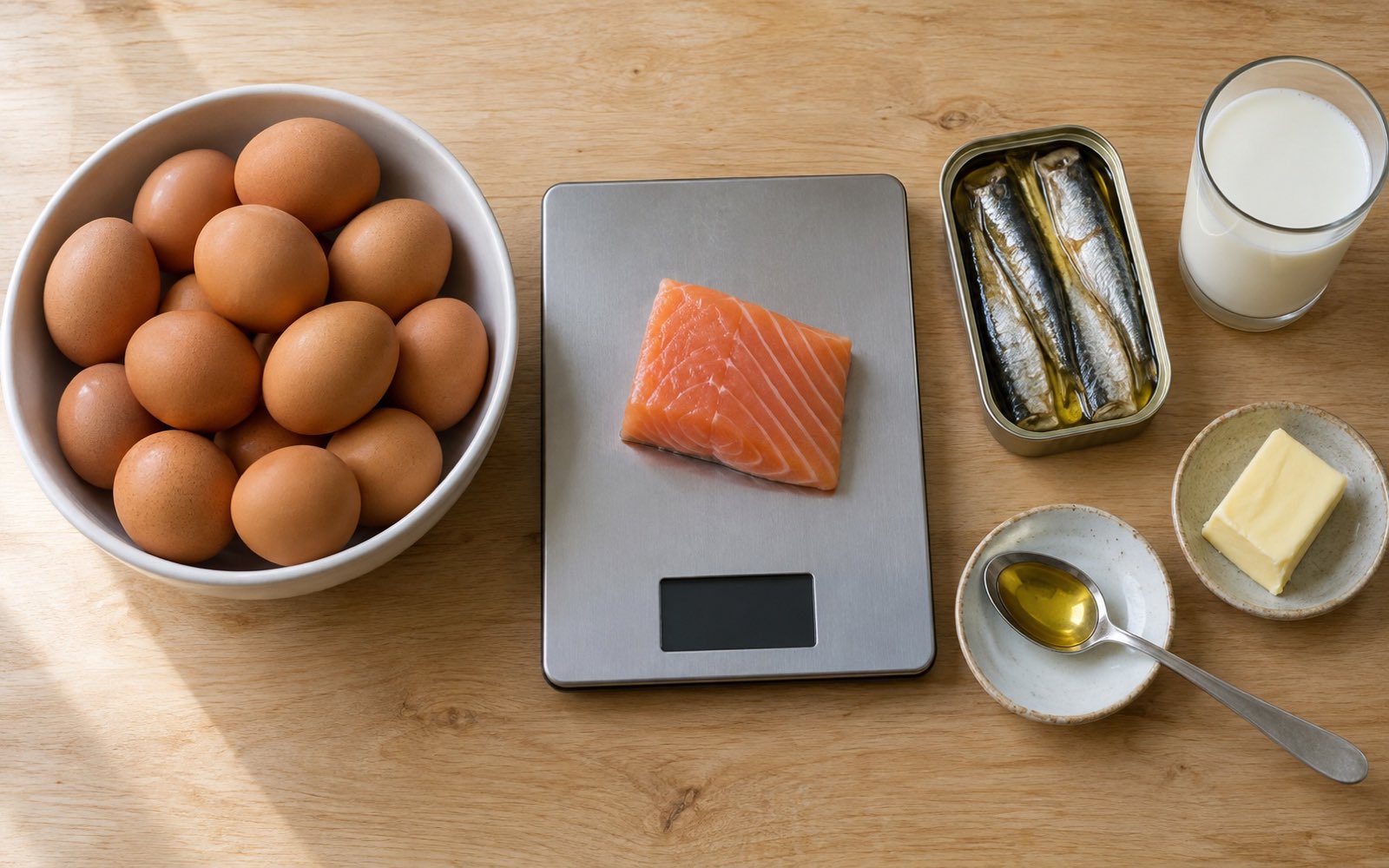
| Egg | 44 per egg (NIH), 20 per yolk (Russian guideline) | 2 eggs | 40–90 | 14–30 eggs |
| Fortified milk | 30–50 per 100 ml | 8 oz (250 ml) glass | 80–125 | 1.2–1.9 L (about 40–64 oz) |
| Regular milk | ~2 | 8 oz (250 ml) glass | ~5 | about 8 gallons |
| Butter | ~52 | 10 g on toast | ~5 | 1.2 kg (2.6 lb) |
Fatty fish and cod liver oil are really the only foods that cover a full day's target alone — everything else adds a few percent at best. A 150 g (5.3 oz) serving of trout or sockeye salmon gets you to around 1,000 IU, plus a dose of omega-3s. The Sportygram food diary tracks calories, protein, fat, carbs, and water, but not vitamin D specifically — a simple proxy is noticing how often fatty fish shows up in your log.
D3 with K2, calcium, magnesium, omega-3, and vitamin C: what actually helps
At standard prevention doses, vitamin D doesn't need a partner supplement — not K2 "for safety," not calcium "for your bones."
K2. The theory is that K2 directs calcium into bone and away from blood vessels. A trial built to test exactly that didn't find the effect: Diederichsen et al. (2022) gave 365 men (average age 71) with aortic valve calcification either 720 mcg of K2 (MK-7) plus 1,000 IU of D3, or placebo, for two years, and calcification progressed at the same rate in both groups. For bone, the picture is a little kinder: in a meta-analysis by Kuang et al. (2020) of 8 trials and 971 people, vitamin K plus D slightly raised bone density (effect size 0.32). Still, there's no trial evidence for paying extra for K2 to make vitamin D safer.
Calcium. The reference intake is 1,000 mg a day for adults and 1,200 mg after 65 (Rospotrebnadzor, MR 2.3.1.0253-21). Get it from food first; a calcium supplement is a decision for your doctor. In a Cochrane review by Bjelakovic et al. (2014), D3 combined with calcium raised the risk of kidney stones (risk ratio 1.17).
Magnesium. The Russian guideline notes that magnesium deficiency lowers the level of active vitamin D, so check how much magnesium you eat first. See our magnesium guide for food sources and targets.
Omega-3. Fine to combine — part of the VITAL cohort took both 2,000 IU of vitamin D and 1 g of omega-3 daily for five years (Manson et al., 2019).
Vitamin C. No known interaction, and no shown benefit from pairing them either.
Medications. Glucocorticoids, anticonvulsants, antifungals, antiretrovirals, cholestyramine, and orlistat can all interfere with vitamin D metabolism or absorption (Russian guideline, NIH). Talk to your doctor if you take any of these long-term.
What vitamin D does — and doesn't do — if you train
Vitamin D reliably fixes an actual deficiency. Beyond that, the proven upside is modest.
Athletes run low too: in a meta-analysis by Farrokhyar et al. (2015), 56% of 2,313 athletes were below 32 ng/ml, more often in winter and spring and in indoor sports.
- Muscle strength — a small bump, mostly if you were deficient. Beaudart et al. (2014), 30 trials and 5,615 participants (average age 61): a weak overall strength improvement (standardized difference 0.17), no change in muscle mass or power, clearer effect below 12 ng/ml and after 65.
- Colds — a modest effect. Jolliffe et al. (2021), 43 trials and 48,488 participants: at least one respiratory infection in 61.3% on vitamin D versus 62.3% on placebo overall, but clearer protection at daily doses of 400–1,000 IU (odds ratio 0.70, meaning roughly 30% lower odds). See exercise and immunity for training's own effect.
- Cancer and heart disease — no effect. In VITAL over 5.3 years, hazard ratios were 0.96 for cancer and 0.97 for major cardiovascular events (1.0 means no difference from placebo) — neither significant.
- Fractures in healthy adults — no effect. LeBoff et al. (2022), the same 25,871 VITAL participants: fracture hazard ratio 0.98 overall, 1.01 for hip fractures, regardless of baseline level or weight.
Questions and answers
Can I take vitamin D without getting tested first?
Yes, at general-prevention doses. The Russian guideline suggests 800–1,000 IU a day without a baseline test and reserves testing for the higher-risk groups in section 02. You can't spot low vitamin D by how you feel anyway: fatigue and hair loss often come from poor sleep, stress, or low iron. Above 2,000 IU, it's worth basing the dose on an actual result.
What's the best form of vitamin D: D3 or D2, drops, tablets, or capsules?
Choose D3, then pick the form by convenience and by the dose in each unit. At a single large dose, D3 raises blood levels more effectively (Tripkovic et al., 2012); at a normal daily dose the difference mostly disappears, and the Russian guideline still prefers D3 for long-term use. The drops in that guideline hold about 500 IU per drop, tablets come in 500–2,000 IU, and capsules in 2,000–10,000 IU. Capsules of 4,000 and 10,000 IU are above prevention doses and are meant for when a doctor sets the dose.
Is it better to take vitamin D in the morning or at night?
Take it whenever you'll remember: neither NIH nor the Russian guideline specifies a time of day. What matters more is taking it daily with a meal that has some fat, which raised peak D3 by 32% in one trial (Dawson-Hughes et al., 2015). It also works on an empty stomach, according to the Russian guideline.
Is 5,000 IU of vitamin D too much to take daily?
Without a blood test and a doctor, yes. It's above the 4,000 IU upper limit NIH sets for healthy adults and above the Russian guideline's limit for long-term use without testing. A dose like that should be based on an actual 25(OH)D result and set with a doctor, with calcium monitoring.
Should I take vitamin D with K2?
Not at standard prevention doses. In Diederichsen et al. (2022), K2 plus D3 for two years didn't slow valve or artery calcification compared with placebo. In VITAL, participants were given 2,000 IU without K2 for more than 5 years, with no more hypercalcemia than on placebo (Manson et al., 2019).
Can I take vitamin D with omega-3, vitamin C, calcium, and magnesium?
Yes, none of these combinations is off-limits: part of the VITAL cohort took omega-3 and vitamin D together for five years (Manson et al., 2019). Check magnesium on your plate first, since low magnesium means less active vitamin D (Russian guideline). Calcium is best covered by food, since D3 combined with a calcium supplement raised kidney stone risk (Bjelakovic et al., 2014). If you take any of the medications from section 02 long-term, talk through your vitamin D dose with a doctor.
Do I need vitamin D supplements in summer?
If you get 5–30 minutes of midday sun on bare arms and legs at least twice a week from spring through early fall, probably not (NIH). People over 65, with a BMI of 30+, or with darker skin get less from the same sun (Russian guideline; Webb et al., 2018). For them, it's worth deciding by test.
How much vitamin D should women over 40 or 50 take?
The same as other adults: 600 IU a day as the standard intake and 800–1,000 IU for prevention under the Russian guideline, rising to 800 IU after 70 per NIH (65 in Russian norms). During pregnancy and breastfeeding, the Russian guideline suggests 800–2,000 IU. A test makes sense with osteoporosis, a BMI of 30+, or falls or low-trauma fractures after 60.
The bottom line
- Vitamin D deficiency is common at higher latitudes, especially from late fall through early spring: in Russia, 84% of adults test below 30 ng/ml in spring.
- Standard intake is 600 IU (15 mcg) a day, 800 IU after 70 (NIH) or 65 (Russia); the Russian guideline suggests 800–1,000 IU for prevention.
- On a 25(OH)D test: under 20 ng/ml is deficient, 20–29 ng/ml is insufficient, and the Russian guideline aims for 30–60 ng/ml.
- Take D3 daily; a fat-containing meal raised peak levels by 32%, and it works on an empty stomach too.
- Roughly 2.5 IU per kg of body weight per day raises levels by 1 ng/ml; anything under 20 ng/ml is worth managing with a doctor.
- 4,000 IU a day is the limit for going without testing past six months; on 10,000 IU for three years, bone density fell more than on 400 IU.
- In large healthy-adult trials, supplementation didn't lower cancer, heart disease, or fracture risk — and K2 isn't a required add-on.
Checklist: vitamin D without unnecessary tests or pills
- Check whether you fall into a risk group from section 02 — if so, get a 25(OH)D test; if not, start with 800–1,000 IU a day.
- Choose D3 and take it with breakfast: a fat-containing meal raised peak levels by 32% in a trial.
- Test result under 30 ng/ml? Find your row in the section 06 table. Under 20 ng/ml — talk to a doctor.
- Don't stay above 2,000 IU for more than six months without a test, and don't go above 4,000 IU without medical guidance.
- Retest no sooner than 6 months out, or 8–12 weeks for a severe deficiency, using the same method each time.
- From spring through early fall, get 5–30 minutes of midday sun on bare arms and legs a couple of times a week.
- Nausea, vomiting, intense thirst, or weakness on a high dose — stop taking it and see a doctor.
Sources
- NIH Office of Dietary Supplements. Vitamin D — Fact Sheet for Health Professionals. — Intake levels, the 4,000 IU upper limit, 25(OH)D cutoffs, sun exposure, toxicity, food sources.
- Russian Association of Endocrinologists. Clinical Guidelines: "Vitamin D Deficiency" (Adults), 2021 revision (in Russian). — Level categories, 30–60 ng/ml target, risk groups, 800–1,000 IU for prevention, treatment protocols, the 2.5 IU/kg formula, drops, food sources.
- Rospotrebnadzor. MR 2.3.1.0253-21, "Physiological Nutrient and Energy Intake Norms for Population Groups of the Russian Federation", 2021 (in Russian). — Vitamin D and calcium reference intakes.
- Suplotova L. A., Avdeeva V. A., Pigarova E. A. et al. First Russian multicenter non-interventional registry study on the prevalence of vitamin D deficiency and insufficiency in the Russian Federation. Therapeutic Archive, 2021. — 996 adults: 72% below 30 ng/ml, 84% in spring, 62% in fall; men 79%, women 70%.
- Demay M. B. et al. Vitamin D for the Prevention of Disease: An Endocrine Society Clinical Practice Guideline. J Clin Endocrinol Metab, 2024. — Against routine testing, including in obesity and darker skin; no supplement above the standard intake for healthy adults under 75; daily dosing after 50; no fixed target level.
- Heaney R. P. et al. Human serum 25-hydroxycholecalciferol response to extended oral dosing with cholecalciferol. Am J Clin Nutr, 2003. — 67 men, 20 weeks: ~0.7 nmol/L rise per 1 mcg of daily D3 (about 0.7 ng/ml per 100 IU).
- Ekwaru J. P. et al. The importance of body weight for the dose response relationship of oral vitamin D supplementation and serum 25-hydroxyvitamin D in healthy volunteers. PLoS ONE, 2014. — 17,614 people: 12 nmol/L per 1,000 IU at doses up to 1,000 IU, 1.1 nmol/L at 15,000–20,000 IU.
- Tripkovic L. et al. Comparison of vitamin D2 and vitamin D3 supplementation in raising serum 25-hydroxyvitamin D status: a systematic review and meta-analysis. Am J Clin Nutr, 2012. — D3 outperforms D2 at large single doses; no difference daily.
- Dawson-Hughes B. et al. Dietary fat increases vitamin D-3 absorption. J Acad Nutr Diet, 2015. — Peak D3 32% higher after a high-fat breakfast.
- Manson J. E. et al. Vitamin D Supplements and Prevention of Cancer and Cardiovascular Disease. N Engl J Med, 2019. — VITAL trial: 2,000 IU for 5.3 years, no reduction in cancer or cardiovascular events.
- LeBoff M. S. et al. Supplemental Vitamin D and Incident Fractures in Midlife and Older Adults. N Engl J Med, 2022. — 2,000 IU didn't reduce fractures.
- Jolliffe D. A. et al. Vitamin D supplementation to prevent acute respiratory infections: a systematic review and meta-analysis of aggregate data from randomised controlled trials. Lancet Diabetes Endocrinol, 2021. — Infections in 61.3% vs. 62.3%.
- Burt L. A. et al. Effect of High-Dose Vitamin D Supplementation on Volumetric Bone Density and Bone Strength: A Randomized Clinical Trial. JAMA, 2019. — Bone density fell more at 4,000 and 10,000 IU than at 400 IU.
- Diederichsen A. C. P. et al. Vitamin K2 and D in Patients With Aortic Valve Calcification: A Randomized Double-Blinded Clinical Trial. Circulation, 2022. — K2 plus D3 didn't slow calcification versus placebo.
- Beaudart C. et al. The effects of vitamin D on skeletal muscle strength, muscle mass, and muscle power: a systematic review and meta-analysis of randomized controlled trials. J Clin Endocrinol Metab, 2014. — Small strength gain; mass and power unchanged.
- Webb A. R. et al. Colour Counts: Sunlight and Skin Type as Drivers of Vitamin D Deficiency at UK Latitudes. Nutrients, 2018. — Brown skin needs about 25 minutes of midday sun daily from March to September.
- Galior K., Grebe S., Singh R. Development of Vitamin D Toxicity from Overcorrection of Vitamin D Deficiency: A Review of Case Reports. Nutrients, 2018. — 13 poisoning cases with 25(OH)D of 150–1,220 ng/ml.
- Kuang X. et al. The combination effect of vitamin K and vitamin D on human bone quality: a meta-analysis of randomized controlled trials. Food & Function, 2020. — Vitamin K plus D slightly raised bone density.
- Bjelakovic G. et al. Vitamin D supplementation for prevention of mortality in adults. Cochrane Database Syst Rev, 2014. — D3 with calcium raised kidney stone risk.
- Farrokhyar F. et al. Prevalence of vitamin D inadequacy in athletes: a systematic-review and meta-analysis. Sports Med, 2015. — 2,313 athletes: 56% below 32 ng/ml.
This article is for informational purposes only and is not a substitute for medical advice.