

omega-3s are fats for your heart, brain and eyes that your body can barely make on its own, so you need to get them from food. The ones to count are EPA and DHA from fish: a healthy adult needs 250–500 mg a day, which is 1–2 servings of herring or salmon a week, or 2–3 servings of mackerel and sardines. A 2020 Cochrane review of 162,796 people found that omega-3s lower triglycerides (fats in your blood) by about 15% on average, but they don't help you lose weight and barely change your risk of heart attack or stroke.Supplements make sense if you eat almost no fish, and you should choose them by the EPA and DHA total per daily serving. Discuss doses above 1 g a day with your doctor: a 2021 review of 81,210 people found atrial fibrillation (an irregular heartbeat) about 1.5 times more often at those doses.
Omega-3s help your heart, brain and eyes work. Your body can barely make these fats on its own, so they have to come from food. A healthy adult needs 250–500 mg a day of the two main types found in fish, EPA and DHA. That's one or two servings of fatty fish a week: 3.5 oz (100 g) of herring or salmon gives you about 2,000 mg. What to do: check whether you eat fatty fish at least once a week. If you do, you don't need a supplement. If you eat almost no fish, a supplement can fill the gap. Don't go over 1 g a day without your doctor's OK.

What omega-3s do for your body and which benefits are hype
Omega-3s are a family of fats. Your body builds them into cell membranes, and your brain and the retina of your eye hold especially large amounts of DHA. Your body also turns omega-3s into compounds that help regulate your blood vessels, blood clotting and inflammation. It can't make the plant omega-3 (ALA) at all, and it makes the fish omega-3s (EPA and DHA) from ALA only in tiny amounts. So you need to get both from food.
Put simply, omega-3 isn't a cure-all. It's a normal part of your diet, like protein or vitamins. If you already get enough, an extra capsule adds nothing. If you don't, fish is the easiest way to cover it.
Omega-3s come with a lot of promises, from protecting your heart to slowing aging. Here's what large research reviews actually back up.
| Claim | What we know | How we know |
|---|---|---|
| Lowers triglycerides (fats in your blood) | Proven: by 15% on average, and a higher dose lowers them more. With very high triglycerides, 4 g a day lowers them by 30% or more, but that's treatment from a doctor | Abdelhamid et al., Cochrane review, 2020, 86 studies; American Heart Association science advisory, 2019 |
| Protects your heart | Fish, yes: 1–2 fish meals a week are linked to a lower risk of heart disease and ischemic stroke. Capsules barely change the overall risk of heart attack, stroke and death. They may slightly lower deaths from coronary heart disease: if 334 people take them for years, one death is prevented | American Heart Association science advisory, Rimm et al., 2018; Cochrane review, 2020 |
| Supports the baby's brain and eyes during pregnancy | Yes: DHA builds up in the baby's brain and retina, which is why pregnant women are advised to add 100–200 mg of DHA to the usual amount. A 2018 Cochrane review of 19,927 women found that omega-3 supplements during pregnancy lower the risk of preterm birth by 11% and birth before 34 weeks by 42% | EFSA opinion, 2010; Middleton et al., Cochrane review, 2018, 70 studies |
| Improves memory, prevents dementia | In healthy adults over 60, supplements don't affect memory or attention: three trials with 4,080 people found no difference from placebo | Sydenham et al., Cochrane review, 2012 |
| Helps you lose weight | No: barely affects weight or body fat | Cochrane review, 2020 |
| Prevents cancer | Not proven: in the VITAL trial, 25,871 people took it for five years and the supplement didn't change the number of cancer cases | Manson et al., VITAL trial, 2019 |
| Joints, skin, immunity, anti-aging, colds | With rheumatoid arthritis, supplements sometimes help people take fewer painkillers, but that's your doctor's call. There's no reliable data on skin, immunity, anti-aging or colds | NIH fact sheet, on joints |
| Safe at any dose | No: the risk of atrial fibrillation goes up with the dose, especially above 1 g a day | Gencer et al., meta-analysis, 2021, 7 studies, 81,210 people |
| Causes bleeding | At normal doses, no dangerous bleeding has been found: in VITAL, 1 g a day caused no more serious bleeding than placebo. Be careful if you take blood thinners or have surgery coming up | NIH fact sheet; VITAL trial, 2019 |
The takeaway: lowering blood fats is proven, and eating fish is linked to a healthier heart. Science hasn't confirmed the claims about "fat burning," "immune support" or "anti-aging."
The three types of omega-3: ALA, EPA and DHA (and which ones count)
You'll see three types of omega-3 in foods and on supplement labels. They're very different, and that changes what you should count.
| Type | Where you find it | What to know |
|---|---|---|
| ALA, the plant omega-3 | Flaxseed and canola oil, flax and chia seeds, walnuts | Your body turns it into EPA and DHA very poorly: less than 15%, per the NIH fact sheet |
| EPA, an omega-3 from fish | Fatty fish, fish oil | Your body uses it to make compounds that affect blood vessels, blood clotting and inflammation |
| DHA, an omega-3 from fish | Fatty fish, fish oil, algae oil | The main fat in the membranes of brain and retina cells |
On supplement labels, EPA and DHA sometimes appear under their full names: eicosapentaenoic acid and docosahexaenoic acid.
Why doesn't flaxseed oil replace fish? A 2005 review by Burdge and Calder, using labeled-ALA tracer studies, found that in men, ALA turns into a little EPA and almost no DHA. Women convert it better, probably because of estrogen, but the amounts are still small. Flaxseed oil, chia and walnuts are a good addition to your diet. But the 250–500 mg target counts only EPA and DHA.
Then there's "omega-3-6-9". Omega-6 is plentiful in soybean and corn oil, seeds and mayonnaise, and a typical diet already has more than enough. Omega-9 is mostly the fat in olive oil, and your body can make it on its own. So there's no point paying for a 3-6-9 blend: count only omega-3. For which fats you need overall and how many grams of fat a day, see our guide to healthy fats.
How much omega-3 you need per day: from daily needs to treatment
Your target is EPA and DHA added together. In a 2010 opinion, the European Food Safety Authority (EFSA) considered 250 mg a day an adequate intake for adults, and a 2012 opinion put the European recommendation for adults at 250–500 mg. The US has no official daily amount for EPA and DHA, only for plant ALA. That's one or two servings of fatty fish a week, in line with the American Heart Association's 2018 advisory to eat seafood once or twice a week.
Here's the dose ladder. The higher the step, the less the decision is yours.
| EPA + DHA per day | What it means | Who decides |
|---|---|---|
| 250 mg | A healthy adult's daily need: about one serving of fatty fish a week | You, with food |
| 500 mg | The top of the usual range: about two servings of fatty fish a week | You, with food or a supplement |
| 100–200 mg of DHA | Extra during pregnancy | You and the doctor managing your pregnancy |
| Over 1 g | In large studies of people around 65, atrial fibrillation showed up about 1.5 times as often as without the supplement | Your doctor only |
| 2–4 g | Treatment for high triglycerides: 4 g a day lowers them by 30% or more | Your doctor only, based on blood tests |
More isn't better. Anything above 1 g a day isn't nutrition anymore. It's treatment.
You may read that up to 5 g a day is safe. In a 2012 opinion, EFSA did say that supplements up to 5 g of EPA and DHA a day caused no bleeding or other problems in adults. Two later trials with 4 g a day, REDUCE-IT and STRENGTH, found something different. In STRENGTH, 13,078 people at high risk for heart disease took 4 g of EPA and DHA a day or corn oil: there was no heart benefit, but atrial fibrillation showed up in 2.2% of them versus 1.3% on corn oil. A safety limit isn't a target to aim for.
Foods highest in omega-3: a table
The numbers below come from the US Department of Agriculture (USDA) food database, as cited in the National Institutes of Health fact sheet. The fact sheet uses 3-oz (85 g) servings of cooked fish. Here everything is converted to 3.5 oz (100 g) and rounded. The fat content of fish changes with the season, where it was caught and what farmed fish were fed, so treat these numbers as estimates.
The two right columns show how many 3.5-oz (100 g) servings a week cover 250 mg or 500 mg a day. That's 1,750 mg and 3,500 mg for the week.
| Food, 3.5 oz (100 g) cooked | EPA + DHA | Servings a week for 250 mg a day | For 500 mg a day |
|---|---|---|---|
| Atlantic salmon, farmed | ≈2,150 mg | 1 | 2 |
| Atlantic herring | ≈2,000 mg | 1 | 2 |
| Sardines, canned in tomato sauce | ≈1,400 mg | 1–2 | 2–3 |
| Atlantic mackerel | ≈1,200 mg | 1–2 | 3 |
| Pink salmon, canned | ≈1,070 mg | 2 | 3–4 |
| Rainbow trout | ≈1,000 mg | 2 | 3–4 |
| Shrimp | ≈280 mg | 6–7 | not realistic with food |
| Light tuna, canned in water | ≈220 mg | 8 | not realistic with food |
| Cod | ≈160 mg | not realistic with food | not realistic with food |
| Chicken breast | ≈35 mg | not a source | not a source |
| Egg, 1 whole | ≈30 mg | not a source | not a source |
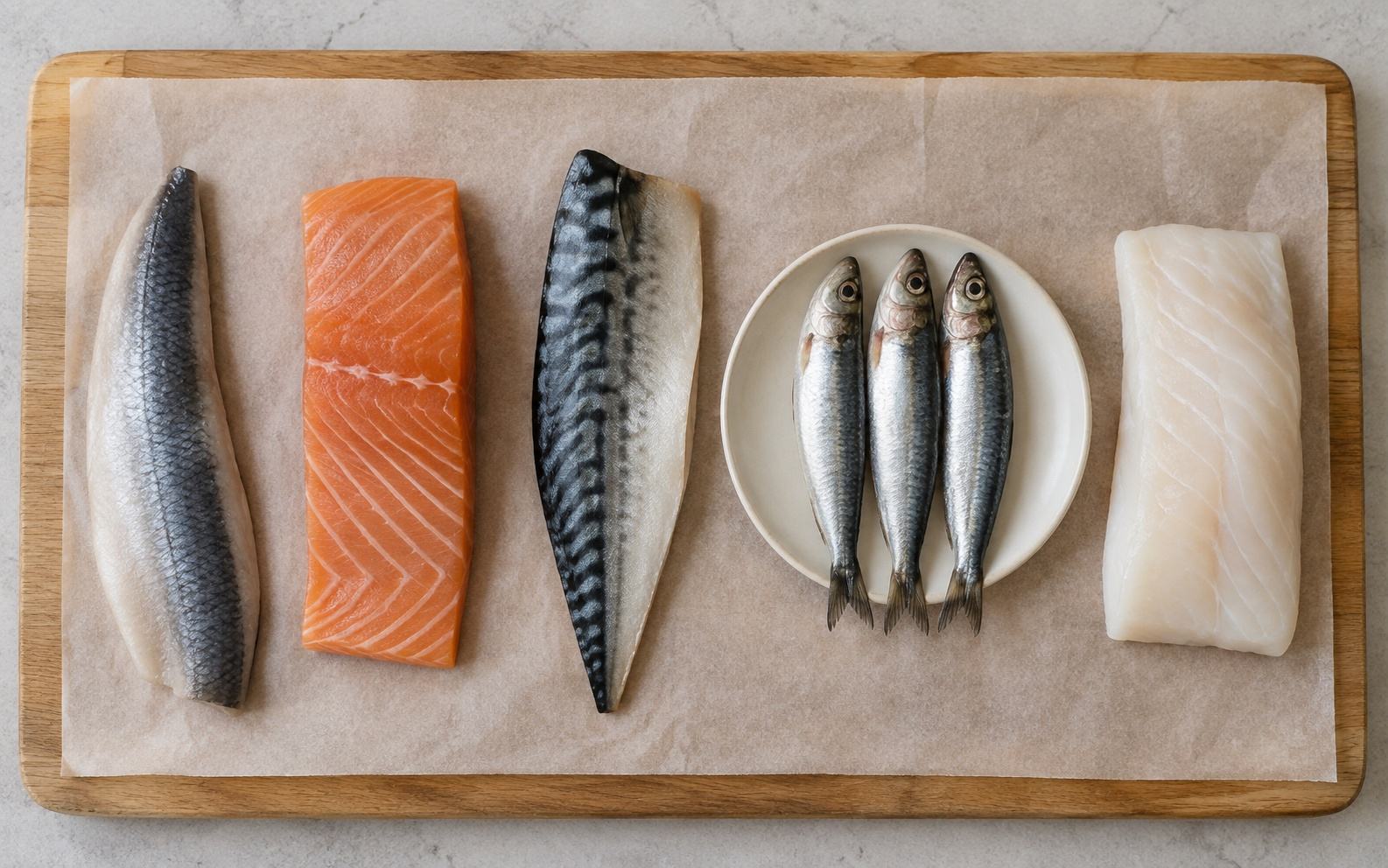
Fatty fish is what delivers omega-3s. Cod, tuna canned in water and shrimp are good sources of protein, but they won't cover your omega-3 needs. Canned fish counts: canned sardines and pink salmon work.
Plant foods are listed separately and in grams. This is ALA, not EPA and DHA.
| Food | ALA |
|---|---|
| Flaxseed oil, 1 tbsp | ≈7.3 g |
| Chia seeds, 1 oz (28 g) | ≈5.1 g |
| Walnuts, 1 oz (28 g) | ≈2.6 g |
| Flaxseed, 1 tbsp | ≈2.4 g |
| Canola oil, 1 tbsp | ≈1.3 g |
A common mistake in omega-3 articles is "five walnuts cover your daily omega-3." Five walnuts do give you about a day's worth of ALA under the US intake levels the NIH fact sheet cites: about 1.1 g for women and 1.6 g for men. But they don't cover EPA and DHA, because the conversion is too weak.
Fish or supplements? A 3-question check
Go in order and answer each question with a yes or a no.
- Does anything on this list apply to you? Pregnancy or breastfeeding. High triglycerides on a blood test. Heart disease or a heart rhythm problem. Taking blood thinners. Surgery coming up. A fish or shellfish allergy. Yes: don't decide on your own. Ask your doctor first.
- Do you eat fatty fish at least once a week? Herring, mackerel, sardines, salmon, canned pink salmon or trout, from the table above. Yes: you don't need a supplement. Keep it at 1–2 servings of herring or salmon a week, or 2–3 of mackerel, sardines, canned pink salmon or trout.
- Do you eat almost no fish, or none at all? Yes: a supplement can cover it, with 250–500 mg of EPA and DHA combined per daily serving. If you're vegan, algae oil works: a capsule usually has 100–300 mg of DHA, sometimes some EPA too.
The decision is yours. In the cases from question 1, you make it together with your doctor.
How to read a fish oil label without overpaying
The "fish oil 1,000 mg" on the front of the bottle is the weight of all the oil in the capsule, not the omega-3. Check the Supplement Facts panel instead. A typical capsule has 180 mg of EPA and 120 mg of DHA. Together that's 300 mg of omega-3. One of those a day puts you in the 250–500 mg range. Two make 600 mg, more than a healthy person needs. Three make 900 mg, almost 1 g: talk to your doctor before taking that much.
before you buy, find two lines on the label, EPA and DHA, and add them up. Divide the 250–500 mg you need by that total, and you'll know how many capsules a day to take. If the bottle doesn't list EPA and DHA separately, only "fish oil" or "omega-3", skip it: you can't work out the dose.
Fish oil is simply oil from fish, and about a third of it is omega-3. Concentrates pack more omega-3 into each capsule, so compare the EPA plus DHA total, not the product names.
What else to check:
- Dose per serving. Sometimes the numbers on the label are for 2–3 capsules, not one.
- Smell. Don't take capsules with a sharp, rancid smell: the oil may have oxidized.
- Storage. Store the bottle the way the label says, away from heat and sunlight.
- How to take it. Take the capsule with a meal: fishy burps and heartburn happen less often.
- Mercury. Testing hasn't found it in omega-3 supplements: it's removed during processing.
Supplement or prescription? Omega-3s come both ways. Dietary supplements don't need FDA approval before they go on sale, and the FDA doesn't check whether they work. High-dose prescription omega-3s are for specific cases, such as very high triglycerides, and only a doctor can prescribe them. If you're healthy and eat no fish, a regular supplement with a clear EPA and DHA total is enough.
Omega-3 for women and men: is there a difference?
Women need omega-3s for the same things men do: the heart, brain and eyes. There's no separate target for women.
| What | Women | Men |
|---|---|---|
| EPA and DHA target | 250–500 mg a day | 250–500 mg a day |
| Plant ALA | Converts to EPA and DHA better, but amounts are still small | Converts worse, almost no DHA |
| ALA target | About 1.1 g a day | About 1.6 g a day |
| Pregnancy and breastfeeding | Extra 100–200 mg of DHA during pregnancy, fish low in mercury | — |
| Claims about hormones or sex drive | No reliable data | No reliable data |
If you're pregnant or breastfeeding, the US Food and Drug Administration (FDA) advises 2–3 servings of fish a week, 4 oz (113 g) each. Choose fish low in mercury: salmon, sardines, herring, Atlantic mackerel and trout. Avoid shark, swordfish, king mackerel, marlin and bigeye tuna: they have the most mercury. Whether you need a supplement on top of fish is up to the doctor managing your pregnancy.
After 50, the target is the same. In the VITAL trial, published by Manson et al. in 2019, 25,871 people (men 50 and older, women 55 and older) took 1 g of omega-3 a day for about five years. The combined risk of heart attack, stroke and death from heart disease didn't go down. But there were 28% fewer heart attacks, and 40% fewer in people who ate fish less than 1.5 times a week. And after 50, what keeps your muscles strong is protein and strength training, which omega-3s can't replace.
When omega-3 can do harm and when to see a doctor
Atrial fibrillation. This is a heart rhythm problem where your heart beats irregularly. A 2021 meta-analysis by Gencer et al., published in Circulation, pooled 7 large trials with 81,210 people, average age 65. People taking omega-3s had atrial fibrillation 25% more often. At doses up to 1 g a day, it was 12% more often. Above 1 g, it was 49% more often. The higher the dose, the higher the risk.
Bleeding. High doses of fish oil slightly affect blood clotting, but at normal doses no dangerous bleeding has been found: in VITAL, 1 g a day caused no more serious bleeding than placebo. If you take blood thinners, your doctor should know about the supplement and keep an eye on your blood tests. Tell your doctor about it before surgery too.
Side effects. They're usually mild: an unpleasant taste, bad breath, heartburn, nausea, an upset stomach, headache and sweat with a slightly fishy smell.
High triglycerides. If a blood test shows high blood fats, don't treat them with capsules on your own. They often go hand in hand with excess weight and diabetes. Decide what to do about that result with your doctor.
See a doctor if:
- You're pregnant or breastfeeding and thinking about a supplement.
- A blood test shows high triglycerides or cholesterol.
- You have heart disease, or your heart skips beats or feels irregular.
- You take blood thinners or have surgery coming up.
- You're allergic to fish or shellfish.
- You have liver, gallbladder or pancreas disease.
- You want to take more than 1 g of EPA and DHA a day.
A budget omega-3 week and how to check it in your food diary
You can hit your target without pricey salmon fillets or supplements. Here's a sample week:
- Monday: herring with boiled potatoes. 3.5 oz (100 g) of herring gives about 2,000 mg.
- Wednesday: a salad with canned pink salmon. 3.5 oz (100 g) gives about 1,070 mg.
- Friday: baked mackerel. 3.5 oz (100 g) gives about 1,200 mg.
Three servings give you about 4,300 mg for the week, or roughly 600 mg a day. Herring, mackerel and canned fish usually cost less than salmon fillets and cover your needs just as well. To build a cheap grocery list for the week, see our guide to healthy eating on a budget.
A food diary is more reliable than your memory for how much fish you actually ate. If you track meals in the Sportygram app, log each fish meal in your food diary. You'll see calories, protein, fat and carbs, plus how many calories you have left for the day, and the days with fish show up by date.
The app doesn't track omega-3 as a separate line, only calories, protein, fat and carbs. To see how much omega-3 is in a serving, use the table above. If your doctor wants to see what you eat, you can export the diary as a PDF.
Omega-3 and working out: what's true and what's hype
If you work out, you've probably seen omega-3 sold as a "sports" supplement. There's no separate target for active people: it's the same 250–500 mg of EPA and DHA a day.
- Weight loss. Doesn't work: omega-3s barely affect weight or body fat. You lose weight with a calorie deficit.
- Sore muscles after the gym. There isn't much reliable data. Light movement, sleep and massage ease soreness better. More in our guide to sore muscles after a workout.
- Strength and muscle growth. There's little reliable evidence that capsules add either one. Muscles grow from strength training, protein and sleep.
- Your heart and blood fats. The foundation here is exercise and losing excess weight. Another bottle of capsules won't replace them.
What to do instead of extra capsules: 150–300 minutes of moderate cardio a week. Incline walking on a treadmill, a stationary bike or an elliptical all work. Go at a pace where you can talk but not sing, for 30–40 minutes at a time. To see how exercise changes cholesterol and triglycerides on your blood tests, read our guide to exercise and cholesterol.
 Incline walking
FAQ
Is omega-3 the same as fish oil?
No. Fish oil is oil from fish, and omega-3 is only part of it. A typical "fish oil 1,000 mg" capsule has about 300 mg of omega-3, and the rest is other fats. Cod liver oil also contains vitamins A and D. What matters isn't the name on the bottle but the EPA and DHA total per daily serving.
Can you take omega-3 every day without breaks?
At a normal dose of 250–500 mg of EPA and DHA, yes: it's part of your diet, like fish on the menu. In large trials, people took the supplement for years, about five years in a row in VITAL. These studies give no reason to take it in cycles with breaks. The real limit is the dose: don't take more than 1 g a day without your doctor.
Can you take omega-3 without asking a doctor?
If you're a healthy adult staying within 250–500 mg a day, yes: that fills a gap in your diet and isn't treatment. Ask your doctor first if you're pregnant or breastfeeding, or have heart disease or a heart rhythm problem. The same goes if you take blood thinners, have surgery coming up, have a fish allergy or want to take more than 1 g a day.
What is the best time to take omega-3: morning or night?
There's no evidence that the time of day changes anything. What matters more is taking the capsule with food, ideally your biggest meal: fishy burps, heartburn and nausea happen less often. Tie the capsule to the same breakfast or dinner every day so you don't forget. Swallow it whole, as the label says.
Does omega-3 help you lose weight?
No. A Cochrane review pooled 86 studies with more than 162,000 people: omega-3s barely affected weight or body fat. You lose weight through a calorie deficit, not a supplement. Here's how to calculate a calorie deficit and stick with it. Fish still helps when you're losing weight, because it's high in protein.
Can you take omega-3 with vitamin D and magnesium?
There's no general rule against it. The VITAL trial gave omega-3 and vitamin D together. Just make sure the doses don't add up without you noticing: cod liver oil already contains vitamin D. Who needs vitamin D and how much, see our vitamin D guide. Magnesium and omega-3 can be taken together too, but whether you need a magnesium supplement is best decided with your doctor.
Is omega-3 bad for your liver, and who should not take it?
Liver damage isn't among the common side effects. The common ones are an unpleasant taste, heartburn, nausea, an upset stomach and headache. If you have liver, gallbladder or pancreas disease, still discuss the supplement with your doctor. Don't start it without your doctor if you have a fish allergy, take blood thinners or have surgery coming up.
Should you get an omega-3 index test?
The test exists: it shows the share of EPA and DHA in your red blood cell membranes. There's no single official normal range for it: the NIH fact sheet only notes that in people who eat little fish it typically runs 3–5%, roughly half the level seen in Japan. If you're healthy, it's simpler to check your week against the fish table above: if you eat enough servings, you're getting enough omega-3. If your doctor suggests the test, decide what to do with the result together.
Do kids need omega-3?
Yes, but the dose and type of supplement should come from a pediatrician: don't give a child capsules on your own. For food, the FDA advises two servings of low-mercury fish a week for kids. The serving depends on age: about 1 oz (30 g) at ages 1–3, 2 oz (60 g) at 4–7, 3 oz (85 g) at 8–10 and 4 oz (113 g) from age 11.
The bottom line
- Omega-3s are fats for your heart, brain and eyes that your body can barely make on its own. Count EPA and DHA from fish, not plant ALA.
- A healthy adult needs 250–500 mg of EPA and DHA a day. That's 1–2 servings of herring or salmon a week, or 2–3 of mackerel, sardines or canned pink salmon.
- Proven: omega-3s lower triglycerides, and fish in your diet is linked to a healthy heart. Not proven: weight loss, better memory in healthy older adults, immunity, skin and anti-aging.
- Supplements make sense if you eat almost no fish. Check the EPA and DHA total on the label, not "fish oil 1,000 mg".
- More than 1 g a day only with your doctor. Pregnancy, heart disease, blood thinners or upcoming surgery: see your doctor first.
Checklist: omega-3 without wasting money
- 1–2 servings of herring or salmon a week, or 2–3 of mackerel, sardines, canned pink salmon or trout.
- Canned fish counts: canned sardines and pink salmon cover your needs as well as fresh fish.
- Flaxseed oil, chia and walnuts are a plus for your diet, not a replacement for fish.
- Choose a capsule by the EPA and DHA total per daily serving: you need 250–500 mg.
- No more than 1 g of EPA and DHA a day without your doctor.
- Pregnancy, heart disease, blood thinners, upcoming surgery or a fish allergy: see your doctor first.
Sources
- Office of Dietary Supplements, National Institutes of Health. Omega-3 Fatty Acids — Fact Sheet for Health Professionals. — A fact sheet from the US National Institutes of Health: omega-3 content of foods from the USDA database, ALA intake levels of 1.6 and 1.1 g a day, a typical fish oil capsule (180 mg of EPA and 120 mg of DHA), ALA conversion below 15%, a breakdown of VITAL including its fish-intake subgroup, rheumatoid arthritis, mercury in supplements, side effects and the omega-3 index.
- European Food Safety Authority (EFSA). Scientific Opinion on Dietary Reference Values for fats. EFSA Journal, 2010. — Adequate intake of EPA and DHA for adults is 250 mg a day; pregnancy and breastfeeding add 100–200 mg of DHA.
- European Food Safety Authority (EFSA). Scientific Opinion on the Tolerable Upper Intake Level of eicosapentaenoic acid (EPA), docosahexaenoic acid (DHA) and docosapentaenoic acid (DPA). EFSA Journal, 2012. — Supplements of EPA and DHA up to 5 g a day caused no bleeding or other problems in adults; the European recommendation for adults is 250–500 mg a day.
- Abdelhamid A. S. et al. Omega-3 fatty acids for the primary and secondary prevention of cardiovascular disease. Cochrane Database of Systematic Reviews, 2020. — 86 studies, 162,796 participants: omega-3s barely change overall deaths or cardiovascular events, may slightly lower deaths from coronary heart disease (one life saved per 334 people), lower triglycerides by about 15% and barely affect weight or body fat.
- Rimm E. B. et al. Seafood Long-Chain n-3 Polyunsaturated Fatty Acids and Cardiovascular Disease: A Science Advisory From the American Heart Association. Circulation, 2018. — 1–2 seafood meals a week lower the risk of heart disease, ischemic stroke and sudden cardiac death.
- Skulas-Ray A. C. et al. Omega-3 Fatty Acids for the Management of Hypertriglyceridemia: A Science Advisory From the American Heart Association. Circulation, 2019. — Since 2002, guidelines have recommended 2–4 g of EPA and DHA a day, prescribed by a doctor, to lower triglycerides; 4 g a day lowers very high triglycerides by 30% or more; high triglycerides are mainly linked to obesity and diabetes.
- Gencer B. et al. Effect of Long-Term Marine ω-3 Fatty Acids Supplementation on the Risk of Atrial Fibrillation in Randomized Controlled Trials of Cardiovascular Outcomes: A Systematic Review and Meta-Analysis. Circulation, 2021. — 7 trials, 81,210 participants, average age 65: atrial fibrillation risk was 25% higher; 12% higher at doses up to 1 g a day and 49% higher above 1 g.
- Manson J. E. et al. Marine n-3 Fatty Acids and Prevention of Cardiovascular Disease and Cancer. New England Journal of Medicine, 2019. — The VITAL trial: 25,871 people, 1 g of omega-3 a day, median follow-up 5.3 years. The combined risk of heart attack, stroke and death from heart disease didn't change, nor did the number of cancer cases; there were 28% fewer heart attacks, and no more serious bleeding than with placebo.
- Nicholls S. J. et al. Effect of High-Dose Omega-3 Fatty Acids vs Corn Oil on Major Adverse Cardiovascular Events in Patients at High Cardiovascular Risk: The STRENGTH Randomized Clinical Trial. JAMA, 2020. — 13,078 people at high risk for heart disease, 4 g of EPA and DHA a day versus corn oil: no cardiovascular benefit, and new atrial fibrillation in 2.2% versus 1.3%.
- Middleton P. et al. Omega-3 fatty acid addition during pregnancy. Cochrane Database of Systematic Reviews, 2018. — 70 studies, 19,927 women: preterm birth was 11% less common, and birth before 34 weeks 42% less common.
- Sydenham E., Dangour A. D., Lim W.-S. Omega 3 fatty acid for the prevention of cognitive decline and dementia. Cochrane Database of Systematic Reviews, 2012. — Three trials, 4,080 people 60 and older without dementia: omega-3 supplements didn't affect memory or other cognitive test scores.
- Burdge G. C., Calder P. C. Conversion of alpha-linolenic acid to longer-chain polyunsaturated fatty acids in human adults. Reproduction Nutrition Development, 2005. — In men, plant ALA converts to EPA to a limited extent and to DHA very poorly; women convert more, probably because of estrogen.
- U.S. Food and Drug Administration. Advice about Eating Fish. — 2–3 servings a week of low-mercury fish, 4 oz (113 g) each, for pregnant and breastfeeding women; 2 age-based servings a week for children; and a list of fish highest in mercury.
This material is for informational purposes and does not replace medical advice. If you're pregnant or breastfeeding, have heart disease, take blood thinners or have high triglycerides on a blood test, talk to your doctor before taking omega-3 supplements.