

a warm-up before a workout takes 8–12 minutes and has three steps: 2–3 minutes of light cardio, 3–4 minutes of joint mobility and 2–3 minutes of muscle activation. Before a barbell lift, do 2–4 warm-up sets: the weight goes up and the reps go down.Stretching a muscle for less than a minute barely costs you strength. A minute or longer cuts performance by 4–5% on average right afterward. Start your workout as soon as you're done: while you sit scrolling on your phone, your body cools down.
A warm-up before a workout is 8–12 minutes of easy work that gets your body ready for the effort ahead. It has three steps. First, 2–3 minutes of light cardio until you feel warm and breathe a little faster. Then 3–4 minutes of mobility moves for your joints: squats, lunges, arm and hip circles. Finally, 2–3 minutes of exercises that activate your muscles: glute bridges, dead bugs, push-ups. Before a barbell lift, add 2–4 warm-up sets: the empty bar, about 50% and 75–80% of your working weight. Save longer stretches for the end of your workout.
A 10-minute warm-up: three steps and 10 exercises
This routine works before most workouts. Only the first step changes: at the gym you warm up on a cardio machine, at home with two no-equipment moves. Keep the pace easy and don't push to the point of fatigue.
Step 1. Get warm: 2–3 minutes. The goal is simple: feel warm and breathe faster, but still be able to talk in full sentences.
- Stationary bike or elliptical (gym). 3 minutes at an easy pace. Keep the resistance low and raise it slightly toward the end.
- High knees (home). 30 seconds. March in place, bring your knees up to hip height and swing your arms in rhythm.
- Jumping jacks (home). 30 seconds. Jump your feet out wider than your shoulders as you raise your arms overhead, then jump back to the start. If jumping isn't an option (say, you have downstairs neighbors), step side to side and raise your arms the same way.
At home, do two rounds: high knees, then jumping jacks. That's 2 minutes.
Step 2. Mobility: 3–4 minutes. You take your joints through their full range of motion while there's no weight on them yet.
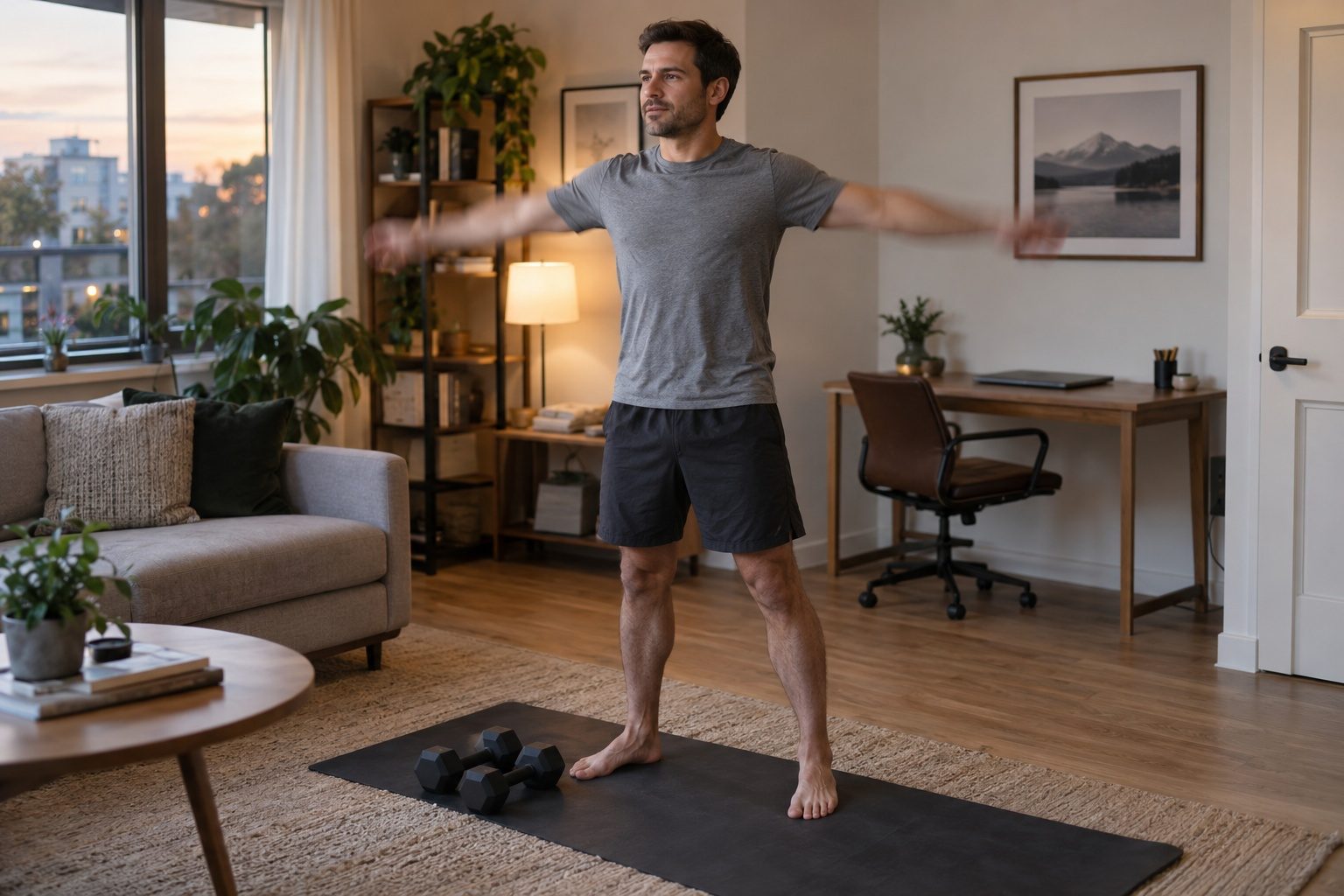
- Joint circles. 1 minute. Circle your shoulders, elbows, hips, knees and ankles, 8–10 circles per joint, switching direction halfway through. For your neck, stick to tilts and turns: no full circles that drop your head back.
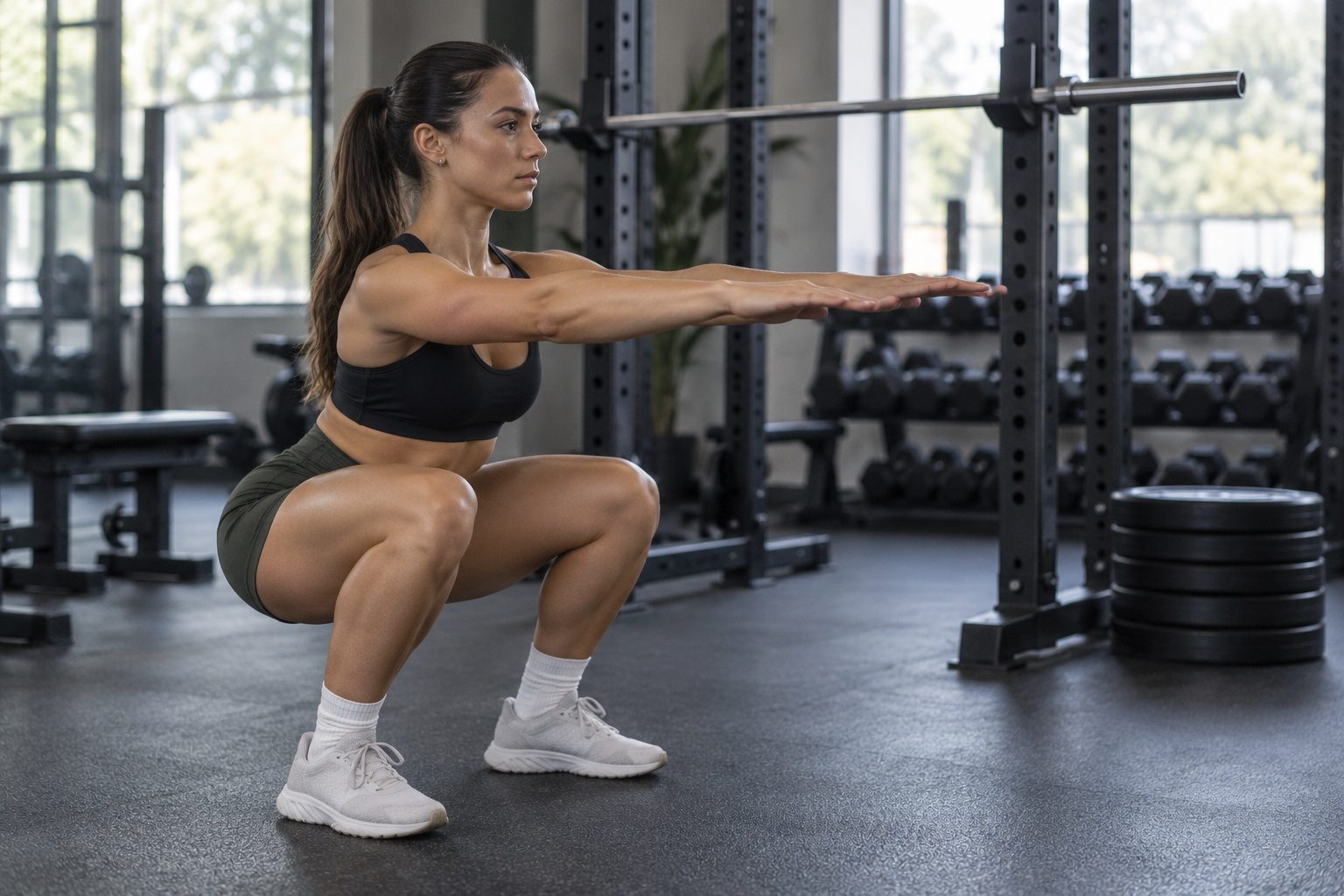
- Squats. 10–12 bodyweight reps, slowly, as deep as you can while keeping your back flat. Keep your heels down and your knees in line with your toes.
- Stationary lunges. 6–8 per leg. Keep your front knee over your foot and lower your back knee almost to the floor.
You can add cat-cow (on all fours, arch and round your back 8 times) and front-to-back leg swings, 10 per leg.
Step 3. Activate your muscles: 2–3 minutes. This is the step people skip most often. Glute bridges, dead bugs, push-ups and supermans wake up your glutes, core, chest and back before you load them.
- Glute bridge. 12–15 reps. Lie on your back with your feet flat, lift your hips and squeeze your glutes at the top for a second.
- Dead bug. 6–8 per side. Lie on your back with your arms reaching toward the ceiling and your knees bent at 90 degrees over your hips. Slowly lower the opposite arm and leg toward the floor, keeping your lower back pressed down.
- Push-ups. 8–10 reps on the floor or with your hands on a bench. Keep your body straight and don't let your hips sag.
- Superman. 10 reps. Lie face down, lift your straight arms and legs at the same time, hold for 1–2 seconds and lower.
At home, the whole routine takes 8–9 minutes. At the gym, go from step 3 straight to warm-up sets (section 03). Before leg day, add 15 calf raises. Before a glute workout, add standing banded hip abductions, 12 per leg.
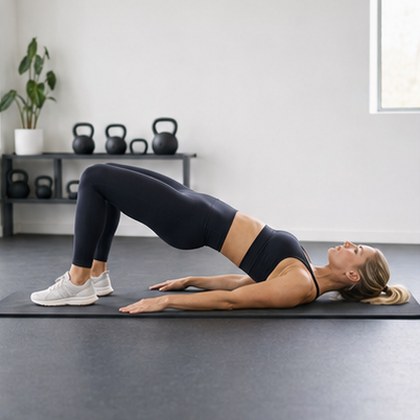 Glute bridge
The right warm-up for today's workout
The three steps stay the same, but what goes into them changes. Before leg day, you prep your hips, knees and ankles. Before bench or overhead presses, you prep your shoulders and chest. Find your row.
| Today's workout | Get warm | Mobility | Activation | Warm-up sets | Minutes |
|---|---|---|---|---|---|
| Legs at the gym: squats, deadlifts, lunges, leg press | Stationary bike, 3 min | Squats, lunges, hip and knee circles | Glute bridge, calf raises | 3–4 sets before the first exercise | 10–12 |
| Upper body at the gym: presses, rows, shoulders and arms | Elliptical or rowing machine, 3 min | Arm and shoulder circles, torso twists | Push-ups, superman, dead bug | 2–3 sets before the press or row | 10 |
| Full body at home, no equipment | High knees and jumping jacks, 2 rounds | Joint circles, squats, lunges | Glute bridge, dead bug, push-ups | Not needed | 8 |
| Glutes and resistance bands | Incline treadmill walk or high knees | Hip circles, lunges | Glute bridge, banded hip abduction | First set with a light band | 8–10 |
| Interval workout | As in section 01 | As in section 01 | As in section 01 | 2–3 bursts of 10–15 seconds in the movement of your first exercise | 10–12 |
| Morning, cold gym, over 40, after a day at a desk | 5 minutes instead of 3 | A longer mobility step | As usual | As usual | 12–15 |
Before an interval workout, do the bursts in the movement you'll start with: burpees, jump squats or fast pedaling on the bike.
The last row isn't a knock on getting older. In the morning, in a cold gym or after a day in a chair, your body simply needs more time to warm up. After 40, you feel it more. The rest of what changes with age is in our guide to getting fit after 40.
Warm-up sets: how to build up to your working weight
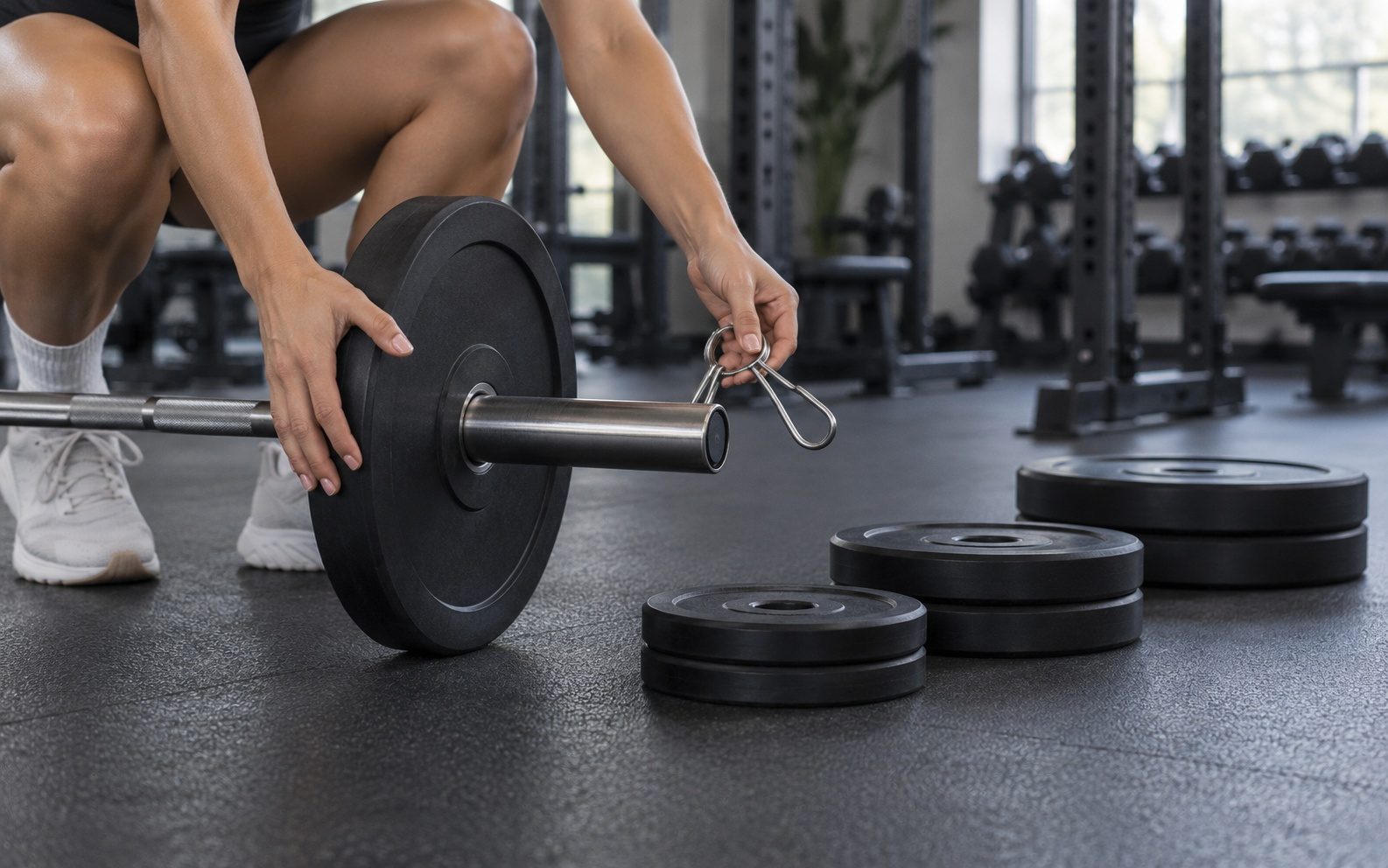
Warm-up sets are the same exercise as your working sets, only lighter. With each set, the weight goes up and the reps go down. They let you check your form and get your joints ready for the load without burning energy you need for your working sets.
| Working weight | Warm-up sets |
|---|---|
| Light, or not the first exercise for this muscle | 1 set: about 50% × 8–10 |
| Moderate: a squat or bench press of 90–175 lb, or 40–80 kg (at 90 lb, or 40 kg, the empty bar is already 50%, so do two sets with it) | Empty bar × 10 → 50% × 5–6 → 75–80% × 2–3 → working sets |
| Heavy: over 175 lb (80 kg), or working sets of 3–6 reps | Bar × 10 → 40–50% × 5 → 60–70% × 3 → 80–85% × 1–2 → working sets |
Here's an example. Say your working squat weight is 135 lb (60 kg). Your warm-up looks like this: the empty 45 lb (20 kg) bar for 10 reps, 65 lb (30 kg) for 6, then 100 lb (45 kg) for 3. After that come your working sets at 135 lb. If your working weight is 225 lb (100 kg), the ladder is longer: 45 lb × 10, 110 lb × 5, 155 lb × 3, 185 lb × 1–2. In kilograms, that's 20 × 10, 50 × 5, 70 × 3, 85 × 1–2.
The rules are short:
- Drop the reps as the weight goes up, and never go to fatigue.
- Rest 1–1.5 minutes between warm-up sets.
- Dumbbells and machines follow the same pattern, as percentages of your working weight.
One caveat: this scheme comes from gym practice. There's very little research on how many warm-up sets work best. In one study, 15 men did 4 sets each of bench press, squats and biceps curls to failure at 80% of their one-rep max. The same men tried three different warm-ups and no warm-up at all. Their total reps didn't differ. So warm-up sets aren't there to squeeze out an extra rep. Their job is to check your form and feel the weight before your working sets. For the form itself, see our guides to squats and the bench press.
a warm-up set shouldn't wear you out. If you need more than a minute and a half of rest after it, the weight was too heavy or you did too many reps. Next time, cut 1–2 reps and keep the weight.
How long to warm up: 5, 10 or 15 minutes
A typical warm-up takes 8–12 minutes. But some days you have less time, and some days your body needs more. Pick the option that fits your day.
| Situation | How long | What changes |
|---|---|---|
| You're short on time, or today is a light bodyweight session | 5 minutes | A short warm-up, three moves, lighter first working sets |
| A regular workout at the gym or at home | 8–12 minutes | The three steps from section 01 plus warm-up sets |
| Morning, cold, over 40, heavy weights, coming back after a break | 12–15 minutes | 5 minutes of cardio, a longer mobility step, a longer ladder of warm-up sets |
If you only have 5 minutes, cut the extras, not the whole warm-up. Keep 1 minute of cardio: high knees or the bike. Then do 10 squats, 6 lunges per leg and 12 glute bridges. Make your first working set lighter so it doubles as your last warm-up set. Got 7 minutes? Add 6 dead bugs per side and 8 push-ups.
Don't overdo it, either. A 20-minute warm-up with hard cardio turns into part of your workout and eats into the energy you need for the main work. A good warm-up leaves you energized, not drained.
Should you stretch before a workout?
Yes, if you keep it short.
Static stretching means holding a muscle in a stretched position. In a large review of studies, stretching one muscle for less than a minute lowered performance by about 1% on average. Stretching for a minute or longer lowered it by 4–5% on average right afterward. And in studies where people did dynamic movements after stretching, there was no clear drop at all.
Dynamic stretching means moving through your full range of motion: swings, lunges with a twist, circles. It gave a small boost, about 1%. After any kind of stretching, the gain in flexibility usually lasted less than 30 minutes. So stretch as part of your warm-up, not at home before you head to the gym.
| Static stretching | Dynamic stretching | |
|---|---|---|
| What it is | Stretch the muscle and hold the position | Full-range movements with no hold |
| When | After the workout or as a separate session | In the warm-up, before the load |
| How much before a workout | Up to 20–30 seconds on a tight muscle, then movement | 8–10 reps per movement |
| Effect right afterward | About −1% in performance if under a minute; −4–5% if longer | A small boost, about 1% |
If you want to stretch a tight muscle, hold it for 20–30 seconds and then be sure to move. The best moves stretch and warm you up at the same time:
- Lunge with a torso twist: 6 per leg, turning toward your front leg.
- Front-to-back leg swings: 10 per leg, going a little higher with each swing.
- Cat-cow: 8 reps, slowly.
Flexibility work, where you hold each stretch for 30–60 seconds over several rounds, belongs at the end of your workout. Which positions to use and how long to hold them is covered in our stretching guide.
What a warm-up does for your body, and does it prevent injuries?
The main thing a warm-up does is raise your muscle temperature. A warm muscle contracts faster and harder. In a review on temperature and muscle function, performance in short efforts rose by 2–5% for every 1°C (1.8°F) rise in muscle temperature. Your breathing and heart rate also climb gradually instead of spiking on your first set.
A review of 32 studies found that warming up improved performance in 79% of the measures tested, with almost no signs of harm. The review only included warm-ups that involved more than just stretching.
Not every warm-up protects you from injury. It depends on what's in it. Stretching alone doesn't help. In a review of 25 trials with 26,610 participants, people who stretched had almost the same injury risk as people who didn't. Strength training, on the other hand, cut sports injuries to less than a third, and balance exercises cut them almost in half.
Warm-ups have also been tested on their own. A Norwegian trial included 1,892 female soccer players aged 13–17 from 125 clubs. At 65 of the clubs, teams started every practice for a whole season with a warm-up program of strength, balance and movement control exercises. The rest trained as usual. Over the season, players who did the program had a 32% lower risk of injury and a 45% lower risk of severe injury.
There are almost no trials this large on gym training. Still, the takeaway is clear: your warm-up needs exercises that activate your muscles, and long stretches won't protect you from injury. That's why our warm-up includes glute bridges, dead bugs and supermans, not just arm circles.
How to tell you're warmed up, and when to dial it back
You're ready when you notice three signs:
- You feel warm and have broken a light sweat.
- You're breathing faster than usual, but you can still talk in full sentences.
- Your first exercise without weight feels smooth through the full range of motion, with no stiffness.
The warm-up also shows what kind of day you're having. Dial it back if a warm-up weight feels like a working weight. The same goes if your heart rate on easy cardio is noticeably higher than usual and your movements feel sluggish and sloppy. That doesn't mean you should go home. Do fewer sets or use a lighter weight. How to adjust a workout on a day like this is covered in our guide to working out on little sleep.
Stop and see a doctor if you notice any of these during your warm-up:
- chest pain or pressure;
- dizziness;
- shortness of breath that's out of proportion to the light effort;
- sharp pain in a joint.
Don't push through any of these. If chest pain doesn't go away with rest, call 911 or your local emergency number right away.
Mistakes that make your warm-up useless
- Going straight to your working weight. Between the empty bar and a working weight of 135 lb (60 kg), you need at least one intermediate set. Otherwise, your first working set turns into your warm-up.
- 10 minutes of cardio instead of a full warm-up. The bike warms you up but doesn't prepare your shoulders, hips and glutes. Add steps 2 and 3.
- Neck circles with your head dropping back. Your neck doesn't need that range. Warm it up with tilts and turns.
- Long stretching before the barbell. Holding one position for a minute or more saps strength.
- Warming up until you're tired. If you need to sit down afterward, it was too long or too fast. A warm-up should energize you.
- A break after the warm-up. Warm up, scroll on your phone for 10 minutes, and your body has already started to cool down. Start right away, or do a quick warm-up again.
- The same warm-up before leg day and bench day. Shoulder circles don't prepare you for squats. Use your row from the table in section 02.
For how to finish your workout, see our guide to cooling down after a workout.
The warm-up in your Sportygram workout log
If you track your workouts in the Sportygram app, workouts from your plan have a warm-up block above the main part. If you train at home, it defaults to 5 minutes of joint mobility; if you train at the gym, to 8 minutes on the treadmill.
If the treadmill doesn't work for you, swap it out, say for the stationary bike or the elliptical. You can do it right in your workout log, and the warm-up block stays in place. For the other steps from section 01, follow the checklist at the end of this article.
FAQ
How long should a warm-up before a workout be?
Usually 8–12 minutes: 2–3 minutes of light cardio, 3–4 minutes of joint mobility, 2–3 minutes of muscle activation, plus warm-up sets. If you're short on time or it's an easy day, 5 minutes is enough. In the morning, in a cold gym, over 40 and before heavy weights, give yourself 12–15 minutes. If the warm-up leaves you tired, it was too long or too fast.
What warm-up exercises should I do at the gym?
Start with 3 minutes on a stationary bike or elliptical at an easy pace. Then do joint circles, 10–12 bodyweight squats and stationary lunges. Next come glute bridges, dead bugs and push-ups. Finish with 2–4 warm-up sets of the first exercise in your workout: the weight goes up and the reps go down. The whole warm-up takes about 10–12 minutes.
How do I warm up at home without equipment?
Do two rounds of 30 seconds of high knees and 30 seconds of jumping jacks. Then do a minute of joint circles, 10–12 squats and 6–8 lunges per leg. Finish with glute bridges, dead bugs, push-ups and supermans. That's 8–9 minutes. You usually don't need warm-up sets at home, because your first set already uses just your body weight.
Is a warm-up different for women and men?
Not really. The three steps and rep counts are the same for everyone. What changes the warm-up is what you're training that day. Before a glute day with bands, do more movements for your hips and thighs. Before bench press, do more for your shoulders and chest. If floor push-ups are still hard, put your hands on a bench: same job, less load.
Can a cardio machine replace a warm-up?
Only partly. A few minutes on a stationary bike or elliptical warms your body, but it doesn't take your shoulders, hips and knees through their full range or activate your glutes and core. After cardio, add 3–4 minutes: squats, lunges, glute bridges, dead bugs. Before a barbell lift, also do warm-up sets of your first exercise.
Should you stretch before a workout?
Yes, if you keep it short. Stretching a muscle for less than a minute barely costs you strength: about 1% on average in a review of studies. A minute or longer cuts performance by 4–5% on average right afterward. Stretch a tight muscle for 20–30 seconds, then be sure to move: squats, lunges, leg swings. Save longer stretches for the end of your workout.
How do I warm up my legs and glutes before a workout?
After 3 minutes of cardio, do hip and knee circles, 10–12 squats and 6–8 lunges per leg. Then do 12–15 glute bridges and 15 calf raises. If you're training with a band, add banded hip abductions, 12 per leg. Before barbell squats or deadlifts, do 3–4 warm-up sets.
Do I need to warm up before every workout?
Yes, before every one, including home workouts and easy days. Only the length changes: 5 minutes is enough before an easy bodyweight session, and heavy squats need 12–15. Warming up almost always helps: in a review of 32 studies, it improved performance in 79% of the measures tested, with almost no harm found.
The bottom line
- A warm-up before a workout takes 8–12 minutes and has three steps: 2–3 minutes of light cardio, 3–4 minutes of joint mobility and 2–3 minutes of muscle activation.
- Before a barbell lift, do 2–4 warm-up sets. For a 135 lb (60 kg) squat: 45 × 10, 65 × 6, 100 × 3, then your working sets.
- Before leg day, prep your hips, knees and ankles. Before pressing, prep your shoulders and chest.
- Stretching a muscle for less than a minute barely costs you strength, while a minute or more cuts performance by 4–5%. Save longer stretches for the end of your workout.
- Stretching doesn't protect you from injuries, but strength and balance exercises do. That's why the warm-up includes glute bridges, dead bugs and supermans.
Checklist: a 10-minute warm-up
- Warm up: a stationary bike or elliptical for 3 minutes. At home, high knees and jumping jacks for 30 seconds each, two rounds.
- Joint circles: 1 minute, 8–10 circles each for your shoulders, elbows, hips, knees and ankles.
- Bodyweight squats: 10–12 reps.
- Stationary lunges: 6–8 per leg.
- Glute bridge: 12–15 reps.
- Dead bug: 6–8 per side.
- Push-ups on the floor or with your hands on a bench: 8–10 reps.
- Superman: 10 reps.
- Before a barbell lift: empty bar × 10, 50% × 5–6, 75–80% × 2–3.
- Check: you feel warm, you're breathing faster and your first exercise moves without stiffness. Start your workout right away.
Sources
- Fradkin A. J., Zazryn T. R., Smoliga J. M. Effects of warming-up on physical performance: a systematic review with meta-analysis. Journal of Strength and Conditioning Research, 2010. — A review of 32 studies: warming up improved performance in 79% of the measures, with almost no harm found.
- Racinais S., Oksa J. Temperature and neuromuscular function. Scandinavian Journal of Medicine & Science in Sports, 2010. — In short efforts, performance rises by 2–5% for every 1°C of muscle temperature.
- Behm D. G., Blazevich A. J., Kay A. D., McHugh M. Acute effects of muscle stretching on physical performance, range of motion, and injury incidence in healthy active individuals: a systematic review. Applied Physiology, Nutrition, and Metabolism, 2016. — Static stretching under 60 seconds: −1.1%; 60 seconds or longer: −4.6%; dynamic stretching: +1.3%. The gain in flexibility usually lasts less than 30 minutes.
- Lauersen J. B., Bertelsen D. M., Andersen L. B. The effectiveness of exercise interventions to prevent sports injuries: a systematic review and meta-analysis of randomised controlled trials. British Journal of Sports Medicine, 2014. — 25 trials, 26,610 participants: stretching doesn't reduce injuries, balance exercises cut them almost in half and strength training to less than a third.
- Soligard T. et al. Comprehensive warm-up programme to prevent injuries in young female footballers: cluster randomised controlled trial. BMJ, 2008. — 1,892 female soccer players aged 13–17 who spent a season with a warm-up program: a 32% lower risk of injury and a 45% lower risk of severe injury.
- Ribeiro A. S. et al. Effect of different warm-up procedures on the performance of resistance training exercises. Perceptual and Motor Skills, 2014. — 15 men, three exercises at 80% of their max: the number of reps didn't differ with or without a warm-up.
This material is for informational purposes and does not replace medical advice.