

grip the bar just outside your shoulders so your forearms are vertical at the bottom, press it in a straight line over the middle of your feet, and keep your glutes and abs tight from the first rep to the last. In Saeterbakken's 2012 measurements, the rectus abdominis worked 81% less during seated presses than standing ones, while the lower back muscles worked the same in both positions — so when your lower back hurts in a standing press, arching is usually the reason. With a barbell, the triceps worked 39% harder than with dumbbells when standing (Saeterbakken, 2013). Behind the neck, people lift about 7–10% less, and that version needs good shoulder mobility (Coratella, 2022; Padovan, 2025). Start with 10 kg (22 lb) for women and 20 kg (44 lb) for men, 3 sets of 10 twice a week with 2–3 reps left in the tank. Over our 8-week plan, training volume per session grows by 80% for women and 65% for men.
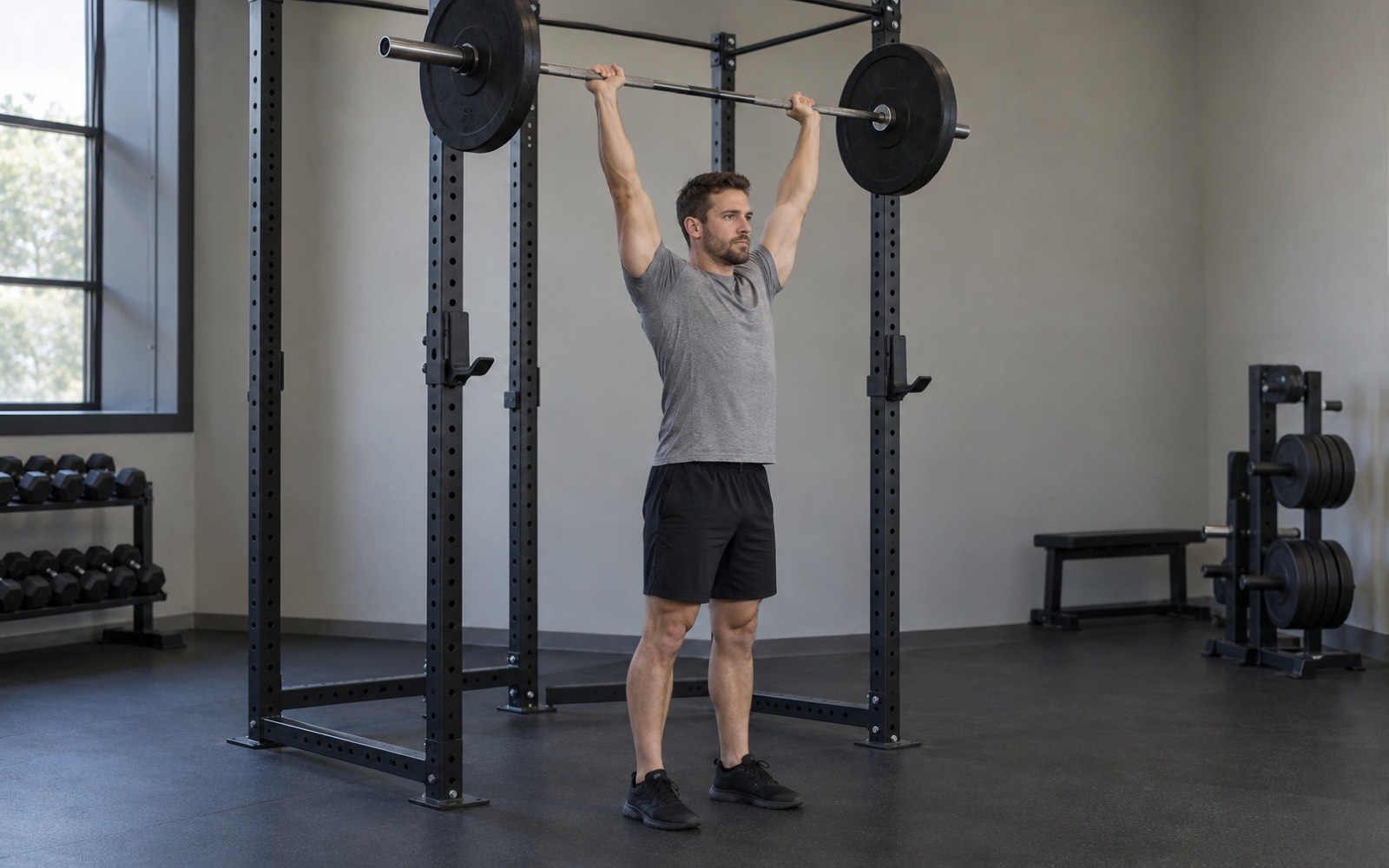
The overhead press is a standing barbell press from your upper chest to straight arms overhead. Your body stays rigid, your knees stay locked out, and your legs don't help the bar move. Your front and side delts do most of the work, your triceps finish the lift at the top, and your abs and glutes hold your torso still. Grip the bar just outside your shoulders and press it in a straight line. On the way up, your head moves back a little, and once the bar clears your forehead, you push your head forward through the "window" between your arms. A beginner is fine with 3 sets of 10 reps twice a week: women with a 10 kg (22 lb) fixed barbell, men with an empty 20 kg (44 lb) Olympic bar.
What the overhead press is and why it's called the military press
The overhead press is a standing barbell press from your upper chest to straight arms overhead, where only your arms and shoulders lift the bar and your legs and torso act as a solid base. Your knees stay straight through the whole set, your back stays neutral, and your hips don't drift forward.
It goes by several names: the standing barbell press, the military press, the shoulder press, and the strict press. Once you start pushing the bar up with your legs, it becomes a different lift, the push press.
Why "military." Sports historian John Fair traced the history of this lift in the Journal of Sport History in 2001. The press became an Olympic weightlifting event at the 1928 Games in Amsterdam. It was meant to be done in a "military" style: torso straight as a ramrod, heels together, eyes forward, like a soldier standing at attention. Over time, weightlifters learned to help themselves with their legs, their hips, and a deep backward lean, and the judges couldn't keep up with all these tricks. At the 1972 Olympics in Munich, the International Weightlifting Federation decided to drop the press from all future competitions. That's where the main rule of the military press comes from: no leaning back and no leg drive.
How it differs from a push press. In a push press, you dip slightly and drive the bar up with your knees, and your arms only finish the press. In a push jerk, you also drop under the bar a second time after the drive. Both let you lift more because your legs take over part of the work. If your knees start bouncing on the last reps, your overhead press has turned into a push press.
The "seated dumbbell military press." People in gyms often use this name for a dumbbell press on a bench with a backrest. It's a related movement, but the equipment and support are different, and we covered its form, bench angle and weights in our guide to the seated dumbbell shoulder press. This article is mainly about the standing barbell press.
What the overhead press does for you. It builds shoulder strength and size, especially in the front and side delts. It gives you strength overhead in everyday life, like lifting a suitcase into an overhead bin. And it trains your core: when you stand under the bar, your abs and glutes work through the entire set.
Muscles worked in the overhead press
In the standing overhead press, the front and side delts do the main work, the triceps straighten your arms at the top, the traps and serratus anterior rotate your shoulder blades, and the abs, obliques and glutes hold your torso in place.
| Muscle | What it does in the press | Where you feel it |
|---|---|---|
| Front delt (anterior deltoid) | raises your upper arm forward and up; the main mover at the bottom | front of the shoulder, burning toward the end of a set |
| Side delt (lateral deltoid) | moves your upper arm up and out; helps through the whole range | side of the shoulder, where a sleeve seam sits |
| Rear delt (posterior deltoid) | stabilizes the shoulder joint; works harder standing than seated | back of the shoulder, faintly |
| Triceps | straightens the elbow; the main mover in the top third | back of the arm, especially in the last few inches |
| Upper chest (clavicular head of the pectoralis major) | helps at the very start of the press off your chest | near the collarbones, in the first few inches |
| Traps and serratus anterior | rotate the shoulder blade upward so your arm can get overhead | between your neck and shoulder, on the side under your armpit |
| Rotator cuff | keeps the head of the upper arm bone centered in the socket | you don't feel it directly, but it fatigues |
| Rectus abdominis and obliques | keep your ribs from flaring and your torso from arching | abs braced, like you're about to take a punch |
| Glutes and leg muscles | lock your pelvis and hold your stance | glutes squeezed through the whole set |
| Forearm muscles | hold the bar over the base of your palm | wrists and forearms under heavier loads |
Delts. The front delt is the main mover when you press from your chest. In 2013, Saeterbakken and Fimland measured the electrical activity of muscles (electromyography) in 15 healthy men during four presses at 80% of their max: with a barbell and dumbbells, seated and standing. With a barbell standing, the front delt worked about 15% less than with dumbbells standing: dumbbells load the shoulder more precisely, but you can go heavier with a barbell. The rear delt worked about 25% less with a barbell seated than standing.
Triceps. In the same study, the triceps worked 39% harder with a barbell standing than with dumbbells standing. The bar ties your hands together, your elbows travel under it, and the triceps have to straighten your arms in the top third. That's why the back of your arms often feels tired after overhead presses, while after dumbbell presses it's usually your shoulders.
Chest. The clavicular head of the pecs helps in the first few inches off your chest. It works harder in a press from the front than behind the neck: that was the result both in Coratella's 2022 study with 8 bodybuilders and in Padovan's 2025 study with 14 trained men.
Where the bar gets stuck. In 2025, Evangelista and colleagues built a biomechanical model of the bench press and overhead press and checked it against bar velocity measurements in the bench press. According to this model, the sticking point, where the bar stalls, happens when the force your shoulder produces drops below what's needed. The triceps barely contribute at the start of the press and become the main mover closer to lockout. Grip width, and the fact that both hands are tied to a single bar, affect the sticking point more than the build of the muscles themselves. The authors conclude that shoulder strength matters more for the start of the press, and triceps strength matters more for the top. What this means for you: if you stall around chin or forehead level, build your shoulders, for example with dumbbell presses. If you stall near the top, work on your triceps.
How to do a standing barbell overhead press: step by step
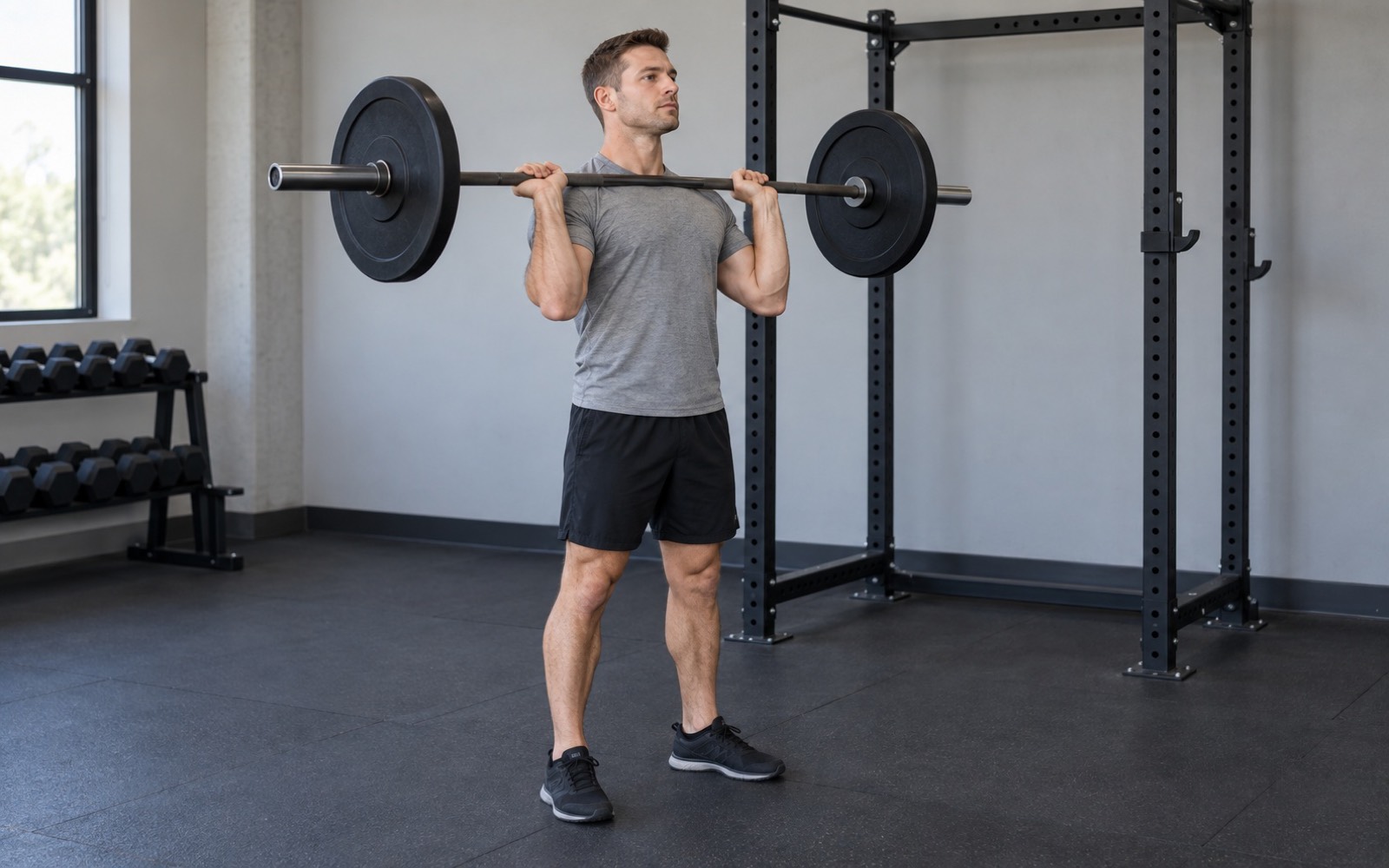
Unrack the bar at collarbone height, grip it just outside your shoulders, brace your glutes and abs, and press the bar straight up while moving your head out of its way, then lower it back to your upper chest over 2 seconds. Step by step:
- Rack height. Set the J-hooks of the power rack just below collarbone height. That way you unrack the bar by bending your knees slightly and standing up, instead of reaching for it on your toes.
- Grip. Take the bar just outside your shoulders, with your thumb wrapped around the bar from below. More on width in section 04.
- Bar in your palm. The bar sits on the base of your palm, close to your wrist, directly over your forearm bones. Your knuckles point to the ceiling, and your wrist is almost straight.
- Unrack. Step under the bar with it resting on your upper chest and front delts, elbows slightly in front of the bar. Straighten your legs, lift the bar off the hooks, and take two short steps back.
- Feet. Hip-width apart, toes forward or turned out slightly. Weight spread across your whole foot. Wear shoes with a flat, firm sole: soft running shoes feel unstable when you're holding a bar overhead.
- Torso. Squeeze your glutes, brace your abs, pull your ribs down. Imagine someone is about to push you in the stomach. Your pelvis stays level, with no backward lean.
- Breath and start. Take a breath into your belly, hold it, and start pressing. The bar goes straight up, and you pull your head back slightly so the bar passes your chin and nose.
- Head through the window. As soon as the bar clears your forehead, move your head forward between your arms. At the top, your ears are roughly level with your biceps, and the bar is over the back of your head and the middle of your feet.
- Lockout. Straighten your arms fully, but don't slam your elbows into lockout. Your shoulder blades move up and slightly outward on their own, and that's normal. Breathe out during the top half of the press.
- Lowering. Lower the bar over 2 seconds along the same straight line back to your upper chest, moving your head back slightly again. Start the next rep with a brief pause at your chest, no bouncing.
The American College of Sports Medicine (ACSM) position stand from 2009 recommends a slow or moderate tempo for beginners, with moderate meaning 1–2 seconds up and the same down. Lower closer to 2 seconds, so the bar doesn't crash onto your collarbones.
Where to look. Straight ahead. If your eyes follow the bar up, your lower back arches right after them.
Breathing. You only need to hold your breath for the short stretch from your chest to forehead level, where the press is hardest. Don't hold it for longer than one rep: straining with a held breath raises your blood pressure. With light weights, you can breathe normally: breathe in at the bottom, out at the top.
Belt. You don't need one for the weights in the plan in section 08. If your lower back gets tired, the problem is your form or the weight.
film one set on your phone from the side, at waist height. On the video, check three things: the bar moves vertically, with no curve around your face; at the top, your ear is under your biceps and the bar is over the middle of your feet; your lower back doesn't arch toward the end of the set. And one test that doesn't need video: if your glutes relax on their own during the last rep, the weight is too heavy for you right now.
Grip width and bar path: how wide to grip and where the bar should travel
Grip the bar just outside your shoulders, so your forearms are vertical at the bottom, and press the bar in a straight line over the middle of your feet, moving your head out of its way.
Grip width in the biomechanics research. In 2026, Gundersen and colleagues compared narrow, medium and wide grips in a seated barbell press in 11 trained men, doing 8 reps to failure. With a narrower grip, the men lifted more weight, the range of motion was bigger, and the load on the shoulder joint was lower. With a wide grip, the load on the elbow was lower, but the arms pushed outward on the bar more. The authors write that grip width can be chosen based on which joint you need to take pressure off.
| Grip | What changes | Who it suits |
|---|---|---|
| Narrow, shoulder-width or closer | more weight and range of motion, less load on the shoulder, more on the elbow (Gundersen, 2026) | when your shoulder aches but your elbows are fine |
| Medium, just outside your shoulders | forearms vertical at the bottom, load split evenly | the starting point for everyone |
| Wide, well outside your shoulders | less load on the elbow, shorter path, arms push outward on the bar | when your elbow aches; harder on the shoulder |
Coratella and co-authors in 2022 set the grip one hand-width outside the delts. Padovan and colleagues in 2025 gripped the bar just outside the shoulders, right past the delts, and made sure the forearms stayed perpendicular to the floor throughout the press. That's our reference point. The check is simple: lower the bar to your upper chest and look at your forearms from the front. If they're vertical, the grip is right for you. If your hands are outside your elbows, the grip is wide; if they're inside, it's narrow.
Thumb. Only a closed grip, with your thumb wrapped around the bar from the other side. In an open, thumbless grip, the bar sits on your palm with nothing to stop it and can roll onto your face or behind your head.
Bar path. The bar travels in a straight vertical line over the middle of your feet. Your head is what's in the way, so you move it: on the way up, pull your chin back slightly, and once the bar clears your forehead, bring your head forward again. If you steer the bar around your face in a forward arc, it drifts far from your shoulders, the lever arm gets longer, and you have to lean back to hold it. At the top, your shoulders should be directly under the bar, and the bar should be over the back of your head.
Elbows. At the bottom, your elbows are slightly in front of the bar, but not raised high like in a front squat. If your elbows are under the bar or behind it, the bar slides off your chest. If your elbows flare out to the sides, the front of your shoulder starts to feel strained.
How low to go. Down to your upper chest or collarbones: according to ACSM's 2026 position stand, a full range of motion builds more strength. If your shoulder feels a sharp pinch at the bottom, stop at chin level and look for the cause in the table in section 07.
Lower back, glutes and abs: how to stand so your back doesn't arch
Stand with your glutes squeezed, your abs braced and your ribs down: that way your torso holds the bar like a column, and your lower back stays neutral.
What the measurements showed. In 2012, Saeterbakken and Fimland compared how core muscles worked in 15 healthy men during overhead dumbbell presses: seated and standing, with two arms and with one, 5 reps at 80% of max. Seated with two arms, the rectus abdominis worked about 81% less than standing, which means standing it worked about 5 times harder. The external obliques worked 58% less seated than standing. The lower back muscles worked the same seated and standing. The measurements were done with dumbbells, and there's no direct data for a barbell, but the mechanics are similar.
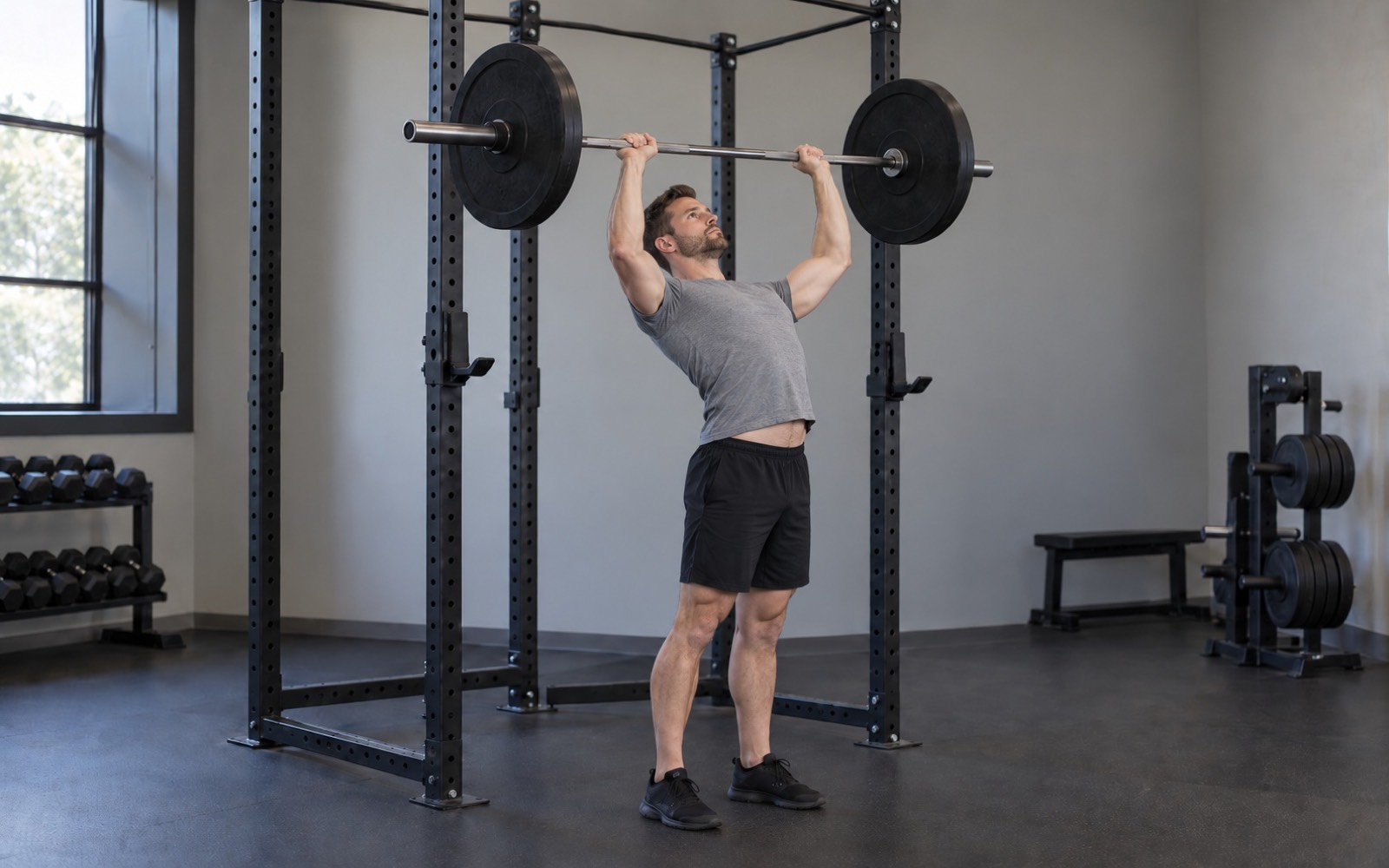
What this means for you. The standing press really does load your abs, while your lower back doesn't get more tired from the standing position itself: its muscles work just as hard as when you're seated. If your lower back aches after overhead presses, the usual culprit is arching back, when your hips drift forward, your ribs flare up, and the bar presses down on your lower back at an angle.
Can the press replace ab exercises. No. In 2011, Comfort and colleagues compared rectus abdominis activity in 10 people during a plank, a prone superman, a back squat, a front squat and a military press. The muscle worked significantly harder in the plank than in all the other exercises, including the press. So you still need to train your abs separately, with planks, for example.
One arm for the obliques. In the same 2012 study by Saeterbakken, the external obliques worked 68% less standing with two arms than with one. When the weight is on one side, your body gets pulled sideways, and the obliques keep it upright. A standing single-arm dumbbell or kettlebell press is a good second exercise for your core.
Your stance, step by step.
- Feet hip-width apart, knees straight but not jammed into lockout.
- Glutes squeezed before you unrack the bar and until the end of the set. This is your main lock against arching.
- Abs braced and ribs down: when you raise your arms, your lower ribs don't stick out.
- Leaning back an inch or so to get your face out of the bar's way is fine. An arch where your chest points at the ceiling is a mistake.
Standing or seated, barbell or dumbbells, front or behind the neck: how the variations differ
All overhead press variations are the same movement with different equipment, support and bar path, and your choice depends on your goal and on what your shoulders and lower back allow. We compared seated and standing dumbbell presses in detail in our seated dumbbell shoulder press guide. Here, the focus is on the barbell and on how much weight to load when you switch.
| Variation | What changes | Lower back | Who it's for |
|---|---|---|---|
| Standing barbell press from the front (military press) | most triceps and core work; the heaviest standing variation | holds the torso under a heavy load | the foundation for overhead strength |
| Seated barbell press with a backrest | less core work, triceps about 20% less than standing, a borderline difference (Saeterbakken, 2013) | pressed against the backrest | when your lower back tires standing |
| Standing dumbbell press | each arm works separately, more balance work | holds the torso | for balance and a weaker side |
| Seated dumbbell press | an easy start, back supported | pressed against the backrest | beginners, home workouts |
| Behind-the-neck barbell press | more side and rear delt, less chest | same as the base variation | experienced lifters with good shoulder mobility |
| Seated Smith machine press | the machine controls the bar path, stabilizers do less | pressed against the backrest | for safety and heavy finishing sets |
| Seated shoulder press machine | muscles work less than with a barbell (Coratella, 2022); heavier weight | pressed against the backrest | first week, fatigue, finishing sets |
| Kettlebell, one or two arms | the weight sits further from your hand, the wrist has to hold tighter | holds the torso | at home, single-arm for the core |
| Push press | legs drive the bar up, more weight | holds the torso | for power, experienced lifters |
Converting weight: how much to load in another variation. You press 30 kg (66 lb) standing. How much should you use with dumbbells or on a machine? We put this answer together from measurements in three studies: Saeterbakken and Coratella tested one-rep maxes, and Padovan used 8-rep loads. We used the standing barbell press from the front as the starting point. Each study had its own participants, so treat these as rough guides with a 5–10% margin of error; you'll find the exact weight in your first set.
| If you switch to… | Weight relative to the original | Example for a 30 kg (66 lb) standing press | Where the number comes from |
|---|---|---|---|
| Standing dumbbells, both combined | about 7% less | about 28 kg (62 lb), 14 kg (31 lb) per hand | Saeterbakken, 2013: standing dumbbell max was 7% lower than standing barbell max |
| Seated dumbbells with a backrest, if you know your standing dumbbell weight | about 10% more | about 31 kg (68 lb), 15–16 kg (33–35 lb) per hand | Saeterbakken, 2013: standing dumbbell max was 10% lower than seated |
| Behind-the-neck barbell instead of front barbell | about 7–10% less | 27–28 kg (60–62 lb) | Coratella, 2022: 76 vs. 82 kg (168 vs. 181 lb); Padovan, 2025: 33.2 vs. 36.8 kg (73 vs. 81 lb) |
| Machine press from the front instead of seated barbell | about 16% more | depends on the machine | Coratella, 2022: 95 vs. 82 kg (209 vs. 181 lb) |
| Machine behind the neck instead of machine from the front | about 8% less | depends on the machine | Coratella, 2022: 87 vs. 95 kg (192 vs. 209 lb) |
Our sources didn't compare seated and standing barbell maxes, so there's no percentage for that switch. With dumbbells, the seated max was 10% higher than standing, and it makes sense to expect a similar shift with a barbell, but check it in your first set. On machines, the numbers on the weight stack depend on the manufacturer, so go by leaving 2–3 reps in the tank.
Seated barbell press. Put a bench in a power rack with the backrest almost vertical; Coratella and Padovan used 80°. Your hips are pressed against the backrest, and the bar travels in front of your face just like standing. This variation helps when your lower back arches while standing.
In a Smith machine. The bar moves strictly vertically, and you can hook it onto the safeties at any point, which is handy when you have no spotter. The downside is that the machine dictates the bar path, so the muscles that balance the bar have less work to do. People press seated in a Smith machine, with the bench positioned so the bar passes an inch or so in front of the nose.
Behind the neck. The bar comes down behind your head to the base of your neck. According to Coratella in 2022, the side and rear delts work harder here, and according to Padovan in 2025, the upper traps and triceps also work harder on the way down. Both research groups consider this variation usable, with conditions. Coratella says it needs good core stability and ideal shoulder mobility. Padovan recommends learning it with a light weight, because the "high-five" position, with the arm raised out to the side and rotated outward, may increase shoulder joint instability. In 2013, Kolber and colleagues examined 159 men: those who lifted weights more often showed signs of anterior shoulder instability, and these signs were linked to exercises in the high-five position: behind-the-neck lat pulldowns and behind-the-neck presses. That's an association, and it doesn't prove cause. The takeaway for a beginner: press from the front, and try behind the neck only once your shoulder moves freely behind your head without pain, starting with the empty bar.
With a kettlebell. The kettlebell's center of mass sits on the back of your forearm, so your wrist has to hold it more firmly than a dumbbell. A standing single-arm kettlebell press loads your obliques well.
 Standing overhead press
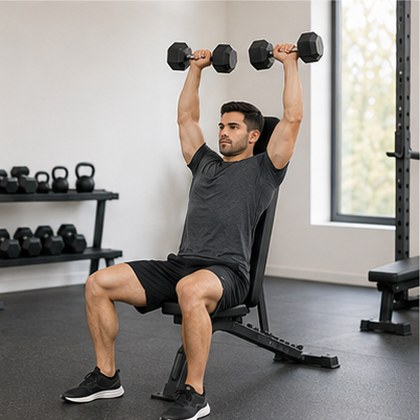 Seated dumbbell press
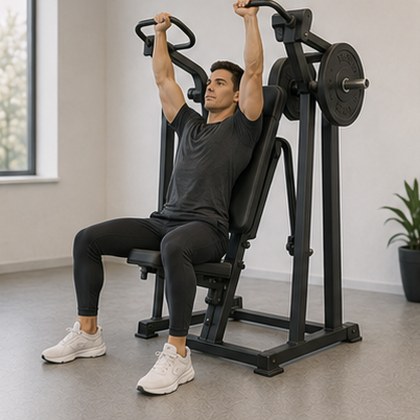 Machine shoulder press
Mistakes: where you feel it → what to fix
A good overhead press is felt in your shoulders and triceps. If your lower back, wrists, elbow or the front of your shoulder aches, your form has drifted:
| Where you feel it | What's wrong | What to fix |
|---|---|---|
| Lower back, aching toward the end of the set | leaning back, hips drifting forward, glutes relaxed | squeeze your glutes and abs before you unrack, ribs down, feet hip-width; drop the weight by 10–20%; if it keeps happening, switch to a seated press with a backrest |
| Front of the shoulder, clicking or pulling | elbows flared out, bar lowered below the collarbones or behind the neck without enough mobility | elbows slightly in front of the bar, lower to your upper chest or collarbones, skip behind-the-neck presses |
| Wrists | bar sitting on your fingers, wrist bent back | bar on the base of your palm over your forearm, knuckles to the ceiling, forearms vertical |
| Chin, nose | head not moving out of the bar's path | pull your head back slightly on the way up, then forward through the window once the bar clears your forehead |
| Elbow | slamming into lockout at the top, grip too wide or too narrow for your elbows | straighten your arms smoothly; with elbow pain, grip slightly wider; with shoulder pain, slightly narrower (Gundersen, 2026) |
| The bar drifts forward and pulls you with it | bar traveling in an arc in front of your face | bar straight over the middle of your feet, over the back of your head at the top, shoulders under the bar |
| Neck, traps up by your ears | shoulders shrugged from the start | shoulders down at the bottom; at the top, your shoulder blades rotate upward on their own, no need to shrug them |
| The bar moves in a jerk, your legs help | a dip and drive with the knees, which makes it a push press | knees straight for the whole set; in the competitive strict press, WRPF rules don't allow bending the knees |
Why your lower back hurts during a standing press. The lower back muscles work the same standing as seated (section 05), so the issue is how you stand. There are usually three causes:
- the weight is a bit too heavy, and you finish the last reps by leaning back;
- your glutes and abs are relaxed, your hips drift forward, and your ribs flare up;
- the bar travels in a forward arc, the lever arm gets longer, and your torso leans back to balance the bar.
The fix is the same for all three: drop the weight by 10–20%, keep your glutes and abs braced for the entire set, and press the bar in a straight line. If you can't hold your torso steady even with the empty bar, press seated with a backrest for the first few weeks.
Sharp shoulder pain with a click, or pain shooting down your arm or leg, means you end the set right away. When to see a doctor about it is covered in section 11.
What weight to start with: an 8-week plan for women and men
Women start with a 10 kg (22 lb) fixed barbell or a body bar, men with an empty 20 kg (44 lb) Olympic bar, 3 sets of 10 reps with 2–3 reps in reserve, adding reps first and weight second.
The progression rule comes from ACSM's 2009 position stand: beginners should use a weight that allows 8–12 reps, and once they can do 1–2 reps more, the weight goes up by 2–10%.
With a light barbell, there's a catch. The smallest jump in most gyms is 2.5 kg, a 1.25 kg plate on each side (in American gyms, usually a 2.5 lb plate on each side, which is 5 lb). Going from 20 to 22.5 kg is +12.5%, and going from 10 to 12.5 kg is +25% in one step, and both jumps are bigger than ACSM's upper limit of 10%. That's why, in the plan, reps drop back down after each weight increase and then climb again. If your gym has 0.5 kg (1 lb) fractional plates, add 1 kg (2 lb) at a time: at 20 kg that's +5%, and you don't need to drop reps.
Eight weeks of overhead pressing in numbers. Two workouts a week. Before your working sets, do two warm-up sets: the empty bar or a body bar for 10 reps, then half your working weight for 5. Then 3 working sets with 2–3 reps in reserve, a tempo of 2 seconds down and 1–2 up, and 2–3 minutes of rest. Tonnage is the total volume of work per session: sets × reps × bar weight. For example, 3 sets × 10 reps × 10 kg = 300 kg.
| Week | Women (fixed barbell or body bar) | Tonnage | Men (20 kg / 44 lb Olympic bar) | Tonnage | What changed |
|---|---|---|---|---|---|
| 1 | 10 kg (22 lb), 3 × 10 | 300 kg (661 lb) | 20 kg (44 lb), 3 × 10 | 600 kg (1,323 lb) | start |
| 2 | 10 kg (22 lb), 3 × 12 | 360 kg (794 lb) | 20 kg (44 lb), 3 × 12 | 720 kg (1,587 lb) | +2 reps per set |
| 3 | 12.5 kg (27.5 lb), 3 × 8 | 300 kg (661 lb) | 22.5 kg (50 lb), 3 × 10 | 675 kg (1,488 lb) | weight: +25% for women with reps dropping to 8, +12.5% for men |
| 4 | 12.5 kg (27.5 lb), 3 × 10 | 375 kg (827 lb) | 22.5 kg (50 lb), 3 × 12 | 810 kg (1,786 lb) | +2 reps |
| 5 | 12.5 kg (27.5 lb), 3 × 12 | 450 kg (992 lb) | 25 kg (55 lb), 3 × 10 | 750 kg (1,653 lb) | women +2 reps, men weight +11% |
| 6 | 15 kg (33 lb), 3 × 8 | 360 kg (794 lb) | 25 kg (55 lb), 3 × 12 | 900 kg (1,984 lb) | women weight +20% with reps dropping, men +2 reps |
| 7 | 15 kg (33 lb), 3 × 10 | 450 kg (992 lb) | 27.5 kg (60.5 lb), 3 × 10 | 825 kg (1,819 lb) | women +2 reps, men weight +10% |
| 8 | 15 kg (33 lb), 3 × 12 | 540 kg (1,190 lb) | 27.5 kg (60.5 lb), 3 × 12 | 990 kg (2,183 lb) | +2 reps |
Over 8 weeks, the volume of work per session grows by 80% for women (from 300 to 540 kg, or 661 to 1,190 lb) and by 65% for men (from 600 to 990 kg, or 1,323 to 2,183 lb). In weeks when the weight goes up, tonnage dips because there are fewer reps. That's by design: after that, volume climbs again through reps.
First-day test. Do 10 reps with your starting weight. If all of them go smoothly and you have 2–3 reps left in the tank, that's your weight. If you finish the last rep by leaning back or using your legs, go lighter: women can use a 5–8 kg (11–18 lb) body bar or dumbbells, men a 15 kg (33 lb) bar or dumbbells. If 10 kg or 20 kg leaves you more than 4 reps in reserve, start with 12.5 or 25 kg (27.5 or 55 lb) and shift the whole plan up a step.
This is a typical path, and none of it is a required standard: some people get through it in 6 weeks, others need 10. The weight goes up only if your torso doesn't arch, your legs don't help, and every set leaves reps in reserve. If your shoulder hurts, the weight doesn't go up.
At home without a barbell. A week-by-week dumbbell plan is in our seated dumbbell shoulder press guide. When pressing dumbbells standing, go one step lighter: according to Saeterbakken's 2013 study, the standing max was 10% lower than seated.
In the Sportygram app (go.sportygram.com; the interface and the coach are in Russian for now), the overhead press is one of 142 exercises in the workout diary, with technique photos for men and women. You log your sets and weight after each workout, and the weight history shows when it's time to add more. You can ask the virtual coach, Alex, in chat to add the overhead press to Tuesday's workout; he shows a confirmation card, and once you confirm, the exercise appears in the plan.
Strength standards: how much beginners and experienced lifters press
For most people, the most useful comparison is with other people who train: an 80 kg (176 lb) man at an intermediate level presses about 53 kg (117 lb), and a 60 kg (132 lb) woman about 28 kg (62 lb).
There are no scientific standards for the overhead press. The most detailed public benchmarks were put together by StrengthLog from the training logs of 14,081 men and 5,711 women. This is app data, and it can't be called a scientific study. Each level means you're stronger than a certain share of users: beginner means stronger than 5%, novice 25%, intermediate 50%, advanced 75%, elite 95%. After each weight, we've added the bar weight as a fraction of body weight, which we calculated ourselves.
| Body weight | Beginner | Novice | Intermediate | Advanced | Elite |
|---|---|---|---|---|---|
| Woman, 50 kg (110 lb) | 13 kg (29 lb), 0.26 | 22 kg (49 lb), 0.44 | 27 kg (60 lb), 0.54 | 31 kg (68 lb), 0.62 | 39 kg (86 lb), 0.78 |
| Woman, 60 kg (132 lb) | 14 kg (31 lb), 0.23 | 23 kg (51 lb), 0.38 | 28 kg (62 lb), 0.47 | 34 kg (75 lb), 0.57 | 43 kg (95 lb), 0.72 |
| Woman, 70 kg (154 lb) | 15 kg (33 lb), 0.21 | 24 kg (53 lb), 0.34 | 30 kg (66 lb), 0.43 | 36 kg (79 lb), 0.51 | 47 kg (104 lb), 0.67 |
| Man, 60 kg (132 lb) | 25 kg (55 lb), 0.42 | 35 kg (77 lb), 0.58 | 42 kg (93 lb), 0.70 | 47 kg (104 lb), 0.78 | 57 kg (126 lb), 0.95 |
| Man, 70 kg (154 lb) | 29 kg (64 lb), 0.41 | 41 kg (90 lb), 0.59 | 48 kg (106 lb), 0.69 | 55 kg (121 lb), 0.79 | 69 kg (152 lb), 0.99 |
| Man, 80 kg (176 lb) | 32 kg (71 lb), 0.40 | 45 kg (99 lb), 0.56 | 53 kg (117 lb), 0.66 | 62 kg (137 lb), 0.78 | 79 kg (174 lb), 0.99 |
| Man, 90 kg (198 lb) | 35 kg (77 lb), 0.39 | 49 kg (108 lb), 0.54 | 58 kg (128 lb), 0.64 | 69 kg (152 lb), 0.77 | 88 kg (194 lb), 0.98 |
The numbers in the table are one-rep maxes. What follows from it:
- Pressing your body weight overhead puts you roughly among the strongest 5% of men using the app. For women, it's even rarer: elite for a 60 kg (132 lb) woman is 43 kg (95 lb).
- Our plan takes you to the novice level. By our estimate, 15 kg (33 lb) for 12 reps with 2–3 in reserve corresponds to a max of about 22 kg (49 lb), which is novice for a woman weighing 50–70 kg (110–154 lb). 27.5 kg (60.5 lb) for 12 reps with reps in reserve is about 41 kg (90 lb) for one rep, which is novice for a man weighing 60–70 kg (132–154 lb).
- A goal for your first six months is reaching the intermediate level: for a 60 kg (132 lb) woman, that's about 28 kg (62 lb), and for an 80 kg (176 lb) man about 53 kg (117 lb) for one rep.
Competition classifications. The strict overhead press is contested by some powerlifting federations, for example the Russian WRPF and NAP. Under WRPF rules, the bar is taken from the rack, you stand upright with your knees straight, and leaning back, bending your knees, or helping yourself with any other movement is not allowed. Below are the WRPF classification standards for men in the drug-tested division. The ranks run from third class, the entry rank, up to Candidate Master of Sport and Master of Sport.
| Classification | 75 kg (165 lb) weight class | 90 kg (198 lb) weight class |
|---|---|---|
| Third class | 52.5 kg (116 lb) | 62.5 kg (138 lb) |
| Second class | 57.5 kg (127 lb) | 67.5 kg (149 lb) |
| First class | 62.5 kg (138 lb) | 77.5 kg (171 lb) |
| Candidate Master of Sport | 72.5 kg (160 lb) | 87.5 kg (193 lb) |
| Master of Sport | 82.5 kg (182 lb) | 97.5 kg (215 lb) |
This reference has no standing press standards for women. And keep in mind: this is a strict competition press, and lifts with a backward lean or leg drive don't count.
How many sets, reps and times per week
A beginner is fine with 3 sets of 8–12 reps twice a week, ending each set 2–3 reps short of failure and resting 2–3 minutes between sets.
ACSM's 2026 position stand pulls together 137 systematic reviews and more than 30,000 participants. For the overhead press, five takeaways are worth keeping:
- Strength. You need weights of 80% of your max or more, 2–3 sets, a full range of motion, and at least two workouts a week. If your goal is the standards from section 09, over time do some of your sets in the 3–6 rep range.
- Muscle growth. Muscles grow more with 10 or more sets per muscle per week and with an emphasis on the lowering phase.
- Equipment. The type of equipment didn't consistently affect results: barbell or dumbbells, whichever is more comfortable.
- Failure. You don't have to take sets to failure.
- Order. Put the exercise you want to get stronger at at the start of your workout.
Once or twice a week. The "train shoulders once a week" advice still gets passed around gyms, but according to ACSM's 2026 position stand, strength grows with two or more workouts a week.
Rest. In 2009, ACSM recommended 1–2 minutes of rest for muscle growth and 3–5 minutes for heavy strength work. In the standing press, your core gets tired too, so we suggest the middle ground, 2–3 minutes.
Is the overhead press alone enough? 3 sets twice a week is 6 sets for your shoulders, and for muscle growth ACSM recommends 10 or more. Make up the remaining 4 sets with dumbbell lateral raises for the side delts and rows for the rear delts. How to combine them into one workout is covered in our roundup of deltoid exercises. How to keep progressing after these eight weeks is covered in our guide to progressive overload.
Do you need the overhead press if you bench press? Yes, if you want broad shoulders. In 2024, Lanza and colleagues trained 13 men with the bench press three times a week for 10 weeks, 3–4 sets of 12 reps at 50–55% of max, with 11 more as controls, and measured their muscles with MRI. The pecs major and minor, the front delts and the triceps all grew, while the side delts grew less than any other muscle. What this means for you: the bench press already loads your front delts, but your side delts need overhead presses and lateral raises.
Order within a workout. If you do the bench press on the same day, start with whichever lift you want to improve right now: the second one will be done on tired triceps. It's easier to put them on different days. How to fit the overhead press into a first program along with the squat, deadlift and bench press is covered in our guide to strength training for beginners.
Shoulders, lower back, elbows: who should be careful and when to see a doctor
The overhead press suits healthy shoulders and backs as long as the bar travels in a straight line, your torso doesn't arch, and the weight goes up gradually; with shoulder instability, a painful arc, or a flare-up of lower back pain, it's put on hold or swapped out.
Why so much attention on the shoulder. According to Kolber's 2010 review, up to 36% of documented injuries from strength training involve the shoulder complex. Among the risk factors, the authors name joint and muscle imbalances and poor attention to technique, and both are in your hands: watch your bar path, and balance your presses with rows.
Warm-up before pressing. 10–15 external rotations with a resistance band: elbows tucked against your sides and bent at a right angle, hands moving out to the sides. In Kolber's 2013 study, people who strengthened their external shoulder rotators were less likely to show signs of instability. Then do the warm-up sets from section 08.
Who should be careful.
- Shoulder instability or a past dislocation. Come back to pressing only after your doctor clears you, with a light weight and only from the front. Behind-the-neck pressing isn't for you in this case.
- A painful arc, when your shoulder hurts over part of the path as you raise your arm out to the side, usually around shoulder height, and the pain eases above and below that point. While it's there, overhead pressing is put on hold.
- Your arms don't go overhead freely. Stand with your back against a wall and raise your straight arms: if they don't touch the wall without your lower back arching, it's too early for a standing barbell press. Start with seated dumbbell presses with a backrest.
- A herniated or bulging disc in your lower back during a flare-up. The standing press waits until your doctor clears you. Once the pain has eased, start with a seated press with a backrest and a light weight.
- High blood pressure. Holding your breath and straining for a long time raises blood pressure, so breathe steadily, choose a weight that leaves reps in reserve, and agree on your program with your doctor.
- Pregnancy. Discuss the exercise with the doctor managing your pregnancy: the weight is usually reduced, and the standing barbell press is often swapped for light seated dumbbells.
When to see a doctor.
- the pain came on suddenly, with a click or a pop, and your arm got weaker;
- shoulder pain doesn't go away after 1–2 weeks, even if you're not pressing;
- your arm goes numb, tingles, or loses strength;
- lower back pain shoots down your leg, or your foot goes numb.
How to tell normal muscle soreness from a real problem, and what to do in the first few days, is covered in our guide to shoulder pain from lifting.
Questions and answers
How is the overhead press different from the seated dumbbell press?
Standing with a barbell, you hold your torso up yourself: in Saeterbakken's 2012 measurements, the rectus abdominis worked 81% less seated than standing. With a barbell standing, the triceps are 39% more active than with dumbbells standing (Saeterbakken, 2013). Seated with dumbbells, your back is supported and each arm works on its own, and the seated dumbbell max is 10% higher than standing.
Can women do the overhead press, and what weight should they start with?
Yes, the form is the same, and only the starting weight is lower: a 10 kg (22 lb) fixed barbell or a body bar, 3 sets of 10 twice a week, and by week 8 of our plan that becomes 15 kg (33 lb) for 12 reps. The advice that women should use light weights for 15–20 reps is common, but in 2009 ACSM recommended the same range for all beginners, 8–12 reps.
How can I do the overhead press at home without a barbell?
With dumbbells, standing or seated on a chair, with a kettlebell, or with a resistance band under your feet. The standing dumbbell max is 10% lower than seated with a backrest (Saeterbakken, 2013), so go one step lighter when standing. With no weights at all, try pike push-ups: hips raised high, your body shaped like an upside-down V, your head lowering toward the floor between your hands.
Is the behind-the-neck press dangerous?
It isn't off-limits: in experienced bodybuilders, it even loads the side and rear delts harder (Coratella, 2022), and the weight is 7–10% lower. But the high-five position is linked to signs of shoulder instability (Kolber, 2013, 159 men). For beginners and anyone with shoulder pain, press from the front only.
What is the military bench press?
It's a strict competitive barbell bench press, popular in Russian powerlifting federations, where your legs are off the floor, bent and crossed, so you can't use leg drive. It has nothing to do with pressing overhead: it's a bench press variation, and we covered bench press form separately.
Why does my lower back hurt after overhead presses?
Usually because of arching: your hips drift forward and your ribs flare up. The lower back muscles work the same standing and seated (Saeterbakken, 2012), so your form or the weight is the more likely cause. Squeeze your glutes and abs, drop 10–20% of the weight, or switch to a seated press with a backrest. If the pain shoots down your leg or your foot goes numb, see a doctor.
Do you need to lock out your arms fully at the top?
Yes, but without slamming your elbows. According to ACSM's 2026 position stand, a full range of motion builds more strength, and under WRPF rules a press only counts with straight arms. At the top, the bar is over the back of your head, your shoulders are under the bar, and the pause lasts no more than a second.
How many times a week should I overhead press?
Twice a week, 3 sets each time. According to ACSM's 2026 position stand, strength grows better with two or more workouts a week, and muscle growth needs 10 or more sets per muscle per week, so add 4 sets of lateral raises and rows to your 6 sets of pressing.
The bottom line
- The overhead press is a strict standing barbell press from your chest to overhead with no leg drive; the military name comes from the Olympic press of 1928–1972, done in a "military" style (Fair, 2001).
- The main muscles are the front and side delts and the triceps; with a barbell standing, the triceps work 39% harder than with dumbbells (Saeterbakken, 2013).
- Grip just outside your shoulders, forearms vertical at the bottom, thumb wrapped around the bar; the bar travels in a straight line, and your head moves out of its way.
- Your lower back muscles work the same standing as seated (Saeterbakken, 2012), so lower back pain usually comes from arching: keep your glutes and abs braced for the whole set.
- Behind the neck only with good shoulder mobility and no pain, with 7–10% less weight (Coratella, 2022; Padovan, 2025).
- Start with 10 kg (22 lb) for women and 20 kg (44 lb) for men, 3 × 10 twice a week; reps go up first, then weight.
- Sudden pain with a click, weakness or numbness in your arm, or shoulder pain lasting more than 1–2 weeks: see a doctor.
Checklist: before a set of overhead presses
- J-hooks just below collarbone height.
- Grip just outside your shoulders, thumb wrapped around the bar.
- Bar on the base of your palm, knuckles to the ceiling, forearms vertical.
- Feet hip-width apart, soles flat and firm.
- Glutes and abs braced, ribs down.
- Breath in before you press, head back slightly, bar in a straight line.
- Weight from the plan, with 2–3 reps in reserve.
- Sets and weight logged in your workout diary.
Sources
- Saeterbakken A.H., Fimland M.S. Effects of body position and loading modality on muscle activity and strength in shoulder presses. Journal of Strength and Conditioning Research, 2013. — 15 men, 80% of max: with a barbell standing, the triceps were 39% more active than with dumbbells standing; the rear delt was 25% less active with a barbell seated than standing; the standing dumbbell max was 7% lower than the standing barbell max and 10% lower than the seated dumbbell max.
- Saeterbakken A.H., Fimland M.S. Muscle activity of the core during bilateral, unilateral, seated and standing resistance exercise. European Journal of Applied Physiology, 2012. — 15 men, overhead dumbbell press: seated, the rectus abdominis was 81% less active and the external oblique 58% less active than standing; the lower back muscles worked the same; the oblique was 68% less active in a two-arm press than in a one-arm press.
- Coratella G., Tornatore G., Longo S., Esposito F., Cè E. Front vs Back and Barbell vs Machine Overhead Press: An Electromyographic Analysis and Implications For Resistance Training. Frontiers in Physiology, 2022. — 8 bodybuilders, seated at 80°, grip one hand-width outside the delts: behind the neck, the side and rear delts worked harder; from the front, the chest worked harder; muscles worked harder with a barbell than on a machine; maxes of 82 and 76 kg with a barbell, 95 and 87 kg on the machine.
- Padovan R., Toninelli N., Longo S., Tornatore G., Esposito F., Cè E., Coratella G. High-Density Surface Electromyography Excitation in Front vs. Back Overhead Press Prime Movers. Journal of Human Kinetics, 2025. — 14 trained men, seated at 80°, 8-rep loads of 36.8 kg from the front and 33.2 kg behind the neck; from the front, the front delt and chest worked harder; behind the neck, the rear delt, traps and triceps worked harder on the way down; the behind-the-neck variation needs more shoulder mobility and should be learned with a very light weight.
- Gundersen A.H., Krosshaug T., Mausehund L., van den Tillaar R., Larsen S. The impact of grip width on kinetics and kinematics in the shoulder press among resistance-trained men. Sports Biomechanics, 2026. — 11 trained men: a narrow grip meant more weight and range of motion and less load on the shoulder; a wide grip meant less load on the elbow.
- Evangelista P., Rum L., Picerno P., Biscarini A. Decoding the Contribution of Shoulder and Elbow Mechanics to Barbell Kinematics and the Sticking Region in Bench and Overhead Press Exercises. Journal of Functional Morphology and Kinesiology, 2025. — A biomechanical model of the sticking point: the shoulder drives the start of the press, the triceps the finish; grip width affects the sticking point more than muscle architecture.
- Kolber M.J., Corrao M., Hanney W.J. Characteristics of anterior shoulder instability and hyperlaxity in the weight-training population. Journal of Strength and Conditioning Research, 2013. — 159 men: people who lifted weights showed signs of anterior shoulder instability more often; linked to exercises in the high-five position, inversely linked to strengthening the external rotators.
- Kolber M.J., Beekhuizen K.S., Cheng M.S., Hellman M.A. Shoulder injuries attributed to resistance training: a brief review. Journal of Strength and Conditioning Research, 2010. — Up to 36% of documented strength training injuries involve the shoulder complex; risk factors include joint and muscle imbalances and poor attention to technique.
- Comfort P., Pearson S.J., Mather D. An electromyographical comparison of trunk muscle activity during isometric trunk and dynamic strengthening exercises. Journal of Strength and Conditioning Research, 2011. — 10 people: the rectus abdominis worked harder in the plank than in the military press and squats.
- Lanza M.B., Prado G.C., Lacerda L.T. et al. Muscle hypertrophy response across four muscles involved in the bench press exercise: Randomized 10 weeks training intervention. Journal of Bodywork and Movement Therapies, 2024. — 10 weeks of bench pressing, MRI: the side delt grew less than any other muscle.
- Currier B.S., D'Souza A.C., Singh M.A.F. et al. American College of Sports Medicine Position Stand. Resistance Training Prescription for Muscle Function, Hypertrophy, and Physical Performance in Healthy Adults: An Overview of Reviews. Medicine & Science in Sports & Exercise, 2026. — 137 reviews, more than 30,000 participants: for strength, 80% of max or more, 2–3 sets, full range of motion, 2 or more workouts a week; for growth, 10 or more sets per muscle group per week; equipment type and training to failure had no consistent effect.
- American College of Sports Medicine. Progression models in resistance training for healthy adults. Medicine & Science in Sports & Exercise, 2009. — Beginners: 8–12 reps at a slow or moderate tempo, add 2–10% once 1–2 extra reps are possible, 1–2 minutes of rest for muscle growth and 3–5 minutes for heavy strength work.
- Fair J.D. The Tragic History of the Military Press in Olympic and World Championship Competition, 1928–1972. Journal of Sport History, 2001. — The press was part of the Olympic program from 1928, performed in a "military" style, and was dropped after 1972.
- Benchmarks from app data: StrengthLog. Overhead Press Strength Standards (kg). — Training logs of 14,081 men and 5,711 women; not a scientific study.
- Federation standards: frs24.ru. Standing barbell press (military press) standards and military bench press standards (in Russian). — WRPF and NAP classifications for men and performance rules.
This article is for informational purposes only and is not a substitute for medical advice.