

2 or 3 workouts a week, with a day or two of rest between them. Workouts A and B each have 5 exercises: legs, a press, a pull, hamstrings and glutes, and core. Weeks 1–2: 2 sets of 10–12. Weeks 3–7: 3 sets of 8–12. Week 8: a lighter deload week. You don't need a barbell to start.Find your starting weight by testing it, not by copying someone else's numbers. Hit 12 reps in every set with 2 still in the tank? Go up one step. Fewer than 8 reps, or your form breaks down? Lower the weight.
A gym workout plan for beginners is 2–3 full-body workouts a week: two alternating sessions, A and B, each with 5 basic exercises on machines and with dumbbells. For the first two weeks, do 2 sets of 10–12 reps and end each set with about 3 reps still in the tank. From week 3, do 3 sets of 8–12. Add weight once you hit 12 reps in every set and could have done 2 more. Men and women follow the same program. Only the starting weights differ.
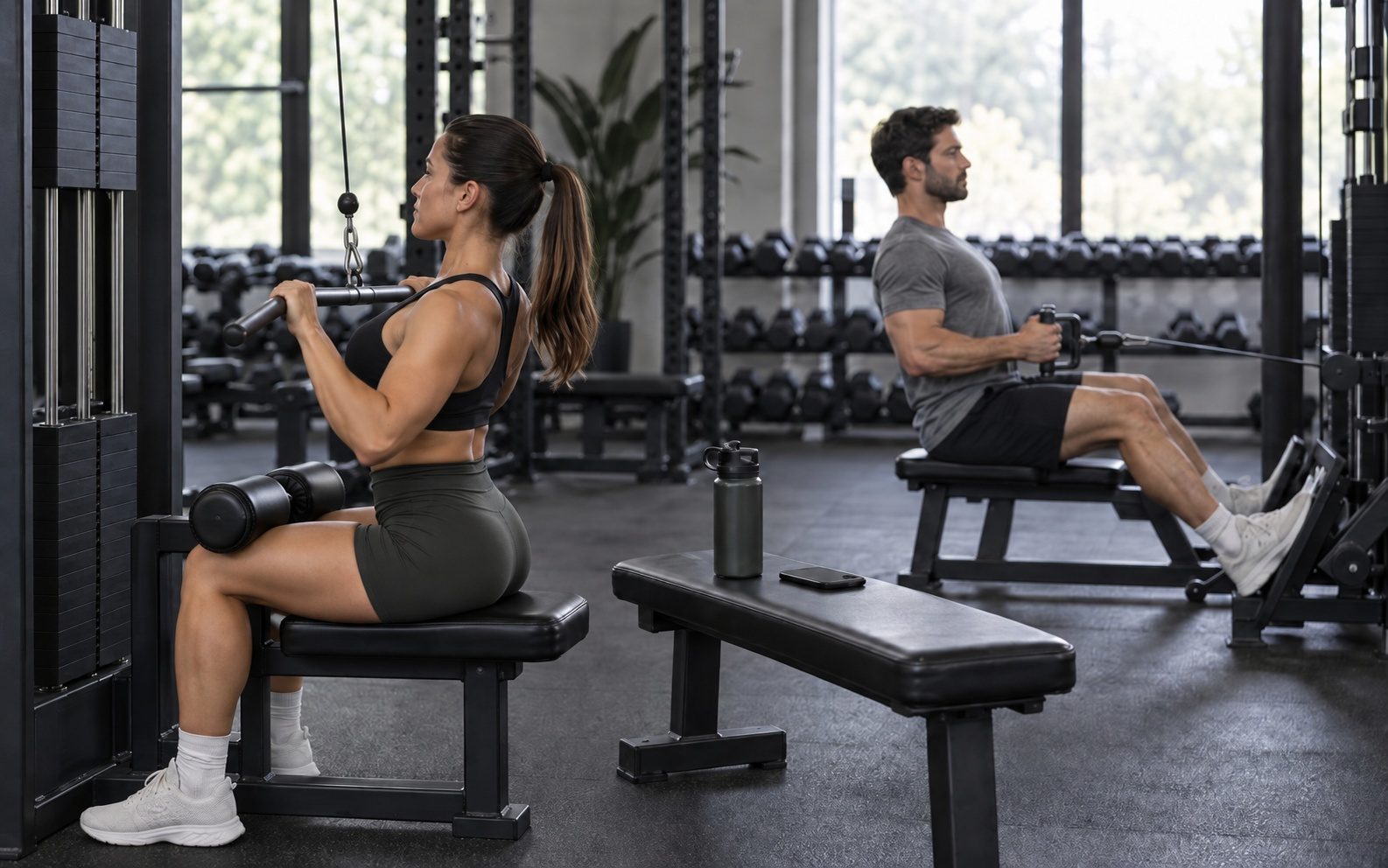
The 8-week program at a glance
The exercises go in this order: big muscles and multi-joint movements first, smaller muscles after. That's the order the American College of Sports Medicine (ACSM) recommends.
| Slot | Workout A | Workout B | Sets × reps | Rest |
|---|---|---|---|---|
| Legs | Leg press | Goblet squat (dumbbell at your chest) | 3 × 8–12 | 2 min |
| Press | Seated machine chest press | Seated dumbbell shoulder press | 3 × 8–12 | 1.5–2 min |
| Pull | Lat pulldown | Seated cable row | 3 × 8–12 | 1.5–2 min |
| Hamstrings and glutes | Dumbbell Romanian deadlift | Glute bridge | 3 × 10–12 | 1.5 min |
| Core | Plank | Side plank | 2–3 × 20–40 sec | 1 min |
The sets in the table are for weeks 3–7. Weeks 1–2 and week 8 are laid out in section 04.
How to spread the workouts across your week:
- 2 days a week. Workout A on Monday, B on Thursday. Or Tuesday and Saturday.
- 3 days a week. Every other day, for example Monday, Wednesday and Friday: A-B-A one week, B-A-B the next.
Before each workout, warm up for 5–8 minutes on a stationary bike or with a brisk walk on an incline treadmill. Then do a few joint mobility drills and 1–2 light sets of your first exercise. More in our guide to warming up before a workout. The whole session takes 45–60 minutes.
It's a complete full-body routine built on basic exercises, with machines and dumbbells only and no barbell. The program is free: copy it into your phone notes or your workout log.
Basic exercises: which ones a beginner needs and how many
Basic exercises, also called compound exercises, work several joints and large muscle groups at once. A squat, for example, works your thighs, glutes and back. Isolation exercises work one joint, like the leg extension machine. When you're a beginner, compound exercises are more than enough. You can add isolation work later.
A common question is how many basic exercises you need: 5, 6, 7 or 10. It's easier to count movements instead of exercises. There are only a few:
- squat: your knees bend and your hips go down;
- hip hinge: you bend forward by pushing your hips back, with a straight back, which works your hamstrings and glutes;
- chest press: chest, shoulders and triceps;
- overhead press: shoulders and triceps;
- pulling down from overhead: your lats (the wide muscles of your back) and biceps;
- rowing toward your waist: the middle of your back;
- holding your torso steady: your abs and lower back.
Cover these seven movements and you've worked your whole body. Each movement gets an exercise in Workout A or B. That's 10 exercises in total, 5 per workout, and a beginner doesn't need more than that in one session.
Machines or dumbbells? Both work. A machine sets the path for you and forgives mistakes early on. Dumbbells teach you to keep your balance. And when you're starting out, you don't need a split, where each day trains a different muscle group. Here's why beginners don't need a split.
Workout A and Workout B: how to do each exercise
Workout A
- Leg press. Keep your lower back and hips pressed into the pad. Lower the platform only as far as you can without your hips lifting.
- Seated machine chest press. Shoulder blades against the back pad, elbows no higher than your shoulders.
- Lat pulldown. Pull the bar to your upper chest, not behind your head. Keep your shoulders down, and don't swing your body.
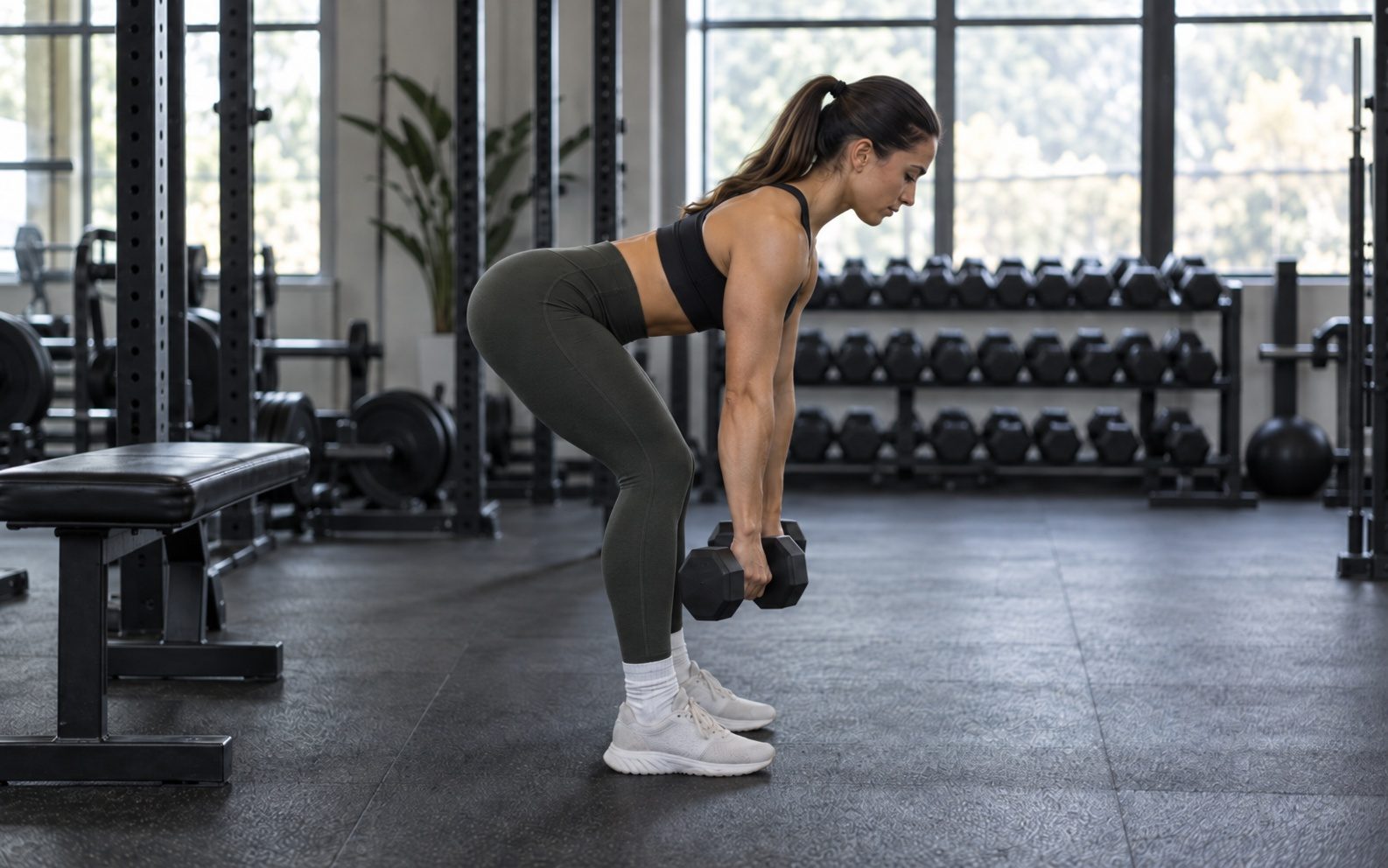
- Dumbbell Romanian deadlift. Knees slightly bent, hips move back, dumbbells slide along your legs. Go down only as far as you can keep your back straight.
- Plank. On your elbows, body in a straight line from head to heels, hips not sagging.
Workout B
- Goblet squat. Hold one dumbbell upright against your chest with both hands. Heels stay on the floor, and your knees track toward your toes.
- Seated dumbbell shoulder press. Set the bench back almost upright. Lower the dumbbells until your elbows are just below your shoulders.
- Seated cable row. Back straight, chest up. Pull the handle to your stomach and squeeze your shoulder blades together at the end.
- Glute bridge. Lie on your back with your feet flat on the floor, hip-width apart. Lift your hips until your thighs and torso form a straight line. Once 12 reps feel easy, rest a dumbbell on your hips.
- Side plank. Elbow right under your shoulder, body straight. Hold for the same amount of time on each side.
Rest between sets as shown in the table: from 1 minute on planks to 2 minutes on leg exercises.
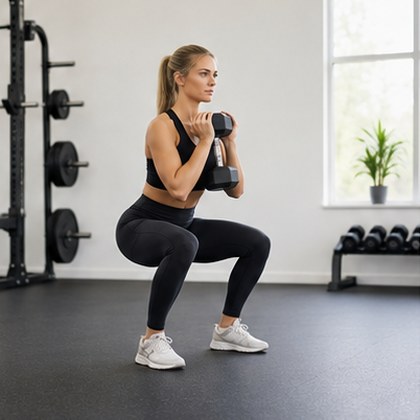 Goblet squat
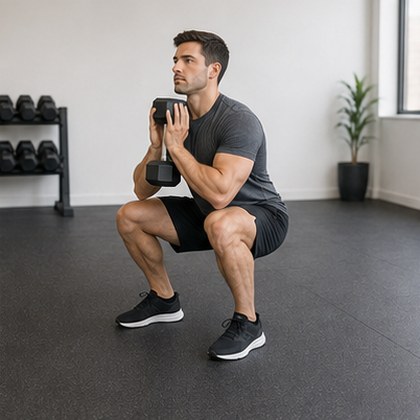 Goblet squat
Week by week: what changes from week 1 to week 8
Reps in reserve means how many more reps you could have done. Two in reserve means you finish a set feeling you could have done two more clean reps.
| Week | Sets | Reps | In reserve | Goal for the week |
|---|---|---|---|---|
| 1 | 2 | 10–12 | 3 | Learn the movements, find your starting weights |
| 2 | 2 | 10–12 | 3 | Write down your weights and machine settings |
| 3 | 3 | 8–12 | 2 | Add a third set, start adding weight by the traffic light (section 06) |
| 4 | 3 | 8–12 | 2 | Add weight by the traffic light |
| 5 | 3 | 8–12 | 2 | Add weight by the traffic light |
| 6 | 3 | 8–12 | 1–2 | Biggest jumps in weight |
| 7 | 3 | 8–12 | 1–2 | Biggest jumps in weight |
| 8 | 2 | 8–12 | 3–4 | Deload: same weights, fewer sets |
In this program, you don't take sets to failure, the point where you can't do even one more clean rep. A 2023 review found only a very small difference in muscle growth between sets taken to failure and sets that stop short of it. And stopping short protects your form and saves energy for the next set.
Week 8 gives your body a break from the steadily rising load. It's also a good time to check your progress: take your week-1 weight and see how many reps you can now do with it while still stopping 3 reps short.
What to do after week 8:
- your weights keep going up: stay on the same program. You count as a beginner for roughly your first six months of regular training;
- a weight hasn't moved in three workouts: drop it by 10% and build back up by the traffic light;
- two workouts a week no longer feel like enough: add a third.
What weight to start with: a two-set test
"Pick a weight you can lift with good form" tells a beginner nothing. Here's how to turn that advice into pounds.
- First set: 10 reps with a weight you know is light.
- If after rep 10 you feel you could do more than 4 extra reps, go up one step for the second set: the next plate on the weight stack, or heavier dumbbells.
- Your working weight is the one that leaves about 3 reps in reserve after rep 10. That's the weight you write down.
- If you still have more than 4 reps in reserve on the second set, write that weight down. Start the test from it next workout.
The table below shows where to begin your first test. It's not a standard, just a starting point. These numbers are the low end of the weights the Sportygram workout log suggests for a first set until you have a weight history. If even this feels heavy, start one step lower.
| Exercise | Men | Women |
|---|---|---|
| Leg press | 130 lb (60 kg) | 75 lb (35 kg) |
| Seated machine chest press | 55 lb (25 kg) | 35 lb (15 kg) |
| Lat pulldown | 55 lb (25 kg) | 35 lb (15 kg) |
| Seated cable row | 55 lb (25 kg) | 35 lb (15 kg) |
| Dumbbell for goblet squats | 17.5 lb (8 kg) | 10 lb (5 kg) |
| Dumbbells for the shoulder press | 17.5 lb (8 kg) each | 10 lb (5 kg) each |
| Dumbbells for Romanian deadlifts | 17.5 lb (8 kg) each | 10 lb (5 kg) each |
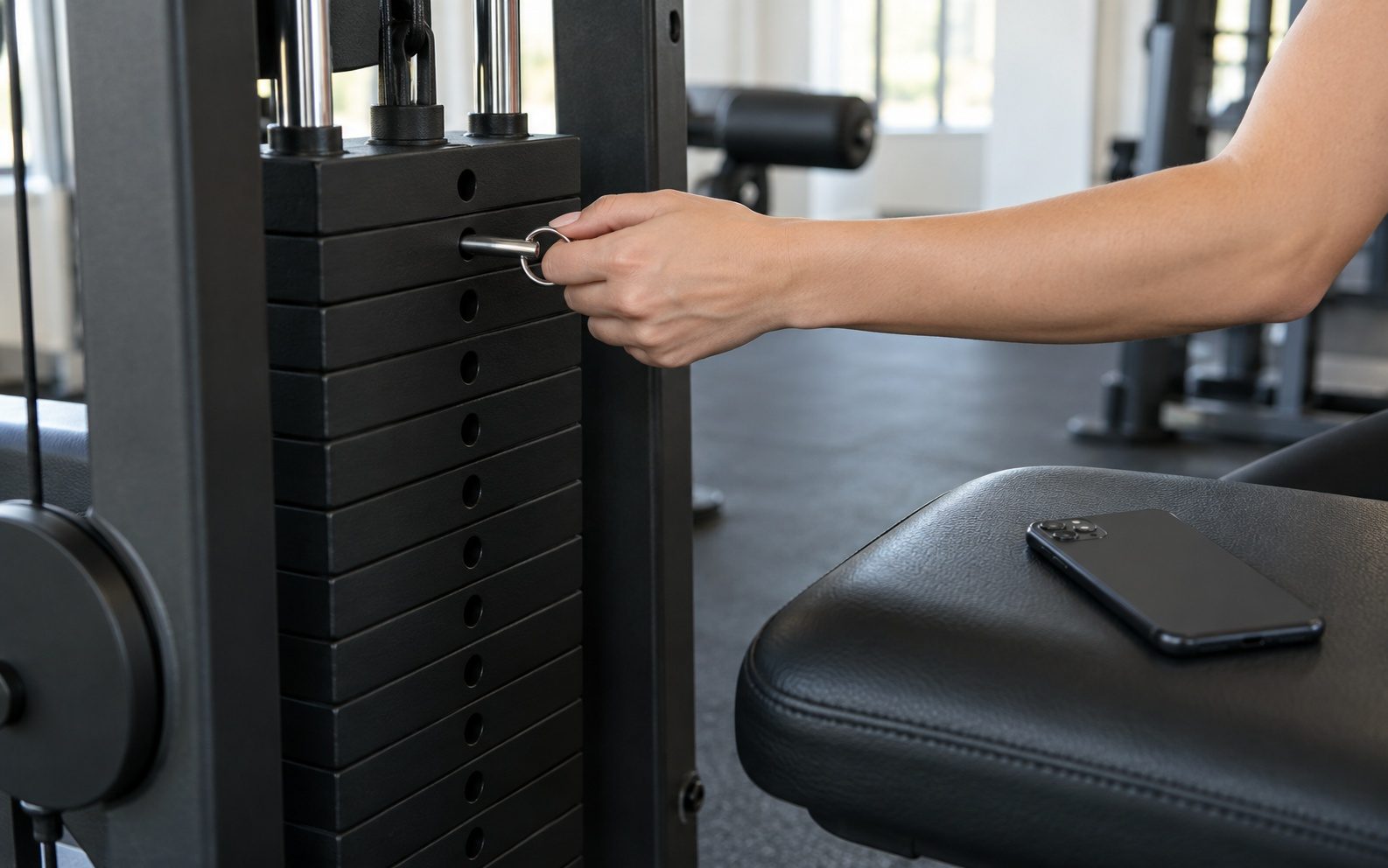
The number on a machine doesn't carry over from one gym to another. Different models have different pulleys and levers, so "65 lb" in one gym and "65 lb" in another are different loads. Write down the weight together with the name of the machine.
write down your machine settings along with the weight: which notch the seat and back pad are set to. Next time you'll sit in exactly the same position, so you're comparing apples to apples.
When to add weight: the traffic light rule
After each workout, check your notes and give each exercise a color.
- Green. You did 12 reps in every working set and could have done 2 more. Add one step next workout.
- Yellow. You got 8 to 11 reps in at least one set, or you hit 12 but couldn't have done 2 more. Keep the weight and work up to 12.
- Red. Fewer than 8 reps, or your form broke down. Drop the weight one step and don't add any for three workouts.
On planks, time goes up instead of weight: start with 20 seconds and work up to 40.
The rule is based on ACSM advice: beginners should do 8–12 reps and add 2–10% to the weight once they can do 1–2 reps more than the target.
That means each step should be as small as possible. With dumbbells, that's usually 2.5–5 lb (1–2 kg). Machines are trickier. If the stack goes up in 10 lb (5 kg) plates and you're pressing 30–40 lb (15–20 kg), one plate is a 25–35% jump. In that case, work up to 15 reps first, and then move to the next plate. If your gym has small add-on weights for the stack, use them.
Change one thing at a time: the weight or the reps. Other ways to make your training harder are covered in our guide to progressive overload.
Gym workout plan for men vs. women: what actually differs
A gym workout plan for men and one for women can be the same plan. Only the starting weights differ, and the size of each step follows from them: the lighter the weight, the smaller the step. The basic exercises are the same for men and women: squats, presses, pulls and the hip hinge.
A large 2020 review of studies backs this up. On the same program, men and women gained muscle and leg strength at the same rate, measured as a percentage of where they started. Women's upper-body strength actually grew faster in percentage terms.
What this means for you:
- Women don't need "women's" programs that replace presses and pulls with inner- and outer-thigh machines.
- Want more focus on your glutes? Once your form feels solid, swap the regular glute bridge in Workout B for a barbell hip thrust and add one set.
- Men don't need a separate "chest day." There's a press in every workout: a chest press in A and an overhead press in B.
- Getting bulky in 8 weeks isn't going to happen, for men or women. Our article on strength training for women explains why lifting doesn't make women bulky.
2 or 3 times a week: how to choose for your schedule
Choose based on your schedule, because the difference between the two options is small. A large 2023 review pooled 178 strength studies with 5,097 participants, almost half of them women. Muscle growth was analyzed across 119 studies. Here's what it found:
- any strength program is better than none;
- in 91% of comparisons, no clear difference between setups showed up;
- for muscle growth, multiple sets with heavy weights twice a week came out slightly ahead;
- for strength, multiple sets with heavy weights three times a week came out ahead.
The World Health Organization (WHO) advises adults to do strength training for all major muscle groups at least 2 days a week, so two workouts are enough. If you have time for 3 days, do 3. If 2 is all you can really manage, do 2 and don't skip them. More on frequency in how many times a week to work out.
Machine taken? Swaps for every exercise
During the evening rush, you may have to wait for the leg press. That doesn't break the program: just pick a swap from the same row of the table.
| Slot | Machine | Dumbbells | Other option |
|---|---|---|---|
| Legs | Leg press | Goblet squat | Dumbbell lunges or step-ups onto a box |
| Chest press | Seated machine chest press | Dumbbell bench press | Push-ups, from your toes or your knees |
| Overhead press | Machine shoulder press | Seated dumbbell shoulder press | — |
| Pull from above | Lat pulldown | Bent-over dumbbell row | Inverted rows |
| Row to your waist | Seated cable row | Bent-over dumbbell row | Inverted rows |
| Hamstrings and glutes | Back extension | Dumbbell Romanian deadlift | Glute bridge |
| Core | — | — | Plank, side plank, dead bug |
For inverted rows, also called Australian pull-ups, you hang under a low bar with your heels on the floor and your body at an angle, then pull your chest up to the bar. For a dead bug, lie on your back with your arms and bent knees raised, press your lower back into the floor and slowly lower the opposite arm and leg, one side at a time. For any swap, find the weight again with the same two-set test.
How to work out without a trainer: check your form on video
You can work out at the gym without a trainer if you have a ready-made program, write down your weights and check your form on video. Set your phone to the side at hip height, 6–10 feet (2–3 m) away. Film a working set and check three points.
- Goblet squat: your heels stay on the floor; your knees track toward your toes; your lower back doesn't round at the bottom.
- Romanian deadlift: the dumbbells slide along your legs; your knees are slightly bent and barely move; your back is straight and your hips go back.
- Lat pulldown: your shoulders stay down, away from your ears; your body doesn't swing; the bar comes to your upper chest.
- Seated machine chest press: your shoulder blades stay against the pad; your elbows are no higher than your shoulders; you don't lock your elbows hard at the top.
- Glute bridge: at the top, your torso and thighs form one line; your lower back doesn't arch; your knees don't cave in.
Spotted a mistake? Fix it on the next set and film again. If it's still there after three videos, one or two sessions with a trainer will pay for themselves.
What to expect after 4 and 8 weeks
In the first 1–2 weeks, your weights go up fast, but that's not muscle yet. It's skill: your body is learning the movement, so you can lift more.
Muscles start growing sooner than most people think. In a 2011 study, 25 untrained men did strength training for 8 weeks, and their thigh muscles were measured with a CT scan every week. Noticeable muscle growth showed up around weeks 3–4. By week 8, their thigh muscles were 9.6% bigger. The study notes that early on, part of that gain may have been swelling from the workouts.
Your notes will show this sooner than the mirror does. So for the first two months, look at your log: how many pounds and reps you did in week 1 and how many you do now.
Three things keep the program from stalling:
- protein in your meals every day;
- decent sleep;
- consistency: 8 weeks without long breaks.
When to stop: pain, soreness and warning signs
- A burn in the muscle at the end of a set is normal. Sharp pain in a joint or your back ends the set right away.
- Sore muscles 1–2 days after your first workouts are DOMS, or delayed onset muscle soreness. You can train, just lighter.
- Chest pain or pressure, feeling like you're about to pass out, or being more out of breath than usual ends the workout. If it doesn't ease within a few minutes of rest, call 911 or your local emergency number.
- If you have high blood pressure, heart disease, or a recent injury or surgery, see a doctor before you start.
- Breathing: breathe out on the effort and in on the way back. Don't hold your breath for the whole set.
How to log the program and keep track of your weights
The traffic light only works if you keep notes. A notebook or a phone note works fine. If you track workouts in the Sportygram app, the workout log keeps a weight history under each exercise, so you can see how your numbers change over time.
For every exercise, write down:
- the exercise and which machine you used;
- the seat and back pad settings;
- the weight and the reps in each set, for example "55 lb: 12, 12, 11";
- your traffic light color for that day.
If a machine is taken and you swap an exercise, log the swap too, so next time you compare the same movement. If you move a workout to another day, keep the A-B order.
FAQ
How many times a week should a beginner go to the gym?
Go 2–3 times a week for full-body workouts, with a day or two of rest between strength sessions. Two workouts are enough if you don't skip them: the World Health Organization advises adults to do strength training for all major muscles at least 2 days a week. A third day helps strength grow a little faster. Pick the number you can definitely keep up for two months straight.
Is a gym workout plan for women different from one for men?
The exercises are the same. Only the starting weights differ: women usually start lighter, so their steps are often smaller too. On the same program, men and women gain muscle at the same rate as a percentage of where they started, and women's upper-body strength grows even faster. For more glute focus, swap the glute bridge for a barbell hip thrust and add a set.
Which basic exercises should a beginner do, and how many?
Basic, or compound, exercises work several joints and large muscles at once. A beginner needs to cover seven movements: a squat or leg press, a hip hinge, a chest press, an overhead press, a pull from above, a row to the waist and holding the torso steady. That comes to 10 exercises across two workouts, with five in each one.
How much weight should a beginner start with?
Start with a test. Do 10 reps with a weight you know is light. If you have more than 4 reps in reserve, go up one step for the second set. Your working weight leaves about 3 reps in reserve after rep 10. The table in section 05 gives starting points. Don't copy other people's numbers: the same number on another machine is a different load.
Can you work out at the gym without a trainer?
Yes, if you have a ready-made program, write down your weights and check your form on video. Film a set from the side and check three points for each exercise. If a mistake is still there after three videos, book one or two sessions with a trainer to get the movement right. After that, you can go back to training on your own.
Should you do cardio before or after weights?
For this program, do it after your strength work or on a different day. Before lifting, a 5–8 minute warm-up on a stationary bike or an incline walk is enough. That way your legs and back aren't tired too early, and you bring your full strength to the leg press and squats. For cardio after a workout, try incline walking, a stationary bike or a rowing machine.
Will this plan work for losing weight or building muscle?
Yes. The workouts stay the same, and your food decides what the scale does. Eat less than you burn and you lose weight, while training helps you keep your muscle. Eat a bit more than you burn and watch your protein, and you gain mass. Either way, the program gives your muscles the work, and food moves the number on the scale.
What should you do if you miss a workout or a week?
Missed one workout? Do the next one on the list. There's no need to train two days in a row. Missed a week? Come back with weights one step lower. You're usually back to your old numbers within 1–2 workouts. After a long break, start again with the weight test, as in week 1, and add weight by the traffic light.
The bottom line
- A gym workout plan for beginners is 2–3 workouts a week: A and B, each with 5 basic exercises.
- Weeks 1–2: 2 sets of 10–12 reps with 3 in reserve. Weeks 3–7: 3 sets of 8–12. Week 8: deload.
- Find your starting weight with a two-set test and write it down along with the machine name.
- Add weight by the traffic light: 12 reps in every set with 2 in reserve means one step up. Keep the step small: 2.5–5 lb on dumbbells.
- Men and women follow the same program, and only the weights differ. As a percentage of where they start, their muscles grow at the same rate.
Checklist: before your first workout
- Pick 2 or 3 days and put them in your calendar.
- Copy Workouts A and B into your notes or your workout log.
- Bring your phone to log your weights and film your sets.
- On your first workout, just find your weights with the test and do 2 sets of each exercise.
- Write down the machine's name and your seat settings.
- Add weight only by the traffic light.
- After 8 weeks, compare your weights with week 1.
Sources
- American College of Sports Medicine. Progression models in resistance training for healthy adults. Medicine & Science in Sports & Exercise, 2009. — For beginners: 8–12 reps, 2–3 workouts a week, and a 2–10% weight increase once they can do 1–2 reps more than the target.
- World Health Organization. WHO guidelines on physical activity and sedentary behaviour. 2020. — Adults should do strength training for all major muscle groups at least 2 days a week.
- Currier B. S. et al. Resistance training prescription for muscle strength and hypertrophy in healthy adults: a systematic review and Bayesian network meta-analysis. British Journal of Sports Medicine, 2023. — Any program is better than none; in 91% of comparisons, no clear difference between setups showed up; multiple sets with heavier loads ranked highest twice a week for muscle growth and three times a week for strength.
- Roberts B. M., Nuckols G., Krieger J. W. Sex Differences in Resistance Training: A Systematic Review and Meta-Analysis. Journal of Strength and Conditioning Research, 2020. — As a percentage of baseline, gains in muscle size and leg strength were the same in men and women; women gained more upper-body strength.
- Refalo M. C. et al. Influence of Resistance Training Proximity-to-Failure on Skeletal Muscle Hypertrophy: A Systematic Review with Meta-analysis. Sports Medicine, 2023. — Sets taken to failure barely outperform sets that stop a few reps short.
- DeFreitas J. M. et al. An examination of the time course of training-induced skeletal muscle hypertrophy. European Journal of Applied Physiology, 2011. — Thigh muscle growth was noticeable by weeks 3–4 and reached 9.6% by week 8.
This material is for informational purposes and does not replace medical advice.