

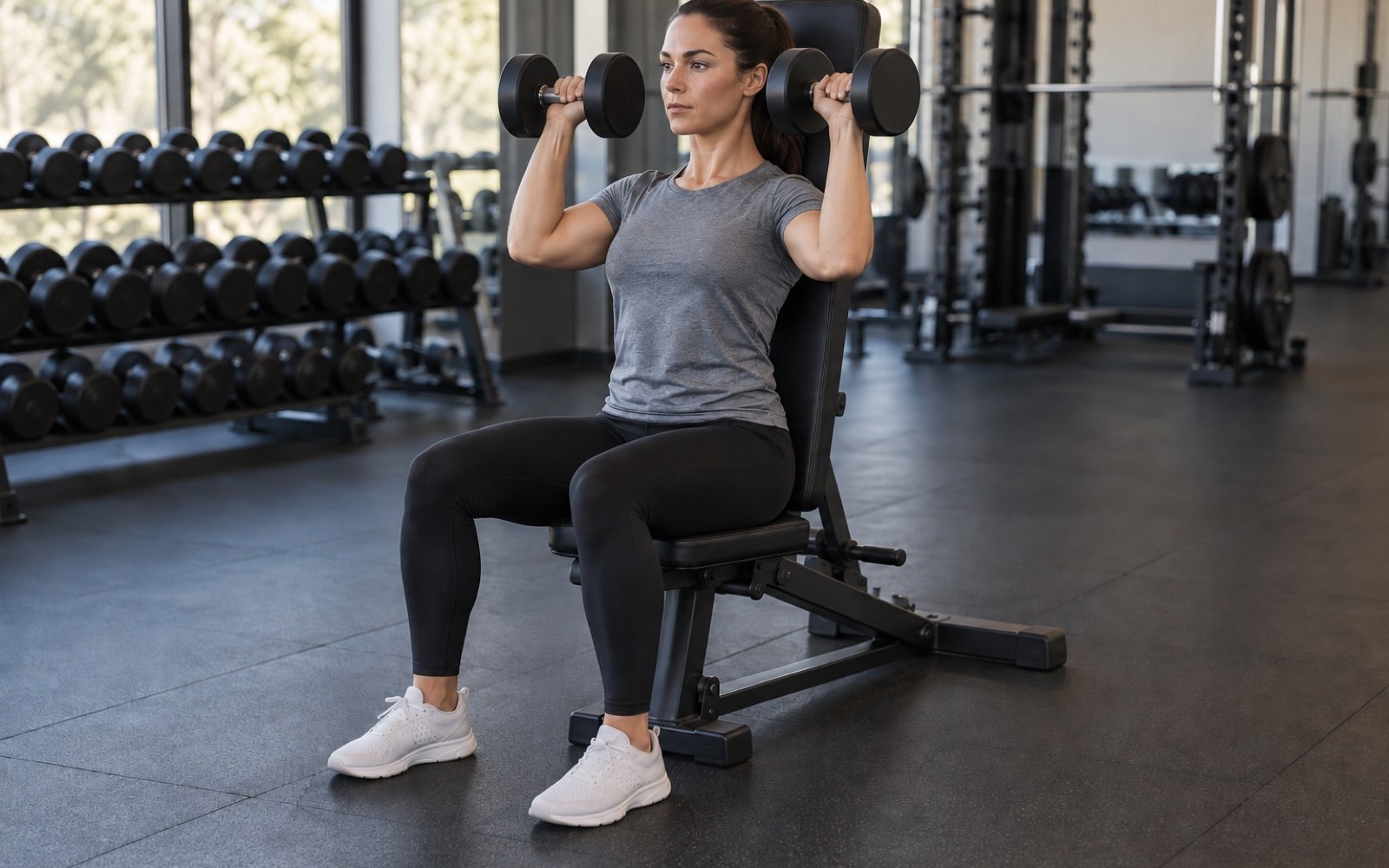
backrest at 75–90°, dumbbells kicked up to your shoulders with your knees, elbows about 30° in front of the line of your shoulders, lower to ear level over 2–3 seconds, and keep your elbows soft at the top. The main muscle is the front delt. In Saeterbakken's 2013 study, the shoulders worked less seated than standing — the rear delt by about a quarter, the side delt by 15% — but the heaviest weight people could press with dumbbells standing was 10% lower than seated.Starting point: 4 kg (9 lb) dumbbells for women and 8 kg (17.5 lb) for men, 3 sets of 10 twice a week with 2–3 reps in reserve. Over our 8-week plan, training volume per session grows by 80%.
A seated dumbbell shoulder press means pressing two dumbbells from your shoulders to overhead while you sit on a bench with a back support. Set the backrest at 75–90°, kick the dumbbells up to your shoulders with your knees, keep your elbows slightly in front of your torso, and lower the dumbbells to ear level. The front delts do most of the work, the side delts help, and the triceps straighten your arms at the top. A beginner needs no more than 3 sets of 10 reps twice a week: 4 kg (9 lb) dumbbells for women and 8 kg (17.5 lb) for men. In gyms you'll also hear it called the seated dumbbell overhead press, the seated dumbbell military press, or simply the dumbbell shoulder press.
What the seated dumbbell shoulder press is and what it does for you
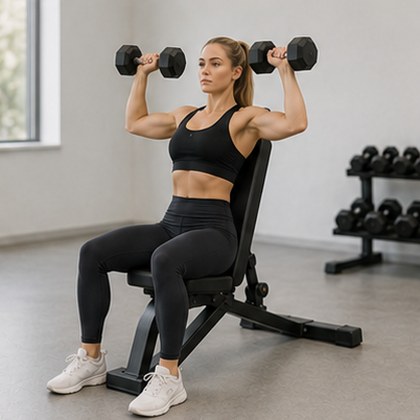
The seated dumbbell shoulder press is a basic shoulder exercise where you press two dumbbells up from your shoulders along a slight arc until your arms are almost straight. You sit on a bench with the backrest raised, feet flat on the floor, lower back against the pad. From there you press the dumbbells up and lower them back to ear level.
The exercise goes by a lot of names, and they all describe the same movement: seated dumbbell press, seated overhead press, dumbbell overhead press, vertical dumbbell press, dumbbell shoulder press. The "seated dumbbell military press" is also this exercise. The name "military press" originally belonged to the standing barbell version, and over time it stuck to almost any overhead press.
What it gives you. First, size at the front and side of your shoulders. Second, strength overhead: lifting a suitcase onto a shelf, picking up a child. Third, a foundation for any shoulder routine: the press builds mass, while lateral raises and rows fill in the shape.
Why dumbbells in particular. Each arm works on its own, so your weaker side can't hide behind the stronger one. Your hands aren't tied to a bar and can follow their own path: you can turn your elbows slightly forward and rotate your palms to whatever position feels good for your shoulder. And the third point, the most important one for a beginner: 4 kg (9 lb) or 8 kg (17.5 lb) dumbbells are available in every gym and in plenty of homes, and you don't need a rack.
Seated dumbbell shoulder press: muscles worked
In the seated dumbbell shoulder press, the front delt does the main work, the side delt helps drive the dumbbells up, the triceps straighten your arms at the top, and the upper chest, traps and the muscles around your shoulder blade support the movement.
| Muscle | What it does in the press | Where you feel it |
|---|---|---|
| Front delt (anterior deltoid) | raises the upper arm forward and up; the prime mover | front of the shoulder, burning toward the end of the set |
| Side delt (lateral deltoid) | moves the upper arm out and up, helps through the whole range | side of the shoulder, where a sleeve seam sits |
| Rear delt (posterior deltoid) | stabilizes the shoulder joint, works only a little | barely anything at the back of the shoulder |
| Triceps | straightens the elbow, finishes the rep at the top | back of the arm, especially in the last few inches |
| Upper chest (clavicular pectoralis major) | helps a little with raising the arm forward and up | upper chest near the collarbones, more with a lower backrest |
| Upper traps and serratus anterior | rotate the shoulder blade so the arm can go overhead | between neck and shoulder, along the side under the shoulder blade |
| Rotator cuff | keeps the head of the upper arm bone centered in the joint | you don't feel it directly, but it gets tired |
| Core and forearms | keep your back against the pad and the dumbbells in your hands | abs and grip under heavy dumbbells |
Front delt. In a 2013 study by Luczak and colleagues, 24 women — half with lifting experience and half without — did three dumbbell presses: flat bench, incline, and seated overhead. The front delt and upper traps worked hardest in the seated overhead press, both on the way up and on the way down. The chest did the opposite: it worked harder in the flat and incline presses than in the seated press. Experience didn't change the picture: beginners and trained women used their muscles the same way. This study was done on women, so it answers their question directly: the seated press loads the shoulders even in beginners, and the starting weight is in the plan in section 09.
Dumbbells or a barbell: which loads the delt more. In 2013, Saeterbakken and Fimland measured the electrical activity of the muscles in 15 healthy men across four presses at 80% of their max: barbell and dumbbells, seated and standing. With a barbell, the front delt worked about 11% less than with dumbbells when seated, and 15% less when standing. On the other hand, the barbell brought in the biceps more: seated, it worked about a third more than with dumbbells. What it means for you: if your goal is your shoulders, dumbbells load them more precisely.
Side delt. The press does train it, but not to the max. A 2024 systematic review by Rabello and colleagues pooled 33 studies with loads of at least 60% of max and showed where each head of the deltoid works hardest: the side delt in abduction, meaning lateral raises; the front delt in horizontal adduction, like incline flyes; the rear delt in pull-ups and horizontal rows. That gives you a simple pairing: the seated dumbbell press builds mass in the front and side delts, lateral raises add more side-delt work, and rows take care of the rear delt. The press alone won't give you round, capped shoulders.
Does it work the chest? Only in passing. The upper part of the pec helps raise your arms a little, and the lower the backrest, the bigger its share. More on this in section 04.
How to do a seated dumbbell shoulder press: step by step
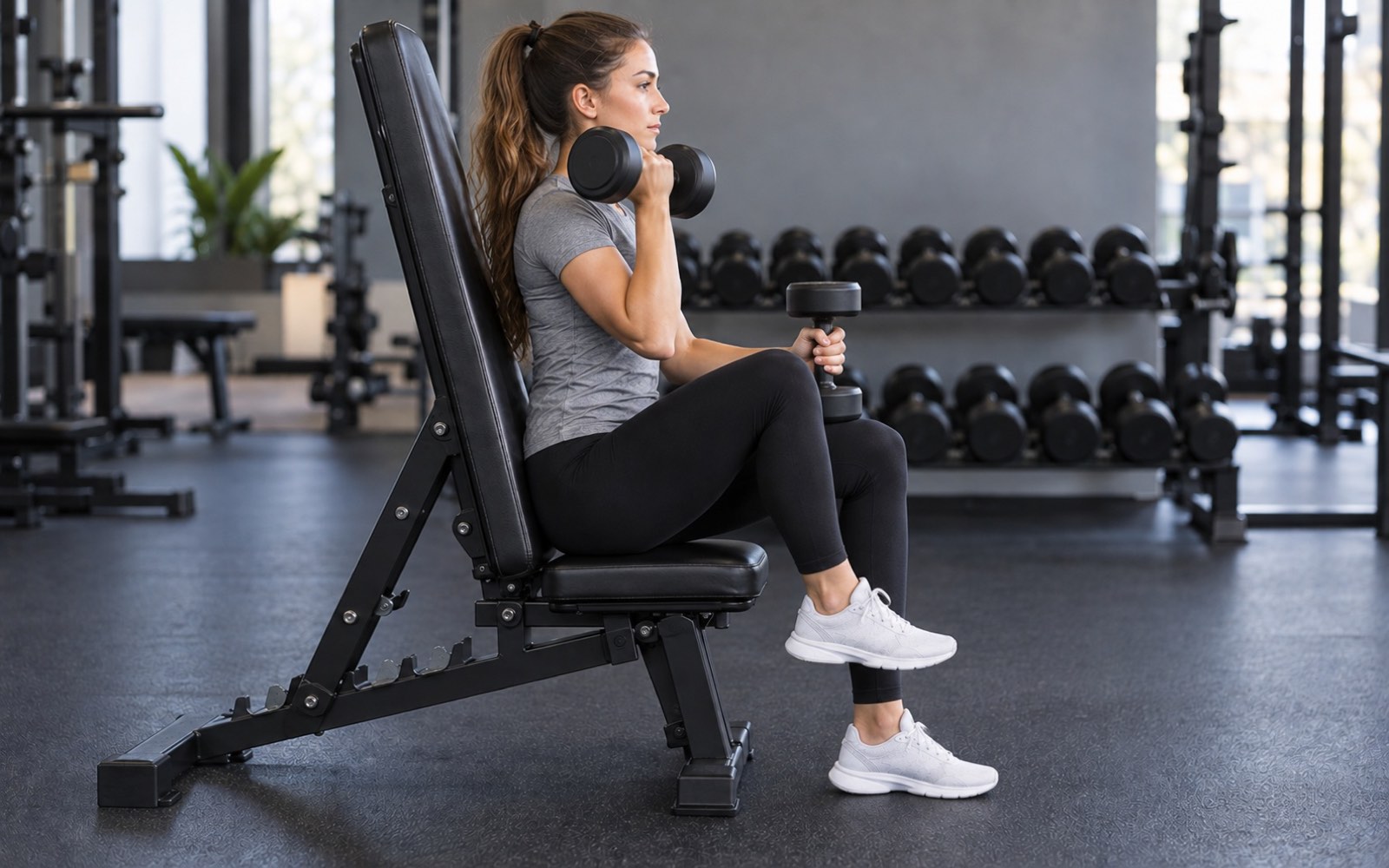
Set the backrest at 75–90°, sit down, press your hips and lower back into the pad, kick the dumbbells up to your shoulders with your knees, press them up along a slight arc, and lower them to ear level over 2–3 seconds. Step by step, it looks like this:
- Backrest. Raise it to 75–90°. On most adjustable benches, that's the last or second-to-last notch. What each angle changes is covered in section 04.
- Seat. Sit so that your hips and lower back touch the pad, with a natural arch in your lower back about the thickness of your hand. Shoulder blades down, the back of your head in line with your spine.
- Feet. Flat on the floor, hip-width apart or a little wider, whole sole down. Your feet keep you balanced: if you put them up on the bench or cross them, your torso starts to wobble.
- Dumbbells on your thighs. Pick the dumbbells up from the floor, sit down and stand them upright on your thighs, close to your knees.
- Getting them up. Lift your right knee and use it to pop the dumbbell up to your right shoulder, catching it there. Then do the same with your left knee. With light dumbbells, you can simply lift your arms; with heavy ones, the knee kick really helps. This way your arms don't burn energy before the first rep.
- Starting position. Dumbbells at shoulder height or slightly higher, forearms vertical, wrists stacked directly over your elbows. Elbows slightly in front of your torso, about 30° forward from the line of your shoulders. A simple check: when you look straight ahead, you can see your elbows in your peripheral vision. Palms facing forward or turned slightly toward each other, whichever feels better for your shoulders.
- Breathe in and press. Take a breath, brace your abs, and press the dumbbells up along a slight arc so they come close together over your head without clanking. The press takes 1–2 seconds. Breathe out during the second half of the press.
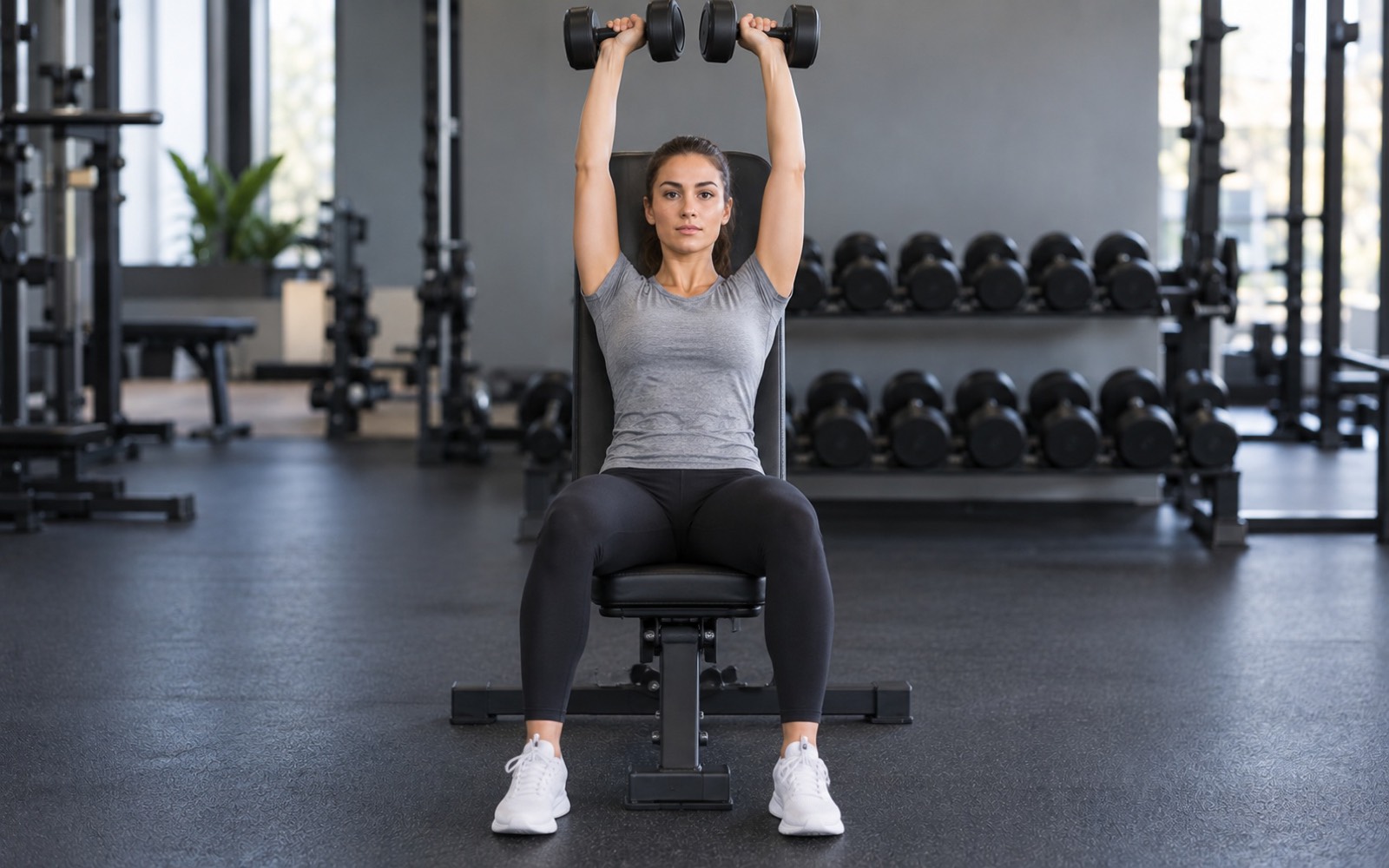
- Top position. Arms almost straight, elbows soft; don't lock them out hard. Don't shrug your shoulders up toward your ears: keep your shoulder blades down.
- Lowering. Lower the dumbbells slowly, over 2–3 seconds, to the level of your ears or chin. A beginner doesn't need to go lower: at the very bottom, the shoulder is stretched the most under load, and if your shoulder hurts anywhere, that's usually where.
- End of the set. After the last rep, lower the dumbbells to your shoulders, then to your thighs, then to the floor. Don't drop them from shoulder height: you can strain your shoulder or wrist.
The American College of Sports Medicine (ACSM) 2009 position stand recommends a slow or moderate tempo for beginners, and "moderate" there means 1–2 seconds for the lifting phase and the same for the lowering phase. We suggest lowering a little slower, over 2–3 seconds, for control: that way the dumbbell doesn't drop onto your shoulder and pull the joint down. Tempo itself has almost no effect on muscle growth: in the 2026 ACSM review, time under tension didn't consistently change results.
Grip. Palms facing forward is the classic version. A neutral grip, with the dumbbells parallel and your palms facing each other, is usually easier on the shoulder: your elbows naturally move forward, and the shoulder has more room at the top of the movement. If your shoulder "catches" when you press with your palms forward, try a neutral grip or a halfway grip with your palms turned 45°.
Breathing. Breathe in before the press, hold briefly through the hardest part at the bottom, and breathe out during the second half of the press. With light dumbbells, just breathe steadily. Don't hold your breath and strain for a long time: your blood pressure rises, and if yours is high, that's a question for your doctor.
before your first set, check your elbow position against a wall. Stand with your back to the wall, raise your arms into the starting position of the press, and notice where your elbows are. If they touch the wall, they've gone straight out to the sides or even behind you, and your shoulder is working in an awkward position. Turn your elbows slightly forward so they come off the wall and show up in your peripheral vision. Keep that same angle on the bench.
What bench angle to use: 90, 80 or 60 degrees
For your shoulders, set the backrest at 75–90°: the closer to vertical, the more the delts work. At 60°, the upper chest joins in, and at 45° and below you're doing an incline chest press, which is a different exercise with a different job.
People often mix up two exercises. The incline dumbbell press, with the bench at 30–45°, is done for the upper chest, and if chest pressing is what you're after, start with our guide to bench press form. The seated press for shoulders uses an almost vertical backrest, and one study describes the transition between the two.
In 2020, Rodríguez-Ridao and colleagues had 30 trained people bench press a barbell at five bench angles — 0°, 15°, 30°, 45° and 60° — with 60% of their max. The upper chest worked hardest at 30°, the middle and lower chest on a flat bench, and the front delt at 60°, the steepest angle tested. The triceps worked the same at all angles. Inclines above 45° significantly raised the front delt's share and reduced chest activity. This was a barbell press, not dumbbells, and 90° wasn't tested, but the direction is clear: the more upright your torso, the more shoulder and the less chest. Luczak's 2013 dumbbell study backs this up: in the seated overhead press, the front delt worked harder than in the incline and flat presses.
| Backrest angle | What works | Who it suits |
|---|---|---|
| 90° (vertical) | most delt, least chest; with a vertical pad or no pad, the lower back works harder | experienced lifters with a steady lower back; if your hips slide away from the pad, lower the angle |
| 75–80° | shoulders work almost as much as at 90°, lower back stays calm, dumbbells are easier to keep over your shoulders | the main working setting for everyone; start here |
| 60° | front delt at its peak in Rodríguez-Ridao's 2020 study, upper chest joins in | a transition option if your shoulder or lower back aches at vertical |
| 45° and 30° | upper chest peaks at 30° (Rodríguez-Ridao, 2020), delts assist | this is the incline chest press, a separate exercise |
A practical rule: start at 75–80°. After a month, if your lower back isn't complaining and your hips stay against the pad, try 90°. If the front of your shoulder aches at 80°, drop the backrest to 60° for a couple of weeks and use a neutral grip.
Seated or standing: what the research shows
Standing, your shoulder muscles work harder; seated, you lift more and don't have to think about your lower back. So for a beginner and for building muscle, seated makes more sense, and standing can be added later as a second variation.
Saeterbakken's 2013 study, mentioned in section 02, answers this with numbers. With dumbbells seated, the side delt worked 15% less than standing, the rear delt about 24% less, and the front delt about 8% less, though that last difference was only a trend and not statistically significant. On the other hand, the heaviest weight people could press with dumbbells standing was 10% lower than seated. The authors' conclusion: the setup where balance was hardest — dumbbells, standing — produced the highest delt activity and the lowest max.
Kohler and colleagues looked at the same idea from another angle in 2010. Thirty trained people did seated overhead presses with a barbell and dumbbells on a bench and on a stability ball, 3 sets of 3 reps with a weight they could lift for 10. The more unstable the setup, the less weight they could lift. The triceps worked hardest with a barbell on a bench and least with dumbbells on a stability ball. With a barbell on the ball, the upper part of the spinal erectors worked harder. The authors' conclusion: there's little point in reducing the weight just to add instability.
| Seated with back support | Standing | |
|---|---|---|
| Delt activity | side delt −15%, rear delt −24% versus standing (Saeterbakken, 2013) | higher, because of balance |
| Heaviest dumbbell weight | higher | 10% lower than seated |
| Lower back | pressed against the pad, barely involved | holds your torso the whole set, arches as you tire |
| What else works | consistently only shoulders and triceps | abs, spinal erectors, glutes |
| Who it suits | beginners, building shoulder size, people with a sensitive lower back | experienced lifters as a second variation, for overhead strength |
What it means for you. Seated, you focus on your shoulders, lift more and don't spend energy on balance. Standing is useful once your technique is solid and you want your core to work too. If you've had lower back trouble, or have it now, the question is settled: sit.
Seated dumbbell press vs. military press, Arnold press, machine press and behind-the-neck press
These are all the same movement pattern with different equipment, body position and path, and the differences come down to which muscle works harder, how much weight you can handle, and how much your lower back has to do.
| Variation | What works harder | Weight | Lower back | Who it suits |
|---|---|---|---|---|
| Seated dumbbell press | front delt: with a barbell seated, it works about 11% less (Saeterbakken, 2013) | baseline | unloaded | beginners, building shoulder size |
| Standing dumbbell press | side and rear delts higher than seated | 10% lower than seated | holds your torso | experienced lifters, overhead strength |
| Standing barbell military press | triceps: 39% higher than with dumbbells standing (Saeterbakken, 2013) | the standing dumbbell max is about 7% lower than with a barbell | holds your torso under the heaviest weight | strength and competition, with a steady lower back |
| Arnold press | front delt over a longer range; few reliable comparisons with the regular press | usually lower than the regular press | same as the seated press | a second exercise after the regular press |
| Machine press | the machine controls the path, muscles work less than with a barbell (Coratella, 2022) | higher: maxes of 95 kg (209 lb) versus 82 kg (181 lb) with a barbell in bodybuilders | unloaded | beginners in week one, when tired, as a finisher |
| Behind-the-neck press | side and rear delts higher than a front press (Coratella, 2022) | lower: 76 kg (168 lb) versus 82 kg (181 lb) from the front | unloaded when seated with a back support, holds your torso when standing | experienced lifters with good shoulder mobility |
Military press. The classic military press is a barbell, standing, pressed from the front of your shoulders. The bar travels in a straight line in front of your face, so you tilt your head back slightly on the way up. In Saeterbakken's 2013 study, the triceps worked 39% harder with a standing barbell than with dumbbells, and the standing dumbbell max was about 7% lower than with a barbell. Your back gets the most work here: there's no support behind you, your legs, hips and lower back hold the heaviest weight, and on the last reps your torso tends to lean back. If you search for a "seated dumbbell military press", this is the article for you: the same movement, just with dumbbells and a bench.
Arnold press. This is a seated dumbbell press where you rotate your hands during the movement, named after Arnold Schwarzenegger. Step by step:
- Sit on a bench with the backrest at 75–80° and raise the dumbbells to your shoulders with your palms facing you, elbows in front of your torso, dumbbells at about chin height.
- Start pressing up while spreading your elbows out to the sides and rotating your hands.
- By the middle of the press, your palms face forward and your elbows are under the dumbbells, as in the regular press.
- At the top, arms almost straight, dumbbells close together, elbows not locked.
- Lower in reverse: first a regular descent, then in the lower half rotate your palms back toward you and bring your elbows together in front of your torso.
- Lower over 2–3 seconds, with no jerk at the turning point.
The range of motion is longer than in the regular press at the bottom, where your elbows come together in front of your chest, so the front delt stays under load longer. That's why people usually use a lighter weight than in the regular press: start with dumbbells one step lighter and adjust using the test in section 09. There are few reliable studies comparing the Arnold press with the regular press, so we don't give an exact percentage difference. Rotating under load doesn't suit every shoulder. A beginner is better off learning the regular press first and adding the Arnold press as a second exercise after a month or two.
Machine press. In 2022, Coratella and colleagues compared four seated presses at 80% of max in 8 competitive bodybuilders: a barbell from the front and behind the neck on a bench with the backrest at 80°, plus a machine press from the front with a neutral grip and behind the neck. The muscles worked harder with a barbell than in the machine, because you control the path yourself. But the machine allowed more weight: the participants' maxes were 95 kg (209 lb) versus 82 kg (181 lb) with a barbell from the front. For a beginner, a machine is fine for a week or two to learn the movement; after that, switch to dumbbells.
Behind-the-neck press. This is a barbell variation where the bar comes down behind your head to your neck. In the same 2022 study by Coratella, the side and rear delts worked harder behind the neck, and the chest worked harder in the front press. The behind-the-neck max was lower: 76 kg (168 lb) versus 82 kg (181 lb). Drawing on earlier work, the authors consider this variation safe for people with good shoulder mobility and a stable core, but they advise learning it with a very light weight, even just a stick. With dumbbells, people rarely press "behind the neck": dumbbells can already come down a little wider and deeper than a bar. For a beginner: press from the front.
With a kettlebell. The technique is the same as with a dumbbell, but the kettlebell's center of mass sits further from your hand, against the back of your forearm. You have to hold your wrist firmer, and people usually use a slightly lighter weight than with a dumbbell.
 Seated dumbbell press
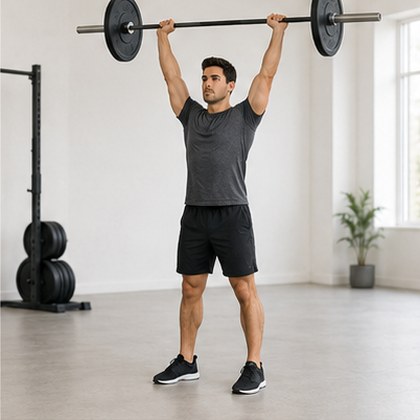 Standing barbell press
 Arnold press
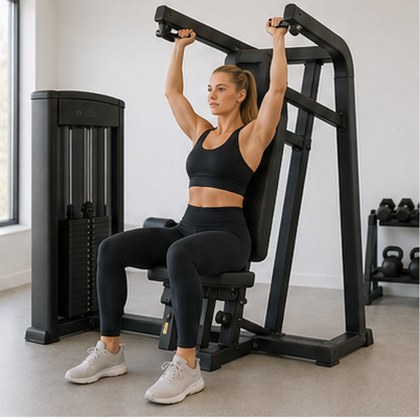 Machine shoulder press
Variations: neutral grip, single-arm, alternating, at home on a chair, in a Smith machine
The main version is two dumbbells, palms forward, on a bench with a back support. Every other variation changes either your grip, your support, or the order of your arms.
Neutral grip. The dumbbells are parallel, palms facing each other, and your elbows naturally move forward. This is usually easier on the shoulder, and people with a cranky shoulder often find this version pain-free where the regular grip "catches". Use the same weight or slightly less.
Single-arm. One dumbbell in one hand; the other hand holds the bench or rests on your thigh. Your torso gets pulled toward the working arm, and your obliques hold it in place. This is useful when one arm clearly lags behind: you train each arm separately and see the difference in reps.
Alternating. Both dumbbells at your shoulders; you press one while the other waits at your shoulder, then switch. Your shoulder stays under load longer, because holding the dumbbell at your shoulder is work too. Use a lighter weight than in the regular press, and count reps per arm.
At home on a chair. A chair with a back replaces the bench: sit deep so your lower back touches the backrest, feet on the floor. A chair back usually ends below your shoulder blades, so you hold your upper back yourself. On a stool or the edge of a bed there's no back support at all, and your lower back works as it would standing: use a lighter weight and watch your arch. If there's nowhere to sit, kneel: hips and torso in one line; your lower back works as it does standing, and the weight is lower. How to fit the seated press into a full home workout, where it's one of six core movements, is covered in our dumbbell workout at home.
In a Smith machine. The bar moves in a strictly vertical line, while in a free press it follows a slight arc. So set the bench so the bar travels in front of your face, an inch or so in front of your nose, and keep your feet from tucking under the bench. The advantage of the Smith machine is safety: you can rack the bar at any height. The downside is that the path is fixed, and your shoulder has to adapt to the machine.
On a stability ball or without a back support. According to Kohler's 2010 study from section 05, the weight you can lift on a ball goes down, with a barbell the spinal erectors work harder, and the authors themselves see little point in going lighter just to add instability. It doesn't work as your main way to press.
Mistakes: where you feel it → what to fix
A good seated dumbbell press feels like fatigue at the front and side of your shoulders toward the end of the set. If your lower back aches, the front of your shoulder feels a sharp pain, or your triceps give out first, your technique has drifted:
| Where you feel it | What's wrong | What to fix |
|---|---|---|
| Lower back, arch gets bigger toward the end of the set | hips slid away from the pad, ribs flared up, your back is holding the weight | press your hips into the pad, pull your ribs down, set the backrest to 75–80°, drop 1–2 kg (2–5 lb) per dumbbell |
| Sharp pain at the front of the shoulder along the pressing arc | elbows straight out to the sides, or dumbbells going below your shoulders | elbows 30° forward, neutral grip, lower only to ear level |
| Triceps tire before shoulders | elbows locking at the top, dumbbells too narrow | keep elbows soft at the top, bring the dumbbells close but not touching overhead |
| Neck and traps, shoulders up by your ears | shoulders rising with the dumbbells | set your shoulder blades down before the press and keep them there the whole set |
| Wrists, dumbbells tipping backward | wrist bent, the dumbbell pulling it toward the back of your head | wrist straight, directly over the elbow; use lighter dumbbells for a while |
| Elbows, a jolt at the bottom | dumbbells dropping onto your shoulders, bouncing | lower over 2–3 seconds, stop at ear level without touching your shoulders |
| One arm lags, dumbbells move out of sync | strength imbalance between arms | choose the weight for your weaker arm; use the alternating or single-arm version for a couple of weeks |
| Head pushing forward, dumbbells drifting behind your head | eyes on the floor, torso slumping | look straight ahead, back of your head to the pad, dumbbells over your shoulders |
| Dumbbells clanking at the top | arms swinging together from momentum | bring the dumbbells within 5–10 cm (2–4 in), pause half a second at the top |
| You can't feel your shoulders, everything works at once | weight too heavy, legs and torso helping | drop the weight by 20%, pause one second at the bottom, use the full range |
Why your lower back aches. Seated with a back support, your lower back should barely work. If it hurts, your hips have slid away from the pad, your arch has become too deep with a vertical backrest, or your torso is helping you grind out heavy dumbbells. The fix is the same for all three: hips against the pad, 75–80° angle, less weight.
Why your shoulder feels a sharp pain. Most often, your elbows have gone straight out to the sides and the dumbbells are coming down too low, so the rotator cuff tendons get cramped at the top of the shoulder joint. Elbows 30° forward, a neutral grip, and stopping at ear level usually get rid of it. If the pain stays even with light dumbbells, stop pressing and read section 11.
What weight to use: an 8-week plan for women and men
Women should start with 4 kg (9 lb) dumbbells and men with 8 kg (17.5 lb), 3 sets of 10 reps with 2–3 reps in reserve, adding reps first and then weight.
We take the progression rule from the ACSM 2009 position stand: a beginner needs a weight they can lift for 8–12 reps, and once they can do 1–2 reps more than the target, the weight goes up by 2–10%. ACSM released a new position stand in 2026, but the progression rule comes from the earlier one.
The shoulders come with a catch. The deltoid is a small muscle, so the dumbbells in a seated press are light, and the step between neighboring dumbbells is 1 kg, or even 2 kg in the heavier range. Going from 4 to 5 kg or from 8 to 10 kg means +25% at once, two and a half times the upper limit of the ACSM range. In gyms that use pounds, the jump is often bigger still: dumbbells usually go up in 5 lb steps, so moving from 10 to 15 lb adds 50%. That's why, in the plan below, reps drop back to 8 after every new dumbbell and then climb to 12 again. Only when you can do 12 clean reps in all three sets do you pick up the next dumbbell.
Day-one test. Take your starting dumbbells and do one set of 10 reps using the form from section 03. If all 10 are clean and you have 2–3 reps left, the weight is right. If you had to grind out the tenth rep with your torso, go one step lighter: 3 kg (6.5 lb) for women, 7 or 6 kg (15.5 or 13 lb) for men. At home, 1.5-liter water bottles can stand in for light dumbbells: that's about 1.5 kg (3.3 lb) per hand. If you're not even tired after 12 reps, go one step heavier and repeat the test.
Eight weeks of the seated dumbbell press in numbers. Two workouts a week, 3 working sets each. Tonnage is your training volume per session: sets × reps × combined weight of both dumbbells. For example, 3 sets × 10 reps × (2 × 4 kg) = 240 kg (529 lb).
| Week | Women | Tonnage | Men | Tonnage | What changed |
|---|---|---|---|---|---|
| 1 | dumbbells 2 × 4 kg (9 lb), 3 × 10 | 240 kg (529 lb) | dumbbells 2 × 8 kg (17.5 lb), 3 × 10 | 480 kg (1,058 lb) | start |
| 2 | 2 × 4 kg (9 lb), 3 × 12 | 288 kg (635 lb) | 2 × 8 kg (17.5 lb), 3 × 12 | 576 kg (1,270 lb) | +2 reps per set |
| 3 | 2 × 5 kg (11 lb), 3 × 8 | 240 kg (529 lb) | 2 × 10 kg (22 lb), 3 × 8 | 480 kg (1,058 lb) | weight +25%, reps back to 8 |
| 4 | 2 × 5 kg (11 lb), 3 × 10 | 300 kg (661 lb) | 2 × 10 kg (22 lb), 3 × 10 | 600 kg (1,323 lb) | +2 reps |
| 5 | 2 × 5 kg (11 lb), 3 × 12 | 360 kg (794 lb) | 2 × 10 kg (22 lb), 3 × 12 | 720 kg (1,587 lb) | +2 reps |
| 6 | 2 × 6 kg (13 lb), 3 × 8 | 288 kg (635 lb) | 2 × 12 kg (26.5 lb), 3 × 8 | 576 kg (1,270 lb) | weight +20%, back to 8 |
| 7 | 2 × 6 kg (13 lb), 3 × 10 | 360 kg (794 lb) | 2 × 12 kg (26.5 lb), 3 × 10 | 720 kg (1,587 lb) | +2 reps |
| 8 | 2 × 6 kg (13 lb), 3 × 12 | 432 kg (952 lb) | 2 × 12 kg (26.5 lb), 3 × 12 | 864 kg (1,905 lb) | +2 reps |
Over 8 weeks, training volume per session grows by 80% for both women (from 240 to 432 kg, or 529 to 952 lb) and men (from 480 to 864 kg, or 1,058 to 1,905 lb). In the weeks when you switch to a heavier dumbbell, tonnage drops back to roughly where it was two weeks earlier, and that's normal: after that it climbs again through reps.
This is a typical path, and none of it is a mandatory target. Shoulders gain strength more slowly than legs, which is why week 8 lands at just 6 and 12 kg (13 and 26.5 lb). The weight goes up only under three conditions: your lower back stays against the pad, your elbows stay slightly forward, and every set leaves 2–3 reps in reserve. If 12 clean reps don't happen in a given week, stay there for another week or two. The ranges in our home program — 5–10 kg (11–22 lb) for women and 8–16 kg (18–35 lb) for men — are working weights after the first few weeks; start your first session with 4 and 8 kg (9 and 17.5 lb).
In the Sportygram app (go.sportygram.com; the interface and the coach are in Russian for now), this plan fits into the workout diary: a plan by day, and you log sets and weight after each session, so the weight history shows when 12 clean reps have happened and it's time for the next dumbbell. If you had to skip a workout, you can ask the virtual coach, Alex, in chat to move it to Thursday, and he shifts that whole training day in the plan. If Thursday already has its own workout, Alex first asks with a card whether to keep both or replace it.
How many sets, reps and days per week
A beginner needs 3–4 sets of 8–12 reps with 2–3 minutes of rest, twice a week, and the shoulders need at least 10 sets a week in total, counting lateral raises.
The updated 2026 ACSM position stand pooled 137 systematic reviews and more than 30,000 participants. Four of its conclusions are worth taking for the seated dumbbell press:
- Volume. Muscles grow more with 10 or more sets per muscle per week. Two press sessions of 3 sets make 6, and you add 4 more sets of lateral raises on the same days: 2 workouts × (3 sets of presses + 2 sets of raises) = 10.
- Frequency. Strength improves more with two or more workouts a week.
- Equipment. The type of equipment didn't consistently affect muscle growth: dumbbells, barbell or machine — pick based on your shoulders and comfort.
- Failure. Training to failure didn't consistently change results, so leaving 2–3 reps in reserve costs you nothing.
Once or twice a week? Twice. In Schoenfeld's 2016 meta-analysis of 10 studies, training a muscle more often produced an effect size of 0.49 versus 0.30 for training it less often. The authors compared frequencies from 1 to 3 times a week at equal volume and concluded that two sessions a week beat one; there wasn't enough data on three. The advice to "hit shoulders once a week, but to failure" loses to two calmer sessions.
8 reps or 15? Both ranges work for shoulder size if the set ends close to failure. In Schoenfeld's 2017 meta-analysis of 21 studies, where all sets went to failure, light loads up to 60% of max and heavy loads above 60% produced the same muscle growth, while maximal strength improved more with heavy loads. For a beginner, 8–12 is more practical: with 15 reps and light dumbbells, form tends to fall apart toward the end of the set, and with 5–6 reps and heavy dumbbells, the shoulder isn't ready yet. How to choose a scheme for your goal is covered in our article on sets and reps.
Rest between sets — 2–3 minutes, longer than people usually suggest in gyms. In Schoenfeld's 2016 study, 21 trained men did 3 sets of 8–12 reps in seven exercises for 8 weeks, resting either 1 minute or 3 minutes. The 3-minute group gained more strength in the bench press and squat and more muscle thickness at the front of the thigh, with a trend in the same direction for the triceps. Advice like "70–90 seconds between sets" saves time, but in this study the short rest lost.
Where it goes in your workout. Make the press your first shoulder exercise, while your delts are fresh. If you're also benching that day, do the bench press first: the front delt works in both, and after the seated press you'll have less left for your chest. Lateral raises and face pulls come after the press.
What's next. After 8 weeks, change one thing at a time: the standing press, the alternating version, a one-second pause at the bottom, or the Arnold press as a second exercise. There's no need to add weight and reps at the same time.
Shoulders, lower back and elbows: safety, who should be careful and when to see a doctor
A healthy shoulder usually handles the seated dumbbell press without trouble, as long as your elbows travel slightly in front of your torso and the dumbbells come down to ear level.
In 2014, Kolber and colleagues examined 77 men, 154 shoulders, with an average age of 28: 46 of them lifted weights at least twice a week, and 31 did no strength training. Using two clinical tests, the painful arc and the Hawkins-Kennedy test, they looked for signs of impingement, meaning the tendons getting pinched in the shoulder joint. These signs were significantly more common in the lifters. They were linked to two exercises: lateral raises and upright rows above 90°, meaning above horizontal. And people who strengthened their external rotators had fewer signs. The authors didn't name the overhead press among the risky exercises. Three practical takeaways follow: stop lateral raises at shoulder height, don't pull upright rows above horizontal, and add external rotator work to your warm-up.
Warm-up before pressing. Two sets of 10 reps with empty hands through the full range, then 15 external rotations with a band: elbows tucked against your sides, bent to 90°, hands moving out to the sides. Then one set of presses with half your working weight. The general warm-up scheme before strength training is in our warm-up guide.
Lower back, elbows and wrists. Your lower back gets into trouble with a vertical backrest and a deep arch, and with heavy dumbbells that you grind up using your torso: 75–80° angle, hips against the pad, weight with reps in reserve. Your elbow suffers from locking out at the top and bouncing at the bottom, your wrist from the dumbbell tipping backward; what to do about these is in the table in section 08.
Who should be careful.
- A recent shoulder injury, dislocation or surgery. Return to pressing only with your doctor's approval and with light dumbbells, starting with a neutral grip and a range down to ear level.
- Pain along the pressing arc, especially between horizontal and vertical. That's exactly the sign Kolber's study looked for. While the pain is there, put the press aside.
- A herniated or bulging disc in your lower back during a flare-up. The bench back takes some of the work off your lower back, but during a flare-up the exercise still has to wait.
- High blood pressure. Holding your breath and straining for a long time raises blood pressure, so breathe steadily, keep reps in reserve, and check your program with your doctor.
- Pregnancy. Talk about the exercise with the doctor managing your pregnancy: usually the weight is reduced and rest is more frequent, and the seated press with light dumbbells is often kept.
When to see a doctor. Three signals:
- the pain came on suddenly, with a click or a pop, and your arm got weaker;
- the pain doesn't go away after 1–2 weeks of rest from shoulder exercises;
- your arm goes numb, tingles or loses strength.
According to Golshani's 2018 review, common upper-body injuries in lifters, from strains to chronic shoulder pain, can be prevented with proper technique and muscle balance, and they're usually treated without surgery: by changing your training, giving the area time to recover, and physical therapy. How to tell normal soreness from a real problem, and what to do in the first few days, is covered in our article on shoulder pain from lifting.
Questions and answers
What's better for your shoulders: the dumbbell press seated or standing?
For a beginner and for building muscle, seated. Standing, your shoulder muscles work harder — the rear delt by about a quarter and the side delt by 15% in Saeterbakken's 2013 study — but the heaviest weight you can press standing is 10% lower, and some of your effort goes into balance. Seated, you lift more and don't have to think about your lower back. Add the standing version as a second variation after a couple of months.
What muscles does the seated dumbbell shoulder press work?
The front and side delts, triceps, upper chest and upper traps. The front delt and traps work harder in the seated press than in the incline and flat presses (Luczak, 2013). The side delt gets the most load in lateral raises (Rabello, 2024), so the press and lateral raises go together.
How is the Arnold press different from the seated dumbbell press, and which should you choose?
In the Arnold press, the dumbbells start at chin height with your palms facing you and rotate as you press up. The range of motion is longer and the front delt stays under load longer, so people use a lighter weight. There are few reliable studies comparing the two. For a beginner: the regular press first, the Arnold press as a second exercise after a month or two.
How is the military press different from the seated dumbbell press?
The military press is a barbell, standing, pressed from the front of your shoulders. The triceps work 39% harder in it than with dumbbells standing (Saeterbakken, 2013), and your lower back holds your torso with no support. The "seated dumbbell military press" is just another name for the exercise in this article.
What bench angle should you use: 90 or 75 degrees?
For shoulders, 75–90°. Start at 75–80°: the delts work almost as much as at vertical, and your lower back stays calm. At 60°, the upper chest joins in, and at 45° and below you're doing an incline chest press (Rodríguez-Ridao, 2020).
What weight should a woman or a man start with?
Women: 4 kg (9 lb) dumbbells; men: 8 kg (17.5 lb), 3 sets of 10 reps with 2–3 reps in reserve. In our plan, by week 8 that becomes 6 and 12 kg (13 and 26.5 lb) for 3 × 12. If you can't do 10 clean reps with 4 kg (9 lb), use 3 kg (6.5 lb), and at home, 1.5-liter water bottles work for a start.
Can you do a seated dumbbell press at home without a bench?
Yes. A chair with a back replaces the bench; on a stool or the edge of a bed, your lower back works as it would standing, so use a lighter weight. You can also kneel. A stability ball gives you no advantage: the weight you can lift on it goes down, and the authors of that study advise against going lighter just for the instability (Kohler, 2010).
Why does my shoulder hurt or click during the seated dumbbell press, and what should I do?
Most often, your elbows have gone straight out to the sides and the dumbbells are coming down below ear level, so the tendons at the top of the joint get cramped. Elbows 30° forward, a neutral grip, range down to ear level, less weight. A painless click with no weakness is usually not a problem. Pain along the pressing arc that doesn't go away after 1–2 weeks of rest, sudden pain with a pop, or numbness in your arm are reasons to see a doctor.
The bottom line
- The seated dumbbell shoulder press means pressing two dumbbells up from your shoulders on a bench with the backrest at 75–90°: elbows about 30° in front of the line of your shoulders, lowering to ear level over 2–3 seconds, elbows soft at the top.
- The main muscle is the front delt, the side delt helps, and the triceps finish the rep; with a barbell, the front delt works 11–15% less than with dumbbells (Saeterbakken, 2013), and it works harder in the seated press than in the incline and flat presses (Luczak, 2013).
- Seated, your shoulders work a little less than standing, but the heaviest weight you can press standing is 10% lower, and seated your lower back is unloaded: for beginners and for building muscle, sit.
- A backrest at 75–80° is the working setting; at 60° the upper chest joins in, and 45° and below is the incline chest press (Rodríguez-Ridao, 2020).
- Start with 4 kg (9 lb) dumbbells for women and 8 kg (17.5 lb) for men, 3 × 10 twice a week. Reps climb to 12 first, then you move up one dumbbell (1 kg for women, 2 kg for men) and drop back to 8 reps (ACSM 2009 rule).
- Shoulders need at least 10 sets a week counting lateral raises, 2–3 minutes of rest, twice a week (ACSM, 2026; Schoenfeld, 2016).
- Sharp shoulder pain: elbows forward, neutral grip, range to ear level. Pain with a pop, numbness, or pain lasting more than 1–2 weeks: see a doctor.
Checklist: before a set of seated dumbbell presses
- Backrest at 75–90°, hips and lower back pressed against the pad.
- Feet flat on the floor, hip-width apart.
- Dumbbells kicked up from your thighs to your shoulders with your knees, one at a time.
- Elbows slightly in front of your torso, visible in your peripheral vision.
- Wrist directly over the elbow, the dumbbell not tipping back.
- Lowering over 2–3 seconds to ear level, no bouncing off your shoulders.
- Elbows soft at the top, dumbbells close but not clanking.
- Shoulder blades down, shoulders away from your ears.
- Weight chosen for your weaker arm, with 2–3 reps in reserve.
- Sets and weight logged in your diary.
Sources
- Saeterbakken A.H., Fimland M.S. Effects of body position and loading modality on muscle activity and strength in shoulder presses. Journal of Strength and Conditioning Research, 2013. — 15 men, 80% of max, barbell and dumbbells, seated and standing: seated with dumbbells, the side delt worked 15% less and the rear delt about 24% less than standing; the standing dumbbell max was 10% lower than seated and about 7% lower than the standing barbell max; with a barbell, the front delt worked 11–15% less than with dumbbells; triceps activity with a standing barbell was 39% higher than with dumbbells.
- Coratella G., Tornatore G., Longo S., Esposito F., Cè E. Front vs Back and Barbell vs Machine Overhead Press: An Electromyographic Analysis and Implications For Resistance Training. Frontiers in Physiology, 2022. — 8 bodybuilders, 80% of max, seated barbell press with the backrest at 80° and machine press: behind the neck, the side and rear delts worked harder, from the front, the chest; activation was higher with a barbell than in a machine; maxes of 82 kg from the front, 76 kg behind the neck, 95 and 87 kg in the machine.
- Luczak J., Bosak A., Riemann B.L. Shoulder Muscle Activation of Novice and Resistance Trained Women during Variations of Dumbbell Press Exercises. Journal of Sports Medicine, 2013. — 24 women, flat, incline and seated overhead dumbbell presses: the front delt and upper traps worked hardest in the seated press, the chest in the flat press; no difference between trained and novice women.
- Kohler J.M., Flanagan S.P., Whiting W.C. Muscle activation patterns while lifting stable and unstable loads on stable and unstable surfaces. Journal of Strength and Conditioning Research, 2010. — 30 trained people, seated barbell and dumbbell presses on a bench and a stability ball: the more unstable the setup, the lower the weight; the triceps worked hardest with a barbell on a bench; with a barbell on the ball, the upper spinal erectors worked harder.
- Rodríguez-Ridao D., Antequera-Vique J.A., Martín-Fuentes I., Muyor J.M. Effect of Five Bench Inclinations on the Electromyographic Activity of the Pectoralis Major, Anterior Deltoid, and Triceps Brachii during the Bench Press Exercise. International Journal of Environmental Research and Public Health, 2020. — 30 trained people, barbell press at 0–60° with 60% of max: the upper chest worked hardest at 30°, the front delt at 60°, the triceps the same at all angles; inclines above 45° raised delt activity and reduced chest activity.
- Kolber M.J., Cheatham S.W., Salamh P.A., Hanney W.J. Characteristics of shoulder impingement in the recreational weight-training population. Journal of Strength and Conditioning Research, 2014. — 77 men, 154 shoulders: signs of impingement were significantly more common in lifters; they were linked to lateral raises and upright rows above 90°; strengthening the external rotators was linked to fewer signs.
- Currier B.S., D'Souza A.C., Singh M.A.F. et al. American College of Sports Medicine Position Stand. Resistance Training Prescription for Muscle Function, Hypertrophy, and Physical Performance in Healthy Adults: An Overview of Reviews. Medicine & Science in Sports & Exercise, 2026. — 137 systematic reviews, more than 30,000 participants: for muscle growth, 10 or more sets per week and overload in the lowering phase; for strength, 2 or more workouts per week; equipment type, training to failure and time under tension didn't consistently change results.
- American College of Sports Medicine. Progression models in resistance training for healthy adults. Medicine & Science in Sports & Exercise, 2009. — Beginners should use a load for 8–12 reps, 2–3 workouts a week, a slow or moderate tempo (moderate means 1–2 seconds for lifting and for lowering); add 2–10% once 1–2 reps above the target are possible.
- Schoenfeld B.J., Grgic J., Ogborn D., Krieger J.W. Strength and Hypertrophy Adaptations Between Low- vs. High-Load Resistance Training: A Systematic Review and Meta-analysis. Journal of Strength and Conditioning Research, 2017. — 21 studies, sets to failure: light loads up to 60% of max and heavy loads above 60% produce the same muscle growth; strength improves more with heavy loads.
- Schoenfeld B.J., Pope Z.K., Benik F.M. et al. Longer Interset Rest Periods Enhance Muscle Strength and Hypertrophy in Resistance-Trained Men. Journal of Strength and Conditioning Research, 2016. — 21 trained men, 8 weeks, 3 × 8–12: with 3 minutes of rest, strength increased more than with 1 minute; muscle thickness increased more at the front of the thigh, with a trend for the triceps.
- Schoenfeld B.J., Ogborn D., Krieger J.W. Effects of Resistance Training Frequency on Measures of Muscle Hypertrophy: A Systematic Review and Meta-Analysis. Sports Medicine, 2016. — 10 studies: training a muscle more often produced an effect size of 0.49 versus 0.30; at equal volume, two sessions a week beat one; little data on three.
- Rabello R., Bertozzi F., Hauschild de Freitas I.L. et al. Activation of the three deltoid muscle portions during common strengthening exercises: A systematic review. Journal of Bodywork and Movement Therapies, 2024. — 33 studies with loads from 60% of max: the side delt worked hardest in abduction, the front delt in horizontal adduction, the rear delt in pull-ups and horizontal rows.
- Golshani K., Cinque M.E., O'Halloran P. et al. Upper extremity weightlifting injuries: Diagnosis and management. Journal of Orthopaedics, 2018. — A review of upper-body injuries in lifters: common injuries can be prevented with technique and muscle balance, and treatment is usually conservative.
This article is for informational purposes only and is not a substitute for medical advice.