

resistance bands build strength as well as dumbbells and machines. What matters is that the last 2–3 reps of each set feel hard. Train your whole body 2–3 times a week: 3 sets of 10–15 reps, with 30–60 seconds of rest.To start, you need a medium mini band and long loop bands ½, ⅞ and 1¼ inches wide (13, 22 and 32 mm). Bands have two weak spots: there's little tension at the start of each rep, and in squats your thighs work noticeably less than with a barbell. So shorten your grip, and add dumbbells for your legs over time.
Resistance band exercises are strength exercises where your muscles work against a stretched band instead of the weight of a dumbbell. Five moves cover your whole body: squats, seated rows, chest presses, overhead presses and glute bridges. Do them as a circuit 2–3 times a week: three rounds, 10–15 reps per exercise. Bands build strength as well as dumbbells and machines do: a review of eight studies found no difference.
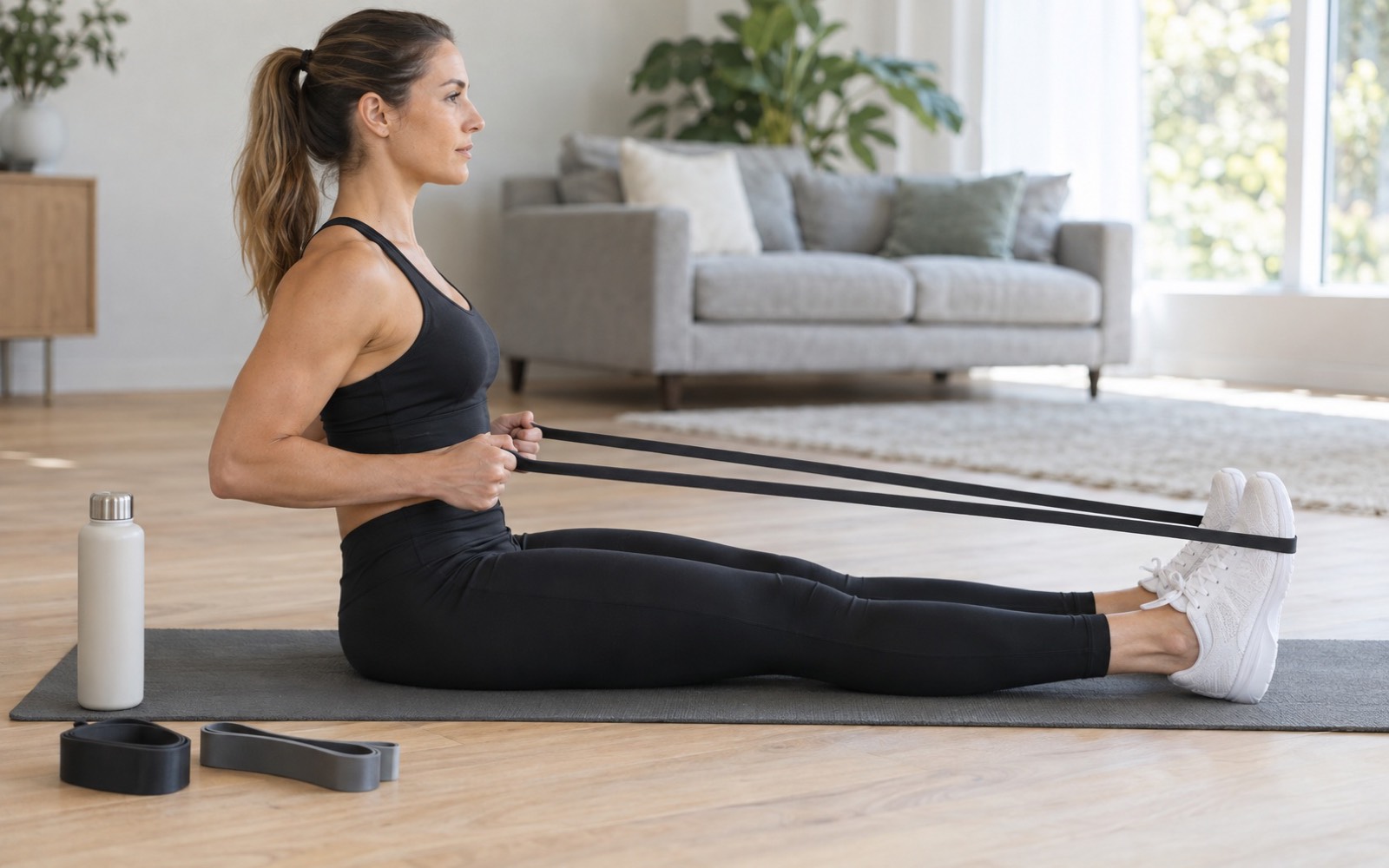
A 20-minute full-body resistance band workout: 5 exercises
If you want just one resistance band workout at home, start with this one. You don't need a door anchor: you stand on the band, wrap it around your back or loop it around your feet.
- Band squat: thighs and glutes. Loop band ⅞–1¼ in (22–32 mm), 3 sets of 12–15 reps.
- Seated rows: back. Loop band ½–1¼ in (13–32 mm), 3 × 12–15.
- Standing chest press, band behind your back: chest and triceps. Loop band ⅞–1¼ in (22–32 mm), 3 × 10–12.
- Standing overhead press: shoulders. Loop band ½–⅞ in (13–22 mm), 3 × 10–12.
- Glute bridge with a mini band: glutes. Medium mini band, 3 × 15–20.
Do them as a circuit: rest 30 seconds between exercises and one minute between rounds. Three rounds take about 20 minutes.
What bands do and how they compare to dumbbells
A band has no weight. The load comes from the stretch: the more you stretch the band, the harder it pulls back. At the start of a rep the band barely resists, and at the end the resistance peaks. A dumbbell weighs the same through the whole movement.
- Strength gains are the same. A review of eight studies found no difference in arm and leg strength gains between bands and dumbbells or machines, across different groups of people and different programs (source 1).
- Your muscles work just as hard. In similar exercises, measurements of muscle activity (EMG) found no difference between bands and regular weights (source 2).
- Muscles grow from light loads too. In a review of 21 studies, muscles grew equally with light and heavy weights, as long as every set was taken to failure, the point where you can't do another rep. Heavy weights built more maximal strength (source 4).
- Women got the same results as on machines. A study included 45 inactive middle-aged women: 21 trained with bands, 14 on machines and 10 didn't train at all. Both training groups worked out twice a week for 10 weeks. Whether they used bands or machines, they lost fat, gained lean mass and did more reps in push-up and squat tests (source 5).
Where bands fall short. In one study, 29 men and women did squats, stiff-legged deadlifts, one-arm rows and lat pulldowns, both with a band and with a barbell or cable machine. The barbell and cable machine worked the main muscles harder in all four exercises. The gap was small in one-arm rows and lat pulldowns, the band could only partly replace the barbell in stiff-legged deadlifts, and in squats the front of the thigh worked much less with the band. The gap showed up in the part of the movement where the band had little tension (source 3).
That gives you two rules. Get tension on the band from the very start of each rep: shorten your grip or step farther from the anchor. For legs, a band is a great way to start, but it won't replace a barbell. When squats get easy, move on to lunges and assisted single-leg squats, or pick up dumbbells.
Types of resistance bands and which ones to buy
Fitness bands come in three types:
- Mini band: a small loop about 12 inches (30 cm) long. It goes above your knees or around your shins and is used for glutes, hips and warm-ups.
- Long loop band: a closed loop 208 cm (82 inches) around, about 41 inches long when laid flat. This is your main band for squats, rows, presses and pull-ups. The wider the band, the more resistance it gives.
- Tube band with handles: a rubber tube with grips, often sold with a door anchor.
The same color can mean a different resistance from one brand to the next, so go by the width and the resistance printed on the package. The numbers in the table are approximate.
| Band | Resistance, approx. | Best for |
|---|---|---|
| Mini band, light | 5–10 lb (2–5 kg) | glute bridge, clamshell, warm-up |
| Mini band, medium | 10–20 lb (5–10 kg) | glute bridge, lateral band walks, standing hip abduction |
| Mini band, heavy | 20–35 lb (10–15 kg) | squats with the band above your knees, walks with the band around your shins |
| Loop band, ¼ in (6 mm) | 5–15 lb (2–7 kg) | band pull-aparts, face pulls, shoulder warm-up |
| Loop band, ½ in (13 mm) | 10–35 lb (5–16 kg) | biceps, triceps, overhead press, Pallof press, woodchop, seated rows for beginners |
| Loop band, ⅞ in (22 mm) | 25–65 lb (11–29 kg) | seated rows, chest press, squats for beginners |
| Loop band, 1¼ in (32 mm) | 35–85 lb (16–39 kg) | squats, Romanian deadlift |
| Loop band, 1¾ in (45 mm) | 50–125 lb (23–57 kg) | Romanian deadlifts and squats for stronger lifters |
Starter set: a medium mini band plus long loop bands ½, ⅞ and 1¼ inches wide (13, 22 and 32 mm). That covers every exercise in this article except pull-ups, and 6–12 months of progress. The whole set weighs under 2 lb (900 g). Choose a pull-up band separately, based on your body weight and the rule in exercise 8.
A band is the right one if the last 2–3 reps are hard but your form holds. If 15 reps feel easy, use a wider band or shorten your grip. If you can't do 10 clean reps, go lighter. Resistance band workouts for women and men use the same exercises. Pick your band by this rule, not by gender.
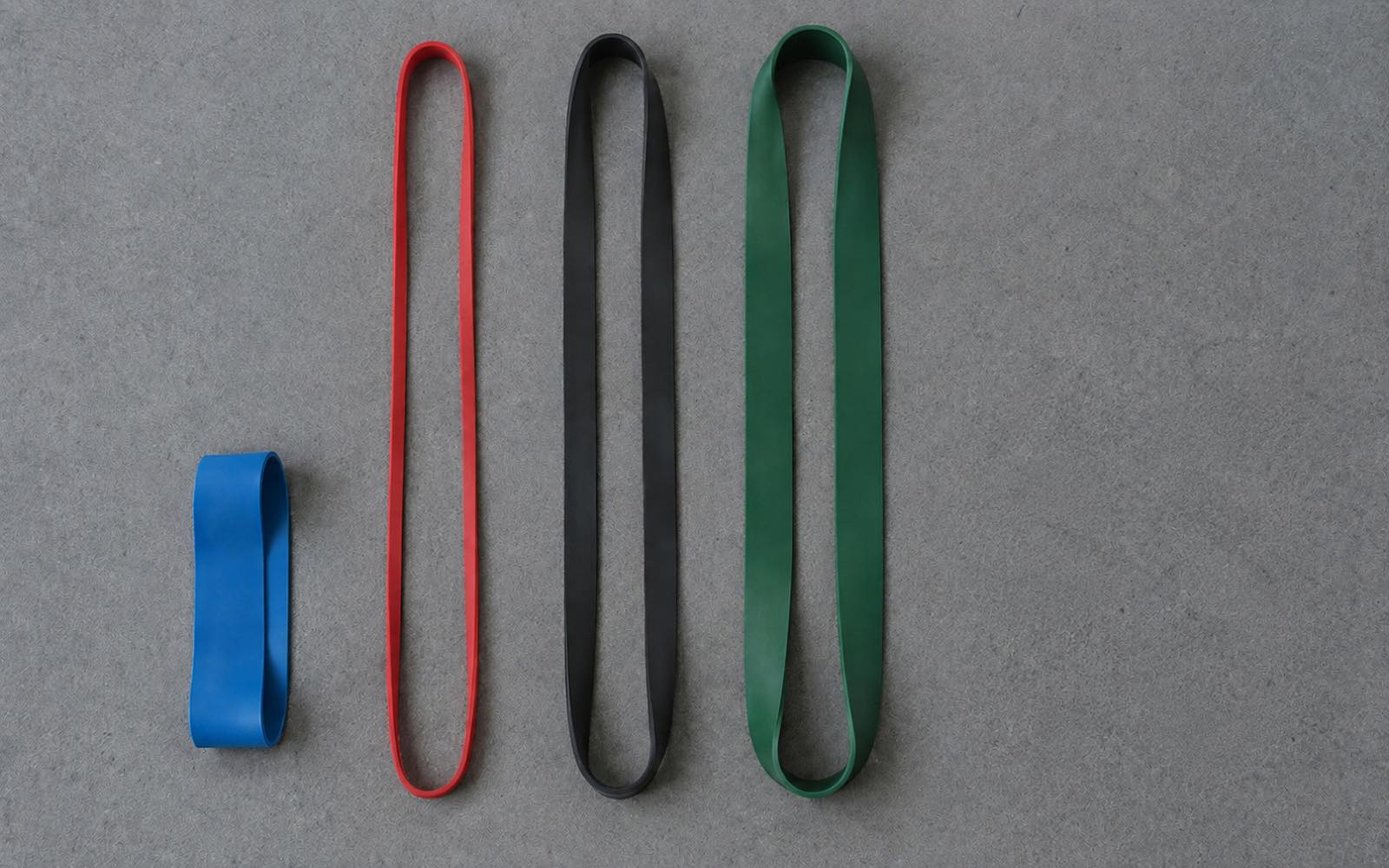
15 resistance band exercises by muscle group
When an exercise needs an anchor, loop the band over a pull-up bar, use a door anchor or wrap it around the leg of a heavy couch.
Legs and glutes
1. Band squat. Works the front of your thighs and your glutes. Stand on the band with your feet shoulder-width apart, bring the top of the loop over the back of your shoulders and hold it in place with your hands. Squat until your thighs are parallel to the floor, knees in line with your toes. Stand up, squeezing your glutes. Mistake: the band pulls your torso forward and your back rounds. 3 × 12–15, loop band ⅞–1¼ in (22–32 mm). Lower slowly, over 3 seconds, to keep your muscles under tension longer.
2. Glute bridge with a mini band. Works your glutes. Lie on your back, feet hip-width apart, band above your knees. Lift your hips while pressing your knees slightly out against the band, hold for 1–2 seconds and lower. Mistake: arching your lower back instead of lifting your hips, or letting your knees cave in. 3 × 15–20, medium mini band.
3. Standing hip abduction with a band. Works the side of your glutes. Put the band around your shins and stand sideways next to a wall or chair for support. Lift one leg out to the side and lower it slowly, toes pointing forward. Mistake: leaning your torso the other way or turning your toes out. 3 × 15 per leg, medium or heavy mini band.
4. Lateral band walks. Works the side of your glutes. Band above your knees or around your shins, half squat, toes forward. Take 10 steps to the right without letting the band go slack, then 10 to the left. Mistake: bringing your feet together so the band goes slack, or rising out of the half squat. 3 sets of 10 steps each way, medium mini band.
5. Romanian deadlift with a band. Works your hamstrings and glutes. Stand on the middle of the band with the ends in your hands, arms hanging down, knees slightly bent. Push your hips back and lean forward with a flat back until you feel a stretch in the back of your thighs, then stand up. Mistake: rounding your back or bending your knees as if you were squatting. 3 × 12–15, loop band ⅞–1¾ in (22–45 mm).
Back
6. Seated row. Works your lats and mid-back. Sit on the floor with your legs straight and the band looped around your feet. Pull the ends toward your stomach, elbows close to your body, squeezing your shoulder blades together. Mistake: rocking your torso and pulling with your arms instead of your back. 3 × 12–15, loop band ½–1¼ in (13–32 mm).
7. Face pull. Works your rear shoulders and the muscles between your shoulder blades. Anchor the band at face height and hold the ends with your arms straight. Pull toward your face with your elbows out and higher than your hands, and pause for a second. Mistake: elbows below your hands, shoulders creeping up toward your ears. 3 × 15, loop band ¼–⅞ in (6–22 mm).
8. Band-assisted pull-up. Works your lats and biceps. Loop the band over the bar and pull it through itself so it tightens. Put one foot in the loop, pull up until your chin clears the bar and take 2–3 seconds to lower. Mistake: the band is too thick and launches you up, or too thin and you only get half a rep. 3 × 5–8. The right band lets you do 5–8 clean reps. How to pick one by body weight is covered in our guide to your first pull-up.
Chest and shoulders
9. Standing chest press, band behind your back. Works your chest, triceps and front shoulders. Wrap the band around your back just below your shoulder blades and hold the ends at your chest. Step forward with one foot and press your arms straight out in front of you. Mistake: shoulders rolling forward, lower back arching. 3 × 10–12, loop band ⅞–1¼ in (22–32 mm). When that gets easy, do push-ups with the band across your back.
10. Band pull-apart. Works your rear shoulders and the muscles between your shoulder blades. Hold a light band in front of your chest with your arms straight. Pull your arms apart until the band touches your chest, shoulder blades squeezed together. Mistake: bending your elbows or shrugging. 3 × 15–20, loop band ¼–½ in (6–13 mm).
11. Standing overhead press. Works your shoulders and triceps. Stand on the band with the ends at your shoulders, palms facing forward. Press up until your arms are straight, then lower back to your shoulders. Mistake: arching your lower back. 3 × 10–12, loop band ½–⅞ in (13–22 mm).
Arms
12. Biceps curl. Works your biceps. Stand on the band, palms up, elbows tucked to your sides. Curl your hands up to your shoulders and lower slowly. Mistake: your elbows drift forward or you swing your torso. 3 × 12–15, loop band ½–⅞ in (13–22 mm).
13. Overhead triceps extension. Works your triceps. Stand on the band with one foot, run the ends up behind your back and grab them behind your head, elbows pointing up. Straighten your arms overhead, then bend them back. Mistake: your elbows flare out. 3 × 12–15, loop band ½–⅞ in (13–22 mm).
Abs and core
14. Pallof press. Works your obliques and deep core muscles. Anchor the band at chest height and stand with your side to the anchor. Press your arms straight out in front of you, hold for 2 seconds and bring them back to your chest. Mistake: letting your hips or shoulders turn, or holding your breath. 3 × 10 per side, loop band ½–⅞ in (13–22 mm).
15. High-to-low woodchop. Works your obliques and the front of your abs. Anchor the band up high and hold it with both hands above one shoulder. Pull diagonally toward the opposite knee, turning your torso. Mistake: pulling only with your arms or rounding your back. 3 × 12 per side, loop band ½–⅞ in (13–22 mm).
No door? Loop the band around the leg of a heavy couch. Do the Pallof press kneeling, and do the woodchop low to high, from your knee to the opposite shoulder.
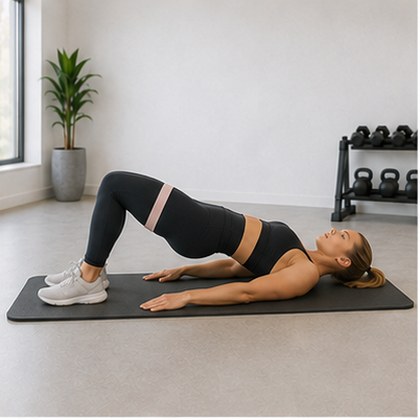 Band glute bridge, women
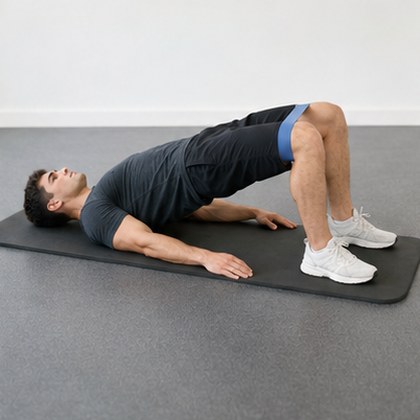 Band glute bridge, men
Three resistance band workout plans by day
Beginners should aim for 2–3 full-body strength workouts a week (source 6), with a rest day in between. Pick the one plan that fits your goal; don't do all three at once.
20 minutes at home: full body, 3 times a week
| Day | What to do | Sets and reps | Rest |
|---|---|---|---|
| Monday | circuit: squats → seated rows → chest press → overhead press → glute bridge | 3 rounds of 12–15 reps, presses 10–12 | 30 seconds between exercises, 60 between rounds |
| Wednesday | the same circuit, with Romanian deadlifts instead of squats and face pulls instead of overhead presses | 3 rounds of 12–15 | the same |
| Friday | Monday's circuit | 3 rounds of 12–15 | the same |
- Weeks 1–2: a light band while you learn the form.
- Weeks 3–4: a thicker band or a shorter grip.
- Weeks 5–6: a fourth round (the workout will take about 27 minutes), or a 2-second pause at the hardest point.
- After that: keep progressing with the steps in section 06.
Glutes: 2–3 times a week
| Day | Exercises | Rest |
|---|---|---|
| Monday (A) | glute bridge with a mini band 3 × 15–20 → standing hip abduction 3 × 15 per leg → lateral band walks 3 × 10 each way → Romanian deadlift 3 × 12 | 45 seconds |
| Thursday (B) | squats with a mini band above your knees 3 × 15 → single-leg glute bridge 3 × 10 per leg → clamshell 2 × 20 per side → band kickback 3 × 15 per leg | 45 seconds |
| Saturday, optional | day A | 45 seconds |
How to do the new moves on day B. Mini band squats: band above your knees, squat with no weight and don't let your knees cave in. Clamshell: lie on your side with your knees bent and open your top knee without separating your feet. Single-leg bridge: a regular bridge, but push through one foot with your other leg straight out. Kickback: band around your shins, move your straight leg back without arching your lower back.
To build noticeably bigger glutes, you'll need weights over time. More in our guide on how to grow your glutes.
Back and posture: 3 times a week, 15 minutes
| Day | Exercises | Rest |
|---|---|---|
| Monday, Wednesday, Friday | seated row 3 × 15 → face pull 3 × 15 → band pull-apart 3 × 20 → Pallof press 2 × 10 per side | 30–45 seconds |
| 5-minute desk break, any day | band pull-apart 2 × 20 + face pull with the band anchored on a door 2 × 15 | no rest |
How to progress with resistance bands without dumbbells
Going up one band width adds several pounds of resistance, and with the thickest bands 20 lb or more. For many exercises that jump is too big, so progress in steps, from easiest to hardest:
- A shorter grip, or a step farther from the anchor. The band is already tight at the start of the rep.
- A heavier band. The next width up.
- Two bands at once. For example, ½ in and ⅞ in (13 and 22 mm) together.
- Slow lowering. Take 3 seconds on the way back.
- A pause. Hold for 2 seconds where the band is stretched the most.
- One leg or one arm. A single-leg bridge, a single-arm row.
- Less rest. Two exercises back to back with no break.
If you did 15 reps and had 2–3 more in you, move to the next step. Change one thing at a time. More on this in our guide to progressive overload.
log not just your reps but also the band width and grip, like "⅞ in band, grip one hand-width shorter." That's your version of the number on a dumbbell. In a month, your progress will show up in your log.
Common mistakes and safety
These are the mistakes people make most often:
- The band is too light. Sets feel easy, and your muscles have nothing to grow from.
- The band yanks your arms back. Release it more slowly than you pull.
- The band is slack at the start of the rep. Shorten your grip.
Check your band before every workout. With regular use, replace it every 1–2 years, and right away if you see a nick or a worn spot. Shut the door firmly over the anchor and lock it if you can. Stand on the side where the door opens away from you, so pulling on the band presses it into the frame. Before face pulls, check the anchor extra carefully: if the band slips loose, it will fly straight at your face.
Sharp joint pain, a painful click, swelling or pain that lasts several days are signs to stop and see a doctor. If your lower back hurts, skip Romanian deadlifts and woodchops until you've talked to a doctor. For what to do about that kind of pain, see our guide to exercises for lower back pain.
How to track your band workouts
If you track training in the Sportygram app, log your sets and reps in the workout log. Four exercises from this article are already in the app's exercise library, with photos for men and women: the band glute bridge, standing band hip abduction, the clamshell and band biceps curls. Add them to today's workout. If your day falls apart, move today's workout to tomorrow in your workout log instead of dropping it.
FAQ
Which resistance bands should a beginner buy?
Get a medium mini band and three long loop bands: ½, ⅞ and 1¼ inches wide (13, 22 and 32 mm). That covers every exercise in this article except pull-ups, and 6–12 months of progress. Choose by the width and the resistance on the package, not by color: the same color means different resistance from brand to brand.
Can you grow your glutes with resistance bands?
At first, yes. Muscles grow from light loads too, as long as you take sets to failure, the point where you can't do another rep. When 20 bridges with a heavy mini band feel easy, move to single-leg bridges and pauses. After that, you'll need dumbbells or a barbell to keep growing, and bands stay in your warm-up.
How many times a week should you do resistance band workouts?
As a beginner, 2–3 full-body workouts a week with a rest day between them is enough. Three short 15–20 minute sessions work too. You don't need to load the same muscles every day, but a 5-minute back routine at your desk is fine on any day.
Are resistance bands better than dumbbells?
Strength gains are the same, according to a review of eight studies. Dumbbells give you exact weights and load the muscle evenly through the whole rep, while a band has little tension at the start. In the study comparing bands with a barbell, that mattered most in squats. Bands are lighter, quieter and fit in a bag, so using both works best. See our dumbbell workout at home.
Can you lose weight with resistance bands?
Bands don't burn fat on their own: you lose weight only when you eat less than you burn. Strength training helps you keep your muscle while you lose weight. So bands help alongside your diet, not instead of it. How many calories to cut is explained in our guide on how to calculate a calorie deficit.
Can you use resistance bands if your knees hurt?
Bands don't treat knee pain, and only a doctor can tell you whether it's safe to train with it. See one before you start, especially if your knee swells, clicks painfully or has hurt for several days. Show your doctor the exercise list from this article and ask which ones are right for you. If your knee starts to hurt during a set, stop.
How do you work out with bands without a door or pull-up bar?
Eleven of the 15 exercises need no anchor. You stand on the band for squats, Romanian deadlifts, overhead presses and arm exercises. It wraps around your back for the chest press, loops around your feet for seated rows, goes around your legs for glute exercises, and for band pull-aparts you just hold it in your hands. For the Pallof press, use the leg of a heavy couch.
The bottom line
- Bands build strength as well as dumbbells. The last 2–3 reps of every set should feel hard.
- Five exercises 2–3 times a week cover your whole body: squats, seated rows, chest presses, overhead presses and glute bridges.
- To start, get a medium mini band and loop bands ½, ⅞ and 1¼ in (13, 22 and 32 mm) wide. Choose by width, not by color.
- The weak spots of bands are the start of each rep and squats: shorten your grip, and add dumbbells for your legs over time.
- Progress one step at a time: grip, band, two bands, tempo, pause, one leg, less rest.
Checklist: before every resistance band workout
- Inspect the band: no nicks or worn spots.
- Check the anchor: the door is shut tight and opens away from you, and the couch doesn't slide.
- Put the band under your whole foot, not just your toes.
- Warm up for 3–5 minutes with your lightest band.
- Get tension on the band from the start of each rep, and never let it snap back.
- Make the last 2–3 reps hard while your form holds.
- Log the band width, your grip and your reps.
Sources
- Lopes J. S. S. et al. Effects of training with elastic resistance versus conventional resistance on muscular strength: a systematic review and meta-analysis. SAGE Open Medicine, 2019. — Eight studies: arm and leg strength gains with elastic bands were the same as with machines or dumbbells.
- Aboodarda S. J., Page P. A., Behm D. G. Muscle activation comparisons between elastic and isoinertial resistance: a meta-analysis. Clinical Biomechanics, 2016. — Muscle activation with elastic bands and with regular weights did not differ.
- Iversen V. M. et al. Multiple-joint exercises using elastic resistance bands vs. conventional resistance-training equipment: a cross-over study. European Journal of Sport Science, 2017. — 29 men and women, four exercises: a barbell and a cable machine activated the main muscles more than a band; the gap was small in one-arm rows and lat pulldowns and large in squats, and it came where the band had little tension.
- Schoenfeld B. J. et al. Strength and hypertrophy adaptations between low- vs. high-load resistance training: a systematic review and meta-analysis. Journal of Strength and Conditioning Research, 2017. — 21 studies with sets taken to failure: muscles grew equally with light and heavy weights, while maximal strength grew more with heavy ones.
- Colado J. C., Triplett N. T. Effects of a short-term resistance program using elastic bands versus weight machines for sedentary middle-aged women. Journal of Strength and Conditioning Research, 2008. — 45 inactive middle-aged women: 21 trained with bands, 14 on machines and 10 didn't train, twice a week for 10 weeks. Both training groups lost fat, gained lean mass and did more reps in push-up and squat tests.
- American College of Sports Medicine. Progression models in resistance training for healthy adults. Medicine & Science in Sports & Exercise, 2009. — Beginners: 2–3 strength workouts a week.
This material is for informational purposes and does not replace medical advice. If you feel sharp joint pain during exercise, notice swelling or have pain that doesn't go away for several days, see a doctor.