

keep your torso upright. At the stretch you can lean forward 10–15°, but don't lean back — in Park and Kim's 2022 study, leaning back 20° made the upper traps work almost three times harder, 41.96% versus 15.36% of maximum. Pull the handle to your waist with your elbows close to your sides. A close grip loads the lats harder (Padovan, 2026), and a wide grip with elbows flared shifts the work to the traps and rear delts (Vasconcelos, 2023).Starting point: 15 kg (33 lb) for women and 30 kg (66 lb) for men, 3 sets of 10 twice a week with 2–3 reps left in the tank. Over our 8-week plan, training volume per session grows by 80% for women and 50% for men.
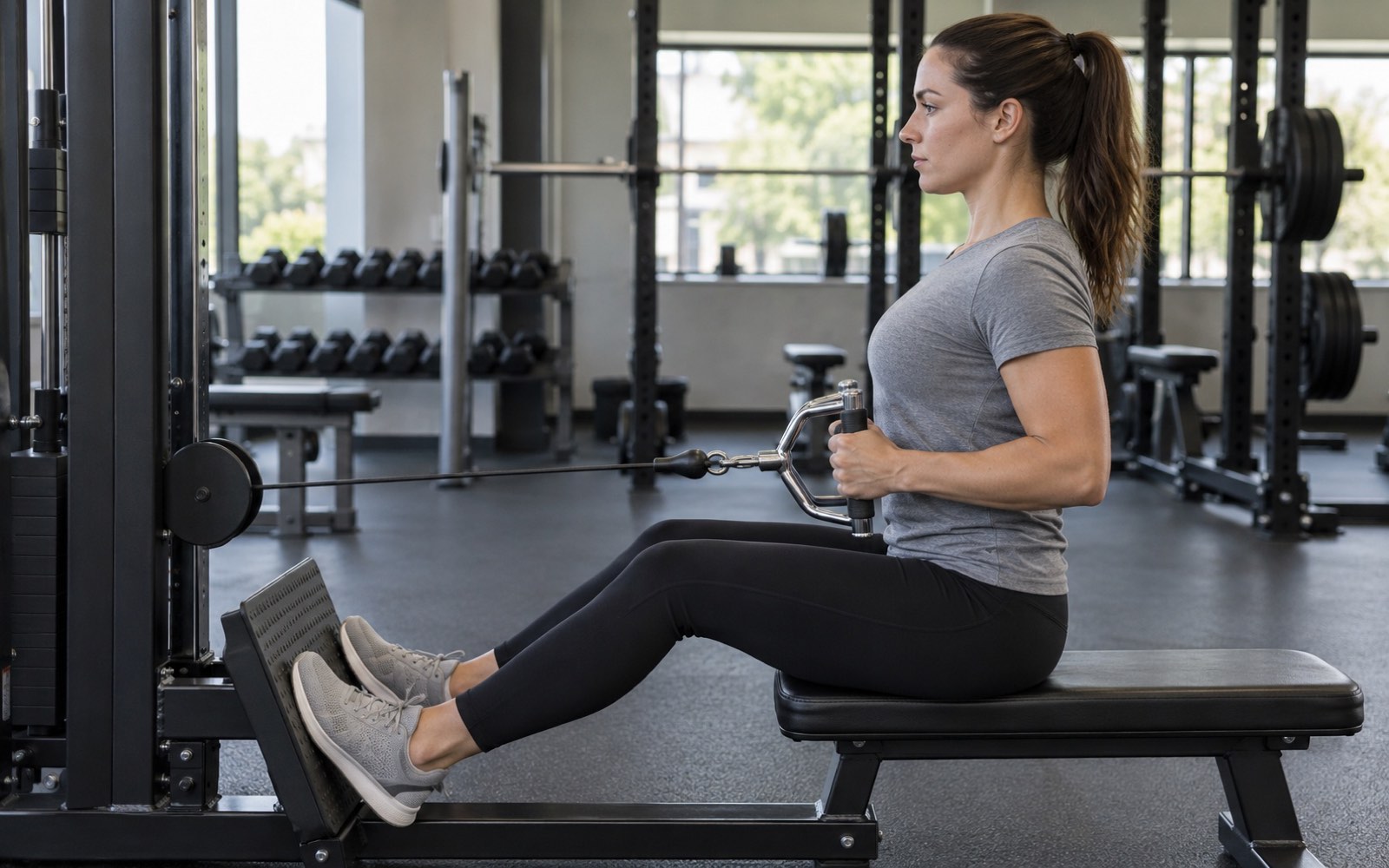
A seated cable row is a pull toward your waist while you sit facing the machine, with the cable running parallel to the floor, your feet braced against a footplate and your back staying still. You pull the handle to your stomach, driving your elbows back along your sides, then let your arms return forward under control until they're straight. Your lats and the muscles between your shoulder blades do most of the work, and your biceps and rear delts help. A beginner is fine with 3 sets of 10–12 reps twice a week. Start with 15 kg (33 lb) on the stack if you're a woman and 30 kg (66 lb) if you're a man, and check the exact weight with your first set: the same number can feel different on different machines.
What a seated cable row is and what muscles it works
A seated cable row is a foundational back exercise: you sit facing the weight stack and pull a handle to your waist along a cable that runs parallel to the floor. The same lift is called a seated row, a cable row or a low row, because the cable comes out of the low pulley. You can do it on a dedicated row station with a footplate, or on the low pulley of a cable crossover with a bench in front of it.
It works the whole back of your torso above the lower back. Your arms transmit the force, and your back does the main job: your shoulder blades move back toward your spine, your upper arm extends, and your elbows travel back until they reach the line of your torso.
| Muscle | What it does in the row | Where you feel it |
|---|---|---|
| Latissimus dorsi (lats) | pulls the upper arm down and back, especially with elbows close to your sides | along the sides of your back under the armpits, down toward your lower back |
| Middle and lower traps, rhomboids | draw the shoulder blades toward the spine and keep them down | between your shoulder blades |
| Rear deltoid | pulls the upper arm back, more so with elbows flared | the back of your shoulder |
| Teres major | helps the lats extend the upper arm | at the lower edge of the shoulder blade, near the armpit |
| Biceps, brachialis and brachioradialis | bend the elbow | the front of your upper arm and forearm |
| Spinal erectors | hold your torso upright | mild tension along the lower back |
| Forearm muscles | hold the handle | hands and forearms as the weight climbs |
The middle back works harder here than in a pulldown. In 2004, Lehman and colleagues compared the seated row and the lat pulldown in 12 men with more than six months of training. The weight was set so that each person could do 10–12 reps to failure in the overhand pulldown, and muscle activity was recorded while each person held the handle in the pulled position for 10 seconds. The middle traps and rhomboids worked at 30–36% of maximal effort in the seated row and at 21–23% in the pulldown, although the difference was statistically significant only against the underhand pulldown. The lats were also more active in the seated row: 30–37% versus 22–26%. Biceps activity was the same across all variations, and by the ratio of lat work to biceps work, the seated row ranked among the best exercises along with the wide-grip pulldown.
The busiest muscle is the trapezius. In 2024, a Spanish team led by Taboada-Iglesias measured the low cable row in 12 men using three grips at three widths, and of the four muscles they recorded, the trapezius was the most active. That's why the spot between your shoulder blades is usually what aches after your first few sessions.
Seated row, low row, cable row: one exercise. Different gyms use different names for the same lift, and all of them mean the horizontal pull to your waist. The lift people most often mix it up with is the lat pulldown, where you sit under a thigh pad and pull the bar down from above to your chest. That's a vertical pull, and we break down its form in our lat pulldown guide. The plate-loaded "seated row machine" with a chest pad is a close relative, covered in section 06.
How to do a seated cable row: step by step
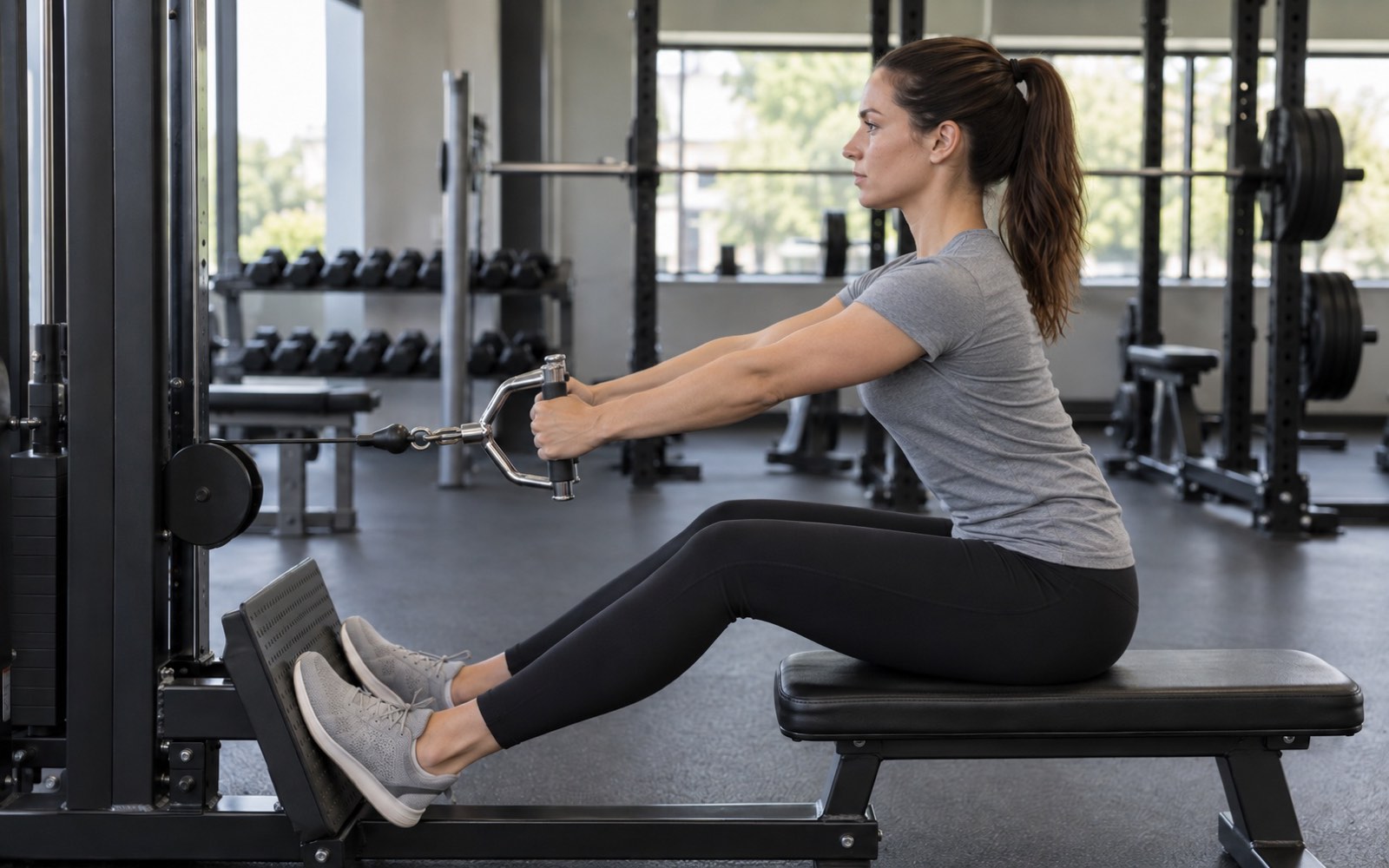
Sit down, brace your feet, grab the handle, sit tall, and pull it to your waist with your elbows traveling along your sides until the handle touches your stomach; then return your arms to straight without letting the weight rest. Step by step:
- Setup. If the seat adjusts, set it so that the cable runs to your stomach roughly parallel to the floor at the end of the pull. Place your feet on the footplate hip-width apart. Keep your knees slightly bent: that way your lower back doesn't round when you reach for the handle.
- Picking up the handle. Sit down and brace your feet first, then lean forward with a flat back and take the handle. Straighten up with your legs and torso together, so your lower back alone isn't dragging the weight off the stack.
- Starting position. Torso upright, chest slightly forward, abs lightly braced. Arms straight, cable taut, and the plate you're lifting hangs clear of the rest of the stack. Drop your shoulders down, away from your ears.
- Starting the pull. The first few centimeters come from your shoulder blades: draw them slightly back and down while your arms are still almost straight. This way your back switches on before your arms do.
- The pull. Drive your elbows back along your sides, as if you're trying to tuck them into your back pockets. Your hands just hold the handle, wrists straight.
- Touch point. The handle reaches your stomach between your belly button and your lower ribs. At this point your elbows are in line with your torso or slightly behind it. There's no need to take them further.
- Pause. Hold the top position for one second, shoulder blades squeezed, shoulders down.
- Lowering. Let your arms travel forward over 2 seconds until they're fully straight. At the end you can let your shoulder blades slide forward. The weight shouldn't touch the stack until the set is done.
- Breathing. Breathe in before the pull or at the stretch, and breathe out as you pull toward you. With a light weight, breathe freely; the main thing is not to hold your breath through the whole set.
The 2009 American College of Sports Medicine (ACSM) position stand recommends a slow-to-moderate tempo for beginners. Moderate means 1–2 seconds on the way up and the same on the way down.
How to end a set. Don't let go of the handle from straight arms, or the stack will slam down and the cable will yank your shoulders forward. Lean forward, let the weight settle gently onto the stack, and only then release the handle or set it on the footplate.
Where to look. Straight ahead. If you look down at the handle or lift your chin toward the mirror, your neck tenses up before your back does.
for the first 3–4 reps of every set, think about your back: "elbows back into my pockets." In Fujita's 2020 study, 20 people with almost no gym experience did seated rows to failure, once with a cue to focus on their back muscles and once without it. With the cue, the lats worked 15.21% harder on the first reps, and by the last reps the difference disappeared. So after the first few reps, shift your attention to a steady torso and low shoulders.
How far to lean back and how to hold your back
Keep your torso upright: at the stretch you can lean it forward 10–15°, then bring it back to vertical as you pull, and don't go past vertical.
We didn't find any studies comparing torso angles in a regular seated row with repetitions, but there is one on what happens to the trapezius at different torso positions. In 2022, Park and Kim measured it in 23 adults, 11 men and 12 women. One caveat: these were 5-second holds at 65% of maximum in a modified close-grip row, with no reps.
| Torso position | Upper traps | Middle traps | Lower traps | What it means for you |
|---|---|---|---|---|
| Upright, 0° | 15.36% | 60.82% | 49.85% | the middle back works, your neck and upper shoulders rest |
| Leaning forward about 30° | 16.12% | 59.48% | 61.47% | the lower traps work hardest; this is a rehab setup, and we don't carry it over to regular rows |
| Leaning back 20° | 41.96% | 51.77% | 36.71% | the upper traps work almost three times harder, the middle and lower traps less, hence "shoulders to ears" and a tired neck |
| Rocking on every rep | not measured | not measured | not measured | mechanically, part of the weight is pulled by your lower back and torso momentum, and your back does less |
The numbers are percentages of maximal effort. When leaning back, the ratio of upper to lower trap activity rose to 1.20, the highest in the study. The ratio of upper to middle traps rose from 0.30 with the torso upright to 0.84. Put simply, when you lean back, the muscles that lift your shoulders toward your ears take over, and the muscles between your shoulder blades lose load.
Why rocking gets in the way. When your torso swings forward and back on every rep, the handle picks up speed from the lean. The weight reaches your stomach even when your back can no longer handle it. If you can't finish the last rep without rocking, the weight is a bit too heavy: take off 5 kg (11 lb).
Leaning forward at the stretch. Leaning your torso forward 10–15° as your arms straighten is fine and even comfortable: your shoulder blades slide further forward and your back gets a bigger stretch. There's one condition: your lower back keeps its natural arch. If you have to round your back to reach, the lean is too deep or the seat is too far from the footplate.
Shoulder blades: squeeze or let them move
Both approaches work, and the difference between them is small. Pick the one where you feel your back better.
In Lehman's 2004 study, actively squeezing the shoulder blades together didn't significantly increase middle trap activity.
In 2025, Padovan and colleagues compared two setups in 14 trained men: shoulder blades held squeezed for the whole set, and shoulder blades moving freely forward. With the blades squeezed, the lats worked 6.83% harder on the lowering phase, the middle traps 3.72% harder, and on the pulling phase the rear delts 4.37% harder. The spinal erectors and biceps showed no difference. The authors' takeaway: overall muscle activity is comparable; squeezed shoulder blades add work for the muscles that stabilize the upper back, and free shoulder blades give the blades themselves more range of motion.
For a beginner, this is usually easiest: shoulder blades squeezed at the top, and at the stretch you can let them slide forward, as long as your lower back doesn't round. If your shoulders "fall forward" at the stretch and pull on your neck, keep your shoulder blades set for the whole set.
Grips and handles: close, wide, neutral or underhand — which to choose
A close grip with your elbows at your sides loads the lats harder and lets you lift more; a wide grip with your elbows flared shifts the work to the traps and rear delts; and underhand and neutral grips add more biceps.
What the measurements show. In 2023, Vasconcelos and colleagues tested 11 men and 10 women with at least a year of training. They compared overhand, underhand and neutral grips with the elbows at the sides, plus grips with the upper arm flared out to 30°, 60° and 90°, all with the torso upright. Strength was higher with the elbows at the sides and dropped as the arms flared to 60–90°. The lats worked harder with the elbows close to the body, and the traps and rear delts worked harder with the arms flared. Among the row variations, the biceps kicked in more with underhand and neutral grips and with the upper arm flared to 90°.
In 2026, Padovan and colleagues compared a close grip and a wide grip in 14 trained men, using a weight they could lift for 8 reps to failure. With the close grip, the lats worked harder in both phases, with an effect size of 1.08: by the standards of this kind of measurement, that's a large difference. With the wide grip, the whole trapezius and the middle deltoid worked harder.
| Handle and grip | Lats | Traps and rhomboids | Rear delt | Biceps | Strength | Source |
|---|---|---|---|---|---|---|
| V-bar or another close grip, palms facing each other | harder than with a wide grip | moderate | less | a lot | high | Padovan 2026, Vasconcelos 2023 |
| Two separate D-handles or a parallel-grip bar, neutral grip | working, no significant differences between grips | middle traps highest with a grip 1.5 times shoulder width | rises with width, highest at twice shoulder width | highest at shoulder width | high | Taboada-Iglesias 2024, Vasconcelos 2023 |
| Straight bar, overhand grip at shoulder width, to the waist | a lot, elbows at your sides | moderate | moderate | less than with underhand and neutral | high | Vasconcelos 2023 |
| Straight bar, underhand grip at shoulder width | working; Taboada-Iglesias found the most with a wide underhand grip, but the difference wasn't significant | moderate | moderate | a lot | high | Vasconcelos 2023, Taboada-Iglesias 2024 |
| Straight bar, wide overhand grip, to the chest, elbows flared 60–90° | less | the most, especially the upper and middle portions | the most | a lot at 90° | lower | Vasconcelos 2023, Padovan 2026 |
| Rope | not measured; mechanically, your hands rotate at the end and your elbows drift slightly apart | not measured | not measured | not measured | usually less weight because of the grip | mechanics only |
| One D-handle, single arm | no measurements for the back muscles | not measured | not measured | not measured | less weight per side | Saeterbakken 2015, for the core muscles |
The bottom line on the lats. In Taboada-Iglesias's 2024 study, lat activity didn't differ significantly across nine grip variations, and in Lehman's 2004 study the differences between variations were also small. Di Fonza's 2026 review of 23 studies sums it up this way: in the seated row, a close grip and elbows closer to the body are each linked to more lat activity in individual studies, although nobody has yet tested the two together; flaring the arms to 60–90° adds traps and rear delts; and actively squeezing the shoulder blades doesn't increase lat activity. For you, this means your lats work with any grip. The grip mainly changes how much your upper back gets and how much your biceps take on.
Handles in brief:
- V-bar — the standard choice for a beginner: your elbows naturally travel along your sides, and you can lift the most weight.
- Two D-handles — a neutral grip at shoulder width with your hands free to move. Handy if the V-bar puts pressure on your wrists.
- Straight bar, overhand grip — less biceps. A good pick if your arms tire first.
- Straight bar, underhand grip — the biceps work harder; if the inside of your elbow starts aching, go back to a neutral grip.
- Rope — easy on the hands, but you'll lift less with it: a thick rope is harder to hold on to.
How to choose. For the first 4–6 weeks, row with a V-bar and learn to drive your elbows along your sides. After that, rotate handles in 4–6-week blocks. If your goal is strength, you can stick with one handle for a long time: it's easier to add weight when the conditions don't change.
To your waist, your stomach or your chest: where to pull
To your waist or stomach is the basic version with your elbows at your sides, where the lats work harder and you lift more; to your chest with a wide grip and elbows flared targets the middle back and rear delts, and the weight will be lighter.
"To your waist" and "to your stomach" mean the same spot: the point between your belly button and your lower ribs. If you pull higher, toward your solar plexus, with a close handle, your elbows rise and your shoulders roll forward.
To the chest you pull with a straight bar and a wide grip. Your elbows rise out to the sides at 60–90° from your torso, and the bar comes to the bottom of your rib cage. In Vasconcelos's 2023 study, strength dropped with the arms flared this way, while the upper and middle traps and the rear delts worked harder.
Which one for whom:
- Your goal is a wider back and overall strength: pull to your waist with a close or neutral handle, elbows along your sides.
- Your goal is the middle back, posture and rear delts: pull to your chest with a wide grip and a light weight, 10–12 reps.
- If you want both, make the pull to the waist your main lift and the pull to the chest a second exercise or a once-a-week variation.
About your shoulders. When pulling to your chest, keep your elbows no higher than shoulder level and don't take them far behind your back. If your shoulder hurts when you raise your arm out to the side, put the chest row on hold and pull to your waist with a neutral grip.
Single-arm row, chest-supported row, standing on a cable crossover and at home with a band
All of these variations do the same movement, but they change how much your core has to work and whether you can even out your sides.
Single-arm seated cable row
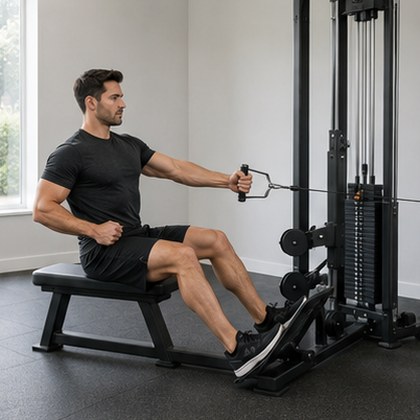
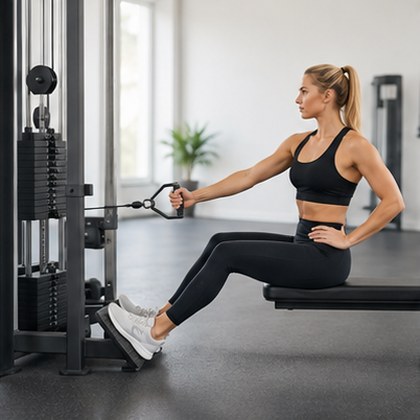
Take one D-handle, sit as you would for a regular row, and rest your free hand on your thigh. Pull the handle toward the side of your stomach, with your elbow traveling along your torso. Your torso doesn't twist to follow the handle: at the stretch your arm reaches forward while your chest faces straight ahead. Start with your weaker arm.
What changes for your core. In 2015, Saeterbakken and colleagues compared three two-arm and single-arm rows in 15 trained men. In the single-arm cable row and the single-arm machine row, the spinal erectors and multifidus worked at 60–63% and 74–78% of their level in the two-arm version. The external obliques, on the other hand, worked harder in the single-arm version: in the two-arm row they produced only 37–41% of the single-arm level.
Why row with one arm. To even out your sides. In 2025, Rodríguez-Perea and colleagues tested the seated single-arm cable row in 29 young athletes. In the pulling phase, the two sides differed by only 7.79% on average, but in 32% of participants the difference was more than 15%.
A simple test. Set the same weight and do a set with each arm until your torso starts to twist. If one arm does 12 clean reps and the other does 9, you have a gap. In that case, keep the single-arm row in your program for 4–6 weeks and start each set with your weaker side.
Chest-supported row
This is a separate lever machine or a cable machine where you sit facing a pad and press your chest against it. In many gyms it's simply called the "seated row machine." You can't rock, and mechanically your lower back takes almost no load, although this machine hasn't been measured on its own. It's a good option if your lower back gets tired after seated cable rows.
Standing on a cable crossover
Stand facing a cable crossover, set the pulley at about waist height, stand in a half squat or a lunge, and pull the handle to your waist. Standing, your core has to keep you balanced and stop the cable from twisting you around. In Fenwick's 2009 study of 7 men, a single-arm standing cable row in a lunge produced 2,457 N of compression between the fourth and fifth lumbar vertebrae, versus 3,576 N in the bent-over barbell row. The torso twisted through 67.7% of its full range of rotation. You can't compare these numbers directly with the seated row, because Fenwick didn't measure it.
At home with a band
Anchor a resistance band around a couch leg, a pipe or a door anchor at foot level. Sit on the floor with your legs straight or slightly bent, hold the ends of the band and pull them to your waist the same way you would on the cable. The resistance increases toward the end of the pull. For building strength, bands hold up well against regular weights: in Lopes's 2019 meta-analysis of 8 studies, strength gains were comparable. How to choose band resistance is covered in our resistance band workout guide.
No band. Inverted rows under a sturdy table or a low bar are a horizontal bodyweight pull. The same exercise also builds strength for regular pull-ups, and the week-by-week path to them is laid out in our first pull-up guide.
Rowing machine. The arm movement on it looks like a cable row, but the resistance is light and the reps number in the hundreds. It's cardio, and it won't replace the cable row for back strength.
 Single-arm cable row, men’s version
 Single-arm cable row, women’s version
What weight to start with: an 8-week plan for women and men
Women start with 15 kg (33 lb) on the stack, men with 30 kg (66 lb), 3 sets of 10 reps with 2–3 reps left in reserve, adding reps first and weight second.
The progression rule comes from the 2009 ACSM position stand. A beginner needs a weight that allows 8–12 reps. Once you can do 1–2 reps more than the target, the weight goes up by 2–10%. Stacks usually go up in 5 kg (11 lb) steps, and many machines have a 2.5 kg (5.5 lb) add-on plate, which is what our plan is built on. If the stack at your gym is marked in pounds, pick the nearest plate: 15 kg is about 33 lb, so 30 or 35 lb works, and many pound stacks have a 5 lb add-on.
Stack numbers don't match between machines. Because of different pulley systems, 20 kg (44 lb) on one machine feels different from 20 kg on the one next to it, so check your starting weight with your first set. If 10 reps go by with more than 3 reps in reserve, add 5 kg (11 lb). If your tenth rep only happens with rocking, take off 5 kg (11 lb). Write down the weight for that specific machine.
Eight weeks of seated cable rows, in numbers. Two sessions a week, 3 working sets each. Volume is the total work per session: sets × reps × weight on the stack. For example, 3 sets × 10 reps × 15 kg = 450 kg (990 lb).
| Week | Women | Volume | Men | Volume | What changed |
|---|---|---|---|---|---|
| 1 | 15 kg (33 lb), 3 × 10 | 450 kg (990 lb) | 30 kg (66 lb), 3 × 10 | 900 kg (1,985 lb) | start |
| 2 | 15 kg (33 lb), 3 × 12 | 540 kg (1,190 lb) | 30 kg (66 lb), 3 × 12 | 1,080 kg (2,380 lb) | +2 reps per set |
| 3 | 17.5 kg (38.5 lb), 3 × 10 | 525 kg (1,160 lb) | 32.5 kg (71.5 lb), 3 × 10 | 975 kg (2,150 lb) | weight: +17% for women, +8% for men |
| 4 | 17.5 kg (38.5 lb), 3 × 12 | 630 kg (1,390 lb) | 32.5 kg (71.5 lb), 3 × 12 | 1,170 kg (2,580 lb) | +2 reps |
| 5 | 20 kg (44 lb), 3 × 10 | 600 kg (1,320 lb) | 35 kg (77 lb), 3 × 10 | 1,050 kg (2,315 lb) | weight: +14% and +8% |
| 6 | 20 kg (44 lb), 3 × 12 | 720 kg (1,590 lb) | 35 kg (77 lb), 3 × 12 | 1,260 kg (2,780 lb) | +2 reps |
| 7 | 22.5 kg (49.5 lb), 3 × 10 | 675 kg (1,490 lb) | 37.5 kg (82.5 lb), 3 × 10 | 1,125 kg (2,480 lb) | weight: +12.5% and +7% |
| 8 | 22.5 kg (49.5 lb), 3 × 12 | 810 kg (1,785 lb) | 37.5 kg (82.5 lb), 3 × 12 | 1,350 kg (2,975 lb) | +2 reps |
Over 8 weeks, volume per session grows by 80% for women (from 450 to 810 kg, or 990 to 1,785 lb) and by 50% for men (from 900 to 1,350 kg, or 1,985 to 2,975 lb). In the weeks when the weight goes up, volume dips slightly because reps drop back to 10. That's intentional: for women, a 2.5 kg (5.5 lb) step on a light weight is +12.5–17%, above ACSM's upper limit of 10%, and dropping back to 10 reps smooths out that jump.
If there's no add-on plate and the step is only 5 kg (11 lb), spend one week at 3 × 8 after each increase, then 3 × 10 and 3 × 12.
This is a typical path, and none of it is a mandatory standard: some people will get through it in 6 weeks, others will need 10. The weight goes up only when every set is done without rocking your torso and with 2–3 reps in reserve.
The program is the same for women. In Roberts's 2020 meta-analysis of 10 studies, men and women gained muscle at the same rate from the same training, and women's relative gains in upper-body strength were even higher.
Where the weight is heading. For scale: in Padovan's 2025 study, 14 trained men weighing about 76 kg (168 lb) used about 50 kg (110 lb) for 8 reps to failure. A beginner takes months to grow to that level.
This kind of plan is easy to track in the workout diary of the Sportygram app (go.sportygram.com; the interface and the coach are in Russian for now). It has the seated cable row and the single-arm cable row, each with technique photos for men and women; weight and reps are logged for every set, and the weight history shows when it's time to add more.
How many sets and reps, and how often per week
3 sets of 8–12 reps twice a week, with 1–2 minutes of rest.
The 2026 ACSM position stand updated the strength training recommendations that had been in place since 2009. It pulls together 137 systematic reviews and more than 30,000 participants. For the cable row, four takeaways are worth using:
- Volume. Muscles grow more with 10 or more sets per muscle per week.
- Frequency. Strength improves more with two or more sessions a week.
- Range of motion. A full range of motion builds more strength, so straighten your arms all the way at the stretch and bring the handle all the way to your stomach at the top.
- Failure. You don't have to take a set to failure; 2–3 reps in reserve is enough.
Rest between sets — 1–2 minutes, per the 2009 ACSM recommendation for muscle growth.
Is one row enough? 3 sets twice a week is 6 sets for your back, and for muscle growth ACSM recommends 10 or more. Make up the remaining 4 sets with a vertical pull: lat pulldowns, pull-ups or an assisted pull-up machine.
Where to place it in your workout. In a full-body session, pair the cable row with a bench press or dumbbell press: one exercise pushes, the other pulls. In a back session, do the vertical pull first, then the seated row. For a beginner, it's a convenient first back exercise: the weight changes in 2.5–5 kg (5.5–11 lb) steps, your torso is braced, and the shoulder blade movement is easier to learn than in a bent-over barbell row.
Mistakes: where you feel it → what to fix
A correct cable row feels like work between your shoulder blades and along the sides of your back under your armpits; if your biceps, neck or lower back tire first, the form has drifted.
| Where you feel it | What's wrong | The fix |
|---|---|---|
| Lower back, on every rep | rocking your torso: the weight is too heavy, and you're pulling by leaning back | take off 5 kg (11 lb), keep your torso upright for the whole set |
| Lower back, at the stretch | your back rounds when you reach for the handle | lean forward no more than 10–15°, keep the arch in your lower back, sit closer to the footplate |
| Neck and upper traps, "shoulders to ears" | you're leaning back and shrugging your shoulders (Park and Kim, 2022) | drop your shoulders before the pull, torso upright |
| Biceps instead of back | you're pulling with your hands while your elbows stay put; neutral and underhand grips load the biceps more (Taboada-Iglesias, 2024; Vasconcelos, 2023) | switch to an overhand grip, think "elbows back" on the first reps (Fujita, 2020) |
| Front of the shoulder | your elbows travel far behind your torso, and the top of your upper arm rolls forward | stop when your elbows are in line with your torso |
| Inside of the elbow | underhand grip with a heavy weight | neutral grip, a V-bar or two D-handles |
| Thighs, knees straightening | you're pushing the weight with your legs | knees slightly bent and still for the whole set |
| The stack slamming | you're dropping the weight on the way back | lower over 2 seconds, the weight doesn't touch the stack until the set is done |
| Nothing in your back | partial range of motion: your arms don't straighten or the handle doesn't reach your stomach | arms straight at the stretch, handle touching your stomach at the top, a 1-second pause |
| Your hands give out before your back | your grip is weaker than your back | straps, but not before week 8; until then, a thinner handle |
Why your traps and neck get tired
Mild tension between your shoulder blades is a normal response to rowing: that's exactly the middle and lower traps. If your neck and upper shoulders ache instead, it's almost always one of three causes:
- your torso is leaning back: in Park and Kim's 2022 study, a 20° lean almost tripled upper trap activity;
- your shoulders rise at the start of the pull: you're shrugging instead of drawing your shoulder blades back and down;
- a wide grip to the chest with a heavy weight: in Padovan's 2026 study, a wide grip loaded the upper traps harder, with an effect size of 1.35 on the pull and 2.79 on the lowering phase.
One fix covers all three: less weight, torso upright, shoulders down from the first rep, a close or neutral handle to your waist.
Why your arms work and your back doesn't
Your arms are used to pulling in everyday life, and the shoulder blade movement has to be learned. Three things help: an overhand grip instead of underhand, starting the movement from your shoulder blades while your arms are almost straight, and the "elbows into your back pockets" cue for the first 3–4 reps. Usually after a few sessions your back starts switching on by itself.
Lower back, shoulders and elbows: who should be careful and when to see a doctor
Mechanically, the seated cable row is easier on your lower back than many other rows, because your feet are braced against the footplate and your torso doesn't have to hold a forward lean; the main thing is not to rock.
Lower back. In Saeterbakken's 2015 study, during single-arm cable and machine rows, the external obliques and multifidus worked at 50–57% and 70–73% of their level in the same single-arm row with a free weight. In the bent-over two-arm row with a free weight, the spinal erectors worked 34% harder than in the same two-arm row on a machine. The muscles that hold your spine get noticeably less work in supported rows than with free weights.
How risky rowing is in general. In Keogh and Winwood's 2017 review of 20 injury studies across weight-training sports, bodybuilding had the lowest injury rate: 0.24–1 injury per 1,000 hours of training. These are data from competitive athletes; there are no such counts for gym beginners. The most commonly injured areas were the shoulder, lower back, knee, elbow and wrist. In the cable row, the parts to look after are your lower back, shoulder and elbow.
Shoulder. Don't take your elbows far behind your back, and don't raise them above shoulder level when pulling to your chest. If your shoulder hurts when you raise your arm out to the side, pull to your waist with a neutral grip and a light weight, and if the pain doesn't go away, see a doctor.
Elbow. Pain along the inside of the elbow most often comes from an underhand grip with a heavy weight. Switch to a neutral grip and give your elbow a week off from heavy rows.
Who should start light and check with a doctor:
- A herniated or bulging disc during a pain flare. While it hurts, rows are put on hold. Once the pain has settled, it's best to return together with a doctor who has seen your scans, starting with a light weight and a chest-supported machine.
- Lower back pain that shoots down your leg. See a doctor first, train second.
- Chronic lower back pain without acute warning signs. Here, movement is more likely to help. In Hayden's 2021 Cochrane review of 249 studies, exercise reduced pain by an average of 15.2 points on a 0–100 scale compared with no treatment, usual care or placebo. Which exercises to do and with what weight is up to your doctor or a physical therapist.
- Shoulder pain when raising your arm out to the side, or recent shoulder or spine surgery: agree on the load with your doctor.
- Late pregnancy. Discuss the exercise with the doctor who's managing your pregnancy. The usual approach is a lighter weight and more rest.
See a doctor if your leg goes numb or feels weak, if the pain wakes you up at night, if it started after a fall or an injury, or if it doesn't ease after 2–3 days of rest. Which exercises help with back pain and which are better put off is covered in our guide to lower back pain exercises.
Seated cable row vs. lat pulldown vs. bent-over row: how they differ and what to combine
The seated cable row and the bent-over barbell row pull from front to back and load the middle back harder, while the lat pulldown pulls from top to bottom and trains the movement for pull-ups, so your week needs one horizontal pull and one vertical pull.
| Exercise | Direction | What it loads harder | Lower back | Who it's for |
|---|---|---|---|---|
| Seated cable row | front to back, seated | middle back and lats; middle traps 30–36% (Lehman, 2004) | feet braced, torso upright; compression not measured, mechanically less than in a bent-over row | beginners, as a first back exercise |
| Bent-over barbell row | front to back, bent over standing | the whole back, with the spinal erectors holding the lean | L4/L5 compression 3,576 N, the highest of the three rows in the study (Fenwick, 2009) | a healthy back, goal is strength and a thicker back |
| Lat pulldown | top to bottom | lats; middle traps 21–23% (Lehman, 2004) | thighs under the pad, no forward lean | everyone, as a second pull and a path to pull-ups |
| Pull-ups | top to bottom, bodyweight | lats, biceps | no forward lean | people who can already do a pull-up on their own |
| Single-arm dumbbell row with support | front to back, one arm | lats; evens out your sides | not measured with a dumbbell; a single-arm standing cable row produced 2,457 N (Fenwick, 2009) | home, gym, side-to-side differences |
| Inverted row | front to back, bodyweight | middle back | 2,339 N, the lowest of the three (Fenwick, 2009) | home with no equipment |
Seated cable row vs. bent-over barbell row. The direction is the same; the difference is what holds your torso. When you're bent over, your spinal erectors hold it, while seated with your feet braced your lower back is mechanically under less load, although Fenwick didn't measure the seated row. The cable row is simpler for a beginner and gentler on the lower back. We covered bent-over row form and its variations in our bent-over row guide.
What to do instead of a seated cable row:
| Where | What | What you lose |
|---|---|---|
| At the gym, machine taken | low pulley on a cable crossover with a bench, chest-supported machine | almost nothing, the movement is the same |
| At the gym, no cable station | single-arm dumbbell row with support, bent-over barbell row | the fixed path; when bent over, your lower back holds more |
| At home, with a band | seated band row on the floor | an exact load: band resistance is harder to dose |
| At home, with dumbbells | single-arm dumbbell row braced on a chair | nothing significant, you train both sides in turn |
| At home, nothing | inverted rows under a table | the ability to add weight in small steps |
If the machine at your gym is taken, you can ask the virtual coach, Alex, in the app chat (he replies in Russian) to add a bent-over dumbbell row for today. He shows a confirmation card, and once you confirm, the exercise appears in that day's plan.
Questions and answers
What muscles does the seated cable row work?
The lats, the middle and lower traps, the rhomboids, the rear delts and the biceps, while the spinal erectors hold your torso upright. In Taboada-Iglesias's 2024 study, the trapezius was the most active of the four muscles measured.
Which grip is better for seated cable rows: close, wide or underhand?
A close grip loads the lats harder (Padovan, 2026), a wide grip with elbows flared loads the traps and rear delts, and underhand and neutral grips add biceps (Vasconcelos, 2023). A beginner will find it easiest to start with a V-bar, then rotate grips after 4–6 weeks.
Should you pull the seated row to your waist, your stomach or your chest?
The waist and the stomach are the same spot between your belly button and your lower ribs, and this is the basic version, where you lift the most. You pull to the chest with a wide grip and elbows flared to load the middle back and rear delts harder.
How far should you lean back on a seated cable row?
Don't lean back; keep your torso upright. At the stretch you can lean forward 10–15° with a flat lower back. With a 20° lean back, the upper traps worked almost three times harder (Park and Kim, 2022).
How much weight should a beginner or a woman start with?
Women start with 15 kg (33 lb) on the stack, men with 30 kg (66 lb), 3 sets of 10 reps, reaching 22.5 kg (49.5 lb) and 37.5 kg (82.5 lb) by week 8 on our plan. Stacks feel different from machine to machine, so check the weight with your first set. The program for women is the same as for men (Roberts, 2020).
How do you do a single-arm seated cable row?
Take one D-handle, rest your free hand on your thigh, and pull the handle toward the side of your stomach without twisting your torso. It's a handy way to even out your sides: in Rodríguez-Perea's 2025 study, 32% of athletes had a side-to-side difference of more than 15% in the pulling phase.
What can you do instead of a seated cable row at home?
A resistance band anchored around a couch leg: sit on the floor and pull it to your waist. For strength, bands hold up well against regular weights (Lopes, 2019). Other options are a single-arm dumbbell row braced on a chair and inverted rows under a table.
What's the difference between a seated cable row and a lat pulldown?
The direction: the seated row pulls from front to back, and the lat pulldown pulls from top to bottom. In the seated row the middle back works harder, 30–36% versus 21–23% (Lehman, 2004), while the pulldown trains the movement for pull-ups. A good program includes both.
The bottom line
- A seated cable row is a pull to your waist while seated: feet braced, knees slightly bent, torso upright, elbows traveling along your sides.
- The lats and the muscles between your shoulder blades do the main work; the middle traps and rhomboids work harder in the seated row than in a pulldown, 30–36% versus 21–23% (Lehman, 2004).
- Don't lean back: with a 20° lean, the upper traps worked almost three times harder, 41.96% versus 15.36% (Park and Kim, 2022). At the stretch you can lean forward 10–15°.
- A close grip means more lats (Padovan, 2026), a wide grip to the chest means traps and rear delts, and underhand and neutral grips mean more biceps (Vasconcelos, 2023). Your lats work with any grip.
- Start with 15 kg (33 lb) for women and 30 kg (66 lb) for men, 3 × 10 twice a week, adding reps first and weight second. Over 8 weeks, volume grows by 80% and 50%.
- Get to 10 sets for your back per week by adding a vertical pull: lat pulldowns or pull-ups (ACSM, 2026).
- Pain shooting down your leg, a numb leg, or shoulder pain when raising your arm out to the side: see a doctor.
Checklist: your first seated cable row session
- Feet on the footplate, knees slightly bent, the cable running to your stomach at the end of the pull.
- A V-bar for the first 4–6 weeks.
- 15 kg (33 lb) for women or 30 kg (66 lb) for men, checked with your first set.
- Torso upright, shoulders down before the pull starts.
- The movement starts from your shoulder blades, elbows travel back along your sides.
- The handle touches your stomach between your belly button and lower ribs, with a 1-second pause.
- 2 seconds on the way back to straight arms, the weight doesn't rest on the stack.
- 3 sets of 10 reps, 1–2 minutes of rest, 2–3 reps in reserve.
- The weight written down for this specific machine.
Sources
- Lehman G.J., Buchan D.D., Lundy A., Myers N., Nalborczyk A. Variations in muscle activation levels during traditional latissimus dorsi weight training exercises: An experimental study. Dynamic Medicine, 2004. — 12 men, 10-second holds in the pulled position: in the seated row, the middle traps and rhomboids worked at 30–36% of maximum versus 21–23% in the pulldown; squeezing the shoulder blades gave no significant increase.
- Vasconcelos C.M.W.A., Lopes C.R., Almeida V.M., Krause Neto W., Soares E.G. Effect of Different Grip Position and Shoulder-Abduction Angle on Muscle Strength and Activation During the Seated Cable Row. International Journal of Strength and Conditioning, 2023. — 21 people: strength was higher with the elbows at the sides; flaring to 60–90° meant more traps and rear delts; the biceps worked harder with underhand and neutral grips and with 90° of abduction.
- Padovan R., Cè E., Longo S., Tornatore G., Trentin C., Esposito F., Coratella G. High-Density Surface Electromyography Excitation of Prime Movers in the Narrow vs. Wide Grip Seated Row Exercise. Journal of Human Kinetics, 2026. — 14 trained men: the close grip loaded the lats harder (effect size 1.08), the wide grip loaded the traps and middle deltoid harder.
- Padovan R., Cè E., Longo S., Tornatore G., Esposito F., Coratella G. High-Density Electromyography Excitation of Prime Movers Across Scapular Positions in the Seated Row. Journal of Functional Morphology and Kinesiology, 2025. — 14 men, about 50 kg for 8 reps: squeezed and free shoulder blades produced comparable activity, with differences of 3.7–6.8%.
- Taboada-Iglesias Y., Buján-Romero S., Alonso-Fernández D., Gutiérrez-Sánchez Á. Comparación de la actividad electromiográfica de los músculos implicados en el remo horizontal de polea baja con diferentes agarres y anchuras bilaterales. Retos, 2024. — 12 men, 9 grip variations: the trapezius was the most active of the four muscles measured, the biceps worked harder with a neutral grip at shoulder width, and the lats showed no significant differences.
- Park J.-R., Kim T.-H. Effect of Trunk Position on Trapezius Muscle Activity and Ratio during Performing Modified Seated Cable Row Exercise. Journal of Musculoskeletal Science and Technology, 2022. — 23 adults, holds at 65% of maximum: leaning back 20° produced 41.96% upper trap activity versus 15.36% with the torso upright.
- Fujita R.A., Silva N.R.S., Bedo B.L.S., Santiago P.R.P., Gentil P.R.V., Gomes M.M. Mind-Muscle Connection: Limited Effect of Verbal Instructions on Muscle Activity in a Seated Row Exercise. Perceptual and Motor Skills, 2020. — 20 beginners: a "focus on your back" cue gave +15.21% lat activity on the first reps, and the effect disappeared by the end of the set.
- Saeterbakken A., Andersen V., Brudeseth A., Lund H., Fimland M.S. The Effect of Performing Bi- and Unilateral Row Exercises on Core Muscle Activation. International Journal of Sports Medicine, 2015. — 15 men: single-arm rows meant more oblique activity and less spinal erector activity; in supported rows, the core muscles worked less than with free weights.
- Rodríguez-Perea Á., Vila H., Ferragut C., Jerez-Mayorga D., Chirosa Ríos L.J., García-García O., Serrano-Gómez V. Reliability of the Seated Unilateral Cable Row and Strength Differences Between Dominant and Non-Dominant Sides in Young Athletes. Journal of Functional Morphology and Kinesiology, 2025. — 29 athletes: 32% had a side-to-side difference of more than 15% in the pulling phase of the single-arm row.
- Fenwick C.M.J., Brown S.H.M., McGill S.M. Comparison of Different Rowing Exercises: Trunk Muscle Activation and Lumbar Spine Motion, Load, and Stiffness. Journal of Strength and Conditioning Research, 2009. — 7 men: lumbar compression was 3,576 N in the bent-over barbell row, 2,457 N in the single-arm standing cable row, and 2,339 N in the inverted row.
- Di Fonza D., Di Claudio G., Colantuono G., Persichini L., Cerulo N., Sangregorio B., Buonsenso A., Fiorilli G., Calcagno G., di Cagno A. Electromyographic Analysis of Latissimus Dorsi Activation During Common Resistance Training Exercises: A Narrative Review. Journal of Functional Morphology and Kinesiology, 2026. — A review of 23 studies: a close grip and elbows at the sides are linked to more lat activity, and squeezing the shoulder blades doesn't increase it.
- American College of Sports Medicine. Progression models in resistance training for healthy adults. Medicine & Science in Sports & Exercise, 2009. — Beginners should train at 8–12 reps, adding 2–10%; a slow-to-moderate tempo (moderate meaning 1–2 seconds); 1–2 minutes of rest for muscle growth.
- Currier B.S., D'Souza A.C., Singh M.A.F. et al. American College of Sports Medicine Position Stand. Resistance Training Prescription for Muscle Function, Hypertrophy, and Physical Performance in Healthy Adults: An Overview of Reviews. Medicine & Science in Sports & Exercise, 2026. — 137 reviews: 10 or more sets per muscle per week, 2 or more sessions a week, full range of motion; training to failure isn't necessary, and 2–3 reps in reserve is enough.
- Roberts B.M., Nuckols G., Krieger J.W. Sex Differences in Resistance Training: A Systematic Review and Meta-Analysis. Journal of Strength and Conditioning Research, 2020. — Men and women gain muscle at the same rate, and women's relative upper-body strength grows faster.
- Keogh J.W.L., Winwood P.W. The Epidemiology of Injuries Across the Weight-Training Sports. Sports Medicine, 2017. — Bodybuilding had 0.24–1 injury per 1,000 hours; the shoulder, lower back, knee, elbow and wrist were most often affected.
- Hayden J.A., Ellis J., Ogilvie R., Malmivaara A., van Tulder M.W. Exercise therapy for chronic low back pain. Cochrane Database of Systematic Reviews, 2021. — 249 studies: exercise reduced chronic lower back pain by an average of 15.2 points out of 100.
- Lopes J.S.S., Machado A.F., Micheletti J.K., de Almeida A.C., Cavina A.P., Pastre C.M. Effects of training with elastic resistance versus conventional resistance on muscular strength: a systematic review and meta-analysis. SAGE Open Medicine, 2019. — 8 studies: bands and regular weights produced comparable strength gains.
This article is for informational purposes only and is not a substitute for medical advice.