

lean forward to about 45° with a flat lower back, pull the bar to your lower belly with your elbows close to your sides, and squeeze your shoulder blades together at the top. Of the three rows Fenwick compared in 2009, the barbell bent-over row put the most load on the lower back: compression between the fourth and fifth lumbar vertebrae was 3,576 N, versus 2,457 N in a one-arm standing cable row and 2,339 N in an inverted row. That's why the weight in this lift goes up last, after your form.Starting point: dumbbells, 2 × 6 kg (2 × 13 lb) for women and 2 × 10 kg (2 × 22 lb) for men, 3 sets of 10 reps twice a week with 2–3 reps left in the tank. From week five, switch to a barbell: a 15 kg (33 lb) women's bar or a 25 kg (55 lb) loaded bar. Over our 8-week plan, training volume per session grows by 75–80%.
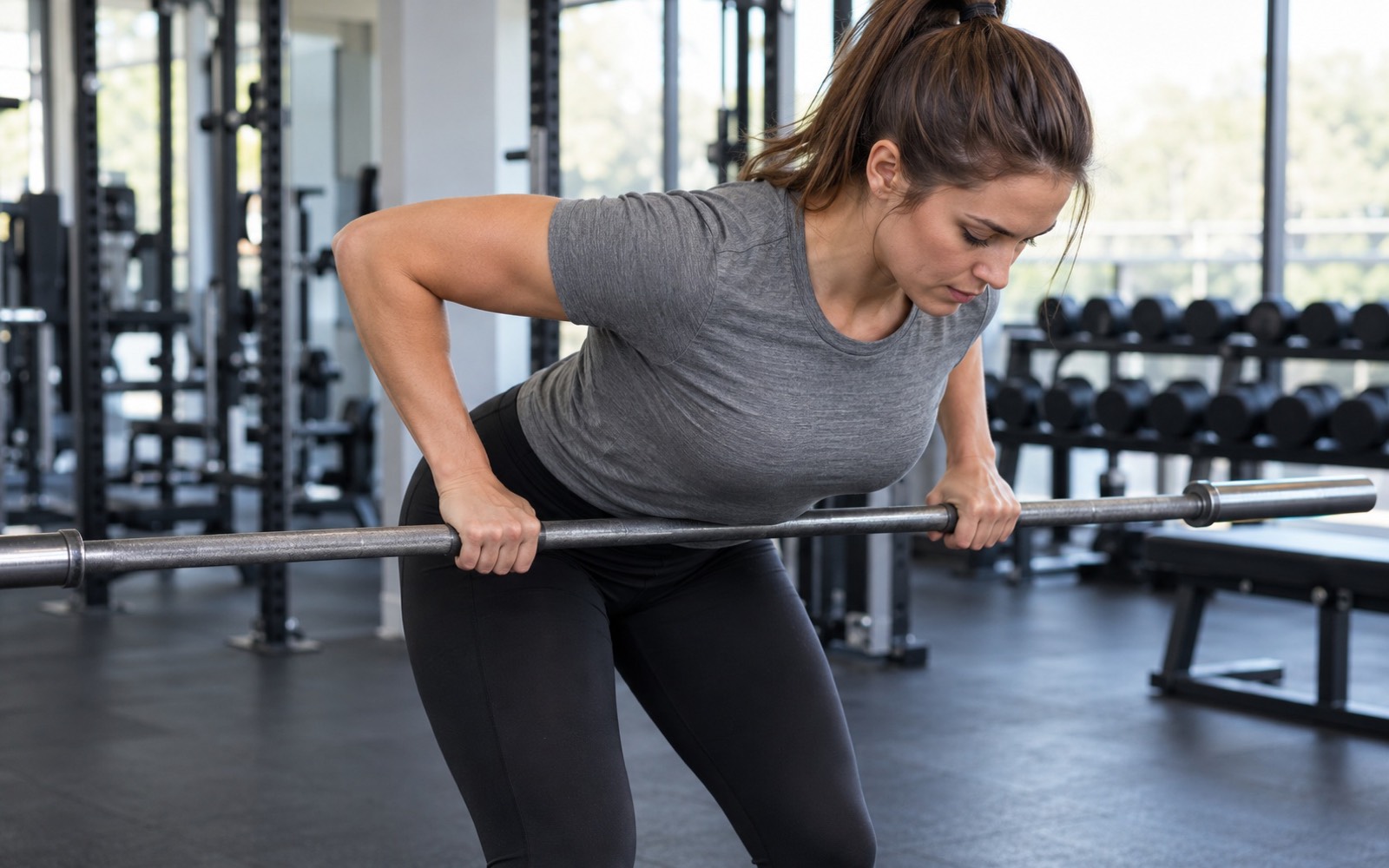
A bent-over row means pulling a barbell to your lower belly from a fixed forward lean: your back holds its position while your shoulder blades and arms do the moving. You hinge forward to about 45°, take an overhand grip a little wider than your shoulders, and pull the bar to your waist with your elbows traveling close to your sides. Your lats and the muscles between your shoulder blades do most of the work, your biceps help, and your spinal erectors hold your lower back flat for the whole set. A beginner is fine with 3 sets of 10 reps twice a week. Start with a pair of dumbbells, 6 kg (13 lb) each for women and 10 kg (22 lb) each for men, and move to a barbell in week five. Below: step-by-step barbell row form, a test to find your own torso angle, what overhand and underhand grips change, how a barbell differs from a one-arm dumbbell row and a T-bar row, mistakes you can feel, your lower back in numbers, and an 8-week weight plan for women and men.
What a bent-over row is and what muscles it works
A bent-over row is a pull of the bar to your lower belly from a forward lean in which your back stays still and your shoulder blades and arms do the work. You stand bent forward, the bar hangs from straight arms, and you pull it up to your waist as you squeeze your shoulder blades together. Your torso stays at the same angle from the first rep to the last. The lift also goes by the barbell row, the bent-over barbell row, or simply "rows" in most gyms.
The lean itself is the same hip hinge you use in a Romanian deadlift, only frozen in place. In a Romanian deadlift your hips travel back and forward, and that movement is the whole exercise. In a barbell row you set the lean once and hold it, and the movement happens at your shoulders and elbows. That has two consequences. First, your spinal erectors work for the whole set without a break, and even experienced lifters feel them tire after heavy rows. Second, the barbell row is a horizontal pull: you pull the weight toward your body, while in a lat pulldown it comes down from above. Gym wisdom says horizontal pulls build a thick back and vertical pulls build a wide one. That's a simplification, but it points the right way: pulling to your waist works the muscles between your shoulder blades harder, and pulling down works the lats along your sides harder.
| Muscle | What it does in the row | Where you feel it |
|---|---|---|
| Latissimus dorsi (lats) | pulls your upper arm back and toward your body; the main mover when you row to your waist | along the sides of your back, under your armpits, lower toward the end of a set |
| Middle and lower trapezius | squeeze and lower your shoulder blades at the top | between your shoulder blades |
| Rhomboids | pull your shoulder blades toward your spine | between your shoulder blades, close to the spine |
| Rear delts | pull your upper arm back; work harder with a wide grip and flared elbows | the back of your shoulder |
| Biceps and brachialis | bend your elbow; work harder with an underhand grip | the front of your upper arm |
| Spinal erectors | hold your lower and upper back flat; they don't move the bar | along your spine, tiring toward the end of a set |
| Glutes and hamstrings | hold your pelvis in the hinge | a light stretch down the back of your thighs |
| Forearm muscles | hold the bar | hands and forearms as the weight goes up |
How hard each muscle works. In 2009, Fenwick, Brown and McGill measured seven healthy men doing three rows: an inverted row on a low bar, a standing barbell bent-over row, and a one-arm cable row. The barbell weight was matched to the share of body weight each person lifted in the inverted row, and they pulled it to the chest from a flat-backed lean. In the barbell row, the lats worked at 53.4% of their maximum voluntary effort on the way up, the thoracic erectors at 72.8%, the lumbar erectors at 42.5–43.3%, the glutes at 19% and the biceps femoris at 12.5%. Here's what that means for you: this lift works your whole back, from your shoulder blades down to your tailbone. Your lumbar erectors don't move the bar at all. They only hold the lean, and they still work at almost half their maximum. Your glutes and hamstrings hold your pelvis and work lightly, at 12–19%.
How to do a barbell row to your waist: step by step
Lean forward to about 45°, take an overhand grip a little wider than your shoulders, and pull the bar to your lower belly with your elbows traveling close to your sides. Your back stays flat and still the whole time, and your shoulder blades come together at the top. Step by step, it looks like this:
- Get the bar off the floor for the first rep. Walk up to the bar so it sits over the middle of your feet, bend your knees and lift it as you would in a conventional deadlift: back flat, bar close to your shins. Stand all the way up. That way the bar ends up in your hands without you yanking it with your back from a deep lean.
- Stance. Feet hip-width apart, toes pointing straight ahead or slightly out. Knees slightly bent, about as much as right before a jump, and that knee angle stays the same from here on.
- Grip. Palms facing you, hands a little wider than your shoulders: if you let your arms hang at your sides, your hands should land just outside your thighs. Wrap your thumbs around the bar. Grip width is covered in section 04.
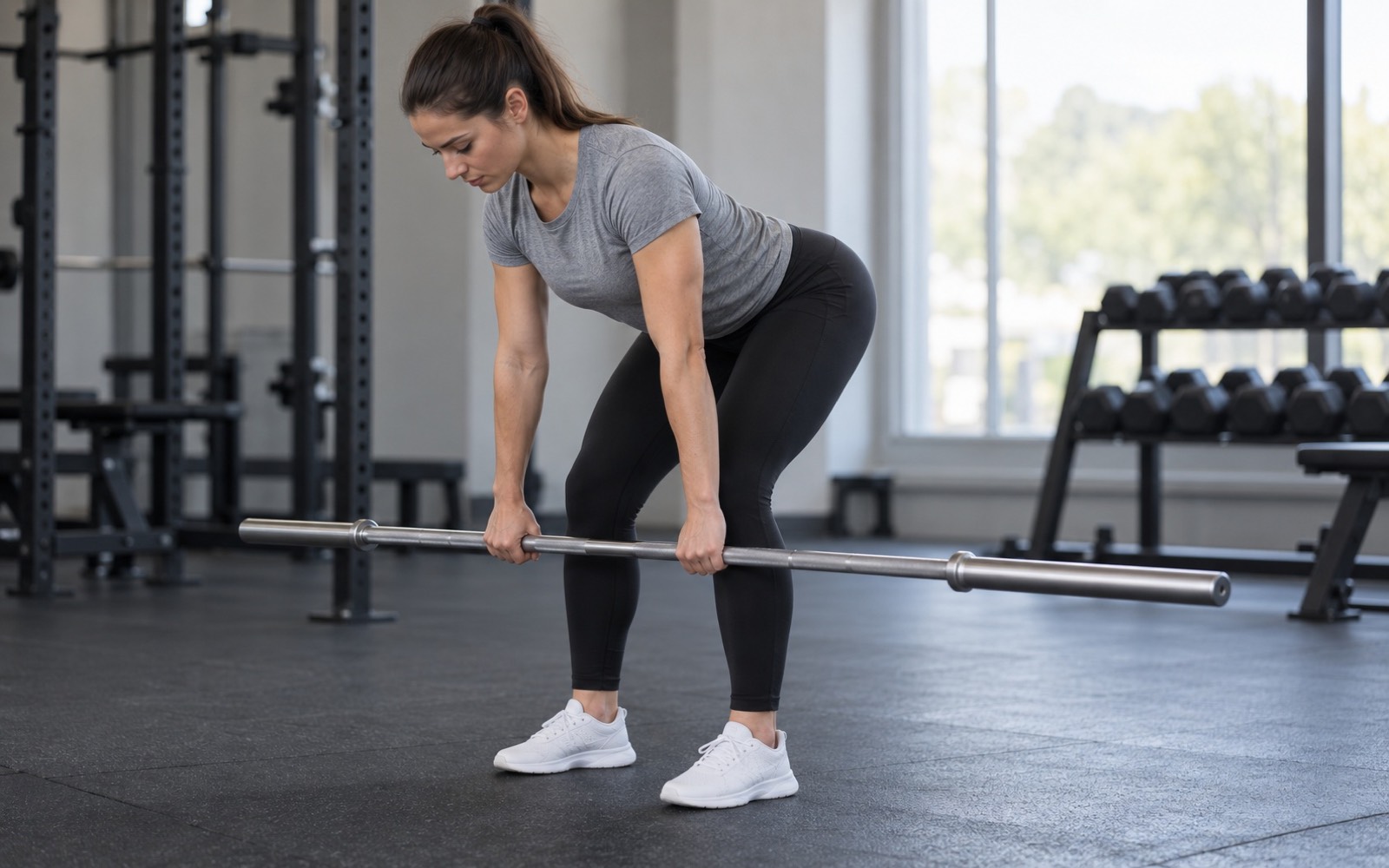
- Lean. Push your hips back and lower your torso until it's at roughly 45° to the floor. The bar slides down your thighs toward your knees. Keep your lower back flat, your chest open and your shoulder blades relaxed. Section 03 has a test to find your own angle.
- Where to look. At the floor about 1–2 m (3–6 ft) in front of you. Your head continues the line of your back. If you look up into the mirror in front of you, your neck overextends, and your lower back follows it.
- Row. Breathe in, brace your abs and pull the bar toward your lower belly, driving your elbows back and up along your sides. Your hands act like hooks; they only hold the bar. The bar moves in an arc toward your body while your torso stays put.
- The top. The bar touches or almost touches your lower belly, your elbows end up slightly higher than your back, and your shoulder blades are squeezed together. Hold for one second and squeeze the muscles between your shoulder blades.
- Lowering. Lower the bar to straight arms over 1–2 seconds and let your shoulder blades drift forward. Don't drop the weight or rest at the bottom: the next rep starts right away.
- Breathing. Breathe in before you pull and breathe out at the top or on the way down. With a light weight you can breathe steadily; the one thing to avoid is letting your abs go slack while you're bent over.
- Ending the set. Stand up with the bar in your hands by driving your hips forward, then lower the bar to the floor through a deadlift position with a flat back.
For tempo, 1–2 seconds up and 1–2 seconds down works well. The American College of Sports Medicine (ACSM) position stand from 2009 calls this a moderate tempo and recommends a slow or moderate tempo for beginners. Go faster and your torso starts to swing. Go slower and your lower back gets tired before your upper back does.
for your first two weeks, do your rows with an empty bar or light dumbbells, standing side-on to a mirror, or film yourself from the side with your phone. The main bent-over row mistake is almost invisible from the inside: your torso rises a little on every rep while it feels like you're holding still. From the side, you can see it from the very first rep. If your torso angle is the same at the start and the end of the set, your form is there.
Torso angle: 45° or parallel to the floor, and how to find yours
Your working angle depends on how flexible your hamstrings are: lean forward only as long as your hips keep moving back and your lower back stays flat, and stop there. For most beginners that's 45–60° to the floor. Parallel to the floor, like in the classic photos, is for people with enough hamstring flexibility to hold a flat lower back at that depth, and there are fewer of them in the gym than it seems.
The empty bar test. Stand side-on to a mirror with an empty bar in your hands. Push your hips back and lean forward slowly, as you would in a Romanian deadlift. Watch two things: your hips keep traveling back, and your lower back stays flat. At some point your hips will stop moving while your torso still wants to go lower. That means any further lean would come from rounding your lower back. The angle where your hips stopped is your working angle for now. Over the months your flexibility improves, and your angle will get deeper.
What changes with the angle. The closer your torso gets to parallel, the longer the bar path and the more your lower back has to hold. In Fenwick's 2009 study, participants were asked to keep their backs flat, and yet in the barbell bent-over row their lumbar spine still flexed by 22.9°, while in the other two rows it stayed almost straight, at about 2.8°. That 22.9° was 42.9% of their full lumbar flexion range. In a preliminary study by García-Jaén in 2021, three experienced participants did bent-over rows with 12 kg (26.5 lb) dumbbells at about a 45° lean, and their lumbar erectors worked at 70.7–74.7% of maximum. There were only three participants, and the authors found no statistically significant difference between the variations, so the numbers only show a direction. And the direction is this: even at 45° with a light weight, your lower back works at almost three quarters of its capacity, and it makes sense to lean deeper only once your lower back is ready for it.
| Torso angle | Bar path | What works harder | Who it suits |
|---|---|---|---|
| 60–70° to the floor, fairly upright | short, to the lower belly | upper back, traps, rear delts; the lower back holds less | beginners, people whose lower back gets tight, people with tight hamstrings |
| 45° | medium, to the lower belly or waist | the whole back, lats and mid-back; the lower back holds a noticeable load | the default for most people |
| close to parallel to the floor | long, to the lower chest or stomach | lats through a full range, spinal erectors; the lower back holds the most | experienced lifters with good flexibility, the Pendlay row |
There's one rule: you set the angle once at the start of the set, and it stays the same until the end. If your torso has risen to 70° by rep eight, you're doing a different exercise that works different muscles.
Grip and where to pull: overhand, underhand, wide, narrow, to your waist or to your chest
An overhand grip a little wider than your shoulders, pulling to your waist, is the default version for the lats. An underhand grip adds more biceps, and a wide grip pulling to your chest with flared elbows shifts the work to your mid-back and rear delts. These differences have been measured with electromyography, which records the electrical activity of muscles through sensors on the skin, and you can lean on them when you pick a grip for your goal.
What the measurements show. In 2023, Vasconcelos and colleagues tested 11 men and 10 women with training experience to see how grip and elbow angle change a seated cable row. Peak force was higher with the elbows close to the body, with all three grips, and it dropped as the elbows flared out to 60° and 90°. The upper and middle traps and the rear delts worked harder with flared elbows, while the upper and lower lats worked harder with the elbows close to the body. The biceps worked least with an overhand grip and tucked elbows, and most with an underhand, neutral or wide grip with flared elbows. Peak force with overhand, underhand and neutral grips did not differ significantly. The test was done on a cable machine, but the shoulder mechanics with a barbell are the same.
García-Jaén in 2021 saw a similar picture in the standing bent-over row with three participants: the rear delts worked at 81.7% with flared elbows versus 64.7% with tucked elbows, and the upper traps at 95.7% versus 50.7%. The lats worked at 43–44% in both standing versions. With only three participants these differences weren't statistically significant, so the study only confirms a direction. For the underhand grip there's a 2025 study by Zyznawska: in 31 students doing bar pulls, the biceps was significantly more active with an underhand grip (p < 0.001). Nobody measured this in a barbell bent-over row, so we apply it carefully: an underhand grip probably gives your biceps more work, and how much depends on the exercise.
| Grip and bar path | Lats | Traps and rhomboids | Rear delts | Biceps | Pulling strength | Data from |
|---|---|---|---|---|---|---|
| Overhand, a little wider than shoulders, to the waist, elbows tucked | highest | moderate | moderate | lowest | high | Vasconcelos 2023, García-Jaén 2021 |
| Underhand, shoulder width, to the lower belly, elbows tight to your sides | high | moderate | moderate | high | high | Vasconcelos 2023, Zyznawska 2025 |
| Wide overhand, to the chest, elbows flared to 90° | lower | highest, upper traps up to 95.7% | highest, up to 81.7% | high | lower | García-Jaén 2021, Vasconcelos 2023 |
| Narrow overhand, to the lower belly | high | moderate | lower | high | high | from mechanics, like tucked elbows |
| Neutral, palms facing each other (T-bar, parallel handle) | high | moderate | moderate | high | high | Vasconcelos 2023 |
Overhand grip. Your palms face you and your hands sit a little wider than your shoulders. Your elbows travel along your sides, and the bar goes to your lower belly. This is the standard barbell row for your back. It's where you start, and it's the version you'll do most of the time.
Underhand grip, step by step. Your palms face away from you, and your hands are shoulder-width apart or a little narrower. You can lean a bit deeper, because with this grip your arms stay closer to your body and the bar naturally lands at your lower belly. Keep your elbows tight to your sides and drive them back; at the top, the bar is at your waist. Your biceps work harder here, and many people find it a more comfortable way to pull. An underhand grip doesn't promise a noticeably heavier weight: in Vasconcelos's study, peak force with overhand and underhand grips didn't differ significantly. There's also a downside: with a heavy bar, an underhand grip loads the inside of your elbow and the spot where the biceps tendon attaches to the bone. If the crook of your elbow aches after a set, go back to an overhand grip.
Grip width. A narrow grip, inside shoulder width, shortens the path of your elbows and keeps more of the work in your lats and biceps. A medium grip, a little wider than your shoulders, is the default. A wide grip, one and a half times shoulder width or more, flares your elbows out and turns the row into a pull to your chest. As the measurements above show, flared elbows make your traps and rear delts work harder, so the wide-grip row to the chest suits your mid-back, the muscles between your shoulder blades.
To your waist or to your chest. Row to your waist with your elbows tucked if your goal is your lats, overall back strength and thickness. Row to your chest with a wide grip and your elbows at 90° if your goal is your mid-back, posture and rear delts. The second version is harder on the shoulder joint and lighter in weight: as Vasconcelos showed, your pulling strength drops in it, so there's no need to use the same weight you use rowing to your waist.
Pendlay row, T-bar row, Smith machine, chest-supported and dumbbell rows
Every bent-over row variation changes two things: how much your lower back has to hold, and what path the weight travels. Once you understand those two axes, picking a variation gets simple.
Pendlay row. Named after weightlifting coach Glenn Pendlay. Your torso is parallel to the floor, the bar returns to the floor on every rep and starts from a dead stop, it travels to your lower chest, and the pull is explosive. Your lower back gets a split-second break at the bottom, but the lean itself is deeper than usual, and pulling the bar off the floor takes a rigid torso. This is a strength exercise for experienced lifters whose section 03 test allows a parallel torso.
T-bar row. One end of the bar is anchored to the floor, the plates sit on the other end, and you pull a handle with a neutral grip. The bar path is set by the arc, so you don't have to balance it, and the weight goes up faster. Many T-bar machines have a chest pad, and then your lower back gets a break. There's no measurement of spinal compression for the T-bar row, so we can only go by mechanics: with a chest pad, the load on your lower back is noticeably lower, and without one it's like a regular bent-over row.
Smith machine row. The bar moves up and down on rails, while in a free-weight row it travels in an arc toward your body. So you set your feet slightly in front of the bar, so that at the top it ends up at your waist without you leaning forward. The Smith machine is handy because the weight can't drift to the side and you can rack the bar at any height. The downside is that the path is fixed, so your stabilizer muscles work less.
Chest-supported row on an incline bench. Set the bench at 30–45°, lie on it chest down with dumbbells or a barbell hanging below, and pull toward your sides. This is the easiest version on your lower back, and it's the only supported variation that has been measured. In García-Jaén's 2021 study, on a bench at 47°, the lumbar erectors worked at 23.7–52.7% versus 70.7–74.7% standing, and the thoracic erectors at 16.7–42.3% versus 52–67%. The lats lost almost nothing: 29.7–42% on the bench versus 43–44% standing. There were three participants, the differences weren't statistically significant, and the authors themselves call the conclusion preliminary. But the direction matches the mechanics: your chest rests on the bench, so your lower back barely has to hold the lean.
Two-dumbbell bent-over row. The same movement with a weight in each hand. The pros: you can start with 5–6 kg (11–13 lb), the weight goes up in 1–2 kg (2–4 lb) steps, you don't need a barbell at home, and you can turn your palms however feels comfortable. The cons: heavy dumbbells are harder to hold than a barbell of the same total weight, and at the top they tend to drift apart. For weights and where this row fits in a home program, see the dumbbell workout at home: the bent-over dumbbell row is one of its six core moves, with 8–16 kg (18–35 lb) per dumbbell for men and 5–10 kg (11–22 lb) for women.
At home without a barbell or dumbbells. A backpack filled with books or water bottles, held by the straps in both hands, works for the first few weeks: four 1.5 L bottles give you 6 kg (13 lb). A resistance band under your feet with the ends in your hands gives you a load that increases toward the top. And there are inverted rows under a sturdy table or on a low bar: in Fenwick's 2009 study, this exercise worked the lats at 64.8% versus 53.4% in the barbell row, while producing the lowest lower back compression of the three, 2,339 N.
| Variation | Lower back | Torso twisting | Grip | Where to do it | Who it suits |
|---|---|---|---|---|---|
| Standing barbell bent-over row | the highest measured: 3,576 N (Fenwick, 2009), erectors at 70.7–74.7% (García-Jaén, 2021) | none, both sides work equally | any | any gym | a healthy back; the goal is strength and back thickness |
| Pendlay row from the floor | not measured; by mechanics, a deeper lean with a pause at the bottom | none | overhand | any gym | experienced lifters, for strength and explosive pulling |
| T-bar row without a chest pad | not measured; by mechanics, like a barbell row | none | neutral | a gym with a T-bar | people who prefer a neutral grip |
| T-bar or chest-supported row | erectors at 23.7–52.7% (García-Jaén, 2021) | none | neutral or overhand | gym, incline bench | people whose lower back gets tight, or after deadlifts on the same day |
| One-arm dumbbell row with support | not measured with support; a standing one-arm cable row in a split stance gave 2,457 N (Fenwick, 2009) | the standing cable version twisted to 67.7% of full rotation range | neutral | gym, home | beginners, people whose lower back gets tight, evening out left and right sides |
| Seated cable row | not measured; the torso is upright, so by mechanics lower than in a lean | none | any | gym | beginners learning how to move the shoulder blades |
| Inverted row | the lowest of the three: 2,339 N (Fenwick, 2009) | none | any | home, pull-up bar, table | home without equipment, when the lower back comes first |
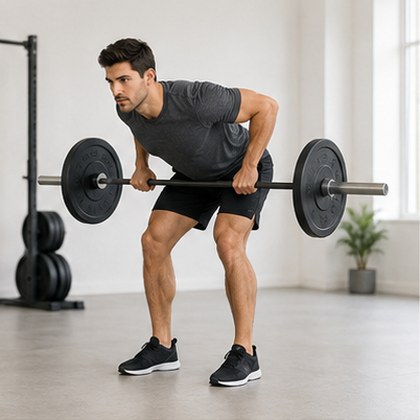 Barbell row
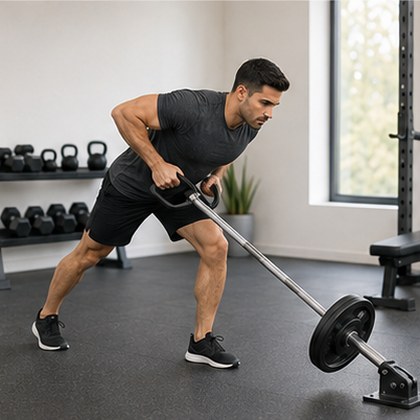 T-bar row
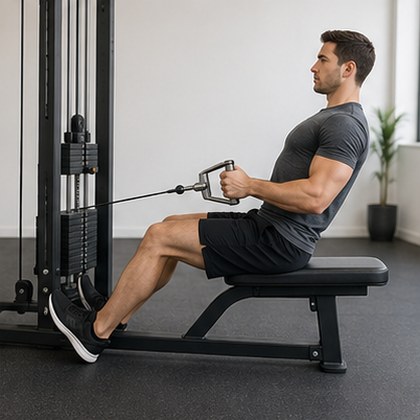 Seated cable row
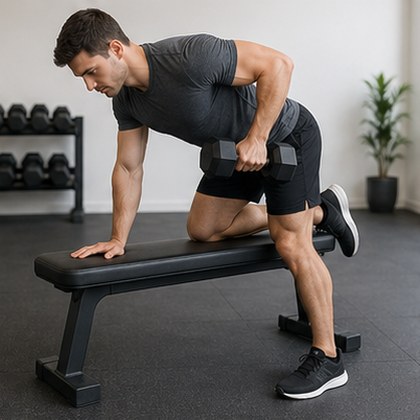 One-arm dumbbell row
Barbell row vs. one-arm dumbbell row: what's the difference
A barbell loads both sides of your back equally and puts more pressure on your lower back. A one-arm row takes load off your lower back but makes your torso resist twisting. They're two different exercises for the same muscle, and the way to choose between them is by how your lower back feels.
In Fenwick's 2009 study, the one-arm row was done on a cable machine, standing in a split stance, and spinal compression was 2,457 N versus 3,576 N in the barbell row. At the same time, the torso rotated through 67.7% of its full twisting range, and the obliques worked noticeably harder: the right internal oblique at 20.8% versus 12–13% in the other two rows. The lumbar erectors, on the other hand, got a rest: 14.7–17.3% versus 42.5–43.3% in the barbell row. The lat on the non-working side worked at only 15.4%. The measurement was done standing at a cable machine; in a dumbbell row with your hand and knee braced on a bench, your lower back should hold even less by mechanics, but this study has no numbers for that version. So a one-arm row trains only half your back at a time, and you have to do every set twice.
What this means in practice. A beginner with a sensitive lower back is better off starting with a dumbbell: one knee and the same-side hand on a bench, the other hand pulling the dumbbell toward your hip, and your torso not rotating after the dumbbell. Our benchmark for moving to a barbell: you can do a clean 3 × 12 with a 12–14 kg (26–31 lb) dumbbell as a woman or a 20–22 kg (44–48.5 lb) dumbbell as a man, and your lower back doesn't ache after the workout. If you want a thicker back and overall strength, you need the barbell: it lets you handle more total weight, and both sides work symmetrically. Many people alternate: barbell on one training day of the week, dumbbell on the other. That way your second workout of the week starts with a rested lower back.
A one-arm dumbbell row has two main rules: you pull with your elbow toward your hip while your hand only holds the dumbbell, and your torso stays parallel to the floor without turning after the weight. If the working shoulder rides up at the top and your torso rotates, the dumbbell is too heavy.
How much weight to use: an 8-week plan for women and men
Women should start with two dumbbells of 6 kg (13 lb), men with two of 10 kg (22 lb), 3 sets of 10 reps with 2–3 reps left in the tank, and switch to a barbell in week five: women to a 15 kg (33 lb) bar, men to 25 kg (55 lb).
Why not start with a barbell right away? A men's Olympic bar weighs 20 kg (44 lb). A 15 kg (33 lb) women's bar isn't in every gym, and a light 10 kg (22 lb) bar is even rarer. For someone with no experience, 20 kg (44 lb) in a bent-over position is already a weight where lower back mistakes are harder to spot than you'd like. Dumbbells go up in 1–2 kg (2–4 lb) steps and don't need a rack. On top of that, the first four weeks go into finding your angle and learning not to lift your torso on every rep, and a light weight helps with that.
The progression rule comes from the 2009 ACSM position stand: beginners use a weight they can lift 8–12 times, and once they can do 1–2 reps more than planned, they add 2–10%. With dumbbells the step is bigger than that, because neighboring dumbbells differ by 1–2 kg (2–4 lb), and going from 6 kg to 7 kg is already +17%. So after every weight change, your reps drop back to 10 and build up to 12 again.
Eight weeks of bent-over rows in numbers. Two workouts a week, 3 working sets in each. Tonnage is the volume of work per session: sets × reps × total weight. For example, 3 × 10 × (2 × 6 kg) = 360 kg (794 lb).
| Week | Women | Tonnage | Men | Tonnage | What changed |
|---|---|---|---|---|---|
| 1 | dumbbells 2 × 6 kg (2 × 13 lb), 3 × 10 | 360 kg (794 lb) | dumbbells 2 × 10 kg (2 × 22 lb), 3 × 10 | 600 kg (1,323 lb) | start |
| 2 | 2 × 6 kg (2 × 13 lb), 3 × 12 | 432 kg (952 lb) | 2 × 10 kg (2 × 22 lb), 3 × 12 | 720 kg (1,587 lb) | +2 reps per set |
| 3 | 2 × 7 kg (2 × 15.5 lb), 3 × 10 | 420 kg (926 lb) | 2 × 12 kg (2 × 26.5 lb), 3 × 10 | 720 kg (1,587 lb) | weight: +17% for women, +20% for men |
| 4 | 2 × 7 kg (2 × 15.5 lb), 3 × 12 | 504 kg (1,111 lb) | 2 × 12 kg (2 × 26.5 lb), 3 × 12 | 864 kg (1,905 lb) | +2 reps |
| 5 | 15 kg (33 lb) bar, 3 × 10 | 450 kg (992 lb) | 25 kg (55 lb) barbell (20 kg bar + 2 × 2.5 kg plates), 3 × 10 | 750 kg (1,653 lb) | switch to a barbell: +7% and +4% over the pair of dumbbells |
| 6 | 15 kg (33 lb) bar, 3 × 12 | 540 kg (1,190 lb) | 27.5 kg (60.5 lb), 3 × 10 | 825 kg (1,819 lb) | women +2 reps, men +10% weight |
| 7 | 17.5 kg (38.5 lb) (bar + 2 × 1.25 kg plates), 3 × 10 | 525 kg (1,157 lb) | 30 kg (66 lb), 3 × 10 | 900 kg (1,984 lb) | +17% for women, +9% for men |
| 8 | 17.5 kg (38.5 lb), 3 × 12 | 630 kg (1,389 lb) | 30 kg (66 lb), 3 × 12 | 1,080 kg (2,381 lb) | +2 reps |
Over 8 weeks, volume per session grows by 75% for women (from 360 to 630 kg, or 794 to 1,389 lb) and by 80% for men (from 600 to 1,080 kg, or 1,323 to 2,381 lb). In the week you switch to a barbell, tonnage dips slightly, and that's on purpose: new equipment, a new bar path, and the reps start again from 10.
A few caveats. If your gym only has a 20 kg (44 lb) bar, women can use it in week five for 3 × 8, build up to 12 reps over two weeks, and start adding plates in week seven. If you train at home without a barbell, in weeks 5–8 women can use 2 × 8 kg (2 × 17.5 lb) dumbbells and men 2 × 14–16 kg (2 × 31–35 lb), the top of the range from the home dumbbell program. The weight goes up only while your back stays flat and you keep 2–3 reps in the tank; if you can't do 12 clean reps in a given week, repeat that week. This is a typical path, and there's nothing mandatory about it: some people get through it in 6 weeks, others need 10.
A plan like this is easy to track in the Sportygram app's workout diary (go.sportygram.com; the interface and the coach are in Russian). It has three row variations — barbell, single dumbbell and two dumbbells — each with technique photos, you log weight and reps for every set, and the weight history shows when it's time to add more. If there's no free barbell on the day, you can ask the virtual coach, Alex, in chat to add a dumbbell row to today's workout: he shows a confirmation card, and once you confirm, the exercise appears in that day's plan.
How many sets and reps, and how often per week
For a beginner, 3 sets of 8–12 reps twice a week with 90–120 seconds of rest between sets is enough. Heavy sets of 3–5 reps aren't necessary in a bent-over row, and extra back volume is better picked up with other rows and pulls.
Why 8–12 reps. Schoenfeld's 2017 meta-analysis of 21 studies compared training with light loads, up to 60% of your max, and heavy loads, above 60%. When sets were taken to failure, muscles grew the same, while maximal strength improved more with heavy loads. In a bent-over row, the price of a heavy set is your lower back, which has to hold the lean under a near-maximal weight. As long as your goal is a bigger back, 8–12 reps give you the same muscle growth while your lower back holds a lighter load.
Why twice a week. The 2009 ACSM position stand recommends 2–3 sessions a week for beginners. The updated 2026 ACSM position stand, which pulls together 137 systematic reviews and more than 30,000 participants, adds detail: strength improves more with 2 or more sessions a week, and muscle grows more with 10 or more sets per muscle per week. It also has a finding that settles an old argument: the type of equipment, free weights or machines, made no consistent difference to results. So barbell versus dumbbells is a question of convenience and of your lower back.
How many sets for your back per week. 3 sets twice a week gives you 6 sets of rows. Make up the rest, up to 10, with other exercises: lat pulldowns, pull-ups or dumbbell rows. Two pulls in one session, one horizontal and one vertical, is a common setup.
Rest. For muscle growth, the 2009 ACSM position stand recommends resting 1–2 minutes between sets. In a bent-over row there's one more argument for 90–120 seconds: that time lets your lower back recover after holding the lean for a whole set.
Where to put it in your workout. The barbell bent-over row goes first or second on a back day or upper-body day, while you're fresh. If the same day has heavy deadlifts or squats, putting heavy rows after them is a bad idea: your lower back has already worked, and you'd be holding a loaded lean with tired erectors. Either split them across different days or do a chest-supported variation after deadlifts. Once the eight weeks are done, keep progressing the same way: reps first, then weight, and only one change at a time.
Mistakes: where you feel it → what to fix
A good bent-over row is felt between your shoulder blades and along the sides of your back; if your biceps, lower back or neck tire first, your form has drifted. The table below is organized by what you feel: find your row.
| Where you feel it | What's wrong | What to fix |
|---|---|---|
| Lower back on the way up | your torso rises on every rep, you're pulling with your back, the weight is too heavy | drop 10–20% of the weight, set your angle once and hold it, watch yourself from the side |
| Lower back at the bottom | your back rounds: the lean is deeper than your flexibility allows, or the bar has drifted away from your legs | raise your torso to the angle from the test, keep the bar close to your thighs |
| Biceps, but not your back | you're pulling with your hands toward your shoulders, your elbows drift forward; an underhand grip with a heavy weight | hands are hooks, pull with your elbows toward your hips, try straps, go back to an overhand grip |
| Upper traps and neck | shoulders creep up to your ears, elbows flare out | pull your shoulders down before the row, elbows along your sides, eyes on the floor |
| Front of your shoulder | the bar goes to your chest with a wide grip, elbows higher than your shoulders | row to your lower belly, elbows no higher than your back |
| Front of your thighs | your knees bend on every rep and the row turns into a squat | lock in your knee angle from the first rep |
| Nothing in your back at all | the range is too short: the bar doesn't reach your waist or your shoulder blades don't come together | pull until the bar touches, pause for one second at the top, use less weight |
| Your hands give out before your back | your grip is weaker than your back, usually from week 6–8 | straps for working sets, chalk |
| Inside of your elbow | underhand grip with a heavy barbell | overhand or neutral grip on heavy weeks |
A word on half reps. Fischer and colleagues in 2025 compared prone barbell rows lying chest-down on a bench in 16 trained men, using the full range of motion, only the top half, and only the bottom half. On average, the lats were more active in the top half of the movement, where the bar comes close to your body and your shoulder blades come together. The authors call the effect of range of motion moderate and inconsistent, and "do half reps" doesn't follow from this study. But there is a lesson for beginners: a rep that stops short loses exactly the part of the movement where the lats were more active.
Why your lower back gets tight. Some mild fatigue along your spine after a set is normal: your erectors held the lean, and in Fenwick's study they worked at 42–43% of maximum while the bar was coming up. If your lower back gets tired before your upper back, or aches for a day or two after training, one of three mistakes is to blame:
- your torso swings on every rep, and your back is lifting the weight;
- you're leaning deeper than your flexibility allows, and your lower back rounds at the bottom;
- the bar has drifted away from your legs, which lengthens the lever that loads your lower back.
The same fix works for all three: less weight, a more upright angle, the bar closer to your legs, one angle for the whole set. If your lower back still doesn't hold as well as you'd like after that, switch to a chest-supported variation for two weeks and then come back.
Sharp pain, pain shooting down your leg, or pain on one side is a reason to stop the set right away. Section 10 covers when to see a doctor about it.
Lower back, shoulders and elbows: safety, who should be careful and when to see a doctor
The barbell bent-over row is safe for a healthy back as long as your lower back stays flat and you keep reps in the tank, but of the three rows compared in the lab, it put the most load on the lower back. It's worth knowing that up front so you add weight by the rules in section 07.
Your lower back in numbers. In Fenwick's 2009 study, compression between the fourth and fifth lumbar vertebrae was 3,576 N in the barbell row, 2,457 N in the one-arm cable row and 2,339 N in the inverted row, and the difference was significant. For scale: the revised NIOSH lifting equation from the US National Institute for Occupational Safety and Health, which Waters and colleagues described in 1993, uses 3,400 N of compression on the lowest lumbar disc as its biomechanical limit for lifting loads at work. So a bent-over row, even with a weight equal to the share of body weight a person lifts in an inverted row, reaches the threshold considered the upper limit for workplace lifting. For a healthy person doing a few sets with good form, that's a normal training load. For a sore lower back, it's an argument for a chest-supported row or a one-arm dumbbell row. Ronai makes the same point in ACSM's journal in 2017: the barbell bent-over row is a core exercise for the back, the back of the shoulder girdle and the elbow flexors, but because it compresses the lower back more than other rows, it needs coaching and good technique. He advises doing it only without back pain and suggests that people with a history of back pain consider a different exercise.
Belt. A beginner doesn't need one. A belt doesn't replace good form, and with the weights from the plan in section 07 it would only hide mistakes: your lower back would be held in place by the belt, and you wouldn't notice your angle drifting. Rules like "wear a belt from such-and-such weight" get passed around gyms, but there are no measurements behind them.
Shoulders. A wide-grip row to the chest with your elbows above your shoulders at the top can pinch the tendons under the acromion, the bony tip of your shoulder blade. If you get pain at the front or side of your shoulder when you row to your chest, go back to rowing to your waist with your elbows tucked, and don't raise your elbows higher than your back.
Elbows. An underhand grip with a heavy barbell loads the inside of your elbow and the biceps tendon. Do your heavy weeks with an overhand or neutral grip, and save the underhand grip for lighter ones.
Who should start with a chest-supported or cable row and check with a doctor:
- anyone with a herniated or bulging disc during a flare-up; once the pain has settled, only with clearance from a doctor who has seen your scans;
- anyone with lower back pain that radiates into the leg, or a recent episode of acute back pain;
- late pregnancy: bending over with weight is something to discuss with your doctor, and it's usually replaced with a seated row;
- a recent surgery on your spine, abdomen or shoulder;
- osteoporosis or suspected osteoporosis: a loaded forward lean needs to be cleared first.
When you need a doctor. The pain radiates down your leg below the knee, your foot goes numb or feels weak; the pain came on suddenly, with a pop, in the middle of a set; the pain doesn't go away after 2–3 days of rest; back pain comes with a fever or problems with bladder or bowel control. What to do in the first days of back pain, and which exercises help, is covered in the guide to lower back pain exercises.
A separate note on your spinal erectors. In a bent-over row they work without moving, only holding position. If your lower back is a weak spot, add back extensions once a week for 2–3 sets of 12–15 reps: there your erectors work through a movement, from a rounded position to a flat back.
Bent-over row alternatives and what to pair it with: lat pulldown, pull-ups, deadlift
You can replace the bent-over row with any horizontal pull: a one-arm dumbbell row, a T-bar row, a seated cable row or inverted rows. The lat pulldown and pull-ups are vertical pulls, and they go alongside it as a complement.
| Where | What to do instead | What you lose |
|---|---|---|
| At home, no equipment | inverted rows under a table or on a low bar | weight steps: the load only changes with your body angle |
| At home with dumbbells | one-arm dumbbell row braced on a chair; two-dumbbell bent-over row | total weight and symmetry; the set takes twice as long |
| At home with a band | standing band row to your waist with the band under your feet | load at the bottom of the range, where the band barely pulls |
| In the gym, lower back is tired | chest-supported row, T-bar with a chest pad, seated cable row | the work of the spinal erectors that held the lean |
| In the gym, you want strength | Pendlay row from the floor | how easy it is to learn: it takes flexibility and a rigid torso |
| In the gym, no barbell free | T-bar row, seated cable row with a parallel handle | nothing important; a neutral grip is often more comfortable |
Bent-over row or pull-ups. They work in different planes: in a row you pull the weight toward you, in a pull-up you pull yourself up. On the bar your lats work very hard, but pull-ups take strength that a beginner doesn't have yet. If you can't do a pull-up yet, follow the step-by-step path to your first pull-up, where inverted rows are one of the early stages. If you can already do pull-ups, do both: one builds width, the other builds thickness.
Bent-over row and lat pulldown. It's the same pairing, only a cable machine works for anyone: you can set it to 20 kg (44 lb) or less. Grips and angles for the machine are covered in the lat pulldown guide. Put them together in your back workout: first the horizontal barbell row while your lower back is fresh, then the vertical pull on the machine.
Deadlifts and bent-over rows in the same week. Both load your spinal erectors, so it's better not to put them on the same day. A common setup: deadlifts on leg day on Monday, bent-over rows on back day on Thursday, with 2–3 days in between so your lower back can recover. If your schedule forces them onto the same day, do the rows first with a light weight, or swap them for a chest-supported variation. And to clear up a common mix-up: a deadlift and a bent-over row are different lifts even though both start in a hinge. In a deadlift your hips move and your torso rises out of the lean. In a bent-over row your torso stays still and your arms move.
Questions and answers
What muscles does the bent-over row work?
The lats, the muscles between your shoulder blades (the middle and lower traps and the rhomboids), the rear delts and the biceps. Your spinal erectors hold the lean for the whole set. In Fenwick's 2009 study, the lats worked at 53.4% of maximum, the lumbar erectors at 42–43% and the glutes at 19%: they hold your pelvis and work lightly.
Overhand or underhand grip: which is better?
An overhand grip a little wider than your shoulders is the default, and it's where you start. An underhand grip adds more biceps: in Zyznawska's 2025 study of bar pulls, the biceps worked significantly harder with an underhand grip (p < 0.001), and Vasconcelos's 2023 study on the seated cable row found the same. Rotate them in blocks, 4–6 weeks overhand and 4–6 weeks underhand, and with a heavy barbell protect the inside of your elbow by staying overhand.
What angle should you lean at in a barbell row?
About 45° for most people. Parallel to the floor only if your lower back stays flat at that depth, which you can check with the empty bar test from section 03. The deeper the lean, the more your lower back has to hold: in Fenwick's study, the lumbar spine flexed by 22.9° in the barbell bent-over row and took 3,576 N of compression.
Should you row to your waist or to your chest?
Rowing to your waist with your elbows tucked works your lats harder, and you can pull more weight. Rowing to your chest with a wide grip and your elbows at 90° works your mid-back and rear delts harder: in García-Jaén's 2021 study, the upper traps worked at 95.7% with flared elbows versus 50.7% with tucked elbows, and the rear delts at 81.7% versus 64.7%, though with three participants the difference wasn't significant. Vasconcelos in 2023 got the same picture on a seated cable row in 21 people, this time with a significant difference. Choose by your goal, and keep the row to your waist as your base.
What weight should a beginner or a woman start with?
Women: 6 kg (13 lb) dumbbells, 3 sets of 10, a 15 kg (33 lb) women's bar by week five and 17.5 kg (38.5 lb) by week seven. Men: 10 kg (22 lb) dumbbells, a 25 kg (55 lb) barbell by week five and 30 kg (66 lb) by week seven. Progress by the 2009 ACSM rule: when you can do 1–2 reps more than planned, add 2–10% to the weight, and only while your back stays flat.
Why does my lower back hurt after bent-over rows, and can I do them with a herniated disc?
There are three causes: your torso swings on every rep, you lean deeper than your flexibility allows and your lower back rounds, or the bar drifts away from your legs. Of the three rows compared, this one loads the lower back the most, 3,576 N in Fenwick's study, so with a herniated disc during a flare-up it's put on hold: people switch to a chest-supported or cable row and see a doctor. If the pain shoots down your leg, your foot goes numb, or the pain came on suddenly with a pop, see a doctor right away.
What can I do instead of barbell rows at home or in the gym?
At home: a one-arm dumbbell row braced on a chair, a two-dumbbell bent-over row, a backpack filled with books, or inverted rows under a table. In the gym: a T-bar row, a chest-supported row or a seated cable row. Lat pulldowns and pull-ups work in a vertical plane, so they complement the bent-over row, and neither one fully replaces it.
Barbell bent-over row or one-arm dumbbell row: which is better?
A barbell works your whole back symmetrically and lets you use more total weight, while a one-arm row takes load off your lower back: in Fenwick's study, a standing one-arm cable row produced 2,457 N of compression versus 3,576 N, but the torso twisted through 67.7% of its full rotation range and the obliques worked harder. With your hand and knee braced on a bench, your lower back should get even more of a break by mechanics. A beginner with a sensitive lower back should start with a dumbbell, then after a month or two move to a barbell or alternate the two across training days.
The bottom line
- The bent-over row is a pull of the bar to your lower belly from a fixed lean: an angle of about 45° is set once and held to the end of the set, and only your shoulder blades and arms move.
- Your lats and the muscles between your shoulder blades do the main work, your biceps help, and your spinal erectors hold the position: 53.4% and 42–43% of maximum in Fenwick's 2009 study.
- An overhand grip to your waist with tucked elbows targets your lats and strength; a wide grip to your chest with flared elbows targets your mid-back and rear delts; an underhand grip adds biceps (Vasconcelos, 2023; García-Jaén, 2021; Zyznawska, 2025).
- Of the three rows compared, this one loads the lower back the most: 3,576 N versus 2,339–2,457 N, while the NIOSH limit for workplace lifting is 3,400 N. That's why the weight goes up last, and people with a history of back pain are better off with a different row (Ronai, 2017).
- Start with 2 × 6 kg (2 × 13 lb) dumbbells for women and 2 × 10 kg (2 × 22 lb) for men, 3 × 10 twice a week, and switch to a barbell in week five; over 8 weeks, tonnage grows by 75–80%.
- 8–12 reps grow muscle as well as heavy sets of five (Schoenfeld, 2017); aim for two sessions a week and 10 sets a week for your back, counting other pulls (ACSM, 2009 and 2026).
- If your lower back gets tight, use less weight, a more upright angle and keep the bar closer to your legs; pain down the leg, numbness or a sudden sharp pain means seeing a doctor.
Checklist: bent-over rows at your first workout
- Your torso angle is set with the empty bar test: hips pushed back, lower back flat.
- The bar comes off the floor through a deadlift, with a flat back.
- Feet hip-width apart, knees slightly bent and not changing angle.
- Overhand grip, a little wider than your shoulders, thumbs wrapped around the bar.
- Eyes on the floor 1–2 m (3–6 ft) ahead, neck in line with your back.
- The bar goes to your lower belly, elbows along your sides, a one-second pause at the top.
- Lowering takes 1–2 seconds to straight arms, and your shoulder blades drift forward.
- Your torso holds one angle from the first rep to the last, checked from the side.
- The weight leaves 2–3 reps in the tank, and no belt.
- Sets, weight and reps are logged in your diary.
Sources
- Fenwick C.M.J., Brown S.H.M., McGill S.M. Comparison of Different Rowing Exercises: Trunk Muscle Activation and Lumbar Spine Motion, Load, and Stiffness. Journal of Strength and Conditioning Research, 2009. — 7 healthy men, three rows with matched loads: L4/L5 compression was 3,576 N in the barbell bent-over row, 2,457 N in the one-arm standing cable row and 2,339 N in the inverted row; lumbar flexion of 22.9° in the bent-over row versus 2.8°; lats at 53.4% in the barbell row and 64.8% in the inverted row; lumbar erectors at 42.5–43.3%; in the one-arm row the torso twisted through 67.7% of its full rotation range.
- Waters T.R., Putz-Anderson V., Garg A., Fine L.J. Revised NIOSH equation for the design and evaluation of manual lifting tasks. Ergonomics, 1993. — The revised NIOSH equation for workplace lifting: the biomechanical criterion is L5/S1 disc compression no higher than 3.4 kN (3,400 N).
- García-Jaén M., Sanchis-Soler G., Carrión-Adán A., Cortell-Tormo J.M. Electromyographical responses of the lumbar, dorsal and shoulder musculature during the bent-over row exercise: a comparison between standing and bench postures (a preliminary study). Journal of Physical Education and Sport, 2021. — A preliminary study of 3 experienced participants with 12 kg dumbbells: lumbar erectors at 70.7–74.7% standing at 45° and 23.7–52.7% chest-supported on a bench at 47°; rear delts at 81.7% with flared elbows versus 64.7% with tucked elbows, upper traps at 95.7% versus 50.7%; lats at 43–44% standing; the differences were not statistically significant.
- Vasconcelos C.M.W.A., Lopes C.R., Almeida V.M., Krause Neto W., Soares E.G. Effect of Different Grip Position and Shoulder-Abduction Angle on Muscle Strength and Activation During the Seated Cable Row. International Journal of Strength and Conditioning, 2023. — 11 men and 10 women, seated cable row: force was higher with the elbows close to the body with every grip and dropped with abduction to 60° and 90°; the traps and rear delts increased with elbow abduction, the lats with the elbows close to the body; the biceps was lowest with an overhand grip and higher with underhand, neutral and wide grips with abducted elbows; peak force did not differ significantly between overhand, underhand and neutral grips.
- Zyznawska J., Wodka-Natkaniec E., Kamirski B. Optimization of hand position on the bar for strengthening biceps brachii and latissimus dorsi during strength training. Acta of Bioengineering and Biomechanics, 2025. — 31 students (12 men and 19 women), bar pulls with overhand and underhand grips at two arm angles: the biceps was significantly more active with the underhand grip (p < 0.001).
- Fischer J., Burger C., Seguel J.M., Rodoplu C., Paternoster F.K., Tilp M., Konrad A. Impact of different ranges of motion in the prone barbell row on muscle excitation. Journal of Electromyography and Kinesiology, 2025. — 16 trained men, prone barbell row on a bench with a 10RM load through the full range, the top half and the bottom half: the lats were on average more active in the top half; no difference for the rear delts and biceps; the authors describe the effect of range of motion as moderate and inconsistent.
- Ronai P. The Barbell Row Exercise. ACSM's Health & Fitness Journal, 2017. — The barbell bent-over row as a core multi-joint exercise for the back, the back of the shoulder girdle and the elbow flexors; because it compresses the lower back more than other rows, it requires coaching and good technique; it should be done without back pain, and people with a history of back pain should consider a different exercise.
- Schoenfeld B.J., Grgic J., Ogborn D., Krieger J.W. Strength and Hypertrophy Adaptations Between Low- vs. High-Load Resistance Training: A Systematic Review and Meta-analysis. Journal of Strength and Conditioning Research, 2017. — 21 studies: with sets taken to failure, muscles grow equally with light (≤ 60% of max) and heavy loads, while maximal strength improves more with heavy loads.
- American College of Sports Medicine. Progression models in resistance training for healthy adults. Medicine & Science in Sports & Exercise, 2009. — Beginners should use a load that allows 8–12 reps and add 2–10% once they can do 1–2 extra reps; 2–3 sessions a week; a moderate tempo of 1–2 seconds up and down; 1–2 minutes of rest for muscle growth.
- Currier B.S., D'Souza A.C., Singh M.A.F. et al. American College of Sports Medicine Position Stand. Resistance Training Prescription for Muscle Function, Hypertrophy, and Physical Performance in Healthy Adults: An Overview of Reviews. Medicine & Science in Sports & Exercise, 2026. — 137 systematic reviews, more than 30,000 participants: muscle growth is greater with 10 or more sets per muscle per week, strength with 2 or more sessions per week; equipment type and training to failure made no consistent difference.
This article is for informational purposes only and is not a substitute for medical advice.