

the road to your first pull-up is a series of stages, not throwing yourself at the bar every day. Train 2–3 times a week for 20–25 minutes, rest a day between workouts and end every set 1–2 reps short of failure.Your timeline depends on where you start and what you weigh: 1–2 months with some base, 3–6 months from scratch. Weight matters a lot: based on one experiment, an extra 10% of body mass cuts the number of pull-ups you can do by 53%, roughly in half. The level test is in section 01. Repeat it every two weeks.
To learn how to do a pull-up from scratch, work through four stages: dead hangs, then inverted rows (pulling your chest to a low bar with your heels on the floor) and scapular pulls, then slow negatives and band-assisted pull-ups, and finally your first full rep. Two or three 20–25 minute workouts a week are enough, and you never need to take a set to failure. If you can hang for 40 seconds, do 12 inverted rows and take 3 seconds to lower yourself from the bar, your first pull-up usually comes in 1–2 months. Starting from scratch, or carrying extra weight, expect 3–6 months. Begin with the 5-minute level test: it tells you which stage to start at.
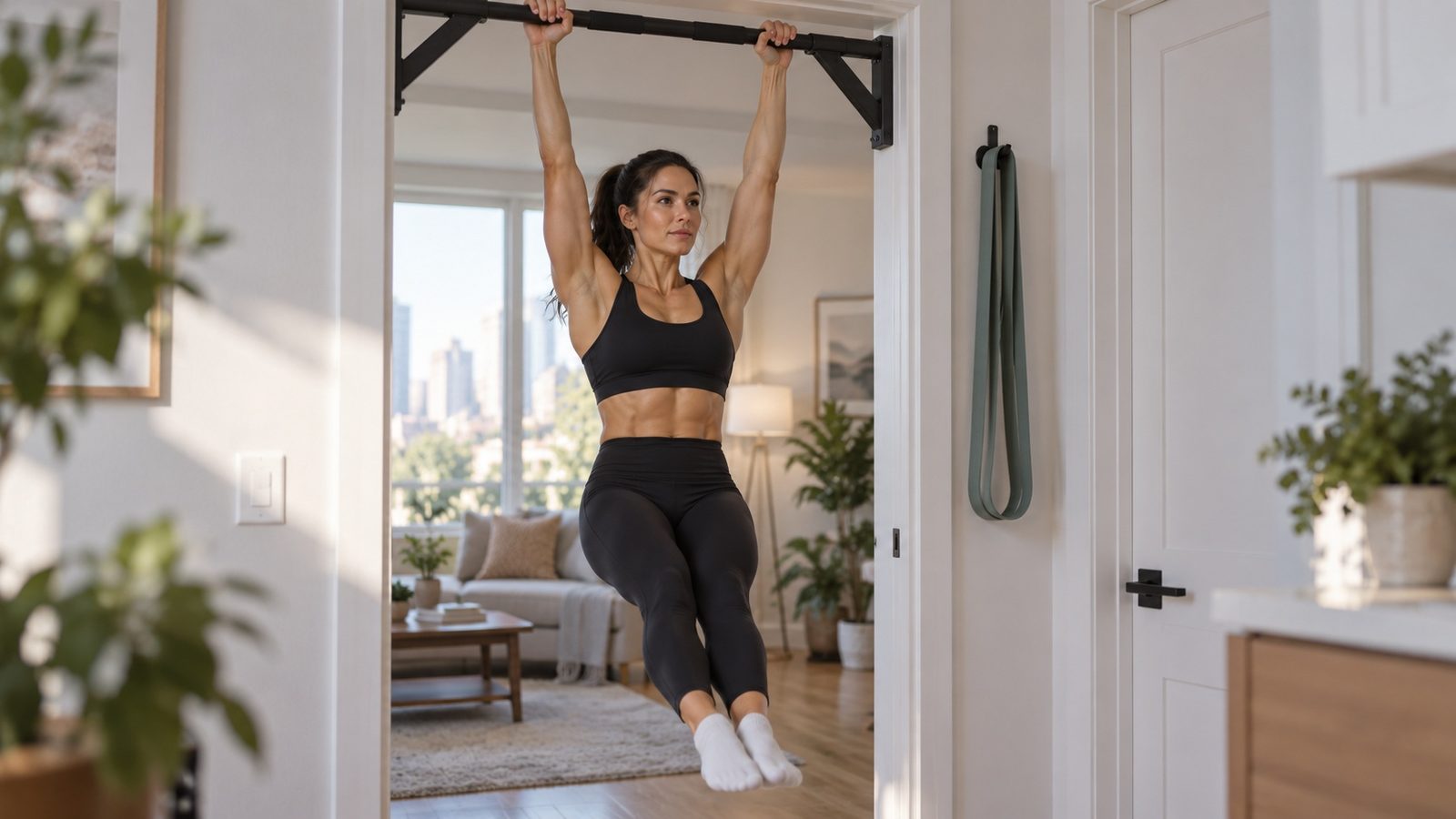
Test your level in 5 minutes
"Just start by hanging from the bar" isn't advice that works for everyone. Some people can hang for a minute but have a weak back. Others are strong, but their fingers give out after 15 seconds. So begin with four quick tests. Do them after an 8–10 minute warm-up, once each, and write down the results with the date.
- Dead hang. Hang from the bar with straight arms, palms facing away. Time how long you can hold on before your fingers start to slip.
- Scapular pulls. From the hang, keep your arms straight and pull your shoulders down, away from your ears. Your body will rise slightly. Then lower back down. Count the clean reps.
- Inverted rows (also called Australian pull-ups). Set a bar at waist height: a low bar or a barbell in a squat rack. Lie under it with your heels on the floor and your body straight. Pull your chest to the bar. Count reps until your hips start to sag.
- Slow negative. Stand on a box, grab the bar and get your chin over it. Take your feet off and lower yourself to straight arms. Time how many seconds the descent takes while you're still in control.
If your results land in different rows, pick the lower stage.
| Test result | Stage | Where you start | First pull-up usually in |
|---|---|---|---|
| Hang under 20 s or fewer than 5 inverted rows | Foundation | Dead hang, inverted rows on a high bar, bent-over dumbbell row, plank | 3–6 months or longer |
| Hang 20–40 s, 5–12 inverted rows, negative under 3 s | Scapular pulls and rows | Scapular pulls, inverted rows on a lower bar, short negatives | 2–4 months |
| Hang 40 s or longer, 12 or more inverted rows, negative 3–8 s | Negatives and a band | Slow negatives, band-assisted pull-ups | 1–2 months |
| Negative 8 s or longer, or 3 sets of 5 reps with a light band | First pull-up | Single attempts while you're fresh, plus negatives | 1–4 weeks |
These cutoffs and timelines come from coaching practice, not from a study. In one study, college women followed a strength and aerobic training program to learn the pull-up, and not all of them could do one by the end. The women who made it were stronger, including relative to their body weight. The researchers built an equation from body fat and strength that predicts who will succeed. So if you're carrying extra weight, start one stage lower.
Four stages to your first pull-up and when to move on
In a pull-up you lift your whole body, and you can't strip a plate off the way you can with a barbell. So two things decide how it goes: how strong your back, arms and grip are, and how much you weigh.
Stage 0. Foundation. Your hands learn to hold your weight, and your back learns to pull. The dead hang builds grip. Inverted rows on a high bar are the same pulling motion, but your feet take some of the load: the higher the bar, the easier it gets. The bent-over dumbbell row trains your back at home, and the plank teaches you to keep your body tight. Move on when you can hang for 30 seconds and do 3 sets of 8 inverted rows.
Stage 1. Scapular pulls and rows. Every pull-up starts with your shoulder blades: first your shoulders move down, then your arms bend. Skip this step and you end up pulling with your arms alone. Your inverted rows move to a waist-height bar, and you add your first 3-second negatives. Move on when you can do 3 sets of 10 inverted rows and 3 sets of 8 scapular pulls.
Stage 2. Negatives and a band. Negatives build strength through the whole range of motion, and the band lets you do full pull-ups right now. Move on when a negative lasts 8–10 seconds or you can do 3 sets of 5 with a light band.
Stage 3. First pull-up. You have almost enough strength. What's missing is the skill. Try single pull-ups while you're fresh and keep doing negatives.
The myth that women just can't do pull-ups doesn't hold up. The stages are the same, but the road is often longer, because upper-body and grip strength are lower on average. What matters is strength relative to body weight, not sex. The same stage-by-stage approach works for push-ups for beginners. The two make a good pair: one exercise pushes, the other pulls.
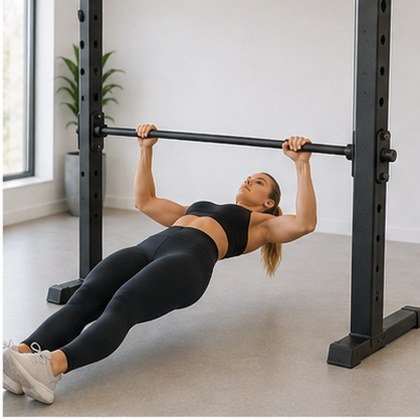 Inverted row
Your training plan for each stage: sets, reps and a sample week
General rules:
- 2–3 workouts a week, 20–25 minutes each, with a rest day in between.
- End each set 1–2 reps short of failure. Failure is the point where you can't do one more clean rep. A review of 15 studies found that strength grows the same whether you train to failure or stop short.
- Rest 2–3 minutes after hard sets and 1–1.5 minutes after easier ones. For why you shouldn't cut those breaks short, see our guide to rest between sets.
- Do the hardest exercise first, and save hangs and grip work for the end.
Stage 0: inverted rows on a high bar, 3 sets of 6–8; bent-over dumbbell row, 3 sets of 10 per arm; plank, 3 sets of 30 seconds; dead hang, 3 sets of 15–20 seconds.
Stage 1: negatives, 2 sets of 3 reps, 3 seconds each; inverted rows at waist height, 3 sets of 8–10; scapular pulls, 3 sets of 6–8; dead hang, 3 sets of 30 seconds.
Stage 2: negatives, 3–4 sets of 3 reps, 5 seconds each; band-assisted pull-ups, 3 sets of 5–6; inverted rows, 3 sets of 10; dead hang for time, 2 sets.
Stage 3: at the start of the workout, 3–5 pull-up attempts with 2–3 minutes of rest; negatives, 3 sets of 3 reps, 5–8 seconds each; band-assisted pull-ups, 3 sets of 5.
If you can't complete an attempt, do a jumping pull-up: stand on a box, push off lightly with your legs, get your chin to the bar and lower yourself slowly. After your first clean rep, switch to a ladder: sets of 1, 1, 2, 1 and 2 reps with 2 minutes of rest between them.
A week at stage 2 with three workouts:
| Day | What to do |
|---|---|
| Monday | Negatives, band, inverted rows, hang |
| Tuesday | Rest |
| Wednesday | Negatives, band, inverted rows, hang |
| Thursday | Rest |
| Friday | Negatives, band, inverted rows, hang; every other week, the test from section 01 instead |
| Weekend | Rest |
if two tests in a row show no progress, don't add more workouts. Check four things instead. Are you sleeping 7–9 hours? Are you training more than three times a week? Is your weight creeping up? Does your grip give out before your back does?
Pull-up bands: which one to get for your weight and how to set it up
A pull-up band is a thick latex loop. You attach it to the bar and put your foot in it. At the bottom, the band stretches and helps push you up. The wider it is, the more it helps.
The rule: pick the band that lets you do 5–8 clean reps, from straight arms to your chin over the bar. If you can't get 3 reps even with the thickest band, it's too early for bands. Go back to negatives and inverted rows.
Brands list how much assistance each band gives, but the numbers vary a lot from one brand to the next. So treat the table as a rough guide and let the 5–8 rep rule decide.
| Band width | Approximate assistance | Good starting point for |
|---|---|---|
| 1/2–3/4 in (1.3–2 cm) | 10–45 lb (5–20 kg) | People who can almost do a pull-up |
| about 1 1/4 in (3 cm) | 35–75 lb (15–35 kg) | Body weight up to 130 lb (60 kg) |
| about 1 3/4 in (4.5 cm) | 45–120 lb (20–55 kg) | Body weight 130–175 lb (60–80 kg) |
| about 2 1/2 in (6.5 cm) | 65–155 lb (30–70 kg) | Over 175 lb (80 kg), or two bands together |
How to set it up without getting snapped in the face:
- loop the band over the bar, pull one end through the other and cinch it tight;
- put your foot in the loop: it's more stable than your knee;
- step into the loop from a box instead of jumping into it;
- check the band for nicks and tears before each workout, and toss any band that's cracked;
- get out while holding the bar: take your foot out first, then step down.
Bands have a catch. They help most at the bottom, with your arms straight, which is exactly where a beginner needs their own strength. That's why the plan always pairs the band with negatives. When 3 sets of 8 feel easy, switch to a lighter band. Spending months on the thickest one is a common mistake. Mini bands for legs and glutes are a different thing; they're covered in our resistance band workout guide.
Negative pull-ups: how to lower slowly and how many to do
A negative pull-up is a pull-up in reverse: instead of pulling up, you lower yourself slowly from the top to straight arms. Your muscles can lower more weight than they can lift. That's why you can do a negative long before you can do a pull-up.
How to do it:
- Put a sturdy box, bench or solid stool under the bar.
- Stand on it, grab the bar, get your chin over it and keep your elbows tucked in.
- Take your feet off and lower yourself while counting out loud to five.
- Lower at an even pace all the way down, and don't drop at the bottom.
- Step back onto the box. Don't jump up.
How many: 3–4 sets of 3 reps, 20–30 seconds between reps, 2 minutes between sets. Once a negative takes less than 3 seconds, the set is over.
Negatives are your main tool on the way to your first pull-up. A review of 20 studies found that heavy lowering-focused training builds more overall strength than lifting-focused training. But the biggest gain is in lowering strength itself, so you still need band-assisted pull-ups and attempts.
Be ready: after your first few workouts with negatives, your muscles will be sorer than usual. Slow lowering causes the worst muscle soreness (DOMS). After 2–3 of these workouts the soreness eases noticeably as your muscles get used to the load.
First pull-up technique: grip, active hang, elbows down
First, learn the difference between a passive and an active hang. In a passive hang, you're relaxed and your shoulders ride up by your ears. Pulling from there is hard and uncomfortable for your shoulders. In an active hang, your arms are straight, but your shoulders are pulled down and your chest is slightly forward. That's where a pull-up begins.
- Grip slightly wider than your shoulders, thumbs wrapped around the bar.
- Start from an active hang: arms straight, shoulders down.
- Body tight: abs and glutes braced, legs together and slightly forward, no swinging.
- Drive your elbows down toward your ribs instead of reaching your chin for the bar. That way your back does the work, not just your arms.
- At the top, your chin clears the bar. Don't crane your neck.
- Lower slowly and evenly to nearly straight arms.
Which grip is easiest for your first rep? Many people find the underhand grip easier: palms facing you, hands shoulder-width apart. Your biceps help more in that position. (Strictly speaking, that version is called a chin-up.) The overhand grip is a bit harder, and a wide grip is harder still, so save it for later.
A rep doesn't count if your arms stay bent at the bottom, you kick or swing, or your chin doesn't clear the bar.
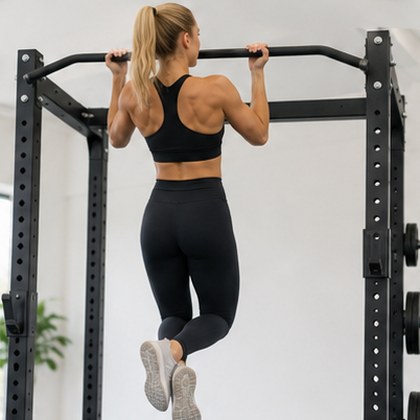 Chin-up
If your grip gives out before your back: how to train it
Notice what gives out first on your last rep. If your back still has more in it but your fingers are opening, your grip is the weak link. At the end of your workout, add one of these three:
- a dead hang for time: 2–3 sets, as long as you can;
- a towel hang: drape a towel over the bar and hold both ends;
- heavy dumbbell holds with your arms at your sides: 3 sets of 20–30 seconds.
In a small study, 30 inactive young men did the same pull-up program twice a week for 8 weeks, with a different add-on in each group. With forearm and grip exercises, pull-ups rose from 4.0 to 12.9 reps, a 222% increase. With core exercises, they rose from 2.7 to 6.5, and with interval training, from 4.3 to 7.0. The participants could already do pull-ups at the start, so this isn't a rule for beginners, but it's a strong reason not to skip grip work.
At the gym: assisted pull-up machine, lat pulldown or band?
An assisted pull-up machine uses a counterweight: you kneel on a pad, and it pushes you up. A lat pulldown is a machine where you sit and pull a bar down toward your chest.
| Option | What it's good for | The trap |
|---|---|---|
| Slow negatives | Strength through the whole range of motion, and all you need is a bar | Dropping fast in the second half |
| Band | Full pull-ups right now | Months on the thickest band |
| Assisted pull-up machine | Helps evenly all the way up | Years with a heavy counterweight |
| Lat pulldown | Easy to set the exact weight, and your grip barely limits you | You don't hold your own body weight, and your core works less |
On the assisted machine, progress means less counterweight, not more. The more weight you select, the more the machine does for you.
If all you have is a bar at home, negatives and a band are enough. At the gym, add the lat pulldown, and use either the assisted machine or a band. Keep negatives in every workout.
Body weight and pull-ups: why even 10 pounds makes a difference
In a 1997 experiment, researchers had fit young men do pull-ups with extra weight attached. From the results, they calculated that an extra 10% of body mass cuts the number of pull-ups by 53%, roughly in half. For a 155-lb (70 kg) person, that's only about 15 lb (7 kg).
Carrying an extra 11–15 lb (5–7 kg) is like doing pull-ups with a kettlebell strapped to your waist. The same strength at a lower body weight brings your first rep closer. But don't crash diet to get there: when you eat far too little, strength builds more slowly. A better approach is to eat at your calorie target, get enough protein and track both in a food log.
When pain means stop: shoulders, elbows, wrists
Your shoulders and elbows aren't used to pull-ups, so some fatigue and muscle soreness in the first few weeks is normal. The key is telling normal discomfort apart from pain that means you should stop.
| Normal | Stop and see a doctor |
|---|---|
| Tired back and arms after a workout | Sharp or shooting pain in your shoulder or elbow during the movement |
| Sore muscles for 1–3 days after negatives | A painful click in the joint |
| Calluses and sore palms | Numbness or tingling in your fingers |
| Tired fingers that lose their grip | Joint pain that lasts longer than a week or shows up at night |
If you've had an injury or surgery on your shoulder, elbow or back, start pull-ups only after your doctor clears you. If your shoulder aches after the gym, see our guide to shoulder pain from lifting.
How to track your progress in the Sportygram workout log
If you don't write things down, it can feel like nothing is changing. Two weeks of numbers usually prove otherwise.
If you track workouts in the Sportygram app, its exercise library has inverted rows, chin-ups, the lat pulldown, the bent-over dumbbell row and the plank. You can add them to your plan and log every set. Hangs, scapular pulls and negatives aren't in the library yet, so write down your test times with the date in a note on your phone.
When you move to a new stage, swap the exercises in your plan and keep logging. Your workout log then shows how your sets and reps grow week by week.
FAQ
How long does it take to learn to do a pull-up from scratch?
It depends on your starting point and your weight. If you can hang for 40 seconds, do 12 inverted rows and take 3 seconds to lower yourself, expect your first pull-up in 1–2 months. From scratch or with extra weight, it's 3–6 months, sometimes longer. Nothing is guaranteed: in the study of college women, not all of them got a pull-up by the end. Take the test in section 01 and repeat it every two weeks.
I can't do a single pull-up. Where do I start?
With the level test in section 01. Most people who can't do a single pull-up start at stage 0 or 1: dead hangs, inverted rows, scapular pulls and bent-over dumbbell rows. Train 2–3 times a week and stop short of failure. Don't throw yourself at the bar every day: fatigue builds up, your technique falls apart and your strength stops growing.
How do I choose a pull-up band for my weight?
Pick one that gives you 5–8 clean reps, from straight arms to chin over the bar. As a rough guide: up to 130 lb (60 kg), start with a 1 1/4 in (3 cm) band; at 130–175 lb (60–80 kg), a 1 3/4 in (4.5 cm) band; heavier than that, a 2 1/2 in (6.5 cm) band or two bands. Brands rate assistance differently, so let your reps decide. When 3 sets of 8 feel easy, go lighter.
Can I do pull-ups every day, or should I rest a day in between?
For a beginner, every other day, 2–3 times a week, works better: strength builds between workouts. If you do pull-ups to failure every day, fatigue piles up and progress stalls. The most you should do daily is a couple of 20–30 second hangs. Save negatives, bands and inverted rows for training days, with a rest day between them.
How can a woman learn to do a pull-up?
The path is the same: dead hang, inverted rows, negatives, a band, then the first pull-up. For women it's often longer, because upper-body and grip strength are lower on average. What matters is strength relative to body weight, not sex. At home, a doorway pull-up bar, a band and a sturdy box for negatives are all you need. Train your grip separately with hangs and dumbbell holds.
What are negative pull-ups and how do you do them?
A negative is a slow lowering from the top of a pull-up. Stand on a sturdy box and grab the bar with your chin above it. Take your feet off and lower yourself for 5 seconds to nearly straight arms, counting out loud. Step back onto the box. Do 3–4 sets of 3 reps, with 20–30 seconds between reps and 2 minutes between sets.
What's better for beginners: an assisted pull-up machine, a band or the lat pulldown?
They all work, as long as two things are true: every workout includes negatives, and the assistance goes down over time. With a band, move to a lighter one. On the assisted machine, lower the counterweight. The lat pulldown builds your back well, but it doesn't teach you to hold your own weight on the bar. The table in section 08 compares all four options and their traps.
How long should you dead hang, and does hanging help you learn pull-ups?
A solid 30–40 second hang is enough to start. Hanging trains your grip and gets your shoulders used to holding your weight, but it doesn't teach you to pull: you can hang for two minutes and still not do a single pull-up. So the hang is only part of the plan. Add inverted rows, scapular pulls and negatives, and put the hang at the end of your workout.
The bottom line
- You can learn to do a pull-up from scratch in stages: dead hang, scapular pulls and inverted rows, negatives and a band, then your first pull-up.
- Start with the 5-minute test and repeat it every two weeks. With some base, the path takes 1–2 months; from scratch or with extra weight, 3–6 months.
- Train 2–3 times a week for 20–25 minutes, ending each set 1–2 reps short of failure.
- Negatives are your main tool. Pick a band that gives you 5–8 clean reps and move to a lighter one over time. On the assisted machine, lower the counterweight.
- Grip giving out before your back? Train it. Sharp joint pain, a painful click or numb fingers mean stop and see a doctor.
Checklist: 20 minutes on the bar
- Warm up for 8–10 minutes.
- Every two weeks, test instead of training: hang, scapular pulls, inverted rows, negative. Write down the results with the date.
- Do 3–4 exercises from your stage, the hardest one first.
- End each set 1–2 reps short of failure, and rest 2–3 minutes after hard sets.
- Check your band for tears and step into the loop from a box.
- Finish with a dead hang or dumbbell holds.
- Log your sets in your workout log.
- Take a rest day between workouts.
Sources
- Vanderburgh P. M., Edmonds T. The effect of experimental alterations in excess mass on pull-up performance in fit young men. Journal of Strength and Conditioning Research, 1997. — 30 fit young men did pull-ups with added mass; the authors calculated that an extra 10% of body mass reduces pull-up reps by 53%.
- Flanagan S. P., Vanderburgh P. M., Borchers S. G., Kohstall C. D. Training college-age women to perform the pull-up exercise. Research Quarterly for Exercise and Sport, 2003. — After a combined strength and aerobic program, the women who could do a pull-up were stronger, including relative to body weight; the authors built an equation that predicts success from body fat and strength.
- Sepehri Rahnama H., Ganji S., Vadasz K., Prokai J. Comparative effects of core versus forearm training on pull-up repetition performance in physically inactive males. Sports (Basel), 2025. — Over 8 weeks, pull-ups rose from 4.0 to 12.9 reps with forearm training added, from 2.7 to 6.5 with core training and from 4.3 to 7.0 with interval training.
- Grgic J., Schoenfeld B. J., Orazem J., Sabol F. Effects of resistance training performed to repetition failure or non-failure on muscular strength and hypertrophy: a systematic review and meta-analysis. Journal of Sport and Health Science, 2022. — A review of 15 studies: strength and muscle size grow about the same with or without training to failure.
- Roig M. et al. The effects of eccentric versus concentric resistance training on muscle strength and mass in healthy adults: a systematic review with meta-analysis. British Journal of Sports Medicine, 2009. — A review of 20 trials: heavy eccentric (lowering) training increased overall strength and eccentric strength more than concentric (lifting) training.
This material is for informational purposes and does not replace medical advice.