

learning push-ups from zero takes six steps: wall, table, chair or knees, a 12-inch (30 cm) support, negatives, floor. On the floor your arms hold 64% of your body weight, on a 12-inch support 55%, on your knees 49%. Every extra 10 lb of body weight puts about 6–7 more lb on your arms in a floor push-up.Train 3 times a week: 3 sets of 8–12, ending each set 1–2 reps short of failure. Rough timelines: from knee push-ups to your first five floor push-ups, 6–10 weeks; from the wall, 2–4 months.
Push-ups for beginners are easiest to learn as a ladder of support heights: a wall, a table, a chair or your knees, a low step, negatives on the floor and, finally, the floor itself. The higher your hands, the less weight your arms hold. On the floor your arms hold about 64% of your body weight, and on your knees about 49%. That's a big gap, so there are two more steps between your knees and the floor. Start at the height where you can do 8–12 clean reps, with a straight body and a full range of motion. Lower the support once you hit 3 sets of 12 in two workouts in a row. Three 15–20 minute workouts a week are enough. A 10-minute test shows which step is yours.
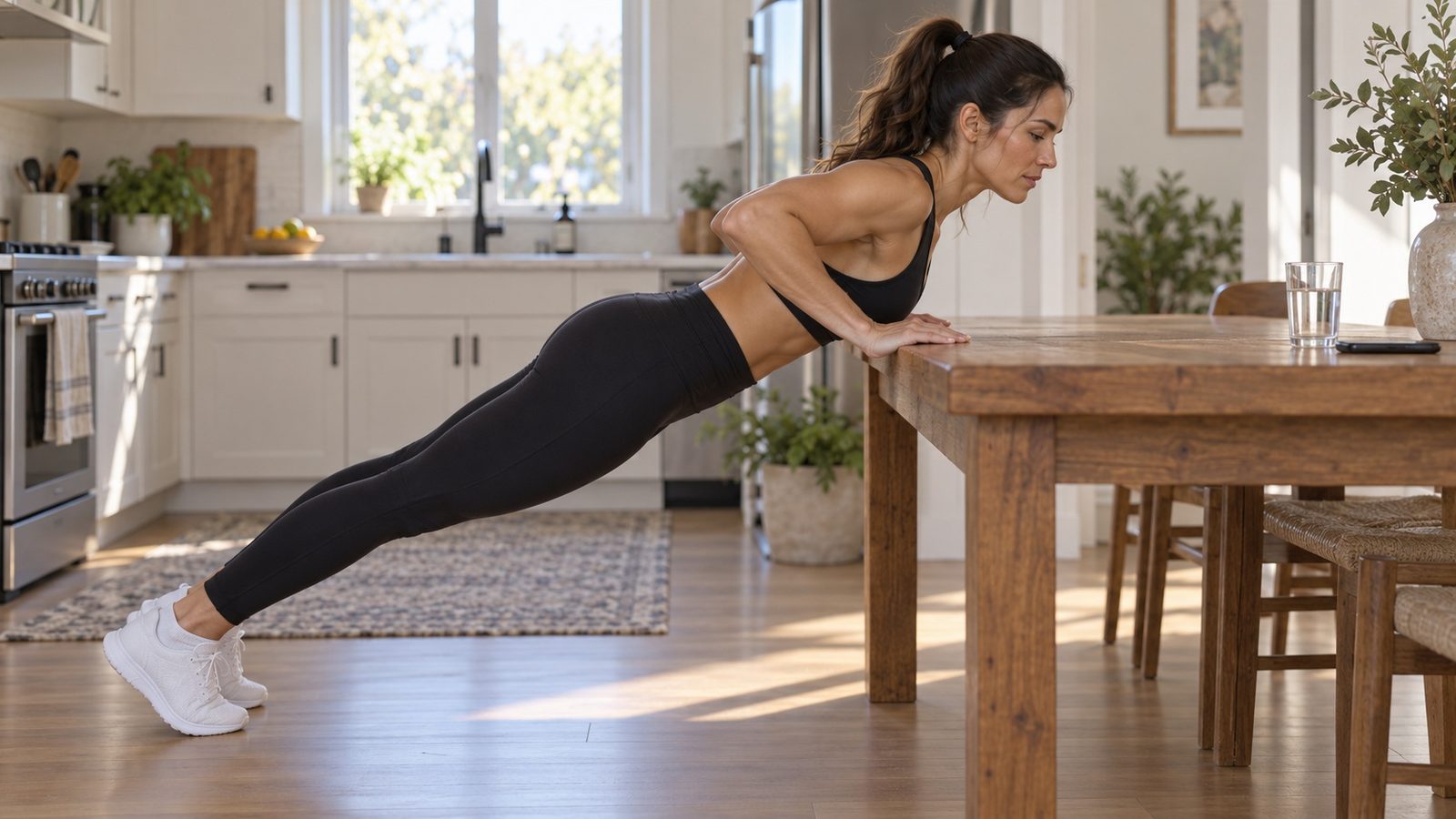
Where to start: a 10-minute test
"Start with wall push-ups" isn't right for everyone. If you can already do 10 knee push-ups, a week at the wall is a week wasted. So test first.
Do a 3–5 minute warm-up. Then work from the hardest variation to the easiest, resting 2 minutes between attempts. Stop at the first variation where you hit the target number. Count only clean reps: your body stays straight, your chest comes close to the support, and your arms straighten fully at the top.
- Floor. Do as many as you can. 5 or more: step 6. From 1 to 4: step 5. None: move on to the next variation.
- Low support, about 12 inches (30 cm). The second stair step or a low bench. 8 or more clean reps: step 4. Fewer: try the next one.
- Chair or knees. Push the chair against a wall so it can't slide. 8 or more: step 3. Fewer: try the next one.
- Table or kitchen counter. 8 or more: step 2. Fewer than 8: you start at the wall.
Your step is the hardest variation where you can do 8–12 clean reps (on the floor, five is enough). Stuck between two steps? Pick the easier one. Write down your result and the date: you'll repeat the test in two weeks.
| Test result | Step | Where you start | First 5 floor push-ups usually in |
|---|---|---|---|
| Fewer than 8 on the table | Wall | wall, 3 sets of 8–12, slowly | 2–4 months |
| 8+ on the table, fewer than 8 on a chair or knees | Table or counter | table 3×8–12 + forearm plank 3×20 s | 2–3 months |
| 8+ on a chair or knees, fewer than 8 on a 12-inch support | Chair or knees | 3×8–12 + plank 3×30 s | 6–10 weeks |
| 8+ on a 12-inch support, none on the floor | 12-inch support | 3×8–12 + 2 sets of 3 floor negatives | 3–6 weeks |
| 1–4 clean reps on the floor | Negatives and hybrid reps | 2–3 sets of 3 negatives + 2 sets of 5–8 hybrid reps | 2–4 weeks |
| 5+ on the floor | Floor | 3×5–12, then section 12 | you're already there |
The timelines in the last column are a guide, not a promise: no study has measured how long it takes to get your first push-up. If you're carrying extra weight or coming back after a long break, it takes longer, and that's normal.
Six steps to floor push-ups: how much weight your arms hold
In a 2011 study, 23 men and women did push-ups on a force plate. It measured the peak load on their hands during each rep. The percentages didn't differ between men and women, so the ladder is the same for everyone.
| # | Variation | Support height | Weight on your arms | What to use at home |
|---|---|---|---|---|
| 1 | Wall push-ups | vertical | the least, no exact figure | any wall |
| 2 | Table or counter push-ups | 30–35 in (75–90 cm) | under 41% | kitchen table, counter |
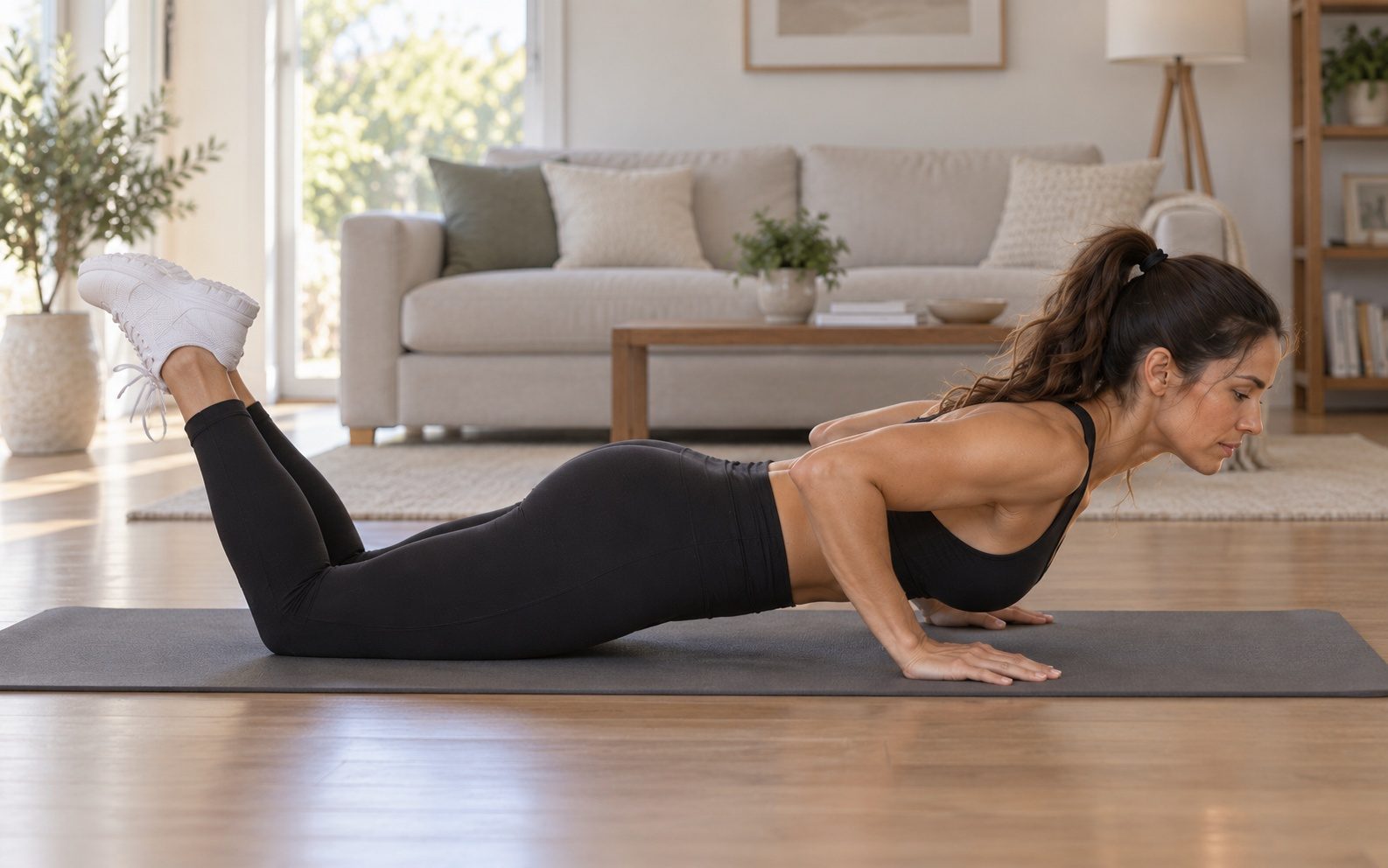
| 3 | Chair or knee push-ups | about 18 in (45 cm), or knees | about half; knees 49% | chair against a wall, couch, mat |
| 4 | Low support | about 12 in (30 cm) | 55% | second stair step, low bench |
| 5 | Floor negatives and hybrid reps | floor | 64%, heavier at the bottom | mat |
| 6 | Standard push-ups | floor | 64% | — |
| next | Feet elevated | 12 or 24 in (30 or 60 cm) | 70% or 74% | second stair step, bench |
Chair and knees are the same step. The load is almost identical, so pick whichever feels better. On a chair your body stays in one straight line, just like on the floor. On your knees you're closer to the floor, and it's a good option if you have nothing sturdy to push against. Incline push-ups on a standard gym bench count as this step too.
The last step is the hardest. Going from your knees to your toes adds 15% of your body weight in one jump, from 49% to 64%. That's why the 12-inch support and negatives sit in between. Another study from the same year found that your arms hold more weight at the bottom of a push-up than at the top, and the gap is even bigger on your knees.
The study didn't measure the wall or the table. A table is higher than a 24-inch (60 cm) support, though, so the load there is under 41% of your weight.
How many pounds you press at your body weight
Pounds are easier to picture than percentages. Find your weight and see how much your arms press at each step.
| Body weight | 24-in support (41%) | Knees (49%) | 12-in support (55%) | Floor (64%) | Feet on 12 in (70%) |
|---|---|---|---|---|---|
| 110 lb (50 kg) | 45 lb | 54 lb | 61 lb | 70 lb | 77 lb |
| 130 lb (59 kg) | 53 lb | 64 lb | 72 lb | 83 lb | 91 lb |
| 155 lb (70 kg) | 64 lb | 76 lb | 85 lb | 99 lb | 109 lb |
| 175 lb (79 kg) | 72 lb | 86 lb | 96 lb | 112 lb | 123 lb |
| 200 lb (91 kg) | 82 lb | 98 lb | 110 lb | 128 lb | 140 lb |
| 220 lb (100 kg) | 90 lb | 108 lb | 121 lb | 141 lb | 154 lb |
Every extra 10 lb of body weight adds about 6–7 lb to a floor push-up. A 200-lb person doing knee push-ups presses almost as much as a 155-lb person on the floor: 98 vs. 99 lb.
If you're heavier, start one step easier. That doesn't mean you can't do it; it's just a different starting point. As the weight comes off, push-ups get easier on their own.
Beginner push-up program: when to move up, plus a weekly plan
The same rule for moving up applies at every step:
- At your step, do 3 sets of 8–12 reps.
- End every set 1–2 reps short of failure. Your last rep should look as clean as your first.
- When you get 3 sets of 12 clean reps in two workouts in a row, move to the next, harder step.
- On the new step, start with 3 sets of 6–8 and build back up to 12.
- Rest 60–90 seconds between sets. Our guide to rest between sets explains why that's enough.
This plan follows the American College of Sports Medicine guideline for beginners: 8–12 reps, 2–3 workouts a week, and more difficulty once you can do 1–2 reps beyond your target. Stopping 1–2 reps short of failure keeps your form from breaking down. Your results decide when you move up, not the calendar.
Weekly plan, 15–20 minutes per workout:
- Monday. Your step, 3 sets of 8–12. Plank, 3 sets of 20–40 seconds.
- Tuesday. Rest.
- Wednesday. Your step, 3 sets of 8–12. Then 2 trial sets of 3–5 reps on the next, harder step.
- Thursday. Rest.
- Friday. Your step, 3 sets of 8–12. Inverted rows (Australian pull-ups) or bent-over dumbbell rows, 3 sets of 10.
- Saturday and Sunday. Rest.
The Friday row is for balance: push-ups push, rows pull. You can learn how to do a pull-up with the same kind of ladder, and the two plans fit together easily.
Every two weeks, repeat the test from section 01. If two tests in a row show no progress, look at your sleep, the number of hard workouts (no more than three a week) and your form on video.
once a week, film one set on your phone from the side, at shoulder height. You can't feel sagging hips or shallow reps, but you'll spot them on video right away. Compare clips two weeks apart: progress is easier to see than to feel.
Negative push-ups and hybrid reps: the bridge from knees to floor
A negative push-up is a push-up in reverse. Get into a high plank with straight arms and a straight body. Take 3–5 seconds to lower yourself until your chest touches the floor. At the bottom, rest on the floor, come up onto your knees and push back up to a high plank from there. That's one rep.
A hybrid rep means lowering from your toes and pushing up from your knees. Lower yourself from a high plank, drop your knees to the floor at the bottom and press up. At the top, straighten your legs again. The lowering puts 64% of your weight on your arms, the push back up 49%.
How much to do:
- negatives: 2–3 sets of 3 reps, with 15–20 seconds between reps;
- hybrid reps: 2–3 sets of 5–8;
- do both at the start of your workout.
After your first negatives, your chest and triceps will be sorer than usual: slow lowering under load causes the worst muscle soreness. It fades in 3–5 days, and after 2–3 weeks the same negatives leave you far less sore.
Proper push-up form: six cues and three checks you can do on your own
How to do a proper push-up:
- Hands slightly wider than your shoulders, level with your chest, fingers pointing forward.
- Elbows travel back at about 45° to your torso, not out to the sides in a T.
- Keep your body in one straight line from head to heels, with your abs and glutes tight.
- Lead with your chest, not your head. Keep your neck in line with your back and look at the floor slightly ahead of your hands.
- Push all the way up until your arms are straight.
- Breathe in on the way down and out on the way up. Don't hold your breath.
Eight clean push-ups on a table do more for you than three sloppy ones on the floor.
Three checks you can do on your own:
- A stick along your back. Ask someone to lay a broomstick or a PVC pipe along your spine. In the plank it should touch the back of your head, your upper back and your hips at the same time. If your hips or head lose contact, the line is broken.
- Depth. Lay a 16.9 oz (500 ml) water bottle on its side on the floor under your chest. If your chest touches it, you're getting full range of motion.
- Side video. Once a week, as in the tip above.
You'll often read that a wide hand position works your chest harder. A 2005 study that put sensors on the muscles of 40 people found the opposite: a narrow hand position worked both the chest and the triceps harder than a wide one. Beginners are still better off in the middle, with their hands slightly wider than shoulder width: a narrow position is harder, and a very wide one lets your elbows flare out.
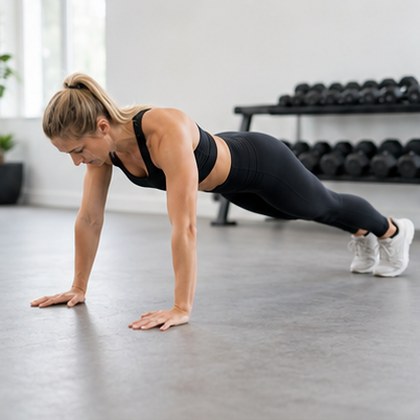 Floor push-up
What muscles push-ups work
Three muscle groups do most of the pressing: your chest, your triceps on the back of your upper arm and the front of your shoulders (the front deltoids). Your abs, glutes and the muscles along your spine hold your body in a straight line. For beginners, these are often the first to give out: the hips sag before the arms get tired.
That makes a push-up a moving plank, so it's worth doing planks on their own too. Our plank guide shows how to hold one.
Common push-up mistakes that stall your progress
You can see every one of these mistakes on a side video. Fix yours before you move up.
| Mistake | What you see on video | What to do |
|---|---|---|
| Sagging hips | belly below the shoulder-to-heel line | drop to an easier step, add planks |
| Piked hips | hips higher than your shoulders | squeeze your glutes, lower your hips into line |
| Elbows flared into a T | elbows level with your shoulders | turn your hands slightly out, bring your elbows toward your ribs |
| Leading with your head | chin reaches the floor before your chest | eyes on the floor ahead of your hands, lead with your chest |
| Half reps | chest doesn't reach the bottle | higher support, but full range of motion |
| Holding your breath | face turns red by the end of the set | breathe out on the way up |
| Moving up by the calendar | "It's been a week, so it's time for the floor" | move up only after 3 sets of 12, twice in a row |
How to breathe during push-ups and how many times a week to do them
Breathe in on the way down, out on the way up. Don't hold your breath on a hard rep: your face turns red, and you may get dizzy.
Aim for 2–3 hard workouts a week, with a rest day in between: you get stronger during recovery.
Can you do push-ups every day? Not at full effort. Programs like the 30-day push-up challenge or "add two reps every day" promise straight-line progress, but strength doesn't build that way: fatigue piles up faster than results. On days between workouts, you can do 1–2 easy sets one step easier, as long as your shoulders, elbows and wrists feel fine. Do about half of what you could in each set.
Are push-ups real strength training? What the research shows
Here's what studies have found:
| What was tested | Who took part | What happened | What it means for you |
|---|---|---|---|
| How much weight the arms hold in six variations | 23 people: 14 men and 9 women | floor 64%, knees 49%, hands on a 12- or 24-in support 55% and 41%, feet on a 12- or 24-in support 70% and 74%; the same for men and women (source 1) | one ladder for everyone |
| 4 weeks, 3 workouts a week: progressive push-ups vs. barbell bench press | 23 young men with some training experience | 1-rep max on the bench press went up in both groups; muscle thickness didn't change in 4 weeks (source 3) | the strength from push-ups is real, but your muscles won't grow in a month |
| 8 weeks, 2 workouts a week: push-ups, including knee push-ups, vs. bench press at the same load | 18 young men | the same gains in strength and in chest and triceps thickness (source 4) | knee push-ups aren't cheating; they're real training |
| Push-up capacity and the heart | 1,104 male firefighters, average age 40, followed for 10 years | those who could do more than 40 push-ups had 96% fewer cardiovascular events than those who could do fewer than 10 (source 5) | it's a link, not proof, but knowing your number is useful |
The last row comes from observing men in one profession, not from an experiment. It doesn't prove that forty push-ups protect your heart on their own.
The takeaway: push-ups are real strength training if you make them harder step by step. They can build your chest and triceps, but not in a month: in one study the muscles grew over 8 weeks, and in another they didn't change over 4.
Pain after push-ups: what to change and when to see a doctor
Tired arms and chest and triceps soreness that fades within 3–5 days are normal after push-ups. Anything else deserves a closer look.
| Situation | What to change | When to see a doctor |
|---|---|---|
| Wrists hurt | push up on your fists or grip dumbbells as handles to keep your wrists straight; use a higher support | your fingers go numb or tingle, or the pain doesn't ease with rest |
| Shoulder aches | keep your elbows closer to your body, use a higher support, only go as low as you can without pain | sharp or shooting pain, a painful click, trouble lifting your arm |
| Lower back aches | an easier step, plus planks and dead bugs on their own | pain spreads into your leg, or your leg goes numb |
| Higher body weight | start one step easier, use the table in section 03 | shortness of breath or chest pain during exercise |
| High blood pressure | don't hold your breath; no slow negatives until you've talked to your doctor | before you start, if your blood pressure isn't under control |
| After giving birth | check for ab separation (diastasis recti) first | your belly bulges in a ridge down the middle when you tense it |
Our guide to shoulder pain from lifting covers the common causes. Don't try to treat yourself based on an article: if the pain doesn't go away, get it checked.
Call 911 (or your local emergency number) right away in three cases: pain or pressure in your chest during a workout that spreads to your arm, neck or jaw; shortness of breath that doesn't ease at rest; or fainting.
What's next after your first 5–10 push-ups
Once you can do 3 sets of 12 on the floor, the ladder keeps going with the same rule.
- Decline push-ups. With your feet on the second stair step, about 12 inches (30 cm) up, your arms hold 70% of your weight. On a 24-inch (60 cm) box, it's 74%.
- Close-grip push-ups. Hands directly under your shoulders, elbows brushing your sides. This puts more work on your triceps and chest.
- Paused push-ups. Hold for 2 seconds at the bottom without resting on the floor.
- Circuit training. Do push-ups in a circuit with squats and rows, with little rest between exercises.
- Pull-ups. Pairing pushing with pulling builds your whole upper body.
Dips, bench dips and push-up norms by age are separate topics we don't cover here.
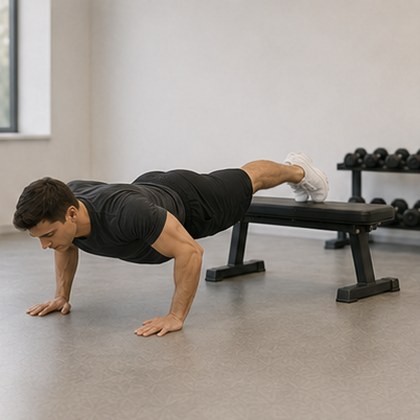 Decline push-up
How to track your progress in the Sportygram workout log
If you track workouts in the Sportygram app, its exercise library has floor push-ups, the plank, inverted rows, the bent-over dumbbell row, the dead bug, decline push-ups and close-grip push-ups. You can add them to your plan right in the workout log and record your sets and reps after each workout. Wall, table, chair and knee push-ups and negatives aren't in the library yet, so write down those steps and your test results with the date in a note on your phone.
Add the plank to Monday and the row to Friday, then adjust the sets and reps to match your plan.
FAQ
How long does it take to learn to do a push-up from scratch?
It depends on your starting step and your weight. Going from knee push-ups to your first five floor push-ups usually takes 6–10 weeks; from a table, 2–3 months; from the wall, 2–4 months. Extra weight makes it longer. Treat these as a guide, not a promise. Take the test in section 01, train three times a week and retest every two weeks to see your own pace.
I can't do a single push-up. Where do I start?
Start with the test in section 01. If you can't do one on the floor, find a support where you can do 8–12 clean reps: the second stair step, a chair, your knees, a table or a wall. Train there three times a week, 3 sets per workout, ending each set 1–2 reps short of failure. Don't test the floor every day: fatigue builds and your form falls apart.
Do knee push-ups count?
Yes. On your knees, your arms hold about 49% of your body weight, almost the same as with chair push-ups. In a 2017 study, push-ups at a matched load, including knee push-ups, produced the same gains in strength and in chest and triceps muscle as the bench press. The one condition: keep your body in a straight line from knees to head and bring your chest close to the floor.
Can I do push-ups every day?
Not at full effort. Do hard workouts 2–3 times a week with a rest day in between: you get stronger during recovery. On the days in between, you can do 1–2 easy sets one step easier, at about half your max, if your shoulders and wrists feel fine. "Add two push-ups a day" challenges quickly stall, because strength doesn't grow in a straight line.
How many sets and reps should a beginner do?
Do 3 sets of 8–12 reps at your step, ending each set 1–2 reps short of failure so your last rep looks as clean as your first. Rest 60–90 seconds between sets. When you hit 3 sets of 12 in two workouts in a row, move to the harder step and start there with 3 sets of 6–8.
How do you breathe during push-ups?
Breathe in on the way down and out on the way up, so you exhale during the hardest part, when you push away from the support. Don't hold your breath on tough reps: your face turns red and you may get dizzy. If your breathing falls apart halfway through a set, the step is still too hard or the set is too long. Pause, or use a higher support.
What muscles do push-ups work, and can they build your chest?
Push-ups work your chest, triceps and the front of your shoulders, while your abs and glutes keep your body straight. They can build your chest and triceps if you keep making the variation harder. In a 2017 study, 8 weeks of push-ups built as much muscle as the bench press. You won't see much muscle growth in the first month, but you will get stronger.
What should I do if my wrists or shoulders hurt from push-ups?
For wrist pain, push up on your fists or grip dumbbells as handles to keep your wrists straight, and use a higher support. For shoulder pain, keep your elbows closer to your body and only go as low as you can without pain. See a doctor if your fingers go numb, the pain is sharp or shooting, you feel a painful click, or the pain doesn't ease with rest.
How can a woman learn to do push-ups?
The same way a man does, with the same steps. In the force plate study, the share of body weight on the arms didn't differ between men and women, so you don't need a separate program. Your timeline depends on your starting step and your weight, not your sex. Start with the test in section 01 and don't skip planks: your core often gives out before your arms do.
The bottom line
- You can learn push-ups from zero in six steps: wall, table, chair or knees, a 12-inch (30 cm) support, negatives, floor. Start where you can do 8–12 clean reps.
- On the floor your arms hold 64% of your weight, on your knees 49%: the last step is the hardest.
- Train 3 times a week for 15–20 minutes: 3 sets of 8–12, stopping 1–2 reps short of failure. Move up after 3 sets of 12 in two workouts in a row.
- Form: hands slightly wider than your shoulders, elbows at 45°, body in one line, lead with your chest, push up to straight arms, breathe out on the way up.
- Knee push-ups are real training. Sharp joint pain, a painful click or numb fingers mean it's time to stop and see a doctor.
Checklist: 15–20 minutes, three times a week
- Warm up for 3–5 minutes: shoulder circles and a couple of easy sets against the wall.
- Your step: 3 sets of 8–12 clean reps.
- End every set 1–2 reps short of failure and rest 60–90 seconds.
- Plank, 3 sets of 20–40 seconds, on Monday.
- Dumbbell rows or inverted rows on Friday.
- 3 sets of 12 in two workouts in a row: move to the harder step.
- Every two weeks: retest (section 01) and film a side video, then note the results and the date on your phone.
Sources
- Ebben W. P. et al. Kinetic analysis of several variations of push-ups. Journal of Strength and Conditioning Research, 2011. — The share of body weight on the arms in six push-up variations; the same for men and women.
- Suprak D. N., Dawes J., Stephenson M. D. The effect of position on the percentage of body mass supported during traditional and modified push-up variants. Journal of Strength and Conditioning Research, 2011. — The arms hold more weight at the bottom of a push-up than at the top; on the knees the gap is bigger.
- Kotarsky C. J. et al. Effect of progressive calisthenic push-up training on muscle strength and thickness. Journal of Strength and Conditioning Research, 2018. — 4 weeks: the bench press went up in both groups; muscle thickness didn't change.
- Kikuchi N., Nakazato K. Low-load bench press and push-up induce similar muscle hypertrophy and strength gain. Journal of Exercise Science & Fitness, 2017. — 8 weeks: push-ups and the bench press at the same load produced the same gains in strength and muscle.
- Yang J. et al. Association between push-up exercise capacity and future cardiovascular events among active adult men. JAMA Network Open, 2019. — Men who could do more than 40 push-ups had fewer cardiovascular events than those who did fewer than 10.
- American College of Sports Medicine. Progression models in resistance training for healthy adults. Medicine & Science in Sports & Exercise, 2009. — For beginners: 8–12 reps, 2–3 workouts a week.
- Cogley R. M. et al. Comparison of muscle activation using various hand positions during the push-up exercise. Journal of Strength and Conditioning Research, 2005. — A narrow hand position loads the chest and triceps more than a wide one.
This material is for informational purposes and does not replace medical advice.