

your load on the assisted pull-up machine = body weight − counterweight. A 60 kg (132 lb) woman with a 45 kg (99 lb) counterweight lifts 15 kg (33 lb), which is 25% of her weight. The starting point from the StairMaster manual: women lift 20–25% of body weight, men 50–55%. Take off one plate when 3 sets of 10 reps feel clean and each rep takes 3–4 seconds.Try the bar once you can do 8–10 clean reps with a counterweight of no more than 20% of your body weight: by a calculation based on Johnson's 2009 data, your max is close to your body weight by then. Over our 8-week plan, a woman's load grows from 15 to 30 kg (33 to 66 lb), and a man's from 40 to 55 kg (88 to 121 lb).
An assisted pull-up machine is a machine for pull-ups and dips with a counterweight. You kneel on a padded platform, the platform is connected by a cable to a stack of plates, and the plates push you up. That's why everything works in reverse here: the more weight you select on the stack, the easier it gets. You only lift the difference between your body weight and the counterweight. StairMaster, the company that made the first Gravitron, recommends that on the first session women lift 20–25% of their body weight and men 50–55%. For a 60 kg (132 lb) woman, that's a counterweight of about 45 kg (99 lb); for an 80 kg (176 lb) man, about 40 kg (88 lb). A beginner is fine with 3 sets of 8–10 reps twice a week.
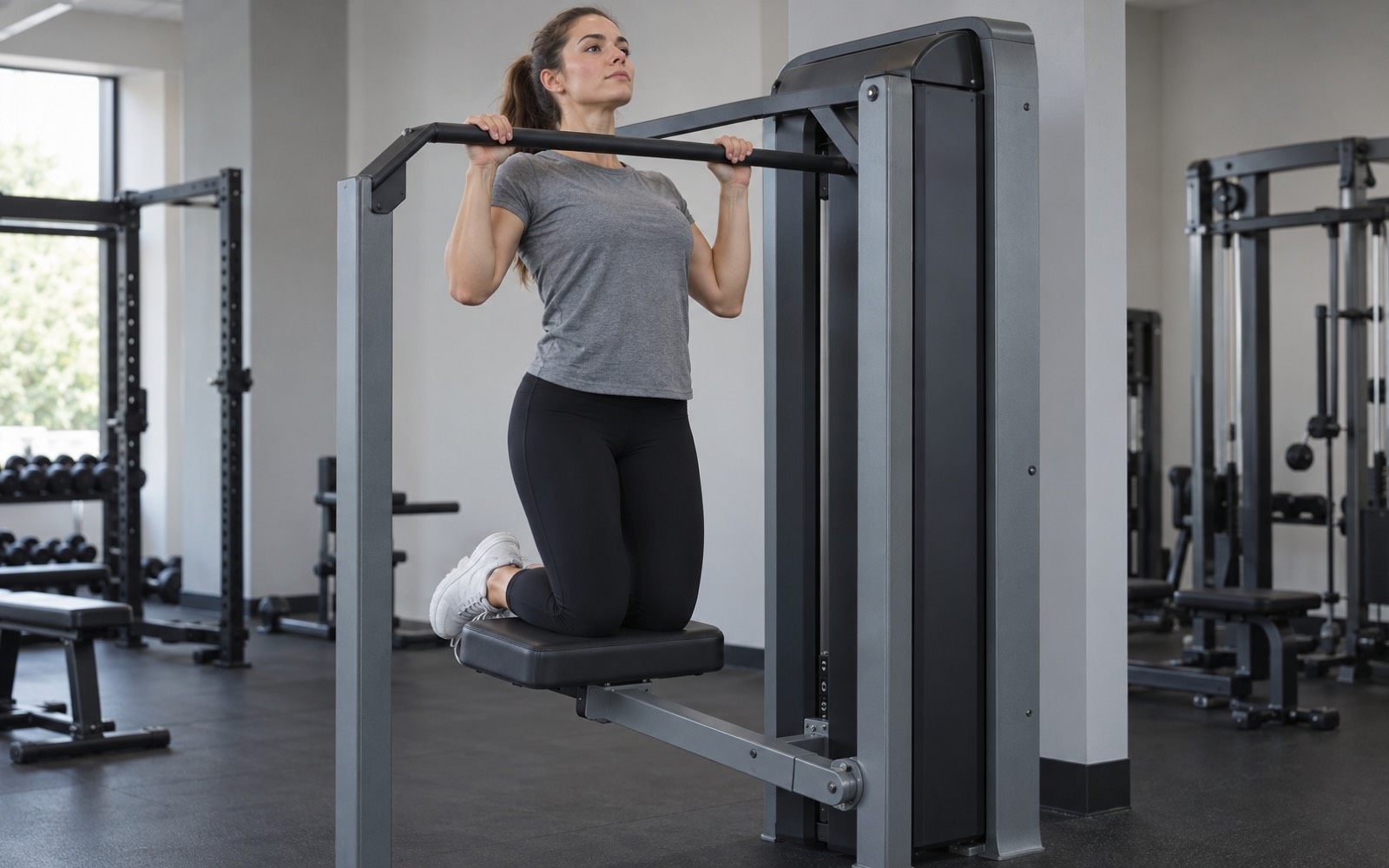
What an assisted pull-up machine is and how it works
An assisted pull-up machine is a machine where the pad under your knees pushes you up with the force you chose by putting the pin into the weight stack.
The first machine of this kind, called the Gravitron, was released by the American company StairMaster in the late 1980s, and the model name stuck. Today, many people call any counterweighted pull-up machine a "Gravitron," whatever brand it is. Its more general names are the assisted pull-up machine, the assisted pull-up and dip machine, or the assisted chin/dip machine.
What it's made of:
- Pull-up handles. There are usually three pairs: wide straight handles at the top, medium ones (the middle part of the bar), and parallel handles where your palms face each other.
- Dip handles. Two handles at waist height for dips.
- Steps. On each side, so you can climb up and get onto the pad.
- The pad. A soft cushion for your knees. It moves up and down together with you.
- The weight stack and pin. You put the pin into the plate with the number you want, and all the plates above it rise together with the pad.
There are other designs too. On lever-arm models, the help comes from weight plates you load onto a lever. On some models, you stand on the platform with your feet. Outdoor gyms have "assisted" machines as well, but they have no weight stack: the help comes from a pendulum or from your own body weight on the other side of a lever. The numbers and the plan in this article don't apply to those outdoor machines.
What the machine gives you. The pull-up is one of the hardest exercises for a beginner. In Johnson's 2009 study, the 23 female students had a one-rep max in the pull-up of 0.73 of their body weight. Even at their limit, they could only lift 73% of their own weight, and a counterweight took the rest. So on average, they couldn't do a single pull-up without help. The assisted machine removes the extra load, and you do the same movement through the full range of motion with a load you can handle. You can set the load precisely and reduce the help step by step until you no longer need it.
Who it's useful for:
- people who have never done a pull-up or can do 1–3 reps;
- people who can do pull-ups but want more clean reps per set;
- people coming back after a break or carrying extra weight;
- people learning to do dips.
Why more weight makes the assisted pull-up machine easier
On the assisted pull-up machine, the plates pull the pad up, so the bigger the counterweight, the more of your body weight it takes away, and the less is left for your arms and back.
On a regular machine, you lift the weight you selected. On an assisted pull-up machine, you lift yourself, and the weight you selected helps you. The formula is simple:
What you lift = body weight − counterweight.
Two examples. A woman weighs 60 kg (132 lb) and sets the pin at 45 kg (99 lb): she lifts 15 kg (33 lb), which is 25% of her weight. A man weighs 80 kg (176 lb) and sets 40 kg (88 lb): he lifts 40 kg (88 lb), exactly half his weight. Progress here goes down the stack. Every plate you take off means you're lifting more.
Table: how much you lift on the assisted pull-up machine. Each cell shows the load in kilograms (pounds) and as a percentage of body weight.
| Body weight | Counterweight 10 kg (22 lb) | 20 kg (44 lb) | 30 kg (66 lb) | 40 kg (88 lb) | 50 kg (110 lb) |
|---|---|---|---|---|---|
| 50 kg (110 lb) | 40 kg (88 lb), 80% | 30 kg (66 lb), 60% | 20 kg (44 lb), 40% | 10 kg (22 lb), 20% | 0 — the machine lifts you |
| 60 kg (132 lb) | 50 kg (110 lb), 83% | 40 kg (88 lb), 67% | 30 kg (66 lb), 50% | 20 kg (44 lb), 33% | 10 kg (22 lb), 17% |
| 70 kg (154 lb) | 60 kg (132 lb), 86% | 50 kg (110 lb), 71% | 40 kg (88 lb), 57% | 30 kg (66 lb), 43% | 20 kg (44 lb), 29% |
| 80 kg (176 lb) | 70 kg (154 lb), 88% | 60 kg (132 lb), 75% | 50 kg (110 lb), 63% | 40 kg (88 lb), 50% | 30 kg (66 lb), 38% |
| 90 kg (198 lb) | 80 kg (176 lb), 89% | 70 kg (154 lb), 78% | 60 kg (132 lb), 67% | 50 kg (110 lb), 56% | 40 kg (88 lb), 44% |
| 100 kg (220 lb) | 90 kg (198 lb), 90% | 80 kg (176 lb), 80% | 70 kg (154 lb), 70% | 60 kg (132 lb), 60% | 50 kg (110 lb), 50% |
How to use the table: find your row, pick a column and see what share of your weight you're lifting. If you weigh 65 kg (143 lb), take the average of the 60 and 70 kg rows.
A caveat about different machines. This math works for models where the help equals the weight of the plates. On the original StairMaster Gravitron 2000 AT, the stack weighs 180 lb, about 82 kg, and is split into 10 lb plates, about 4.5 kg each. Its manual has a separate table that shows, by body weight and selected plate, what percentage of your weight you lift. On lever models and machines with pulleys, the help can differ from the number on the plate, and manufacturers don't always say by how much. So don't compare numbers between gyms. Compare yourself with yourself on the same machine, and write down which plate you worked with.
Muscles worked on the assisted pull-up machine
The assisted pull-up machine works the same muscles as a pull-up on the bar: the main ones are the lats and the biceps, with help from the brachialis, the trapezius, the rhomboids, the rear delts and the rotator cuff.
The most detailed numbers on pull-ups come from Youdas and colleagues in 2010. They recorded electromyography, meaning the electrical activity of muscles, in 21 men and 4 women during overhand and underhand pull-ups. Activity was measured as a percentage of maximal voluntary contraction. A number above 100% means the muscle worked harder during the movement than it did when it was tensed as hard as possible in isolation.
| Muscle | What it does | Activity in the pull-up (Youdas, 2010) | Where you feel it |
|---|---|---|---|
| Latissimus dorsi (lats) | pulls the upper arm down and toward the body; the main mover | 117–130% | the sides of your back, under your armpits |
| Biceps brachii | bends the elbow | 78–96% | the front of your upper arm |
| Infraspinatus (part of the rotator cuff) | keeps the head of the upper arm in the joint | 71–79% | on your shoulder blade, back of the shoulder |
| Lower trapezius | pulls the shoulder blades down | 45–56% | between your shoulder blades, below the middle |
| Pectoralis major | helps pull the upper arm down | 44–57% | your chest near the armpit, more with an underhand grip |
| Spinal erectors | keep your torso straight | 39–41% | along your lower back, faintly |
| External obliques | stabilize your torso | 31–35% | the sides of your abdomen |
The rhomboids, the middle trapezius and the rear delts also squeeze and lower your shoulder blades, and you feel them between your shoulder blades. The brachialis lies under the biceps and bends the elbow with any grip. In Youdas's participants, the elbow bent through 93–101° per rep, so about a right angle or slightly more.
What grip changes. According to the same study, with an underhand grip, palms facing you, the pectoralis major and the biceps worked harder. With an overhand grip, palms facing away, the lower trapezius worked harder. More on grips in section 06.
How the assisted machine differs from the bar. In 2018, Hewit and colleagues compared the pull-up on a bar with three alternatives in 41 people (28 men and 13 women) in a lab at the United States Military Academy: a seated lat pulldown and a kneeling lat pulldown, both with a weight equal to 80% of body weight, and the assisted pull-up machine with a counterweight of 20% of body weight. Each exercise was done for 5 reps. The participants were split into those who could do fewer than 10 pull-ups and those who could do more. The first group had 14 people, 11 of them women. For them, the link between how hard the lats worked on the bar and on the assisted machine was almost zero, r = 0.08. Between the bar and the kneeling lat pulldown, the link was strong, r = 0.90. For the biceps, the link between the assisted machine and the bar was strong, r = 0.83. Of the four muscles measured, the one that worked hardest on the bar in this group was the rectus abdominis.
This is one study in a small journal, and there's no need to draw big conclusions from it. The authors explain the strong ab activity on the bar by the fact that your body hangs without support, so you have to keep your torso rigid for the whole set. On the assisted machine, your knees rest on the pad, and that's probably why weaker lifters show a different pattern of muscle activity on it. That's our guess: the study has no direct measurements of how much less your abs work on the machine. What it means for you: the assisted machine teaches the movement and builds arm strength well, but on its own it may not be enough for your first pull-up. Add negatives on the bar and lat pulldowns; more on that in sections 08 and 12.
Back, biceps or chest? Pull-ups on the assisted machine are a back exercise, with the biceps working as the second mover. The machine loads your chest and triceps during dips, which are covered in section 09.
How to use the assisted pull-up machine: setup, getting on and getting off
First set the counterweight with the pin, then climb onto the steps, grab the handles and lower one knee onto the pad, then the other; getting off also happens one leg at a time.
Step by step:
- Warm-up. The StairMaster manual recommends 5 minutes of light warm-up before using the machine. Shoulder circles, 10–15 arm swings and 1–2 light sets with a big counterweight all work.
- Counterweight. Push the pin all the way into the plate you want. A pin that's only halfway in can pop out under load. How to pick your plate is explained below in this section and in section 07.
- Handles. Step up and grab the handles you want. Wrap your thumb fully around the handle; that's what the manufacturer recommends.
- The pad. Lower one knee onto it first, then the other. Under your weight, the pad will go down, and you'll end up hanging on straight arms. Put your knees in the center, with your shins resting fully on the cushion.
- Starting position. Arms straight, shoulders pulled down away from your ears, torso straight. Every rep starts from here.
- Getting off. After your set, pull yourself to the top or stay on straight arms while holding the handles. Put one foot on a step and let the pad rise smoothly. Take the second foot off only once the pad has returned to its place. The StairMaster manual gives this its own warning: don't step off with both feet at once, and don't let the plates slam down.
Why you shouldn't jump off with both feet. While you're on the pad, the plates are lifted and pull it up. If you suddenly take both legs off, the pad will hit hard from below, and the plates will crash down. That's a blow to your knees, face or hands, and extra wear on the cable.
How to find your weight in 2–3 trial sets. The goal is a counterweight that lets you do 8 clean reps with 1–2 reps left in the tank.
- Take the starting number from section 07 and do 5 reps.
- If it was easy and felt like you could do 15, rest 2 minutes and take off one plate.
- If you already had to jerk your body by the 3rd rep, add a plate.
- When 8 reps came out smoothly and you could still have done a 9th and 10th, you've found your weight. Write it down.
What to do if something's off. The pad doesn't go down under you: the counterweight is heavier than you are, so take off a few plates. The pad kicks up hard at the bottom: the counterweight is a bit too heavy, or you're relaxing at the bottom, so keep your shoulders set. The pin won't go all the way in: the plates are uneven, so ask the gym staff to fix them.
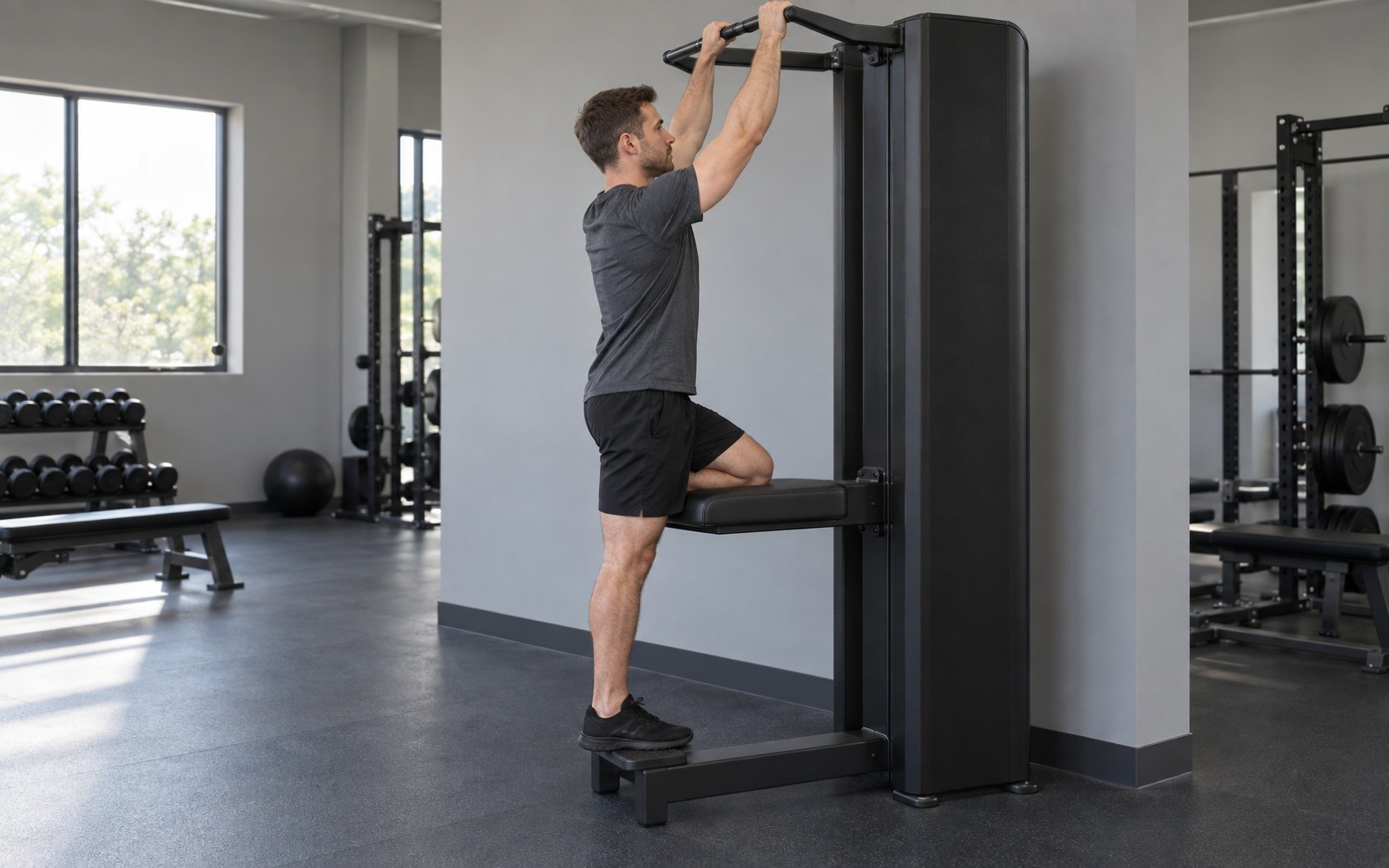
Assisted pull-ups: step-by-step form
Start on straight arms with your shoulders down, pull your elbows down toward your ribs until your chin is above the handles, and lower yourself to straight arms over 2 seconds.
- Grip. For the first weeks, use a medium overhand grip (palms facing away, slightly wider than your shoulders) or a neutral grip (palms facing each other). Section 06 explains why these two.
- Shoulders down. Before you bend your arms, pull your shoulders down away from your ears and squeeze your shoulder blades slightly together. Your arms are still straight, but your body rises a couple of centimeters. This is called an active hang.
- The pull. Pull your elbows down and back, toward your sides. Imagine driving your elbows into your ribs, and your chin will rise on its own. Your chest moves toward the handles.
- The top. Chin above the handles, elbows pointing down, shoulders down. Hold for half a second.
- The descent. Lower yourself slowly, over 2 seconds, to straight arms. Don't drop down; your muscles work on this part too.
- The bottom. Arms straight, shoulders down again. If your shoulders shot up to your ears at the very bottom, set them before the next rep.
How long a rep takes. In the StairMaster manual, one rep takes 3–4 seconds, and the muscles should work in both directions. The manufacturer also recommends emphasizing the lowering phase. A handy pattern: 1 second up, a short pause, 2 seconds down.
Breathing. Breathe out as you pull up, breathe in as you lower. There's no need to hold your breath for the whole set.
Torso and legs. Knees on the pad, shins pressed down, torso almost vertical with a slight lean back. Don't flare your ribs or arch your lower back: lightly brace your abs and glutes. That way your torso works closer to how it does on the bar.
Where to look. Forward or slightly up. There's no need to throw your head back to reach the handles with your chin.
for your first two sessions, do one set in front of a mirror or ask someone to take a photo of you at the top. Check three things: chin above the handles, shoulders far from your ears, elbows pointing at the floor. If even one of the three isn't happening, add one plate of counterweight and try again.
Which grip to choose: wide, medium, close, underhand or neutral
A beginner should start with a medium overhand grip or a neutral grip: they give your back a full workout and put the least load on your shoulder, and you can add the wide and underhand grips later.
| Grip | What works harder | Who should be careful and when |
|---|---|---|
| Medium overhand, slightly wider than shoulders, palms facing away | the lats; with an overhand grip, the middle trapezius works harder than with a neutral grip: 60.1% versus 37.1% (Dickie, 2017) | good for starting out; Prinold and Bull (2016) consider it, with counterweight assistance, a reasonable option for people who are still weak |
| Neutral, palms facing each other | the lats and biceps, comfortable for the shoulder | good for starting out; helps with pain on the inside of the elbow |
| Wide overhand, well wider than shoulders | the lats work the same as with a medium grip, judging by the lat pulldown (Andersen, 2014) | be careful if you have pain at the front of the shoulder or clicking at the top; the shoulder blade position is closer to impingement risk (Prinold, 2016) |
| Underhand, palms facing you (chin-up) | the biceps and pectoralis major work harder (Youdas, 2010) | be careful if you have shoulder pain or pain on the inside of the elbow |
| Close overhand, narrower than shoulders | the biceps and brachialis | uncomfortable if your wrists are stiff |
Does grip change how much your back works? Less than people think. In 2017, Dickie and colleagues compared four pull-up variations in 19 trained men: overhand, underhand, neutral grip and on a rope. Overall, the activity of the eight muscles was similar across grips. The difference was noticeable in the middle trapezius: with an overhand grip, its peak activity was 60.1% of maximum, and with a neutral grip, 37.1%. On the way up, the biceps, brachioradialis and pectoralis major worked harder than on the way down, with any grip.
A wide grip doesn't build your back more. In 2014, Andersen and colleagues compared three grip widths on the lat pulldown in 15 men: one, one and a half, and two shoulder widths. With the narrow and medium grips, the participants lifted more: about 80 kg (176 lb) for 6 reps, versus 77 kg (170 lb) with the wide grip. Lat activity over the whole movement was the same with all three widths; only on the way down did the wide grip produce slightly more than the narrow one. These are lat pulldown data, but the mechanics of a pull-up are similar. So a wide grip slightly lowers the weight you can use and gives your back no noticeable advantage.
Why your shoulder is calmer with a medium grip. In 2016, Prinold and Bull studied how the shoulder blade moves during different pull-ups in 11 people. When your arm is raised high, the space under the acromion, the bony ridge above your shoulder joint, gets narrower. The supraspinatus tendon runs through that space. If it gets pinched over and over, impingement develops: pain at the front and side of the shoulder when you raise your arm. With the wide and underhand grips, the shoulder and shoulder blade moved in a way that's usually seen with a higher risk of that pinching. The authors describe counterweight-assisted overhand pull-ups as an option that can be recommended to people who are still weak, and they note that it still needs to be studied. In practice, that's exactly the assisted pull-up machine.
How to alternate. Once you've mastered the medium grip, you can switch grips between sessions: medium overhand on Monday, neutral or underhand on Thursday. The basic program in the StairMaster manual does just that: three sets of pull-ups, each with its own grip — wide, medium and parallel. If a grip gives you pain in your shoulder or elbow, just drop it.
How much weight to set: starting counterweight and our 8-week plan
On your first session, set the counterweight so that women lift 20–25% of their body weight and men 50–55%, and lower it by one plate when 3 sets of 10 reps feel clean.
Where these numbers come from. This is the recommendation from the manual for the StairMaster Gravitron 2000 AT, a model from the very line that gave the machine its nickname. The same manual says it's better to work with more assistance at first, until you feel confident.
Why you see "70–80% of body weight" online. If a woman lifts 20–25%, her counterweight is 75–80% of her body weight. That's the number for women. For a man, the starting counterweight is about half his body weight. That's where the mixed advice comes from: some say 80% counterweight, others say 50–70%, and both are right; they're just talking about different people.
| Body weight | Woman: starting counterweight (lifts 25%) | Man: starting counterweight (lifts 50%) |
|---|---|---|
| 50 kg (110 lb) | 37.5 → set 40 kg (88 lb) | 25 kg (55 lb) |
| 60 kg (132 lb) | 45 kg (99 lb) | 30 kg (66 lb) |
| 70 kg (154 lb) | 52.5 → set 55 kg (121 lb) | 35 kg (77 lb) |
| 80 kg (176 lb) | 60 kg (132 lb) | 40 kg (88 lb) |
| 90 kg (198 lb) | 67.5 → set 70 kg (154 lb) | 45 kg (99 lb) |
| 100 kg (220 lb) | 75 kg (165 lb) | 50 kg (110 lb) |
If the number falls between plates, round up: extra help at the start is better than jerking. The starting number is just your entry point. After that, fine-tune the weight with trial sets as described in section 04.
The jump of one plate. In many gyms, the stack goes up in 5 kg (11 lb) steps; on the original StairMaster, about 4.5 kg (10 lb). When you're lifting only a little, a step like that is huge. If your machine is labeled in pounds, the logic is the same: work with whatever step your stack has.
| What you lift now | Minus one 5 kg (11 lb) plate — your load grows by |
|---|---|
| 15 kg (33 lb) | +33% |
| 20 kg (44 lb) | +25% |
| 30 kg (66 lb) | +17% |
| 40 kg (88 lb) | +12.5% |
| 50 kg (110 lb) | +10% |
In its 2009 position stand, the American College of Sports Medicine (ACSM) recommends adding 2–10% at a time once you can do 1–2 reps more than your target. A woman lifting 15–20 kg (33–44 lb) jumps by 25–33% at once with one plate. That's why in our plan the reps grow first: a week of 3 sets of 8, a week of 3 sets of 10, and only then one plate off. After you take off a plate, the reps drop back to 8.
How to smooth out the jump:
- if the machine has an add-on 2.5 kg (5.5 lb) weight next to the stack, use it as an in-between step;
- if 3 sets of 8 don't work after you take off a plate, put it back, do 3 sets of 12 and add the negatives from section 08;
- you can do the first set with the lighter counterweight and the second and third with the old one, until all three even out.
An 8-week assisted pull-up plan. Two sessions a week, not on back-to-back days, a 5 kg (11 lb) stack step, 1–2 minutes of rest between sets. The starting point follows the StairMaster manual: a woman lifts 25% of her body weight, a man 50%.
| Week | Woman, 60 kg (132 lb): counterweight → you lift | Man, 80 kg (176 lb): counterweight → you lift | Sets |
|---|---|---|---|
| 1 | 45 kg (99 lb) → 15 kg (33 lb), 25% | 40 kg (88 lb) → 40 kg (88 lb), 50% | 3 × 8 |
| 2 | 45 kg (99 lb) → 15 kg (33 lb) | 40 kg (88 lb) → 40 kg (88 lb) | 3 × 10 |
| 3 | 40 kg (88 lb) → 20 kg (44 lb), 33% | 35 kg (77 lb) → 45 kg (99 lb), 56% | 3 × 8 |
| 4 | 40 kg (88 lb) → 20 kg (44 lb) | 35 kg (77 lb) → 45 kg (99 lb) | 3 × 10 |
| 5 | 35 kg (77 lb) → 25 kg (55 lb), 42% | 30 kg (66 lb) → 50 kg (110 lb), 63% | 3 × 8 |
| 6 | 35 kg (77 lb) → 25 kg (55 lb) | 30 kg (66 lb) → 50 kg (110 lb) | 3 × 10 |
| 7 | 30 kg (66 lb) → 30 kg (66 lb), 50% | 25 kg (55 lb) → 55 kg (121 lb), 69% | 3 × 8 |
| 8 | 30 kg (66 lb) → 30 kg (66 lb) + negatives on the bar, 3 × 3 at 4–5 s | 25 kg (55 lb) → 55 kg (121 lb) + negatives, 3 × 3 at 4–5 s | 3 × 10 |
Over 8 weeks, the woman's load grows from 15 to 30 kg (33 to 66 lb), so it doubles. The man's grows from 40 to 55 kg (88 to 121 lb), by 37.5%. The woman's growth in percentage terms is bigger because her starting point is lower, while the plate is the same for everyone.
This is a guideline, and everyone moves at their own pace. Some people get through two weeks in one, others need to stay longer. There's one rule: you take off a plate only when all 3 sets of 10 were done with full range of motion and without jerking. If you don't weigh 60 or 80 kg (132 or 176 lb), calculate your start from the share of body weight in the table above, round to the nearest plate and follow the same pattern.
How many sets and how often. 3 sets of 8–10 reps twice a week. The StairMaster manual recommends the same volume: 3 sets, at least 2 sessions a week on non-consecutive days. The 2009 ACSM position stand gives beginners 8–12 reps 2–3 times a week. The new 2026 ACSM position stand, which pulls together 137 systematic reviews and more than 30,000 participants, shows that strength improves more if you train at least twice a week and do 2–3 sets per exercise. Training to failure didn't give a consistent advantage there, so keep 1–2 reps in the tank.
Is the assisted machine enough on its own? 3 sets twice a week is 6 sets for your back. According to the 2026 ACSM position stand, muscles grow better with 10 or more sets a week. Make up the other 4 sets with lat pulldowns or one-arm dumbbell rows. How to keep adding load once the eight weeks are over is covered in our guide to progressive overload.
Why the numbers in our dips article are different. In our breakdown of dips, the starting counterweight is about two thirds of body weight for both women and men. That plan is built for people who have never done a dip and come to the bars from zero. Here, the pull-up numbers come from the manufacturer's manual and differ by sex. If you do both exercises in one session, you'll have to move the pin, and that's normal.
Log your counterweight and reps after every session; the manufacturer recommends keeping records too. In the Sportygram app (go.sportygram.com; the interface and the coach are in Russian for now), the workout diary has a day-by-day plan. If you miss a session, you can ask the virtual coach, Alex, in chat to move it to Friday, and he moves it in your plan. If Friday already has another workout, Alex first asks you with a card what to do with it. After the gym, Alex can mark the workout as done when you ask him to.
How to go from the assisted machine to unassisted pull-ups
Try a pull-up on the bar once you can do 8–10 clean reps on the assisted machine with a counterweight of no more than 20% of your body weight.
Where the 20% rule comes from. In Johnson's 2009 study, 35 male and 23 female students had their pull-up max tested. To do that, weight was added to the body or, the other way around, part of the body weight was taken away with a counterweight, until exactly one pull-up was possible. Then, with a load of 80% of that max, they did as many pull-ups as they could. The women did an average of 10.5 reps, the men 8.1.
Now flip it around. If a counterweight of 20% of your body weight means you're lifting 80% of yourself, and you can do 8–10 reps, your max is already about 100% of your body weight. And that's exactly one unassisted pull-up.
| Body weight | 20% of body weight | Counterweight at which to try the bar (rounded down to a 5 kg / 11 lb plate) |
|---|---|---|
| 50 kg (110 lb) | 10 kg (22 lb) | 10 kg (22 lb) |
| 60 kg (132 lb) | 12 kg (26 lb) | 10 kg (22 lb) |
| 70 kg (154 lb) | 14 kg (31 lb) | 10 kg (22 lb) |
| 80 kg (176 lb) | 16 kg (35 lb) | 15 kg (33 lb) |
| 90 kg (198 lb) | 18 kg (40 lb) | 15 kg (33 lb) |
| 100 kg (220 lb) | 20 kg (44 lb) | 20 kg (44 lb) |
This is a calculation based on averages, so some people will get their first pull-up earlier and some later. But it's a workable guideline: as long as you're doing 8 reps with a counterweight of 40% of your body weight, nothing will happen on the bar, and there's no reason to get upset about it.
How many more weeks. If you continue the plan from section 07 with the same pattern, a 60 kg (132 lb) woman has 4 plates to go from a 30 kg (66 lb) counterweight down to 10 kg (22 lb), which is about 8 weeks. An 80 kg (176 lb) man going from 25 to 15 kg (55 to 33 lb) has 2 plates, about 4 weeks. The man's path is shorter because, by the plan, he starts with a bigger load: 50% of body weight versus the woman's 25%. That matches Johnson's data: the average pull-up max is 1.16 of body weight in men and 0.73 in women.
Negatives. Alongside the assisted machine, add slow negatives on the bar. Stand on a bench, grab the bar so your chin is above it, take your feet off and lower yourself over 4–5 seconds to straight arms. 3 sets of 3 reps at the end of your session. The StairMaster manual recommends emphasizing the lowering phase, and research agrees. Roig's 2009 meta-analysis showed that heavy lowering-phase work adds more strength and muscle mass than lifting-phase work. Your muscles can lower more than they can lift, so a negative on the bar with your full body weight becomes possible sooner than a pull-up.
How to test. Once every 2 weeks, at the start of your session and after your warm-up, try one pull-up on the bar. If it doesn't happen, that's fine; it's just a check. Once you've got one, do a few sets of 1–2 reps on the bar every session, and get the rest of your volume on the assisted machine.
The full path from zero — with a level check, bands, inverted rows and a plan for every stage — is covered in our guide on how to do your first pull-up. This article covers only the assisted machine part of that path.
Assisted dips and other exercises on the machine
Besides pull-ups, you can do dips on the assisted machine: the form is the same as on regular parallel bars, only your knees rest on the pad and the counterweight takes away part of your weight.
Assisted dips step by step.
- Set the counterweight, grab the dip handles and get onto the pad one knee at a time.
- Arms straight, shoulders down, torso leaning slightly forward.
- Lower yourself until your elbows bend to a right angle. That's how the StairMaster manual describes the bottom position. Your shoulder shouldn't drop below your elbow.
- Press yourself up to straight arms. As with pull-ups, a rep takes 3–4 seconds.
Leaning your torso forward shifts the load to your chest; an upright torso shifts it to your triceps. How much counterweight to use for dips, how to lower it week by week and when to move to regular bars is covered in detail in our article on dips. We won't repeat that plan here.
The "assisted press." That's usually what people mean by dips on the machine: you press yourself up. The basic program in the StairMaster manual alternates a set of dips with a set of pull-ups, 6 sets in total. It's a handy pairing for one upper-body session.
Leg presses, squats and "glute work" on the assisted machine. In gyms, people sometimes use the machine for things it wasn't designed for: they put one foot on the pad and push it down like a leg press, or they squat while holding the handles. It can work, but the load is limited by the weight of the stack, and standing on one leg on a moving pad is unstable. For your legs and glutes, a regular leg press machine, a glute bridge or a hip thrust is safer and more comfortable.
Assisted machine exercises for your back and arms:
- medium overhand pull-ups — back;
- neutral-grip pull-ups — back and biceps;
- underhand pull-ups (chin-ups) — biceps and back;
- dips — chest, triceps, front delts.
Mistakes: where you feel it → what to fix
If assisted pull-ups strain your neck or the front of your shoulder, or "only your arms are working," your form has drifted, and it's almost always fixed by the position of your shoulders and elbows.
| Where you feel it | What's wrong | What to fix |
|---|---|---|
| Upper traps, neck, shoulders up by your ears | you're pulling with your arms without lowering your shoulders first | lower your shoulders and squeeze your shoulder blades first, then bend your arms |
| The pad drifts to the side, a knee slips | your knees aren't centered, or one knee is on the edge | kneel in the middle of the pad, with both shins fully on the cushion |
| You get bounced up at the bottom, a jerk at the start | the counterweight is too heavy, or you relaxed at the bottom | keep your shoulders set at the bottom, 3–4 seconds per rep, take off a plate if needed |
| Front of the shoulder, a click at the top with a wide grip | with a wide grip, the shoulder blade moves in a way linked to the risk of pinching under the acromion (Prinold, 2016) | narrow your grip to medium overhand or switch to neutral |
| Inside of the elbow with an underhand grip | load on the flexor tendons | switch to a neutral grip |
| "Only my arms are working," you can't feel your back | you're pulling with your hands, your elbows drift forward | think about your elbows: down toward your ribs, chest toward the handles |
| Your lower back arches | ribs flared, abs relaxed | bring your ribs down, lightly brace your abs and glutes |
| The whole set is easy, you get 15 or more | the counterweight is too heavy | take off a plate; the goal is 8–10 reps with 1–2 in the tank |
| Your chin doesn't reach the handles | the counterweight is too light, or you're tired | add a plate; full range with help is better than half reps |
Half reps. A common mistake on the assisted machine is not lowering all the way to straight arms. You get more reps with less counterweight that way, but the bottom part of the movement, where the bar is hardest, gets no work. According to the 2026 ACSM position stand, strength improves more with full range of motion. So it's better to add a plate and do the full movement.
Stepping off the pad with both feet. It has nothing to do with form, but it's a common cause of bruises. Step off one leg at a time, as in section 04.
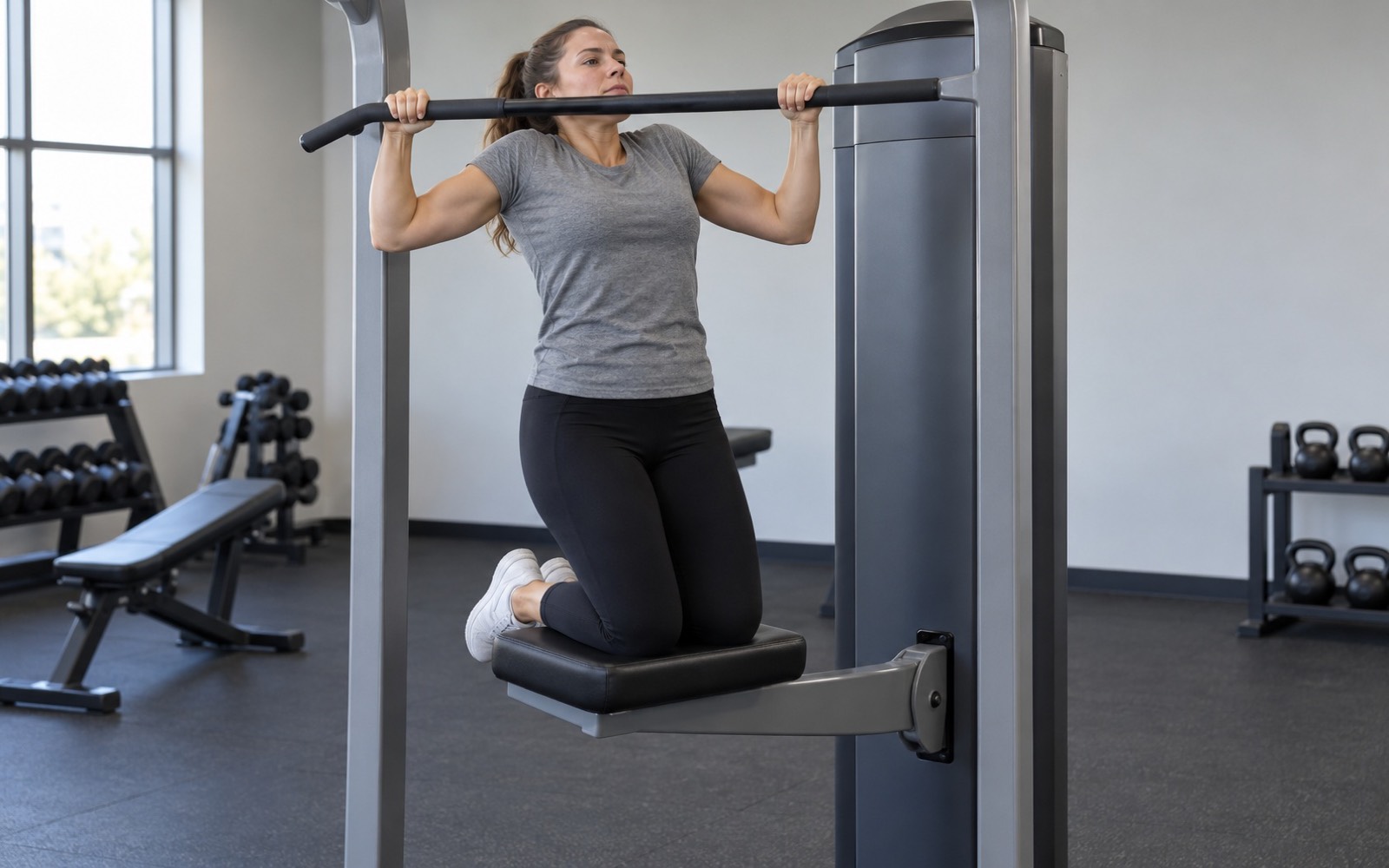
Shoulders, elbows, back: who should be careful and when to see a doctor
For a healthy person, the assisted pull-up machine works at almost any age and fitness level; the manufacturer says so too. If you have pain in your shoulder, elbow or neck, or after a shoulder injury, agree on the counterweight, grip and range of motion with your doctor.
The shoulder is one of the most common injury sites in strength training. In Kolber's 2010 review, the shoulder complex accounted for up to 36% of these injuries. The assisted machine itself is gentler than the bar because you can reduce the load. But the position of your arm high overhead is the same.
- Pain at the front or side of the shoulder when you raise your arm. Start with a medium overhand or neutral grip, and put the wide and underhand grips aside (Prinold, 2016). If the pain doesn't go away within 1–2 weeks or gets worse, see a doctor.
- A past shoulder dislocation or subluxation. Get clearance from a doctor or physical therapist first. Start with a big counterweight and a full but smooth range of motion, without jerking at the bottom.
- Pain on the inside or outside of the elbow. Switch to a neutral grip, drop the underhand grip and reduce the load. If your elbow also hurts in everyday life, see a doctor first.
- A herniated disc in the neck. During a flare-up, see a doctor first and ask whether you can work with your arms overhead right now. Outside a flare-up, train with your doctor's approval and a big counterweight.
- A lot of extra weight or a long break from training. The StairMaster manual specifically warns that these people may underestimate the load: it feels easy, but the work is actually harder than it feels. For the first two weeks, keep 2–3 reps in the tank and don't rush to take off plates.
- Sore knees. If kneeling on the pad hurts, put a folded towel under your knees. On models where you stand on the platform with your feet, this isn't a problem.
- Pregnancy. Discuss exercise with the doctor who's following your pregnancy.
- High blood pressure, heart disease. Agree on your program with your doctor, and don't hold your breath during a set.
Stop signs. The StairMaster manual says to stop exercising right away if you get chest pain, severe muscle pain, faintness or shortness of breath. If it doesn't go away, you need a doctor immediately. Also see a doctor if you get sharp shoulder pain with a click right during a set, if your fingers or arm go numb, if pain runs from your neck down your arm, or if pain doesn't go away after 2–3 days of rest.
Mild soreness in your lats and biceps a day after your first sessions is ordinary delayed onset muscle soreness. It goes away on its own within a few days, especially if you've added negatives.
Assisted machine, resistance band, lat pulldown or negatives: what to choose and what to use instead
All four options lead to the pull-up, and a combination works best: the assisted machine or a band for the movement itself, negatives for strength at the bottom and the lat pulldown for volume.
| Option | Upside | Catch | Where |
|---|---|---|---|
| Assisted pull-up machine | precise dosing, the same help through the whole range, easy to track progress | your knees rest on the pad; in people who can do fewer than 10 pull-ups, lat activity on the machine is barely linked to lat activity on the bar (Hewit, 2018) | gym |
| Pull-up resistance band | you hang from a real bar, your body is free | helps most at the bottom, where you need your own strength; big jumps between band strengths | home, gym, outdoors |
| Lat pulldown | precise weight, you can work for volume | in women, the link between lat pulldown max and pull-up max is weak, r = 0.44 (Johnson, 2009) | gym |
| Negatives on the bar | work with your full body weight; heavy lowering-phase work builds more strength than lifting-phase work (Roig, 2009) | heavy soreness after the first sessions, so you can't do many sets | home, gym, outdoors |
Assisted machine or band? On the assisted machine, the help is the same through the whole range of motion, and it's easy to log in kilograms or pounds. A band is closer to the bar because you hang from it yourself. But it helps a lot at the bottom and barely at all at the top, and the weights on the packaging differ between manufacturers. In the gym, the assisted machine is more convenient; at home and outdoors, a band. How to pick a band and attach it to a pull-up bar is covered in our guide to resistance band workouts.
Assisted machine or lat pulldown? Both are better. The assisted machine teaches the pull-up movement itself. The lat pulldown is a good way to add volume for your back: the weight changes one plate at a time, and it's easier to keep your form. In Johnson's 2009 study, men's lat pulldown max and pull-up max were closely linked, r = 0.78, while in women the link turned out to be weak. In 2018, Hewit found that in people who can do fewer than 10 pull-ups, the exercise closest to the bar in terms of lat activity was the kneeling lat pulldown with a weight equal to 80% of body weight: r = 0.90. We covered form and variations in our article on the lat pulldown.
What to use instead of the assisted pull-up machine if there isn't one.
- In the gym: the lat pulldown, including the kneeling version, plus negatives on the bar and a band on the bar.
- At home with a pull-up bar: a pull-up resistance band, negatives from a chair, and an active hang with your shoulders down for time.
- At home without a bar: inverted rows under a sturdy table, band rows to your chest, one-arm dumbbell rows. They prepare your back, but you'll still need a bar later.
Questions and answers
Why does more weight make the assisted pull-up machine easier?
The counterweight plates pull the pad under your knees up and take away part of your body weight. What you lift is your body weight minus the counterweight. A 60 kg (132 lb) woman with a 45 kg (99 lb) counterweight lifts 15 kg (33 lb), and with a 30 kg (66 lb) counterweight she lifts 30 kg (66 lb). That's why progress on the assisted machine means moving down the stack.
How much weight should a woman and a man set on the assisted pull-up machine for the first session?
According to the StairMaster manual, a woman should lift 20–25% of her body weight and a man 50–55%. At 60 kg (132 lb), a woman sets a counterweight of about 45 kg (99 lb); an 80 kg (176 lb) man sets about 40 kg (88 lb). After that, fine-tune the weight with trial sets: you want 8 clean reps with 1–2 reps left in the tank.
What muscles do assisted pull-ups work?
Pull-ups work the lats, biceps, brachialis, trapezius, rhomboids, rear delts and rotator cuff. According to Youdas's 2010 data, the lats work at 117–130% of maximal contraction in the pull-up. Dips on the assisted machine work the chest, triceps and front delts.
Which grip is best on the assisted pull-up machine: wide, close, underhand or neutral?
For starting out, a medium overhand or a neutral grip. A wide grip doesn't give the lats more work (Andersen, 2014, on the lat pulldown), but with it the shoulder blade moves the way it does with a higher risk of impingement (Prinold, 2016). An underhand grip loads the biceps and chest more. Once you've mastered the medium grip, you can alternate grips.
Can you learn to do a pull-up using only the assisted machine?
You can, but it's slower and doesn't work for everyone. In Hewit's 2018 study, in people who could do fewer than 10 pull-ups, lat activity on the assisted machine was barely linked to their lat activity on the bar. So it's more reliable to combine the machine with negatives on the bar and lat pulldowns. Try the bar once you can do 8–10 reps on the machine with a counterweight of no more than 20% of your body weight.
When and by how much should you lower the counterweight?
By one plate, which is 5 kg (11 lb) in many gyms, once 3 sets of 10 reps feel clean. If you're lifting 15–25 kg (33–55 lb), taking off a 5 kg (11 lb) plate raises your load by 20–33%, while the ACSM recommends 2–10% per step. So after you take off a plate, start again with 3 sets of 8, and if that doesn't work, put the plate back and do 3 sets of 12.
Which is better: the assisted machine, a resistance band or the lat pulldown?
Each has its own role. The assisted machine doses help more precisely, a band is closer to hanging from a bar, and the lat pulldown is good for back volume. The fastest way to your first pull-up is to combine one of them with negatives on the bar.
What can you do instead of the assisted pull-up machine if your gym doesn't have one or you train at home?
In the gym, lat pulldowns, negatives and a band on the bar. At home with a bar, a pull-up resistance band and slow negatives from a chair. Without a bar, inverted rows under a table and rows with a band or a dumbbell, but for real pull-ups you'll still need a bar sooner or later.
The bottom line
- The assisted pull-up machine helps you do pull-ups and dips: load = body weight − counterweight, so more plates make it easier.
- The starting point from the StairMaster manual: women lift 20–25% of body weight, men 50–55%. That's where the "70–80% counterweight" you see online comes from: it's the number for women.
- Form: shoulders down, elbows toward your ribs, chin above the handles, lower to straight arms, 3–4 seconds per rep. Get on and off one leg at a time.
- For starting out, use a medium overhand or neutral grip. On the lat pulldown, a wide grip didn't add work for the lats. In the pull-up, it's linked to a higher risk for the shoulder (Andersen, 2014; Prinold, 2016).
- The pattern: 3 × 8 → 3 × 10 → one plate off, twice a week, with 1–2 reps in the tank. Over our 8-week plan, a woman's load doubles and a man's grows by 37.5%.
- Try the bar once 8–10 clean reps come with a counterweight of no more than 20% of your body weight (Johnson, 2009). Negatives on the bar speed things up (Roig, 2009).
- Chest pain, shortness of breath, sharp shoulder pain with a click, a numb arm: stop and see a doctor.
Checklist: before a set on the assisted pull-up machine
- The pin is pushed all the way into the plate.
- Your counterweight from last session is logged, and today's is chosen by the rule 8 → 10 → one plate off.
- Medium overhand or neutral grip, thumb wrapped around the handle.
- Knees in the center of the pad, shins fully on the cushion.
- Before the first rep, shoulders down and shoulder blades slightly squeezed.
- Every rep goes to straight arms at the bottom and chin above the handles at the top.
- Step off one leg at a time, after the pad has returned to the top.
- Once every 2 weeks, a test pull-up on the bar after your warm-up.
Sources
- StairMaster Sports/Medical Products. Gravitron 2000 AT Upper-Body Exercise System: Owner's Manual. Manufacturer's manual. — A 180 lb (about 82 kg) stack in 10 lb steps; suitable for people of almost any age and fitness level; on the first session, women lift 20–25% of body weight and men 50–55%; get on and off the platform one leg at a time without letting the plates slam; the thumb wraps fully around the handle; a rep takes 3–4 seconds, dips go down to a right angle at the elbows; the basic program is 6 sets, alternating dips with wide, medium and parallel-grip pull-ups; 3 sets, at least 2 sessions a week on non-consecutive days; reduce assistance when 10 reps feel confident, and in the advanced program take off 10 lb once 12 reps are consistent; emphasize the lowering phase, keep records; a warning for people who are overweight or deconditioned; stop if you have chest pain, faintness or shortness of breath.
- Johnson D., Lynch J., Nash K., Cygan J., Mayhew J.L. Relationship of lat-pull repetitions and pull-ups to maximal lat-pull and pull-up strength in men and women. Journal of Strength and Conditioning Research, 2009. — 35 men and 23 women; pull-up max of 1.16 of body weight in men and 0.73 in women; at 80% of max, women did 10.5 pull-ups and men 8.1; the link between lat pulldown max and pull-up max was r = 0.78 in men and r = 0.44 in women, not significant.
- Hewit J.K., Jaffe D.A., Crowder T. A Comparison of Muscle Activation during the Pull-up and Three Alternative Pulling Exercises. Journal of Physical Fitness, Medicine & Treatment in Sports, 2018. — 41 people (28 men, 13 women); the assisted machine with a counterweight of 20% of body weight, seated and kneeling lat pulldowns at 80% of body weight; in people doing fewer than 10 pull-ups, the link in lat activity between the bar and the assisted machine was r = 0.08, between the bar and the kneeling lat pulldown r = 0.90, and for the biceps between the bar and the assisted machine r = 0.83; this group had 14 people, 11 of them women; the rectus abdominis was the most active of the measured muscles on the bar; each exercise was done for 5 reps.
- Youdas J.W., Amundson C.L., Cicero K.S., Hahn J.J., Harezlak D.T., Hollman J.H. Surface electromyographic activation patterns and elbow joint motion during a pull-up, chin-up, or perfect-pullup rotational exercise. Journal of Strength and Conditioning Research, 2010. — 21 men and 4 women; lats at 117–130% of maximal contraction, biceps 78–96%, infraspinatus 71–79%, lower trapezius 45–56%, pectoralis major 44–57%, spinal erectors 39–41%, external obliques 31–35%; the underhand grip loads the pectoralis major and biceps more, the overhand grip the lower trapezius; elbow range of motion 93–101°.
- Dickie J.A., Faulkner J.A., Barnes M.J., Lark S.D. Electromyographic analysis of muscle activation during pull-up variations. Journal of Electromyography and Kinesiology, 2017. — 19 trained men, 8 muscles, overhand, underhand, neutral grip and rope; activity was broadly similar across grips; peak middle trapezius 60.1% with an overhand grip versus 37.1% with a neutral grip; on the way up, the biceps, brachioradialis and pectoralis major work harder than on the way down.
- Prinold J.A., Bull A.M. Scapula kinematics of pull-up techniques: Avoiding impingement risk with training changes. Journal of Science and Medicine in Sport, 2016. — 11 people; a high arm position narrows the subacromial space; wide and underhand grips produce shoulder blade motion linked to impingement risk; the authors consider counterweight-assisted overhand pull-ups a possible recommendation for weaker people, but say they need to be studied.
- Andersen V., Fimland M.S., Wiik E., Skoglund A., Saeterbakken A.H. Effects of grip width on muscle strength and activation in the lat pull-down. Journal of Strength and Conditioning Research, 2014. — 15 men, grips at 1, 1.5 and 2 shoulder widths; for 6 reps, the narrow and medium grips moved about 80 kg and the wide grip 77.3 kg; lat activity over the whole movement was the same, and on the way down slightly higher with the wide grip than with the narrow one.
- Kolber M.J., Beekhuizen K.S., Cheng M.S., Hellman M.A. Shoulder injuries attributed to resistance training: a brief review. Journal of Strength and Conditioning Research, 2010. — The shoulder complex accounts for up to 36% of injuries from strength training.
- Roig M., O'Brien K., Kirk G., Murray R., McKinnon P., Shadgan B., Reid W.D. The effects of eccentric versus concentric resistance training on muscle strength and mass in healthy adults: a systematic review with meta-analysis. British Journal of Sports Medicine, 2009. — Heavy lowering-phase (eccentric) training adds more strength and muscle mass than lifting-phase (concentric) training.
- American College of Sports Medicine. Progression models in resistance training for healthy adults. Medicine & Science in Sports & Exercise, 2009. — Beginners: 8–12 reps 2–3 times a week; add 2–10% once you can do 1–2 reps more than your target; 1–2 minutes of rest.
- Currier B.S., D'Souza A.C., Singh M.A.F. et al. American College of Sports Medicine Position Stand. Resistance Training Prescription for Muscle Function, Hypertrophy, and Physical Performance in Healthy Adults: An Overview of Reviews. Medicine & Science in Sports & Exercise, 2026. — 137 systematic reviews, more than 30,000 participants; strength improves more with 2–3 sets, at least 2 sessions a week and full range of motion; muscles grow better with 10 or more sets a week; training to failure gives no consistent advantage.
This article is for informational purposes only and is not a substitute for medical advice.