

the main muscle in dips is the triceps, and the second is the lower chest. In McKenzie's 2022 study, the triceps worked about a quarter harder on parallel bar dips than in bench dips: 1.04 mV versus 0.83 mV. According to Çınarlı's 2021 data, your triceps don't need you to go deeper than a right angle: during the pause at the bottom, they were more active with the elbow bent to 75° than to 95°, and the pectoralis major didn't change with depth. On parallel bars, the shoulder moves back to 88% of its limit, in bench dips to 101%, and on rings to 69%, so there's one rule: your shoulder never goes lower than your elbow.Start on the assisted dip machine with a counterweight of about two thirds of your body weight and 3 sets of 8. By our plan, your first clean rep is about three months away from there. Add a dip belt after 3 sets of 12 with body weight: 2.5 kg (5.5 lb) for women and 5 kg (11 lb) for men.
Dips mean lowering and raising your body on your arms between two parallel bars. You start in a support position on straight arms, lower yourself until your elbows bend to a right angle, and press yourself back up. Your arms hold your entire body weight the whole time, so the exercise is hard from the very first rep: in a regular push-up your hands carry about 64% of your weight, and on the dip bars they carry all 100%. Dips work your triceps and lower chest, with help from the front delts and the muscles that hold your shoulder blades in place. If you're starting from zero, there's a ladder of steps that leads to your first clean rep: push-ups, bench dips, negatives, and then the assisted dip machine or a resistance band. By our plan, it takes about three months from your first session on the assisted machine to your first clean rep, and longer if you're starting with push-ups. Once you can do 3 sets of 12, it's time to put on a dip belt with weight.
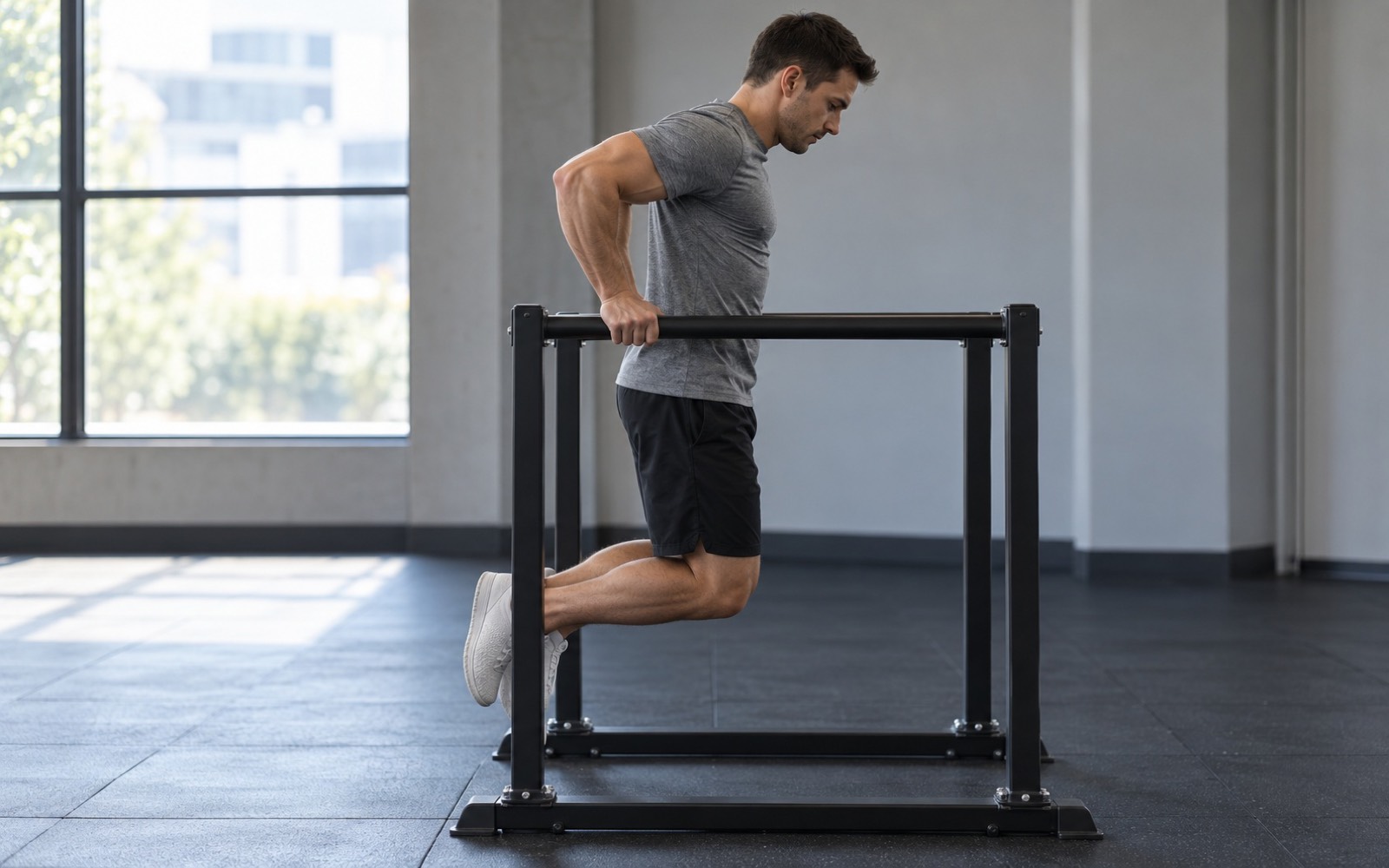
What dips are and what they do for you
Dips are an exercise where you lower and raise your body on straight arms between two parallel bars, and your arms hold your entire body weight. People also call them parallel bar dips or bar dips, and the equipment itself is called a dip station.
What sets dips apart from push-ups is the load. In Ebben's 2011 study, 23 people did six push-up variations on force plates, and in a standard push-up the hands held about 64% of body weight, the same for men and women. On the dip bars there's nothing under your feet, so a person who weighs 80 kg (176 lb) presses all 80 kg. That makes dips roughly one and a half times harder than regular push-ups, and plenty of people can't do one from scratch. The upside is that dips are one of the few upper-body exercises where you can keep adding load without a machine or a barbell: you just hang weight from a belt.
What dips give you:
- Triceps. The triceps straighten your elbow, and in the upright version they're the main muscle doing the work. The triceps are bigger than the biceps, which is why they're the muscle that makes your arm look noticeably thicker in a T-shirt sleeve.
- Chest. When you lean forward, the pectoralis major gets more involved, especially its lower part.
- Shoulders and shoulder blades. The front delts help you press your body up, and the muscles around your shoulder blades learn to hold your shoulders in place with your whole body weight pushing down on them.
- Carryover to other lifts. Strong triceps finish the lockout in the bench press and any standing press.
Dips suit any healthy person, women included. Hold off for now if the front of your shoulder hurts, you've dislocated your shoulder before, or your elbow is inflamed. Section 10 covers this.
What muscles do dips work
The main muscles in dips are the triceps brachii and the pectoralis major, especially its lower part; the front delts, the serratus anterior, and the muscles that hold your shoulder blades all help.
| Muscle | What it does in a dip | Where you feel it |
|---|---|---|
| Triceps (triceps brachii) | straightens the elbow and lifts your body out of the bottom position | back of the upper arm, especially on the last reps |
| Pectoralis major, lower portion | pulls the upper arm toward the torso and works under stretch at the bottom | lower chest, closer to the armpit; stronger in the forward-lean version |
| Front delt (anterior deltoid) | helps drive the upper arm forward and up on the way up | front of the shoulder; if that's the only place you feel it, your depth or lean is too big |
| Serratus anterior | holds your shoulder blade against your ribs in the support position | side of the rib cage under the armpit |
| Rhomboids and lower traps | keep your shoulders from creeping up toward your ears | between the shoulder blades, toward the end of a set |
| Lats | help pull your shoulders down and stabilize the support position at the top | side of the back below the shoulder blade |
| Abs and hip flexors | hold your legs and torso still and stop you from swinging | stomach, if your legs are out in front |
| Forearms | hold your grip on the bars | hands, as the weight goes up |
How hard the triceps work. In 2022, McKenzie and colleagues compared three types of dips in 13 experienced men with an average of 4.2 years of training: bench dips, parallel bar dips and ring dips. The movement was recorded with 3D cameras, and electrical activity was measured in 9 muscles. The triceps registered 0.83 mV on the bench, 1.04 mV on parallel bars and 1.05 mV on rings. The gap between the bench and the bars is about 25%. What this means for you: once bench dips feel easy, parallel bar dips give your triceps noticeably more work, while rings add almost nothing on top of the bars.
How hard the chest works. In the same study, the pectoralis major worked hardest on rings, less on the bars, and least on the bench. Yet on the rings, the shoulder moved back the least of all, so stretch wasn't the reason. The authors explain the difference by stability: rings are free to drift apart, and the pecs, together with the lats, pull the arms toward the body to hold them in place. The practical takeaway for section 03: you don't need to go deeper for your chest, and Çınarlı's 2021 measurements back this up.
Are bench dips a real exercise? Yes. In a 2011 study by the American Council on Exercise (ACE), 15 women aged 20–24 did 8 triceps exercises, and muscle activity was counted as a percentage of triangle push-ups with a narrow hand position. Bench dips from a low bench scored 87%, cable pushdowns with a rope 74%, and the close-grip bench press 62%. Your own body weight loads the triceps as well as a cable machine does, so bench dips are a proper step toward parallel bar dips.
Chest dips vs. triceps dips: torso lean, elbows, and bar width
Leaning your torso forward 20–30° with your elbows slightly out shifts the work to your chest, while an upright torso with your elbows tucked back shifts it to your triceps.
That's how almost every coach splits the dip, and 20–30° is their practical guideline. We couldn't find a direct measurement of how torso lean changes chest activity on the dip bars. What is known is how lean affects the shoulder. In McKenzie's 2022 study, the torso leaned forward much more on parallel bars than in bench dips, and the authors write that the lean takes over part of the depth. Your shoulder then has to travel back less, into extension. On the bench, the torso stayed almost upright, leaning only about 13°, and the shoulder went past its own limit.
Çınarlı and colleagues tested the other half of the question in 2021. They measured the triceps and pectoralis major in 10 men on the dip bars as they lowered to elbow bends of 75°, 85° and 95°. The angle was measured from a straight arm, so 75° is slightly above a right angle and 95° is slightly below it. A metronome set the tempo: 2 seconds down, a 1-second pause, 2 seconds up, with the torso held upright and the elbows close to the body. Both heads of the triceps measured were significantly more active during the bottom pause at 75°, the shallowest of the three positions. The pectoralis major didn't change with depth. The takeaway is simple: going deeper than a right angle does nothing for your triceps or your chest, and you bring in the chest by leaning.
| Feature | Chest dips | Triceps dips |
|---|---|---|
| Torso | leaning forward 20–30°, eyes on the floor | upright, eyes forward and slightly down |
| Elbows | slightly out, at 30–45° from your torso | tucked in, traveling back |
| Bar width | slightly wider than your shoulders | shoulder width or narrower |
| Legs | knees bent and brought forward, which tilts your torso on its own | crossed and hanging under your hips |
| Depth | shoulder level with the elbow; any deeper and the load on the front of the shoulder grows | down to 90° at the elbow; the triceps gain nothing from going deeper |
| Where you feel it | lower chest, closer to the armpit | back of the upper arm |
Bar width changes the same shoulder position: on wide bars your arms spread apart, your elbows flare out, and the dip turns into a chest dip on its own. If your gym has bars of only one width, leaning your torso and bringing your legs forward gives the same effect. McKenzie and co-authors warned in 2022 that a wide grip, added weight and fatigue may noticeably raise the risk of a pec injury, so wide bars aren't for your first months.
For your first weeks as a beginner, the triceps version is the better choice: torso nearly upright with a slight natural forward lean, elbows back. Don't stand perfectly vertical and also go deep, because then almost all of that depth goes to your shoulder. Add a pronounced chest lean once you can do 3 sets of 10 with no pain in the front of your shoulder.
ask someone to film you from the side, or prop your phone on a bench. In the triceps version, the line from your shoulder to your hip should stay almost vertical. In the chest version, it should tilt forward by about the width of your palm at chest level. By eye, the lean almost always looks bigger than it actually is.
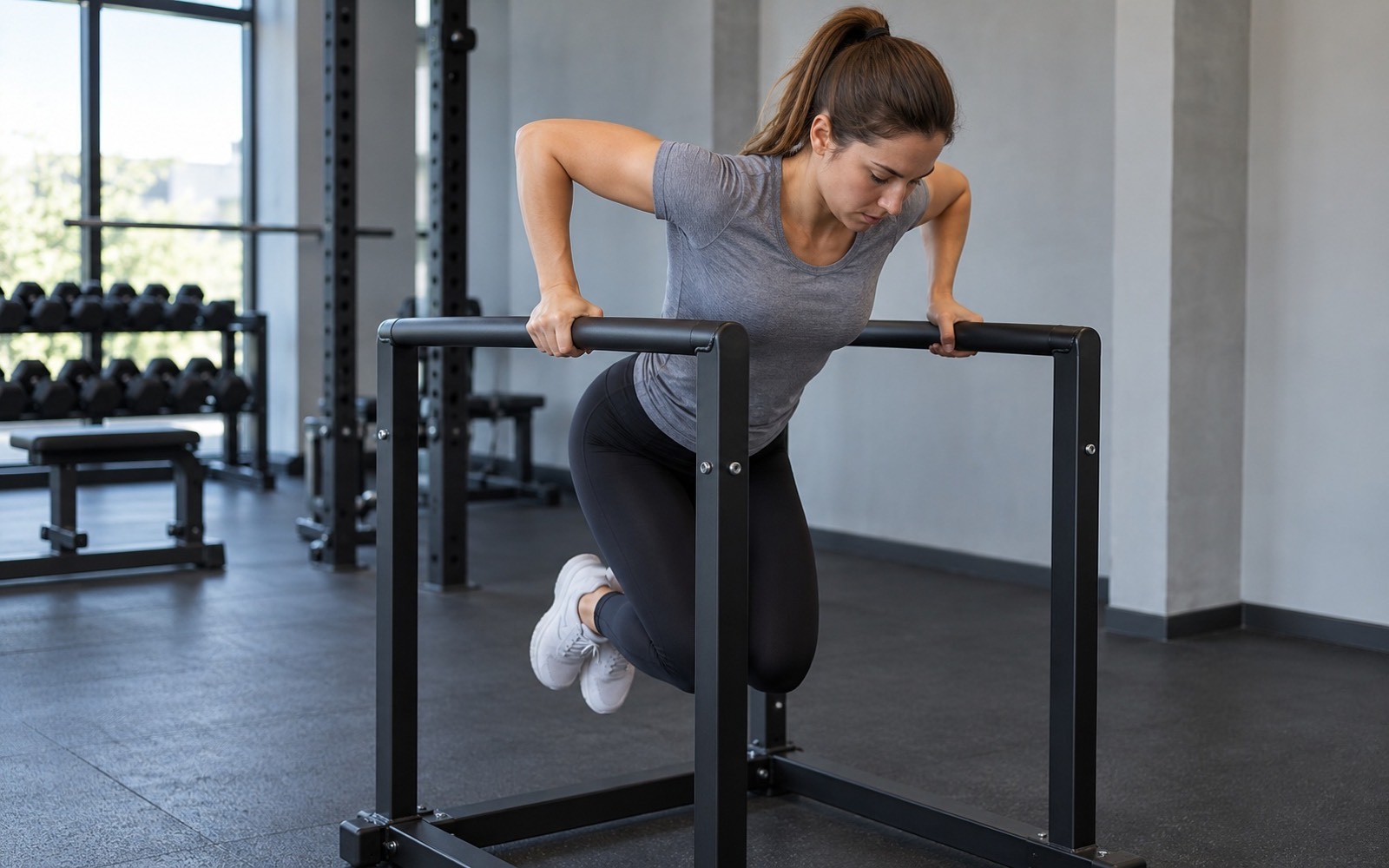
How to do dips: step-by-step form
Step up into a support position on straight arms, pull your shoulders down away from your ears, lower yourself over 2 seconds until your elbows reach a right angle, press yourself up in 1 second, and don't snap your elbows into lockout. Step by step:
- Getting on. Stand on a step or box, grab the bars and press up into support on straight arms. Don't jump from the floor into the full range: dropping down from a jump suddenly loads your shoulder in its most vulnerable position.
- Grip. Neutral, palms facing each other. Your wrist stays straight, in line with your forearm, and the bar rests in the base of your palm, closer to the wrist.
- Support at the top. Shoulders down away from your ears, shoulder blades pulling down toward your hips. Hold this position for the whole set: as soon as your shoulders start creeping up, your range of motion is over.
- Torso. For a beginner, nearly upright with a slight forward lean. Chest slightly forward, stomach tight, no arch in your lower back.
- Legs. Crossed at the ankles or slightly bent at the knees. They hang under your hips and don't swing.
- Lowering. Your elbows bend and travel back, along your torso. Take 2 seconds to lower, breathing in on the way down.
- Bottom position. Elbow bent to about 90°, shoulder level with the elbow. Your shoulder doesn't drop below your elbow. Hold for half a second, without resting and without bouncing.
- Pressing up. Press yourself up in 1 second, breathing out on the way up. Your elbows travel along the same line, back and up.
- Top position. Elbows straight, shoulders still down. Finish softly: your elbow straightens all the way, but without a click in the joint.
A tempo of 2 seconds down and 1–2 seconds up is the moderate tempo the American College of Sports Medicine (ACSM) recommends for beginners in its 2009 position stand.
Breathing. Breathe in as you lower, breathe out as you press up. With a heavy belt, take your breath at the top, hold it on the way down, and breathe out after the midpoint of the press.
How deep to go. Down to a right angle at the elbow, so your shoulder ends up level with your elbow. That's the working standard for a beginner, and here's why. Going deeper doesn't help your triceps: in Çınarlı's 2021 study, they were more active during the bottom pause at a 75° elbow bend than at 95°. And as you go deeper, shoulder extension increases, meaning your shoulder travels back, which is the joint's most vulnerable position. McKenzie and co-authors wrote in the Strength and Conditioning Journal in 2021 that extreme shoulder extension at the bottom of a dip is a vulnerable position that had previously been overlooked. In their 2022 paper they add that this shoulder movement stresses the front of the joint capsule. In their measurements, the shoulder reaches 88% of its maximum extension on parallel bars: close to the limit, but with some margin left. Dropping "all the way down," until your shoulders are below your elbows, uses up that margin. The rule: shoulder no lower than elbow. If the front of your shoulder already feels a pull at 90°, stop higher and work in that range until you get stronger.
How to learn dips from zero: five steps
The path from zero runs from push-ups to bench dips, then negative reps on the bars, then a band or the assisted dip machine, and only after that full reps. By our plan, it takes about three months from your first session on the assisted machine to your first rep, and if you're starting with push-ups, allow more time.
The idea behind the ladder is that each step puts more kilograms on your arms than the one before. Here's roughly how much that is for a woman who weighs 60 kg (132 lb) and a man who weighs 80 kg (176 lb):
| Step | What it is | On the arms, woman 60 kg (132 lb) | On the arms, man 80 kg (176 lb) | When to move on |
|---|---|---|---|---|
| Knee push-ups | knees on the floor, body straight | ≈ 29 kg / 64 lb (49% of body weight) | ≈ 39 kg / 86 lb (49%) | 3×12, clean |
| Push-ups | classic, body straight | ≈ 38 kg / 84 lb (64% of body weight) | ≈ 51 kg / 112 lb (64%) | 3×10, clean |
| Bench dips | hands behind you on a bench, feet on the floor | no precise measurements; less than parallel bar dips | less than parallel bar dips | 3×12 with straight legs |
| Negatives on the bars | step up, lower over 4–5 seconds | 60 kg / 132 lb on the way down | 80 kg / 176 lb on the way down | 3×5 at 5 seconds, no dropping |
| Assisted machine or band | body weight minus the counterweight or the band's help | 60 − 40 = 20 kg / 44 lb at the start | 80 − 50 = 30 kg / 66 lb at the start | counterweight ≤ 25–30% of body weight |
| Dips | full rep with body weight | 60 kg / 132 lb | 80 kg / 176 lb | 3×12, then a belt |
The push-up percentages come from Ebben's 2011 study, and they're the same for men and women. The full push-up ladder, with wall, table and chair steps, is covered in our guide to push-ups for beginners; here it's just the first step.
Step 1. Push-ups. Don't skip them. In 2018, Kotarsky and colleagues trained 23 moderately trained men 3 times a week for 4 weeks: 14 did a push-up progression and 9 did the bench press. Max bench press went up in both groups. So push-ups build upper-body strength without a barbell, and 3 sets of 10 clean reps is your ticket to the next step.
Step 2. Bench dips. Sit on the edge of a bench with your hands on the edge behind you, fingers pointing forward. Slide your hips off the bench and lower yourself, bending your elbows back, to a right angle. Start with your knees bent, then straighten your legs, then put your feet up on a second bench. According to ACE's 2011 study, the triceps work here at 87% of the top exercise. There's one caveat: in McKenzie's 2022 study, the shoulder reached 101% of its extension on the bench, past its own limit, and the authors advise against doing bench dips regularly at all. We keep them as a short step: don't sink below a right angle, and keep your shoulders away from your ears.
Step 3. Negatives. Stand on a step, press up into support on straight arms, and slowly lower yourself, over 4–5 seconds, until your elbows reach a right angle. Get off, step up again, repeat. Do 3 sets of 3–5. Don't try to push yourself back up: your legs on the step do the lifting. Why this works: in Roig's 2009 review of 20 randomized studies, high-load training on the lowering phase produced more strength and more muscle than training on the lifting phase, and the ACSM's 2026 position stand lists eccentric overload as one of the proven ways to build muscle. Lowering on the dip bars is exactly that: you're holding all of your 60 or 80 kg.
Step 4. Band or assisted machine. Loop a band around both bars and put your knees or feet on it. Bands come in different strengths; pick the one that lets you do 3 sets of 8. The assisted dip machine, often called a Gravitron, is more convenient: the help comes from plates on the weight stack, and it's easy to reduce precisely and in small steps. The next section covers it.
Step 5. Your first full rep. Once the counterweight on the assisted machine is down to 25–30% of your body weight and your negatives take 5 seconds without dropping, give it a try. As soon as you get a rep, switch to the plan in section 07. If you're also learning pull-ups, the steps there work in a similar way, and you can alternate the days: the path is covered in our guide to your first pull-up.
The standard for moving on from each step is in the table, and the condition is the same for all of them: every set is clean, with a straight body and full range of motion. Reps done through pain or with a jerk don't count.
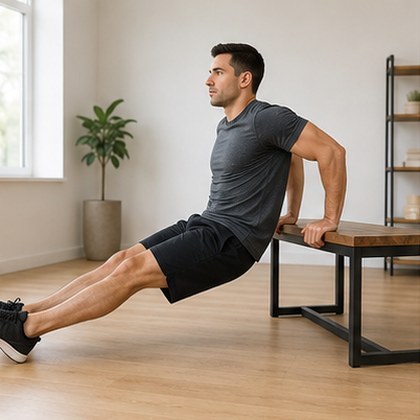 Bench dip, men’s version
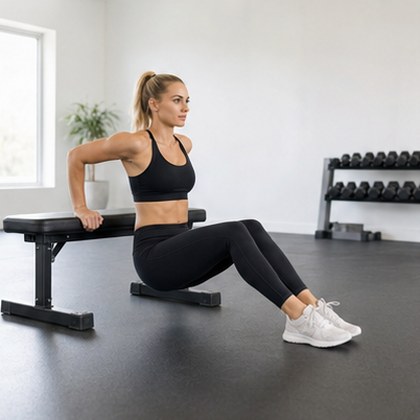 Bench dip, women’s version
Assisted dips: how much counterweight to use and how to reduce it
Start with a counterweight of about two thirds of your body weight, do 3 sets of 8, and take off 5 kg (11 lb) each time you manage 3 sets of 10 without jerking.
The assisted dip machine works the opposite way from regular machines: the bigger the plate, the easier it gets. The plate pushes the platform up and takes away part of your weight, so the load on your arms is your body weight minus the counterweight. A 60 kg (132 lb) woman with a 40 kg (88 lb) plate is pressing 20 kg (44 lb), a third of herself. So the question "how much weight should I set on the assisted dip machine" really means: how many kilograms do you want to press.
How to get on: put one knee on the platform, grab the handles, then put the other knee on. Press up into support on straight arms, pull your shoulders down away from your ears, and do the same movement you'd do on the bars: elbows back, down to a right angle, shoulder no lower than elbow. Get off one leg at a time too, or the platform will shoot up.
Our 8-week plan for a 60 kg (132 lb) woman and an 80 kg (176 lb) man, with a 5 kg (11 lb) weight stack step and two sessions a week:
| Week | Woman 60 kg: counterweight → you press | Man 80 kg: counterweight → you press | Sets |
|---|---|---|---|
| 1 | 40 → 20 kg / 88 → 44 lb (33% of body weight) | 50 → 30 kg / 110 → 66 lb (38%) | 3×8 |
| 2 | 40 → 20 kg | 50 → 30 kg | 3×10 |
| 3 | 35 → 25 kg / 77 → 55 lb (42%) | 45 → 35 kg / 99 → 77 lb (44%) | 3×8 |
| 4 | 35 → 25 kg | 45 → 35 kg | 3×10 |
| 5 | 30 → 30 kg / 66 → 66 lb (50%) | 40 → 40 kg / 88 → 88 lb (50%) | 3×8 |
| 6 | 30 → 30 kg | 40 → 40 kg | 3×10 |
| 7 | 25 → 35 kg / 55 → 77 lb (58%) | 35 → 45 kg / 77 → 99 lb (56%) | 3×8 |
| 8 | 25 → 35 kg + negatives on the bars 3×3 | 35 → 45 kg + negatives 3×3 | 3×10 |
Over 8 weeks, the load on the woman's arms grows from 20 to 35 kg (44 to 77 lb), which is +75%, and on the man's from 30 to 45 kg (66 to 99 lb), which is +50%. The rhythm goes like this: one week at 8 reps, one week at 10, and only then a lighter plate. The reason is the stack step: taking off 5 kg of counterweight adds 12.5 to 25% to your load at once, depending on how much you're pressing now, while the ACSM's 2009 position stand advises adding 2–10% at a time, once you can do 1–2 reps more than your target. Going from 8 to 10 reps before dropping a plate smooths out that jump.
If 3 sets of 10 don't come out clean in a given week, stay on that week for another one or two. If you don't weigh 60 or 80 kg, work it out yourself: the starting counterweight is two thirds of your body weight, rounded to the nearest plate, and then the same scheme.
The assisted machine trap. It's comfortable, and it's easy to get stuck on it for a long time with a counterweight of half your body weight. The rule for getting off it: as soon as the counterweight is ≤ 25–30% of your body weight and your negatives take 5 seconds, try a full rep on real bars. By the end of our plan, the counterweight is still about 40% of body weight, so after week eight keep going with the same scheme: 3×8, 3×10, minus 5 kg. A 60 kg woman needs to get down to a 15 kg (33 lb) plate and an 80 kg man to 20 kg (44 lb), which takes another 4–6 weeks. The 3×3 negatives from week eight help you make that transition. Pull-ups have the same trap, and our first pull-up guide covers it.
How many reps and sets: an 8-week body-weight plan
Once you have your first rep, do 3 sets of 5–8 with 2 reps in reserve twice a week, build up to 3 sets of 12, and then move on to added weight.
| Week | Sets × reps | Reps per session | Anything else |
|---|---|---|---|
| 1 | 3×5 | 15 | 2–3 minutes between sets |
| 2 | 3×6 | 18 | |
| 3 | 3×8 | 24 | |
| 4 | 3×8 | 24 | negatives 2×3 at 5 seconds after your main sets |
| 5 | 3×10 | 30 | |
| 6 | 3×10 | 30 | one set with a forward lean, for your chest |
| 7 | 3×12 | 36 | |
| 8 | 3×12 | 36 | if every set is clean, put on a belt next week |
Over 8 weeks, your volume per session grows from 15 to 36 reps, 2.4 times more. The ACSM's 2009 position stand names 8–12 reps as the working range for beginners, and the first weeks at 5–6 reps are there so your form can settle in with full body weight. If the reps don't come in week 5 or week 7, stay there another week: clean reps matter more than the dates in the table.
Reps in reserve. You don't need to take every set to failure. In Grgic's 2022 meta-analysis of 15 studies, training to failure and stopping short of it produced almost identical gains in strength and muscle: the strength difference was negligible, and the muscle difference was small and not significant. End the set when you could still do 2 more reps but not 3. On the dip bars this is also about safety: failure at the bottom means your shoulder sinking below your elbow.
Rest between sets. 2–3 minutes. In 2016, Schoenfeld and colleagues trained 21 experienced men for 8 weeks on 3 sets of 8–12, and the group resting 3 minutes gained more bench press and squat strength and more thigh muscle thickness than the group resting 1 minute. The triceps difference pointed the same way but fell just short of significance. Short rest on dips just cuts your reps.
How many times a week. Twice, with a rest day in between. The ACSM's 2009 position stand advises 2–3 sessions a week for beginners, and its 2026 position stand, which pulls together 137 systematic reviews, names at least 2 sessions a week for strength and at least 10 sets per muscle group per week for muscle growth. Two sessions of 3 sets give you 6, so get the remaining 4 sets for your triceps and chest from the bench press, push-ups or cable pushdowns.
Where dips go in your workout. On upper-body day, put dips first or second, while you're fresh. If you bench press on the same day, dips come after it: tired triceps under a barbell are more dangerous than on the dip bars.
How many is a good number. There's no single official standard for dips. Our guidelines: 1–5 clean reps is beginner level, your first month with full body weight; 10–12 is a solid level where you can try the lean and the chest version; 20 clean reps in a row with body weight is the latest point to put on a belt, because from there you mostly build endurance, and those sets add almost no strength.
In the Sportygram app (go.sportygram.com; the interface and the coach are in Russian for now), dips come in two variations, chest and triceps, each with technique photos for men and women. You can ask the virtual coach, Alex, in chat to add triceps dips to Wednesday's workout; he shows a confirmation card, and once you confirm, the exercise appears in that day's plan. Log your reps and belt weight in the workout diary, and the history shows when it's time to add more.
Weighted dips: when to add weight and how much
Put on a belt after 3 clean sets of 12 with body weight, and add 2.5 kg (5.5 lb) for women and 5 kg (11 lb) for men. That's 4–6% of your total load, within the ACSM rule of adding 2–10% at a time.
The biggest mistake with weighted dips is counting your progress from the plate. The first 2.5 kg looks tiny, but you're already pressing 60 or 80 kg of your own body, so the right way to count an increase is against your total load. For a 60 kg (132 lb) woman, +2.5 kg is +4%, and for an 80 kg (176 lb) man, +5 kg is +6%. Both steps fall within the rule from the ACSM's 2009 position stand: add 2–10% once you can do 1–2 more reps than your target.
Our 8-week plan, two sessions a week:
| Week | Woman 60 kg: belt → total load | Man 80 kg: belt → total load | Sets × reps | Increase over previous weight |
|---|---|---|---|---|
| 1 | +2.5 → 62.5 kg / +5.5 → 138 lb | +5 → 85 kg / +11 → 187 lb | 3×8 | +4% / +6% |
| 2 | +2.5 → 62.5 kg | +5 → 85 kg | 3×10 | |
| 3 | +2.5 → 62.5 kg | +5 → 85 kg | 3×12 | |
| 4 | +5 → 65 kg / +11 → 143 lb | +10 → 90 kg / +22 → 198 lb | 3×8 | +4% / +6% |
| 5 | +5 → 65 kg | +10 → 90 kg | 3×10 | |
| 6 | +5 → 65 kg | +10 → 90 kg | 3×12 | |
| 7 | +7.5 → 67.5 kg / +16.5 → 149 lb | +15 → 95 kg / +33 → 209 lb | 3×8 | +4% / +6% |
| 8 | +7.5 → 67.5 kg | +15 → 95 kg | 3×10 |
Over 8 weeks, total load grows from 62.5 to 67.5 kg (138 to 149 lb) for the woman and from 85 to 95 kg (187 to 209 lb) for the man. The numbers look modest, but that's +8% for the woman and +12% for the man over the first belted week. First the reps grow from 8 to 10 to 12, then the weight goes up, and the reps drop back to 8. How to keep building once the plan is over is covered in our guide to progressive overload.
What to hang the weight from. A dip belt with a chain is the most convenient: the plate hangs between your legs and stays out of the way. A weighted vest doesn't swing, and it works well if its weights are removable and small. A dumbbell held between your feet is fine for the first 2.5–5 kg (5.5–11 lb), but beyond that your legs start to swing.
Why you shouldn't bounce at the bottom. With added weight, the bottom position gets more dangerous. In 1998, Carek and Hawkins described a pectoralis major rupture during weighted dips. This injury is rare, and most such ruptures in athletes happened during the bench press and overhead presses. But McKenzie and co-authors also warned in 2022 that added weight, fatigue and a wide grip on the dip bars may noticeably raise the risk of a pec injury. Bouncing out of the bottom with a belt on is exactly that situation. The rule is simple: a belt only after 3 clean sets of 12 with body weight, 2 seconds on the way down, a pause at the bottom without bouncing, and never "all the way down."
Do muscles grow without added weight? They do. Schoenfeld's 2017 meta-analysis of 21 studies showed that muscles grow equally from light and heavy weights, as long as sets are taken to failure. So 15–20 body-weight reps to failure or close to it is full-value work for building your triceps and chest; according to Grgic's 2022 meta-analysis, strict failure isn't required for that. Max strength, according to the same 2017 analysis, grows better with heavy weight. If your goal is "twenty dips," the belt can wait; if you want strength that carries over to your bench press, you need the belt.
Mistakes: where you feel it → what to fix
Good dips are felt in your triceps and lower chest; if you feel a pull in the front of your shoulder, your breastbone, your elbow or your wrist, your form has drifted.
| Where you feel it | What's wrong | What to fix |
|---|---|---|
| Front of the shoulder, at the bottom | you're going below elbow level, or your shoulders have crept up to your ears | stop at 90°, shoulder blades down toward your hips, shoulders away from your ears |
| Top of the shoulder, on the way up | you're snapping your elbows into lockout and shrugging your shoulders at the end | finish softly, keep your shoulders down to the very last inch |
| Breastbone, in the middle | you're dropping at the bottom with a big lean, often with a belt on | reduce depth and lean, drop the weight for 2 weeks; if it doesn't go away, see section 10 |
| Inner side of the elbow | your elbows flare out in the triceps version | elbows back, along your torso; lean and flare only in the chest version |
| Wrist | your wrist is bent back and the bar sits in your fingers | wrist straight, bar in the base of your palm, deeper grip |
| Neck, back of the head | you're looking up or at a mirror above you | eyes on the floor about a meter (3 ft) ahead |
| Nothing in the chest, only triceps | torso upright, elbows tucked | lean forward 20–30°, bend your legs and bring them forward |
| Swinging back and forth | you're kicking your legs to help yourself | cross your ankles, 2 seconds down and 1 up, fewer reps |
| You feel nothing, reps are easy | your range is short, the elbow isn't reaching 90° | film yourself from the side, go down to a right angle |
Is it normal to be sore after your first few sessions? A dull ache in your triceps and lower chest the next day or the day after is delayed onset muscle soreness (DOMS), and it goes away by itself within a few days. Joint pain is a different story: sharp pain during a particular movement, in the front of the shoulder or in the elbow, with a click. For that, go to the next section.
Shoulders, elbows and breastbone: who should be careful and when to see a doctor
Dips are fine for a healthy person, but if you have shoulder instability, a recent dislocation, pain in the front of the shoulder or in the sternoclavicular joint, agree on range of motion and weight with a doctor.
The shoulder is the most mobile and most fragile link in this exercise. In Kolber's 2010 review, the shoulder complex accounted for up to 36% of all documented injuries and disorders from strength training, and the authors name two main causes: muscle imbalance around the joint and technique. On the dip bars, technique mostly means depth. As covered in section 04, the shoulder reaches 88% of its limit at the bottom of a parallel bar dip and 101% in bench dips. That's why "shoulder no lower than elbow" keeps coming up here: that boundary leaves the joint some margin.
For balance, here are the numbers on how dangerous strength training actually is. In Keogh and Winwood's 2017 review, bodybuilders had the lowest injury rate of all the weight-training sports: 0.12–0.7 injuries per athlete per year, most often in the shoulders, lower back, knees, elbows and wrists. Dips are no more dangerous than the rest of the gym if your form is in place.
The good news: even shoulder instability in lifters often gets better without surgery. In 1993, Gross and co-authors described 23 shoulders in 20 athletes who had pain when working with the arm raised out to the side and rotated outward. 13 shoulders were treated without surgery, with active rehab and changes in technique to stay out of the painful position. The other 10 needed surgery, and in the end all 20 athletes returned to training. The study wasn't about dips, but the principle is the same: with a painful shoulder, you change your technique and work with a physical therapist first.
Who should be careful with dips:
- A past shoulder dislocation or subluxation, or instability. See a doctor or physical therapist first, then use the assisted machine with a big counterweight and a range that stops above 90°.
- Joint hypermobility. Keep your range strictly to a right angle, your shoulders away from your ears, and don't rush to add weight.
- Pain in the front of your shoulder right now. Put dips aside and find the cause: what to do about a shoulder that hurts after training is covered in our article on shoulder pain from lifting.
- An elbow that has been inflamed. Come back through the assisted machine, and add a belt once your elbow no longer hurts with body weight.
- A herniated disc in the neck during a flare-up. While it hurts, no support positions on your arms. Outside a flare-up, only with your doctor's approval, starting on the assisted machine.
- Pregnancy. Talk to the doctor who's following your pregnancy. Dips are usually swapped for incline push-ups against a support.
- After 40 and after 60. You can do them: the ACSM's 2026 position stand calls strength training safe for healthy adults of any age. Start with the assisted machine and negatives, and progress more slowly.
See a doctor if pain shoots down your arm or your fingers go numb, if you felt a click with sharp pain at the bottom, if the pain doesn't go away after 2–3 days of rest, or if swelling appears near your breastbone or the sternoclavicular joint hurts when you press on it. Technique can't fix these.
Dips vs. bench press, push-ups or bench dips: which to choose
Dips are the only one of these four exercises where your arms hold your whole body weight and the load grows without a barbell; the bench press is easier to dose, push-ups are about a third lighter, and bench dips remain a step toward parallel bar dips.
| Exercise | Weight on the arms | Triceps | Chest | Shoulder at the bottom | Who it's for |
|---|---|---|---|---|---|
| Parallel bar dips | 100% of body weight | 1.04 mV (McKenzie, 2022) | moderate, increases with lean | 88% of its extension | anyone who has worked through the steps; add weight with a belt |
| Ring dips | 100% | 1.05 mV | higher than on bars | 69%, the most room | experienced lifters: they take stabilization, but give the shoulder more room |
| Bench dips | less, feet on the floor | 0.83 mV; 87% of the top triceps exercise (ACE, 2011) | lowest of all | 101%, past its own limit | a beginner's step, no deeper than 90° |
| Push-ups | ≈ 64% (Ebben, 2011) | moderate | moderate | moderate | starting from zero; builds your bench even without a barbell (Kotarsky, 2018) |
| Bench press | barbell weight | ≈ 15% of max at 60% 1RM (Rodríguez-Ridao, 2020) | all three portions of the pec evenly | shoulder blades pinned to the bench | precise weight control; see the comparison below |
| Close-grip bench press | barbell weight | 62% of the top triceps exercise (ACE, 2011) | lower portion | supported by the bench | people whose shoulders aren't ready for dips yet |
You can't compare numbers from different studies directly: McKenzie measured the triceps in millivolts, Rodríguez-Ridao as a percentage of maximum contraction, and ACE as a percentage of another exercise. But they all point the same way: in the bench press, the chest works evenly and predictably, with the triceps assisting; on the dip bars, the triceps take the lead, and the chest comes in with a lean.
Dips or bench press. Ideally, both. The bench press is easier to dose: 2.5 kg (5.5 lb) steps, shoulder blades pinned, shoulder stable. Dips give your triceps and lower chest work that's hard to get from the bench press, and strong triceps come back to the bench as a stronger lockout. In a program with two upper-body days, this pair works well: bench press on one day, dips on the other. Bench press technique is covered in our bench press guide.
Dips or close-grip bench press for triceps. If you have access to both, dips: in ACE's 2011 study, the close-grip bench press gave the triceps 62% of the top exercise, bench dips 87%, and on parallel bars the triceps work even harder than on the bench. If the front of your shoulder hurts, the close-grip bench press is the better choice: your shoulder blades are on the bench, and your shoulder doesn't go into extension.
What to do instead of dips at home. Between two chairs, only if they're heavy and stable, with their backs pressed against a wall and your feet on the floor. In that setup your feet take part of the load, so it's closer to a bench dip, and a chair tipping over under your body weight is a real risk. Bench dips off a sofa or a low bench give your triceps 87% of the top exercise, and push-ups with your hands close together load your triceps and lower chest. Nothing at home fully replaces parallel bars, but many parks and outdoor fitness areas have a set.
Questions and answers
What muscles do dips work?
Your triceps and lower chest, with help from the front delts, the serratus anterior and the muscles around your shoulder blades. In McKenzie's 2022 study, the triceps registered 1.04 mV on parallel bars versus 0.83 mV in bench dips, and the pectoralis major worked hardest on rings, where the shoulder has more freedom.
How do you do dips for chest, and how for triceps?
For chest: lean your torso forward 20–30°, elbows slightly out, knees bent and brought forward. For triceps: torso upright, elbows back along your body. Depth doesn't change how hard the pecs work: in Çınarlı's 2021 study, they worked the same at elbow bends of 75°, 85° and 95°, while the triceps were more active at 75°, the shallowest of the three positions. So your chest needs a lean, and neither version needs you to go below a right angle.
How do you learn to do dips from zero, and how long does it take?
Through five steps: push-ups, bench dips, negatives on the bars at 4–5 seconds, the assisted machine or a band, and then a full rep. Move on once you've hit the standard from the table on your current step, usually 3 sets of 10–12 clean reps. By our plan, the assisted machine alone takes 12–14 weeks; if you start with push-ups, it'll take longer, and that's normal.
How much weight should you set on the assisted dip machine?
A counterweight of about two thirds of your body weight: 40 kg (88 lb) for a 60 kg (132 lb) woman, 50 kg (110 lb) for an 80 kg (176 lb) man. With that, do 3 sets of 8, then 3 sets of 10, and only then take off 5 kg (11 lb). Remember that your load is your body weight minus the counterweight: with a 40 kg plate, a 60 kg woman is pressing 20 kg (44 lb).
How many dips should you be able to do, and is there a standard?
There's no single official standard. Our guidelines: 1–5 reps is beginner level, 10–12 is a solid level, and 20 clean reps in a row with body weight is the latest point to put on a belt; by our plan, the belt goes on after 3 sets of 12. For muscle growth, 15–20 reps taken to failure or close to it are enough: Schoenfeld's 2017 meta-analysis found that light weights build muscle as well as heavy ones, and Grgic's 2022 meta-analysis found that strict failure isn't required. Strength, on the other hand, grows from heavy weight.
Can you do dips every day?
There's no need. Twice a week with a rest day in between, 3 sets each time. The ACSM's 2026 position stand advises at least 10 sets per muscle group per week, and it also says that with the same volume, muscle growth doesn't depend on whether you split it into 1 session or into 5 or more. Doing dips every day adds nothing, and your shoulder and elbow get less rest. Get the missing 4 sets for your triceps and chest from pressing, push-ups or cables on other days.
What can you do instead of dips at home?
Bench dips off a sofa or a bench: according to ACE's 2011 study, they load the triceps at 87% of the top exercise. Other options are push-ups with your hands close together, and two heavy, stable chairs with your feet on the floor. A band looped over an outdoor bar also works. Nothing at home replaces a full hang with your body weight.
Why do your shoulders hurt after dips, and are dips bad for your shoulders?
Most often it's depth: your shoulder dropped below your elbow, or your shoulders crept up to your ears. According to McKenzie's 2022 data, the shoulder reaches 88% of its maximum extension on parallel bars and 101% in bench dips. Dips don't harm a healthy shoulder if you stick to the rule "shoulder no lower than elbow." If pain shoots down your arm, your fingers go numb, you felt a click, or the pain doesn't go away in 2–3 days, see a doctor.
The bottom line
- Dips mean raising your body on your arms between two bars, with 100% of your body weight on your arms versus 64% in push-ups (Ebben, 2011). They work your triceps and lower chest, with help from the front delts and the muscles around your shoulder blades.
- The triceps work about 25% harder on parallel bar dips than in bench dips: 1.04 mV versus 0.83 mV (McKenzie, 2022).
- You bring in your chest with a 20–30° torso lean and elbows out, and your triceps with an upright torso and elbows back. Elbow depth doesn't change how hard the pecs work, and the triceps are more active during the bottom pause at a 75° bend than at 95° (Çınarlı, 2021).
- Depth: down to a right angle at the elbow, shoulder no lower than elbow. On parallel bars the joint already reaches 88% of its extension, and on a bench it goes past its limit.
- From zero, there are five steps: push-ups, bench dips, 4–5 second negatives, the assisted machine with a counterweight of two thirds of your body weight, and a full rep. By our plan, the assisted machine takes 12–14 weeks.
- With body weight: 3×5 → 3×12 over 8 weeks, twice a week, 2–3 minutes of rest, 2 reps in reserve (Grgic, 2022; Schoenfeld, 2016). Then a belt: +2.5 kg (5.5 lb) for women, +5 kg (11 lb) for men.
- Pull in the front of the shoulder: stop higher. Pull at the breastbone: less lean and no weight. Pain that lasts 2–3 days, shoots down your arm or came with a click: see a doctor.
Checklist: before a set of dips
- Step up from a box, no jumping from the floor.
- Wrist straight, bar in the base of your palm.
- Shoulders away from your ears, shoulder blades down toward your hips, for the whole set.
- Torso nearly upright if your goal is triceps; a lean of about 20–30° if it's chest.
- Legs crossed and still.
- Down over 2 seconds, to a right angle at the elbow, shoulder no lower than elbow.
- Up in 1 second, no click in the elbows at the top.
- Keep 2 reps in reserve; a belt only after 3 sets of 12 without one.
Sources
- McKenzie A., Crowley-McHattan Z., Meir R., Whitting J., Volschenk W. Bench, Bar, and Ring Dips: Do Kinematics and Muscle Activity Differ?. International Journal of Environmental Research and Public Health, 2022. — 13 experienced men, 3D motion capture and electromyography of 9 muscles: triceps 0.83 mV on the bench, 1.04 mV on bars, 1.05 mV on rings; pectoralis major highest on rings, lowest on the bench; shoulder extension at the bottom as a percentage of maximum — bench 101%, bars 88%, rings 69%; torso lean on the bars takes part of the depth away from the shoulder; the authors link pec activity on rings to arm stabilization; added weight, fatigue and a wide grip may raise the risk of a pec injury; the authors advise against doing bench dips regularly.
- McKenzie A.K., Crowley-McHattan Z.J., Meir R., Whitting J.W., Volschenk W. Glenohumeral Extension and the Dip: Considerations for the Strength and Conditioning Professional. Strength and Conditioning Journal, 2021. — Extreme shoulder extension at the bottom of a dip is a vulnerable position that had previously been overlooked.
- Çınarlı F.S., Kafkas M.E., Soylu A.R., Yılmaz N. Effect of elbow angle on triceps brachii and pectoralis major muscle activity during parallel bar dip. Kinesiologia Slovenica, 2021. — 10 men, elbow bends of 75°, 85° and 95° from a straight arm, 2-1-2 second tempo: both measured heads of the triceps were significantly more active during the bottom pause at 75°, the shallowest position; pectoralis major didn't change with angle.
- Boehler B., Porcari J.P., Kline D., Hendrix C.R., Foster C. ACE Study Identifies Best Triceps Exercises. ACE Certified News, 2011. — 15 women aged 20–24, 8 exercises, triceps activity as a percentage of triangle push-ups: bench dips from a low bench 87%, kickbacks 87%, overhead extensions 76%, rope pushdowns 74%, bar pushdowns 67%, lying triceps extensions 62%, close-grip bench press 62%.
- Ebben W.P., Wurm B., VanderZanden T.L., Spadavecchia M.L., Durocher J.J., Bickham C.T., Petushek E.J. Kinetic analysis of several variations of push-ups. Journal of Strength and Conditioning Research, 2011. — 23 people, 6 push-up variations on force plates: in a standard push-up the hands carry about 64% of body weight, on the knees about 49%, the same for men and women.
- Kotarsky C.J., Christensen B.K., Miller J.S., Hackney K.J. Effect of Progressive Calisthenic Push-up Training on Muscle Strength and Thickness. Journal of Strength and Conditioning Research, 2018. — 23 moderately trained men, 4 weeks of 3 sessions a week: max bench press went up in both the push-up group and the bench press group.
- Roig M., O'Brien K., Kirk G., Murray R., McKinnon P., Shadgan B., Reid W.D. The effects of eccentric versus concentric resistance training on muscle strength and mass in healthy adults: a systematic review with meta-analysis. British Journal of Sports Medicine, 2009. — 20 randomized studies: high-load training on the lowering phase produces more strength and muscle mass than training on the lifting phase.
- American College of Sports Medicine. Progression models in resistance training for healthy adults. Medicine & Science in Sports & Exercise, 2009. — 8–12 reps for beginners, a 2–10% increase once you can do 1–2 more reps; a moderate tempo of 1–2 seconds up and down; 2–3 sessions a week for beginners; 6–12 reps with 1–2 minutes of rest for muscle growth.
- Currier B.S., D'Souza A.C., Singh M.A.F. et al. American College of Sports Medicine Position Stand. Resistance Training Prescription for Muscle Function, Hypertrophy, and Physical Performance in Healthy Adults: An Overview of Reviews. Medicine & Science in Sports & Exercise, 2026. — 137 systematic reviews: at least 10 sets per muscle group per week and eccentric overload for muscle growth, with training frequency not affecting growth when volume is equal; at least 2 sessions a week, full range of motion and 2–3 sets for strength; strength training is safe for healthy adults of any age.
- Schoenfeld B.J., Grgic J., Ogborn D., Krieger J.W. Strength and Hypertrophy Adaptations Between Low- vs. High-Load Resistance Training: A Systematic Review and Meta-analysis. Journal of Strength and Conditioning Research, 2017. — 21 studies: muscles grow equally with light (up to 60% of max) and heavy loads when sets are taken to failure; max strength grows more with heavy loads.
- Grgic J., Schoenfeld B.J., Orazem J., Sabol F. Effects of resistance training performed to repetition failure or non-failure on muscular strength and hypertrophy: a systematic review and meta-analysis. Journal of Sport and Health Science, 2022. — 15 studies: training to failure and stopping short of it produce similar gains in strength and muscle, with no significant difference.
- Schoenfeld B.J., Pope Z.K., Benik F.M. et al. Longer Interset Rest Periods Enhance Muscle Strength and Hypertrophy in Resistance-Trained Men. Journal of Strength and Conditioning Research, 2016. — 21 trained men, 8 weeks of 3 sets of 8–12: 3 minutes of rest produced more bench press and squat strength and more thigh muscle thickness than 1 minute of rest; the triceps trended the same way (p = 0.06).
- Kolber M.J., Beekhuizen K.S., Cheng M.S., Hellman M.A. Shoulder injuries attributed to resistance training: a brief review. Journal of Strength and Conditioning Research, 2010. — Up to 36% of documented injuries and disorders from strength training involve the shoulder complex; the main risk factors are muscle imbalance and technique.
- Carek P.J., Hawkins A. Rupture of pectoralis major during parallel bar dips: case report and review. Medicine & Science in Sports & Exercise, 1998. — A pectoralis major rupture during weighted parallel bar dips; the injury is rare, and most ruptures in athletes happened during the bench press and overhead presses.
- Keogh J.W., Winwood P.W. The Epidemiology of Injuries Across the Weight-Training Sports. Sports Medicine, 2017. — Bodybuilders have the lowest injury rate among weight-training sports, 0.12–0.7 injuries per athlete per year; the shoulders, lower back, knees, elbows and wrists are affected most often.
- Gross M.L., Brenner S.L., Esformes I., Sonzogni J.J. Anterior shoulder instability in weight lifters. American Journal of Sports Medicine, 1993. — 23 shoulders in 20 athletes with pain in abduction and external rotation; 13 shoulders were treated without surgery through rehab and technique changes, 10 were operated on, and all 20 athletes returned to training.
- Rodríguez-Ridao D., Antequera-Vique J.A., Martín-Fuentes I., Muyor J.M. Effect of Five Bench Inclinations on the EMG of the Pectoralis Major, Anterior Deltoid, and Triceps Brachii during the Bench Press. International Journal of Environmental Research and Public Health, 2020. — 30 trained participants at 60% of max: in the flat bench press, all three portions of the pectoralis major work evenly, at about 27% of maximum contraction, and the triceps at about 15%.
This article is for informational purposes only and is not a substitute for medical advice.