

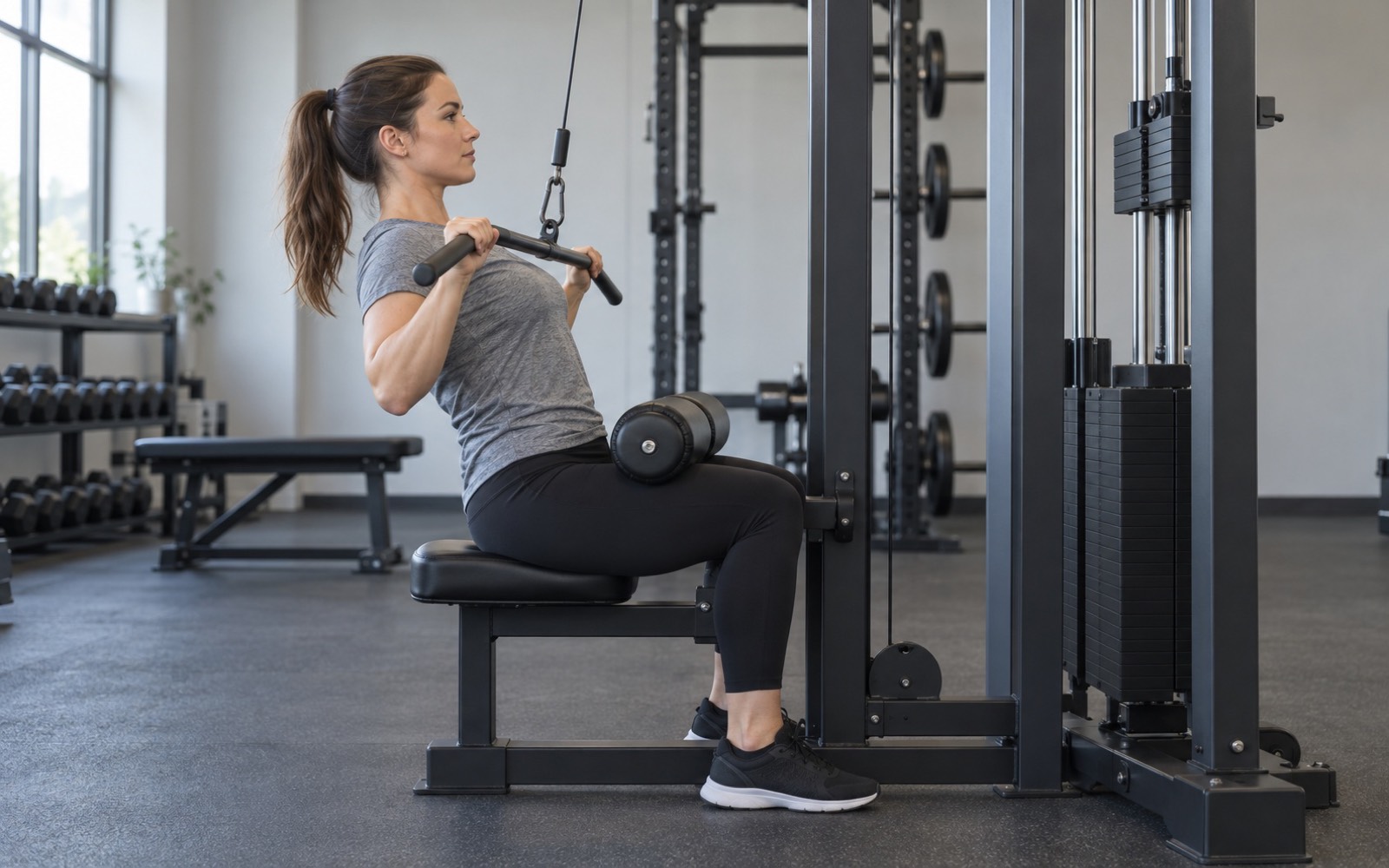
sit so the pad presses firmly on your thighs, take the bar at about one and a half times shoulder width, drop your shoulders first, then drive your elbows down until the bar reaches your upper chest. Pick your grip by what your shoulders tolerate and what feels comfortable: in Buonsenso's 2025 study of 40 experienced men, all seven grip and torso-angle variations worked the lats at the same 45–50% of maximal effort.A beginner is fine with 3 sets of 8–12 reps, 2–3 times a week. On average, a 10-rep weight is about 0.74 of bodyweight for men and 0.44 for women; the table is in section 05. The behind-the-neck version takes about 15% off your working weight and demands a mobile shoulder, so pull to the chest for your first few months.
The lat pulldown is a back exercise done on a cable machine: you sit with your thighs pinned under a pad and pull a bar from overhead down to your upper chest. The latissimus dorsi, the big muscle down the sides of your back, does most of the work, with help from the muscles between your shoulder blades, the rear delts, the biceps and even the chest. Some gyms label the machine a vertical pull or a pulldown station. Here's the form step by step, what grip actually changes according to EMG measurements, how much weight to pull at your bodyweight, how many sets to do, and what to use instead at home.
What a lat pulldown is and what muscles it works
The lat pulldown is a vertical pull done on a cable machine, and the main muscle in it is the latissimus dorsi. It runs from your lower back up the sides of your back to the upper arm bone and pulls a raised arm down toward your torso. That's why the lat pulldown is one of the main back exercises in any gym.
Muscle activity is measured with electromyography (EMG): electrodes on the skin record how hard a muscle is working and compare it to a maximal contraction. In Buonsenso's 2025 study, the lats of experienced men working at 70% of their one-rep max fired at 45–50% of maximal effort.
Lat pulldown muscles worked:
| Muscle | Where it is | What it does in the pulldown |
|---|---|---|
| Latissimus dorsi (lats) | Sides of the back, from the lower back to the armpit | Main mover: pulls the upper arm down toward the torso |
| Teres major | Near the bottom corner of the shoulder blade | Works together with the lats |
| Middle and lower trapezius, rhomboids | Between the shoulder blades | Pull the shoulder blades down and together |
| Rear deltoid | Back of the shoulder | Draws the upper arm back |
| Infraspinatus | On the shoulder blade | Keeps the shoulder in its socket |
| Biceps and brachialis | Front of the upper arm | Bend the elbow |
| Pectoralis major | Chest | Helps bring the arms down |
| Abs and back muscles | Torso | Keep you still on the seat |
The chest surprises a lot of people on that list, but in Padovan's 2024 study the pectoralis major worked noticeably harder in the front pulldown than in the behind-the-neck version. There's no need to fight it.
The same high pulley is used for other exercises: triceps pushdowns, face pulls with a rope, straight-arm pullovers. This article covers only the pulldown to the chest.
How to do a lat pulldown to the chest: step-by-step form
Correct lat pulldown form looks like this: thighs locked under the pad, torso leaning back slightly, shoulders dropping first, then the elbows drive the bar to your collarbones. Step by step:
- The pad. Slide your thighs under the pad tightly enough that the weight can't lift you off the seat. Knees bent at roughly a right angle, feet flat on the floor.
- Grip. Stand up, take the long bar with an overhand grip, palms facing away, at about one and a half times shoulder width, and sit down with it. Wrap your thumb around the bar or rest it on top, whichever is comfortable.
- The start. Arms straight. Let your shoulders rise a little toward the bar: that stretches the lats before the pull.
- Shoulders down. Without bending your arms, drop your shoulders away from your ears. This shoulder-blade movement is where every rep begins.
- Elbows down. Drive your elbows down and slightly back, toward your sides, as if you were putting them into your trouser pockets. The bar travels to your upper chest, collarbone level.
- Torso. Lean back a little and hold that angle for the whole set. In Buonsenso's study, a 30° torso lean made no difference to lat activity. With a wide overhand grip, all it did was add work for the rear delt. So there's no point leaning far back: the bigger the angle, the easier it is to slip into swinging.
- The pause. Hold the bottom for a second: chest up, shoulder blades down.
- The return. Let the bar back up smoothly to straight arms, so the plates on the stack don't clank.
Tempo. A good one comes from Li's 2025 experiment, where students trained this exercise for 8 weeks: 2 seconds down, 1 second pause, 3 seconds back up. At that pace the weight never gets a chance to swing you.
How far down to pull. To your upper chest, roughly the collarbones. Studies have chosen the stopping point differently: Padovan lowered the bar to mid-chest, Li to just below the chin. So use your elbows as the guide: they should reach your sides while your torso stays put. Pulling the bar to your stomach forces you to lean far back or drive the elbows behind your body, and the load shifts to your lower back and the front of your shoulder.
Head and breathing. Look straight ahead or slightly up, neck neutral, chin not lifted. Breathe out as you pull down, breathe in on the way up.
Which grip to use: wide, medium, close, reverse or neutral
Grip width barely matters for the lats, so choose the grip that doesn't bother your shoulders and wrists and lets you pull more weight. That's what three EMG studies show: Andersen's 2014 study of 15 men, Lusk's 2010 study of 12 men, and Buonsenso's 2025 study of 40 experienced men. They disagree only on the reverse grip. Gym lore says a wide grip "builds width," a close grip "hits the lower lats," and a reverse grip "loads the biceps." In the measurements, grip width barely changed lat activity. The biceps didn't work harder with a reverse grip either. The "lower lats" weren't measured separately in any of these studies.
What grip changes: data from three studies
| Grip | What the measurements showed | Who it suits |
|---|---|---|
| Wide overhand, about two shoulder widths | Lats same as medium grip, weight 77.3 kg (170 lb) versus 80.0–80.3 kg (176–177 lb) (Andersen) | For variety, if your shoulders are healthy |
| Medium overhand, about one and a half shoulder widths | Lats the same, weight 80.0 kg (176 lb) (Andersen) | The default grip for a beginner |
| Close overhand, shoulder width | Lats the same, weight 80.3 kg (177 lb) (Andersen) | If a wide grip bothers your shoulders |
| Reverse, palms facing you | Lusk found less lat activity than overhand, Buonsenso found no difference. No extra biceps work | If an overhand grip bothers your wrists or elbows |
| Neutral, palms facing each other | Lats at the same 45–50% of maximum (Buonsenso) | Often the most comfortable for shoulders and elbows |
| Wide overhand with a 30° lean | Lats the same, rear delt works harder (Buonsenso) | To add rear delt work |
Wide grip lat pulldown
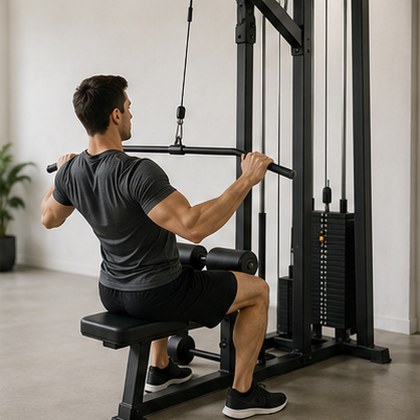
The wide grip lat pulldown is the most familiar version in gyms. In Andersen's study, lats at two shoulder widths worked the same as at one and one and a half widths, and on the way back up even slightly harder than with a close grip. But the 6-rep weight was 3–4% lower. If you get pain or clicking at the front of the shoulder, narrow the grip.
Medium grip
A medium grip is about one and a half shoulder widths, palms facing away. It let Andersen's subjects pull almost their heaviest weight, and the authors allow that it may have a slight edge, though they expect the same muscle growth from any grip between one and two shoulder widths. For your first session it's the best choice.
Close grip lat pulldown
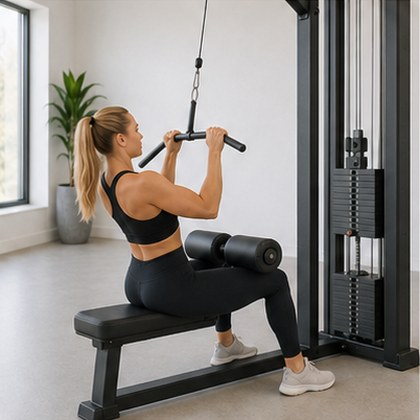
The close grip lat pulldown comes in two forms: an overhand grip at shoulder width on the long bar, and the V-bar handle, where your palms face each other. Lat activity with a close grip matched the wide grip in all three studies. In Lusk's study, grip width made no difference at all. A close grip keeps the elbows tracking along your body, which many people find easier on the shoulders.
Reverse grip lat pulldown
The reverse grip lat pulldown, also called underhand, is when your palms face you. It feels like the biceps should be working harder, but in both Lusk's and Buonsenso's studies the biceps worked the same with any grip. On the lats the data disagree: Lusk found the overhand grip gave the lats more than the underhand, Buonsenso found no difference. The reverse grip is useful if an overhand grip is uncomfortable for your wrists or elbows.
Neutral grip lat pulldown
A neutral grip, also called parallel, is when your palms face each other. It needs a V-bar or a wide handle with parallel grips. In Buonsenso's study, all seven variations, including close and wide neutral, worked the lats at the same 45–50% of maximum. The shoulder usually has more room in a neutral grip, so it's the one people pick when their shoulders or elbows are sore.
If you want a lat pulldown that targets the lats, any of these grips will do it. Start with a medium overhand grip, and once your form is stable you can swap the handle every month or six weeks for variety.
 Wide grip
 Close grip
Behind the neck or to the chest: what's the difference and should you pull behind your head
A beginner, and anyone who can't raise straight arms directly overhead without arching the lower back, is better off pulling to the chest. The working weight is higher, and the shoulder doesn't need maximal mobility.
Padovan's 2024 study compared both versions in 14 trained men. For 8 reps they pulled an average of 70.0 kg (154 lb) to the chest and 59.3 kg (131 lb) behind the neck, about 15% less. The front pulldown worked the prime movers harder overall, including the lats and the pectoralis major on the way down. The behind-the-neck version had one advantage of its own: the lats worked harder on the way back up.
The authors' main caveat concerns the shoulder: the behind-the-neck pulldown needs a lot of shoulder mobility. Anyone who lacks it tips the head forward to get the bar past the neck, and the neck and shoulder end up under load in an awkward position.
The wall test. Stand with your back to a wall, feet a hand's width away from it, knees slightly bent. Press your glutes, shoulder blades and lower back against the wall. Raise straight arms overhead. If your thumbs touch the wall above your head and your lower back doesn't come off, you most likely have enough mobility. If your arms don't reach the wall or your lower back arches away, don't pull behind the neck yet.
So the behind-the-neck lat pulldown is lighter on weight and more demanding on the shoulder. The authors themselves suggest keeping both versions in a program, and the caveat about shoulder mobility is theirs too. If you pass the wall test, the behind-the-neck pulldown can go in as a second option.
How much weight to use on the lat pulldown
For your first sessions, use a weight that lets you do 15 reps with room to spare, and work on form. Once the movement is stable, check yourself against the table below: we calculated it from Johnson's 2009 study.
How we calculated it. In 35 male and 23 female college students, the one-rep max on the pulldown averaged 0.93 of bodyweight for men and 0.55 for women. At 80% of their max, they did about 10 reps to failure: 9.9 and 10.0. So a 10-rep weight comes out at roughly 0.74 of bodyweight for men and 0.44 for women. We rounded to the nearest 2.5 kg (5.5 lb). The "typical range" is plus or minus one standard deviation, which covers roughly two people out of three.
Lat pulldown weight at your bodyweight
| Your bodyweight | Men: 10-rep weight | Typical range | Women: 10-rep weight | Typical range |
|---|---|---|---|---|
| 50 kg (110 lb) | 37.5 kg (83 lb) | 30–45 kg (66–99 lb) | 22.5 kg (50 lb) | 17.5–27.5 kg (39–61 lb) |
| 60 kg (132 lb) | 45 kg (99 lb) | 37.5–52.5 kg (83–116 lb) | 27.5 kg (61 lb) | 20–32.5 kg (44–72 lb) |
| 70 kg (154 lb) | 52.5 kg (116 lb) | 42.5–62.5 kg (94–138 lb) | 30 kg (66 lb) | 25–37.5 kg (55–83 lb) |
| 80 kg (176 lb) | 60 kg (132 lb) | 47.5–70 kg (105–154 lb) | 35 kg (77 lb) | 27.5–42.5 kg (61–94 lb) |
| 90 kg (198 lb) | 67.5 kg (149 lb) | 55–80 kg (121–176 lb) | 40 kg (88 lb) | 32.5–47.5 kg (72–105 lb) |
| 100 kg (220 lb) | 75 kg (165 lb) | 60–87.5 kg (132–193 lb) | 45 kg (99 lb) | 35–52.5 kg (77–116 lb) |
- The numbers come from college students in a single study, so this is a reference point, not a lat pulldown standard and not a starting weight.
- A set of 8 reps with your "10-rep weight" leaves 2 reps in reserve.
- The numbers on the stack don't match between machines: the pulleys and levers differ from model to model, and "40 kg" in one gym can feel like 30 kg in another. That's why you log the weight for the specific machine.
Lat pulldown weight for women is in the right half of the table: a woman weighing 60 kg (132 lb) has a reference point of about 27.5 kg (61 lb) for 10 reps. The gap between men and women is normal; section 10 explains why.
Where to start. A two-set test and starting weights for the pulldown are laid out in our gym workout plan for beginners.
When to add weight. The American College of Sports Medicine (ACSM), in its 2009 position stand, recommends adding 2–10% once you can do 1–2 reps more than planned. On a machine, that's usually one plate on the stack. If the jump is big, say 5 kg (11 lb) on a working weight of 25 kg (55 lb), the increase is 20%: add reps first in that case. Stacks in the US often step by 10 or 15 lb, which is the same problem at light weights. Other ways to keep growing without injury are in our guide to progressive overload.
If you keep a workout log, write the weight down per machine, not just per exercise. The Sportygram workout diary at go.sportygram.com, for example, logs weight for every set and has both the lat pulldown and the close-grip version with photos; note that the app is currently in Russian.
How many sets and reps, and how often
For a beginner: 3 sets of 8–12 reps, 2–3 times a week, resting 1–2 minutes between sets. That's the frame from the 2009 ACSM position stand: it recommends beginners use a weight that allows 8–12 reps, train 2–3 times a week, and do multiple sets with that rest for muscle growth.
The popular "3 by 12" scheme sits inside that frame. The last 2 reps should be hard but done without losing form. If all 12 reps come easily, it's time to add weight.
A plan from an experiment. In Li's 2025 study, 34 physically active male students did lat pulldowns 3 times a week for 8 weeks, 4 sets of 12 reps. The weight started at 65% of one-rep max and rose by 5% every two weeks, up to 80%. Rest was 3 minutes, tempo 2–1–3. But the back was trained with only this one exercise there, while in a normal program the pulldown is one of two or three back exercises.
Where it goes in your workout. ACSM recommends doing large-muscle exercises before small-muscle ones, and multi-joint before single-joint. So the lat pulldown goes at the start of a back workout, before biceps curls. How long to rest and why it matters is covered in our guide to rest between sets.
Mistakes: where you feel it and what to fix
If something other than your back is tired after a set, something in your form is off. The place where you feel the load points to the mistake.
| Where you feel it | What's wrong | The fix |
|---|---|---|
| Forearms and biceps burn, almost nothing in the back | Elbows bend first, shoulders stay up by your ears | Drop your shoulders without bending your arms, then drive your elbows to your sides |
| Neck and upper traps | Shoulders rise toward the ears at the bottom, head pushes forward | Drop your shoulders before the pull, look ahead, bar to the collarbones |
| Lower back | Leaning far back, swinging, pulling with your whole body | A small, fixed lean, one plate lighter |
| Front of the shoulder, clicking | Pulling behind the neck or below the chest, elbows going behind the body | Pull to the chest, stop at the collarbones, work without pain |
| Chest | Shoulders roll forward at the bottom | Chest up, shoulder blades down. The chest helps the pull anyway (Padovan, 2024) |
| Can't feel your back at all | Too much weight, fast tempo, no stretch at the top | Two plates lighter, let your shoulders rise at the top, tempo 2–1–3 |
| The weight lifts you off the seat | Pad set too high, or the weight is more than you weigh | Lower the pad snugly onto your thighs. If it still pulls you up, the weight is too heavy |
If you can't feel your back. This is fixable. In 2009, Snyder had eight women with almost no training experience do pulldowns at 30% of their max, then gave them a short explanation of how to pull with the back and less with the arms. After the instruction, the lats worked noticeably harder. The biceps didn't get quieter, and the authors conclude that you can't take the arms out of a pulldown completely. That's normal. Three cues:
- "Elbows into your pockets": drive your elbows down to your sides.
- "Chest to the bar": at the bottom, bring your chest up to meet the bar instead of hauling it down with your arms.
- "Shoulders first": start every rep by dropping your shoulders and only then bend your arms.
film yourself from the side on your phone, three reps with a light weight. Compare the video with the steps in section 02: do your shoulders drop before your arms bend, does the bar reach your collarbones, does your torso stay in place.
Lat pulldown vs pull-ups: which to choose and whether the pulldown helps you get a pull-up
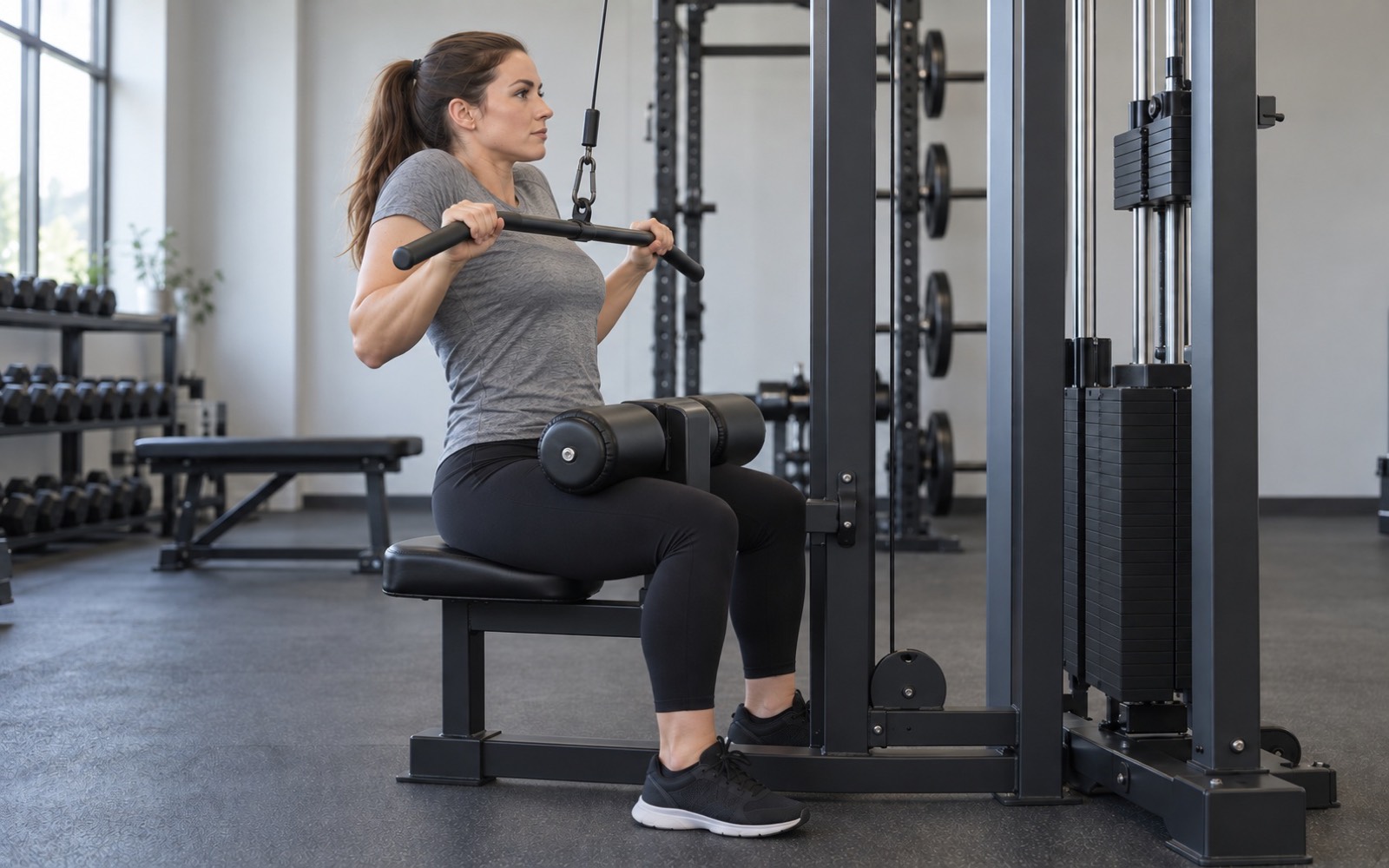
The lat pulldown helps you get to pull-ups, but it doesn't replace them completely.
Does the pulldown help with pull-ups. In Li's 2025 study, the students did only lat pulldowns for 8 weeks, 4 sets of 12 three times a week, with no pull-ups in the program. Their pull-ups still went up from an average of 2.2 to 5.8. In the group that pulled with elastic bands attached to the bar, the result rose to 8.5 pull-ups.
How much to pull down before you can do a pull-up. In Johnson's 2009 data, men's max on the pulldown was about 80% of their pull-up max: 0.93 versus 1.16 of bodyweight. For women it was about 75%: 0.55 versus 0.73. That gives a rough benchmark: if you can pull 75–80% of your bodyweight for a single rep, your first pull-up is close. For a man weighing 80 kg (176 lb) that's 60–64 kg (132–141 lb) for one rep. For women the benchmark is less reliable: the relationship between the two exercises came out weak, and the authors couldn't distinguish it from chance.
The women's pull-up max was 0.73 of bodyweight. That means on average they couldn't do a single unassisted pull-up. If you can't yet either, that's an ordinary starting point.
How the exercises differ. In a pull-up you lift your own bodyweight and hold your torso in the air yourself. On the machine the weight is set precisely and can be less than you weigh. So the pulldown is easier to start with, while pull-ups add grip and core work.
Which to choose: in the gym, do both. Until you can do a pull-up, add slow negatives on the bar or the assisted pull-up machine, where the counterweight is reduced gradually, to your pulldowns. A stage-by-stage plan to your first rep is in our guide to how to do a pull-up.
Lat pulldown alternatives at home and in the gym
At home, the best lat pulldown substitute is a resistance band anchored high on a door or a pull-up bar: it's the same top-down movement. For strength gains, bands don't fall short of machines. In Lopes's 2019 meta-analysis of 8 studies, bands and machines with free weights produced the same strength gains for both arms and legs.
| Alternative | Where | How close it is |
|---|---|---|
| Kneeling band pulldown | Home: a band on a door anchor or a pull-up bar | The closest: the same movement |
| Single-arm band pulldown | Home | Close, adds core work |
| Band-assisted pull-ups or slow negatives | Pull-up bar at home or in the gym | Closest by muscles, but harder |
| Assisted pull-up machine | Gym | Close: your bodyweight with a counterweight |
| Single-arm cable pulldown, seated or kneeling | Gym | Close |
| Dumbbell row, dumbbell pullover | Home with dumbbells | Partial: you pull to the waist or with straight arms |
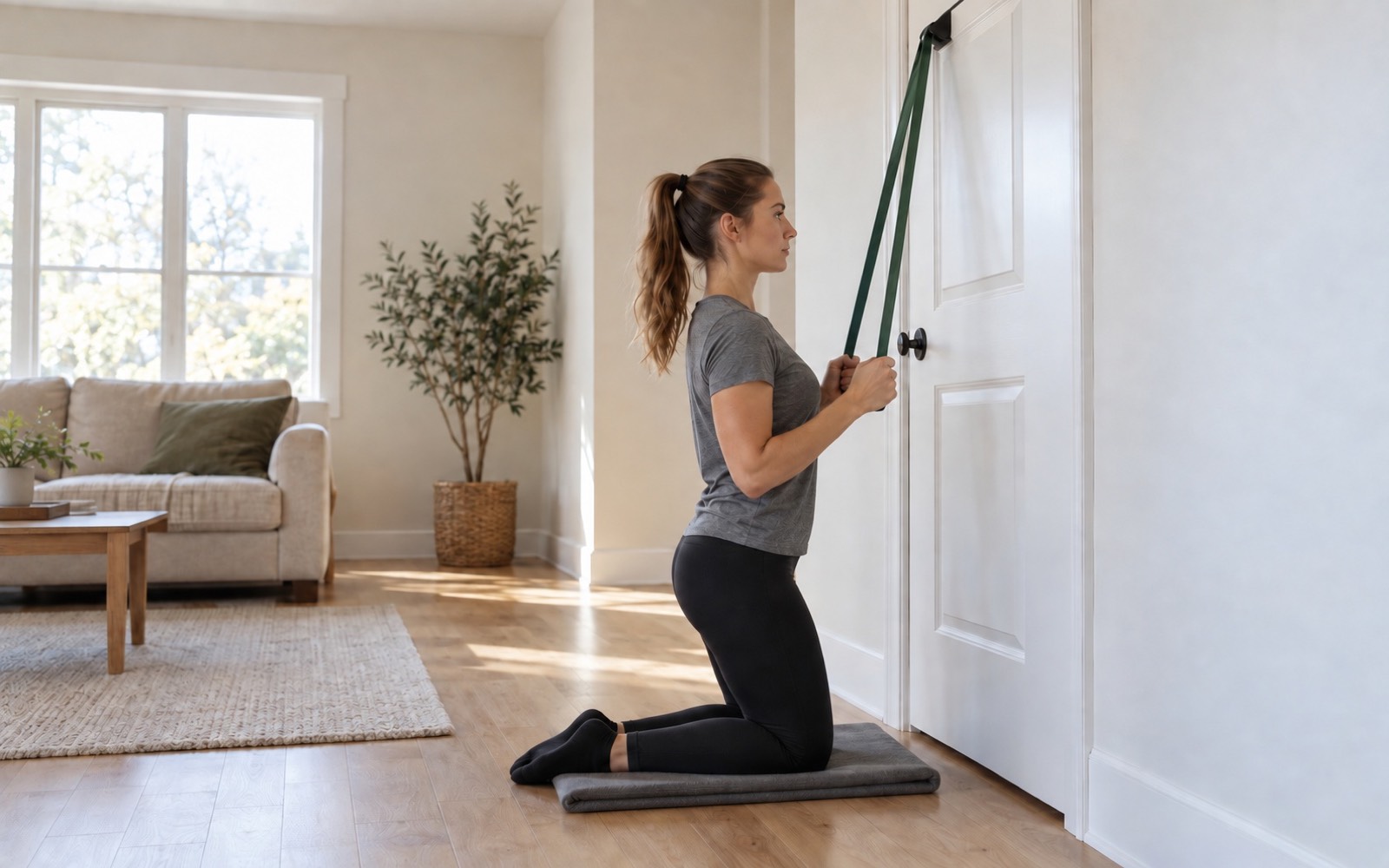
How to do a lat pulldown with a resistance band at home.
- Anchor a long loop band at the top of a door with a door anchor: a fabric strap with a thick end that the closed door clamps. The door should open away from you, so the pull presses it into the frame. Or loop the band over a pull-up bar.
- Kneel facing the door so the band is already taut with your arms straight overhead, and hold the loop at one and a half shoulder widths.
- From there it's the same as the machine: shoulders down, elbows to your sides, hands to your upper chest, pause, slow return.
A band gets heavier the more it's stretched, so the load peaks at the bottom. If 15 reps come easily, move further from the door or take a stiffer band. Which bands exist and how to choose the resistance is in our guide to resistance band workouts.
With dumbbells you can't reproduce a vertical pull: gravity pulls the dumbbell down, while on the machine the resistance comes from above. Bent-over dumbbell rows and lying pullovers are good additions, but only a band or a pull-up bar gives you a full replacement.
Lat pulldown for women, beginners and after 40
The form is the same for everyone; only the weight differs.
For women. Women pull less on the machine than men, as the table in section 05 shows, but they grow just as well. In Roberts's 2020 meta-analysis, men and women on the same programs gained muscle at the same rate, based on 10 studies. And upper-body strength in women, as a percentage of the starting point, went up even more, based on 17 studies. So the lat pulldown works just as well for women. Why it won't give you a "man's back" is covered in our article on strength training for women. With narrow shoulders, women often find the neutral or close handle more comfortable.
For beginners. Spend the first two weeks learning the movement with a light weight; that counts as a full workout. In Snyder's study, one short instruction was enough for beginners to activate the lats harder in their very next sets.
After 40. Age by itself is not a contraindication. The pulldown is a convenient place to start: you're seated, your thighs are locked under the pad, and the weight changes one plate at a time. Warm up your shoulders and do a light warm-up set before the working sets. If a shoulder is sore, take the neutral handle. With high blood pressure or heart disease, don't hold your breath on the pull, and discuss the load with your doctor.
When to hold off on pulldowns and when to see a doctor
If the shoulder joint hurts during the movement, stop. Burning and fatigue in the back muscles are a normal part of a set; sharp pain in the joint is a reason to quit. Skip the pulldown and see a doctor if:
- you had sharp pain or a painful click in the shoulder during a set, and the pain doesn't go away over several days;
- the pain runs down your arm, or your fingers go numb or tingle after pulldowns: don't wait until the next session;
- neck pain doesn't ease in two or three days;
- you recently had shoulder surgery or an injury: come back only with clearance from your doctor or physical therapist;
- your lower back hurts at rest too. If it only hurts during the set, drop the weight and check your torso angle.
Muscle pain the day after an unfamiliar load is called delayed-onset muscle soreness. It goes away on its own, and a light workout doesn't get in its way, so there's no need to skip pulldowns because of it. What shoulder pain in the gym usually means, and how to tell the harmless kind from the kind that needs a doctor, is covered in our guide to shoulder pain from lifting.
Questions and answers
What is the lat pulldown machine called, and can you do pulldowns on a cable crossover?
The machine is simply called a lat pulldown machine, or a high pulley station. It's a frame with a seat, a thigh pad and a cable running to a stack of plates. The lever version, where the handles move in an arc, is often called a plate-loaded or "hammer" pulldown. You can also pull on a cable crossover, seated on a bench under the high pulley or kneeling. Your thighs aren't locked there, so you use less weight.
How should you breathe during a lat pulldown?
Breathe out as you pull the bar down, and breathe in as you let it back up. Don't hold your breath for long, especially with high blood pressure. If your breathing gets out of sync, slow the tempo: 2 seconds down, pause, 3 seconds up.
Wide grip vs close grip lat pulldown: which is better?
For the lats, almost the same: that's how it came out in Andersen's 2014 study and in Buonsenso's 2025 study. With a wide grip you pull 3–4% less weight. If the wide grip clicks or pulls in your shoulder, use a close or neutral grip.
Why do my arms give out, and do I need straps?
Your arms give out when the movement starts with the elbows bending. Start each rep by dropping your shoulders, and don't crush the bar with your grip. Straps help only if your fingers give out first while your back can still work. If your biceps and forearms are what's tiring, it's the form that needs changing.
Is the straight-arm pulldown the same exercise?
No, that's a different exercise, the cable pullover. You stand facing the pulley and lower the bar with straight arms from head height to your thighs. The biceps barely take part; the lats do the work. It's a good addition if your arms tire before your back in the regular pulldown.
Can you do single-arm or standing pulldowns?
Yes. The single-arm pulldown helps even out your two sides. The standing pulldown on a cable crossover loads the core harder, but the weight is lower: there's no pad holding you down. The seated two-arm pulldown stays the foundation for a beginner: it's easier to build form and track weight there.
Which is better: lat pulldown or the assisted pull-up machine?
The assisted pull-up machine is closer to pull-ups: you kneel on a platform and the counterweight takes part of your bodyweight. On the pulldown the weight changes one plate at a time, and the form is easier to hold. If your goal is a pull-up, do both: the pulldown for back strength, the assisted machine for the movement itself.
Do I need a horizontal row if I already do a vertical pull?
Yes. They're two different directions of movement: top-down and front-to-back. The shoulder blades move differently in each, so a good back program has both pulls, for example the lat pulldown on one day and a seated cable row on another.
The bottom line
- The lat pulldown is a vertical pull, and the main muscle in it is the latissimus dorsi.
- For the lats, grip barely matters: in 40 experienced men, all seven grip and torso-angle variations worked the lats at the same 45–50% of maximum (Buonsenso, 2025). With a wide grip you pull 3–4% less weight (Andersen, 2014).
- Pull to the chest: behind the neck, the working weight is about 15% lower, and the shoulder needs a lot of mobility (Padovan, 2024).
- Form: shoulders down first, then elbows to your sides, bar to the collarbones, torso nearly still.
- On average, a 10-rep weight is about 0.74 of bodyweight for men and 0.44 for women (from Johnson, 2009). For the first weeks, use a weight that allows 15 easy reps.
- A beginner: 3 sets of 8–12 reps, 2–3 times a week, 1–2 minutes of rest (ACSM, 2009).
- The pulldown helps you get a pull-up: over 8 weeks, pull-ups went from 2.2 to 5.8 (Li, 2025). At home, a band anchored overhead replaces it.
Checklist: your first lat pulldown workout
- Slide your thighs under the pad so it presses firmly and your feet stay flat on the floor.
- Take the long bar with an overhand grip at about one and a half shoulder widths.
- Start every rep by dropping your shoulders without bending your arms.
- Drive your elbows down to your sides, the bar to your upper chest, collarbone level.
- Keep the tempo: 2 seconds down, 1 second pause, 3 seconds up.
- Pick a weight that allows 15 reps with room to spare, and do 3 sets.
- Film one set from the side on your phone and check it against the form.
- Log the weight and the pad setting for this specific machine.
Sources
- Buonsenso A. et al. Electromyographic Analysis of Back Muscle Activation During Lat Pulldown Exercise: Effects of Grip Variations and Forearm Orientation. Journal of Functional Morphology and Kinesiology, 2025. — 40 experienced men, 7 grip and torso-angle variations: lats at 45–50% of maximum in all of them, the only difference was in the rear delt.
- Andersen V. et al. Effects of grip width on muscle strength and activation in the lat pull-down. Journal of Strength and Conditioning Research, 2014. — 15 men: lats the same across grips, 6-rep weight 80.3, 80.0 and 77.3 kg.
- Lusk S. J. et al. Grip width and forearm orientation effects on muscle activity during the lat pull-down. Journal of Strength and Conditioning Research, 2010. — 12 men: the overhand grip gave the lats more than the underhand, biceps unchanged.
- Padovan R. et al. High-Density Electromyography Excitation in Front vs. Back Lat Pull-Down Prime Movers. Journal of Human Kinetics, 2024. — 14 trained men: 70.0 kg to the chest versus 59.3 kg behind the neck for 8 reps; the behind-the-neck pulldown needs a lot of shoulder mobility.
- Johnson D. et al. Relationship of lat-pull repetitions and pull-ups to maximal lat-pull and pull-up strength in men and women. Journal of Strength and Conditioning Research, 2009. — 58 students: pulldown max 0.93 and 0.55 of bodyweight, pull-up max 1.16 and 0.73.
- Li Q. et al. Eight-week lat pull-down resistance training with joint instability leads to superior pull-up endurance performance and reduced antagonist coactivation in recreationally active male college students. European Journal of Sport Science, 2025. — 34 male students, 8 weeks of pulldowns: pull-ups from 2.2 to 5.8, in the group with bands on the bar up to 8.5.
- American College of Sports Medicine. Progression models in resistance training for healthy adults. Medicine & Science in Sports & Exercise, 2009. — Beginners: a weight allowing 8–12 reps, 2–3 times a week, increases of 2–10%.
- Snyder B. J., Leech J. R. Voluntary increase in latissimus dorsi muscle activity during the lat pull-down following expert instruction. Journal of Strength and Conditioning Research, 2009. — 8 women with almost no experience: after instruction the lats worked harder, biceps unchanged.
- Lopes J. S. S. et al. Effects of training with elastic resistance versus conventional resistance on muscular strength: a systematic review and meta-analysis. SAGE Open Medicine, 2019. — 8 studies: bands and machines with free weights produced the same strength gains in arms and legs.
- Roberts B. M. et al. Sex differences in resistance training: a systematic review and meta-analysis. Journal of Strength and Conditioning Research, 2020. — Muscle grows at the same rate (10 studies), upper-body strength as a percentage grows more in women (17 studies).
This article is for informational purposes only and is not a substitute for medical advice.