

a muscle needs about 48 hours between hard workouts, and up to 72 after training to failure. You can train different muscles on back-to-back days, and walk or do joint mobility every day.The minimum is 2 workouts a week for each major muscle. A beginner does fine with 2–3 full-body workouts. Want to recover faster? End each set with 2–3 reps left in the tank.
How long to rest between workouts depends on what you trained. The same muscle group needs about 48 hours after strength training, and closer to 72 after sets to failure. It's the muscle that needs rest, not your whole body: the day after legs you can train back and chest, and you can walk every day. How often you train should depend on your schedule, not on how hard you want to push. Aim to work each major muscle at least twice a week, and with the same number of sets, 3 workouts a week deliver the same results as 6. Below you'll find a table of how long to rest after each type of workout, weekly plans for 2–6 workouts and a five-question check to run before the gym.

How long to rest after each type of workout
If you mean the break between sets, that's a separate guide. This one is about how long to wait before your next workout. Find what you did yesterday in the left column.
| What you did | When to do it again | What's fine the next day |
|---|---|---|
| Heavy strength work for a muscle group, sets to failure | In 2–3 days (48–72 hours) | Other muscle groups, walking |
| Strength work with 2–3 reps left in the tank | In 2 days (about 48 hours) | Other muscle groups, easy cardio |
| Full-body workout as a beginner | Every other day: Mon, Wed, Fri | Walking, joint mobility |
| Intervals or circuits that leave you out of breath | Not two days in a row | Strength work with reps in reserve, walking |
| A new exercise or your first week back after a break | In 2–3 days, and keep the weight light for the first 1–2 weeks | Other muscle groups, walking |
| Plank, glute bridge, dead bug, not to failure | More often is fine if nothing hurts the next day and your form holds | — |
| Walking, stationary bike at a conversational pace, stretching | Every day, if you like | — |
The "no intervals two days in a row" rule is a coaching guideline. No study tested it directly.
For example, if you squat on Monday, your next heavy leg day should be Wednesday at the earliest, and on Tuesday you can train your upper body. Working out two days in a row is fine as long as you train different muscles.
Why 48 hours: supercompensation in simple terms
A muscle doesn't grow during the set. The workout sends the signal, and the growth happens afterward. Earlier measurements showed that 4 hours after a hard workout, a muscle builds protein 50% faster than usual, and at 24 hours more than twice as fast. In a small study, six young men did a hard biceps workout with one arm, and 36 hours later researchers compared both arms (source 1). By then, protein building in the trained arm was almost back to baseline.
So the boost in muscle building lasts about a day and a half. If you train a muscle once a week, it spends only a day and a half out of seven in building mode. That's one reason why, in a review of ten studies, training a muscle twice a week led to more growth than training it once (source 2). And 48 hours between workouts gives the muscle time both to finish rebuilding and to get its strength back.
Coaches explain the value of rest with a model called supercompensation. In simple terms, your body doesn't just recover after a workout. It overshoots a little and, for a while, ends up slightly stronger than before. What happens next depends on when your next workout comes.
- Too soon. Your next hard workout comes before your strength is back. Fatigue piles up, and your weights stall.
- Just right. The muscle has recovered, and you add a rep or some weight.
- Too far apart. With one session a week, you get fewer growth windows, so progress is slower.
This is a simplified model. Real recovery doesn't follow a neat curve with a set peak date. That's why 48 hours is a guideline, not an alarm clock.
What affects how much rest you need
| What matters | Longer rest | Shorter rest |
|---|---|---|
| How you end a set | To failure, when you can't do one more rep | With 2–3 reps left |
| Sets per muscle in one workout | Many | Moderate |
| How new it is | A new exercise, your first week after a break | A program you're used to |
| Which muscles | Large ones: legs, back (a coaching observation) | Small ones: arms, calves |
| Sleep | A short or sleepless night | Your usual sleep |
| Food | A steep calorie deficit, too little protein | Enough calories and protein |
| Age | Sometimes longer after 40, but the data disagree | Let the check in section 08 decide, not your birth year |
Failure is the biggest lever. Going to failure means ending a set when you can't do even one more rep. In a Spanish study, ten trained men did the bench press and squat three ways with the same weight (source 3). The key comparison: 3 sets of 10 to failure versus the same 30 reps split into 6 sets of 5, stopping short of failure. After failure, strength and bar speed came back noticeably slower, and the gap showed up between 24 and 48 hours.
The American College of Sports Medicine's 2026 position stand draws on 137 research reviews covering more than 30,000 participants (source 4). Training to failure gave no consistent advantage in strength or muscle growth. The takeaway is simple: if you want to train more often, leave 2–3 reps in reserve. Failure adds almost nothing, and it costs you extra recovery time.
Sleep. In one study, 13 young men and women spent a night without sleep (source 5). The next day their muscles built protein 18% more slowly, the stress hormone cortisol rose 21% and testosterone dropped 24%. There's no formula like "sleep this many hours, rest this much less," but after a bad night it makes sense to go lighter. Read more about how sleep affects muscle.
Food. On a steep calorie deficit or with too little protein, your muscle has nothing to build with, and an extra rest day won't fix that.
Sex and age. There's no separate rest rule for women. The American College of Sports Medicine guidelines are written for all healthy adults and give no separate numbers for women (source 4). Many people recover more slowly after 40, but studies disagree. Instead of adding a rest day just because of your age, check how ready you are before each workout.
How many times a week to train: what the research says
| What was tested | What they found | What it means for you |
|---|---|---|
| Review of 10 studies: one muscle trained 1, 2 or 3 times a week with equal volume | 2 times beat 1; whether 3 beats 2 is unclear | Train each major muscle at least twice a week |
| 27 experienced men, 6 weeks: 3 or 6 workouts a week with the same number of sets | Strength and muscle thickness grew the same | Six days don't get you results faster |
| American College of Sports Medicine position stand: 137 reviews, more than 30,000 participants | Strength improves more with 2+ workouts a week, muscle size with 10+ weekly sets per muscle; with equal volume, frequency didn't affect muscle growth | Count your weekly sets, not your gym visits |
Frequency is just a way to spread your training across the week, not a badge of honor. For example, you can do 12 sets for your legs in a week as two workouts of 6 sets or four workouts of 3. With the same number of sets, the result will be similar (sources 4 and 6). The 2016 review still found an edge for training a muscle twice a week over once, but in the newer guidelines frequency no longer affected muscle growth when the number of sets was the same.
The takeaway: train each major muscle at least twice a week. Strength improves more that way, and it's easier to get your sets in without going to failure. Beyond that, two things matter: how many sets you do per week and how many workouts your schedule can actually hold.
Weekly plans for 2, 3, 4, 5 or 6 workouts
In every option, each major muscle gets worked at least twice a week, with at least 48 hours between workouts for the same muscle. "Upper" means chest, back, shoulders and arms. "Lower" means legs, glutes and abs.
- 2 days. Mon and Thu: full body. Walk on the other days. For getting started and for anyone short on time.
- 3 days. Mon, Wed, Fri: full body. Rest or walk on the other days. The most reliable setup for your first months.
- 4 days. Mon: upper, Tue: lower, Thu: upper, Fri: lower. Wednesday and the weekend are for rest or walking.
- 5 days. Mon: chest and shoulders, Tue: back, Wed: legs, Thu: full upper body, Fri: legs and glutes, Sat: a walk, Sun: rest. For people who have trained for more than six months and sleep well.
- 6 days. Mon, Wed, Fri: upper. Tue, Thu, Sat: lower. Sun: rest. The same weekly sets, cut into shorter workouts. With equal volume, 6 days gave the same results as 3 (source 6), so choose them for convenience, not for speed.
Training at home with dumbbells and resistance bands? The plans stay the same. For upper days: push-ups, bent-over dumbbell rows and standing dumbbell presses. For lower days: squats, lunges and glute bridges.
after a hard leg day, put upper body or a walk in your plan, and schedule your hardest workout of the week right after a rest day. That way the load spreads itself out across the week.
How to pick your number of days: the eight-week rule
Pick as many days as you can repeat for eight ordinary weeks in a row, with work, family and the occasional cold. Two workouts you actually do will give you more than five planned ones where half fall through.
- If you recover well from two workouts and want more, add a third.
- If the third one keeps falling through, go back to two and don't skip them.
- If your weights are going up and you sleep fine, change nothing.
- If your weights have stalled for two or three weeks and fatigue is building, don't add a day. Cut a set or two, or take an easy week.
Can you work out every day?
Moving every day: yes. Loading the same muscles hard every day: no. Spreading different muscles across the days: yes.
| Fine every day | Every other day | Not two days in a row |
|---|---|---|
| Walking, stationary bike at a conversational pace | Strength work for the same muscle group | Intervals and circuits that leave you out of breath |
| Joint mobility, stretching | Push-ups and squats for strength, with progression | Heavy legs right after intervals |
| Plank, dead bug, bodyweight glute bridge, not to failure | Glute bridge with a dumbbell or barbell | — |
You can do the joint mobility routine from our app's library for 5 minutes every morning. Planks and dead bugs are fine daily if your sets are short, you stop before failure and your abs aren't sore.
What happens if you do push-ups or squats every day. If you do a few and stop with reps to spare, nothing bad happens: the movement becomes familiar and your form gets more solid. If you go to failure every day, your muscles don't have time to recover, and your rep count stops going up. Want to do more push-ups? Do them every other day, add a rep each time and leave 2–3 in the tank.
What happens if you train abs every day. Your abs will build endurance, but that won't get rid of belly fat: your body doesn't burn fat from the spot you're working. Planks and stomach vacuums are fine daily. Save high-rep crunches for every other day.
What happens if you work out every day. Hard strength work for the same muscles every day means slow progress and extra fatigue. What works: strength training 2–6 times a week using one of the plans above, with walking on the other days.
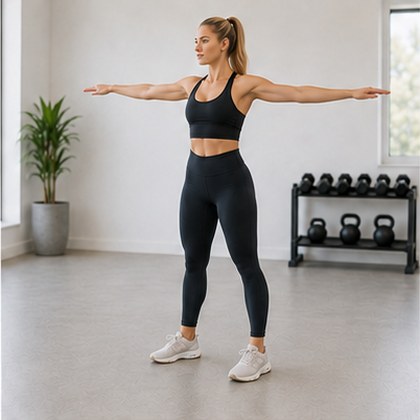 Joint mobility
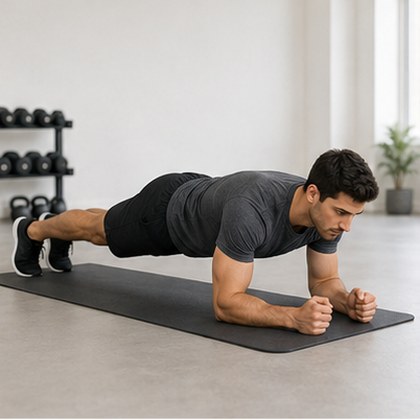 Plank
PlankShould you train hard today? A 5-question check
Ask yourself four questions in the morning and the fifth during your warm-up. Answer yes or no.
- Did you sleep about as usual and wake up without feeling wiped out?
- Are the muscles on today's plan pain-free when you walk and bend?
- Is your morning heart rate close to your usual for the past week, not noticeably higher? Compare it with your own numbers. There's no universal norm.
- Do you want to train, or at least not dread the thought of the gym?
- Does your warm-up weight feel the same as always, not heavier?
- 4 or 5 yeses: train as planned.
- 3 yeses: go lighter. Same weight, fewer sets, no failure.
- 2 yeses or fewer: rest or take a walk, and move the workout to tomorrow.
Three light workouts in a row mean one rest day isn't enough (section 11). This isn't a medical scale: everyone has a bad morning now and then. Watch how many days the signs last.

Sore muscles: does that mean it's too soon?
Not necessarily. Muscle soreness and readiness to train are two different things. A muscle can ache while its strength is already back, and the reverse happens too.
If your legs are sore after squats, train upper body tomorrow: bent-over dumbbell rows and push-ups. For your legs, just walk. If the soreness is severe, train that muscle lighter for the first 1–2 days, or leave it alone.
Waiting until the soreness is completely gone is a bad rule. After the first workout of a new program, your muscles can hurt for several days. Over time, the same program makes you less and less sore, even though your muscles keep growing. Here's how to tell sore muscles from an injury.
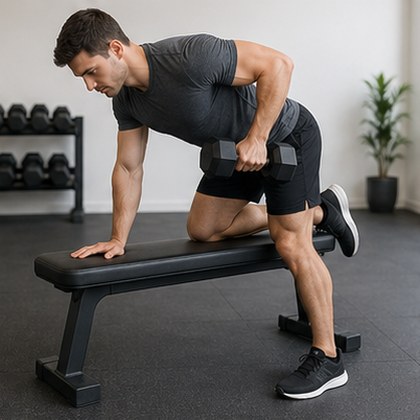 Bent-over dumbbell row
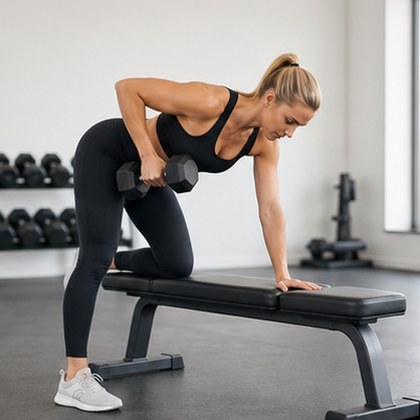 Bent-over dumbbell row
What to do on a rest day
A rest day isn't a couch day. Easy movement gets your blood flowing and eases stiffness:
- a walk at a relaxed pace;
- joint mobility or gentle stretching;
- a stationary bike or swimming at a pace where you can still talk;
- your normal daily activity, without turning it into a workout.
Watch out for hidden workouts. A long hike, a soccer game with friends or a day of moving boxes all count as load for your body. If something like that is planned for Saturday, move Friday's heavy leg day. Find more ideas in our guide to active recovery.
When one day isn't enough: an easy week, a break and a doctor
- Your weights have dropped for two weeks straight, your sleep is off and everything irritates you. You don't need another day off. You need a deload week: the same exercises with fewer sets and lighter weights.
- The signs last for weeks, even after an easy week. See your primary care doctor. Illness, low iron or a steep calorie deficit can look the same. We have a separate guide on overtraining, but a doctor makes the diagnosis.
- Fever, body aches, a cough. Don't push through a workout. Once you're well, start lighter than usual.
- A joint hurts, not a muscle, or the pain is sharp or gets worse when you move. Rest won't treat that. Get it checked.
- Get medical help right away if, after a very hard workout, your muscles are badly swollen, the pain keeps getting worse and your urine turns dark, the color of strong tea.
Don't be afraid of resting too much. In a Japanese study, 14 young men did the bench press for six months (source 7). One group trained without breaks. The other trained in cycles: 6 weeks of training, then 3 weeks off. By the end of six months, both groups had gained the same muscle and strength.
How to plan your rest days in the app
If you track training in the Sportygram app, your weekly plan lives in the workout log. When the check in section 08 says rest, don't delete the workout. Move it to tomorrow or the next free day, and the plan keeps its order.
Two habits that help:
- Pick your rest days when you plan the week, so they don't turn into random skipped days.
- Log your weights after every session. If they stall for two or three weeks, that's your cue for an easy week (section 11).
FAQ
How many rest days do you need between strength workouts?
The same muscle group needs about 48 hours, which means one full day between workouts. After sets to failure, closer to 72 hours. You can train different muscles on back-to-back days. If you train your whole body in one session, a Monday, Wednesday, Friday schedule fits these windows.
Can you work out every day?
Moving every day is fine and good for you: walking, a stationary bike, joint mobility. Hard strength work for the same muscles every day is not, because progress will slow down. You can spread different muscles across six days: with the same number of sets, six short workouts give the same result as three long ones.
Can you do push-ups and squats every day?
In small amounts and without going to failure, yes. That's how you lock in good form. If your goal is more reps and stronger muscles, train every other day, add a rep each time and end each set with 2–3 reps left. Doing push-ups to failure every day usually means your rep count stops going up.
Is working out 2 days a week enough?
Yes, if each workout is full body. Then every major muscle gets worked twice a week, and at that minimum both strength and muscle grow. For a beginner or a busy person, it's a complete plan. Add a third workout once two are sticking without skips and you still have energy left after them.
Should you work out with sore muscles?
Yes, if the pain is dull, spread across the muscle and doesn't get worse after a warm-up. Train other muscles, or the sore one but lighter: if your legs are sore, do upper body. Don't train if the pain is sharp, in a joint or in one spot, or if there's swelling. Then you need a doctor's exam, not a workout.
Will you lose muscle if you take a week off?
No. In a bench press study, one group trained in cycles: 6 weeks of training, then 3 weeks off. After six months, they had gained as much muscle and strength as the group that trained without breaks. So there's no need to fear an extra day or even a week of rest.
Do beginners need more rest than experienced lifters?
Not necessarily. Beginners lift lighter weights, but new movements make their muscles sorer. An every-other-day, full-body schedule works for almost everyone in the first months. Add new exercises one at a time and start light, and three workouts a week will be plenty.
How do you combine strength training and cardio in one week?
Easy cardio, like walking, a stationary bike or swimming at a conversational pace, can go on any day. Intervals and circuits that leave you out of breath are best kept off back-to-back days and away from the day before heavy legs. That's a coaching guideline: it means your legs show up fresh for strength work.
What is supercompensation in simple terms?
It's a model coaches use to explain why rest pays off. After a workout, your strength drops, then recovers and for a while ends up a little higher than before. If your next workout lands on that rise, you make progress. If it comes too early, you pile up fatigue. There's no exact peak date. As a rule of thumb, allow about 48 hours per muscle.
The bottom line
- A muscle needs about 48 hours between hard workouts, and up to 72 after training to failure. You can train different muscles on back-to-back days.
- Work each major muscle at least 2 times a week. With the same number of sets, 3 and 6 workouts a week give the same results.
- Pick the number of days you can repeat for eight ordinary weeks.
- Sets with 2–3 reps left recover faster than sets to failure, and your muscles grow just as well.
- You can move every day. If fatigue lasts for weeks, take an easy week, and if that doesn't help, see a doctor.
Checklist: a week without overload
- You've picked a number of workouts you can keep up for eight weeks.
- Each major muscle gets worked 2 times a week.
- At least 48 hours pass between workouts for the same muscle.
- You end your sets with 2–3 reps left.
- Before a hard workout, you run the five questions from section 08.
- At least one day a week has no strength training.
- Three light workouts in a row mean it's time for an easy week.
Sources
- MacDougall J. D. et al. The time course for elevated muscle protein synthesis following heavy resistance exercise. Canadian Journal of Applied Physiology, 1995. — 6 men: 36 hours after a hard workout, muscle protein synthesis had almost returned to baseline. The authors cite earlier data for the 50% rise at 4 hours and the doubling at 24 hours.
- Schoenfeld B. J., Ogborn D., Krieger J. W. Effects of Resistance Training Frequency on Measures of Muscle Hypertrophy: A Systematic Review and Meta-Analysis. Sports Medicine, 2016. — 10 studies: training a muscle 2 times a week works better than once.
- Morán-Navarro R. et al. Time course of recovery following resistance training leading or not to failure. European Journal of Applied Physiology, 2017. — 10 trained men, three protocols: after failure, strength and speed recover more slowly, with the gap between 24 and 48 hours.
- Currier B. S. et al. American College of Sports Medicine Position Stand. Resistance Training Prescription for Muscle Function, Hypertrophy, and Physical Performance in Healthy Adults: An Overview of Reviews. Medicine & Science in Sports & Exercise, 2026. — 137 reviews: strength from 2 workouts a week, muscle from 10 sets a week per muscle; with equal volume, frequency and training to failure did not affect muscle growth.
- Lamon S. et al. The effect of acute sleep deprivation on skeletal muscle protein synthesis and the hormonal environment. Physiological Reports, 2021. — 13 people, one night without sleep: muscle protein synthesis −18%, cortisol +21%, testosterone −24%.
- Saric J. et al. Resistance Training Frequencies of 3 and 6 Times Per Week Produce Similar Muscular Adaptations in Resistance-Trained Men. Journal of Strength and Conditioning Research, 2019. — 27 men, 6 weeks: 3 and 6 workouts a week with equal volume produced the same gains.
- Ogasawara R. et al. Comparison of muscle hypertrophy following 6-month of continuous and periodic strength training. European Journal of Applied Physiology, 2013. — 14 men, 24 weeks: cycles with 3-week breaks produced the same gains as training without breaks.
This material is for informational purposes and does not replace medical advice.