

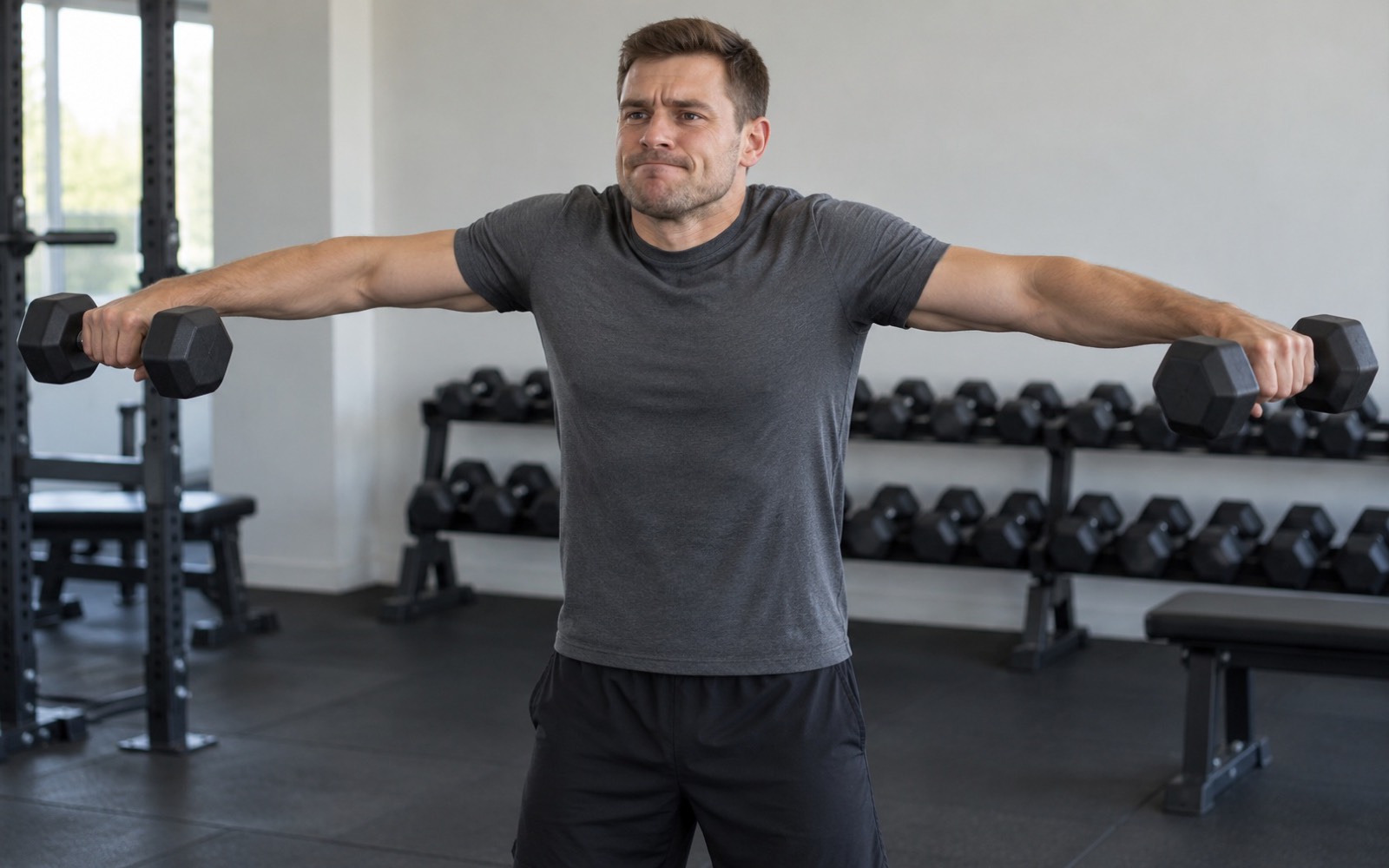
raise the dumbbells to shoulder height with your elbows slightly bent, your arms travelling a little in front of your body, and your palms facing the floor, taking 2 seconds up and 2–3 seconds down. Your traps always work in a lateral raise: in Andersen's 2008 measurements, the upper trapezius reached 97% of its maximum with 3–10 kg (6.6–22 lb) dumbbells, almost as much as in a shrug. The goal is to stop shrugging, and there's no need to switch the traps off. In Larsen's 2025 experiment, the lateral deltoid grew the same amount over 8 weeks from cable and dumbbell lateral raises.Starting point: 2 kg (4.4 lb) for women and 4 kg (8.8 lb) for men, 3 × 12 twice a week, with 2–3 reps left in the tank. Over our 8-week plan, training volume per session grows by 119–150%.
A lateral raise means lifting your arms, nearly straight and holding dumbbells, out to the sides up to shoulder height and then lowering them slowly. You'll also hear it called a side raise or a side lateral raise. The exercise comes in three versions. Raising your arms out to the sides works the middle part of your deltoid, the muscle that gives your shoulders their width. The bent-over version works the rear part of the deltoid, and the front raise works the front part. A beginner is fine with 3 sets of 12 reps twice a week. Start light: 2 kg (4.4 lb) in each hand for women and 4 kg (8.8 lb) for men.
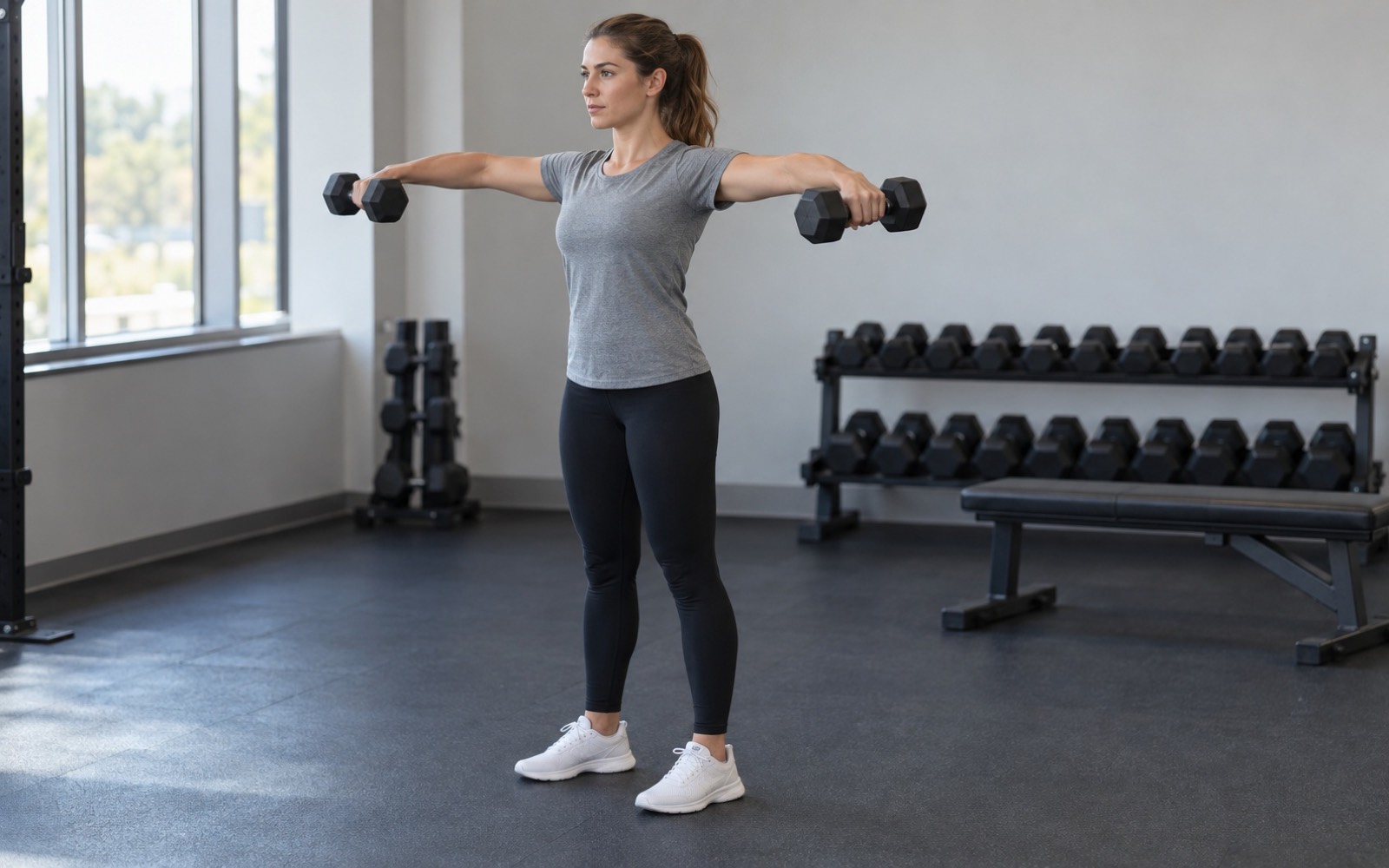
What a lateral raise is and how it differs from a dumbbell fly
A lateral raise is an exercise where you stand or sit with dumbbells at your thighs and lift your arms out to the sides until they're level with the floor. Side raises, side lateral raises and dumbbell lateral raises are all names for the same movement. In physical therapy you'll also see it called shoulder abduction, which simply means moving the arm away from the body to the side.
People sometimes confuse lateral raises with the dumbbell fly. In a fly, you lie on your back on a bench and lower your arms out to the sides from your chest, and the main muscle working is your chest. That's a different exercise, and its technique is covered in our dumbbell fly guide.
Many people treat the lateral raise as a swing, throwing the dumbbells up with momentum. A good lateral raise is a slow movement with no swinging. Once you start swinging, your back and legs end up doing the lifting.
There are three types of raises, and each one targets its own part of the deltoid:
- out to the sides — the lateral deltoid, which makes your shoulders wider;
- bent over — the rear deltoid, which shapes the back of your shoulder and helps keep your shoulders pulled back;
- to the front — the front deltoid, which already works hard in every pressing exercise.
When people just say "lateral raises," they usually mean standing side raises, so that's where we'll start.
What muscles do lateral raises work
In a side lateral raise, the lateral deltoid does most of the work, while the rear and front deltoids assist, the upper trapezius rotates your shoulder blade, and the small supraspinatus works alongside the deltoid and keeps the head of your upper arm bone centred in the joint.
| Muscle | What it does in a lateral raise | Where you feel it |
|---|---|---|
| Lateral (middle) deltoid | lifts the arm out to the side, the main mover | on the side of your shoulder |
| Posterior (rear) deltoid | assists on the way up, becomes the main mover in bent-over raises | at the back of your shoulder |
| Anterior (front) deltoid | assists, especially when your arm drifts forward or your thumb points up | at the front of your shoulder |
| Upper trapezius | rotates the shoulder blade upward so the arm can rise | between your neck and shoulder |
| Supraspinatus (part of the rotator cuff) | helps the deltoid lift the arm and pulls the head of the upper arm bone into the socket | deep above your shoulder blade, usually not felt |
| Serratus anterior | holds the shoulder blade flat against your ribs | on the side of your ribcage, under your armpit |
| Triceps and forearm muscles | hold the elbow angle and the dumbbell | at the back of your upper arm and in your forearm with heavier weights |
The lateral deltoid. Rabello's 2024 systematic review pulled together 33 studies that used loads of at least 60% of maximum. The lateral deltoid worked hardest in abduction movements, meaning side raises, and in horizontal abduction. That's why lateral raises are the main isolation exercise for shoulder width. How to combine them with presses and rows into one program for all three heads is covered in our deltoid exercises guide.
Raises or presses. In 2020, Campos and colleagues compared several shoulder exercises in 13 trained men, each done for one set of 12 reps at 60% of their max. Both the lateral raise and the barbell overhead press were performed seated with a backrest. The lateral deltoid worked at 30.3% of maximal effort in the lateral raise and at 27.9% in the seated press, a difference that wasn't significant. The front deltoid worked harder in the press: 33.3% versus 21.2%. The rear deltoid reached 24% in the lateral raise and just 11.4% in the seated press. What this means for you: lateral raises load your lateral deltoid at least as hard as a press does, and your rear deltoid twice as hard, which is why they sit next to the press in any shoulder program.
The traps. The upper trapezius works very hard in lateral raises. In 2008, Andersen and colleagues measured muscle activity in 12 women aged 30–60 with chronic neck pain. In shrugs, where you lift your shoulders with weight, the upper trapezius worked at 102% of maximal effort. In lateral raises it reached 97%, and in upright rows 85%. For lateral raises, dumbbells of 3–10 kg (6.6–22 lb) were enough, while shrugs needed 20–30 kg (44–66 lb). You can't switch your traps off in a lateral raise; more on that in section 08.
Side, bent-over or front raises: which type to choose
Side raises for the lateral deltoid are the foundation, bent-over raises for the rear deltoid come second, and front raises are mostly useful for people who don't do any pressing.
The differences between the types were measured with electromyography, which records the electrical activity of muscles. In 2020, Coratella and colleagues had 10 competitive bodybuilders perform several raise variations seated, so their lower back couldn't help. The weight allowed 8 reps, the tempo was 2 seconds up and 2 seconds down, and the arms rose to 90°. The authors themselves present the values as approximate, so we say "about" throughout.
| Variation | Main head worked | What the measurements showed | Who it suits |
|---|---|---|---|
| Side raise, palms down, elbows slightly bent | lateral deltoid | lateral about 55% of max, rear about 52%, front about 36% (Coratella, 2020) | the default version for everyone |
| Side raise, thumb up | front and lateral | front about 80%, lateral about 48% (Coratella, 2020); the shoulder blade tips forward less (Thigpen, 2006) | people whose shoulder is touchy at the front |
| Side raise, pinky up ("pouring from a jug") | rear deltoid and traps | rear about 85%, lateral about 52%, traps highest of all (Coratella, 2020); the shoulder blade tips forward (Thigpen, 2006) | not for beginners, and only up to shoulder height (Kolber, 2014) |
| Elbows bent to 90° | front, lateral less | lateral deltoid lower than with nearly straight arms (Coratella, 2020) | an easier option when the weight won't move |
| Bent over, palms facing each other | rear deltoid, infraspinatus | a neutral grip loads the rear deltoid harder than palms down (Schoenfeld, 2013) | everyone, for the back of the shoulder and posture |
| Front raise | front deltoid and upper chest | the highest front deltoid and upper chest activity of all variations (Coratella, 2020) | if you don't press; with presses it's optional (Campos, 2020) |
| Single-arm cable raise | lateral deltoid | 8-week growth same as with a dumbbell (Larsen, 2025) | for variety, and when your shoulder prefers a cable |
| With a resistance band | lateral deltoid | muscle activity at maximal resistance same as with a dumbbell (Andersen, 2010) | at home and on the road |
Rotating your whole arm at the shoulder shifts the load around. With your thumb up, the front deltoid takes over; with your pinky up, the rear deltoid and traps do. The lateral deltoid worked harder with palms down and nearly straight arms than with the thumb up or bent elbows. With the pinky up it worked about the same, but the rear deltoid and traps kicked in harder alongside it. Keep in mind that electromyography only hints at muscle growth; Larsen measured growth directly in 2025, and we cover that study in section 05.
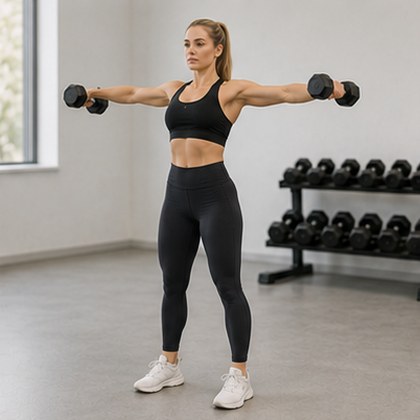 Lateral raise
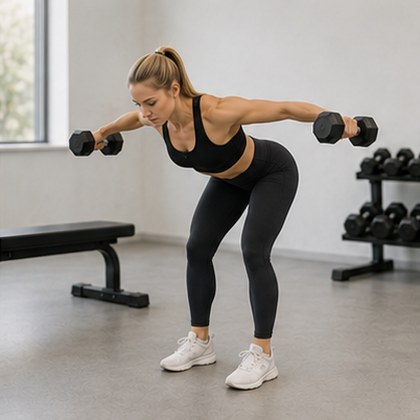 Bent-over rear delt raise
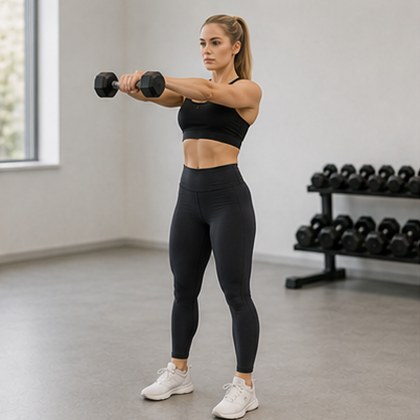 Front raise
How to do a standing dumbbell lateral raise: step by step
Stand tall with the dumbbells at your thighs, drop your shoulders, bend your elbows slightly and raise your arms out to the sides up to shoulder height over 2 seconds, then lower them over 2–3 seconds without letting the dumbbells drop. Step by step:
- Stance. Feet hip-width apart, knees soft. Brace your abs and keep your torso upright, with no forward lean and no arching back.
- Starting position. Dumbbells at your thighs, slightly in front, palms facing your body.
- Shoulders. Before your first rep, pull your shoulders down and away from your ears, as if your neck just got longer. Hold that position for the whole set.
- Elbows. Bend them slightly, about 10–20°. That angle stays the same until the last rep. If your arms bend more and more toward the end of the set, the weight is too heavy.
- The raise. Lift your arms out to the sides as if you're leading with your elbows and your hands are just hanging from them. Your hand never rises above your elbow. Palms face the floor, and you can turn your thumb up slightly.
- Direction. Your arms travel out to the sides and a little forward, so at the top the dumbbells are slightly in front of your shoulders. This is more comfortable for the shoulder joint. In Larsen's 2025 experiment, participants who felt shoulder pain with a strictly sideways raise were allowed to lift slightly in front of that line, halfway between it and the plane of the shoulder blade.
- Height. Up to shoulder height, with your arm roughly parallel to the floor. Section 11 explains why not higher.
- The top. Pause for 1 second, shoulders still down.
- Lowering. Lower the dumbbells over 2–3 seconds. At the bottom, don't drop them onto your thighs; stop a couple of centimetres (about an inch) short and start the next rep.
Tempo. Coratella's 2020 study used 2 seconds up and 2 seconds down. The American College of Sports Medicine (ACSM) 2009 position stand recommends a slow or moderate tempo for beginners, with moderate meaning 1–2 seconds per phase. At 2 seconds up and 2–3 seconds down, there's simply no time for swinging to creep in.
Breathing and grip. Breathe out on the way up and in on the way down; with light weights there's no need to hold your breath. Hold the dumbbell calmly without white-knuckling it, and keep your wrist straight.
test yourself against a wall. Stand with your back to it so your heels, glutes and shoulder blades touch it, and do a set. If your shoulder blades or glutes come off the wall on the way up, you're helping with your torso and need to drop the weight. The second way is to film a set on your phone from the front: on the video your shoulders shouldn't rise toward your ears, and your hands shouldn't get ahead of your elbows.
Seated, single-arm, cable, band and at-home lateral raises
Seated, the technique is the same, except your torso rests against a backrest and you can no longer throw the dumbbell up; cable and band raises give the same load as dumbbells.
Seated. Sit on a bench with an upright backrest, shoulder blades and lower back touching it, dumbbells hanging beside the seat. Coratella in 2020 had all raise variations performed seated precisely so the lower back couldn't help. For a beginner, that's the main advantage: swinging is ruled out. Seated, the weight is usually one step lighter than standing.
Single-arm with support. Hold on to an upright with your free hand and lean slightly away from it. This is often called a lean-away lateral raise. Your working arm then starts the lift from a more stretched position.
Lying on your side. Lie on your side on a bench set to a 30–45° incline and raise your top arm out to the side. Here the load is highest at the bottom of the movement, so you need very little weight, 1–3 kg (2.2–6.6 lb).
On a cable. Stand sideways to a low pulley, take the handle in your far hand, and let the cable run in front of your body. In 2025, Larsen and colleagues tested which option grows the lateral deltoid better. Twenty-four trained people, 16 men and 8 women, spent 8 weeks doing lateral raises with a dumbbell on one arm and on a cable with the other: two sessions a week, 5 sets per arm from week 2, 12–16 reps to failure, arms raised to 90°. Lateral deltoid thickness grew by 3.3–4.6% on the cable arm and by 3.4–3.9% on the dumbbell arm, with no difference between them. A cable loads the arm at the bottom of the movement too, while dumbbells are available everywhere.
With a band. Stand on the middle of a resistance band, hold the ends and raise them out to the sides. In 2010, Andersen and colleagues compared lateral raises and two other exercises in 16 women aged 26–55, using dumbbells of 2–7.5 kg (4.4–16.5 lb) and elastic bands. At a resistance that allowed only 3 reps, the main muscles worked at 59–87% of maximum with dumbbells and at 64–86% with bands, a difference that wasn't significant. There's one condition: move smoothly, without jerking. Choose a band where the last 2–3 reps out of 15–20 feel hard; if the band is too light, fold it in half. Which bands to buy is covered in our resistance band workout.
At home without dumbbells. A 1.5-litre (50 oz) water bottle weighs about 1.5 kg (3.3 lb), and for the first weeks of lateral raises that's enough for many women. Where lateral raises fit into a home session is shown in our dumbbell workout at home.
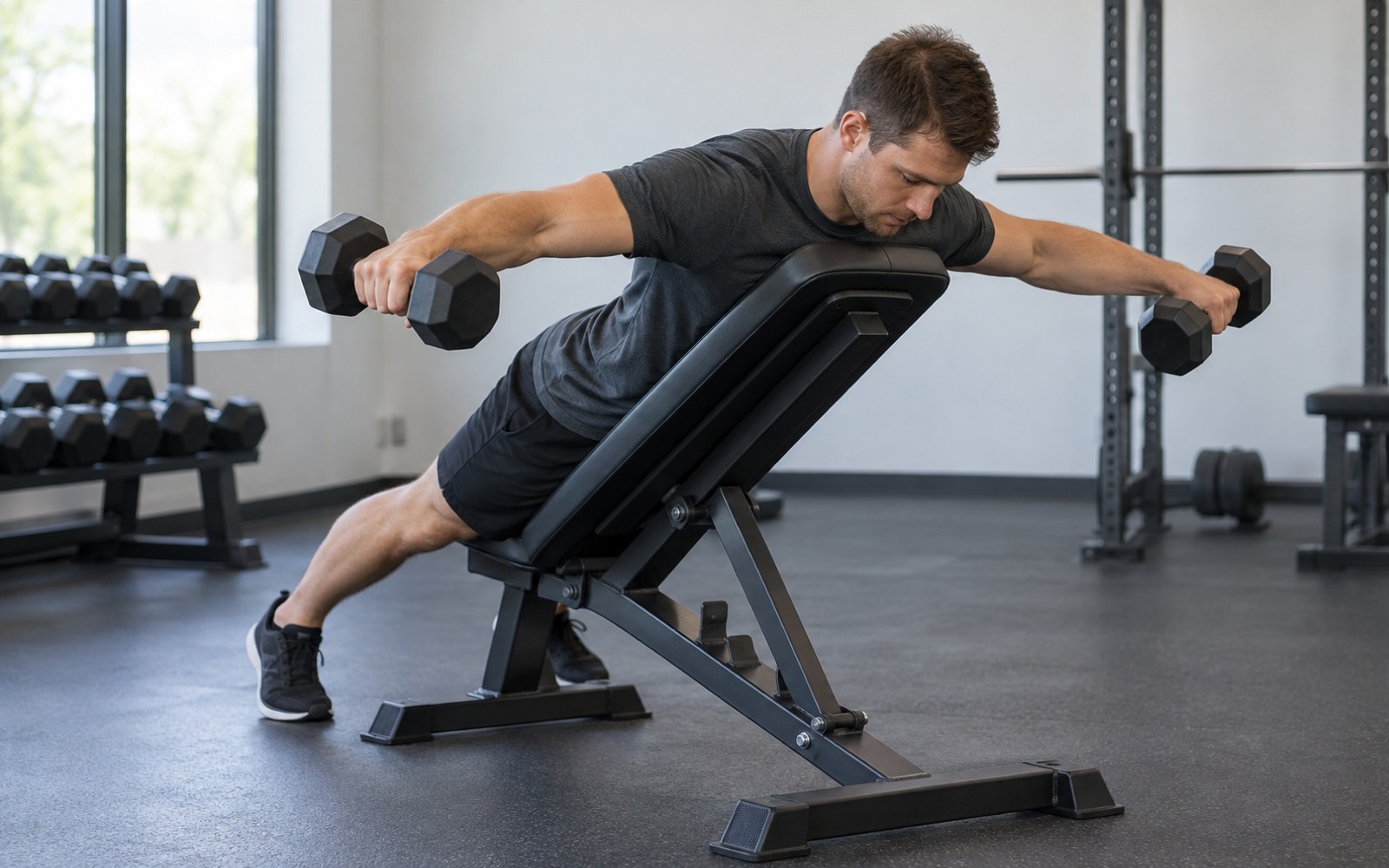
Bent-over rear delt raises: standing, seated and lying on a bench
In a bent-over raise, your torso is nearly parallel to the floor, your palms face each other, and your arms rise out to the sides until they're in line with your torso, without squeezing your shoulder blades together.
This exercise also goes by bent-over lateral raise, rear delt fly and reverse fly. The rear deltoid works only lightly in presses: in Campos's 2020 study, just 11.4% of maximum in the seated press. That's why bent-over raises are useful for anyone who presses in the gym.
| Position | How to set up | Pros | Cons |
|---|---|---|---|
| Standing bent over | knees soft, hips pushed back, back flat, torso nearly parallel to the floor | no bench needed | your lower back holds the bend for the whole set, easy to swing |
| Seated, chest on knees | sit on the edge of a bench, chest resting on your thighs, dumbbells under your knees | lower back is unloaded, swinging is almost impossible | slightly shorter range of motion |
| Lying chest-down on an incline bench | backrest at 30–45°, lie on it chest-down, feet on the floor | the gentlest option for your lower back | needs an adjustable bench |
A beginner is better off starting chest-down on an incline bench or seated with the chest on the knees, and moving to the standing version once the back reliably stays flat.
How to do it.
- Get into one of the three positions. Your neck continues the line of your back, eyes on the floor.
- The dumbbells hang under your shoulders, palms facing each other, elbows slightly bent.
- Raise your arms out to the sides like wings until they're in line with your torso. There's no need to go higher.
- Keep your shoulder blades in place and don't squeeze them together as you would in a row.
- Lower the dumbbells over 2–3 seconds.
Why palms facing each other. In 2013, Schoenfeld and colleagues tested 19 trained men on a reverse fly machine, which is the same movement, horizontal abduction of the arm, just with handles. With palms facing each other, the rear deltoid worked harder than with palms down, and so did the infraspinatus, one of the rotator cuff muscles. The measurements were taken on a machine, but the mechanics of a bent-over raise are the same.
The main mistake. If the middle of your back is tired and the back of your shoulders didn't feel anything, the raise has turned into a row: your elbows travelled back toward your waist and your shoulder blades squeezed together. Your arms should move out to the sides, at roughly 90° to your torso, and the weight almost always needs to come down.
What to do instead of bent-over raises. In the gym, use the reverse pec deck or a face pull with a rope on the high pulley. At home, do bent-over raises with a band. The rear deltoid also works in pulling exercises: according to Rabello's 2024 review, it was loaded hardest in pull-ups, above all in the standard pull-up and in the inverted row on suspension straps. Bent-over raises complement pulling exercises, and there's no need to replace your rows with them.
Dumbbell front raises: do you need them if you already press
Front raises load the front deltoid and upper chest, but if your program already has an overhead press or a bench press, the front deltoid is getting plenty of work, and a beginner can skip this version.
How to do it. Stand tall, dumbbells in front of your thighs, palms facing your body or each other. Raise one or both arms forward to shoulder height, elbows slightly bent, then lower over 2–3 seconds. Keep your torso from leaning back.
What the measurements show. In Coratella's 2020 study, the front raise produced the highest front deltoid and upper chest activity of all the variations. But in Campos's 2020 study, the front deltoid worked at 33.3% of maximum in the seated press and at 21.2% in the lateral raise. Pressing already loads the front deltoid well, and most of the time it doesn't need separate raises.
Who they suit. People who don't press, or who want to add volume for the front deltoid: 2–3 sets of 10–15 reps.
Mistakes: where you feel it → what to fix
A good lateral raise is felt on the side of your shoulder; if your neck is burning, the front of your shoulder is pulling, your joint is clicking or your lower back is tiring, your technique has drifted:
| Where you feel it | What's wrong | What to fix |
|---|---|---|
| Neck and upper traps burning, shoulders up by your ears | you shrug on the way up, the weight is too heavy | drop your shoulders before you start, keep your neck long, lift only to shoulder height, take dumbbells one step lighter |
| Pulling or stabbing at the front of the shoulder | the dumbbells drift forward toward your face, thumb pointing down | arms out to the sides and slightly forward, dumbbells a little in front of your shoulders at the top, palms down or thumb slightly up |
| A click or pain in the shoulder midway up, worse above shoulder height | a sign of a painful arc | no higher than 90°, drop the "jug"; if it keeps happening, see a doctor (section 11) |
| Elbow tires or aches | your arms bend more and more through the set, or the elbow is locked straight | bend your elbows 10–20° and hold that angle to the end of the set |
| Lower back | swinging your torso, arching back, throwing the dumbbells up | sit on a bench with a backrest or stand with your back to a wall, less weight, 2 seconds on the way up |
| Nothing on the side of the shoulder, dumbbells fly up easily | momentum is doing the work, the range is short | pause for 1 second at the top, lower over 2–3 seconds, don't drop the dumbbells onto your thighs at the bottom |
| In bent-over raises, mid-back tires, shoulder not felt | you squeeze your shoulder blades and pull your elbows toward your waist, like a row | palms facing each other, move your arms out to the sides, keep your shoulder blades apart, less weight |
| Wrists and forearms get pumped | wrist bent down, dumbbell in a clenched fist | wrist straight, relaxed grip, the dumbbell continues the line of your arm |
Your traps always work. A common complaint is "I feel lateral raises in my traps instead of my shoulders." According to Andersen's 2008 measurements, the upper trapezius works almost as hard in lateral raises as in shrugs, 97% of maximum versus 102%: it rotates the shoulder blade, and without that your arm can't rise very high. Mild fatigue at the base of your neck is normal. The problem starts when your shoulders creep toward your ears and your traps take over part of the lift. The fix: one step less weight, shoulders down before you start, raise only to shoulder height, and don't turn your pinky up (Coratella, 2020).
Pinky up and "pouring from a jug." An old piece of advice says to rotate your hand at the top as if pouring water from a jug, with your pinky higher than your thumb. Some coaches swear by it, others ban it. Here's what it gives you and what you pay for it.
- What it gives. With the shoulder rotated inward, the rear deltoid in Coratella's 2020 study worked at about 85% of maximum, versus about 52% with a neutral grip. The lateral deltoid barely changed: about 52% versus 55%. Rabello's 2024 review names this variation the best for the lateral deltoid, yet in Coratella's measurements the lateral deltoid was actually slightly lower with inward rotation than with a neutral grip.
- What you pay. In 2006, Thigpen and colleagues compared raising the arm with the thumb down and with the thumb up in 20 people. With the thumb down, the shoulder blade tipped forward and rotated inward more at 30°, 60° and 90° of elevation. That narrows the space under the acromion, the bony ledge above the shoulder joint where the tendons pass.
- What shows up in people who lift. In 2014, Kolber and colleagues examined 77 men, 154 shoulders. Signs of impingement, meaning the tendons getting pinched under the acromion, were significantly more common in people who lifted weights and were linked specifically to lateral raises and upright rows above shoulder height.
The practical takeaway: palms down or thumb slightly up, and raise to shoulder height. You can keep the "jug" for a trained, healthy shoulder, with light weight and strictly up to horizontal. If your shoulder has clicked or ached even once, that's the first thing to drop.
What weight to use: an 8-week plan for women and men
Women should start with 2 kg (4.4 lb) dumbbells and men with 4 kg (8.8 lb), 3 sets of 12 reps with 2–3 reps left before failure, adding reps first and weight second.
The lateral deltoid is a small muscle, and an outstretched arm is a long lever, so even 5 kg (11 lb) feels heavy in a lateral raise. In our home dumbbell program, the starting range for lateral raises is 2.5–5 kg (5.5–11 lb) for women and 4–8 kg (8.8–17.6 lb) for men. This plan starts with the lightest dumbbell, 2 and 4 kg (4.4 and 8.8 lb), so the first weeks go into technique. If your gym has pound dumbbells, take the closest pair.
The day-one test. With your starting dumbbells, do a set of 12 reps using the technique from section 04. If every rep was clean with no swinging and you had 2–3 reps left, that's your weight. If you had to finish the last reps with your torso, go lighter: 1–1.5 kg (2.2–3.3 lb) for women, 3 kg (6.6 lb) for men.
The progression rule comes from the 2009 ACSM position stand: a beginner needs a weight that allows 8–12 reps, and once you can do 1–2 reps more than the target, the weight goes up by 2–10%.
The catch with light dumbbells. Dumbbells usually go up in 1 kg (2.2 lb) steps. Going from 2 to 3 kg is an immediate 50% jump, and from 4 to 5 kg it's 25%, 2.5–5 times more than the upper limit ACSM recommends. That's why reps climb first, to 15–20, and only then does the weight go up. Light weight for high reps builds muscle as well as heavy weight does: in Schoenfeld's 2017 meta-analysis of 21 studies where sets were taken to failure, muscle growth was the same with loads up to 60% of maximum and above 60%, while strength improved more with heavy loads. If you have dumbbells in 0.5 kg (1.1 lb) steps, you can add weight in smaller increments.
Eight weeks of lateral raises in numbers. Two sessions a week, 3 working sets each, 2–3 reps in reserve, up to shoulder height. Tonnage is the volume of work per session: sets × reps × the weight of both dumbbells. For example, 3 × 12 × (2 × 2 kg) = 144 kg (317 lb).
| Week | Women | Tonnage | Men | Tonnage | What changed |
|---|---|---|---|---|---|
| 1 | dumbbells 2 × 2 kg (4.4 lb), 3 × 12 | 144 kg (317 lb) | dumbbells 2 × 4 kg (8.8 lb), 3 × 12 | 288 kg (635 lb) | start |
| 2 | 2 × 2 kg (4.4 lb), 3 × 15 | 180 kg (397 lb) | 2 × 4 kg (8.8 lb), 3 × 15 | 360 kg (794 lb) | +3 reps |
| 3 | 2 × 2 kg (4.4 lb), 3 × 20 | 240 kg (529 lb) | 2 × 5 kg (11 lb), 3 × 12 | 360 kg (794 lb) | women +5 reps, men weight +25% |
| 4 | 2 × 3 kg (6.6 lb), 3 × 12 | 216 kg (476 lb) | 2 × 5 kg (11 lb), 3 × 15 | 450 kg (992 lb) | women weight +50%, men +3 reps |
| 5 | 2 × 3 kg (6.6 lb), 3 × 15 | 270 kg (595 lb) | 2 × 6 kg (13.2 lb), 3 × 12 | 432 kg (952 lb) | women +3 reps, men weight +20% |
| 6 | 2 × 3 kg (6.6 lb), 3 × 20 | 360 kg (794 lb) | 2 × 6 kg (13.2 lb), 3 × 15 | 540 kg (1,190 lb) | women +5 reps, men +3 reps |
| 7 | 2 × 4 kg (8.8 lb), 3 × 12 | 288 kg (635 lb) | 2 × 7 kg (15.4 lb), 3 × 12 | 504 kg (1,111 lb) | weight: +33% for women, +17% for men |
| 8 | 2 × 4 kg (8.8 lb), 3 × 15 | 360 kg (794 lb) | 2 × 7 kg (15.4 lb), 3 × 15 | 630 kg (1,389 lb) | +3 reps |
Over 8 weeks, training volume per session grows by 150% for women (from 144 to 360 kg, or 317 to 794 lb) and by 119% for men (from 288 to 630 kg, or 635 to 1,389 lb). Women's reps go up to 20 because each dumbbell step is a bigger percentage jump for them, while 15 is enough for men. Tonnage dips in the weeks when the weight changes, and that's by design.
This is a typical path, and none of it is a mandatory target. The weight only goes up when your shoulders stay down, your torso doesn't swing, and you have 2–3 reps in reserve on every set. If your shoulder aches, the weight doesn't go up.
Starting weight for other raise types (per dumbbell, 3 sets with 2–3 reps in reserve):
| Type | Women | Men | Reps | Why |
|---|---|---|---|---|
| Standing side raise | 2 kg (4.4 lb) | 4 kg (8.8 lb) | 12–20 | long lever, small lateral deltoid |
| Seated side raise | one step lighter than standing | one step lighter than standing | 12–20 | seated, you can't throw the dumbbell up with your torso |
| Bent-over (standing, seated, chest-down on a bench) | 2 kg (4.4 lb) | 3–4 kg (6.6–8.8 lb) | 12–20 | the rear deltoid is even smaller than the lateral |
| Front raise | 2–3 kg (4.4–6.6 lb) | 4–5 kg (8.8–11 lb) | 10–15 | the chest helps the front deltoid |
| Single-arm cable | the lightest stack setting, usually 2.5–5 kg (5.5–11 lb) | 5 kg (11 lb) | 12–16 | as in Larsen's 2025 protocol |
| Resistance band | light or medium band | medium or heavy band | 15–20 | the last 2–3 reps feel hard (Andersen, 2010) |
Cheat lateral raises, where you swing the weight up, are a technique experienced lifters use for heavy loads. A beginner doesn't need them: swinging shifts the work to your back and traps.
How many sets, reps and sessions per week; where raises go in your workout
A beginner is fine with 3 sets of 12–20 reps twice a week, resting 1–2 minutes between sets, and in total the shoulders need at least 10 sets a week, counting presses.
The 2026 ACSM position stand pulled together 137 systematic reviews covering more than 30,000 participants. Three of its conclusions matter for lateral raises:
- Volume. Muscles grow more with 10 or more sets per muscle per week. Two sessions of 3 sets of lateral raises give you 6 sets, pressing adds another 6, for 12 in total.
- Frequency. Strength improves more with two or more sessions a week.
- Range of motion. A full range of motion builds more strength. In a lateral raise, full range means from your thighs to shoulder height.
Rest between sets is 1–2 minutes, as ACSM recommended in 2009 for muscle growth. A handy trick is alternating single-arm raises: while your right arm works, your left arm rests.
Where to put them. Do lateral raises after your presses. ACSM in 2009 recommends starting with multi-joint exercises while you're fresh and doing isolation work afterwards. The press as the backbone of a shoulder workout is covered in our seated dumbbell shoulder press guide. Bent-over raises can go on your back day, after rows.
A sample upper-body day: seated dumbbell press 3 × 10, bent-over dumbbell row 3 × 10, lateral raises 3 × 12–15, bent-over rear delt raises 2 × 15.
The Sportygram app (go.sportygram.com; the interface and the coach are in Russian for now) has dumbbell lateral raises and front raises in its workout diary, a single-arm cable lateral raise, and for the rear deltoid a standing and seated bent-over reverse fly and a reverse pec deck. Each exercise comes with technique photos, separate sets for men and for women. You can ask the virtual coach, Alex, in chat to add lateral raises to Thursday; he shows a confirmation card, and once you confirm, the raises appear in that day's plan. You log your sets and weight in the diary, and the weight history shows when it's time for the next dumbbell.
What comes next. Once you've finished the plan from section 09, change one thing at a time: seated instead of standing, single-arm on a cable, or a 2-second pause at the top. There's no need to add weight and reps at the same time.
Shoulder, neck and lower back: who should be careful and when to see a doctor
For a healthy shoulder, lateral raises to shoulder height with light weight are fine at any age, but if you have shoulder pain, or you're coming back from a dislocation or surgery, the weight and range of motion should be agreed with a doctor or physical therapist.
The shoulder and impingement. In Kolber's 2014 study, signs of impingement in people who lifted weights were linked to lateral raises and upright rows above 90°, while people who strengthened their shoulder external rotators showed fewer signs. That gives three rules:
- raise the dumbbells to shoulder height and no higher;
- keep your palms down or your thumb slightly up, with no "jug";
- add shoulder external rotation with a light band to your warm-up: elbow tucked against your side, forearm moving outward, 2 sets of 15.
The neck. In Andersen's 2008 study, lateral raises were one of the exercises for women with chronic neck pain, done with dumbbells of just 3–10 kg (6.6–22 lb). If your neck hurts more after lateral raises than before your workout, lower the weight and the height of the raise, and if that doesn't help, talk the exercise over with a doctor.
The lower back. It takes a beating when you swing while standing. If your lower back hurts, do your lateral raises seated with a backrest, and your bent-over raises lying chest-down on an incline bench.
After a dislocation, with shoulder instability, or after surgery, bring lateral raises back only together with a doctor or physical therapist, usually starting with a band or very light weight and a partial range of motion.
When to see a doctor. Book an appointment with an orthopaedic or sports medicine doctor if:
- pain appears midway through raising your arm to the side and eases above or below that point;
- your shoulder hurts at night and stops you sleeping on that side;
- you can't hold your arm out to the side, or it has suddenly become weak;
- your fingers go numb or the pain radiates down your arm;
- the pain lasts longer than 1–2 weeks even though you lowered the weight and dropped the exercise.
How to tell normal muscle soreness from a joint problem is covered in our article on shoulder pain from lifting.
Questions and answers
Why do I feel lateral raises in my traps, and how do I stop it?
There's no need to stop your traps working: they rotate your shoulder blade, and without them your arm can't rise. In Andersen's 2008 measurements, the upper trapezius worked at 97% of maximum in lateral raises, almost as much as in shrugs. The only thing that gets in the way is the habit of lifting your shoulders toward your ears. Drop your shoulders before you start, raise the dumbbells to shoulder height, take one step less weight, and don't turn your pinky up: that rotation brings in the traps more than anything else (Coratella, 2020).
How high should you raise the dumbbells in a lateral raise?
To shoulder height, roughly 90°, when your arm is parallel to the floor. In Kolber's 2014 study, signs of impingement in people who lifted weights were linked to raises above 90°. In Larsen's 2025 study, where the deltoid grew over 8 weeks, participants also raised to 90°.
How should you hold the dumbbells: pinky up like pouring water, or palms down?
Palms down or with your thumb slightly up. The "jug" loads the rear deltoid and traps more but adds almost nothing for the lateral deltoid: about 52% versus 55% with a neutral grip (Coratella, 2020). It also tips your shoulder blade forward and narrows the space under the acromion (Thigpen, 2006).
What weight should a beginner use for lateral raises?
Women 2 kg (4.4 lb) dumbbells and men 4 kg (8.8 lb), 3 sets of 12 reps. By week 8 of our plan, that becomes 4 kg (8.8 lb) and 7 kg (15.4 lb). If your shoulders creep up toward your ears on the last reps, the weight is too heavy.
How many sets and reps of lateral raises, and how many times a week?
3 sets of 12–20 reps twice a week, with 1–2 minutes of rest. Together with presses, that's 10–12 sets a week for your shoulders. According to the 2026 ACSM position stand, muscles grow more when they get 10 or more sets a week. Light weight for high reps builds muscle as well as heavy weight, as long as the set ends close to failure (Schoenfeld, 2017).
Which is better: standing or seated lateral raises?
For the lateral deltoid, the difference is small. Seated with a backrest, it's harder to throw the dumbbell up with your torso and easier on your lower back, which is why Coratella in 2020 had all raise variations done seated. Standing, you can use slightly more weight but it's easy to swing, so a beginner is better off seated or standing against a wall.
Are cable lateral raises better than dumbbells?
They're equally effective. In Larsen's 2025 study, 24 trained people spent 8 weeks doing dumbbell raises with one arm and cable raises with the other. The lateral deltoid grew by 3.3–4.6% on the cable arm and by 3.4–3.9% on the dumbbell arm, with no significant difference. Pick whichever feels better for your shoulder.
Can you do lateral raises at home with a band instead of dumbbells?
Yes. In Andersen's 2010 study, at a resistance that allowed only 3 reps, the muscles worked at 64–86% of maximum with a band and at 59–87% with a dumbbell, with no significant difference. Pick a band where the last 2–3 reps out of 15–20 feel hard, and move without jerking.
The bottom line
- A lateral raise means lifting nearly straight arms out to the sides up to shoulder height. Side raises build the lateral deltoid, bent-over raises the rear deltoid, and front raises the front deltoid.
- With palms down and nearly straight arms, the lateral deltoid works at about 55% of maximum, more than with the thumb up or bent elbows (Coratella, 2020). Lateral raises load it at least as hard as a press does (Campos, 2020).
- Your traps always work in lateral raises, at 97% of maximum in Andersen's 2008 study. The goal is to stop shrugging.
- Raise to shoulder height, with no "jug" and your arms slightly in front of your body: raises above 90° are linked to signs of impingement in recreational lifters (Kolber, 2014).
- Start with 2 kg (4.4 lb) for women and 4 kg (8.8 lb) for men, 3 × 12 twice a week. Reps go up to 15–20 first, then you move to the next dumbbell.
- Pain midway through the raise, night pain in the shoulder, or a weak arm are reasons to see a doctor.
Checklist: before a set of lateral raises
- Shoulders down, neck long.
- Abs braced, torso not swinging.
- Elbows bent 10–20°, angle unchanged for the whole set.
- Palms facing the floor, or thumb slightly up.
- Arms travelling out to the sides and a little forward.
- Raise to shoulder height, 2 seconds up and 2–3 seconds down.
- The weight leaves 2–3 reps in reserve.
- Sets and weight logged in your workout diary.
Sources
- Coratella G., Tornatore G., Longo S., Esposito F., Cè E. An Electromyographic Analysis of Lateral Raise Variations and Frontal Raise in Competitive Bodybuilders. International Journal of Environmental Research and Public Health, 2020. — 10 bodybuilders, seated, a load for 8 reps, raised to 90°: with a neutral grip the lateral deltoid reached about 55% of maximum; with the thumb up the front deltoid worked harder, with inward shoulder rotation the rear deltoid and traps; the front raise loaded the front deltoid and upper chest the most.
- Larsen S., Wolf M., Schoenfeld B.J. et al. Dumbbell versus cable lateral raises for lateral deltoid hypertrophy: an experimental study. Frontiers in Physiology, 2025. — 24 trained participants, 8 weeks, one arm with a dumbbell and the other on a cable, up to 5 sets of 12–16 reps to failure twice a week, raised to 90°: lateral deltoid +3.3–4.6% with the cable and +3.4–3.9% with the dumbbell, no difference.
- Campos Y.A.C., Vianna J.M., Guimarães M.P. et al. Different Shoulder Exercises Affect the Activation of Deltoid Portions in Resistance-Trained Individuals. Journal of Human Kinetics, 2020. — 13 trained men, 12 reps at 60% of max, seated lateral raises and barbell press: lateral deltoid 30.3% in the raise and 27.9% in the press; front deltoid 33.3% in the press and 21.2% in the raise; rear deltoid 24% in the raise and 11.4% in the press.
- Andersen L.L., Kjaer M., Andersen C.H. et al. Muscle activation during selected strength exercises in women with chronic neck muscle pain. Physical Therapy, 2008. — 12 women with neck pain: upper trapezius at 102% of maximum in shrugs, 97% in lateral raises and 85% in upright rows; 3–10 kg was enough for lateral raises.
- Andersen L.L., Andersen C.H., Mortensen O.S. et al. Muscle activation and perceived loading during rehabilitation exercises: comparison of dumbbells and elastic resistance. Physical Therapy, 2010. — 16 women, lateral raises and two other exercises: at a 3-rep resistance, muscle activity was 59–87% with dumbbells and 64–86% with bands, no significant difference.
- Schoenfeld B., Sonmez R.G., Kolber M.J. et al. Effect of hand position on EMG activity of the posterior shoulder musculature during a horizontal abduction exercise. Journal of Strength and Conditioning Research, 2013. — 19 trained men, reverse fly: with palms facing each other the rear deltoid and infraspinatus worked harder than with palms down.
- Rabello R., Bertozzi F., Hauschild de Freitas I.L. et al. Activation of the three deltoid muscle portions during common strengthening exercises: A systematic review. Journal of Bodywork and Movement Therapies, 2024. — 33 studies with loads of at least 60% of max: the lateral deltoid works hardest in abduction movements, and among single exercises in lateral raises with inward shoulder rotation; the rear deltoid in pull-ups, above all the standard pull-up and the inverted row on suspension straps.
- Thigpen C.A., Padua D.A., Morgan N., Kreps C., Karas S.G. Scapular kinematics during supraspinatus rehabilitation exercise: a comparison of full-can versus empty-can techniques. American Journal of Sports Medicine, 2006. — 20 people: with the thumb down the shoulder blade tips forward and rotates inward more at 30°, 60° and 90° of elevation, and the space under the acromion shrinks.
- Kolber M.J., Cheatham S.W., Salamh P.A., Hanney W.J. Characteristics of shoulder impingement in the recreational weight-training population. Journal of Strength and Conditioning Research, 2014. — 77 men, 154 shoulders: signs of impingement were more common in people who lifted weights and linked to lateral raises and upright rows above 90°; strengthening the external rotators was linked to fewer signs.
- Schoenfeld B.J., Grgic J., Ogborn D., Krieger J.W. Strength and Hypertrophy Adaptations Between Low- vs. High-Load Resistance Training: A Systematic Review and Meta-analysis. Journal of Strength and Conditioning Research, 2017. — 21 studies, sets to failure: muscle growth was the same with loads up to 60% and above 60% of maximum, while strength improved more with heavy loads.
- Currier B.S., D'Souza A.C., Singh M.A.F. et al. American College of Sports Medicine Position Stand. Resistance Training Prescription for Muscle Function, Hypertrophy, and Physical Performance in Healthy Adults: An Overview of Reviews. Medicine & Science in Sports & Exercise, 2026. — 137 systematic reviews: 10 or more sets per muscle per week for muscle growth, 2 or more sessions a week and a full range of motion for strength.
- American College of Sports Medicine. Progression models in resistance training for healthy adults. Medicine & Science in Sports & Exercise, 2009. — Beginners should use a load allowing 8–12 reps, adding 2–10% once 1–2 extra reps are possible; a slow or moderate tempo for beginners, with moderate meaning 1–2 seconds per phase; 1–2 minutes of rest; multi-joint exercises before single-joint ones.
This article is for informational purposes only and is not a substitute for medical advice.