

in Solstad's 2020 study, the elbow angle at the bottom of the fly was held at 150–160°, meaning the arm was bent 20–30° from straight, and the biceps — which, according to the authors, holds that angle — worked 76% harder than in the barbell bench press. Over the whole movement, the chest was 16% more active in the bench press, and a 6-rep weight was 88.5 kg (195 lb) in the press versus 40.5 kg (89 lb) for both dumbbells in the fly. That's why the press goes first and the fly second. To start, 3 kg (6.5 lb) dumbbells work for women and 6 kg (13 lb) for men: 3 sets of 10 twice a week, stopping 2–3 reps short of failure. Over our 8-week plan, the volume you lift per session doubles.
A dumbbell fly is a chest exercise where you lie on a bench, lower your arms with the dumbbells out to the sides in a wide arc, and bring them back up over your chest. From the side it looks like you're hugging a big tree trunk. The movement happens only at your shoulder joint. Your elbows are bent 20–30° and hold that angle from the first rep to the last. You lower the dumbbells over 2–3 seconds to about the level of your torso, and at the top you stop them over your shoulders without clanking them together. Flys go after a press: 2–3 sets of 10–15 reps. Women can start with 3 kg (6.5 lb) dumbbells in each hand, men with 6 kg (13 lb).
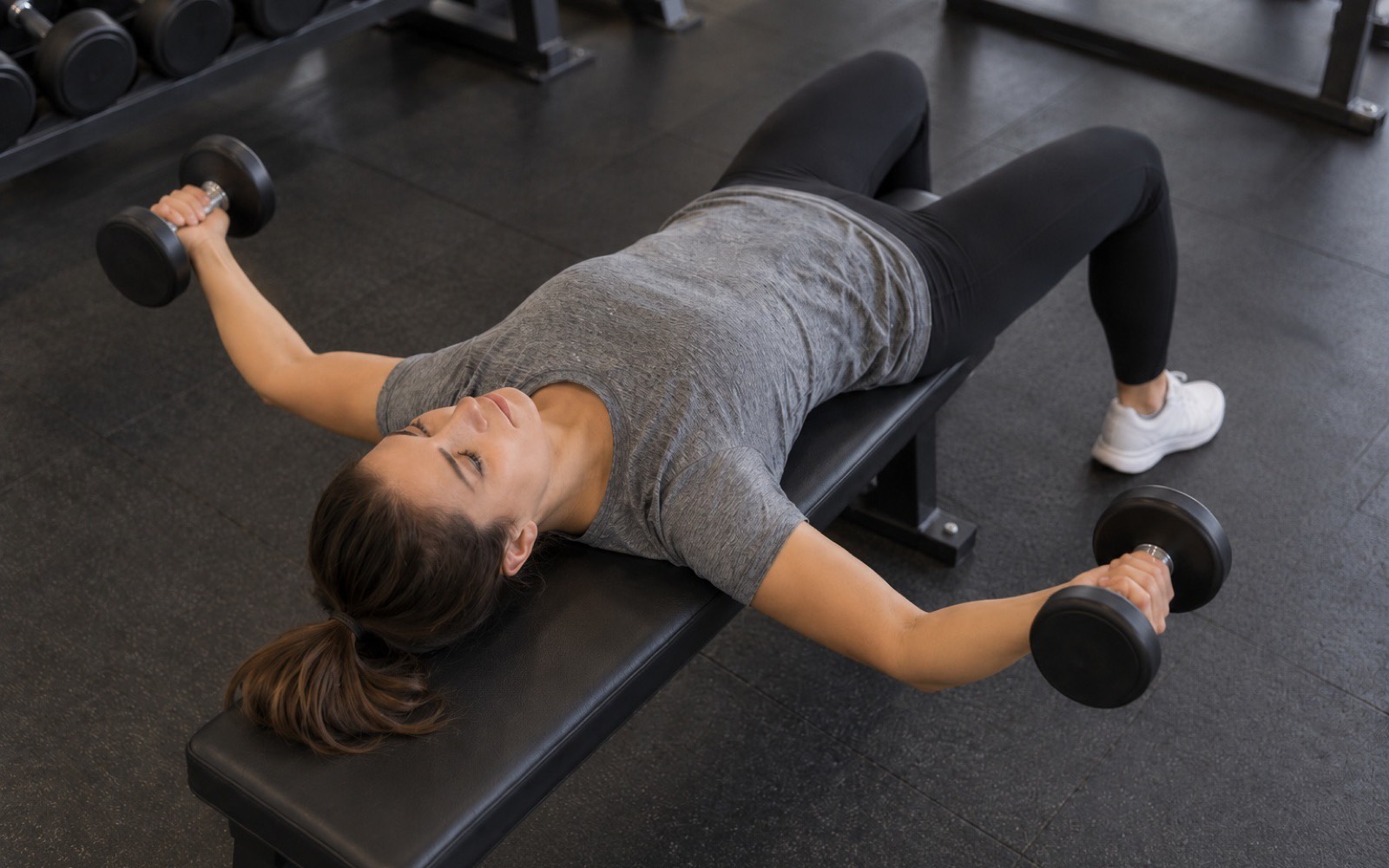
What a dumbbell fly is and how it differs from lateral raises
A dumbbell fly is an isolation exercise for the chest: only one joint moves, the shoulder, and the elbow just holds its angle.
You'll see it written as dumbbell fly, dumbbell flye, flyes or flys, and some people call it a chest fly. The name comes from the way your arms move, like a pair of wings.
The main difference from a dumbbell bench press is what your elbows do. In a press they bend and straighten, and your triceps push the weight up. In a fly the elbow angle stays nearly constant, so your shoulder does all the work: it brings your arms together in front of your chest. Anatomists call this horizontal adduction of the shoulder, and the main muscle that does it is the pectoralis major.
What this means for you. Your fly dumbbells will be much lighter than your press dumbbells, your chest gets a big stretch at the bottom, and at the top the load almost disappears. Depth and control matter more here than the number on the dumbbell.
If you were looking for a standing or bent-over fly, that's a different exercise for the shoulders, and we covered it in our guide to lateral raises.
Dumbbell fly muscles worked
In the dumbbell fly, the pectoralis major does most of the work, the front delts help, the biceps holds your elbow angle, and the triceps barely does anything.
| Muscle | What it does in the fly | Where you feel it |
|---|---|---|
| Pectoralis major, sternocostal head (middle and lower chest) | brings your arms together in front of your chest; the main muscle of the exercise, loaded hardest at the bottom | a stretch across your whole chest at the bottom, a burn toward the end of the set |
| Pectoralis major, clavicular head (upper chest) | helps bring your arms together; its share grows on an incline bench | just below your collarbones, more on an incline |
| Anterior deltoid (front of the shoulder) | helps raise and bring your arms together; works 25% harder in a bench press | the front of your shoulder, especially on an incline bench |
| Biceps brachii | keeps the elbow bent; works 76% harder in the fly than in a bench press | the front of your upper arm, near the elbow |
| Coracobrachialis | helps pull the upper arm toward your body | deep in the armpit; you usually don't feel it on its own |
| Serratus anterior | helps keep the shoulder blade against your ribs | on the side of your ribs, under your armpit |
| Triceps | does little; it's 75% more active in a bench press | almost nothing |
Chest and shoulder. In Solstad's 2020 study, 17 trained men with about five years of lifting experience did a barbell bench press and a dumbbell fly with a weight they could lift exactly 6 times. The researchers recorded the electrical activity of four muscles, a method called electromyography. Over the whole movement, the pectoralis major worked 16% harder in the press, the front delt 25% harder, and the triceps 75% harder. The biceps went the other way: it was 76% more active in the fly. The authors think its main job here is holding a steady elbow angle, so after your first few sessions you may feel it near the crease of your elbow. The other muscles in the table weren't measured in that study; their roles are described from anatomy.
Do flys actually grow your chest? Yes. In Pinto's 2025 study, 15 untrained young men spent 12 weeks doing only one chest exercise — the pec deck machine, which is built around the same movement as the fly. They trained twice a week and worked each arm separately: one arm did one set to failure, the other did three. The thickness of the upper, clavicular part of the chest grew 17–18%, the middle and lower chest grew 21%, and strength on the pec deck went up 43–46%, with no difference between one set and three. So an isolation fly movement grows the whole pec on its own, upper chest included, and the idea that it only "defines" your chest doesn't hold up.
How to do a flat bench dumbbell fly: step by step
Lie on the bench with the dumbbells over your chest, bend your elbows slightly, and lower your arms out to the sides in an arc to the level of your torso, then bring the dumbbells back along the same arc until they're over your shoulders. Step by step:
- Start seated. Sit on the end of the bench and stand the dumbbells upright on your thighs, right by your knees.
- Lie back. Hold the dumbbells against your chest and roll onto your back, giving them a push up with your knees as you go. Press the dumbbells up over your chest.
- Starting position. Arms over your shoulders, palms facing each other, dumbbells almost touching but not clanking. Elbows slightly bent and pointing out to the sides.
- Your torso. Squeeze your shoulder blades together and pull them down, as if you're tucking them into your back pockets. Keep a small natural arch in your lower back with your hips on the bench. Feet flat on the floor. Back of your head on the bench, eyes on the ceiling.
- Lowering. Breathe in and lower the dumbbells out to the sides in a wide arc over 2–3 seconds. Your elbows point out and slightly down, and their angle doesn't change. The dumbbells travel roughly in line with the middle of your chest, without drifting toward your head or your stomach.
- The bottom. Stop when your upper arms reach the level of your torso and you feel a strong but tolerable stretch in your chest. Don't let your elbows drop below the bench.
- Lifting. Breathe out and bring the dumbbells back along the same arc, as if you're hugging a barrel. Think of your chest pulling your arms together while your elbows just hold their shape.
- The top. Stop the dumbbells over your shoulders, about a hand's width apart. Don't bang them together or bring your arms any further toward the middle of your chest. Start the next rep right away.
- Finishing the set. Bend your elbows, lower the dumbbells to your chest and sit up, setting them back on your thighs. Don't drop the dumbbells out to the sides from straight arms: your shoulder takes a jolt in its most vulnerable position.
Breathing. Breathe in on the way down, out on the way up.
How long one rep takes. About 4–5 seconds: 2–3 seconds down, 1–2 seconds up. In Solstad's study, the lifters chose their own pace, and a 6-rep set of flys took an average of 23.5 seconds, compared with 18.7 seconds for the bench press. That works out to roughly 4 seconds per fly rep.
before your first set, do 10 reps lying on the bench with no dumbbells. Imagine you're hugging a thick tree trunk: arms wide, elbows soft and pointing out, hands resting on the bark. Notice where your elbows stop when your upper arms reach the level of your torso. That's your bottom position once you pick up the dumbbells.
What elbow angle to keep, and why your arms shouldn't be straight
Keep your elbows bent about 20–30° from straight — an angle of 150–160° at the elbow itself — and don't let it change for the whole set.
That number comes from Solstad's 2020 study. The elbow angle at the bottom was set with a goniometer at 150–160°, and each lifter held it nearly constant. If the angle got smaller, the attempt was stopped. The logic is simple: the more your elbows bend as you go, the more the fly turns into a press.
Why not straight arms. The straighter your arm, the longer the lever from your shoulder to the dumbbell. On a long lever, the same dumbbell puts more load on your shoulder and elbow. Your biceps already works 76% harder in a fly than in a press, and Solstad and colleagues cite data showing that two-joint muscles like the biceps kick in more when they're stretched at their other joint, which for the biceps means an almost straight elbow. With straight arms, the stress on the inside of your elbow goes up, and you'll feel discomfort there before your chest gets tired.
Why not heavily bent. If you bend your elbows to 90°, the lever gets shorter, the dumbbell feels lighter, and you can handle more weight. But then your triceps join in, your elbows start bending and straightening, and you end up doing a press. If you want to press, it makes more sense to do a regular dumbbell bench press with a proper weight.
How to tell the angle is holding. 20–30° is a soft elbow, like someone carrying a big box in front of them. You don't need a protractor: check your elbows in a mirror from the side or film a set on your phone. If your arms bend noticeably on the last reps and the dumbbells come down closer to your chest, the weight is too heavy for now. Go 1–2 kg (2–4 lb) lighter.
How low to go, and should the dumbbells touch at the top
Lower the dumbbells until your upper arms reach the level of your torso — roughly parallel to the floor — and stop them at the top over your shoulders without clanking them together.
The bottom is where the work happens. In Solstad's study, chest activity was analyzed separately for the top, middle and bottom thirds of the movement. On the way down, the chest was more active in the press than in the fly: 42% more in the top third, 21% in the middle and 23% in the bottom. On the way up, a difference remained only in the top third, 34%, while in the middle and bottom thirds the chest worked equally in both exercises. The authors explain this with the moment arm. At the bottom, the dumbbell is far from your shoulder horizontally, and the muscle has a hard time. At the top, the dumbbell is almost directly over your shoulder, the lever is short, and there's almost no load.
What this means for you. The most useful inches of a fly are the bottom two-thirds. Banging the dumbbells together at the top adds nothing for your chest and only breaks your control. Plenty of people clank them loudly to "squeeze" the chest, but a cable fly does that job better, because the cable pulls you out to the side even at the end of the movement.
Why not deeper than your torso. Below the level of the bench, your shoulder goes into an end-range position: the arm is out to the side, rotated outward and stretched under load. In that position the pec is stretched and contracting at the same time, which is the riskiest moment for its tendon. ElMaraghy's 2012 systematic review collected 365 reported cases of pectoralis major rupture. 83% of them happened without a direct blow, from overloading the muscle itself, and 48% happened during strength training. It's a rare injury, but the takeaway is simple: don't chase personal records on the fly, and don't drop into the stretch.
There are no direct studies yet on which depth grows the chest best in a fly. Use a strong stretch in your chest with no pinching in your shoulder as your guide.
| Depth | What's happening | What to do |
|---|---|---|
| Elbows clearly above the level of your torso | you're skipping the bottom, most useful part of the range, and your chest works little | go lower until your upper arms reach the level of your torso |
| Upper arms level with your torso, roughly parallel to the floor | a strong stretch in your chest, shoulder in a safe position | the working depth for most people |
| Elbows below the bench | shoulder at end range under load, more stress on the front of the joint and the pec tendon | raise your bottom position, squeeze your shoulder blades, use lighter dumbbells |
If your shoulder is sensitive, try the floor fly from section 08: the floor stops your elbows for you.
Incline dumbbell fly: what bench angle to use
For an incline dumbbell fly, set the backrest to 15–30°: in that range the upper chest works hardest, while the front delt hasn't taken over yet.
There are no direct comparisons of bench angles for the fly yet, so the guideline comes from pressing. In Rodríguez-Ridao's 2020 study, 30 trained people did a barbell bench press at 60% of their max with the bench at 0°, 15°, 30°, 45° and 60°. The upper, clavicular part of the pectoralis major worked hardest at 30°, although its difference from the flat bench was small. The middle and lower chest worked hardest on the flat bench and got weaker with every step of incline. The front delt was already working noticeably more at 30° than on the flat bench, and at 45° and 60° it became the most active muscle. The authors conclude that inclines above 45° add work for the front delt and take it away from the chest. The fly uses the same muscle and the same joint, so the logic carries over.
| Bench angle | What works harder | Who it suits |
|---|---|---|
| 0°, flat | middle and lower chest | beginners, and everyone as the main version |
| 15–30° | upper chest, most at 30°; the delt joins in more noticeably | when you want more upper chest, as a second exercise after a press |
| 45° | upper chest works less than at 30°, the front delt takes over first place | experienced lifters, if 30° feels awkward; your shoulders already get plenty of work from seated presses |
| Decline, −15 to −30° | commonly believed in gyms to shift the focus to the lower chest; this study didn't measure it | optional; the middle and lower chest already work hardest on a flat bench |
How to do it on an incline. The form is the same as on a flat bench. The dumbbells travel in an arc in line with your upper chest, and at the bottom your elbows sit slightly below shoulder level. On an incline, people usually go 1–2 kg (2–4 lb) lighter than on a flat bench: that's a practical rule of thumb, and no study gives that number.
30 or 45 degrees. If you're choosing between those two, go with 30°. At 45° and above, the fly becomes more and more of a shoulder exercise, and your shoulders already get enough from the seated dumbbell shoulder press and lateral raises. If your bench has no markings, 30° is the backrest raised about a third of the way from flat to upright.
Dumbbell fly vs. dumbbell press: what's the difference and which comes first
The press is your main chest exercise and the fly is your second one: you do it after pressing, with light dumbbells, to put extra work on your chest in the stretched position.
What the measurements show. In Solstad's 2020 study, the 6-rep weight was 88.5 kg (195 lb) in the barbell bench press and 40.5 kg (89 lb) for both dumbbells in the fly — about 20 kg (44 lb) in each hand. The chest worked 16% harder over the whole set in the press. Welsch in 2005 compared a barbell bench press, a dumbbell press and a dumbbell fly in 12 college students, men and women, doing 3 reps with their 6-rep weight, and looked only at the lifting phase. Peak chest and front delt activity didn't differ much between the three exercises, but in the fly the muscles were active for a much smaller part of each rep. Solstad explains the gap by pointing out that Welsch used only 3 reps without fatigue and counted peak values. Both studies land in the same place: the fly is an accessory exercise.
| Exercise | Chest | Weight | Triceps and elbow | Where the load peaks | Who it's for |
|---|---|---|---|---|---|
| Barbell bench press | 16% more active over the set than in the fly (Solstad, 2020) | the heaviest: 88.5 kg (195 lb) for 6 reps in trained men | triceps 75% more active than in the fly | the moment arm barely changes, so the load is even through the whole range (Solstad, 2020) | the foundation of your program |
| Dumbbell bench press | peak activity similar to the barbell press and the fly (Welsch, 2005) | lighter than the barbell | triceps works | more even than in the fly | the foundation if there's no barbell or your shoulders prefer dumbbells |
| Dumbbell fly | loaded at the bottom, almost resting at the top | 40.5 kg (89 lb) for both dumbbells in the same men | triceps barely works, biceps 76% more active | at the bottom, in the stretch | a second exercise after the press |
| Cable fly | loads the whole range; the cable keeps the load from vanishing at the top | set by the weight stack | triceps barely works | more even across the arc | a substitute or a partner for the dumbbell fly |
| Pec deck | same as the barbell bench press (Rocha Júnior, 2007) | set by the weight stack | triceps significantly less active than in the press | across the whole arc | beginners, or when your triceps or elbows are tired |
| Push-ups | with a band at a 6-rep load, same strength gain as the bench press (Calatayud, 2015) | body weight | triceps works | at the bottom | at home, with no equipment |
For form on the main lift, see our guide to the bench press.
The "fly press" hybrid. Some people search for a mix of the two exercises, where the dumbbells go down in an arc and come up as a press. We didn't find any research on that hybrid. It's simpler and clearer to do the two exercises separately in the same workout:
- barbell or dumbbell bench press — 3 sets of 8–12 reps;
- dumbbell fly on a flat or incline bench — 2–3 sets of 10–15 reps.
Can you do flys first? You can, as a warm-up, if your triceps give out before your chest when you press: 1–2 light sets of 15 reps, saving your main effort for the press.
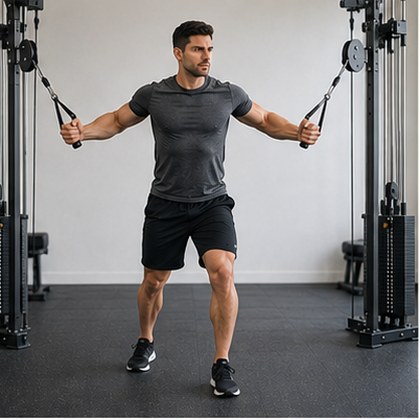 Cable fly, men’s version
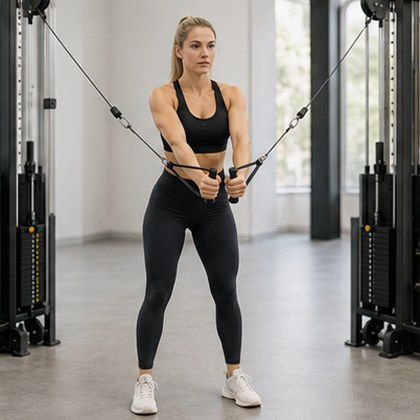 Cable fly, women’s version
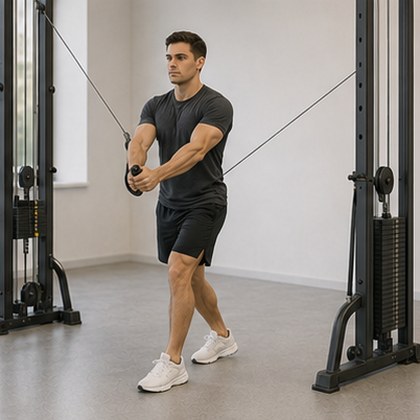 Low-to-high cable fly, men’s version
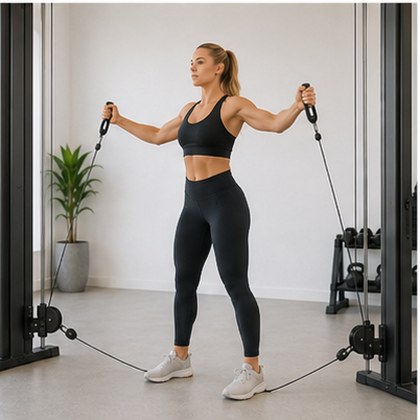 Low-to-high cable fly, women’s version
Cable fly and pec deck: what to do instead of dumbbell flys
The best substitutes for a dumbbell fly are the cable fly and the pec deck machine: the movement at your shoulder is the same, but the load doesn't drop off at the top of the arc.
Pec deck. In 2007, Rocha Júnior and colleagues compared the barbell bench press and the pec deck in 13 trained men doing 10 reps to failure. The pectoralis major and the front delt worked equally in both exercises, while the triceps was significantly more active in the press. On the pec deck it's almost switched off. That makes the pec deck handy after pressing, when your triceps and elbows are already tired. And in Pinto's 2025 study from section 02, the pec deck alone added 17–21% to beginners' chest thickness over 12 weeks.
How to use the pec deck:
- Raise the seat so the handles are level with the middle of your chest.
- Press your back and the back of your head into the backrest, shoulder blades squeezed together and down.
- Keep your elbows slightly bent. If the machine has forearm pads, press your arms into them from elbow to wrist.
- Bring your arms together in front of your chest over 1–2 seconds, and open them over 2–3 seconds until you feel a stretch in your chest.
- At the back of the movement, don't let the weight pull your arms behind the line of your torso.
The path on a pec deck is fixed, and you don't have to balance and control dumbbells, so it's a good first option for beginners and for sensitive shoulders.
Cable fly. A cable crossover station is a frame with a pulley on each side. A dumbbell pulls straight down, so the load disappears once it's over your shoulder, but a cable pulls toward the pulley, so your chest keeps working at the top of the arc too.
- Set the pulleys at shoulder height or slightly higher and grab the handles.
- Take a step forward, one foot slightly ahead of the other, torso leaning a little forward.
- Keep your elbows soft, at the same angle as in a dumbbell fly.
- Bring your arms together in an arc in front of your chest, as if hugging a barrel, until your hands are about a hand's width apart.
- Let your arms go back over 2–3 seconds, to the level of your torso.
A low-to-high cable fly, with the pulleys at the bottom and your arms rising in an arc to chin height, shifts the focus to your upper chest. A high-to-low cable fly, from high pulleys down toward your waist, is what gyms use for the middle and lower chest. We didn't find measurements for these variations, so go by feel.
There are no direct studies yet comparing chest growth from dumbbell flys and cable flys. Muscle grows from load, so choose based on comfort and what your gym has.
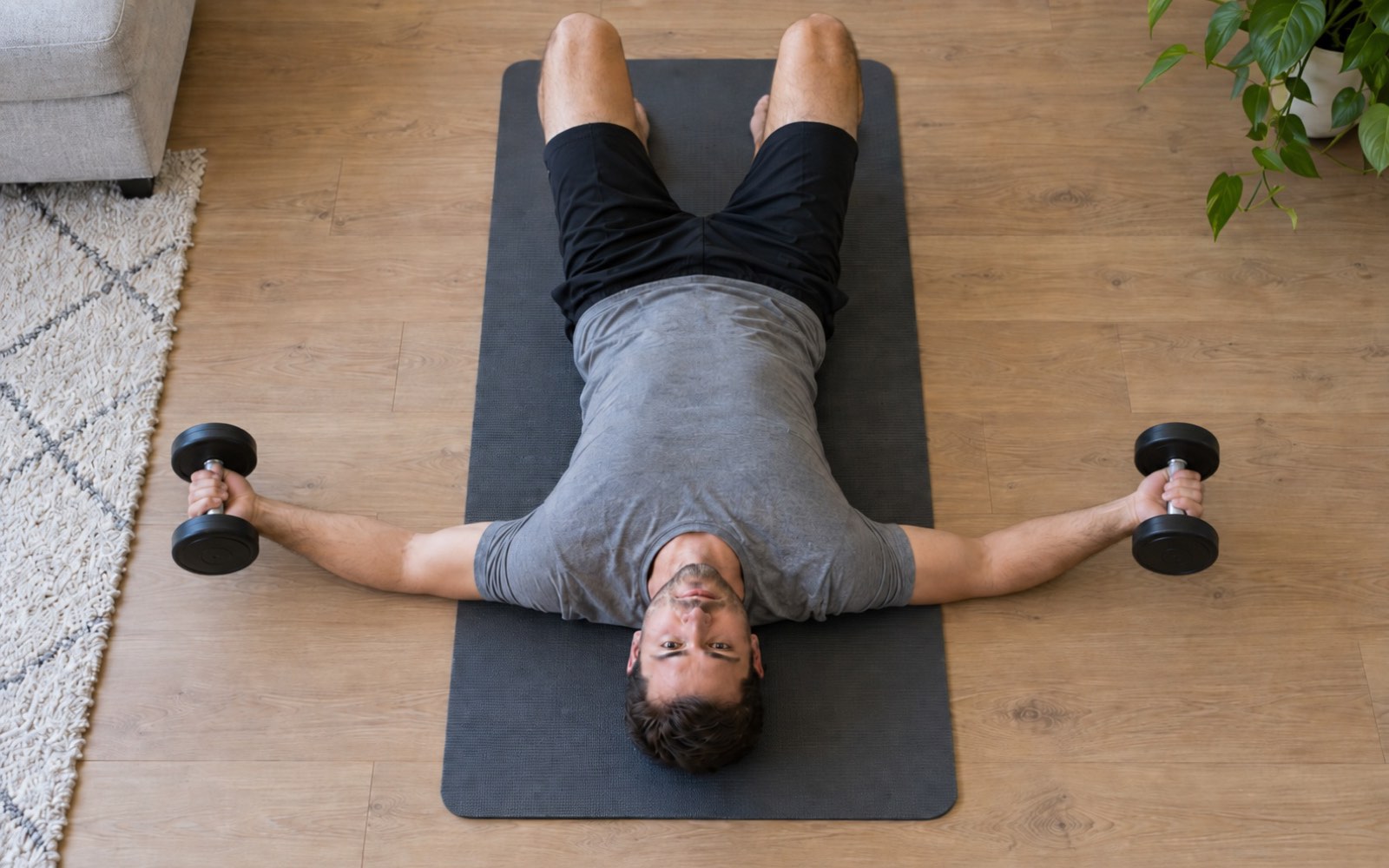
At home: the floor fly. Lie on the floor or a mat with your feet flat and knees bent. The form is the same, but the bottom position takes care of itself: your elbows touch the floor, and you can't go any lower. Touch down softly, without banging. The floor limits your depth to roughly the level of your torso, so this version is easier on your shoulders.
At home with a band. Anchor a resistance band behind you at chest height, for example on a door handle, and bring your arms together in front of you as in a cable fly.
If you have no dumbbells at all. Push-ups will give you a solid base for your chest. In 2015, Calatayud and colleagues followed 30 college students with plenty of training experience for 5 weeks: one group did the bench press, another did push-ups with a resistance band, and a third didn't train. In both training groups the load was set for 6 reps, and strength went up equally, by 13.65–22.21%, while the control group didn't change. If you can't do a push-up yet, our guide on push-ups for beginners walks you through it from zero.
What weight to use and how many sets: an 8-week plan for women and men
Women should start with 3 kg (6.5 lb) dumbbells in each hand, men with 6 kg (13 lb), doing 3 sets of 10 twice a week with 2–3 reps in reserve, and add reps first, then weight.
Why 10–15 reps. The 2009 position stand from the American College of Sports Medicine (ACSM) recommends that beginners use a weight that allows 8–12 reps and train 2–3 times a week. Schoenfeld and colleagues revisited those limits in a 2021 review and concluded that muscles grow across a wide range of loads as long as the set is taken close to failure. There's no hard rule like "8 reps for size, 15 for definition." The fly has a long lever, and heavy dumbbells break your form before your chest gets tired, so 10–15 reps with light dumbbells works better.
The progression rule. The 2009 ACSM position stand recommends adding 2–10% once you can do more reps than the top of your range. With flys that's tricky: going from a 3 kg (6.5 lb) pair to a 4 kg (9 lb) pair is an immediate 33% jump. That's why in the plan below, reps drop back to 10 after each new pair of dumbbells and climb back up to 15.
Eight weeks of dumbbell flys, in numbers. Two sessions a week, 3 working sets each. Volume is the amount of work per session: sets × reps × the combined weight of both dumbbells. For example, 3 sets × 10 reps × (2 × 3 kg) = 180 kg (397 lb).
| Week | Women | Volume | Men | Volume | What changed |
|---|---|---|---|---|---|
| 1 | 2 × 3 kg (6.5 lb), 3 × 10 | 180 kg (397 lb) | 2 × 6 kg (13 lb), 3 × 10 | 360 kg (794 lb) | starting point |
| 2 | 2 × 3 kg, 3 × 12 | 216 kg (476 lb) | 2 × 6 kg, 3 × 12 | 432 kg (952 lb) | +2 reps per set |
| 3 | 2 × 3 kg, 3 × 15 | 270 kg (595 lb) | 2 × 6 kg, 3 × 15 | 540 kg (1,190 lb) | +3 reps |
| 4 | 2 × 4 kg (9 lb), 3 × 10 | 240 kg (529 lb) | 2 × 8 kg (17.5 lb), 3 × 10 | 480 kg (1,058 lb) | dumbbell +1 kg and +2 kg, reps back to 10 |
| 5 | 2 × 4 kg, 3 × 12 | 288 kg (635 lb) | 2 × 8 kg, 3 × 12 | 576 kg (1,270 lb) | +2 reps |
| 6 | 2 × 4 kg, 3 × 15 | 360 kg (794 lb) | 2 × 8 kg, 3 × 15 | 720 kg (1,587 lb) | +3 reps |
| 7 | 2 × 5 kg (11 lb), 3 × 10 | 300 kg (661 lb) | 2 × 10 kg (22 lb), 3 × 10 | 600 kg (1,323 lb) | dumbbell +1 kg and +2 kg, reps back to 10 |
| 8 | 2 × 5 kg, 3 × 12 | 360 kg (794 lb) | 2 × 10 kg, 3 × 12 | 720 kg (1,587 lb) | +2 reps |
Over the 8 weeks, the volume per session grows by 100%: from 180 to 360 kg (397 to 794 lb) for women and from 360 to 720 kg (794 to 1,587 lb) for men. Meanwhile each dumbbell got only 2 kg (4.5 lb) heavier for women and 4 kg (9 lb) heavier for men. In the weeks when you switch dumbbells, volume dips a little because the reps drop back down, and that's normal.
This is a typical path: some people will move through it faster, others will need 10–12 weeks. Only move up in weight if your elbow angle holds to the last rep and you still have 2–3 reps in reserve. If your gym doesn't have dumbbells in 1 kg (2 lb) steps, stay at 15 reps for an extra week or add a fourth set.
Check yourself. If you already do the dumbbell bench press, use roughly half of the dumbbell you press for 10 reps. That's our practical rule of thumb from experience, and no study gives that number. It does fit the overall picture: for the men in Solstad's study, the fly weight was less than half of the bench press weight.
How many sets for your chest per week. Sets are counted per muscle, so your presses and flys add up. In Schoenfeld's 2017 meta-analysis of 15 studies, each additional weekly set was linked to about 0.37% more muscle growth. Higher volume produced an average of 3.9% more growth than lower volume. A beginner doesn't need much: in Pinto's 2025 study, one set on the pec deck twice a week did as well as three. For your first few months, 3 sets of pressing and 2–3 sets of flys twice a week is plenty, and you can add sets once your progress slows down.
Rest between sets — 1–2 minutes, which is what ACSM recommended in 2009 for training aimed at muscle growth.
In the Sportygram app (go.sportygram.com; the interface and the coach are in Russian for now), the workout diary includes the dumbbell fly, the cable fly and the pec deck, each with technique photos. You log weight and reps set by set, and the weight history shows when it's time to move up to the next pair of dumbbells. The virtual coach, Alex, can add flys to your plan or move a workout in chat: he shows a confirmation card, and once you confirm, the change appears in your diary.
Mistakes: where you feel it → what to fix
A proper fly feels like a stretch across your chest at the bottom and tension in your chest on the way up; if your shoulders, biceps or triceps are doing the work, your form has drifted:
| Where you feel it | What it means | What to fix |
|---|---|---|
| A pinch or pull at the front of your shoulder at the bottom | you're going below your torso, and your shoulders have rolled forward | stop at the level of your torso, squeeze your shoulder blades together and down, lighten the weight |
| A pull in your biceps and the inside of your elbow | your arms are almost straight, and the lever is too long | bend your elbows 20–30°: the biceps already works 76% harder than in a press (Solstad, 2020) |
| Your triceps are working, and the dumbbells get "pressed" up | your elbows bend more and more, turning it into a press | use lighter dumbbells, hold the angle from the first rep to the last |
| You can't feel your chest, the dumbbells clank at the top | there's almost no load at the top, and you're not reaching the bottom | stop over your shoulders a hand's width apart, work in the bottom two-thirds |
| Lower back | a big arch, your hips lift off the bench | feet on the floor or on the end of the bench, a small arch with your hips down |
| Neck, back of your head | your head lifts to watch the dumbbells | back of your head on the bench, eyes on the ceiling |
| One arm lags or drifts | a weaker side, dumbbells a bit too heavy | lighter dumbbells, 2–3 seconds down, keep an eye on both arms |
| Wrists | your hands bend back under the weight | keep your wrists straight, palms facing each other |
| A sudden sharp pain in your chest or armpit with a pop | a possible pec tear | stop the set immediately and see a doctor (section 11) |
| Your shoulder aches the next day | too much depth or weight, the tendons are overloaded | a week off flys, use the pec deck or floor fly instead; if the pain lasts longer than 1–2 weeks, see a doctor |
Why you feel it in your shoulder instead of your chest. Most often it's one of three things: your shoulder blades aren't pulled back, so your shoulders roll forward; your elbows are going below the bench; or the dumbbells are coming down too close to your head. The fix is the same for all three: lighter dumbbells, shoulder blades pinned back, the bottom at the level of your torso, and the arc in line with the middle of your chest.
Shoulders, elbows and chest: who should be careful and when to see a doctor
The fly is one of those exercises where your shoulder goes to end range under load, so if you have shoulder pain, a recent injury or past surgery, agree on the weight and depth with your doctor.
The shoulder is the most vulnerable spot in strength training. In Kolber's 2010 review, the shoulder joint accounted for up to 36% of documented injuries linked to resistance training. In another study, Kolber in 2014 found that among recreational lifters, signs of impingement — the tendons getting pinched under the acromion — were linked to lateral raises and upright rows above 90°. And lifters who strengthened their external rotators had fewer of those signs. This doesn't apply directly to the dumbbell fly, but a couple of sets of external rotation with a band in your warm-up won't hurt your shoulders.
Be careful, and talk to your doctor first, if you have:
- Pain at the front of your shoulder, or a history of impingement or bursitis. Start with the pec deck or the floor fly: the depth is limited for you there.
- A history of shoulder dislocation. At the bottom of a fly, your arm is out to the side and rotated outward, which is close to the position in which a shoulder usually pops out forward. Agree on depth and weight with your doctor or physical therapist.
- Recent shoulder or pec surgery. Only go back to flys with your surgeon's go-ahead.
- Elbow pain: at the front near the crease, on the outside ("tennis elbow") or on the inside ("golfer's elbow"). The biceps is loaded harder in a fly than in a press, and the long lever adds work for the tendons around the elbow. A pec deck with forearm pads may be a better place to start.
- Pregnancy. Lying on your back can get uncomfortable later in pregnancy, so discuss this exercise with the doctor managing your pregnancy. Often the dumbbell fly is swapped for a standing cable fly or a seated pec deck.
When to see a doctor right away. If you felt a pop or a tearing sensation in your chest or armpit during a set. If, over the next few days, a bruise appears on your chest, armpit or upper arm, the shape of your pec changes, or it becomes hard to bring your arms together in front of you. Those are signs of a pec tear, and it's best to get checked in the first few days. It's also worth seeing a doctor if shoulder pain lasts longer than 1–2 weeks, hurts at night, or your arm goes numb.
What to do about a shoulder that aches after training, and how to tell when it's just overload, is covered in our article on shoulder pain from lifting.
Questions and answers
Which is better for your chest: dumbbell flys or pressing?
Pressing, and it's best to do both. In Solstad's 2020 study, the chest worked 16% harder over the whole movement in the barbell bench press, and the weight was more than double: 88.5 kg (195 lb) versus 40.5 kg (89 lb) for both dumbbells in the fly. Do the press first and the fly second, 2–3 sets of 10–15 reps.
Can you do dumbbell flys on the floor at home?
Yes. The form is the same, but the floor sets your bottom position: your elbows touch the mat softly, and you bring the dumbbells right back up. The floor won't let you go deeper than the level of your torso, so this version is easier on your shoulders. Bend your knees and keep your feet flat on the floor.
What weight should a woman or a man start with for dumbbell flys?
A woman can start with 3 kg (6.5 lb) dumbbells in each hand and a man with 6 kg (13 lb), for 3 sets of 10. First work up to 15 reps, then move to dumbbells 1–2 kg (2–4 lb) heavier. If you already do the dumbbell bench press, use roughly half the dumbbell you press for 10 reps.
What can I do instead of dumbbell flys?
A cable fly or the pec deck machine. In Rocha Júnior's 2007 study, the chest worked as hard on the pec deck as in the barbell bench press, while the triceps barely switched on. In Pinto's 2025 study, beginners added 17–21% to their chest thickness in 12 weeks of pec deck alone. At home, you can use the floor fly, band flys and push-ups.
Why does my shoulder hurt during dumbbell flys?
Most often it's from going deeper than your torso, straight arms, loose shoulder blades or dumbbells that are too heavy. Try stopping at the level of your torso, bending your elbows 20–30° and going lighter. If that doesn't help, switch to the pec deck or floor fly for a week. Pain that lasts longer than 1–2 weeks, pain at night or numbness is a reason to see a doctor.
Should the dumbbells touch at the top?
No. At the top, the dumbbell is almost directly over your shoulder, and there's almost no load on your chest: in the top third of the lowering phase, the chest was 42% more active in the press than in the fly (Solstad, 2020). Stop the dumbbells over your shoulders a hand's width apart and start the next rep right away.
Flat or incline dumbbell fly — which should I choose?
Beginners should start on a flat bench, where the middle and lower chest work harder. Set an incline to 15–30° if you want more upper chest. In Rodríguez-Ridao's 2020 study, the upper chest worked hardest in the press at 30°, and at inclines above 45° the front delt took over the load.
Which is better: dumbbell flys, cable flys or the pec deck?
All three load your chest with the same shoulder movement and differ in where the load is heaviest. There are no direct comparisons of chest growth between them yet. Dumbbells load your chest hardest at the bottom and almost let go at the top. A cable keeps the load more even across the whole arc. The pec deck is the simplest to learn and the safest for a beginner. Pick whatever suits your shoulders and whatever your gym has.
The bottom line
- The dumbbell fly is an isolation exercise for the chest: your elbows are bent 20–30° and don't change angle (Solstad, 2020).
- The main work happens at the bottom: lower the dumbbells to the level of your torso over 2–3 seconds, and stop them over your shoulders at the top without clanking.
- Press first, fly second: the chest is 16% more active in the press, and the fly weight is less than half the pressing weight.
- For an incline, use 15–30°; at 45° and above, the front delt takes over (Rodríguez-Ridao, 2020).
- Start with 2 × 3 kg (6.5 lb) for women and 2 × 6 kg (13 lb) for men, 3 × 10, work reps up to 15 first, then move to dumbbells 1–2 kg (2–4 lb) heavier. Over 8 weeks, your volume per session doubles.
- The pec deck and the cable fly are full substitutes: on the pec deck the chest works as hard as in the press (Rocha Júnior, 2007) and grows even from a single set in beginners (Pinto, 2025).
- A pop and tearing pain in your chest, a bruise in your armpit, or shoulder pain that lasts longer than 1–2 weeks is a reason to see a doctor.
Checklist: before a set of dumbbell flys
- Shoulders warmed up, 1–2 sets of external rotation with a band done.
- Dumbbells about half as heavy as the ones you bench press with.
- Shoulder blades squeezed together and down, hips on the bench, feet on the floor.
- Elbows bent 20–30°, and the angle doesn't change for the whole set.
- Bottom position — upper arms level with your torso, not below the bench.
- At the top, dumbbells over your shoulders a hand's width apart, no clanking.
- 2–3 seconds down, 1–2 seconds up.
- 2–3 reps left in the tank, weight and reps logged in your diary.
Sources
- Solstad T.E.J., Andersen V., Shaw M., Hoel E.M., Vonheim A., Saeterbakken A.H. A Comparison of Muscle Activation between Barbell Bench Press and Dumbbell Flyes in Resistance-Trained Males. Journal of Sports Science and Medicine, 2020. — 17 trained men, 6-rep load: elbow angle at the bottom of the fly 150–160°; 6-rep weight 88.5 kg in the bench press and 40.5 kg for both dumbbells in the fly; chest 16% more active in the press, 42% more in the top third of the lowering phase, no difference in the middle and bottom thirds of the lifting phase; triceps 75% more active in the press, biceps 76% more active in the fly (according to the authors, it holds the elbow angle); a 6-rep set took 18.7 s in the press and 23.5 s in the fly.
- Welsch E.A., Bird M., Mayhew J.L. Electromyographic activity of the pectoralis major and anterior deltoid muscles during three upper-body lifts. Journal of Strength and Conditioning Research, 2005. — 12 college students, barbell bench press, dumbbell press and dumbbell fly, 3 reps with a 6-rep load, lifting phase only: peak chest and front delt activity did not differ; in the fly the chest was active for a smaller part of each rep.
- Rocha Júnior V.A., Gentil P., Oliveira E., do Carmo J. Comparação entre a atividade EMG do peitoral maior, deltóide anterior e tríceps braquial durante os exercícios supino reto e crucifixo. Revista Brasileira de Medicina do Esporte, 2007. — 13 trained men, 10 reps to failure in the barbell bench press and on the pec deck: the chest and front delt worked equally; the triceps was significantly more active in the press.
- Pinto M.D., Ughini C., Nunes J.P., Cadore E.L., Pinto R.S. Pectoralis Clavicular and Sternocostal Thicknesses Increase Similarly in Response to One and Three Sets of Pec Deck Resistance Training in Untrained Young Men. Journal of Strength and Conditioning Research, 2025. — 15 untrained men, 12 weeks of pec deck only, twice a week, each arm trained separately, 1 set versus 3: clavicular head +17–18%, sternocostal head +21%, strength +43–46%, no difference between conditions.
- Rodríguez-Ridao D., Antequera-Vique J.A., Martín-Fuentes I., Muyor J.M. Effect of Five Bench Inclinations on the Electromyographic Activity of the Pectoralis Major, Anterior Deltoid, and Triceps Brachii during the Bench Press Exercise. International Journal of Environmental Research and Public Health, 2020. — 30 trained people, barbell bench press at 0° to 60° with 60% of max: upper chest most active at 30°, middle and lower chest at 0°; front delt most active at 45° and 60°; inclines above 45° increase delt work and reduce chest work.
- American College of Sports Medicine. Progression models in resistance training for healthy adults. Medicine & Science in Sports & Exercise, 2009. — Beginners should use a load allowing 8–12 reps and train 2–3 times a week; 1–2 minutes of rest; add 2–10% once reps exceed the top of the range.
- Schoenfeld B.J., Grgic J., Van Every D.W., Plotkin D.L. Loading Recommendations for Muscle Strength, Hypertrophy, and Local Endurance: A Re-Examination of the Repetition Continuum. Sports, 2021. — Muscles grow across a wide range of loads when sets are taken close to failure; there is no hard rep boundary between training "for size" and "for definition."
- Schoenfeld B.J., Ogborn D., Krieger J.W. Dose-response relationship between weekly resistance training volume and increases in muscle mass: A systematic review and meta-analysis. Journal of Sports Sciences, 2017. — 15 studies: each additional weekly set was associated with about 0.37% more muscle growth; the difference between higher and lower volume was 3.9%.
- ElMaraghy A.W., Devereaux M.W. A systematic review and comprehensive classification of pectoralis major tears. Journal of Shoulder and Elbow Surgery, 2012. — 365 reported cases of pectoralis major rupture from 1822 to 2010: 83% without a direct blow, 48% during strength training.
- Kolber M.J., Beekhuizen K.S., Cheng M.S., Hellman M.A. Shoulder injuries attributed to resistance training: a brief review. Journal of Strength and Conditioning Research, 2010. — Up to 36% of documented resistance training injuries involve the shoulder; the review covers internal and external risk factors.
- Kolber M.J., Cheatham S.W., Salamh P.A., Hanney W.J. Characteristics of shoulder impingement in the recreational weight-training population. Journal of Strength and Conditioning Research, 2014. — Signs of impingement in recreational lifters were linked to lateral raises and upright rows above 90°; lifters who strengthened their external rotators had fewer signs.
- Calatayud J., Borreani S., Colado J.C., Martin F., Tella V., Andersen L.L. Bench press and push-up at comparable levels of muscle activity results in similar strength gains. Journal of Strength and Conditioning Research, 2015. — 30 experienced college students, 5 weeks, three groups: the bench press and band-resisted push-ups at a 6-rep load produced the same strength gain, 13.65–22.21%; no change in the control group.
This article is for informational purposes only and is not a substitute for medical advice.