

protein powder only helps if you're falling short on protein from food. People who train need 1.4–2.0 g/kg of body weight a day (about 0.6–0.9 g/lb), and past about 1.6 g/kg extra powder adds no more muscle. A serving is 20–40 g every 3–4 hours. The 25 g of protein in a typical serving is also in about 3 oz of chicken breast or 6 oz of low-fat cottage cheese, for similar calories. A 2025 audit found mislabeling in 17 of 18 tested whey brands, so check protein per 100 g before you buy, not just the price.
Protein powder is dried milk or plant protein, and your body can't tell whether the amino acids came from a shaker or a chicken breast. If you train, you need roughly 1.4–2.0 g of protein per kilogram a day, and powder only earns its place when food doesn't get you there. Below: what a scoop gives you in numbers, how many you need at your weight, what to eat instead, and how to pick a tub that isn't secretly a gainer.
What's Actually in the Tub
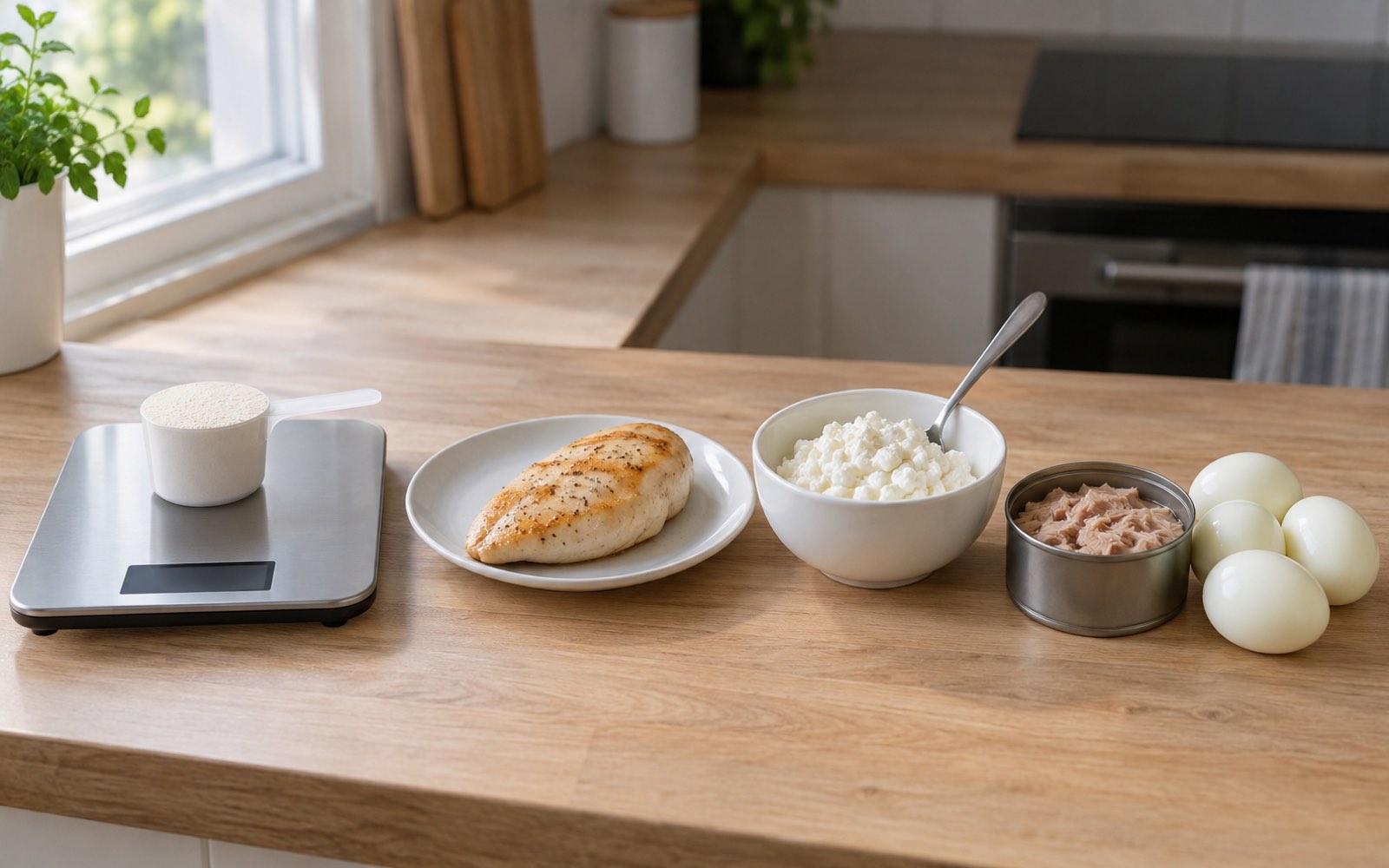
Protein powder is the same protein you get from food, separated out and dried. Whey is dried milk whey, the liquid left over after cheese is made. Casein is the other milk protein; plant powders come from peas, rice, soybeans or hemp. Per the ISSN, the whey concentrates used in sports nutrition are 70–80% protein by weight, and an isolate is over 90%. A standard 31 g scoop of a popular whey brand gives 24 g of protein and 116 calories. In makeup, it's closer to powdered milk than to a medicine. There's no fiber, few vitamins, none of the fullness of a real plate, and no muscle-building power a chicken breast lacks.
Do You Need Protein Powder to Build Muscle?
No, you don't need powder to build muscle: muscle grows from resistance training plus your total daily protein, wherever it comes from. Morton and colleagues put numbers on this in a 2018 meta-analysis in the British Journal of Sports Medicine: 49 trials, 1,863 participants, all lifting for at least 6 weeks. A protein supplement on top of normal eating added an average 0.30 kg (0.66 lb) of lean mass (range 0.09–0.52 kg) and 2.49 kg (5.5 lb) on a one-rep max. The groups without a supplement trained and gained muscle too; the supplement added about 0.3 kg on top of that. The effect is real, but it's measured in fractions of a pound.
The same data revealed a tipping point: 1.62 g/kg a day. Past that from food alone, a supplement added nothing more. The estimate is rough, since the authors' range runs from about 1.0 to 2.2 g/kg, so treat 1.6 g/kg as a handy target. Closer to 1 g/kg, a supplement helps, whether it's whey or cottage cheese. Trained lifters gained 0.75 kg more lean mass from it than beginners, and the effect shrank by about 0.01 kg for every year of age.
A 2022 meta-analysis by Nunes and colleagues, covering 74 studies, found the same small effect of extra protein on lean mass and leg strength (standardized effect sizes of 0.22 and 0.40). The authors rated the evidence as moderate for lean mass and low for leg strength. In people under 65, the gain showed up at 1.6 g/kg a day or more, which matches Morton's tipping point. What counts is your daily total, and powder is just one way to reach it.
How Much Protein Do You Actually Need?
The ISSN's 2017 position stand sets the target for people who train at 1.4–2.0 g/kg a day, rising to 2.3–3.1 g/kg for lifters on a calorie deficit, so less muscle goes along with the fat. If you don't train, the RDA the ISSN cites is 0.8 g/kg: enough to avoid deficiency, not enough to build muscle. Russia's official norms (MR 2.3.1.0253-21) land a little higher for people with low activity: 84 g a day for men aged 18–29, 81 g at 30–44 and 75 g at 45–64, and 67, 63 and 60 g for women of the same ages. That's roughly 1 g/kg, with half of it meant to come from animal foods.
At 165 lb (75 kg), the ISSN range works out to 105–150 g a day, and 1.6 g/kg to 120 g. Here's what 1.6 g/kg means by body weight, and how many 25 g servings close the gap if food alone gives you 60 g a day:
| Body weight | Target (1.6 g/kg) | Servings needed (food gives 60 g/day) |
|---|---|---|
| 120 lb (54 kg) | 87 g | 1 |
| 140 lb (64 kg) | 102 g | 1.5 |
| 160 lb (73 kg) | 117 g | 2 |
| 180 lb (82 kg) | 131 g | 3 |
| 200 lb (91 kg) | 146 g | 3.5 |
| 220 lb (100 kg) | 160 g | 4 |
A gap under 20 g is easier to close with food than a shaker. If you'd need more than two servings a day, fix your food first with the table in the next section: along with the protein, you get fullness and everything powder lacks. If you carry a lot of excess weight, calculate from your goal weight instead. Log three ordinary days in a food diary first: the Sportygram app at go.sportygram.com tracks protein, calories and water, and you can add a scoop by scanning the tub's barcode. Full breakdown: how much protein you actually need per day.
What a Scoop Actually Replaces in Food
A serving with 25 g of protein (about 33 g of powder) comes to about 123 calories. Here's what the same 25 g of protein costs from whole foods. The math is ours, from the data in our protein-in-foods chart; the powder row uses a label with 76 g of protein and 374 calories per 100 g.
| Food | Amount for 25 g protein | Calories | Difference vs powder |
|---|---|---|---|
| Whey protein | 33 g, a bit more than a scoop | ~123 | — |
| Shrimp, cooked | 104 g (3.7 oz) | ~103 | −20 |
| Tuna in water | 104 g (3.7 oz) | ~108 | −15 |
| Alaska pollock, cooked | 129 g (4.6 oz) | ~112 | −11 |
| Cod, baked | 110 g (3.9 oz) | ~115 | −8 |
| Cottage cheese, 0.5% fat | 167 g (5.9 oz) | ~121 | −2 |
| Turkey breast, roasted | 83 g (2.9 oz) | ~122 | −1 |
| Chicken breast, roasted | 81 g (2.9 oz) | ~133 | +10 |
| Greek yogurt, 0.1% fat | 250 g (8.8 oz) | ~138 | +15 |
| Lean beef, braised | 72 g (2.5 oz) | ~154 | +31 |
| Cottage cheese, 5% fat | 152 g (5.4 oz) | ~178 | +55 |
| Tofu, firm | 145 g (5.1 oz) | ~208 | +85 |
| Protein milk, 0.5% fat | 470 ml (16 fl oz) | ~211 | +88 |
| Soybeans, cooked | 137 g (4.8 oz) | ~236 | +113 |
| Eggs, boiled | 198 g, 4 eggs | ~308 | +185 |
| Lentils, cooked | 278 g (9.8 oz), a big bowl | ~322 | +199 |
| Semi-hard cheese, 50% fat in dry matter | 102 g (3.6 oz) | ~361 | +238 |
| Milk, 2.5% fat | 830 ml (28 fl oz) | ~460 | +337 |
Calorie for calorie, powder gives more protein than almost any food; only shrimp, fish, low-fat cottage cheese and turkey breast match or beat it. On a cut, that's useful: 25 g of protein costs 123 calories versus 308 from four eggs. On a bulk, eggs and milk are more convenient, since you want the extra calories. Food also brings what a tub doesn't: fiber in lentils and soybeans, calcium in cottage cheese, iron in beef, and the fullness of a real plate. More swaps: how to choose your protein sources.
Powder earns its place if you're consistently 20–50 g short and can't eat more meat or dairy, your day is on the road with no real lunch, you have zero appetite after training, or you eat little animal protein and a plant blend helps you get enough protein and leucine. Otherwise, skip the tub.
Whey, Isolate, Casein or Plant: Which to Buy
Most people do fine with whey concentrate at 70–80 g of protein per 100 g. Protein figures for concentrate and isolate are from the ISSN; the rest were measured by Gorissen and colleagues (2018).
| Type | Protein per 100 g | What's different | Best for |
|---|---|---|---|
| Whey concentrate | 70–80 g | fast-digesting, some lactose | most people, the default pick |
| Whey isolate | 90 g+ | filtered again, less lactose and fat | lactose sensitivity |
| Hydrolysate | varies by brand | partly broken down, digests faster | rarely needed: no more muscle than concentrate |
| Casein | 67–78 g | slow, releases amino acids for hours | before bed |
| Multi-source blend | depends on the mix | whey, casein and other proteins together | if you like the taste; check what's listed first |
| Egg | 51 g in Gorissen's sample | egg protein, no lactose | milk allergy |
| Soy isolate | 61–91 g | the best-studied plant protein | vegans, milk allergy |
| Pea or rice | ~80 g | low in lysine or methionine alone | vegans, best blended together |
Paying extra for isolate or hydrolysate is a waste for muscle growth alone, because your daily total is what matters.
Gorissen and colleagues (2018) measured essential amino acids at 43% in whey, 39% in milk protein, 34% in casein, 32% in egg, and 21–22% in oat and wheat protein. Plant powders averaged 3.6% lysine versus 7.0% in animal proteins, and 1.0% methionine versus 2.5%, which is why pea and rice are sold blended. To match the leucine in 25 g of whey protein, you'd need about 40 g of soy protein or 38 g of pea protein, so take a bigger serving of a plant powder.
The gap nearly disappears in practice. Messina and colleagues (2018) pooled 9 studies with 266 people and found no difference in strength or lean mass gains between soy and animal protein. Lim and colleagues (2021), across 16 studies, also found no difference in strength or in absolute lean mass. In adults under 50, animal protein had a small edge of 0.41 kg (0.9 lb) of lean mass.
Soy doesn't lower testosterone. Reed and colleagues (2021) pooled 41 studies, with testosterone measured in 1,753 men. Neither soy protein nor isoflavones changed testosterone, estrogen or SHBG levels at any dose or duration. Whey already has plenty of leucine on its own; see BCAA vs EAA for when extra aminos matter.
How to Read the Label So You Don't Buy a Gainer by Accident
You can't spot a mislabeled tub at home, so check the numbers, the ingredients and the seller. On September 18, 2025, Russia's consumer quality agency Roskachestvo published a test of 18 whey concentrate brands against 73 parameters. Most concentrates had more than 65% protein, but in many the actual figure differed from the label. 17 failed mandatory standards. Nine had a different protein content than claimed, 8 were off on fat, 14 on carbohydrates, and 11 on BCAA content.
The worst tub listed 60 g of protein per 100 g but actually held 16 g and up to 75 g of carbs, which makes it a gainer sold as protein. Three brands went over the limit for the sweetener cyclamate (E952), one by 7 times, and four went over the limit for acesulfame potassium (E950). Arsenic, cadmium and lead were within limits, no preservatives were found, and no one had padded the powder with starch. One brand met the mandatory standards but fell short of the agency's stricter standard, so none earned its quality mark. So a tub that's much cheaper than the rest is a warning sign: in the worst sample, the protein had been swapped for carbs.
The checklist that catches this:
- Protein per 100 g. Concentrate: 70–80 g. Isolate: above 90 g. At 60 g or below, it's a carb blend wearing a protein label.
- Ingredients list. Whey concentrate or isolate should come first. If maltodextrin, sugar or starch leads the list, it's a gainer under another name. Ingredients are listed by weight, so an isolate near the end means there's little of it in the tub.
- Sweeteners. In this audit, the excesses were for sodium cyclamate (E952) and acesulfame potassium (E950). Between two similar tubs, the one without them is the simpler pick.
- Batch number, expiration date, intact seal under the lid.
- Seller. Buy from an authorized retailer or the brand's own store; half price from a random marketplace seller is a bad sign. An independent seal such as NSF Certified for Sport means the product was tested for purity and banned substances, but you still read the protein line yourself.
Casein vs Whey: What's the Difference?
Casein is also protein powder, just the slow kind. Boirie and colleagues showed this in 1997 in PNAS. After whey, blood amino acids spiked fast and dropped quickly; whole-body protein synthesis rose 68%, and breakdown didn't change. After casein, the rise was moderate and long; synthesis rose 31%, breakdown fell 34%, and the net balance over 7 hours came out better for casein.
Tang and colleagues (2009) compared whey, casein and soy servings with the same 10 g of essential amino acids after a leg workout. Whey raised muscle protein synthesis 122% more than casein and 31% more than soy, and soy beat casein by 69%. That's the response in the first few hours, and it says little about muscle gained over months.
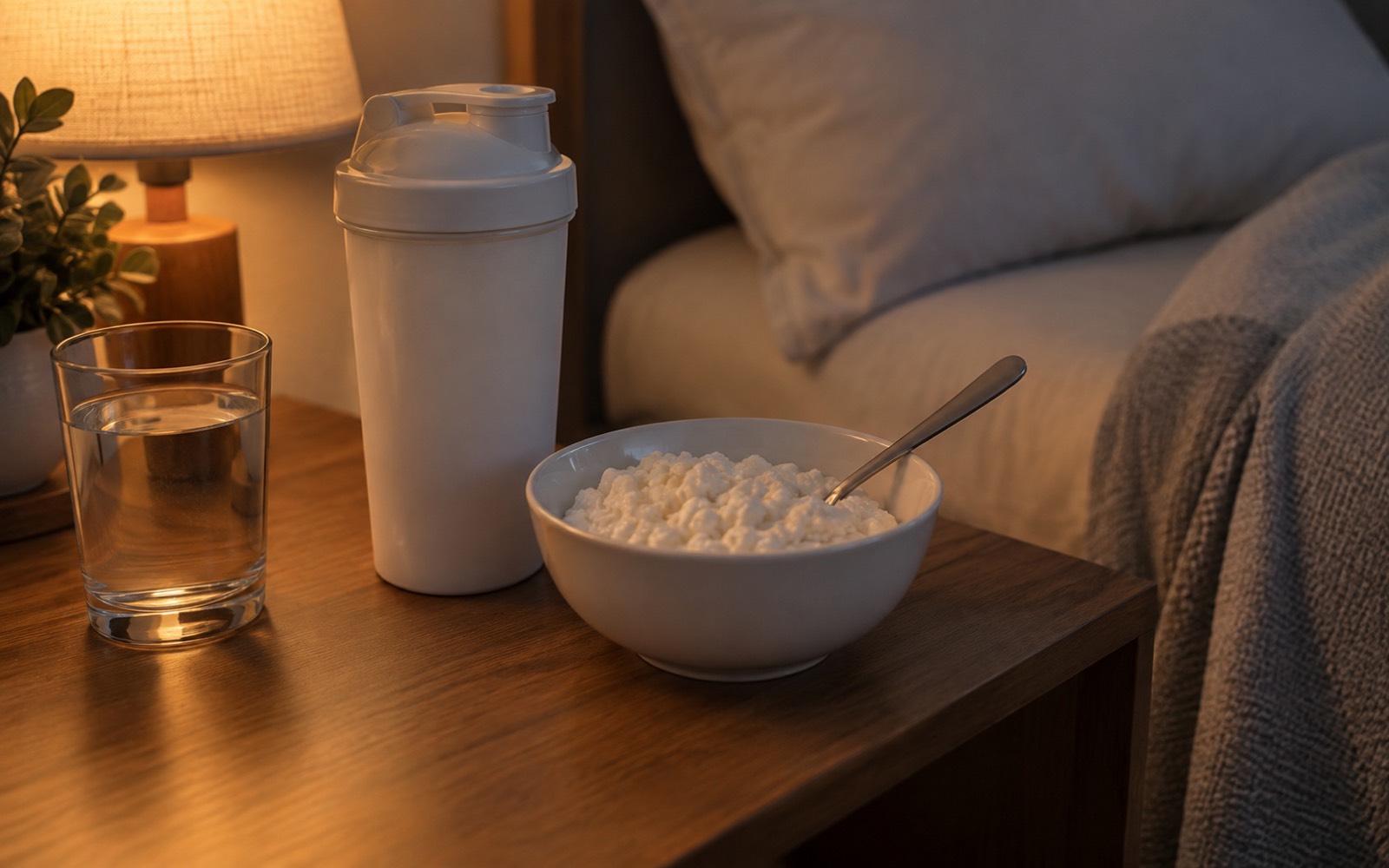
Before bed, casein makes sense: the ISSN says 30–40 g of casein before sleep raises overnight muscle protein synthesis. Res and colleagues (2012) gave 16 young men 40 g of casein 30 minutes before sleep after an evening workout. Overnight muscle protein synthesis came out about 22% higher than without protein (0.059 vs 0.048% per hour), though the difference was borderline significant. Whole-body protein balance overnight turned positive; without protein, it stayed negative.
Snijders and colleagues (2015) tested this over the long run. 44 young men lifted for 12 weeks; half drank 27.5 g of protein every night before bed, and half drank a calorie-free placebo. In the protein group, combined one-rep-max strength rose 164 kg versus 130 kg, and quadriceps cross-sectional area grew 8.4 cm² versus 4.8 cm². Since the placebo had no calories, the protein group also ate more protein per day. The study backs the value of total daily protein, and bedtime is simply a convenient slot for a serving.
A 180 g tub of 5% cottage cheese has about 30 g of protein, most of it casein, so cottage cheese before bed does the same job for less money.
Mass Gainer or Protein Powder for Bulking?
A gainer is protein plus a lot of carbohydrate, typically 75–77 g per 100 g of powder. It only makes sense for someone lean who can't eat enough real food to stay in a calorie surplus.
| Product (labels, September 2026) | Serving | Calories | Protein | Carbs |
|---|---|---|---|---|
| Optimum Nutrition Gold Standard 100% Whey | 31 g, one scoop | 116 | 24 g | 1.6 g |
| Prime Kraft Mass Gainer | 100 g, four scoops | 374 | 13 g | 77 g |
| Maxler Special Mass Gainer | 240 g, mixed with water | 920 | 36 g | 181 g |
| Optimum Nutrition Serious Mass | two heaped scoops | 1,250 | 50 g | 250+ g |
Look at the Prime Kraft row: 13 g of protein and 77 g of carbs. The worst tub in the Roskachestvo audit had 16 g and 75 g, only it was sold as protein. For most people, a regular protein powder plus an extra bowl of oats does the same job with more fiber.
A gainer helps a lean person who physically can't finish another plate, and someone with no appetite after training for anything but liquid. If you gain fat quickly on a bulk, it's more likely to get in the way. Calories from maltodextrin are no better than calories from oats, rice or bananas; they just come without fiber. Full plan: lean bulking without piling on fat.
How Much and When to Drink It
Per serving, the ISSN recommends 0.25 g/kg or 20–40 g of protein with 700–3,000 mg of leucine, spread evenly every 3–4 hours. At 170 lb (77 kg), that's about 20 g per sitting.
Areta and colleagues (2013) showed why splitting protein helps. They split 24 trained men into three groups, and after a lifting session each group drank 80 g of whey over 12 hours in a different pattern: 8 × 10 g every 1.5 hours, 4 × 20 g every 3 hours, or 2 × 40 g every 6 hours. Four 20 g servings raised muscle protein synthesis 31–48% more than the other two patterns.
The old "25 g cap" doesn't hold up: Schoenfeld and Aragon (2018) traced it to studies using fast whey alone, and put the practical range at 0.4–0.55 g/kg across at least four meals. Trommelen and colleagues (2023) compared 25 g and 100 g after training; the 100 g dose gave a bigger response that lasted more than 12 hours, with barely more amino acids burned as fuel.
You don't need a shake within 30 minutes of the gym either: per the ISSN, the effect of a workout lasts at least 24 hours. Drink it whenever it best closes your gap: after the gym if you have no appetite, on the road instead of a pastry, or with oatmeal at breakfast if your morning is low on protein.
treat powder like groceries. Log three normal days first, see your real protein total, then use a scoop only to cover the gap to 1.6 g/kg. If the gap is under 20 g, close it with cottage cheese or eggs instead, and skip the tub.
Is Protein Powder Bad for You? Kidneys, Liver, Stomach, Skin
In healthy people, high protein doesn't damage the kidneys. Devries and colleagues (2018), pooling 28 studies and 1,358 people, found no difference in the change in kidney filtration between higher- and lower-protein diets; "higher" meant at least 1.5 g/kg, at least 20% of calories, or over 100 g a day. Antonio and colleagues (2016) followed 14 trained men for a year at 2.5–3.3 g/kg with no change in kidney, liver or blood lipid markers. Fat mass didn't rise on the high-protein phase either, even though they ate more calories. It's a small sample, so it's one study, but it doesn't back the worry.
Bloating after a shake usually means lactose in the concentrate, so try an isolate or a plant powder. If that doesn't help, talk to a doctor.
We found no large studies that tie acne specifically to protein powder. If your skin got worse after you started drinking shakes, try a month without powder or switch to isolate and see what changes. If breakouts don't clear up, see a dermatologist.
See a doctor first if you have kidney disease or gout, are pregnant or breastfeeding, or are under 18. In those cases, your doctor sets your protein target.
Protein Powder Without Training, for Weight Loss, Women, After 40, and Teens
Without resistance training, protein powder won't add muscle; it just adds 116 calories a scoop. Even without the gym, it can help you reach your protein target if you eat little, eat few animal foods, or your appetite has shrunk with age.
For weight loss it helps only when it replaces something more caloric and keeps protein up on a deficit; for lifters, the ISSN puts that at 2.3–3.1 g/kg. The powder itself doesn't burn fat.
The same powder works for women, and the dose scales with body weight. At 132 lb (60 kg), the ISSN's 0.25 g/kg works out to 15 g per serving, and Schoenfeld and Aragon's 0.4 g/kg to 24 g, about one regular scoop. There are no hormones in the tub. It won't make you "bulky" either: that takes years of heavy training and male testosterone levels.
The benefit shrinks with age, by roughly 0.01 kg of lean mass per year in Morton's data. Nunes and colleagues found that past 65, benefits from higher protein show up from 1.2–1.6 g/kg, always alongside resistance training. The ISSN cites a study by Yang and colleagues in which men averaging 71 years old needed 40 g of whey isolate in one serving to maximize muscle protein synthesis after training. So past 65, it makes sense to aim for the upper end, 30–40 g per serving.
Teens are better off covering their protein needs with regular food and talking to a pediatrician before using powder. Growth and strength at that age depend on calories, sleep and technique, and a tub can't replace them.
Questions and answers
Can you drink protein powder every day?
Yes, protein powder is food, so drinking it every day is fine. Count it toward your daily protein and calories, just like chicken or yogurt. One or two servings cover a 20–50 g gap, and most people don't need more. If powder has become your main protein source, bring back whole foods, which add fiber, calcium and iron.
Can you build muscle without protein powder?
Yes. Muscle responds to resistance training plus your total daily protein, and a shake is just one way to hit that number. In Morton's 2018 meta-analysis, the groups without a supplement trained and gained muscle too. The supplement groups came out ahead by an average of 0.3 kg (0.66 lb) of lean mass. If you already eat about 1.6 g/kg of protein, a tub adds almost nothing.
How much protein is in one scoop, and how many scoops a day?
Usually 20–25 g; a popular whey brand lists 24 g per 31 g scoop. Scoop sizes differ between brands, so check the serving weight on your own label and weigh a scoop on a kitchen scale at least once. How many scoops you need depends on your gap: if you're 20–50 g short, that's one or two. Two scoops at once count as two servings, so log them that way.
Is it OK to drink protein powder before bed?
Yes, a serving of protein before bed helps your muscles recover overnight. The ISSN says 30–40 g of casein before sleep raises overnight muscle protein synthesis without affecting fat breakdown. In Res and colleagues' 2012 study, 40 g of casein before bed raised overnight synthesis by about 22%. A 180 g tub of 5% cottage cheese gives you about the same casein. Weight gain comes from extra calories across the day, and a bedtime shake counts the same as one at noon.
Should you mix protein powder with milk or water?
Pick by calories, since your body gets the protein either way. A 250 ml glass of 2.5% milk adds 7.5 g of protein and about 138 calories. Water suits a cut, and milk suits a bulk. If milk upsets your stomach, lactose may be the reason, and water solves that too.
Why does protein powder upset my stomach?
Most often it's lactose in the whey concentrate. Isolate has very little, and plant powders have none, so try one of those. A smaller serving or a shake taken with food also helps. If isolate bothers you too, see a doctor, since the cause may be something else.
At what age can you start taking protein powder?
There's no special age cutoff, but under 18, talk to a pediatrician first. For teens, it's easier to cover protein needs with regular food: cottage cheese, eggs, meat and fish. Growth and strength at that age depend on calories, sleep and good technique. If you're pregnant or breastfeeding, your doctor sets your protein target.
Is protein powder basically chemicals?
No. It's dried milk or plant protein, and it's regulated as a food. There are no hormones or steroids in it. In the 2025 Roskachestvo audit, no preservatives turned up, and the main violations concerned what was printed on the label. Sweeteners are common, though, and three brands had more cyclamate than allowed.
The bottom line
- Protein powder is dried milk or plant protein, food in a convenient form.
- On top of normal eating, it adds an average 0.66 lb (0.30 kg) of lean mass over a training block (Morton, 2018); past about 1.6 g/kg of protein a day, it adds no more.
- People who train need 1.4–2.0 g/kg a day; a serving is 20–40 g every 3–4 hours, and four 20 g servings beat two 40 g ones (Areta, 2013).
- There's no 30-minute window: the effect of a workout lasts at least 24 hours.
- A serving with 25 g of protein equals about 3 oz of chicken breast or 6 oz of low-fat cottage cheese, for similar calories.
- Whey concentrate suits most people; reach for isolate if lactose bothers you, and casein or cottage cheese at night.
- Soy protein gives nearly the same gains as animal protein and doesn't lower testosterone.
- A 2025 audit found mislabeling in 17 of 18 tested brands, so check protein per 100 g and the ingredient list wherever you shop.
Checklist: Should You Buy Protein Powder?
- Track your actual protein intake for three ordinary days.
- Compare it with your target: about 0.73 g/lb (1.6 g/kg), from goal weight if you carry a lot of excess weight.
- Gap under 20 g? Close it with food: cottage cheese, eggs, tuna, chicken.
- Gap of 20–50 g? One or two servings of whey concentrate cover it.
- On the label: 70–80 g protein per 100 g, whey listed first.
- Not the cheapest tub on the shelf; authorized retailer, seal intact.
- Lactose trouble? Pick isolate or a pea and rice blend.
- Want protein at night? 30–40 g of casein or a tub of cottage cheese.
- Kidney disease, gout, pregnancy, or under 18: talk to a doctor first.
Sources
- Morton R. W. et al. A systematic review, meta-analysis and meta-regression of the effect of protein supplementation on resistance training-induced gains in muscle mass and strength in healthy adults. British Journal of Sports Medicine, 2018. — +0.30 kg of lean mass on average; tipping point at 1.62 g/kg.
- Jäger R. et al. International Society of Sports Nutrition Position Stand: protein and exercise. Journal of the International Society of Sports Nutrition, 2017. — Daily targets, per-serving amounts, casein before sleep without affecting fat breakdown, protein share in concentrate and isolate, the 0.8 g/kg RDA, 40 g of whey in men around 71.
- Nunes E. A. et al. Systematic review and meta-analysis of protein intake to support muscle mass and function in healthy adults. Journal of Cachexia, Sarcopenia and Muscle, 2022. — 74 studies; benefit thresholds before and after age 65; certainty of evidence.
- Schoenfeld B. J., Aragon A. A. How much protein can the body use in a single meal for muscle-building? Implications for daily protein distribution. Journal of the International Society of Sports Nutrition, 2018. — 0.4–0.55 g/kg per meal; origin of the "25 g limit" myth.
- Areta J. L. et al. Timing and distribution of protein ingestion during prolonged recovery from resistance exercise alters myofibrillar protein synthesis. The Journal of Physiology, 2013. — 24 trained men, 80 g of whey over 12 hours: 4 × 20 g beat 8 × 10 g and 2 × 40 g by 31–48%.
- Trommelen J. et al. The anabolic response to protein ingestion during recovery from exercise has no upper limit in magnitude and duration in vivo in humans. Cell Reports Medicine, 2023. — 100 g of protein versus 25 g.
- Boirie Y. et al. Slow and fast dietary proteins differently modulate postprandial protein accretion. PNAS, 1997. — Fast whey versus slow casein.
- Tang J. E. et al. Ingestion of whey hydrolysate, casein, or soy protein isolate: effects on mixed muscle protein synthesis at rest and following resistance exercise in young men. Journal of Applied Physiology, 2009. — After exercise, whey raised synthesis 122% more than casein and 31% more than soy; soy beat casein by 69%.
- Res P. T. et al. Protein ingestion before sleep improves postexercise overnight recovery. Medicine & Science in Sports & Exercise, 2012. — 40 g of casein before sleep: overnight synthesis 0.059 vs 0.048% per hour, positive overnight protein balance.
- Snijders T. et al. Protein Ingestion before Sleep Increases Muscle Mass and Strength Gains during Prolonged Resistance-Type Exercise Training in Healthy Young Men. The Journal of Nutrition, 2015. — 44 men, 12 weeks, 27.5 g of protein before sleep: strength +164 vs +130 kg, quadriceps +8.4 vs +4.8 cm².
- Messina M. et al. No Difference Between the Effects of Supplementing With Soy Protein Versus Animal Protein on Gains in Muscle Mass and Strength in Response to Resistance Exercise. International Journal of Sport Nutrition and Exercise Metabolism, 2018. — Soy matches animal protein.
- Lim M. T. et al. Animal Protein versus Plant Protein in Supporting Lean Mass and Muscle Strength: A Systematic Review and Meta-Analysis of Randomized Controlled Trials. Nutrients, 2021. — 16 studies: no difference in strength or absolute lean mass; +0.41 kg with animal protein in adults under 50.
- Reed K. E. et al. Neither soy nor isoflavone intake affects male reproductive hormones: An expanded and updated meta-analysis of clinical studies. Reproductive Toxicology, 2021. — 41 studies, testosterone in 1,753 men: soy and isoflavones don't change hormone levels.
- Gorissen S. H. M. et al. Protein content and amino acid composition of commercially available plant-based protein isolates. Amino Acids, 2018. — Protein and amino acid content across powders, 51% protein in egg, plant protein needed to match the leucine in 25 g of whey.
- Devries M. C. et al. Changes in Kidney Function Do Not Differ between Healthy Adults Consuming Higher- Compared with Lower- or Normal-Protein Diets: A Systematic Review and Meta-Analysis. The Journal of Nutrition, 2018. — High protein and kidney function.
- Antonio J. et al. A High Protein Diet Has No Harmful Effects: A One-Year Crossover Study in Resistance-Trained Males. Journal of Nutrition and Metabolism, 2016. — A year at 2.5–3.3 g/kg, no harm, no rise in fat mass.
- Rospotrebnadzor. MR 2.3.1.0253-21 "Norms of physiological requirements for energy and nutrients for various population groups of the Russian Federation" (in Russian, via Garant), 2021. — Protein for adults with low activity by age: 84 / 81 / 75 g for men, 67 / 63 / 60 g for women a day, half from animal foods.
- Roskachestvo. Testing of whey protein concentrate from 18 brands (in Russian, via Milknews), September 18, 2025. — Violations in 17 of 18 brands: protein in 9, fat in 8, carbs in 14, BCAA in 11, cyclamate in 3, acesulfame in 4; heavy metals and preservatives within limits.
- Product labels, checked September 23, 2026: Optimum Nutrition Gold Standard 100% Whey, Prime Kraft Mass Gainer, Maxler Special Mass, Optimum Nutrition Serious Mass. — Calories, protein and carbs per serving.
This article is for informational purposes only and is not a substitute for medical advice.