

find your maintenance calories and add 10–15%, usually 200–450 kcal a day. Protein: 0.7–1 g per pound of body weight (1.6–2.2 g/kg). Fat: about 0.45 g per pound (1 g/kg). Carbs fill the rest. Your weight should go up 0.25–0.5% a week: at 165 lb (75 kg), that's 0.4–0.8 lb (190–375 g).Carrying belly fat? Eat at maintenance and train. If the scale hasn't moved in 3–4 weeks, add 100–150 kcal. If your waist is growing faster than your lifts, cut the same amount.
A muscle building diet comes down to two numbers: a small calorie surplus and enough protein. Eat 10–15% more than your maintenance calories, the amount that keeps your weight steady. That's usually an extra 200–450 kcal a day. Get 0.7–1 g of protein per pound of body weight (1.6–2.2 g per kilogram), and let your weight climb 0.25–0.5% a week. But food only supplies the building material. Training is what tells your muscles to grow: if your loads don't go up, the extra calories turn into fat. Below you'll find a scale for skinny, average and heavier starting points, a table of how much of the gain goes to fat and two meal plans with gram weights.
| What | Target | Example at 165 lb (75 kg) |
|---|---|---|
| Calories | Maintenance plus 10–15% | About 2,900 kcal if maintenance is 2,600 |
| Protein | 1.6–2.2 g per kg of body weight | 120–165 g a day |
| Fat | 0.8–1 g per kg of body weight | 60–75 g a day |
| Carbs | Whatever is left | 390–470 g a day |
| Rate of gain | 0.25–0.5% of body weight a week | Plus 0.4–0.8 lb (190–375 g) a week |
How much to eat to build muscle: maintenance and surplus
Maintenance is the number of calories at which your weight stays the same. A surplus is anything you eat above that. There are two ways to find your maintenance.
- Track it. For two weeks, eat as usual, log everything and weigh yourself in the morning 3–4 times a week. If your average weight didn't move, your average daily calories are your maintenance. This is the most accurate method.
- Estimate it. Our calorie calculator works it out from your sex, age, height, weight and activity level. It's an estimate, so check it against the scale after 3–4 weeks.
How much to add on top depends on where you're starting. A skinny person needs more. Someone with belly fat needs almost nothing: the body can fuel part of its muscle growth from its own fat stores.
| Starting point | How to tell | Surplus over maintenance | Rate of gain |
|---|---|---|---|
| Skinny | BMI 18.5–21, ribs show, "I eat a lot and can't gain" | +15% (about 300–450 kcal), beginners up to +20% | About 0.5% of body weight a week |
| Average | BMI 21–25, no belly | +10% (about 200–300 kcal) | 0.25–0.5% of body weight a week |
| Carrying belly fat | Waist more than half your height, or BMI 25 and up | 0–5%: maintenance or slightly above | Weight holds, waist shrinks, lifts go up |
| 3+ years of strength training | Adjustment to any row | Subtract 5 from the percentage: for example, +5% instead of +10% | Up to 0.25% of body weight a week |
For example, say you weigh 165 lb (75 kg), your BMI is 23, you've been training for a year and your maintenance is 2,600 kcal. Your row is "average," so add 10%: about 2,900 kcal a day.
Beginners with some fat to spare often build muscle even at maintenance. If you'd rather lose the belly first, read how to cut fat without losing muscle. If your BMI is under 18.5, or you're losing weight for no clear reason, start with a doctor, not a surplus.
The percentages come from a review of bodybuilders' off-season nutrition (source 1). For beginners and intermediate lifters, it recommends a surplus of about 10–20% and a gain of 0.25–0.5% of body weight a week, and less for advanced lifters. The skinny, average and belly-fat split is a practical rule of thumb that hasn't been tested in studies. Nobody knows the exact surplus that maximizes muscle growth either (source 2). So treat the table as a starting point, then adjust based on your scale and waist.
How much of the gain will be fat
Muscle growth has a ceiling, and anything you eat beyond it is stored as fat. That's why +500 kcal a day doesn't build muscle twice as fast as +250. The difference settles on your belly.
Here's a rough calculation. It uses 7,700 kcal per kilogram of gain (about 3,500 kcal per pound), which is roughly the energy stored in a kilogram of body fat. The monthly ceiling for muscle growth is about 0.75 kg (1.7 lb) for a beginner, 0.4 kg (0.9 lb) with 1–3 years of training and 0.2 kg (0.4 lb) for anyone who has trained longer. These ceilings come from coaches' practical models. They're estimates, not measurements.
| Daily surplus | Gain per month | Beginner: muscle / fat | 1–3 years: muscle / fat | 3+ years: muscle / fat |
|---|---|---|---|---|
| +150 kcal | ~0.6 kg (1.3 lb) | up to 0.6 / ~0 kg | up to 0.4 / ~0.2 kg | up to 0.2 / ~0.4 kg |
| +300 kcal | ~1.2 kg (2.6 lb) | up to 0.75 / ~0.4 kg | up to 0.4 / ~0.8 kg | up to 0.2 / ~1.0 kg |
| +500 kcal | ~1.9 kg (4.2 lb) | up to 0.75 / ~1.2 kg | up to 0.4 / ~1.5 kg | up to 0.2 / ~1.7 kg |
| +800 kcal | ~3.1 kg (6.8 lb) | up to 0.75 / ~2.4 kg | up to 0.4 / ~2.7 kg | up to 0.2 / ~2.9 kg |
| +1,000 kcal | ~3.9 kg (8.6 lb) | up to 0.75 / ~3.1 kg | up to 0.4 / ~3.5 kg | up to 0.2 / ~3.7 kg |
A beginner eating 300 kcal over maintenance gains about 1.2 kg (2.6 lb) in a month, and up to 0.75 kg of that can be muscle. Someone with more than three years of training gains almost the same on +300, but about 80% of it is fat. The longer you've been training, the smaller your surplus should be.
A study backs this up. In Norway, 39 young elite athletes spent 8–12 weeks trying to gain weight. Both groups kept up their regular training and added four strength sessions a week. One group followed a meal plan of about 3,600 kcal a day. The other ate as much as they wanted, which came to about 3,000. The first group gained 3.9% of their body weight, the second 1.5%. Lean mass gains were about the same in both groups. But fat mass went up 15% in the first group and only 3% in the second (source 4). Gaining fast doesn't speed up muscle growth. It just adds fat you'll have to lose later.
Protein, carbs and fat: where your calories should come from
When you're eating for muscle, some things matter more than others: weekly calories come first, then protein, then carbs, then everything else. There's no point debating "fast" protein while you're hundreds of calories short.
| Level | What it is | Target |
|---|---|---|
| Calories | Your average intake over a week | The surplus from the scale in section 01 |
| Protein | Building material for muscle | 1.6–2.2 g per kg of body weight |
| Carbs | Fuel for hard training | At least 3–5 g per kg of body weight |
| Fat and food quality | Fat, vegetables, fruit, grains | Fat 0.5–1.5 g per kg, vegetables every day |
Protein. In a review of 49 studies (source 3), protein above about 1.6 g per kg a day (0.7 g per pound) didn't add more muscle on average. The upper limit of 2.2 g/kg (1 g per pound) is a buffer. At 165 lb (75 kg), that's 120–165 g a day. Split it across 4–6 meals, with about 0.4–0.55 g per kg of body weight in each (sources 1 and 6). At 165 lb, that's 30–40 g per meal: for example, 175 g (6 oz) of farmer's cheese, 100 g (3.5 oz) of chicken breast or 150 g (5 oz) of fish. To see how much protein other everyday foods contain, check our guide on how much protein per day.
Carbs. They fuel your hard sets, so there's no reason to fear them. Carbs get whatever is left after protein and fat, but no less than 3–5 g per kg: grains, potatoes, bread, pasta and fruit.
Fat. Keep it at 0.5–1.5 g per kg. A convenient middle is about 1 g/kg (0.45 g per pound). Nuts, oil, fatty fish and cheese also make it easier to hit your calories. Don't drop vegetables and fruit to make room for more calories: they give you fiber, and your gut still needs it on a bulk.
Meal timing. You don't have to eat right after training. If you ate 1–2 hours before the gym, just have a meal within a couple of hours afterward (sources 1 and 5). Your total calories and protein for the day matter more than the clock.
Sample meal plans for building muscle: 2,800 and 3,400 kcal
You don't need meal-prep containers of chicken and rice. Below are two days built from ordinary foods. Calories and macros are based on typical per-100 g values from the Sportygram food database, so your brand may differ slightly.
A 2,800 kcal day: for a body weight of about 155 lb (70 kg) and maintenance of about 2,500 kcal.
| Meal | What and how much | kcal | Protein / Fat / Carbs, g |
|---|---|---|---|
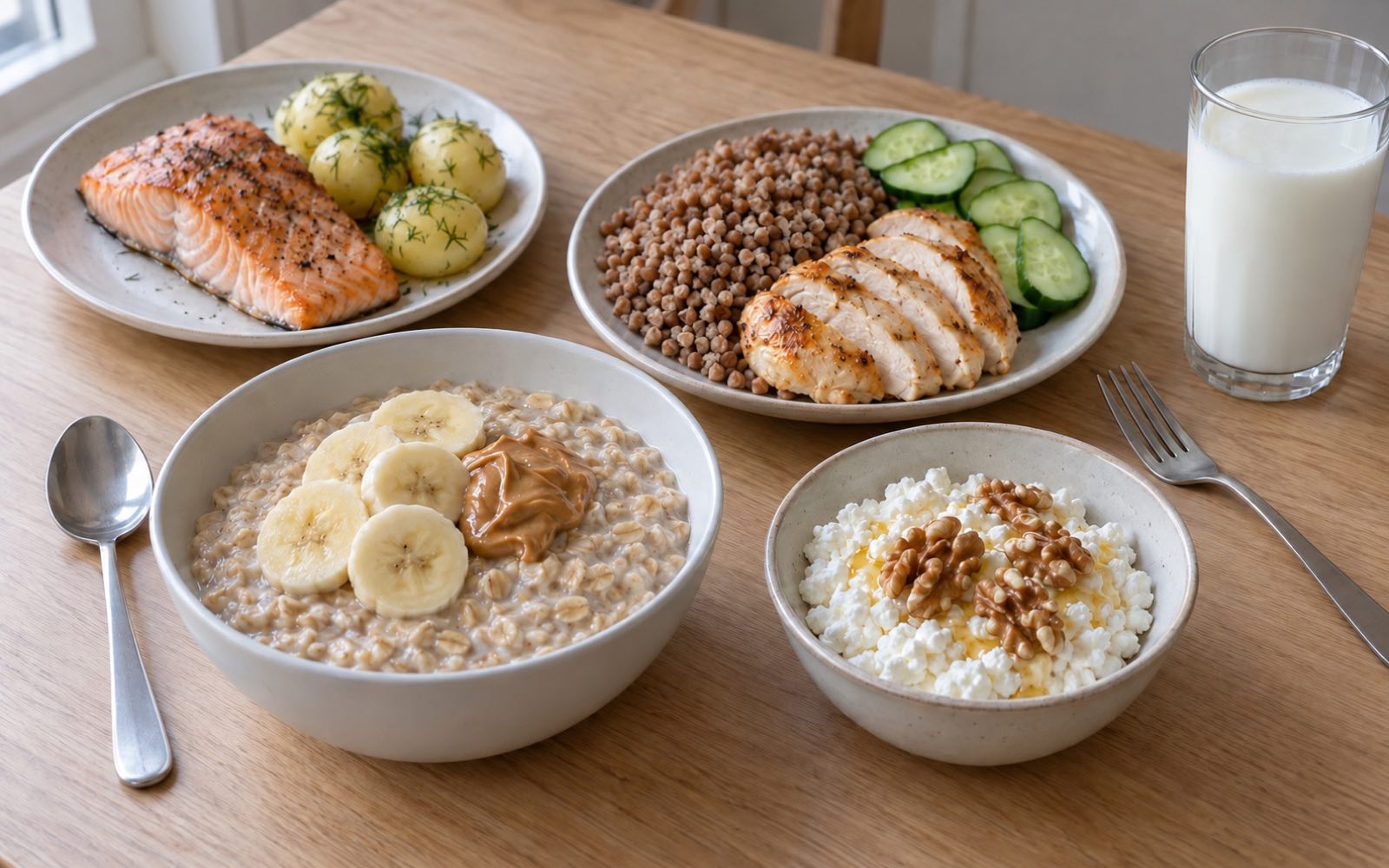
| Breakfast | Rolled oats 80 g (dry), 2.5% milk 250 g, banana 120 g, peanut butter 15 g | 608 | 22 / 18 / 91 |
| Snack | Farmer's cheese 5% fat 130 g, honey 20 g, walnuts 15 g | 320 | 24 / 16 / 21 |
| Lunch | Baked chicken breast 100 g, cooked buckwheat 300 g, cucumber and tomato salad with oil 150 g, dark rye bread 60 g | 749 | 49 / 20 / 91 |
| Afternoon snack | Greek yogurt 2% 150 g, apple 150 g, white bread 50 g, Gouda 20 g | 369 | 21 / 11 / 46 |
| Dinner | Baked salmon 120 g, boiled potatoes 300 g, butter 10 g, cucumber 100 g | 584 | 31 / 24 / 54 |
| Before bed | Kefir 2.5% 300 g | 150 | 9 / 8 / 12 |
| Total | 2,780 | 156 / 97 / 315 |
A 3,400 kcal day: for a body weight of about 185 lb (85 kg) and maintenance of about 3,000 kcal.
| Meal | What and how much | kcal | Protein / Fat / Carbs, g |
|---|---|---|---|
| Breakfast | Rolled oats 90 g (dry), 2.5% milk 300 g, banana 120 g, peanut butter 20 g, 1 hard-boiled egg 55 g | 785 | 34 / 28 / 101 |
| Snack | Farmer's cheese 5% fat 150 g, light sour cream 10% 30 g, honey 20 g, walnuts 20 g | 412 | 29 / 24 / 23 |
| Lunch | Braised beef 120 g, cooked rice 280 g, cucumber and tomato salad with oil 150 g, dark rye bread 60 g | 897 | 45 / 29 / 107 |
| Afternoon snack | Greek yogurt 2% 150 g, dates 40 g, white bread 60 g, Gouda 20 g | 448 | 22 / 11 / 66 |
| Dinner | Baked chicken breast 100 g, cooked pasta 250 g, olive oil 10 g, tomato 150 g | 680 | 48 / 17 / 81 |
| Before bed | Kefir 2.5% 300 g | 150 | 9 / 8 / 12 |
| Total | 3,372 | 187 / 117 / 390 |
Both days come to about 2.2 g of protein per kg, the top of the range. Want to be closer to the middle? Drop the farmer's cheese from the snack and have a piece of fruit instead. Fat in these days comes to about 1.4 g per kg. That's more than in the table at the top, but still within the 0.5–1.5 g range: nuts, cheese and oil make it easier to hit your calories.
How to swap foods. You can trade the sides for one another: buckwheat, rice, pasta and potatoes. Their calories differ, so check your food log after a swap. The proteins are interchangeable too: chicken breast, turkey, cod and canned tuna. Greek yogurt can stand in for farmer's cheese. Cod is leaner than chicken or salmon, so if you make that swap, add 10 g of oil to your side.
You can log your day in the Sportygram food diary. It has a barcode scanner and works out your calorie and protein targets from your stats and goal.
prep ingredients, not meals. A pot of grains for two days, a sheet pan of baked chicken and a bowl of chopped vegetables let you put together any plate from the plans above in five minutes.
Can't eat enough? How to gain weight if you're skinny
"I eat everything and still can't gain" is a common line from skinny people, including those who call themselves ectomorphs. It usually comes down to math, not some special metabolism. Skinny people often eat less than they think: a big lunch sticks in your memory, but a skipped dinner doesn't. Many of them also move a lot during the day, and that burns calories too. To check yourself, log everything you eat honestly for two weeks. To get more calories in, lean on foods that pack a lot of energy into a small volume.
| Food | Serving | Calories |
|---|---|---|
| Walnuts | 30 g, a handful | 196 kcal |
| Rolled oats | 50 g dry | 174 kcal |
| 2.5% milk | 300 ml | 159 kcal |
| Dates | 40 g | 124 kcal |
| Peanut butter | 20 g | 121 kcal |
| Gouda | 30 g | 105 kcal |
| Olive oil | 10 g, in oatmeal or salad | 90 kcal |
- Drink your calories. A smoothie with 300 ml of milk (about 1¼ cups), 50 g of rolled oats (about ⅔ cup), a banana and 20 g of peanut butter gives you about 560 kcal and 22 g of protein. It goes down in a couple of minutes and doesn't leave you feeling stuffed.
- Eat more often: three full meals and two or three snacks.
- Start with the dense part of your plate, the side and the protein, and save soup and salad for last.
- Add extras to cooked food: butter in your oatmeal, cheese in your pasta, nuts in your farmer's cheese.
- Don't drink a lot of water right before a meal: it takes up room in your stomach.
See your primary care doctor if your weight won't go up for a long time even at an honest +15–20% over maintenance, if nausea or a heavy feeling in your stomach keeps you from eating or if you're losing weight without trying.
Training at the gym and at home: without it, your surplus turns to fat
Without strength training, a surplus is just extra calories, and they go to fat.
- 3–4 strength workouts a week. Beginners do fine with 2–3.
- Build around compound exercises, the ones that work several muscles at once: squats, rows and deadlifts, presses, pull-ups and lunges.
- 10–20 hard sets per muscle group per week. Start at the low end.
- Progressive overload. Every week, add a little weight, a few reps or a set. If your training load stays flat for months, your body has no reason to build new muscle.
- Sleep 7–9 hours. Your muscles recover while you sleep, and short sleep saps your strength and throws off your appetite.
At home, the rules are the same. Adjustable dumbbells, resistance bands and a pull-up bar can work almost your whole body. Adding weight isn't the only way to progress at home: add reps and sets, lower the weight more slowly and move to a harder version of the exercise, such as push-ups with your feet on a chair. When a set feels easy all the way to the last rep, it's time to make it harder.
For a ready-made plan with exercises and starting weights, see our gym workout plan for beginners.
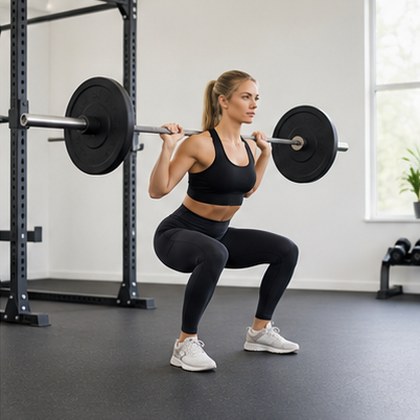 Barbell back squat
How to tell you're gaining muscle, not belly fat
In your first 1–2 weeks of eating more, your weight may climb faster than planned. That's not muscle or fat yet. It's water and glycogen: your muscles store water along with carbs. Don't draw any conclusions before week three.
After that, watch three numbers: your weekly average weight, your waist and your working weights at the gym. We explain how to track them in gaining muscle vs. gaining fat. The short rules:
- your weight is going up 0.25–0.5% a week, your waist barely moves and your lifts are creeping up: change nothing;
- your average weight has been flat for 3–4 weeks and you're tracking food honestly: add 100–150 kcal;
- your waist is growing noticeably faster than your lifts: cut 100–150 kcal;
- your weight is going up but your lifts are stuck: the problem isn't food, it's your program and sleep.
weigh yourself in the morning after using the bathroom, 3–4 times a week, and compare the averages. Measure your waist once a week at belly-button level. Don't change your calories more often than once every 3–4 weeks.
Red flags. A constant heavy feeling in your stomach and poor sleep after a big dinner mean your surplus is too large, so scale it back. If your blood pressure has gone up, or you get winded on an ordinary flight of stairs, see a doctor. If counting food makes you very anxious, and slip-ups lead to binges followed by strict restriction, see an eating disorder specialist.

Building muscle for women and after 40
For women, the same logic applies: maintenance, a small surplus, 1.6–2.2 g of protein per kg and strength training with progressive overload. The difference is in the totals: women put on less muscle than men do. So aim for a surplus of about 10% and a rate of about 0.25% of body weight a week. At 132 lb (60 kg), that's about a third of a pound (150 g) a week.
You won't get "bulky" by accident: muscle grows slowly, over months of work. Women's weight shifts over the menstrual cycle because of water, so when you compare month to month, compare the same phase of your cycle.
After 40, muscles respond less strongly to protein. In the same review of 49 studies (source 3), the older the participants, the less extra muscle they gained from added protein. So don't keep your protein at the low end, and split it across at least 4 meals with 0.4–0.55 g per kg in each. The surplus stays just as moderate, and strength training is a must. If you have high blood pressure, heart disease or joint problems, talk through your training plan with a doctor first.
Mass gainer, protein powder, creatine: what you need to build muscle
Supplements don't replace your surplus, your program or your sleep.
- Protein powder is just protein in dry form. You only need it if you can't hit your protein target with food. One scoop gives you 20–25 g of protein.
- A mass gainer is a mix of carbs and protein, in other words, calories in a glass. It helps when you can't eat enough, but a smoothie of milk, rolled oats, a banana and peanut butter does the same job for less money. If you're carrying belly fat, you don't need a gainer.
- Creatine monohydrate is the most studied supplement for strength training. The usual dose for a healthy adult is 3–5 g a day (source 7). It helps you get more work done in heavy sets. In the first few weeks, your weight may go up from water in your muscles, and that's not fat. More in our guide to creatine. If you have kidney disease, talk to a doctor first.
- BCAAs add almost nothing if your protein intake is on target: you already get them from farmer's cheese, meat and fish.
FAQ
How many calories do I need to build muscle?
Maintenance plus 10–15%. Find your maintenance from two weeks of food logging or with a calculator. If your maintenance is 2,600 kcal, your target is about 2,900–3,000 kcal a day. A skinny beginner can go up to +20%, while someone with belly fat only needs maintenance or +5%. Check the scale after 3–4 weeks: if your weight hasn't moved, add 100–150 kcal.
How much protein do I need to build muscle?
1.6–2.2 g per kg of body weight a day, or 0.7–1 g per pound. At 155 lb (70 kg), that's 110–155 g; at 185 lb (85 kg), 135–185 g. Going above 1.6 g/kg adds almost nothing for muscle on average, so the upper limit is a buffer. Split your protein across 4–6 meals of 30–40 g: farmer's cheese, eggs, meat, fish or yogurt.
Mass gainer or protein powder: which is better for bulking?
It depends on what you're short on. Getting enough calories but not enough protein? Use protein powder. Can't eat enough, and your weight won't go up? A gainer or a homemade 500–600 kcal smoothie will do. If you're carrying belly fat, you don't need a gainer. Neither one is required: regular food covers both calories and protein.
Can you build muscle at home?
Yes. Your muscles don't care where you train them. What they need is progressive overload. Adjustable dumbbells, resistance bands and a pull-up bar work almost your whole body. Keep adding reps, sets and harder variations. Your diet is the same as for the gym: a small surplus and 1.6–2.2 g of protein per kg. Without progressive overload, the only thing that grows is fat.
How many meals a day should I eat, and do I need to eat right after a workout?
Three to six meals works best for most people: it makes it easier to hit your calories and spread protein across the day. There's no strict rule, and your daily calories and protein matter more than the schedule. You don't need to rush to down a shake the moment you leave the gym. If you ate 1–2 hours before your workout, just eat when you get home.
Why am I gaining belly fat instead of muscle, and what if the scale hasn't moved in a month?
Belly fat builds up when your surplus is bigger than your muscles can use, or when your training has no progressive overload. Cut 100–150 kcal and check whether your lifts are going up. If your weight has been flat for 3–4 weeks, you're usually eating less than you think: on weekends, routines slip and meals get skipped. Check your tracking and add 100–150 kcal.
Can you bulk without meat?
Yes. You can get protein from eggs, farmer's cheese, yogurt, cheese, fish, tofu, chickpeas and lentils. Plant foods have less protein per serving, so track it more carefully. If you eat dairy and eggs, build your meals around them. Get your extra calories from grains, nuts and oil, as in the meal plans in this article.
How should women eat to build muscle?
The same way men do: maintenance plus about 10%, 1.6–2.2 g of protein per kg and 3–4 strength workouts a week with progressive overload. Aim to gain 0.25% of body weight a week: at 132 lb (60 kg), that's about a third of a pound (150 g). Your weight shifts with your cycle because of water, so compare the same phase each month. You won't get "bulky" by accident: muscle takes months to grow.
The bottom line
- Eat 10–15% above maintenance, usually 200–450 kcal. A skinny beginner can go up to +20%. With belly fat, stay at maintenance or +5%.
- Protein: 1.6–2.2 g per kg (0.7–1 g per pound). Fat: about 1 g/kg. Carbs fill the rest. Spread your food across 3–6 meals.
- Aim to gain 0.25–0.5% of body weight a week. Coaches estimate that you can add no more than 0.2–0.75 kg (0.4–1.7 lb) of muscle a month, and most of anything above that is fat.
- Without strength training with progressive overload and 7–9 hours of sleep, your surplus goes to your belly. The same rules apply at home.
- What you gain in the first two weeks is water and glycogen. After that, adjust based on your average weight, waist and lifts.
Checklist: your first 4 weeks of building muscle
- Find your maintenance: two weeks of food logging and weigh-ins, or a calculator.
- Find your row on the scale: skinny, average or belly fat. Adjust for training experience.
- Work out your protein: body weight in kg × 1.6–2.2 g (or pounds × 0.7–1 g).
- Build your day from one of the meal plans and adjust the portions to your calories.
- Weigh yourself in the morning 3–4 times a week, and measure your waist once a week.
- Train 3–4 times a week, and every week add weight, reps or sets.
- Sleep 7–9 hours.
- After 3–4 weeks, make one decision: change nothing, or add or cut 100–150 kcal.
Sources
- Iraki J., Fitschen P., Espinar S., Helms E. Nutrition Recommendations for Bodybuilders in the Off-Season: A Narrative Review. Sports, 2019. — A surplus of about 10–20% and a gain of 0.25–0.5% of body weight a week for novice and intermediate lifters, more conservative for advanced ones; protein 1.6–2.2 g/kg, 0.40–0.55 g/kg per meal across 3–6 meals, including within 1–2 hours before and after training; fat 0.5–1.5 g/kg; carbs from 3–5 g/kg.
- Slater G. J. et al. Is an Energy Surplus Required to Maximize Skeletal Muscle Hypertrophy Associated With Resistance Training. Frontiers in Nutrition, 2019. — The exact surplus needed for muscle growth is unknown, and common estimates have never been validated in people who lift.
- Morton R. W. et al. A systematic review, meta-analysis and meta-regression of the effect of protein supplementation on resistance training-induced gains in muscle mass and strength in healthy adults. British Journal of Sports Medicine, 2018. — 49 studies, 1,863 participants: protein above ~1.6 g/kg a day didn't add more lean mass; the benefit of added protein declines with age.
- Garthe I. et al. Effect of nutritional intervention on body composition and performance in elite athletes. European Journal of Sport Science, 2013. — 39 athletes, 8–12 weeks: a planned diet (~3,600 kcal) versus eating freely (~3,000 kcal) led to +3.9% versus +1.5% body weight and +15% versus +3% fat mass, with no difference in lean mass gains.
- Aragon A. A., Schoenfeld B. J. Nutrient timing revisited: is there a post-exercise anabolic window?. Journal of the International Society of Sports Nutrition, 2013. — The post-workout "window" is wider than commonly believed, and how much it matters depends on when you ate before training.
- Schoenfeld B. J., Aragon A. A. How much protein can the body use in a single meal for muscle-building? Journal of the International Society of Sports Nutrition, 2018. — About 0.4 g of protein per kg per meal, across at least four meals; at 2.2 g/kg a day, up to 0.55 g/kg per meal.
- Kreider R. B. et al. International Society of Sports Nutrition position stand: safety and efficacy of creatine supplementation in exercise, sport, and medicine. Journal of the International Society of Sports Nutrition, 2017. — Creatine monohydrate is effective and safe for healthy people; the maintenance dose is 3–5 g a day.
This article is for informational purposes and does not replace medical advice. If you have a chronic condition, a BMI under 18.5 or an eating disorder, plan your diet and rate of gain with a doctor.