

keep the deficit at 300–500 calories a day. For most people between 120 and 200 lb (55–90 kg), that works out to roughly 0.5% of body weight a week. A 2022 meta-analysis by Murphy and Koehler found that a deficit around 500 calories already stalls muscle gain even with heavy lifting, so going deeper buys you nothing. Protein: 1.6–2.2 g/kg per day (roughly 0.7–1.0 g per pound). Lift 3–4 times a week. Don't cut your sleep short.A cut of 6–15 lb (3–7 kg) of fat takes 2–5 months, and reversing out of it takes another 1–2. "Deflated" muscles in the first couple of weeks are water: every gram of glycogen holds onto at least 3 grams of water.
Cutting means losing fat while you hold on to muscle and strength. What separates it from ordinary weight loss is resistance training, plenty of protein and a pace that isn't rushed. For most people that's a deficit of 300–500 calories a day and a stretch of 2 to 5 months. Below: how long a cut takes at your weight, how much protein to eat, how to train at home or in a gym, how it differs for women, men and people over 40, and how to reverse diet out of it without the weight bouncing back.

What cutting actually means, and how it's different from just losing weight
Cutting is lowering your body fat percentage while trying to hold on to muscle. The word comes from bodybuilding: before a show, competitors "cut" so less fat sits under the skin and the muscle underneath shows. For a regular gym-goer the goal is the same — strip the fat off your stomach and sides so your arms, legs and glutes stay where they are, and your working weights in the gym don't fall apart.
On a cut, what matters is what the number on the scale is made of. Just eat less and skip training, and a meaningful chunk of what you lose is lean mass — everything in your body that isn't fat: muscle, water, glycogen (the stored carbs in your muscles and liver), organs and bone. To make sure your body burns mostly fat, a cut relies on three levers, plus a fourth one people forget about.
| Lever | Working setting | What it buys you | Based on |
|---|---|---|---|
| Calorie deficit | 300–500 calories a day, about 0.5% of body weight a week; Helms allows up to 1% | fat comes off, muscle gets enough energy | Murphy & Koehler 2022, Helms 2014, Garthe 2011 |
| Protein | 1.6–2.2 g/kg per day (0.7–1.0 g/lb), 4–5 meals | raw material so the body doesn't strip muscle for fuel | Morton 2018, Longland 2016, Roberts 2020 |
| Resistance training | 3–4 sessions a week, sets taken close to failure | signals to the body that the muscle is still needed | Sardeli 2018, Garthe 2011 |
| Sleep | don't cut it short for workouts or errands | short sleep meant 60% more lean mass lost | Nedeltcheva 2010 |
Murphy and Koehler, researchers at the Technical University of Munich, ran a 2022 meta-analysis — pooling results from multiple randomized trials, where people are assigned to groups by chance. In those trials, people lifted weights for at least 3 weeks while in a calorie deficit. They gained less muscle than people training without a deficit, but strength went up just as much either way. That sets a realistic goal for a cut: hold on to the muscle you already have. If strength keeps climbing too, that's a bonus.
Don't start a cut without a doctor if you're underweight, have a current or past eating disorder, are pregnant or breastfeeding, are a teenager, or manage a chronic condition that requires diet changes.
Why cutting costs you muscle, and who's at higher risk
In a deficit, your body pulls energy from both fat and its own protein, and the leaner you are, the deeper the deficit, and the less you train with weights, the bigger the share of the loss that comes from muscle. A body with plenty of fat has plenty to spend from. A lean body reaches for muscle sooner.
This is measurable. Physiologist Kevin Hall at the US National Institutes of Health revisited and refined Forbes's formula in 2007. In its original form: the share of lean mass in every kilogram you lose equals 10.4 / (10.4 + your body fat in kilograms). Hall showed that for moderate weight loss, the refined version gives nearly the same answer. Here's what that looks like for a few common cases.
| Body fat | Example | Share of lean mass in every kg lost |
|---|---|---|
| 6 kg (13 lb) | man, 165 lb (75 kg), 8% body fat | about 63% |
| 10 kg (22 lb) | woman, 121 lb (55 kg), 18% body fat | about 51% |
| 12 kg (26 lb) | man, 176 lb (80 kg), 15% body fat | about 46% |
| 15 kg (33 lb) | woman, 132 lb (60 kg), 25% body fat | about 41% |
| 20 kg (44 lb) | man, 176 lb (80 kg), 25% body fat | about 34% |
| 30 kg (66 lb) | man, 220 lb (100 kg), 30% body fat | about 26% |
| 40 kg (88 lb) | person, 242 lb (110 kg), 36% body fat | about 21% |
This is a forecast for weight loss without lifting and without high protein, built from data on women. Lean mass here includes water, glycogen and organs, so the muscle share of the loss is actually smaller than it looks. But the takeaway holds: it's harder to cut when you're already lean than when you're carrying more fat. For someone with 88 lb of fat, roughly 80% of every pound lost is fat. For a lean man with just 13 lb of fat and no lifting, almost two-thirds of what he loses is lean mass.
Lifting changes this picture more than any diet tweak. In a 2018 meta-analysis by Sardeli covering 6 randomized trials in older adults with obesity, resistance training 3 times a week over 12–24 weeks prevented 93.5% of the lean-mass loss that dieting alone caused. Fat and total weight came off at the same rate either way.
Part of "lost muscle" is water. A team led by Fernández-Elías confirmed in 2015, using muscle biopsies, that every gram of glycogen is stored with at least 3 grams of water. In a deficit, glycogen drops, and the water goes with it. How to tell water loss from real muscle loss is covered in section 09.
How big a deficit you need, and how long a cut takes: calculate it for your weight
Most people do fine with a 300–500 calorie deficit a day. For anyone between roughly 120 and 200 lb (55–90 kg), that's around 0.5% of body weight a week, and most cuts take 2 to 5 months. Here's what those numbers are based on.
- Helms, Aragon and Fitschen, in a 2014 review for natural bodybuilders, recommend losing 0.5–1% of body weight a week and note that a diet longer than 2–4 months likely preserves more muscle than a short, aggressive one.
- In a Norwegian study by Garthe in 2011, 24 elite athletes lifting 4 times a week lost weight at two different paces. The slower group had calories cut by 19% with a target of 0.7% a week; the faster group had calories cut by 30% with a target of 1.4%, though they actually lost closer to 1% a week. Both groups lost about 5.5% of body weight — the slower group over 8.5 weeks, the faster over 5.3. Fat dropped 31% in the slow group versus 21% in the fast one. Lean mass rose 2.1% in the slow group and didn't change in the fast one.
- Murphy and Koehler's 2022 meta-regression — a calculation of how the result shifts with the size of the deficit — found that a deficit around 500 calories a day already stops lean mass from increasing during resistance training, and advise against going deeper.
- Roberts, Helms, Trexler and Fitschen, in a 2020 review, recommend that lean athletes prepping for competition keep the pace at 0.5% a week or less.
We ran the numbers for six sample people: how much fat each needs to lose, how many weeks it takes at different paces, and what deficit that requires in week one.
How long a cut takes and what deficit it needs: six examples
| Who | Body fat now → goal | Fat to lose | Weight at the end | Weeks at 0.5 / 0.7 / 1% a week | Starting deficit, calories/day: 0.5 / 0.7 / 1% |
|---|---|---|---|---|---|
| Woman, 121 lb (55 kg) | 22 → 18% | 6 lb (2.7 kg) | 115 lb (52.3 kg) | 10 / 7 / 5 | 302 / 424 / 605* |
| Woman, 132 lb (60 kg) | 28 → 23% | 8.6 lb (3.9 kg) | 124 lb (56.1 kg) | 13 / 10 / 7 | 330 / 462 / 660* |
| Woman, 154 lb (70 kg) | 35 → 28% | 15 lb (6.8 kg) | 139 lb (63.2 kg) | 20 / 15 / 10 | 385 / 539 / 770 |
| Man, 165 lb (75 kg) | 15 → 10% | 9.3 lb (4.2 kg) | 156 lb (70.8 kg) | 11 / 8 / 6 | 412 / 578 / 825 |
| Man, 176 lb (80 kg) | 20 → 13% | 14 lb (6.4 kg) | 162 lb (73.6 kg) | 17 / 12 / 8 | 440 / 616 / 880 |
| Man, 198 lb (90 kg) | 27 → 18% | 22 lb (9.9 kg) | 177 lb (80.1 kg) | 23 / 17 / 12 | 495 / 693 / 990 |
* A deficit above 500 calories a day — the zone where, per Murphy and Koehler's 2022 meta-regression, lean mass stops increasing.
How we calculated this: only fat is assumed to leave, so the end weight is lean mass divided by (1 − target body fat %). Pace is figured off that week's current weight, and the starting deficit is weight × pace × 3,500 calories per pound, spread over 7 days. The 3,500-calorie-per-pound figure is the old rule of thumb. Hall showed by calculation in 2008 that it holds up reasonably well for people with more than 66 lb (30 kg) of body fat and overstates the needed deficit for leaner people — so treat that last column as an upper estimate.
What this tells us:
- A typical cut of 6–15 lb (3–7 kg) of fat takes 2 to 5 months, which lines up with Helms's timelines.
- Above 120 lb (55 kg), a 1% weekly pace needs more than 600 calories of deficit — past Murphy and Koehler's threshold. That's why 0.5% a week is the default target, with 0.7% reasonable for people carrying more fat, since Forbes's formula gives them a smaller muscle share in the losses.
- A 132 lb (60 kg) woman moving from 28% to 23% body fat needs to lose about 8.6 lb (3.9 kg) of fat. That's 7–13 weeks.
- For a lean man (15 → 10%), a 1% weekly pace already means an 825-calorie deficit, and his muscle share of the loss is higher (see the table in section 02). He's better off at 0.5% a week, as Roberts recommends.
- Dropping the pace from 1% to 0.7% for a 165 lb (75 kg) man costs about 250 fewer calories a day of deficit and roughly 2 extra weeks.
- Over 4 weeks at 0.5–1% a week, you lose 2–4% of body weight: 2.4–4.8 lb at 121 lb (55 kg), and 3.5–7 lb at 176 lb (80 kg).
You can estimate body fat percentage from calipers or a smart scale — methods are covered in our guide to body fat percentage. A few percentage points of error won't throw off the table much; it's meant to show the rough timeline. Work out your maintenance and deficit with the formula in how to calculate a calorie deficit. If you'd rather not do the math by hand, the profile in the Sportygram app calculates your calorie target from your stats and goal, and the food diary tracks what you actually ate against it.
spend two weeks eating normally before a cut and logging everything. If your weight hasn't moved, your average daily intake over that stretch is your maintenance. Subtract the deficit from the table, and that number is yours — no calculator guesswork involved.
How much protein you need while cutting, and how to spread it through the day
While cutting, aim for 1.6–2.2 g of protein per kg of body weight a day — roughly 0.7–1.0 g per pound. The leaner you are and the deeper your deficit, the closer to the top of that range you should sit. Split it across 4–5 meals, as Roberts and colleagues recommend in their 2020 review.
Morton and colleagues, in a 2018 meta-analysis, pooled 49 studies and 1,863 people who lifted weights. Protein beyond 1.62 g/kg per day added no further lean-mass gain. That figure isn't precise — the 95% confidence interval runs from 1.03 to 2.20 g/kg — so the authors suggest anyone chasing the most out of their training aim for 2.2 g/kg. But that meta-analysis only included people who weren't in a calorie deficit.
In a deficit, you need more. Longland and colleagues, in 2016, put 40 young overweight men through 4 weeks at roughly a 40% deficit, combined with resistance and interval training 6 days a week. At 2.4 g of protein per kg, they gained 1.2 kg of lean mass and lost 4.8 kg of fat; at 1.2 g/kg, they gained only 0.1 kg and lost 3.5 kg of fat. Helms and colleagues, in 2014, recommend athletes on a diet get 2.3–3.1 g per kg of lean body mass. For a 165 lb (75 kg) man at 15% body fat, that's 147–198 g a day, or 2.0–2.6 g per kg of total body weight.
Protein while cutting, by body weight
| Weight | 1.6 g/kg a day | 2.2 g/kg a day | Per meal (4 meals) |
|---|---|---|---|
| 121 lb (55 kg) | 88 g | 121 g | 22–30 g |
| 143 lb (65 kg) | 104 g | 143 g | 26–36 g |
| 165 lb (75 kg) | 120 g | 165 g | 30–41 g |
| 187 lb (85 kg) | 136 g | 187 g | 34–47 g |
| 209 lb (95 kg) | 152 g | 209 g | 38–52 g |
The last column is the daily target split across 4 meals — 0.4–0.55 g per kg of body weight per sitting. Helms recommends 0.4–0.5 g of protein per kg in the meals right before and after your workout.
If you're carrying a lot of extra weight, calculate protein from your goal weight instead: at 220 lb (100 kg) aiming for 176 lb (80 kg), that's 128–176 g rather than an intimidating 160–220 g. That works because, as Roberts and colleagues note, protein needs track mostly with how much muscle you carry, and for someone with a lot of extra weight that's closer to the goal weight than the current one. On a standard cut with a moderate deficit, going past 2.2 g/kg doesn't buy much; the extra protein just displaces carbs your training needs. Higher numbers show up with a very aggressive deficit and hard training, as in Longland's study, and with lean competitive athletes on a diet, which is why Helms gives that group 2.3–3.1 g per kg of lean mass. With kidney disease, your protein target is a conversation with your doctor. For food sources and meal ideas, see how much protein per day.
What to eat while cutting: carbs, fats and what's actually off the table
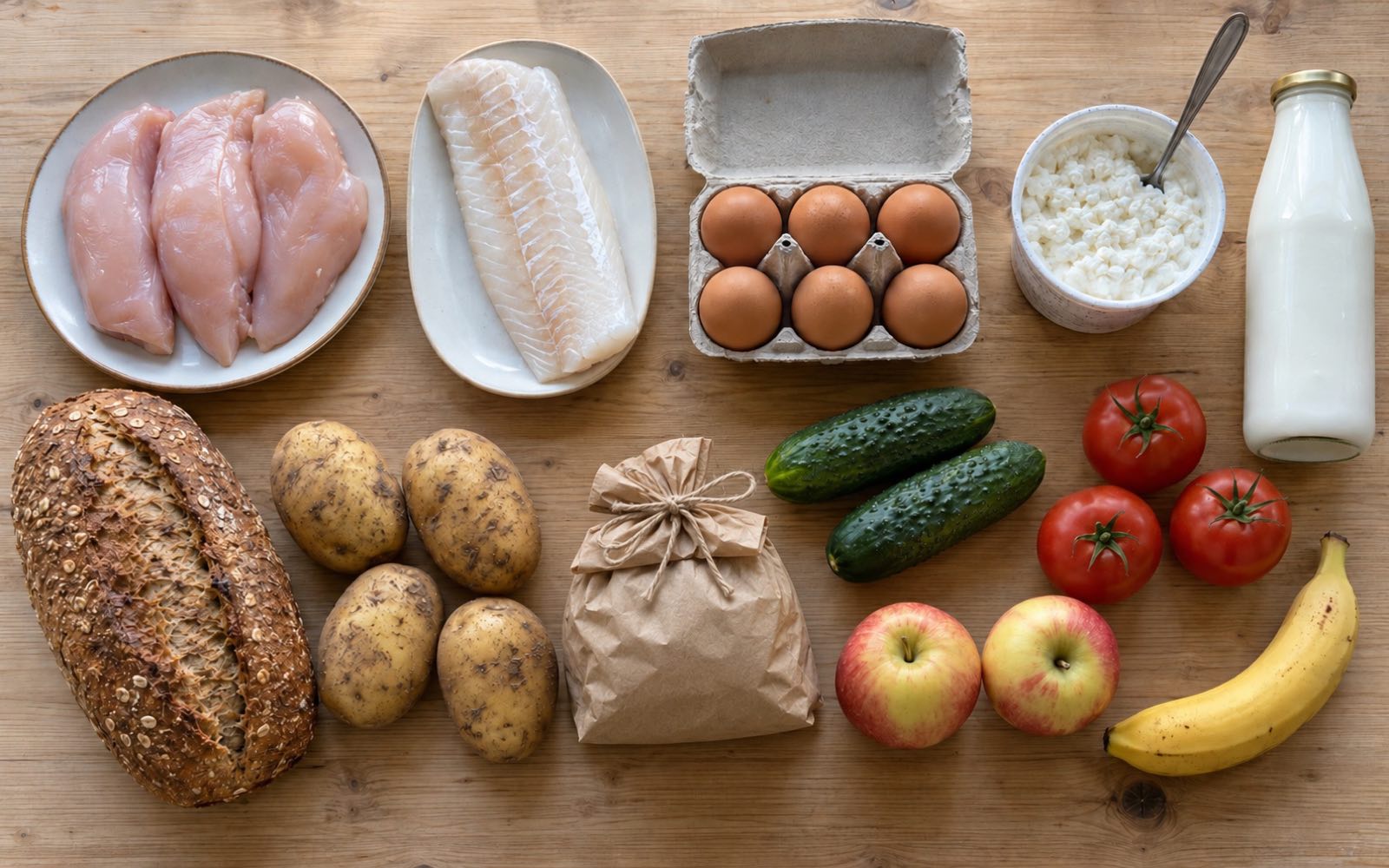
Nothing is banned on a cut. The result comes down to total calories, protein at every meal, fat at 15–30% of calories, and carbs filling in the rest so you have the energy to train.
Helms and colleagues lay out that same split in 2014: 15–30% of calories from fat, the rest from carbs. Roberts's 2020 review has competitors drop fat as low as 10–25% before a show to free up more calories for carbs, but there's no reason for a regular person to go that low. Meal timing, per Helms, has little effect on fat loss or muscle retention — eating 3 to 6 times a day is fine, whatever fits your schedule.
Example: a 132 lb (60 kg) woman eating 1,700 calories on a cut. Protein at 1.8 g/kg is about 108 g; fat at 25% of calories is about 47 g; that leaves about 210 g for carbs. That's an ordinary plate — oatmeal, bread, potatoes and fruit.
What to put on your plate:
- Protein at every meal: chicken, turkey, beef, fish, eggs, cottage cheese, plain yogurt or kefir, beans and lentils, tofu.
- Vegetables and greens: at lunch and dinner, half the plate.
- Grains and potatoes: rice, oats, buckwheat, potatoes, whole-grain bread — more of it around your workout.
- Fruit: apples, bananas, berries, citrus.
- Fats: oil, nuts, avocado, fatty fish. Measure these with a spoon and a handful — calories add up fastest here.
A sample day of eating for a 165 lb (75 kg) man, with 30–40 g of protein at each meal, matching the table above:
- Breakfast: oats made with milk, eggs, an apple.
- Lunch: rice, chicken breast, a cucumber-and-tomato salad with a spoon of olive oil.
- Post-workout: cottage cheese with a banana.
- Dinner: white fish, potatoes, roasted vegetables, a glass of kefir or milk.
Salt and water. There's no need to cut salt or drink less water — why, is covered in the FAQ below.
Protein and calories are easy to track in the Sportygram food diary: search a food in a database of roughly 101,000 items or scan a barcode with your camera, and the diary totals your protein, fat, carbs and calories for the day.
Training while cutting: strength, cardio and how often
What keeps your muscle on a cut is 3–4 resistance sessions a week with sets that are genuinely heavy for you. Cardio helps burn more energy, but it can't stand in for lifting.
That shows up clearly in Villareal's 2017 study in the New England Journal of Medicine. 160 adults over 65 with obesity dieted for six months while exercising in different ways: aerobic only, resistance only, or both. Every exercise group lost about 9% of body weight. But lean mass fell 5% in the aerobic-only group, 3% in the combined group, and just 2% in the resistance-only group. Strength climbed 18–19% in the groups that lifted, and 4% in the aerobic-only group.
How to train:
- How often. Three full-body strength sessions a week works for most people. In the studies where muscle held up best, training landed at 3–4 sessions: three for Sardeli, four for Garthe.
- What kind of sets. Your working sets should be genuinely hard: the last few reps are a grind, with 1–3 reps left in the tank.
- If recovery tanks. Cut the number of sets, not the weight on the bar. It's a standard coaching move in a deficit — fewer sets for a few weeks, same intensity.
- Cardio. Walking and daily steps are the gentlest way to burn more energy. Running, cycling and intervals work too, as long as you enjoy them and they don't eat into your lifting.
- How much cardio. Enough to hold your deficit without constant hunger. You can run a cut with zero cardio at all if the deficit comes entirely from food.
Cutting at home: dumbbells, bands and bodyweight
You can run a full cut at home if you take sets close to failure or all the way there: a light weight for lots of reps builds muscle about as well as a heavy one, so it should hold muscle just as well too.
Schoenfeld and colleagues, in a 2017 meta-analysis, pooled 21 studies lasting 6 weeks or longer where every set went to failure. Muscle grew the same whether the load was light (up to 60% of a one-rep max) or heavy; max strength grew faster with heavier loads. For cutting, the takeaway is that a pair of dumbbells, a band and a chair are probably enough to hold on to your muscle.
The same five movements work at home and in the gym. Do them 3 times a week, full body, 2–4 working sets each:
- Squat pattern. At home: goblet squat with a dumbbell, Bulgarian split squat with your back foot on a chair. In the gym: barbell squat, leg press.
- Hinge. At home: dumbbell Romanian deadlift, single-leg glute bridge. In the gym: barbell Romanian deadlift, barbell hip thrust.
- Push. At home: push-ups, floor dumbbell press. In the gym: bench press, machine chest press.
- Pull. At home: single-arm dumbbell row, band row. In the gym: lat pulldown, barbell bent-over row.
- Core. Plank, dead bug, side plank — the same whether you're home or at the gym.
Reps: 6–12 in the gym, 12–25 at home, and stop each set with 1–3 reps left in the tank. This is a practical scheme built on Schoenfeld's data — the studies themselves don't set exact set-and-rep numbers. Once your dumbbells get too light, add difficulty without buying anything new: slow the lowering phase to 3 seconds, pause 1–2 seconds at the bottom, switch to one leg or one arm, add reps, or shorten your rest.

Cutting for women, men and people over 40: what's different
The rules of cutting are the same for everyone, but women's cycles are usually the first system to react, lean men lose a bigger share of muscle, and after 40, lifting and protein matter even more.
Cutting for women. Finnish researchers led by Hulmi followed 27 women preparing for fitness competitions and 23 women in a control group for about 20 weeks in a 2017 study. The competitors lost about 12% of body weight and 35–50% of their fat. Lean mass, measured precisely by DEXA (a bone-density scan that also reads body composition), stayed the same; bioimpedance and skinfold measurements showed a small drop. But leptin, thyroid hormone T3, testosterone and estradiol all fell, and 63% of the dieting women had an irregular cycle, versus 30% in the control group. Once the women started eating more and doing less cardio, weight and most hormones returned to baseline within 3–4 months — except T3 and testosterone. And after 17.5 weeks of recovery, 28% of the competitors still had no menstrual bleeding, versus 14% in the control group.
There's a floor on how little you can eat. Loucks and Thuma, in 2003, varied the diets of 29 young, sedentary women with regular cycles over 5 days and tracked energy availability — food calories minus exercise calories. At 30 calories per kg of lean mass a day, the rhythm of luteinizing hormone (LH), which drives the menstrual cycle, stayed normal; below that threshold, it broke down.
Example: a 132 lb (60 kg) woman at 25% body fat has about 99 lb (45 kg) of lean mass, so her minimum energy availability is 45 × 30 = 1,350 calories a day. If training burns 300 calories a day, she needs to eat at least 1,650 calories. Check that your deficit still leaves you above that floor.
A disrupted cycle or missed periods is a reason to eat more and see a gynecologist — not something to write off as a normal part of cutting. Roberts and colleagues note that the cycle can take longer to recover than weight and hormones after an aggressive prep.
Cutting for men. Roberts's 2020 review calls preserving lean mass a sharper problem for men: nearly every study of male competitors found lean mass loss during prep, while women typically lose less. The authors suspect testosterone is the reason: men start higher, so the drop during a cut hits them harder. Helms's 2014 review describes a natural bodybuilder whose testosterone fell to a quarter of baseline by the third month of prep and took three months post-show to recover. The takeaway for an ordinary cut: if you're already at 15% body fat and aiming for 10%, keep the pace around 0.5% a week.
Cutting after 40, after 50 and through menopause. Muscle gets harder to hold on to with age, which makes lifting non-negotiable. Both Villareal and Sardeli studied older adults specifically, and in both studies, resistance training sharply cut the lean-mass loss that comes with dieting. In Morton's meta-analysis, the protein benefit shrank with age, so don't skimp on protein after 40. Menopause on its own isn't a reason to avoid cutting. With chronic conditions, high blood pressure or medications, build your cutting plan together with a doctor.
Are you losing muscle on your cut? Check strength, waist and photos
Watch your working weights, your waist and photos over several weeks — if strength holds and your waist keeps shrinking, your muscle is intact. A single scale or bioimpedance reading tells you nothing on its own.
In the first week or two, muscles often look "deflated": glycogen drops, and every gram of it takes at least 3 grams of water with it (Fernández-Elías, 2015). A bioimpedance scale can show "muscle loss" during this window, when what's actually leaving is mostly water.
How to track it:
- Working weights. Log your weights and reps on your main lifts. Holding steady or climbing means the muscle is there.
- Body weight. Weigh yourself every morning after the bathroom, and compare weekly averages.
- Waist. Once a week, in the morning, at belly-button height. Waist shrinking while arms and thighs barely change means it's fat coming off.
- Photos. Every 2–4 weeks, same lighting, same pose.
don't make decisions off a single bioimpedance reading. Those scales react to water, food and time of day. Measure in the morning, fasted, under the same conditions every time, and compare month to month.
Sleep. Nedeltcheva and colleagues at the University of Chicago kept 10 overweight adults on a moderate deficit for 14 days in 2010 — once sleeping 8.5 hours, once sleeping 5.5. With short sleep, they lost 0.6 kg (1.3 lb) of fat instead of 1.4 kg (3 lb), and 2.4 kg (5.3 lb) of lean mass instead of 1.5 kg (3.3 lb), and hunger was worse. The diet was identical — sleep was the only thing that changed.
Signs you've gone too far. Ease off the deficit if your working weights drop two weeks running, you're constantly cold, sleep falls apart, food is on your mind all day, or — for women — your cycle gets thrown off. Shift your pace, say from 1% to 0.7% a week (about 250 fewer calories a day for a 165 lb/75 kg person), and watch for a week or two. If the scale won't budge at all, check whether it's a genuine weight loss plateau before assuming your metabolism has stalled.
Diet breaks. The evidence here goes both ways. In the Australian MATADOR study (Byrne and colleagues, 2018), 51 men with obesity ate 67% of maintenance for 16 weeks — one group straight through, the other in 2-week blocks of dieting alternated with 2 weeks at maintenance, which stretched their program to 30 weeks. The intermittent group lost 14.1 kg (31 lb) versus 9.1 kg (20 lb) for the continuous group, with 12.3 kg (27 lb) of that as fat versus 8.0 kg (18 lb); lean-mass loss was about the same in both. In the ICECAP trial (Peos and colleagues, 2021), 61 trained people, 32 of them women, held a moderate deficit for 12 weeks either straight through or in 3-week blocks with a week at maintenance in between. Fat, lean mass, strength and hormones didn't differ between groups, but the group with breaks reported less hunger.
For people with a lot of weight to lose, breaks may help you lose more overall; for trained lifters, they mainly make hunger easier to manage. Roberts calls breaks and refeed days "possibly beneficial." If a cut is grinding you down, a maintenance week after every 3 weeks of dieting, as in ICECAP, won't hurt your muscle.
How to reverse diet out of a cut without gaining the weight back
Reversing out of a cut takes 1–2 months: raise calories back to maintenance, ideally in weekly steps.
- Roberts and colleagues, in 2020, recommend that athletes reach a stable, comfortable weight within the first 1–2 months after a competition, then add weight back in a controlled way and gradually return to eating by hunger and fullness. Competitors on stage are extremely lean, which is why they're told to run a noticeable surplus. After an ordinary cut with a moderate deficit, getting back to maintenance is enough.
- In Hulmi's study, weight and most hormones in the women returned to baseline within 3–4 months of eating more again.
- In MATADOR, over six months of follow-up after the program, both groups regained some weight — 5.9 kg (13 lb) without breaks and 3.5 kg (7.7 lb) with breaks, a gap that could be down to chance. But the group with diet breaks had lost more during the diet itself and, six months on, was still about 8 kg (18 lb) lighter on average.
Example step-up: a 132 lb (60 kg) woman cut on a deficit of about 460 calories a day (0.7% a week from our table). Stretching the reversal over 3–4 weeks means adding back 115–155 calories a day each week. Add carbs first — oats, bread, potatoes, fruit — to bring your training energy back. Keep protein where it was during the cut, and keep lifting.
Expect the scale to tick up in the first week of reversing: glycogen refills, and every gram of it brings at least 3 grams of water along. As long as you're still under maintenance, that isn't fat. Judge by your weekly average weight and your waist, not a single morning's number.
From here, two paths: hold your new weight at maintenance, or move into building muscle. For eating in a surplus without your waist creeping back up, see eating in a surplus without gaining fat.
Questions and answers
Can you cut at home, without a gym?
Yes. Schoenfeld's 2017 meta-analysis of 21 studies found muscle grew the same from light and heavy loads, as long as sets went to failure. A pair of dumbbells, a band, a chair and a mat is enough: do 12–25 reps with 1–3 in reserve, and make the movements harder as the weight gets light. The food and pace are the same as cutting with a gym.
How many pounds can you lose in a month while cutting?
At a 0.5–1% weekly pace, that's 2–4% of body weight over 4 weeks — 2.4–4.8 lb at 121 lb (55 kg), and 3.5–7 lb at 176 lb (80 kg). The scale will show more in week one from water leaving with glycogen. Going faster is risky: in Garthe's fast group, which lost close to 1% a week, lean mass didn't increase at all. In the slow group, it rose 2.1%.
Do you need to cut carbs, sugar and bread while cutting?
No — calories and protein decide the outcome. Helms recommends 15–30% of calories from fat, the rest from carbs, which is what fuels your training. Bread, potatoes, grains and fruit all stay. Sweets can fit within your calories, but they're not very filling, which makes the deficit harder to hold without feeling hungry.
Do you need to drink less water and cut salt while cutting?
No. Helms writes that dehydration and water-and-salt manipulation before a show are risky and may not even improve how someone looks, even for competitors. Water comes back once you rehydrate — it doesn't touch your actual fat. Drink to thirst and salt food normally, unless a doctor has you on a restricted-sodium diet for something like blood pressure.
Can you cut without doing any cardio?
Yes, as long as the deficit comes from food: lifting is what holds your muscle, and cardio just adds extra burn. In Villareal's study, the groups that lifted kept the most muscle, while overall fitness improved most in the group that combined lifting with aerobic work. The simplest way to add burn is walking and daily steps.
Can you cut after 40, after 50, or through menopause?
Yes, and lifting and protein matter even more. In Villareal's study, adults over 65 who dieted with resistance training lost 2–3% of their lean mass, versus 5% with aerobic exercise alone. Don't skimp on protein: 1.6–2.2 g per kg of body weight a day. With chronic conditions, high blood pressure or medications, build your cutting plan with a doctor.
Do you need fat burners, L-carnitine or BCAAs to cut?
We don't recommend supplements. Helms's 2014 review found a genuine benefit for creatine, caffeine and beta-alanine during prep; the evidence for most other popular supplements is thin or missing. Fat comes off from the deficit, and muscle is held by lifting and protein. Talk to a doctor before adding any supplement, especially with heart conditions or high blood pressure.
Should a beginner cut right away, or build muscle first?
A beginner carrying extra fat can start cutting right away. Per Murphy and Koehler, strength climbs the same in a deficit as without one — muscle just grows slower, and around a 500-calorie deficit, that growth stops entirely. But beginners have a lot of room to grow: in Longland's study, young overweight men still gained 1.2 kg of lean mass on a 40% deficit at 2.4 g of protein per kg. With more fat to spare, the muscle share of any loss is small too. Building muscle first makes more sense if you're already lean with little fat to lose.
The bottom line
- Cutting means losing fat while holding on to muscle. Three levers do the work: a moderate deficit, protein and lifting — plus a fourth: sleep.
- Deficit: 300–500 calories a day, about 0.5% of body weight a week for 120–200 lb (55–90 kg). Helms allows up to 1% a week, but a deficit around 500 calories, per Murphy and Koehler, already stalls muscle gain.
- A cut of 6–15 lb (3–7 kg) of fat takes 2–5 months. A 132 lb (60 kg) woman moving from 28% to 23% body fat needs 7–13 weeks.
- Protein: 1.6–2.2 g/kg a day (0.7–1.0 g/lb), split into 4 meals of 0.4–0.55 g/kg each. If you carry a lot of extra weight, calculate from your goal weight.
- Lifting 3–4 times a week holds your muscle: in Sardeli's study, it prevented 93.5% of the lean-mass loss from dieting alone. At home, light weight taken close to failure works too.
- "Deflated" muscles in the first weeks are water — a gram of glycogen holds at least 3 grams of it. Judge by strength, waist and photos.
- Reversing out of a cut takes 1–2 months. A missed cycle is a reason to eat more and see a doctor.
Checklist: cutting without losing muscle
- Log two weeks of normal eating to find your real maintenance.
- Pick your target and pace from the table: about 0.5% a week, up to 0.7% if you're carrying more fat.
- Check the table that your starting deficit isn't above 500 calories a day; if it is, slow the pace down.
- Work out protein: 1.6–2.2 g/kg, split into 4 meals.
- Keep fat at 15–30% of calories, and let carbs fill the rest.
- Plan 3 full-body strength sessions a week, and log your working weights.
- Don't cut sleep short for workouts or errands.
- Compare average weight and waist weekly; take photos every 2–4 weeks.
- Watch for signs you've overdone it: strength dropping, feeling cold, sleep falling apart, a disrupted cycle.
- Plan your reversal ahead of time: add calories back weekly and reach maintenance within 1–2 months.
Sources
- Murphy C., Koehler K. Energy deficiency impairs resistance training gains in lean mass but not strength: A meta-analysis and meta-regression. Scandinavian Journal of Medicine & Science in Sports, 2022. — Strength climbs the same in a deficit; lean mass gains suffer, and a deficit around 500 calories stalls them.
- Garthe I. et al. Effect of two different weight-loss rates on body composition and strength and power-related performance in elite athletes. International Journal of Sport Nutrition and Exercise Metabolism, 2011. — 0.7%/week target: fat −31%, lean mass +2.1%; 1.4%/week target (actual pace near 1%): fat −21%, lean mass unchanged.
- Helms E. R., Aragon A. A., Fitschen P. J. Evidence-based recommendations for natural bodybuilding contest preparation: nutrition and supplementation. Journal of the International Society of Sports Nutrition, 2014. — 0.5–1%/week pace, 2.3–3.1 g protein per kg of lean mass, 15–30% fat, supplements, dehydration risks.
- Roberts B. M., Helms E. R., Trexler E. T., Fitschen P. J. Nutritional Recommendations for Physique Athletes. Journal of Human Kinetics, 2020. — Up to 0.5%/week pace, 4–5 protein meals, protein needs track lean mass, diet breaks and refeeds, sex differences, 1–2 month reverse diet.
- Morton R. W. et al. A systematic review, meta-analysis and meta-regression of the effect of protein supplementation on resistance training-induced gains in muscle mass and strength in healthy adults. British Journal of Sports Medicine, 2018. — 49 studies, no calorie deficit: protein beyond 1.62 g/kg/day added no lean mass (95% CI 1.03–2.20), weaker effect with age.
- Longland T. M. et al. Higher compared with lower dietary protein during an energy deficit combined with intense exercise promotes greater lean mass gain and fat mass loss: a randomized trial. American Journal of Clinical Nutrition, 2016. — 40 overweight men, 40% deficit: 2.4 g/kg protein → +1.2 kg lean mass; 1.2 g/kg → +0.1 kg.
- Sardeli A. V. et al. Resistance Training Prevents Muscle Loss Induced by Caloric Restriction in Obese Elderly Individuals: A Systematic Review and Meta-Analysis. Nutrients, 2018. — Lifting 3x/week prevented 93.5% of diet-induced lean mass loss.
- Hall K. D. Body fat and fat-free mass inter-relationships: Forbes's theory revisited. British Journal of Nutrition, 2007. — Forbes's formula, 10.4 / (10.4 + kg of fat), the basis of our table in section 02.
- Hall K. D. What is the required energy deficit per unit weight loss?. International Journal of Obesity, 2008. — The "3,500 calories per pound" rule overstates the deficit needed for people with under 30 kg (66 lb) of body fat.
- Fernández-Elías V. E. et al. Relationship between muscle water and glycogen recovery after prolonged exercise in the heat in humans. European Journal of Applied Physiology, 2015. — A gram of glycogen is stored with at least 3 grams of water.
- Schoenfeld B. J., Grgic J., Ogborn D., Krieger J. W. Strength and Hypertrophy Adaptations Between Low- vs. High-Load Resistance Training: A Systematic Review and Meta-analysis. Journal of Strength and Conditioning Research, 2017. — 21 studies: muscle grows the same from light and heavy loads when sets go to failure.
- Villareal D. T. et al. Aerobic or Resistance Exercise, or Both, in Dieting Obese Older Adults. New England Journal of Medicine, 2017. — Over 65: lean mass −2–3% with resistance training, −5% with aerobic-only.
- Hulmi J. J. et al. The Effects of Intensive Weight Reduction on Body Composition and Serum Hormones in Female Fitness Competitors. Frontiers in Physiology, 2017. — Irregular cycle in 63% versus 30%; weight and most hormones back to baseline in 3–4 months, 28% still had no menstrual bleeding after recovery (14% of controls).
- Loucks A. B., Thuma J. R. Luteinizing hormone pulsatility is disrupted at a threshold of energy availability in regularly menstruating women. Journal of Clinical Endocrinology & Metabolism, 2003. — Energy availability threshold of 30 calories per kg of lean mass a day.
- Nedeltcheva A. V. et al. Insufficient sleep undermines dietary efforts to reduce adiposity. Annals of Internal Medicine, 2010. — At 5.5 hours of sleep instead of 8.5, lean mass lost was 2.4 kg instead of 1.5 kg.
- Byrne N. M. et al. Intermittent energy restriction improves weight loss efficiency in obese men: the MATADOR study. International Journal of Obesity, 2018. — Diet breaks: −14.1 kg versus −9.1 kg; six months later, both groups had regained some weight, with about an 8 kg gap remaining.
- Peos J. J. et al. Continuous versus Intermittent Dieting for Fat Loss and Fat-Free Mass Retention in Resistance-trained Adults: The ICECAP Trial. Medicine & Science in Sports & Exercise, 2021. — In trained adults, diet breaks didn't change fat or lean mass, but reduced hunger.
This article is for informational purposes only and is not a substitute for medical advice. If you have a chronic condition, including kidney disease, a history of disordered eating, or are pregnant or breastfeeding, plan your nutrition together with a specialist.