

a back extension is a forward bend at the hips, hips resting on a pad, followed by a rise to a straight line. In a 2021 study by Andersen and colleagues, the gluteus maximus was 140% more active on the 45-degree machine than on a seated back-extension machine, and the biceps femoris was 71% more active than in a Romanian deadlift. A 154 lb (70 kg) man lifts about 93 lb (42 kg) of his own body weight in this exercise; a 132 lb (60 kg) woman lifts about 77 lb (35 kg) (our calculation). At the top, your body should form a straight line — going higher than that doesn't help, it just shifts work onto your lower back. Start with 2–3 sets of 10–20 reps twice a week, and see a doctor first if you have sudden severe back pain, pain shooting down a leg, or numbness.
A back extension, also sold as a hyperextension bench, is the exercise where you rest your hips on a pad, bend forward at the hips, and raise your torso back up until it forms a straight line from head to heels. The main work falls on your glutes and hamstrings, while the muscles running along your spine — the spinal erectors — keep your back straight instead of doing the bending. You can do it on a 45-degree machine, on a flat bench (often called a Roman chair), on the edge of a bed at home, or on a stability ball.
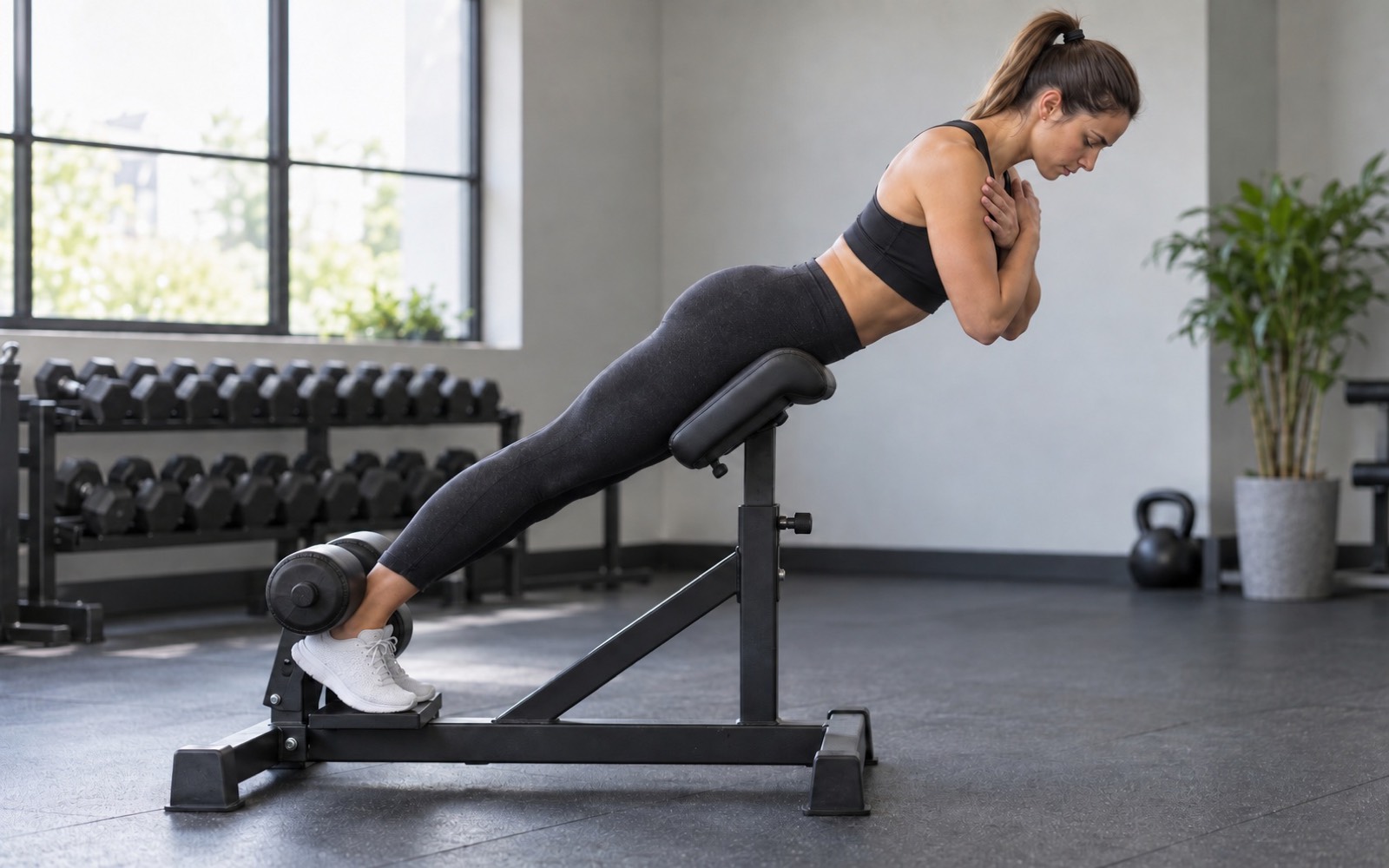
What is a back extension and which muscles does it work
A back extension is hip extension performed from a forward bend, with your hips on a pad and your feet locked in place. The movement happens at your hip joints: your pelvis and torso rotate together around the pad, like a door on a hinge. The muscles doing the work are on the back side of your body.
| Muscle | Where it is | What it does in a back extension | What the research shows |
|---|---|---|---|
| Gluteus maximus | from the pelvis to the back of the thigh | extends the hip and raises your torso | 140% more active than on a seated back-extension machine, on par with a Romanian deadlift; 74% more active than the deadlift in the top half of the movement |
| Hamstrings: biceps femoris, semitendinosus, semimembranosus | from the sit bone to the shin | extends the hip alongside the glutes | biceps femoris 71% more active than in a Romanian deadlift, and 174% more active than on a seated machine |
| Spinal erectors: longissimus, iliocostalis, multifidus | along the spine from the pelvis to the neck | keep the back straight; extend the lower back if you let it move | roughly the same in all three exercises tested; 25% higher when the lower back is allowed to arch |
| Abdominal muscles | front and sides of the torso | brace the pelvis and rib cage so the lower back doesn't sag | not measured in these particular studies |
Most of the numbers above come from a 2021 study by Andersen and colleagues. They measured muscle electrical activity (electromyography, or EMG) in 15 resistance-trained women, average age 22 with roughly 4 years of training experience. Each performed 3 reps at a weight she could lift 6 times, in three exercises: a 45-degree back extension wearing a weighted vest with a plate held at the chest, a Romanian deadlift, and a seated back-extension machine. The figure on arching comes from a separate 2002 study by Mayer and colleagues, covered in detail in section 05.
A second experiment shows the same pattern from a different angle. In 2003, Mayer and colleagues trained 9 people for 12 weeks on a 45-degree machine — once a week, one set of 8–20 reps to failure holding a plate — while 6 other people didn't train at all. The working weight in the exercise went up over those 12 weeks. But the strength of lumbar extension itself, measured on a dynamometer with the pelvis fixed in place, didn't change in any meaningful way: it went from 224 to 240 newton-meters (N·m), versus 176 and 178 N·m in the untrained group.
Together, these two studies point to the same conclusion: on the machine, the hips and thighs do the main work, while the lower back mostly holds the spine steady. That's the whole point of the technique below — move at the hips, keep the back still.
Why "hyper." In medicine, hyperextension means a joint bending past its normal range — a knee or a neck, for example. In gyms, the name stuck to this back-and-hip bench movement, even though a correct rep ends at a straight line, not past it. "Back extension" describes the same movement more plainly, and it's also the name used for the seated machine version.
What it's for. It strengthens your glutes, hamstrings and back muscles without a barbell in your hands, meaning without loading your spine along its length. Beginners often use it to build up to a Romanian deadlift or conventional deadlift; more advanced lifters use it as a finisher for glutes and hamstrings.
How to do a back extension on a 45-degree machine: step by step
On a 45-degree machine, you bend at the hips with a straight back and rise to a straight line from head to heels — no farther. Before your first set, spend a minute on setup: the pad height decides whether your hips can bend freely.
- Pad height. The top edge of the pad should sit about an inch (2–3 cm) below the crease where your belly meets your thighs. That lets your hips bend freely over the pad without the pad pressing into your stomach. Too high, and you'll bend from your lower back instead. Too low, and your torso will slide down.
- Feet. Set your feet on the platform about hip-width apart. The ankle pads sit behind your heels; press your heels into them firmly, with no gap.
- Knees. Keep your legs almost straight with soft knees. Locking your knees out fully tends to pull behind the knee.
- Arms. Cross your arms over your chest, hands on your shoulders. Arms behind your head make the exercise harder — save that for later.
- Starting position. Straighten out into one line from head to heels. Brace your core slightly, as if bracing for a light punch to the gut, and squeeze your glutes.
- The descent. Lower yourself over 2–3 seconds, bending at your hips. Keep your back straight for as long as you can hold it — for most people that's a hip angle around 90 degrees or a little less. Once your lower back starts to round, you've reached your bottom position for the day.
- The rise. Come up over 1–2 seconds, as if driving your hips into the pad, until your body is a straight line again. Don't go higher than that.
- The pause. Hold for one second at the top and squeeze your glutes.
- Head and breathing. Look at the floor 3–5 feet in front of you, with your neck in line with your spine. Inhale on the way down, exhale on the way up.
The tempo, the exact pad height, and the length of the pause are practical coaching cues — they haven't been tested against each other in research. What matters is a controlled movement with no jerking.
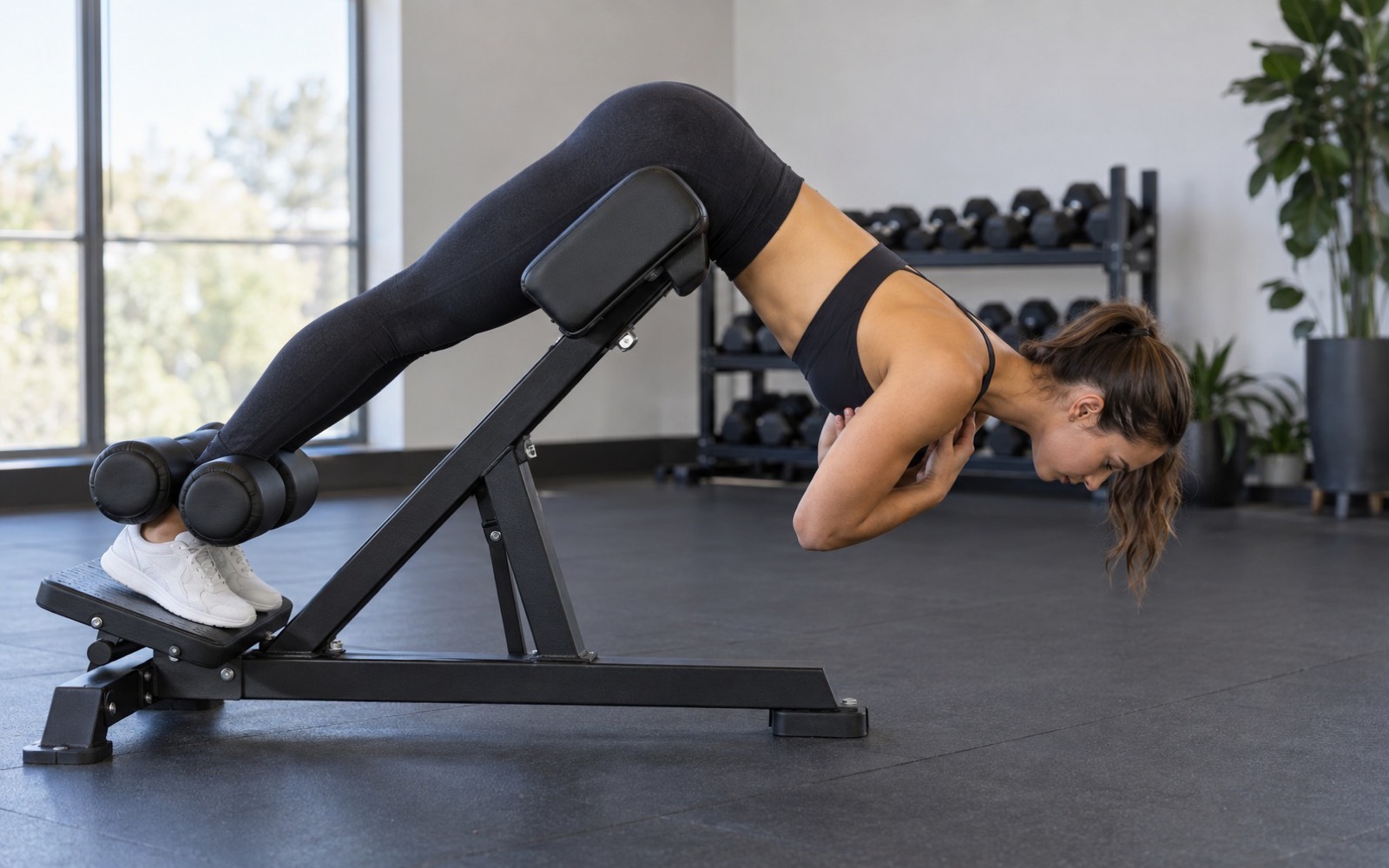
Horizontal back extension: how it differs from the 45-degree version
The horizontal and 45-degree versions differ in where the hardest point of the movement is. On a flat bench, your torso hangs almost vertically at the bottom, putting very little load on the muscles. At the top, you're holding it horizontal, and the load from your own body weight is at its highest. On a 45-degree machine, your torso stays angled throughout, so the peak load lands in the middle of the movement, and around 71% of it remains at the top (the math is in section 04). Coaches usually introduce the horizontal version second: its hardest point lines up with the end of the rep, and holding a pause there is tougher.
Who should use which version:
- The 45-degree machine — for starting out. The load is spread more evenly, it's easier to get set on the pad, and your feet are held more securely. This is usually what people mean by "back extension machine."
- A flat bench, or Roman chair, — once 20 clean reps on the 45-degree machine feel easy. The range of motion is longer, the hardest point sits at the top, so a pause there pays off the most. A glute-ham developer (GHD) works the same way for this version: the hip pad is round and the ankles are locked behind you.
- An outdoor gym station. Public fitness parks often have flat benches like this. The technique is the same, but the pad height usually isn't adjustable. Shift your position so the pad lands under the crease of your hip. If it still digs into your stomach, an at-home variation or a reverse hyperextension is a better fit.
Side back extension uses the same bench. You lie on your side, the pad under the upper part of your thigh, feet locked one behind the other, and raise your torso sideways. This works your obliques and quadratus lumborum. Start it with no weight and a short range of motion.
How much of your own weight you're actually lifting
A 154 lb (70 kg) man lifts about 93 lb (42 kg) of his own body weight during a back extension; a 132 lb (60 kg) woman lifts about 77 lb (35 kg). We calculated this using body-segment mass tables that de Leva refined in 1996 from data collected by Zatsiorsky and Seluyanov. By those tables, the head, torso and arms together weigh 60.3% of total body mass in men and 58.2% in women. Both legs together weigh 39.7% and 41.8%.
Table A. How much of your own body you're lifting (our calculation, based on de Leva, 1996)
| Body weight | Man: torso, head and arms (standard and 45°) | Woman: torso, head and arms | Man: legs (reverse hyperextension) | Woman: legs (reverse hyperextension) |
|---|---|---|---|---|
| 110 lb (50 kg) | 66 lb (30 kg) | 64 lb (29 kg) | 44 lb (20 kg) | 46 lb (21 kg) |
| 132 lb (60 kg) | 79 lb (36 kg) | 77 lb (35 kg) | 53 lb (24 kg) | 55 lb (25 kg) |
| 154 lb (70 kg) | 93 lb (42 kg) | 90 lb (41 kg) | 62 lb (28 kg) | 64 lb (29 kg) |
| 176 lb (80 kg) | 106 lb (48 kg) | 104 lb (47 kg) | 71 lb (32 kg) | 73 lb (33 kg) |
| 198 lb (90 kg) | 119 lb (54 kg) | 115 lb (52 kg) | 79 lb (36 kg) | 84 lb (38 kg) |
| 220 lb (100 kg) | 132 lb (60 kg) | 128 lb (58 kg) | 88 lb (40 kg) | 93 lb (42 kg) |
The second factor that decides the load is torso angle. It's hardest on your hips and thighs when your torso is horizontal — that's when its full weight works on the longest lever. The more your torso tilts away from horizontal, the smaller the load: it's proportional to the cosine of the angle. At 45°, about 71% of the load remains; at 60°, it's 50%; and when your torso hangs vertically, the load from body weight drops to zero. This tells you exactly where the hardest point falls in each version.
Table B. Where the load from body weight peaks (100% = torso or legs horizontal; our calculation)
| Phase | Flat bench (Roman chair) | 45-degree machine | Reverse hyperextension | Bodyweight "superman" |
|---|---|---|---|---|
| Bottom, hip angle around 90° | 0%, torso hanging | about 71% | 0%, legs hanging | — |
| Middle, hip angle around 45° | about 71% | 100% | about 71% | — |
| Top, body in a straight line | 100% | about 71% | 100% | 94–97% at a 15–20° torso lift, but the whole movement comes from arching your lower back |
| Above the line, arched | load on the hips drops, the movement shifts to the lower back | an extra 15° drops the load from 71% to 50% | load on the hips drops, the movement shifts to the lower back | — |
What this means in practice:
- On a flat bench, the peak is at the top, which is why a pause at the top is the single most valuable thing you can add there.
- On the 45-degree machine, the peak is in the middle of the rep, and your muscles stay under load even at the stretched bottom position. Andersen and colleagues describe the machine the same way in their 2021 paper. By their account, the load in a Romanian deadlift drops close to zero near the top.
- Rising above the straight line adds nothing for your glutes: on the 45-degree machine, an extra 15° of arch drops the load on your hips from 71% to 50%.
This math assumes a straight torso and arms crossed on your chest. Arms behind your head move part of your body weight farther from the hip joint and make the exercise harder. The percentages show how the load changes through the movement; in actual newton-meters, it also depends on your height and torso length.
Back extension for glutes vs. for your back: technique differences
The difference comes down to three things: which way your toes point, what your upper back does, and whether your lower back joins the movement. The same muscles work in both versions — what changes is how much of the work your lower back takes on.
| For glutes | For your back | |
|---|---|---|
| Feet | toes turned out, heels closer together | feet straight or toes slightly in |
| Upper back | slightly rounded, chin tucked, the shape doesn't change through the rep | straight from hips to head |
| What moves | only the hips; the torso rotates around the pad as one unit | the hips, with the back straight and braced the whole way |
| Range of motion | up to a straight line | up to a straight line, no arch |
| Pause | 1–2 seconds at the top, glutes squeezed | 1 second at the top |
| When to add weight | earlier, as soon as you can do 20 clean reps | later, once 20 reps with no weight feel easy and your lower back isn't sore the next day |
What the research shows. In 2002, Mayer and colleagues compared different hip and foot positions on a Roman chair in 12 healthy adults (7 men and 5 women, ages 18 to 35). When the hips and feet were turned inward, the lower-back muscles worked 18% harder than when turned outward. When someone deliberately arched their lower back, those same muscles worked 25% harder than in a neutral position. The glutes and hamstrings worked the same across all the variations.
That means turning your toes out and skipping the arch takes work off your lower back while your glutes keep doing just as much. That makes the glute-focused version a good fit if your lower back tires or aches quickly. Want more lower-back involvement instead? Turn your toes slightly in. Arching adds work for your lower back too, but it also adds load to your vertebrae — which is why we don't recommend it.
Why the pause at the top matters. In the 2021 Andersen study, the glutes were 74% more active in the top half of the 45-degree machine movement than in the top half of a Romanian deadlift, and the hamstrings were 124% more active. There was no such gap in the bottom half between the two exercises. The machine's advantage is concentrated right at the top, so don't skip that one second of pause.
Rounded-back back extension. For glutes, coaches often recommend rounding the upper back and tucking the chin. Researchers haven't measured this cue on its own, but the logic holds up: when your upper back is rounded and stays still, it's harder for your torso to arch at the top, and the rep ends with hip movement instead. Only the upper back rounds here — your lower back neither flexes nor extends under load.
check your pad height before your first set. Step into the machine and bend forward slowly with no weight. If you're bending from your lower back while your hips stay put, or the pad presses into your stomach at the bottom, drop the pad one notch.
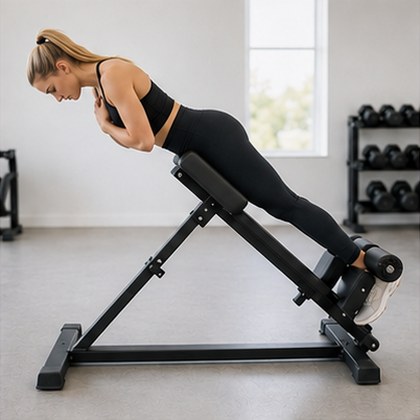 Glute-focused
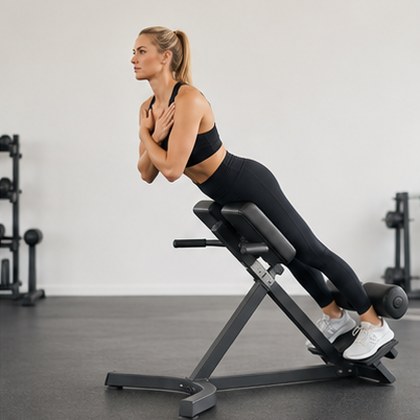 Back-focused
Sets, reps and when to add weight
Starting out, 2–3 sets of 10–20 reps twice a week is enough. Once you can do 20 clean reps with a pause at the top, and your lower back isn't sore the next day, you can start adding weight.
Here's where these numbers come from. In 2026, the American College of Sports Medicine (ACSM) updated its position stand on resistance training, replacing one from 2009. The authors pooled 137 systematic reviews covering more than 30,000 people. Strength gains respond best to 2–3 sets, full range of motion, and two or more sessions a week. Muscle growth responds best when a muscle gets 10 or more total sets a week across all exercises. Training to failure didn't reliably improve outcomes.
For a back extension, that translates as follows: 2–3 sets twice a week gives you 4–6 sets for your glutes and hamstrings, and you'd fill out the rest of the 10-set target with a Romanian deadlift, hip thrust or lunges. Mayer's 2003 study used one set once a week for 12 weeks — well below those targets — and it added working weight without changing the strength of the lower back itself.
A beginner plan (our guideline; these exact schemes haven't been directly compared in research):
| Stage | What to do | When to move on |
|---|---|---|
| Weeks 1–2 | no weight, 2–3 sets of 12–15 reps, arms crossed on chest | every rep has a pause at the top, and your lower back isn't sore the next day |
| Weeks 3–4 | no weight, 2–3 sets of 15–20 reps | 20 clean reps in every set |
| Month 2 | an 11 lb (5 kg) plate at your chest, 2–3 sets of 10–15 reps | 15 reps with a pause |
| Beyond that | a 22–44 lb (10–20 kg) plate or dumbbell at your chest, a plate behind your head, or a band | add 5–11 lb (2.5–5 kg) once you hit the top of your rep range again |
Hold the plate with crossed arms at your chest. Behind your head, it lengthens the lever, and the same weight feels noticeably heavier. A resistance band anchored under the platform and looped over your shoulders adds load right at the top of the movement.
Where to place it in your workout. If your session includes a deadlift or barbell squats, do the back extension after them: tired spinal erectors hold your back less well under a loaded bar. The ACSM's 2026 position also found strength gains were larger for exercises placed earlier in a session, so put whichever exercise you most want to improve first. Rest 60–90 seconds between sets. We break down how to pick sets and reps for different goals in how many sets and reps should you do.
The Sportygram workout diary has both versions of this exercise, "Back Extension" and "Back Extension for Glutes," with technique photos. You can tell Alex, the virtual coach in the chat, "add back extensions for glutes on Thursday," and he'll show a "Yes, add it" confirmation card before it lands in your Thursday plan. Log your sets and weight in the diary after training, so you can see when it's time to pick up a heavier plate. The app and the chat with Alex are in Russian for now.
Mistakes: where it pulls or hurts and what to fix
Most back-extension mistakes tell on themselves — where you feel a pull or an ache usually points straight to the fix.
| Where you feel it | What's wrong | What to fix |
|---|---|---|
| Lower back aches during the set or the next day | rising above the straight line, arching at the top, jerking up from the bottom | stop at a straight line, drop the weight, take 1–2 seconds on the way up |
| Neck | head tipped back | look at the floor a few feet ahead, keep your neck in line with your spine |
| Pressure in the groin or lower belly, can't bend far | pad set too high | drop the pad one notch |
| Torso slides down, knees hit the pad | pad too low or feet not locked in | raise the pad, press your heels into the ankle pads |
| Pull behind the knee | knees locked out fully | bend your knees slightly |
| Can't feel your glutes | short range of motion, no pause, lower back doing the moving | pause 1–2 seconds at the top, turn feet out, keep your upper back still |
| Hamstrings cramp | too many sets back to back with no rest, no warm-up | rest 60–90 seconds, make your first set light |
| Dizzy at the bottom | hanging head-down too long, holding your breath | don't linger at the bottom, exhale on the way up |
One of the most common mistakes is rising above the straight line: it feels like the muscles are working harder, but the load on your hips actually drops (section 04), while your lower back picks up more of the work. Another frequent one is jerking: when your torso gets thrown upward by momentum from the bottom, your lower back takes a sharp jolt.
An arch is hard to feel from the inside, so for your first few sessions, prop your phone up at hip height off to the side and film a set or two. On video, it's immediately obvious where the straight line ends and the arch begins.
How to do a back extension at home without a machine
At home, you can do a back extension on the edge of a sturdy bed, couch or bench while someone holds your shins, or on a stability ball with your feet braced against a wall. With no partner or ball on hand, a floor-based bird dog or superman is what's left.
On the edge of a bed or couch. Lie face down so the edge lands right under the crease of your hips, with your torso free to hang down. A partner holds your shins with both hands or sits on them. Lower yourself by bending at the hips, then rise to a straight line. The bed needs to be high enough that your torso can drop at least 45 degrees. Pad the edge with a folded towel.
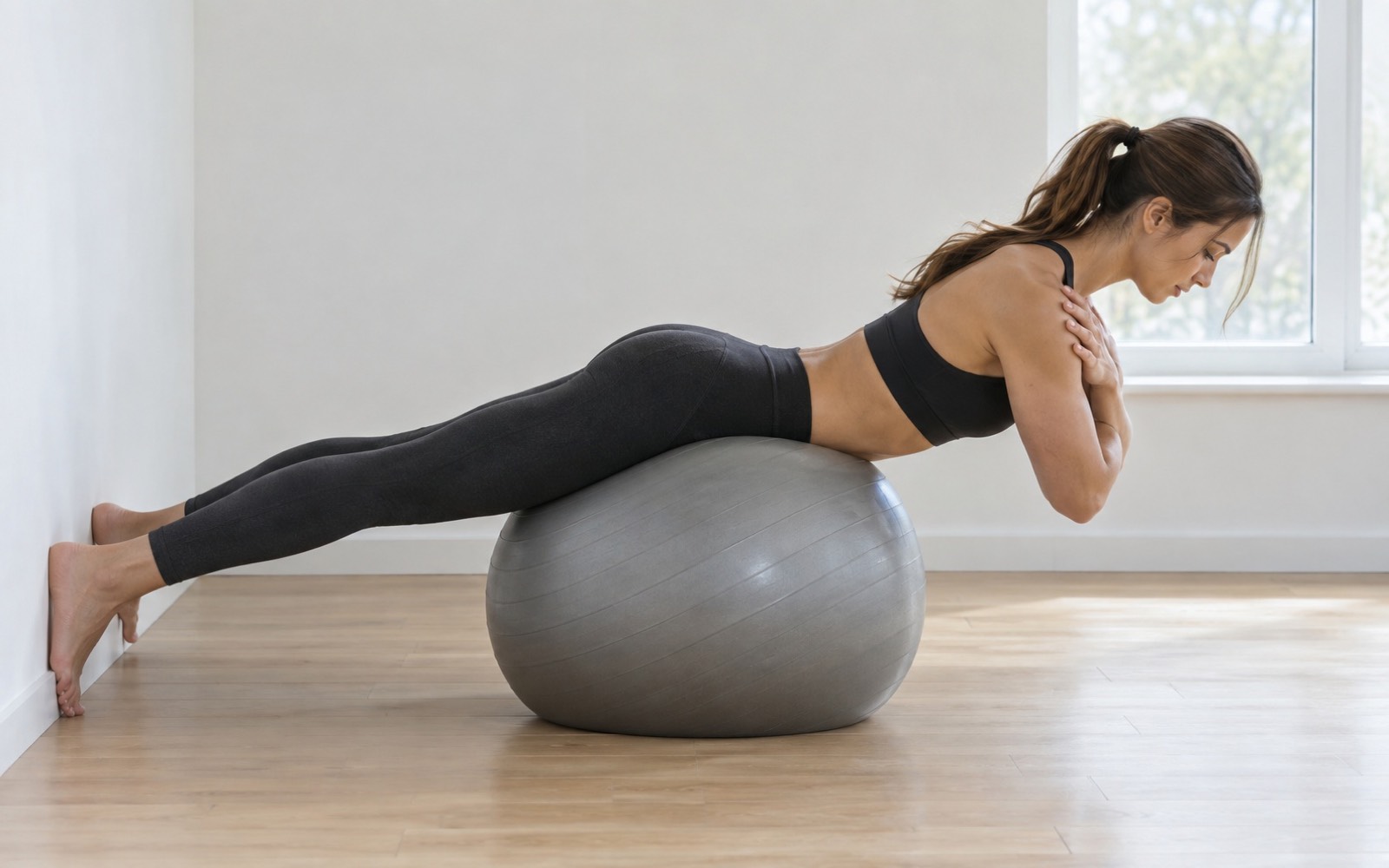
On a stability ball. Lie face down over the ball with your hips on it, feet braced where the floor meets a wall, feet a little wider than shoulder-width. Hands at your temples or crossed on your chest. Lower your torso around the ball and rise to a straight line. The range of motion here is shorter than on a machine, so you'll usually need more reps per set — 15–20.
On a chair. A regular chair is unstable and can tip over once your torso hangs off the edge. If you don't have another option, a stability ball or floor exercises are the safer call.
On the floor: superman and bird dog. In a superman, you lie face down and raise your torso and legs together. At a 15–20° lift, your torso is nearly horizontal, so the load from its weight stays around 94–97% of the maximum (our calculation) — but the entire movement comes from arching your lower back. In 1998, Callaghan, Gunning and McGill measured lumbar spine load and the activity of 14 trunk muscles in 13 young men across four back-extensor exercises. Exercises with active torso extension loaded the lower back the most, and the superman is exactly that kind of exercise. The least loading on the lower back came from raising one straight leg while the spine stayed still. Raising the opposite arm at the same time increases the load. That's how a bird dog works: on all fours, you extend one arm and the opposite leg at the same time. So start at home with single-leg raises and bird dogs, and save the superman for later.
A back-extension-and-sit-up bench. If you're buying one for home, check three things: whether the hip pad height is adjustable, whether the ankle pads are padded well, and whether the frame wobbles as you lower down.
If your goal is your glutes, a glute bridge pairs well with an at-home back extension: it needs only floor space, and the main load falls on the same gluteus maximus.
A test that shows progress. Holding your torso horizontal like this is known as the Sorensen test. Lie with your hips on the edge of a bench so the edge sits at the top of your pelvic bones, with a partner holding your shins. Cross your arms on your chest and hold your torso horizontal for as long as you can. In 1999, McGill and colleagues measured this hold time in 75 young healthy adults, 31 men and 44 women. Men held it for an average of 146 seconds, women 189 seconds. Repeat measurements on five consecutive days, and again 8 weeks later, came out nearly identical, with a reliability coefficient above 0.97. Repeat the test every 4–6 weeks: if your time goes up, your back muscles are getting more resilient. Skip the test if your back hurts.
Reverse hyperextension: what it is and how to do it with or without a machine
A reverse hyperextension is the same hip extension, run in reverse: your torso stays still on a bench, and your straight legs lift up to a line with your torso instead. Gyms have a dedicated pendulum-style machine for this, loaded with plates. At home, a tall bench or a sturdy table works.
What the research shows. Two studies came to different conclusions, so here are both. In 2019, Lawrence and colleagues compared two sets of 10 reps at matched weight in each exercise across 20 people. Total glute and hamstring activity per set was higher in the standard back extension, while the spinal erectors worked about the same in both. In the reverse version, lumbar flexion was smaller — 20.4° versus 31.1° — and the hip-to-torso angle changed more, 76.6° versus 64.7°. But the peak extensor moment on the lower back — essentially the load its muscles and ligaments have to hold — was 129% higher in the reverse hyperextension, and the average moment was 78% higher.
In 2021, Cuthbert and colleagues measured 10 people and got a different result. In the reverse hyperextension, peak activity of the spinal erectors, gluteus maximus and biceps femoris was 34–71% higher than in the standard version, and average activity was 28–65% higher across nearly every measurement. With only 20 and 10 people in these two studies, there's no settled answer yet on which exercise loads the glutes harder. Legs make up about 40% of body weight, so even with no plates, a 154 lb (70 kg) person lifts 62–64 lb (28–29 kg) in a reverse hyperextension (Table A, section 04).
On the machine:
- Lie face down on the platform so your hips are at the edge and your legs hang free.
- Grab the handles and press your chest into the platform.
- Hook your shins under the pendulum strap, just above your ankles.
- Raise your straight legs to a line with your torso, driving with your glutes, and hold for a second.
- Lower under control. Don't let the pendulum swing — momentum ends up in your lower back.
Start with no plates, or the smallest weight available, until the movement is smooth. The top position is the same as a standard back extension: a straight line, no arch.
Without a machine. Lie face down on a tall, flat bench, table, or the edge of a bed so your hips are at the edge and your legs hang down. Hold the edges of the surface with your hands. Raise your straight legs, toes together, to a line with your torso, hold for a second, and lower. On a stability ball, you do the same thing with your hands braced on the floor; the range of motion is shorter there, which makes it a good starting point at home. To feel your glutes more, squeeze them at the top and don't raise your legs past the line of your torso.
Can you do back extensions with a herniated disc or lower back pain
During an acute flare-up, when your back hurts suddenly and severely, skip back extensions. With chronic lower-back pain, exercise helps, but with a herniated disc or bulging disc, a doctor or physical therapist should design your program — they know exactly which movements your specific back can tolerate.
What we know about exercise as treatment. A 2021 Cochrane review by Hayden and colleagues pooled 249 randomized trials with 24,486 participants who had chronic nonspecific low back pain, meaning pain lasting more than 12 weeks with no specific identified cause. Compared with no treatment, usual medical care, or a placebo, exercise reduced pain by an average of 15.2 points on a 0-to-100 scale. The authors had set 15 points in advance as the threshold for a difference people would actually notice, and exercise cleared it. Disability dropped by 6.8 points, short of their 10-point threshold. The review looked at exercise broadly, so a back extension is one option among several, not the only one.
How to come back after pain. Once the acute pain has passed and your doctor has cleared you for load:
- start with no weight, on a 45-degree machine or with the at-home exercises from section 08;
- shorten the range of motion and only lower yourself halfway;
- stop at a straight line, no arch at the top;
- turn your toes out, which shifts less work onto your lower back;
- pay attention to how you feel the next day: if your back isn't worse, add 2–3 reps.
If your lower back is sore after a deadlift, a back extension done with a straight back and a stop at the straight line is a gentler substitute for a week or two. Neither one belongs in your program during an acute flare-up. For which other exercises help with back pain and the order to bring them in, see lower back pain: exercises that actually help.
See a doctor first if:
- pain shoots down your leg below the knee;
- your foot goes numb or your leg feels weak;
- you notice bladder changes or numbness in your groin — the same day, in that case;
- the pain started after a fall or a blow;
- your back hurts at night at rest and doesn't ease with a change in position;
- a fever shows up alongside the pain.
Pregnancy. Lying face down over a pad should only happen after talking to the doctor managing your pregnancy. In the second and third trimesters, back extensions are usually swapped for standing or all-fours exercises, like a bird dog.
Past 40. Age by itself isn't a reason to avoid this exercise — it works for both women and men past 40. Start with no weight on the 45-degree machine and progress using the plan in section 06. If you have chronic spine or joint conditions, check your program with a doctor.
Questions and answers
What's better for glutes: a back extension or a hip thrust?
Do both. On a 45-degree back extension machine, the gluteus maximus works on par with a Romanian deadlift (Andersen, 2021), and it also loads the hamstrings heavily. In a hip thrust, the load peaks right at the top, and you can use noticeably more weight. We cover the technique in how to do hip thrusts.
Can you do back extensions every day?
There's not much point. Under the ACSM's 2026 position, two or more sessions a week is enough for strength, and muscle growth needs 10 or more total sets a week per muscle, added up across exercises. Do weighted back extensions 2–3 times a week. A light, no-weight set as a warm-up can be done more often, as long as your lower back isn't sore afterward.
Back extension or deadlift: which is safer for your back?
In a deadlift, the barbell loads your spine along its length, and the heavier the weight, the stricter your form has to be. A back extension carries no such load, and the spinal erectors worked just as hard in it as in a Romanian deadlift (Andersen, 2021). For a beginner, a back extension is simpler and easier on the back, but it doesn't replace a deadlift: a deadlift teaches you to pick up something heavy off the floor with your whole body. We cover the technique in how to deadlift with proper form.
Why does your lower back hurt after back extensions?
Most often, it's the arch at the top: it adds 25% more work for your lower-back muscles and nothing at all for your glutes (Mayer, 2002). Other causes include jerking from the bottom, adding weight too soon, and a pad set too high, which makes your lower back bend instead of your hips. A little muscle soreness in your back after your first few sessions is normal and passes in a few days. If the pain is sharp, shoots down a leg, or lasts a week, see a doctor.
What can you use instead of a back extension if you don't have a machine?
At home: the edge of a bed or couch with a partner, a stability ball against a wall, a reverse hyperextension on a tall bench, a glute bridge, or a bird dog. At the gym, a dumbbell or barbell Romanian deadlift works your glutes at the same level (Andersen, 2021). If your back is sore, start with a single-leg raise with a still spine: in Callaghan's 1998 study, it loaded the lower back the least of everything tested.
Do women need back extensions, and will it widen your waist?
Yes, if your goal is glutes and a strong back — the 2021 Andersen study specifically used trained women. The spinal erectors are long, narrow muscles running along your spine; they sit toward your back and don't meaningfully affect waist width. Waist width comes down mostly to belly fat and skeletal build.
Do back extensions work your abs?
Barely. Your abdominal muscles only brace your torso here — the actual work falls on your glutes, hamstrings and spinal erectors. The confusion comes from home benches marketed as "back extension and sit-up" combos: one bench, two different exercises, sit-ups lying on your back and back extensions lying on your front.
How many seconds should you be able to hold a horizontal back extension for your back to count as strong?
McGill's 1999 measurements give a benchmark: young healthy men held their torso horizontal at the edge of a bench for an average of 146 seconds, women for 189 seconds. The spread is wide — plus or minus 51 seconds for men, 60 for women. Compare yourself against yourself: time it now, then again in 4–6 weeks. This isn't a diagnostic test, and it's not one to do while your back hurts.
The bottom line
- A back extension is hip extension with your hips resting on a pad. On a 45-degree machine, the glutes work on par with a Romanian deadlift, the biceps femoris works 71% harder than in that lift, and the spinal erectors hold the spine steady (Andersen, 2021).
- At the top, your body forms a straight line. Rising above it on the 45-degree machine drops the load on your hips from 71% to 50%, and an arch adds 25% more work for your lower-back muscles.
- A 154 lb (70 kg) man lifts about 93 lb (42 kg) of his own body weight; a 132 lb (60 kg) woman lifts about 77 lb (35 kg). On a flat bench, the peak load is at the top; on a 45-degree machine, it's in the middle of the movement.
- For glutes, turn your toes out, keep your upper back still, and pause 1–2 seconds at the top. With toes turned in, the lower-back muscles worked 18% harder than with toes out, while the glutes worked the same either way (Mayer, 2002).
- Start with 2–3 sets of 10–20 reps twice a week. Add a plate once you get 20 clean reps.
- With sudden severe pain, pain shooting down a leg, numbness, or bladder changes, see a doctor first.
Checklist: before your back extension set
- Top edge of the pad about an inch (2–3 cm) below your hip crease, hips bending freely.
- Feet on the platform, heels pressed into the ankle pads.
- Knees soft, not locked out.
- Arms crossed on your chest.
- Down over 2–3 seconds with a straight back.
- Straight line from head to heels at the top, 1-second pause.
- Eyes on the floor ahead of you, exhale on the way up.
- Your lower back isn't sore the next day — add reps or weight.
Sources
- Andersen V., Pedersen H., Fimland M.S. et al. Comparison of Muscle Activity in Three Single-Joint, Hip Extension Exercises in Resistance-Trained Women. Journal of Sports Science and Medicine, 2021. — 15 resistance-trained women: gluteus maximus was 140% more active on the 45-degree back extension than on a seated machine, and on par with a Romanian deadlift (74% higher in the top half); hamstrings were 71% more active than in the deadlift; spinal erectors were equal across exercises.
- Mayer J.M., Udermann B.E., Graves J.E., Ploutz-Snyder L.L. Effect of Roman chair exercise training on the development of lumbar extension strength. Journal of Strength and Conditioning Research, 2003. — 9 people, 12 weeks, one set once a week: working weight increased, but lumbar extension strength didn't change meaningfully (224 → 240 N·m).
- Mayer J.M., Verna J.L., Manini T.M., Mooney V., Graves J.E. Electromyographic activity of the trunk extensor muscles: effect of varying hip position and lumbar posture during Roman chair exercise. Archives of Physical Medicine and Rehabilitation, 2002. — 12 healthy adults: lower-back muscles were 18% more active with hips turned in versus out, and 25% more active with a deliberate lumbar arch; glutes and hamstrings were unchanged.
- de Leva P. Adjustments to Zatsiorsky-Seluyanov's segment inertia parameters. Journal of Biomechanics, 1996. — Body segment mass data, the basis for our Table A and Table B.
- Currier B.S., D'Souza A.C., Singh M.A.F. et al. American College of Sports Medicine Position Stand. Resistance Training Prescription for Muscle Function, Hypertrophy, and Physical Performance in Healthy Adults: An Overview of Reviews. Medicine & Science in Sports & Exercise, 2026. — 137 reviews, more than 30,000 participants: strength responds best to 2–3 sets and two or more sessions a week; muscle growth responds best to 10 or more sets a week; training to failure didn't reliably help.
- Callaghan J.P., Gunning J.L., McGill S.M. The relationship between lumbar spine load and muscle activity during extensor exercises. Physical Therapy, 1998. — 13 men: active torso-extension exercises loaded the lower back the most; a single straight-leg raise with a still spine loaded it the least.
- McGill S.M., Childs A., Liebenson C. Endurance times for low back stabilization exercises: clinical targets for testing and training from a normal database. Archives of Physical Medicine and Rehabilitation, 1999. — 75 young healthy adults: horizontal torso hold times of 146 ± 51 seconds for men and 189 ± 60 seconds for women.
- Lawrence M.A., Chin A., Swanson B.T. Biomechanical Comparison of the Reverse Hyperextension Machine and the Hyperextension Exercise. Journal of Strength and Conditioning Research, 2019. — 20 people: total glute and hamstring activity was higher in the standard back extension; the reverse version showed less lumbar flexion (20.4° vs. 31.1°) but a 129% higher peak lumbar moment.
- Cuthbert M., Ripley N.J., Suchomel T.J., Alejo R., McMahon J.J., Comfort P. Electromyographical Differences Between the Hyperextension and Reverse-Hyperextension. Journal of Strength and Conditioning Research, 2021. — 10 people: peak activity of the spinal erectors, gluteus maximus and biceps femoris was 34.1–70.7% higher in the reverse hyperextension than in the standard version.
- Hayden J.A., Ellis J., Ogilvie R., Malmivaara A., van Tulder M.W. Exercise therapy for chronic low back pain. Cochrane Database of Systematic Reviews, 2021. — 249 trials, 24,486 participants: exercise reduced chronic low-back pain by an average of 15.2 points out of 100 compared with no treatment, usual care, or a placebo.
This article is for informational purposes only and is not a substitute for medical advice.