

the protocol is 20/10 × 8 = 4 minutes. In Tabata's 1996 experiment, 7 men trained 5 times a week for 6 weeks and gained 28% in anaerobic capacity and 7 ml/kg/min in VO2max, but they pedaled at 170% of their maximal aerobic power, to exhaustion. For regular people, one block costs 55–58 calories (Emberts, 2013; Wang, 2024), and the afterburn adds 6–15% on top (LaForgia, 2006). In untrained students, 8 weeks of Tabata raised VO2max by 18%, 20 minutes of steady cardio raised it by 19%, and the difference between them was not significant (Foster, 2015).Without a calorie deficit, Tabata does not reduce fat: 12 weeks of three sessions a week in overweight adults changed neither body fat percentage nor fat mass (Padkao, 2025). Belly fat never comes off on its own (Ramírez-Campillo, 2013). Do it 2–3 times a week with 48–72 hours between sessions; every day is a no.
A Tabata workout is interval training made of 8 rounds: 20 seconds of all-out work, 10 seconds of rest, repeated for 4 minutes straight. The protocol was built for the Japanese speed skating team, and physiologist Izumi Tabata tested and published it in 1996, so the name is simply the scientist's surname. In one 4-minute block an average person burns about 55–58 calories, a bit more than half a banana, and no afterburn effect changes that number in any serious way. What Tabata does build quickly is endurance: in female university students, 12 weeks of three sessions a week raised oxygen uptake by almost 13%. A beginner needs only 4 rounds at an effort of 7 out of 10, three times a week. Nobody should start a full Tabata from zero: 4–6 weeks of walking and easy cardio come first.
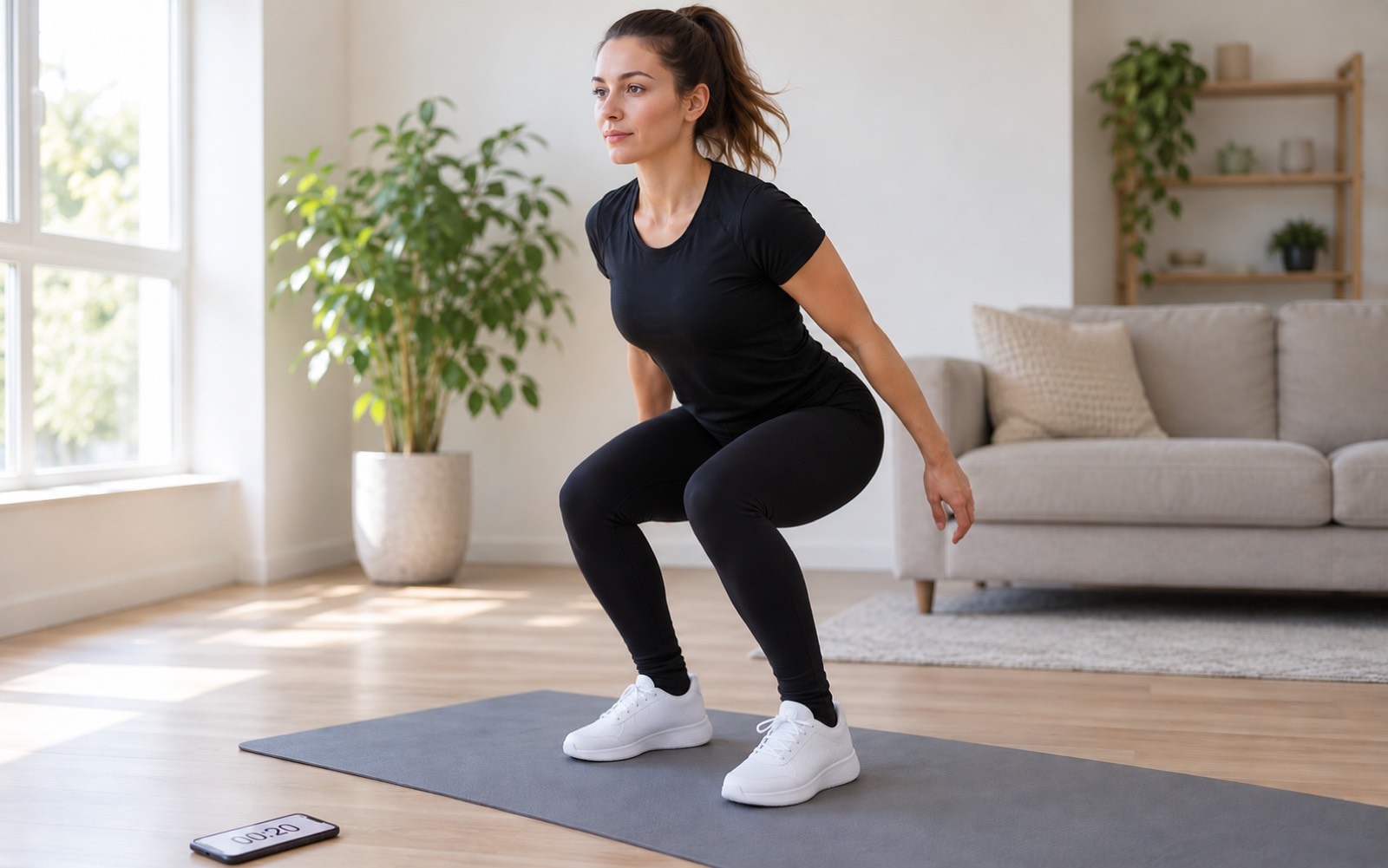
What Tabata is and where the 20 seconds of work and 10 of rest come from
Tabata is a specific interval protocol: 7–8 bouts of 20 seconds of very hard work with 10 seconds of rest in between, about 4 minutes in total. Any other split, say 30 seconds on and 30 off, or 40 on and 20 off, is still interval training, but it is no longer Tabata.
Here is where those exact numbers come from. In the 1980s, Koichi Irisawa, head coach of the Japanese national speed skating team, trained his athletes with short bouts on a stationary bike. Physiologist Izumi Tabata studied the scheme in the lab and published the results in 1996 in Medicine & Science in Sports & Exercise. The experiment was set up like this. One group pedaled steadily for 6 weeks, 5 days a week: 60 minutes at 70% of maximal oxygen uptake (VO2max). The second group, 7 men, trained for the same 6 weeks and the same 5 days a week doing 7–8 bouts of 20 seconds at a power of about 170% of VO2max with 10 seconds of rest.
Tabata's 1996 result came out like this. The hour-of-cardio group raised VO2max from 53 to 58 ml/kg/min, and their anaerobic capacity, the ability to work flat out without oxygen, did not change. The interval group gained 7 ml/kg/min in VO2max and 28% in anaerobic capacity. Four minutes of hard work delivered more than an hour of steady work. That is where the fame comes from.
Three corrections that usually get lost in other articles but are stated plainly in Tabata's own papers from 2019 and 2025.
- The power was prescribed, there was no "as hard as you can." 170% of VO2max is a workload at which a person is exhausted in about 50 seconds of steady pedaling, and it was chosen so that in intervals they would be exhausted by the 7th or 8th bout. They pedaled at 90 rpm, and once the cadence dropped to 85, the set was over. So in the original protocol, 8 rounds means failure, and "I did 8 and walked off feeling fine" means the power was lower than required.
- It was 5 times a week in young, trained men. In his 2019 review, Tabata writes directly that the method was created for elite athletes. A home Tabata of squats and burpees three times a week is an adaptation that grew out of that experiment over 30 years (Tabata, 2025).
- Names like "Tabata for abs" and "morning Tabata" have nothing to do with the protocol. Tabata sets intensity and time. No muscle group is written into it.
What this means for you: the original Tabata was a tool for athletes with a solid base. For a regular person it gets softened, and below we show exactly how.
How Tabata differs from regular HIIT, circuit training and steady cardio
Tabata is one specific type of high-intensity interval training (HIIT) with a rigid 20/10 × 8 structure and an effort above maximal aerobic power; other HIIT formats can be longer, gentler, and use any work-to-rest ratio. What intervals are in general, what they do for your heart, and how the afterburn works are covered in our HIIT guide; here we focus on the differences.
| Tabata | Regular HIIT | Circuit training | Steady cardio | |
|---|---|---|---|---|
| Duration | 4 min per block, 1–3 blocks | 15–25 min | 20–40 min | 30–60 min |
| Work / rest | 20 s / 10 s, 8 rounds | e.g. 3 min work / 2 min easy × 4 (Wang, 2024) | stations of 30–60 s, rest between circuits | no rest |
| Effort | originally 170% VO2max, above maximal aerobic; at home 8–9 out of 10 | 7–9 out of 10, about 80–95% VO2max | 6–8 out of 10, often with weights | 5–6 out of 10, 50–70% VO2max |
| Calories per session in overweight men (Wang, 2024) | 55 in 4 min | 215 in 20 min | no data in this study | 225 in 30 min |
| VO2max gain in untrained people over 8 weeks (Foster, 2015) | +18% | +18% (13 × 30 s / 60 s) | — | +19% (20 min at 90% of threshold) |
| Best for | people with a base and little time | people who want gentler, longer intervals | people who need both strength and endurance | beginners and anyone who wants to enjoy the session |
The most telling comparison was done by Foster in 2015. 55 untrained students trained on a stationary bike 3 times a week for 8 weeks in one of three modes: 20 minutes of steady cardio, Tabata 8 × 20/10 at 170% VO2max, or the Meyer protocol, 13 bouts of 30 seconds with a minute of rest. VO2max rose by 19%, 18% and 18%, peak power by 17%, 24% and 14%. No statistical difference between groups was found. Something else was: participants rated Tabata as the least enjoyable of the three, and enjoyment dropped in all groups across the 8 weeks.
What this means for you: for a beginner, Tabata beats regular cardio in nothing except time. If you like walking uphill or riding a stationary bike for 20 minutes, you get the same endurance gain and, judging by Foster's data, you are more likely to stick with it. Circuit training is a separate genre with stations and weights, and it has its own guide.
How many calories Tabata burns: the honest math
One Tabata block, 4 minutes, costs about 55–58 calories, and a 20-minute session of four blocks with a minute of rest between them costs 240–360 calories.
Here is where the numbers come from. In 2013, Emberts and Porcari measured gas exchange in 16 trained people, 8 men averaging 35 and 8 women around 28, during a 20-minute Tabata: four 4-minute blocks of bodyweight exercises with a minute of rest between blocks. Heart rate held at 156 beats, which is 86% of maximum, oxygen uptake was 74% of maximum, blood lactate reached 12.1 mmol/L, and participants rated the effort 15.4 out of 20 on the Borg scale, which means "hard." Energy expenditure was 14.5 ± 2.7 calories per minute, 240–360 calories per session.
That is the origin of the "15 calories a minute" line that travels through every Tabata article. What usually gets left out is that these were trained people holding the pace for 20 minutes. In 2024, Wang tested the same thing in 15 overweight students (body mass index 27): one 4-minute Tabata block cost them 55 calories, 20 minutes of intervals at "3 minutes at 80% / 2 minutes at 20%" cost 215, and 30 minutes of steady cardio at 50% VO2max cost 225. Per minute, Tabata really does burn the most of the three. Per session, it burns the least, simply because it is short.
| What you did | Minutes of work | Calories at full effort | About the same as | Weeks to lose 1 kg (2.2 lb) of fat at 3 sessions a week, if you don't change your diet |
|---|---|---|---|---|
| 4 rounds (half a block) | 2 | 28–29 | a third of a banana | about 90 |
| 1 block, 8 rounds | 4 | 55–58 | a bit more than half a banana (a banana is about 90–100 calories) | about 45 |
| 2 blocks | 8 | 110–116 | one banana and a bit | about 23 |
| 3 blocks | 12 | 165–174 | almost two bananas | about 15 |
| 20-minute session, 4 blocks | 16 (+ 4 min rest) | 240–360 | a cheese sandwich, about 250 calories | 7–11 |
| Afterburn after any of these | — | +6–15% of the row's number | +3–9 calories per block, +15–54 for 20 minutes | — |
The calculation uses the usual benchmark that a kilogram (2.2 lb) of fat corresponds to a deficit of about 7,700 calories; Hall showed in 2008 that this rule works reasonably well in people carrying more than 30 kg (66 lb) of fat, and in leaner people the deficit per kilogram comes out even smaller.
Now the afterburn, also called EPOC, excess post-exercise oxygen consumption. The main review on the subject is LaForgia's from 2006. A prolonged afterburn lasting 3–24 hours is possible, but only after workloads an average person cannot complete: 50 minutes or more at 70% VO2max, or 6 minutes or more at 105% VO2max and above. Even in those studies, the afterburn came to 6–15% of what was spent during the workout itself. The authors conclude that optimism about the role of the afterburn in weight loss is generally unfounded. So add 3–9 calories to the 58 of a block, and 18–45 to the 300 of a session. Lines like "your metabolism is revved for a day" and "fat keeps burning for 36 hours" have no connection to these numbers.
In 2025, Cheng measured the afterburn right after Tabata in 32 students with obesity (body mass index 31.5) who did one, two or three blocks with 10 minutes of rest between them. In 30 minutes of recovery, they oxidized 4.41 g of fat after one block, 5.04 g after two, and 4.11 g after three. These are grams of fat, nowhere near the promised hundreds of calories. And the third block turned out worse than the second on this measure.
Does Tabata work for weight loss
Tabata helps you lose weight exactly the way any cardio does: it adds calorie expenditure, and fat comes off only in a deficit. Its one advantage is time.
Here is what the meta-analyses say. In 2017, Wewege pooled 13 studies in overweight adults, on average 10 weeks of 3 sessions a week: intervals and steady cardio reduced fat mass and waist circumference equally, and intervals took about 40% less time. One more detail from that paper: running produced noticeable fat loss in both formats, the stationary bike did not. The authors stress that body weight barely changed in either case: 10 weeks take off a modest amount of fat, and the promised "several times faster" exists in neither format.
Now the most sobering part. In 2025, Padkao trained 36 overweight adults for 12 weeks, 3 times a week, using a modified Tabata: four progressive bodyweight blocks at 75–85% of maximal perceived effort, roughly 7.5–8.5 out of 10. Over 12 weeks, leg muscle mass, arm and thigh muscle thickness, strength, endurance and VO2peak all increased, and the waist-to-hip ratio decreased. Body fat percentage and fat mass did not change at all. The authors conclude that results would be more visible if the training were combined with dietary changes. Two takeaways for us from this paper: Tabata without a calorie deficit does not burn fat, and a modified Tabata at 75–85% effort is a workable option for overweight people with no athletic background.
There is also a counterexample. In 2023, Lu followed 117 female university students around age 20 for 12 weeks: 59 did Tabata three times a week, 58 lived as usual. The session was short: 10 minutes of warm-up, one block of 8 × 20/10 using four bodyweight exercises, and 5 minutes of cool-down. In the Tabata group, body fat percentage dropped by 2.57% while it rose by 3.23% in the control group, fat mass fell by 2.61%, resting heart rate dropped by 8.62%, and time spent in moderate and vigorous activity on regular days, measured by accelerometer, rose by 15.5%. Here Tabata worked, but notice: young women without excess weight, 12 weeks, and probably that same increase in activity outside the sessions. How intervals affect appetite and why it is easy to overeat after a hard workout is covered in our article on exercise for weight loss and appetite.
What this means for you: if the goal is weight, a calorie deficit comes first, and Tabata is a way to add 170–900 calories a week to it, depending on volume. If you are overweight and have had a long break from exercise, Tabata the Padkao way, at 75–85% effort, is a good start for endurance and muscle. A magic button for fat it will never be.
Tabata for belly fat: myth or not
Your belly gets leaner from Tabata, but only together with the rest of your body and only in a calorie deficit; ab exercises inside a Tabata do not remove fat from the belly specifically.
Spot fat reduction does not exist, and this was tested in a direct experiment. In 2013, Ramírez-Campillo trained one leg in 11 people for 12 weeks, 3 times a week: 960–1,200 reps of a light leg press per session. Whole-body fat mass dropped by 5.1%, but the trained leg kept exactly as much fat as the untrained one. The fat came off the arms, minus 10.2%, and the trunk, minus 6.9%. The body takes fat from wherever it finds convenient, and the muscles under that fat have nothing to do with it. Why there is no such thing as a fat-burning exercise is covered in a separate article.
The good news is that intervals are good at removing the deep belly fat specifically. In 2018, Maillard pooled 39 studies with 617 participants, average age 39, half of them women: interval training reduced total, abdominal and visceral fat, with no difference between men and women, and running worked better than the stationary bike. One nuance: the abdominal changes in these studies were visible only on CT and MRI scans, and a tape measure often missed them. In other words, your waist can barely change while the fat around your internal organs is already going.
What this means for you: mountain climbers and planks in a Tabata load your abs, and that is useful for the muscles. But "Tabata for belly fat" and "Tabata for legs and glutes" slim you the same way, across the whole body, in a calorie deficit. Choose exercises by what you can do at 9 out of 10. The area you want to shrink has no say in that choice.
What Tabata gives you besides calories
The main thing Tabata gives you is endurance and heart fitness: VO2max rises fast, resting heart rate drops, and in overweight people leg muscles grow.
- VO2max. This is the maximum amount of oxygen your body can use per minute, the main measure of endurance and one of the strongest predictors of health. In untrained students, 8 weeks of Tabata gave +18% (Foster, 2015); in female students, 12 weeks of one block three times a week gave +12.87% against −0.27% in the control group (Lu, 2023); in athletes, 6 weeks gave +7 ml/kg/min (Tabata, 1996).
- Anaerobic capacity. +28% in Tabata's 1996 group, while an hour of steady cardio a day did not change it. For you this means running up the stairs to the seventh floor without stopping on the fourth.
- The heart in people who need it most. In 2014, Weston pooled 10 studies with 273 patients with coronary heart disease, heart failure, hypertension, metabolic syndrome and obesity: intervals raised VO2peak by 3.03 ml/kg/min, or 9.1%, more than steady cardio did. An important caveat: all these people trained under medical supervision, more on that in section 12.
- Muscle. In Padkao's 2025 study, 12 weeks of modified Tabata increased muscle mass in both legs and the thickness of the biceps, triceps and front thigh muscles. Tabata will not build a bodybuilder's muscles, but in someone who has not trained for a long time, the body changes noticeably.
- Resting heart rate. −8.62% over 12 weeks in female students (Lu, 2023). If it was 72, it becomes about 66.
How to do Tabata: warm-up, effort, timer and counting rounds
One Tabata session is 10 minutes of warm-up, 8 rounds of 20 seconds of work and 10 seconds of rest, then 5 minutes of cool-down; effort in the work intervals is 8–9 out of 10, and heart rate by the end of the block is 85–90% of maximum.
The warm-up is part of the protocol. In Lu's 2023 study, the warm-up lasted 10 minutes, and that was for a single Tabata block. Five minutes of marching in place or light jogging, two minutes of circles at the shoulders, hips and knees, then 2–3 minutes of the same exercises that will be in the block, at half speed. Cold muscles and 20 seconds of all-out jumping are a bad pair.
Effort. The benchmark for a beginner in the first two weeks is 7 out of 10, then 8–9. By heart rate, that is 85–90% of maximum by the end of the block: in Emberts' 2013 study, trained people averaged 86%, and Lu's students in 2023 reached 83% against a target of 90%. A heart rate monitor lags during Tabata because the intervals are so short, so go by the feeling of "ten more seconds and I couldn't." If you wear a monitor, look at the peak toward the end of the block: the average heart rate over 4 minutes including rests tells you nothing.
The 10-second rest means standing and breathing. No walking to the water bottle, no fixing the mat. In the original protocol, the pause is short precisely so that the oxygen debt accumulates from round to round.
The timer. Any interval timer app on your phone with fields for "work 20 / rest 10 / rounds 8" and a sound. Settings by level:
| Level | Work | Rest | Rounds | Blocks | Break between blocks | Total with 10 min warm-up and 5 min cool-down |
|---|---|---|---|---|---|---|
| Beginner, weeks 1–2 | 20 s | 10 s | 4–6 | 1 | — | 17–18 min |
| Beginner, weeks 3–6 | 20 s | 10 s | 8 | 1 | — | 19 min |
| Intermediate | 20 s | 10 s | 8 | 2 | 3–4 min of walking | 26–27 min |
| Advanced | 20 s | 10 s | 8 | 2–3 | 3 min of walking | 26–33 min |
| "30/30", "40/20", "45/15" | — | — | — | — | — | this is regular HIIT, it does not count as Tabata |
How to count rounds without an app. Put a phone with a stopwatch in front of you, or a watch with a second hand. Every minute is exactly two rounds: start at the 12, work until the 4 (20 seconds), rest until the 6, work until the 10, rest until the 12. Four minutes is eight rounds, nothing to count, just watch the hand. If you are doing 4 or 6 rounds, that is 2 or 3 minutes.
for your first two sessions, set the timer to 4 rounds instead of 8 and do them at an effort of 7 out of 10. The job of these sessions is to learn the scheme and find out what pace you can hold for all 20 seconds without collapsing in the last five. If the pace in round four is the same as in round one, add two rounds next session. If the pace halved, the exercises you picked are too hard; swap them for the no-jump versions in the tables below.
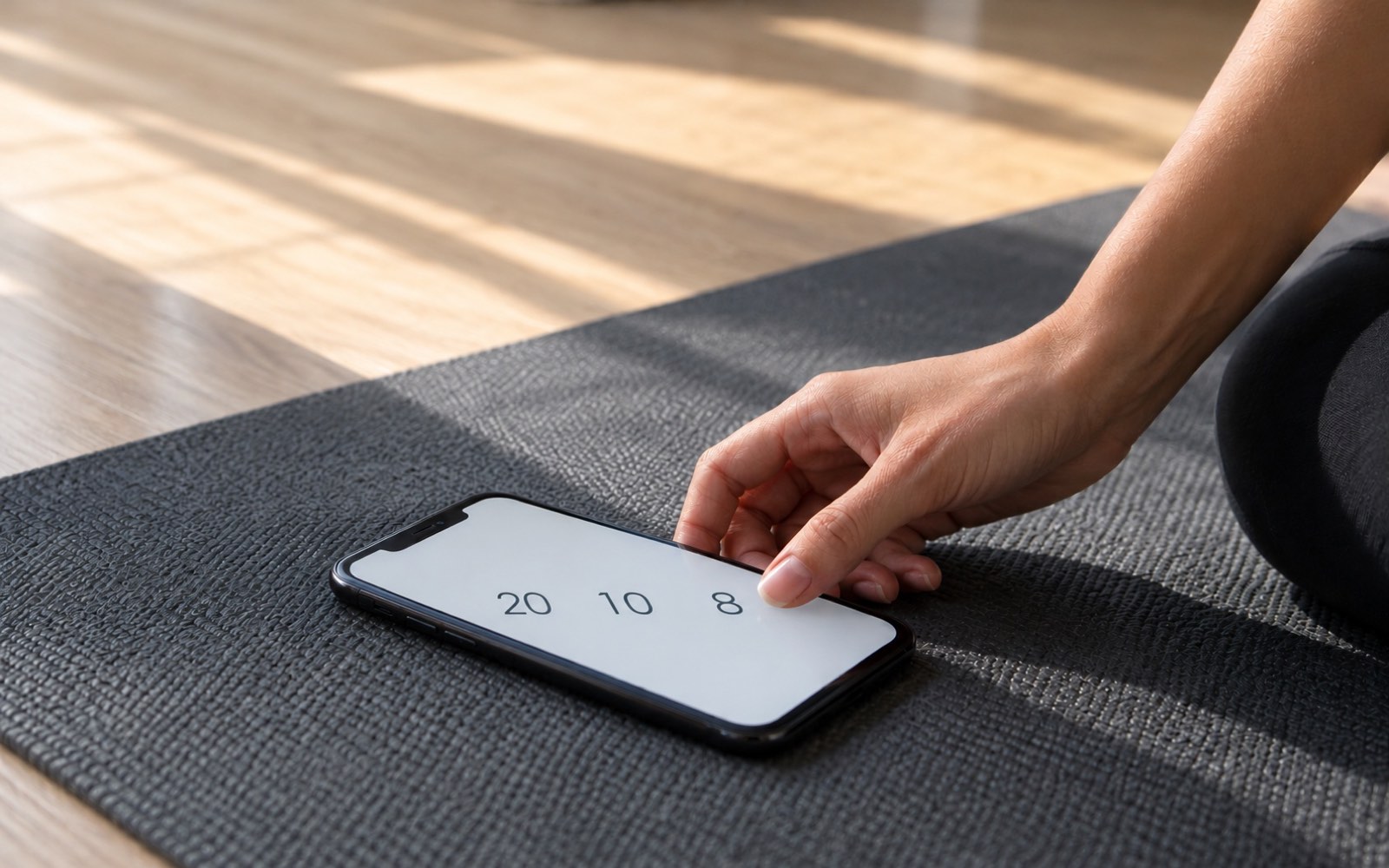
Ready-made Tabata routines for home with no equipment
One Tabata block is built from four exercises in a cycle: you do each one twice, so rounds 1–4 and 5–8 are identical. That is how the block was built in Lu's 2023 study: jumping jacks, high knees, jump squats and mountain climbers in turn, then the cycle repeats. Wang in 2024 built the block the same way, from squats, jumping jacks, high knees and burpees. No equipment needed, just a mat and 2 × 2 meters (about 6 × 6 ft) of floor.
The three routines below differ only in impact; the structure is the same for all. The selection rule is simple: an exercise fits if you can do it for 20 seconds at 8–9 out of 10 with steady form. If your form breaks down at the ten-second mark, take the swap from the last column.
Beginner routine, no jumping at all; the effort comes from pace.
| Round | Exercise | What it does | If your knees or your downstairs neighbors object |
|---|---|---|---|
| 1 and 5 | Fast squats to parallel | legs, glutes, heart rate | squats to a chair, touching it |
| 2 and 6 | Alternating reverse lunges | legs, balance | steps back with a hand touch to the floor |
| 3 and 7 | Fast high-knee march in place | heart rate, abs, hips | the same march, knees lower |
| 4 and 8 | High plank with shoulder taps | abs, shoulders | plank from the knees with shoulder taps |
Intermediate routine, the exact block from Lu's 2023 study.
| Round | Exercise | What it does | No-jump swap |
|---|---|---|---|
| 1 and 5 | Jumping jacks | heart rate, shoulders, calves | fast side steps with arm raises |
| 2 and 6 | High knees | heart rate, hips, abs | fast high-knee march |
| 3 and 7 | Jump squats, soft landing | legs, glutes, power | squat with a fast rise onto the toes |
| 4 and 8 | Mountain climbers: from a plank, knees to chest alternately | abs, shoulders, heart rate | stepping mountain climbers, no hop |
Advanced routine, for anyone who can cleanly do two intermediate blocks.
| Round | Exercise | What it does | No-jump swap |
|---|---|---|---|
| 1 and 5 | Burpees | whole body, highest heart rate | walk-out burpees: step back and forward |
| 2 and 6 | Skaters: side-to-side hops from one leg to the other | glutes, thighs, balance | fast side lunge with a floor touch |
| 3 and 7 | Jump squats | legs, power | squat with a rise onto the toes |
| 4 and 8 | Fast mountain climbers | abs, shoulders, heart rate | stepping mountain climbers |
A couple of notes on the tables. Burpees are the hardest exercise of all, and in beginners they break down first: the back sags in the plank, the jump comes off straight legs. How to do them properly and what to swap them for, step by step, is covered in our burpees guide. The landing in any jump is soft, onto the toes with bent knees: if you hear a loud thud, jumping is too early for you, switch to the swap. And do not try to "fit in more reps." Tabata counts seconds, and reps mean nothing to it: a steady 20 seconds at 8 out of 10 is worth more than 15 seconds of sprinting and 5 seconds of standing.
A separate word on "Tabata for abs," "for legs" and "for glutes." You can build a block from squats, lunges and skaters only, and your legs really will get more tired. But Tabata works as long as you keep your heart rate high for all 4 minutes, and four exercises for one muscle group usually end with your legs giving out in round five while your heart rate has not even climbed. That is why every routine above alternates legs and upper body.
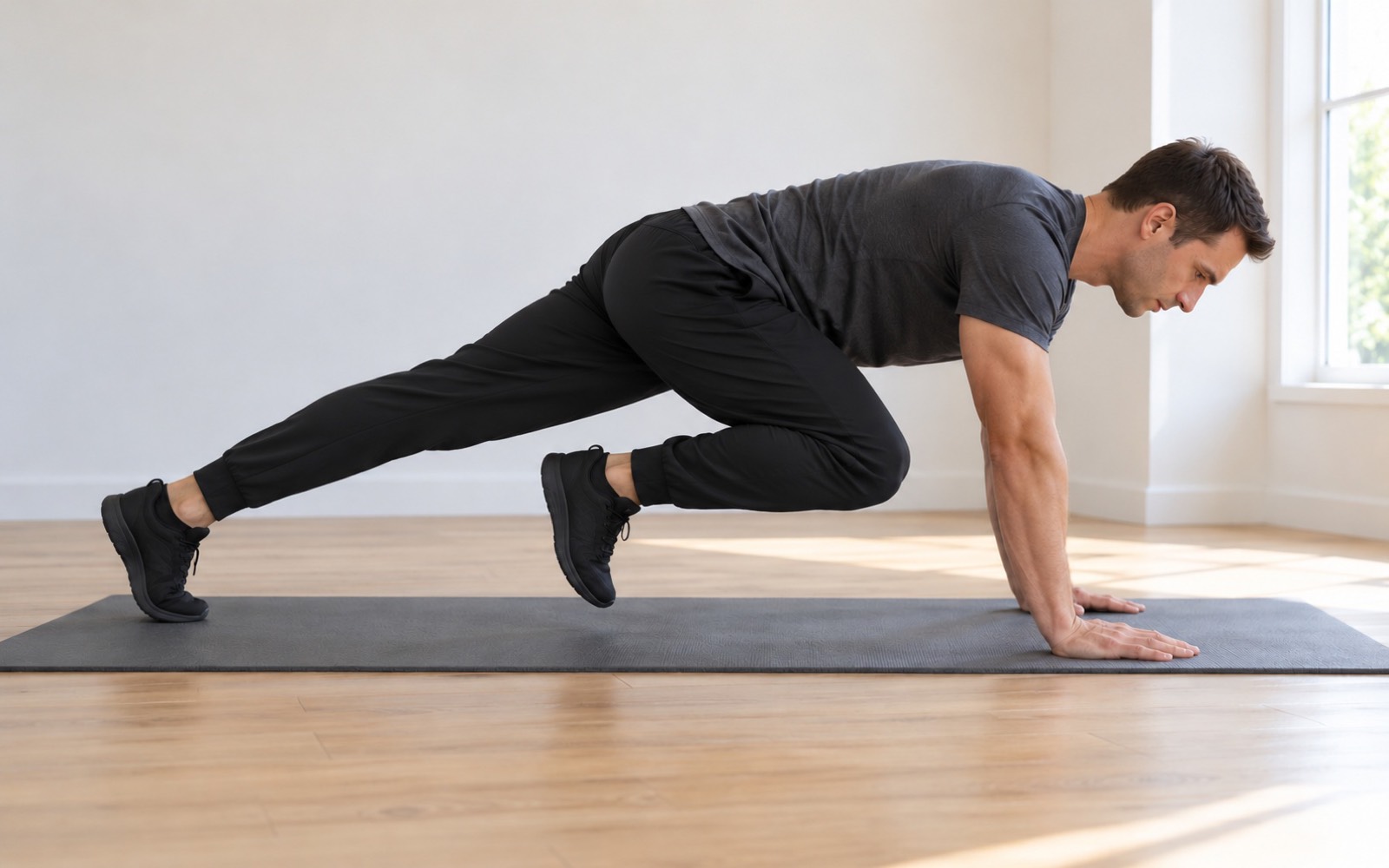
 Burpee
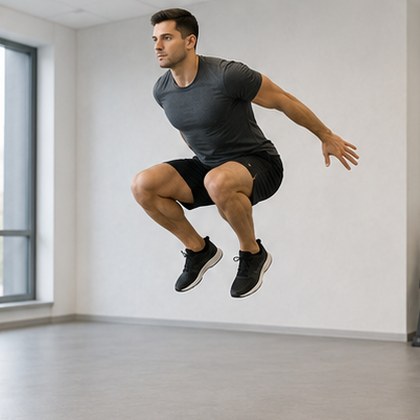 Jump squat
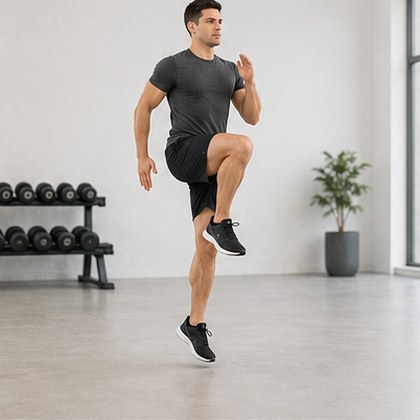 High knees
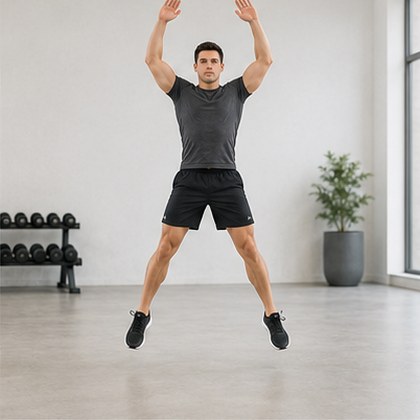 Jumping jack
The 8-week plan: from 4 rounds to two or three blocks
Over 8 weeks, a beginner goes from 4 rounds at an effort of 7 out of 10 to two full blocks, an intermediate goes from one block to two at 9 out of 10, and an advanced trainee gets to three blocks; three sessions a week, at least 48 hours apart.
The plan draws on four papers: Padkao 2025, where four progressive blocks at 75–85% effort over 12 weeks produced muscle and endurance gains in overweight adults; Lu 2023, where one block three times a week was enough for results; Cheng 2025, where two blocks produced more fat oxidation in recovery than three; and the 2013 ACE recommendation of 48–72 hours between sessions. The protocol is the same for women and men; the only difference is which routine from section 08 you pick based on your level.
| Week | Beginner | Intermediate | Advanced | Minutes per session (warm-up 10 + work + cool-down 5) | What changes |
|---|---|---|---|---|---|
| 1 | 4 rounds, effort 7/10, 1 block | 8 rounds, 8/10, 1 block | 2 blocks of 8, 8–9/10, 4 min break | 17 / 19 / 27 | start, learn the scheme |
| 2 | 6 rounds, 7/10 | 8 rounds, 8/10, intermediate routine | 2 blocks, 9/10, 3 min break | 18 / 19 / 26 | beginner +2 rounds |
| 3–4 | 8 rounds, 7–8/10 | 2 blocks, 8/10, 4 min break | 2 blocks, 9/10, advanced routine | 19 / 27 / 26 | beginner's first full block |
| 5–6 | 8 rounds, 8/10 | 2 blocks, 8–9/10, 3 min break | 3 blocks, 9/10, 3 min break | 19 / 26 / 33 | effort goes up, breaks get shorter |
| 7–8 | 2 blocks, 8/10, 4 min break | 2 blocks, 9/10, 3 min break | 3 blocks, or 2 blocks with burpees in each | 27 / 26 / 33 | beginner reaches two blocks |
Three rules for the plan.
- Didn't finish 8 rounds? Cut rounds, not rest. The 20/10 scheme is untouchable. If your pace collapsed in round six, next time set 6 rounds or lower the effort, but do not stretch the pause to 20 seconds: that is a different workout.
- Effort matters more than volume. Two blocks at 7 out of 10 is 8 minutes of light exercise. One block at 9 out of 10 is Tabata.
- Missed a week? Step back one row. After an illness or a vacation, start from the previous row of the table.
If you keep a training diary in the Sportygram app, put the Tabata session on its day there and move it to another day when plans change.
How often to do Tabata per week, and whether you can do it every day
Tabata is done 2–3 times a week with 48–72 hours between sessions, and there is no need to do it every day.
The 2–3 times a week recommendation with 48–72 hours between sessions comes from a 2013 review by the American Council on Exercise (ACE), written in response to Emberts' study. In it, John Porcari, co-author of that study, says that working at this intensity without a base level of fitness is potentially dangerous. Tabata's 1996 group trained 5 times a week, but these were athletes under supervision. In Lu, Padkao and Foster, where the participants were regular people, it was 3 times a week everywhere, and the results came.
Why not every day. Lactate of 12 mmol/L and a heart rate at 86% of maximum (Emberts, 2013) is a load after which your nervous system and muscles need a day or two. Enjoyment of Tabata drops even at three sessions a week (Foster, 2015), and at seven you will quit by week three. If you want to move every day, walk, swim or do 20–30 minutes of easy cardio on the days in between.
"Morning Tabata" as a daily routine. If you do it every morning, by definition it is a lighter version at 6–7 out of 10, and that is a perfectly good morning routine, just not Tabata. A full Tabata on an empty stomach straight out of bed is harder to tolerate: no warm-up, no food, heart rate still asleep. If morning is your only slot, get up 20 minutes earlier, drink some water, do a proper 10-minute warm-up, and keep the full block to 3 days a week.
Mistakes: what you feel → what to fix
A correct Tabata feels like this: by round six it is hard, by round eight it is very hard, and after 3–5 minutes of walking you can talk again. Anything else is a signal to adjust something.
| What you feel | What it means | What to fix |
|---|---|---|
| Nausea in rounds 6–8 | blood lactate reaches 12 mmol/L by the end of the block (Emberts, 2013); plus you ate less than 1.5–2 hours ago, or the effort is beyond your current readiness | eat 2 hours before, drop the effort to 7/10 for one session, 6 rounds; leave the 10 s rest alone |
| Dizziness right after the "stop" signal | you stopped abruptly, blood stayed in your legs, blood pressure dropped | walk for 2–3 minutes after the block, do not sit or lie down right away |
| Heart rate doesn't drop during the 10 s rest | that is how it should be: 10 seconds is too little to recover, that is the point of the protocol | nothing; but if your heart rate is above 120 five minutes after the block, the volume is too much for now |
| Knees on landing | hard landing on straight legs, feet splayed | soft knees, land on the toes; no-jump swap from section 08 |
| Lower back in mountain climbers | hips sagging or piked up, back arched | brace your abs, hips in line with shoulders, slow the pace; stepping mountain climbers |
| Wrists in planks and mountain climbers | your hands are not used to the load | rest on your fists or on the edge of a sofa; forearm plank |
| "I don't feel it" | effort is below 7/10, that is light exercise, not Tabata | move up a routine or add pace; heart rate at the end of the block should be 85–90% |
| Can't finish 8 rounds | the effort is above your base | cut to 6 rounds, slow the pace; do not lengthen the rest |
| Legs feel like jelly and shake after the block | a normal reaction to work above the aerobic limit, lactate around 12 mmol/L by the end of the block (Emberts, 2013) | 5-minute walking cool-down, water; easy activity the next day |
Nausea and dizziness deserve a separate word, because they are the main reasons people quit. Nausea toward the end of a block is almost always a combination of food within an hour of the session and an effort your body is not ready for yet. The fix is simple: a light meal 2 hours before, effort down for one session, 6 rounds. Dizziness after the "stop" signal is the result of stopping abruptly: your leg muscles stopped pumping blood back to your heart, and your blood pressure dipped for a few seconds. Two rules: after the last round, walk for 2–3 minutes right away, and no "dropping onto the mat and lying there." If you get dizzy regularly, at normal effort and with a proper cool-down, that is already a reason for section 12.
Who should not do Tabata, and when to see a doctor
Tabata suits healthy people with a base of 4–6 weeks of regular cardio; with heart disease, high blood pressure, pregnancy, or as a complete beginner, you need either a lighter version or a conversation with a doctor before the first block.
Instead of a list of "just in case" diagnoses, it is more useful to apply the screening model the American College of Sports Medicine (ACSM) proposed in 2015 (Riebe, 2015). It is built on three questions:
- Are you currently regularly active? Regularly means at least 30 minutes of moderate exercise 3 days a week for the last 3 months.
- Do you have symptoms or known heart, metabolic or kidney disease? Symptoms are pain or pressure in the chest during exertion, breathlessness out of proportion to the effort, fainting, an irregular heartbeat, swelling in the lower legs.
- What intensity are you planning? Tabata is high intensity, the very top category.
If you are active, healthy and symptom-free, you can start Tabata using the plan in section 09. If you are active but have a diagnosis, see a doctor before moving from moderate to high intensity. If you are inactive and have a diagnosis or symptoms, a doctor first, then any training. If you are inactive and healthy, start with light and moderate exercise and put Tabata off for 4–6 weeks.
The heart. Intervals are used in heart disease, and not without success (Weston, 2014), but under supervision. In 2012, Rognmo analyzed 4,846 patients with coronary heart disease at three Norwegian rehabilitation centers, 175,820 hours of training. In that time there was one fatal cardiac arrest per 129,456 hours of moderate exercise and two non-fatal ones per 46,364 hours of interval training, which is one per 23,182 hours; there were no heart attacks. The risk is low in both cases, and the authors consider intervals suitable for cardiac patients. But these people trained in rehabilitation centers with staff watching, and their intensity was set by doctors. With a diagnosis, nobody prescribes themselves Tabata at home.
Blood pressure. Pescatello's 2019 review of 17 meta-analyses covering 594,129 adults: physical activity lowers blood pressure and the risk of cardiovascular disease progression in people with hypertension. Judging by moderate evidence, the effect does not differ by type of exercise, while data on intensity, frequency and duration are still insufficient. You need to move with hypertension; which intensity to choose is a doctor's decision, and Tabata is not the first candidate.
Complete beginners. 4–6 weeks of walking, stationary bike, swimming or easy jogging for 30 minutes 3–4 times a week, then 4 rounds at 7 out of 10. The Padkao 2025 version at 75–85% effort is a good bridge between "nothing" and a full Tabata.
Be careful with: pregnancy (agree intensity and jumping with the doctor managing your pregnancy), varicose veins (swap jumps for steps, discuss compression with a vein specialist), bad knees or ankles (the no-jump routine), being over 40 with no athletic base (the three ACSM questions first, then modified Tabata), recovery after surgery or infection (only with a doctor's clearance).
See a doctor, the timer can wait, if during or after a session you had pain or pressure in the chest, breathlessness beyond what the effort explains, fainting or near-fainting, an irregular or "fluttering" heartbeat, or dizziness that comes back session after session. These are questions for your heart, and it is worth checking before the next block.
Questions and answers
Can you do Tabata every day?
No. The working frequency is 2–3 times a week with 48–72 hours between sessions (ACE, 2013). Tabata's 1996 group trained 5 times a week, but these were athletes under supervision, and for 6 weeks. If you do "Tabata" every morning and feel fine, your effort is below 7 out of 10, and that is easy interval work, also useful, but not Tabata.
How many calories does Tabata burn in 4 minutes?
About 55–58 calories at full effort: 14.5 calories a minute in trained people (Emberts, 2013) and 55 calories per block in overweight men (Wang, 2024). A 20-minute session of four blocks burns 240–360 calories. The afterburn adds 6–15% (LaForgia, 2006), another 3–9 calories per block.
What is the difference between Tabata and HIIT?
Tabata is one HIIT protocol with a rigid 8 × 20/10 structure and effort above maximal aerobic power. HIIT is any alternation of hard and easy intervals: 30/30, 4 × 4 minutes, 13 × 30 seconds. In untrained people, 8 weeks of Tabata and gentler intervals produced the same VO2max gain, 18% and 18%, and participants rated Tabata the least enjoyable (Foster, 2015).
Is Tabata good for complete beginners?
Not right away. First 4–6 weeks of walking, stationary bike or easy jogging 3–4 times a week, then 4 rounds at an effort of 7 out of 10. A modified Tabata at 75–85% of maximal effort over 12 weeks gave overweight adults gains in muscle and endurance (Padkao, 2025), so you can start without an athletic past, but with the gentle version.
Does Tabata burn belly fat?
Belly fat goes together with overall fat in a calorie deficit, and intervals help with that: per Maillard's 2018 meta-analysis, they reduce both abdominal and visceral fat. Mountain climbers and planks on their own do not remove fat from the belly: in Ramírez-Campillo's 2013 experiment, the fat in the trained leg stayed put while it came off the arms and trunk.
How many rounds and blocks of Tabata should you do per workout?
A beginner does 4 to 8 rounds, which is one block. Then two blocks with 3–4 minutes of walking between them: in Cheng's 2025 study, 30 minutes of recovery after two blocks oxidized 5.04 g of fat against 4.41 g after one and 4.11 g after three. Three blocks make sense for endurance in advanced trainees; for fat they are no better than two.
Can you do Tabata without jumping?
Yes. Jumping jacks become fast side steps, jump squats become squats with a rise onto the toes, burpees become walk-out burpees, mountain climbers become stepping mountain climbers. The 8–9 out of 10 effort comes from pace and range of motion, with no impact on the floor, so neither your downstairs neighbors nor your knees suffer.
Can you do Tabata in the morning on an empty stomach instead of a morning routine?
A lighter version at 6–7 out of 10 is fine; it makes a good morning routine. A full Tabata straight out of bed with no food is harder to tolerate: no warm-up, heart rate still asleep, and lactate reaching 12 mmol/L by the end of the block. If morning is the only time you can train, get up 20 minutes earlier, drink some water and warm up for 10 minutes, and do the full block three times a week.
The bottom line
- Tabata is 8 rounds of 20 seconds of work and 10 seconds of rest, 4 minutes. In the 1996 experiment, it was a prescribed power of 170% VO2max to failure, 5 times a week, in athletes: +28% anaerobic capacity and +7 ml/kg/min VO2max in 6 weeks.
- One block costs 55–58 calories, a 20-minute session 240–360 (Emberts, 2013; Wang, 2024). The afterburn is 6–15% on top (LaForgia, 2006); "a day of burning fat" is a fiction.
- For weight loss, Tabata works like any cardio and only in a calorie deficit: without a change in diet, 12 weeks did not touch fat (Padkao, 2025). The gain is about 40% in time (Wewege, 2017).
- Belly fat does not come off on its own (Ramírez-Campillo, 2013), but intervals are good at removing visceral fat along with the rest (Maillard, 2018).
- For a beginner, Tabata is no better for endurance than 20 minutes of steady cardio: +18% against +19% VO2max in 8 weeks (Foster, 2015), and it is harder to tolerate.
- Start with 4 rounds at 7 out of 10, a full block after 3–4 weeks, two blocks after 7–8. Three times a week, 48–72 hours between sessions.
- With a heart diagnosis, hypertension, pregnancy or after a long break: the three ACSM questions and a doctor first, then the timer.
Checklist: before a Tabata block
- Over the last 3 months you have moved for at least 30 minutes 3 times a week, or completed 4–6 weeks of easy cardio.
- No chest pain, no breathlessness out of proportion to effort, no fainting, no irregular heartbeat.
- You ate no later than 1.5–2 hours ago and had some water.
- A 10-minute warm-up is done, with the last 2–3 minutes being the block's exercises at half speed.
- The timer is set to 20/10, with 4, 6 or 8 rounds per the plan.
- The routine matches your level: you hold form for all 20 seconds; when in doubt, the no-jump version.
- After the block, 2–3 minutes of walking, then a 5-minute cool-down.
- Your previous Tabata was at least 48 hours ago.
Sources
- Tabata I., Nishimura K., Kouzaki M., Hirai Y., Ogita F., Miyachi M., Yamamoto K. Effects of moderate-intensity endurance and high-intensity intermittent training on anaerobic capacity and VO2max. Medicine & Science in Sports & Exercise, 1996. — Stationary bike, 6 weeks, 5 days a week: 60 minutes of steady cardio at 70% VO2max raised VO2max from 53 to 58 ml/kg/min with no change in anaerobic capacity; 7–8 bouts of 20 s at ~170% VO2max with 10 s rest in 7 men gave +7 ml/kg/min VO2max and +28% anaerobic capacity.
- Tabata I. Tabata training: one of the most energetically effective high-intensity intermittent training methods. Journal of Physiological Sciences, 2019. — Review by the protocol's author: the method was used by elite athletes; 170% VO2max is a power at which a person is exhausted in about 50 seconds of steady pedaling, and in intervals it exhausts them by the 7th–8th bout; cadence 90 rpm, failure defined as a drop to 85; the protocols came from Koichi Irisawa, head coach of the Japanese national speed skating team in the 1980s.
- Tabata I. Tabata training in perspective. Applied Physiology, Nutrition, and Metabolism, 2025. — Originally 6–8 × 20 s of supramaximal cycling with 10 s recovery for athletes; over ~30 years the method has been adapted for regular people and different goals.
- Emberts T., Porcari J., Doberstein S., Steffen J., Foster C. Exercise Intensity and Energy Expenditure of a Tabata Workout. Journal of Sports Science & Medicine, 2013. — 16 trained people (8 men ~35, 8 women ~28), 20 minutes: four 4-minute blocks with a minute of rest; heart rate 156 (86% of maximum), VO2 74% of maximum, lactate 12.1 mmol/L, effort 15.4 on the Borg scale, expenditure 14.5 ± 2.7 kcal/min, 240–360 kcal per session.
- Foster C., Farland C.V., Guidotti F. et al. The Effects of High Intensity Interval Training vs Steady State Training on Aerobic and Anaerobic Capacity. Journal of Sports Science & Medicine, 2015. — 55 untrained students, 8 weeks of 3 sessions: 20 minutes of steady cardio, Tabata 8 × 20/10 at 170% VO2max, Meyer protocol 13 × 30 s / 60 s; VO2max +19%, +18%, +18%, peak power +17%, +24%, +14%, no difference between groups; Tabata rated the least enjoyable, enjoyment fell in all groups.
- Lu Y., Wiltshire H.D., Baker J.S., Wang Q., Ying S. The effect of Tabata-style functional high-intensity interval training on cardiometabolic health and physical activity in female university students. Frontiers in Physiology, 2023. — 117 female students ~20 years old (59 Tabata, 58 control), 12 weeks of 3 sessions: 10 min warm-up, one block of 8 × 20/10 using jumping jacks, high knees, jump squats and mountain climbers, 5 min cool-down; VO2max +12.87% (control −0.27%), body fat −2.57% (control +3.23%), fat mass −2.61%, resting heart rate −8.62%, moderate and vigorous activity by accelerometer +15.51%; actual block intensity 83% of maximum heart rate against a 90% target.
- Wang Y., Fan C., Cheng L., Wang Y., Peng D., Li F., Han Y., Wang H. A comparative analysis of energy expenditure and substrate metabolism in male university students with overweight/obesity: Tabata vs HIIT and MICT. Frontiers in Endocrinology, 2024. — 15 men with BMI 27: 4-minute bodyweight Tabata (squats, jumping jacks, high knees, burpees) 55 kcal, 20-minute HIIT (3 min at 80% / 2 min at 20% VO2max × 4) 215 kcal, 30 minutes of steady cardio at 50% VO2max 225 kcal; fat oxidation rate higher in Tabata (0.27 g/min vs 0.20), total fat per session higher in steady cardio.
- Cheng Z., Liu L., Han Y., Wang H., Wang Y., Han Y. Two Tabata cycles in a single training set maximize fat oxidation after exercise in male college students with overweight/obesity. Scientific Reports, 2025. — 32 men with BMI 31.5; one, two or three Tabata blocks with 10 min rest between them: fat oxidation over 30 min of recovery 4.41 g, 5.04 g and 4.11 g; the authors consider two blocks optimal.
- Padkao T., Prasertsri P. The Impact of Modified Tabata Training on Segmental Fat Accumulation, Muscle Mass, Muscle Thickness, and Physical and Cardiorespiratory Fitness in Overweight and Obese Participants: A Randomized Control Trial. Sports, 2025. — 36 overweight adults, 12 weeks of 3 sessions, four progressive bodyweight blocks at 75–85% of maximal perceived effort: body fat percentage and fat mass unchanged, waist-to-hip ratio reduced, leg muscle mass, muscle thickness, strength, endurance and VO2peak increased; the authors suggest combining such training with dietary changes.
- LaForgia J., Withers R.T., Gore C.J. Effects of exercise intensity and duration on the excess post-exercise oxygen consumption. Journal of Sports Sciences, 2006. — Review of the afterburn: prolonged EPOC is possible after ≥50 min at ≥70% VO2max or ≥6 min at ≥105% VO2max, but even then it amounts to 6–15% of the expenditure during the workout; optimism about the afterburn's role in weight loss is unfounded.
- Wewege M., van den Berg R., Ward R.E., Keech A. The effects of high-intensity interval training vs. moderate-intensity continuous training on body composition in overweight and obese adults: a systematic review and meta-analysis. Obesity Reviews, 2017. — 13 studies, on average 10 weeks of 3 sessions: intervals and steady cardio reduced fat mass and waist equally, intervals took ~40% less time; running produced fat loss in both formats, the stationary bike did not; body weight did not change significantly.
- Maillard F., Pereira B., Boisseau N. Effect of High-Intensity Interval Training on Total, Abdominal and Visceral Fat Mass: A Meta-Analysis. Sports Medicine, 2018. — 39 studies, 617 people (mean age 38.8, 52% women): intervals reduce total, abdominal and visceral fat with no difference between sexes, running more effective than the stationary bike; abdominal changes detected only on CT and MRI.
- Ramírez-Campillo R., Andrade D.C., Campos-Jara C., Henríquez-Olguín C., Alvarez-Lepín C., Izquierdo M. Regional fat changes induced by localized muscle endurance resistance training. Journal of Strength and Conditioning Research, 2013. — 11 people (7 men, 4 women), 12 weeks of 3 sessions, 960–1,200 reps of single-leg press: body fat −5.1%, no change in the trained leg, arms −10.2%, trunk −6.9%.
- Rognmo Ø., Moholdt T., Bakken H. et al. Cardiovascular risk of high- versus moderate-intensity aerobic exercise in coronary heart disease patients. Circulation, 2012. — 4,846 coronary heart disease patients in rehabilitation, 175,820 hours of training: 1 fatal cardiac arrest per 129,456 hours of moderate exercise and 2 non-fatal per 46,364 hours of interval training (1 per 23,182 hours), no heart attacks.
- Weston K.S., Wisløff U., Coombes J.S. High-intensity interval training in patients with lifestyle-induced cardiometabolic disease: a systematic review and meta-analysis. British Journal of Sports Medicine, 2014. — 10 studies, 273 patients with coronary heart disease, heart failure, hypertension, metabolic syndrome and obesity: VO2peak after intervals higher than after steady cardio by 3.03 ml/kg/min (9.1%).
- Riebe D., Franklin B.A., Thompson P.D., Garber C.E., Whitfield G.P., Magal M., Pescatello L.S. Updating ACSM's Recommendations for Exercise Preparticipation Health Screening. Medicine & Science in Sports & Exercise, 2015. — ACSM screening model based on three factors: current physical activity, symptoms or known cardiovascular, metabolic or renal disease, and planned exercise intensity.
- Pescatello L.S., Buchner D.M., Jakicic J.M. et al. Physical Activity to Prevent and Treat Hypertension: A Systematic Review. Medicine & Science in Sports & Exercise, 2019. — Umbrella review of 17 meta-analyses, 594,129 adults: physical activity lowers blood pressure and the risk of cardiovascular disease progression in hypertension; moderate evidence that the effect does not depend on the type of exercise; insufficient data on intensity, frequency and duration.
- Hall K.D. What is the required energy deficit per unit weight loss?. International Journal of Obesity, 2008. — The "3,500 kcal per pound" rule, about 7,700 kcal per kilogram, roughly matches the energy density of lost weight in people with more than 30 kg of initial fat and overstates the required deficit in leaner people.
- American Council on Exercise. Is Tabata All It's Cracked Up To Be?. ACE ProSource, 2013. — Review of Emberts' study: effort 15.4 on the Borg scale, a recommendation of 2–3 sessions a week with 48–72 hours between them, and John Porcari's words that such a load without a base level of fitness is potentially dangerous.
This article is for informational purposes only and is not a substitute for medical advice.