

per the 2024 Compendium of Physical Activities, burpees at a vigorous pace cost 7.5 METs, and all-out intervals with burpees cost 11 METs. For a 70 kg (154 lb) person that's 9 and 13.5 kcal per minute, and 100 burpees come to roughly 50–80 kcal. As cardio, though, they are nearly a match for sprints: in Gist's 2014 study, four 30-second bursts of burpees took participants to 77.6% of peak oxygen uptake.The "average" band for ages 18–25 in the international 3-minute test standards (Podstawski, 2019) is 37–60 burpees for women and 47–66 for men. A beginner starts with 3 sets of 5–6 easier burpees every other day and reaches 5 sets of 8–9 full burpees by week 8. Volume per session grows 2.5–2.7 times over that period.
A burpee is an exercise where you drop from standing into a squat with your hands on the floor, jump your feet back into a plank, do a push-up, jump your feet back to your hands and leap straight up. One movement works your legs, chest, arms, abs and back, and in 30-second all-out bursts your heart rate averages 85% of max (Gist, 2014). You need no equipment and no more floor space than a hallway. A beginner is fine with 15–20 reps per session every other day, and the right place to start is the easier version: hands on a couch, feet stepping back instead of jumping. Below: step-by-step form, a calorie table for your weight and pace, per-minute and 3-minute standards, an 8-week plan from zero for women and men, mistakes you can feel, Tabata and a 30-day challenge.
What a burpee is and where it came from
A burpee is a chain of five or six simple movements done without pausing: stand, squat with hands on the floor, jump your feet back into a plank, push-up, jump your feet back to your hands, and jump up with a clap overhead. The strictest version includes the push-up and the jump; the basic version has neither. What makes it special is that your body keeps changing position — vertical, horizontal, vertical again. Your heart has seconds to switch from leg work to arm work and back, and that's why your pulse climbs so fast.
Where the name comes from. The exercise was invented by American physiologist Royal H. Burpee in 1939 for his doctoral thesis at Teachers College, Columbia University. He wanted a quick way to assess someone's fitness and proposed a four-rep test with a pulse check before and after. From 1942, the US Army used the burpee to screen recruits, counting how many a person could do in 20 seconds. Since then the name has traveled the world unchanged.
Squat thrust or burpee. In older fitness manuals the same movement, minus the push-up and the jump, is called a squat thrust. Today "burpee" covers every version, and that's the word people search for, so that's what we use here.
What burpees give you. Heart fitness and muscular endurance at the same time, in minutes: in McRae's 2012 study, four minutes of intervals four times a week raised oxygen uptake by 8% and the number of push-ups by 135% in one month. Details in section 09.
Muscles worked in burpees
Burpees work almost the whole body: legs and glutes in the squat and the jump, chest, triceps and shoulders in the push-up, abs and back in the plank.
| Muscle | Which phase | Where you feel it |
|---|---|---|
| Quadriceps (front of thigh) | squat, bringing the feet back to the hands, jump and landing | burning in the front of your thighs toward the end of a set |
| Gluteus maximus | standing up out of the squat, the jump | glutes during the jump |
| Calves | pushing off in the jump, soft landing | calves the day after your first sessions |
| Pectoralis major (chest) | push-up | chest on the way down and up |
| Triceps | push-up, bracing on your arms as you jump into the plank | back of the upper arm |
| Front deltoids | holding the plank, push-up | front of the shoulders |
| Rectus abdominis and obliques | plank, jumping the feet back and forward | abs, when you keep the plank straight |
| Spinal erectors | plank, straightening out of the squat | mild fatigue along the lower back |
| Hip flexors | bringing the feet back to the hands | front of the hip joints |
First, what the science doesn't have. We couldn't find an electromyography study of the burpee that measures each muscle's share in percent, so any claim like "burpees work 70% of your muscles" is a guess. What does exist is measurements of the individual phases, and they say more about the load than percentages would.
Arms. In Ebben's 2011 study, 23 people did push-ups on a force plate: a standard push-up put 64% of body weight on the hands, a knee push-up 49%, and a push-up with hands on a 61 cm (24 in) box 41%. That is the same plank and the same push-up you do inside a burpee. For a 70 kg (154 lb) person, the gap between a standard push-up and hands on a bench is about 16 kg (35 lb) of load on the wrists and shoulders. That's where our ladder of easier versions in section 05 comes from.
Knees. In Di Pietro's 2024 biomechanical analysis, the burpee with a push-up was studied with motion capture and predicted ground reaction forces. The knees turned out to be the most loaded joints: landing after the jump produces up to 3.5 times body weight. For 70 kg (154 lb) that's roughly 245 kg (540 lb) on the knees at touchdown. That's why the jump is the first part of the burpee to go when your knees aren't right.
Heart. In 2014, Gist and colleagues compared burpees and cycle sprints in 11 students under the same protocol: 4 all-out 30-second bursts with 4 minutes of easy recovery. Burpees produced 77.6% of peak oxygen uptake and 84.6% of maximum heart rate; cycle sprints produced 80.4% and 86.8%. The difference wasn't significant. So your heart works almost as hard in burpees as in a sprint, and that is the exercise's main effect.
How to do a burpee: step-by-step form
A proper burpee is a six-count movement where your palms sit under your shoulders, your plank stays a straight line, your feet come all the way back to your palms, and you land softly on bent knees after the jump.
- Stand. Feet hip-width apart, eyes forward, abs lightly braced. Breathe in.
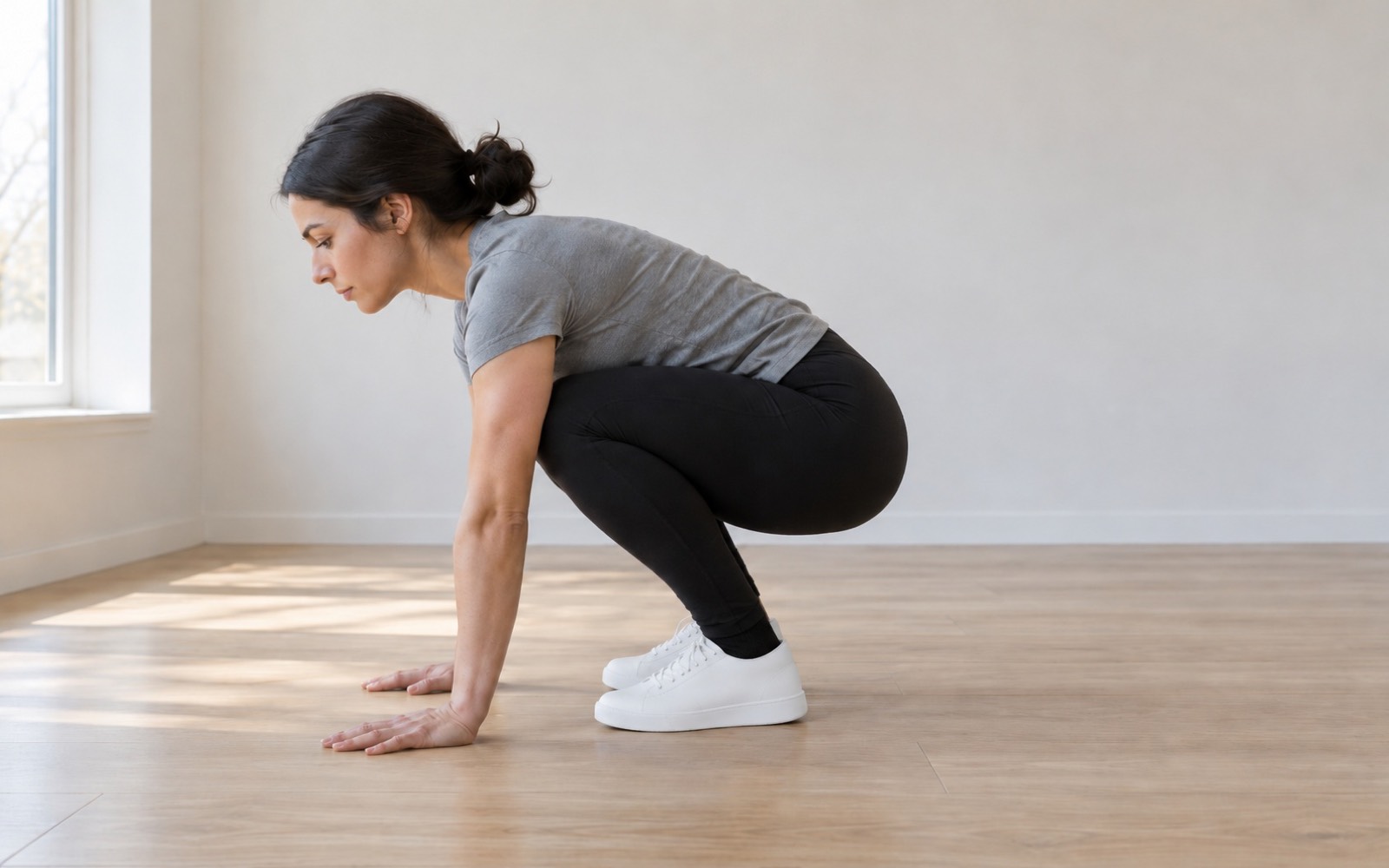
- Squat down. Squat and place your palms on the floor in front of your feet, shoulder-width apart. Your heels may lift off the floor; that's normal. Palms under your shoulders, fingers pointing forward.
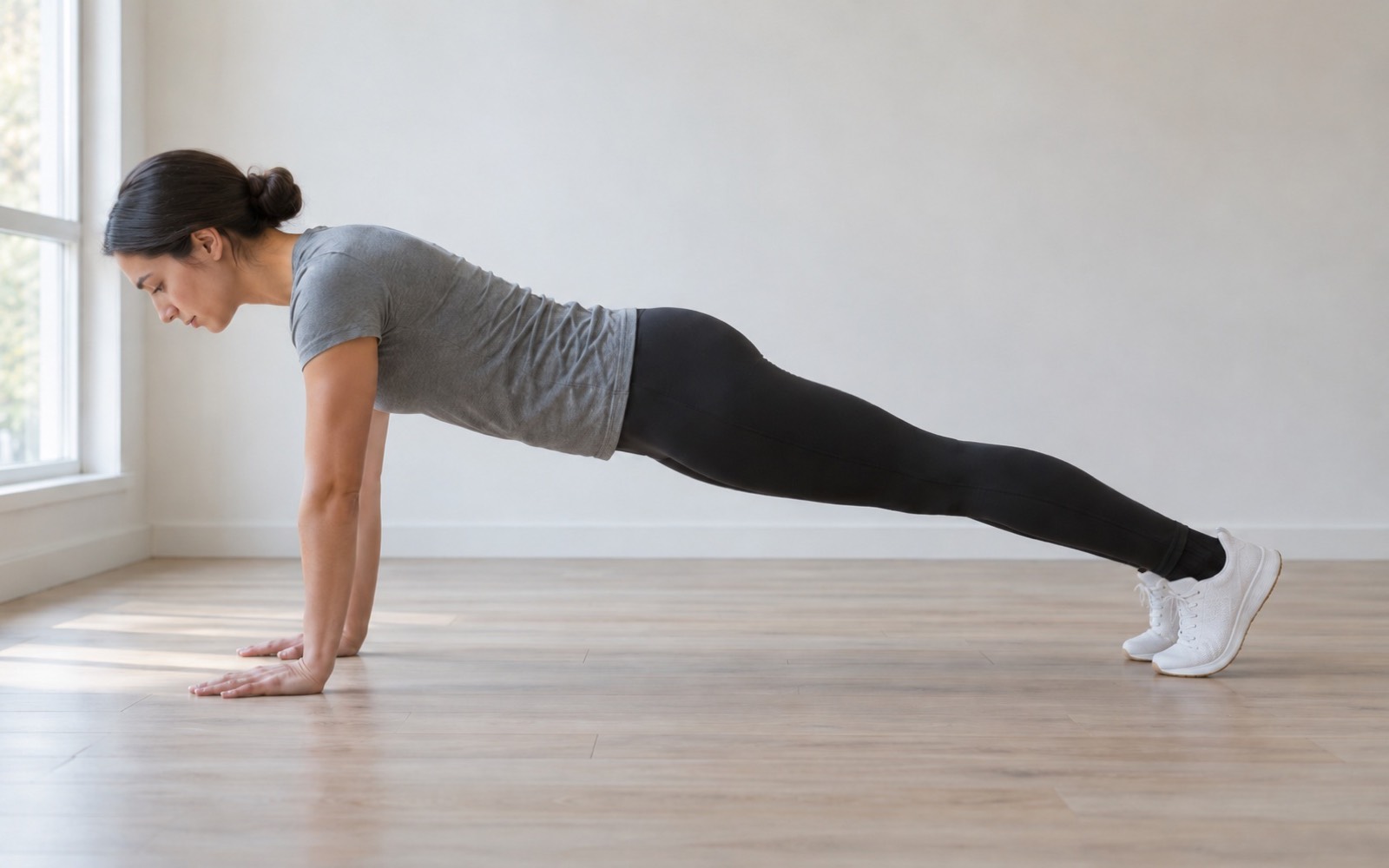
- Plank. Shift your weight onto your hands and jump both feet back. At the end of the movement your body is a straight line from the back of your head to your heels: hips neither sagging toward the floor nor pointing up. Abs braced, eyes on the floor.
- Push-up. Lower your chest to the floor with your elbows traveling back at about 45° to your torso, then press back up. If a push-up isn't there yet, skip this count or do it from your knees. That's a legitimate version, covered in section 05.
- Return. Jump your feet back to your palms, all the way, heels down. If your feet only make it halfway, you'll stand up with a rounded back and overload your lower spine.
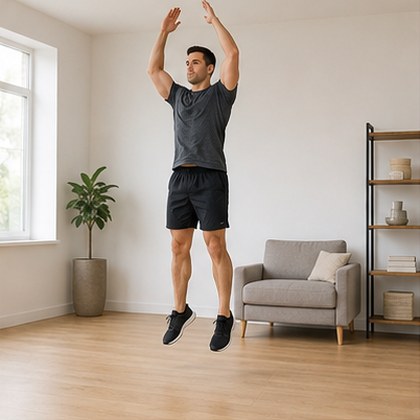
- Jump. Straighten up and push off upward, arms out to the sides or straight overhead, with a clap if you like. Land on the balls of your feet and roll onto the whole foot, knees soft. From the landing you go straight into the next squat.
Breathing. Inhale as you drop into the squat and the plank, exhale on the push-up and the jump. The main rule is simple: never hold your breath for more than a second. If your breathing falls apart in the third minute, slow down or take a 10-second pause instead of gutting it out.
Pace. For the first two weeks, go exactly as fast as you can while every burpee looks the same: 6–8 per minute with pauses between reps. The vigorous pace the Compendium assigns 7.5 METs to starts, by our estimate, at 12–15 burpees per minute without stopping, and it takes several weeks to get there. The Compendium itself doesn't set reps per minute; it only describes the effort level.
Three things you must not do: jump into the plank with a sagging back, stand up out of the squat with a rounded lower back, and land on straight legs. Those three account for almost every complaint after burpees; see section 10.
for the first two weeks, replace the jump into the plank with a step back, one leg and then the other, and come back the same way. Put your phone on the floor off to the side and film a couple of reps: in the plank, your body should be a straight line. If your hips sag, brace your abs harder and put your palms a little closer to your feet. Once ten step-back burpees in a row look identical, you can bring the jump back.
How many calories burpees burn: calculated for your weight
Burpees burn 3 to 19 kcal per minute depending on your weight and pace, and 100 burpees for a person weighing 60–80 kg (132–176 lb) cost roughly 50–80 kcal.
Energy cost is calculated through METs — a multiplier showing how many times harder an activity is than sitting quietly. The 2024 Compendium of Physical Activities (Herrmann and colleagues) gives three relevant values: calisthenics at a moderate pace, 3.8 METs; calisthenics at a vigorous pace including burpees, 7.5 METs; high-intensity intervals with burpees and Tabata, 11 METs. The formula: kcal per minute = METs × 3.5 × weight in kg / 200. The pace in brackets in the table header is our guideline; the Compendium doesn't specify reps per minute.
| Weight | Easy pace, 3.8 METs (8–10 per minute, stepping) | Vigorous, 7.5 METs (12–15 per minute, no stopping) | All-out intervals, 11 METs (18–20 per minute, 20/10) |
|---|---|---|---|
| 50 kg (110 lb) | 3.3 kcal/min | 6.6 kcal/min | 9.6 kcal/min |
| 60 kg (132 lb) | 4.0 | 7.9 | 11.6 |
| 70 kg (154 lb) | 4.7 | 9.2 | 13.5 |
| 80 kg (176 lb) | 5.3 | 10.5 | 15.4 |
| 90 kg (198 lb) | 6.0 | 11.8 | 17.3 |
| 100 kg (220 lb) | 6.7 | 13.1 | 19.3 |
Let's convert that to reps. At 60 kg (132 lb) and a vigorous 15 burpees per minute, one burpee costs about 0.5 kcal; at 80 kg (176 lb), 0.7. So 10 burpees are 5–8 kcal, 100 burpees are 50–80 kcal, and 10 minutes without stopping is 80–105 kcal. In 11-MET intervals the numbers are a little higher, but few people can hold 20 burpees per minute for longer than 20 seconds at a time.
A direct measurement. In 2019, Podstawski and colleagues ran the 3-minute burpee test on 45 women averaging 63.9 kg (141 lb) and 51 men averaging 76.4 kg (168 lb). In three minutes at maximum pace, the women did 38 burpees on average and the men 47. Sports watches with heart rate monitors counted 53.9 kcal for the women and 59.5 kcal for the men. That works out to 1.3–1.4 kcal per burpee, twice the table figure. Two caveats: the watches estimate expenditure from heart rate, with no analysis of expired air, so it's an estimate; and the pace was all-out, with average heart rates of 157 and 171 beats per minute. You don't work like that in a normal session.
Afterburn. After hard exercise, the body keeps using extra oxygen for a while, which is called EPOC. In LaForgia's 2006 review, this afterburn amounts to 6–15% of what you burned during the session itself. Add 5–10 kcal to 100 burpees, and that's it. The stories about "fat burning for 24 hours" aren't backed by that review.
What this means for you: 100 burpees burn less than a single pastry, so you can't work off dessert with them. Burpees are good above all for your heart: 10 minutes of intervals keep your heart rate around 85% of max, and the calories come as a nice extra. Fat loss comes from a daily calorie deficit. If you log food in a nutrition diary, record the honest 60 kcal for 100 burpees as 60 kcal, no more.
Easier versions: where to start if you can't do a full burpee
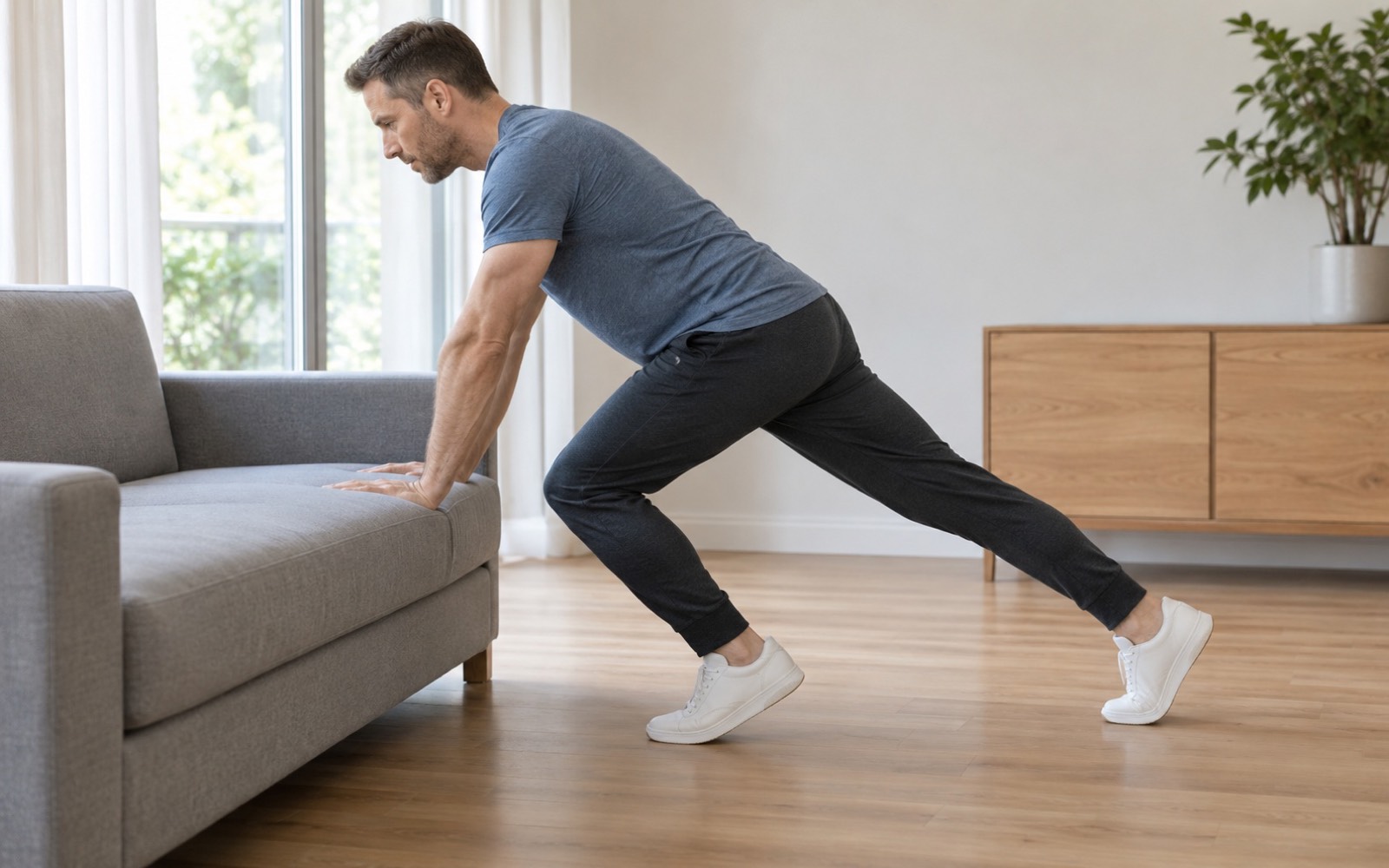
If a full burpee isn't happening, start with your hands on a bench and a step back instead of a jump: your arms take 41% of body weight instead of 64%, and your knees get no impact at all.
The easier versions are the ordinary steps everyone who hasn't done a push-up in six months goes through. The arm loads come from Ebben's 2011 push-up study, because the plank and the push-up inside a burpee are no different from the regular kind.
| Step | What it looks like | On the arms, % of body weight | What's removed | Who and when |
|---|---|---|---|---|
| 1 | hands on a bench or couch edge 40–60 cm (16–24 in) high, step back and forward, no push-up, no jump | ~41% | both jumps, the push-up | first 2 weeks; excess weight; weak wrists; blood pressure under a doctor's supervision |
| 2 | hands on the floor, step back and forward, no push-up, no jump | ~64% in the plank, no impact | both jumps, the push-up | weeks 3–4; the move to a floor plank |
| 3 | hands on the floor, jump the feet back and forward, no push-up, stand up with a clap overhead | ~64% | the push-up, the jump up | weeks 5–6; this is the cycle used in the international 3-minute test |
| 4 | the full movement with a knee push-up | ~49% in the push-up | full push-up range | weeks 5–7; until a standard push-up is there |
| 4a | hands on a 30 cm (12 in) box, both jumps, push-up off the box | ~55% | part of the arm load | if your knees are fine but your arms lag behind |
| 5 | the full burpee: full-range push-up and a jump with a clap | ~64% | nothing | from week 7 for men; once step 4 comes out 4 × 8 clean |
Step 1 looks like a plain "squat, lean, step back" and there's nothing embarrassing about it. Step 3 is the version Podstawski used to collect norms on nearly 10,000 people, and it's what we call the "standard burpee." The push-up and the jump are added on top, and together they make step 5, the full burpee: in the plan from section 07, men reach it in week 7.
If the push-up is what's stuck, don't hold the whole burpee hostage to it: work through the ladder from the wall to the floor separately, as laid out in push-ups for beginners. There's a weekly program there that fits into our plan from section 07.
Harder versions: with a push-up, a jump, dumbbells, a box
There are four ways to make burpees harder: add a full push-up, a jump with a clap, weight in your hands, or an extra element like a box jump. Move to them from weeks 5–7 of the plan, once 4 sets of 8 full burpees come out clean.
| Variation | What it adds | When to move to it | What to avoid |
|---|---|---|---|
| With a full-range push-up | chest, triceps, shoulders; 64% of body weight on the arms plus the movement | from weeks 5–7 | hips sagging at the bottom |
| With a jump and clap | plyometrics for the legs, higher heart rate; up to 3.5 times body weight on the knees at landing | once step 3 comes out 4 × 8 | stiff landing on straight legs |
| With 2–5 kg (5–10 lb) dumbbells | dumbbells pressed overhead instead of the clap, shoulder work | after the full version with a push-up | jumping with weight; dumbbells heavier than 5 kg (10 lb) for a beginner |
| With a kettlebell | a burpee plus a kettlebell clean to the chest or press overhead | experienced | jumping with a kettlebell; Tabata with a kettlebell |
| Mountain climber inside the burpee | 2–4 knee drives to the chest in the plank | once the full version comes out 4 × 10 | a sagging lower back on the knee drive |
| Burpee box jump | a jump onto a 30–50 cm (12–20 in) box instead of a jump up | experienced, healthy knees | a box higher than your knee; jumping down off the box |
| Burpee pull-up | a pull-up on a bar after the jump | experienced | a jerky pull-up on tired shoulders |
What the jump gives you. In Pérez-Ifrán's 2024 study, 43 active adults did 10 all-out 4-second bursts with 30 seconds of rest, about 8 minutes per session, over 5 training days. The burpee group improved their vertical jump; the sprint group did not. Oxygen uptake, body composition and blood pressure didn't change in anyone over five days. Two takeaways: the jump in a burpee really does train explosive leg power, and five days won't do much more than that.
Dumbbells and kettlebells. Weight in your hands turns the burpee into a strength exercise of 6–10 reps with rest. Keep weight out of Tabata and out of the 30-day challenge: at the 20th second of an all-out effort, form with dumbbells falls apart.
How many burpees a day: an 8-week plan for women and men
A beginner needs 15–20 easier burpees per session in the first week, three sessions on alternate days, and by week 8 that becomes 40–45 full burpees per session.
The plan below is our working scheme. Every session starts with 5 minutes of warm-up: marching on the spot, arm circles, bodyweight squats, a few forward bends. Then burpee sets with 60–90 seconds of rest between them. The steps come from the table in section 05: 1 — hands on a bench, stepping; 2 — hands on the floor, stepping; 3 — feet jumping, no push-up and no jump up; 4 — full movement with a knee push-up; 5 — full movement with a push-up and a jump.
| Week | Women: step × sets × reps | Men: step × sets × reps | Burpees per session (W / M) |
|---|---|---|---|
| 1 | step 1, 3 × 5 | step 2, 3 × 6 | 15 / 18 |
| 2 | step 1, 3 × 7 | step 2, 3 × 8 | 21 / 24 |
| 3 | step 2, 3 × 6 | step 3, 3 × 7 | 18 / 21 |
| 4 | step 2, 4 × 7 | step 3, 4 × 8 | 28 / 32 |
| 5 | step 3, 4 × 6 | step 4, 4 × 7 | 24 / 28 |
| 6 | step 3, 4 × 8 | step 4, 4 × 9 | 32 / 36 |
| 7 | step 4, 4 × 7 | step 5, 4 × 8 | 28 / 32 |
| 8 | step 4, 5 × 8 or the 3-minute test | step 5, 5 × 9 or the 3-minute test | 40 / 45 |
Over 8 weeks, volume per session grows from 15 to 40 burpees for women, 2.7 times, and from 18 to 45 for men, 2.5 times. In weeks 3, 5 and 7 the rep count drops: you're moving up to a harder step, and that's by design. Volume catches up again afterward.
The progression rule. Move up a step when every set of the week is done with 2 reps to spare and no pain in your wrists, lower back or knees. No reps to spare — repeat the week. That is the same logic as the 2009 American College of Sports Medicine (ACSM) position stand on resistance training: load goes up once you can do 1–2 reps more than required.
Why women and men have different columns. The difference is one step on the plank and the push-up: in our experience, women are more often held back by their arms, so we gave them two extra weeks on the elevated surface. It's a safety margin. If you're a woman doing floor push-ups from week one, follow the men's column. If you're a man over 100 kg (220 lb) or haven't trained in a long time, start with the women's.
How many times a week. Three sessions on alternate days. The 2011 ACSM position stand (Garber and colleagues) advises adults to get at least 75 minutes of vigorous activity a week, in bouts of at least 20 minutes on at least three days, or 500–1,000 MET-minutes. At 7.5 METs, 75 minutes gives about 560 MET-minutes. The same 75 minutes a week — 150–300 minutes moderate or 75–150 vigorous — appear in the 2020 WHO guidelines (Bull and colleagues). Three 25-minute sessions in which burpees take 8–12 minutes and the rest is warm-up, rest and a couple of other exercises meet that target.
Can you do them every day. Better not, at least for the first two months. Burpees put impact on the wrists, shoulders and knees, and those need a day between sessions. If you want to move every day, walk or do exercises without jumping on the days in between; how to build a full no-equipment week out of those is covered in home workouts. The daily version, in the form of a 30-day challenge, is in section 09, and it has rest days too.
Write every session down: the step, the sets, the reps. A line in a workout diary is what tells you next month whether it's time to move up a step or repeat the week.
Standards: how many burpees per minute and per 3 minutes
The average young man does about 19 burpees per minute, the average young woman about 16, and in 3 minutes at maximum pace 57 and 49 respectively.
Those figures come from the international 3-minute test standards that Podstawski and colleagues published in 2019 in the Journal of Human Kinetics. They're based on 9,833 people — 3,862 women and 5,971 men — from Poland, the UK, Hungary and Serbia, mostly students around age 20, collected from 2004 to 2018. The men averaged 56.7 burpees in 3 minutes, the women 48.8. The best results were 82 and 73. Only 0.52% of men and 0.26% of women scored "very good," so the top row of the table is rare.
| Level | Women, in 3 min | Men, in 3 min | Roughly per minute (W / M) |
|---|---|---|---|
| Very poor | up to 26 | up to 37 | up to 9 / up to 12 |
| Poor | 27–36 | 38–46 | 9–12 / 13–15 |
| Average | 37–60 | 47–66 | 12–20 / 16–22 |
| Good | 61–71 | 67–75 | 20–24 / 22–25 |
| Very good | 72–83 | 76–85 | 24–28 / 25–28 |
The norms are for ages 18–25. The paper has no official table for older ages, so here's our guideline: for every 10 years past 25, subtract 2–3 burpees from the boundaries. That's our own estimate; there's no verified standard for older ages yet.
How to run the test at home. Set a 3-minute timer and do burpees in the test cycle: stand → squat with hands down → jump into a straight-arm plank → back to the squat → stand with arms overhead and clap. No push-up, no jump up. Count only complete cycles: if the plank didn't straighten or the clap didn't happen, the rep doesn't count. That's how it was done in Yamashita's 2023 study of 127 young men, where incomplete movements and a plank with the hips piked or sagging weren't counted. The average there was 66.8, the maximum 96, and the number of burpees in 3 minutes correlated with estimated maximal oxygen uptake from a shuttle run test at r = 0.78. For home use, that's a solid endurance measure without a treadmill or a gas analyzer.
Repeat the test every 4 weeks, at the same time of day and after the same warm-up. A gain of 5–8 burpees a month is normal for a beginner.
Records and old standards. The 1942 Army test counted burpees in 20 seconds, and you can't compare it directly with the 3-minute test: a 20-second sprint and 3 minutes of work are different distances. Records for burpees per minute and per hour do get registered, but we don't have a primary table with verified figures, so we'd advise against chasing them based on secondhand accounts.
Tabata with burpees and the 30-day challenge
Tabata with burpees is 8 rounds of 20 seconds of work with 10 seconds of rest, 4 minutes in total, and for a beginner it's simply short intervals: the original study's Tabata is a long way off, and that's fine.
What Tabata actually did. In 1996, Izumi Tabata and colleagues compared two regimens in trained students on a cycle ergometer: steady cardio for 60 minutes at 70% of max, and 7–8 bursts of 20 seconds at 170% of maximal oxygen uptake with 10 seconds of rest, 5 days a week for 6 weeks. The intervals raised maximal oxygen uptake by 7 ml/kg/min and anaerobic capacity by 28%; the steady cardio raised VO2max from 53 to 58 with no gain in anaerobic capacity. The key features of that protocol are 170% of max in trained people and 5 days a week. A beginner doing burpees can't produce that kind of power, but the 20/10 format works at lower intensity too.
What 20/10 with burpees gives you. In McRae's 2012 study already mentioned, 22 active women did 8 × 20/10 with a single exercise — burpees, jumping jacks, mountain climbers or squat thrusts — meaning 4 minutes per session, 4 times a week, for 4 weeks. Peak oxygen uptake rose 8%; in the group running steadily for 30 minutes at 85% of max heart rate it rose 7%. But muscular endurance improved only in the interval group: push-ups +135%, sit-ups +64%, back extensions +75%. Enjoyment of the sessions and the wish to keep doing them also went up in the interval group over the month.
Schaun and colleagues checked the same thing in 2018 on 55 men over 16 weeks of 3 sessions: bodyweight intervals, running intervals and 30 minutes of steady running. Maximal oxygen uptake rose equally in all three groups. Running performance — speed and time to exhaustion — improved more in the runners. So for the heart, burpee intervals gave the same as running and took less time. If you want to run faster, though, there's no way around running itself.
How to do Tabata with burpees:
| Parameter | Beginner (from week 5 of the plan) | Intermediate |
|---|---|---|
| Burpee version | step 3: no push-up, no jump up | step 5: full movement with a jump |
| Format | 8 × 20 s work / 10 s rest | 8 × 20/10 |
| Pace | the same count in all 8 rounds, for example 5-5-5-5-5-5-5-5 | 7–8 in each round |
| Times a week | 2 | 2–3 |
| Calories in 4 minutes at 70 kg (154 lb) | up to 55 kcal at 11 METs, in practice less: the pace is lower | about 55 kcal |
The main sign of a proper Tabata is even rounds. A pattern like 10-9-7-5-4-3-3-2 means the first round was too fast and you just survived the rest. It's better to do six burpees in each of the eight rounds than ten in the first and then barely make it to the end. How Tabata itself works and which other exercises fit into it is covered in our Tabata workout guide. Protocols for intermediates, from 30/30 to 4 × 4 minutes, are collected in our guide to HIIT workouts, and if you want burpees inside a whole-body session, put them as the last station of a circuit.
How long an all-out effort can go is shown by Machado's 2018 study: in 20 men, 30 minutes of 30/30 intervals with jumping jacks, burpees, mountain climbers and jump squats produced an average of 382 movements and a blood lactate of 14.1 mmol/L versus 0.98 at rest. That's a level a beginner doesn't need at all. Four to eight minutes of intervals is plenty.
The 30-day challenge. The "5 to 50" scheme with a rest day every sixth day:
| Days | Burpees per day | How to split them |
|---|---|---|
| 1–5 | 5, 7, 9, 11, 13 | one set |
| 6 | rest | a walk |
| 7–11 | 15, 17, 19, 21, 23 | 2 sets |
| 12 | rest | |
| 13–17 | 25, 27, 29, 31, 33 | 3 sets |
| 18 | rest | |
| 19–23 | 35, 37, 39, 41, 43 | 4 sets |
| 24 | rest | |
| 25–29 | 45, 46, 47, 48, 50 | 4–5 sets |
| 30 | rest or the 3-minute test |
The rules. First: pick the burpee version by the week of the plan in section 07 you're currently on; a beginner does the challenge at steps 2–3, no jumps, and that counts. Second: if you miss a day, carry on down the column and don't double anything. Third: wrist or knee pain that hasn't gone by the morning is an unscheduled rest day. Fourth: start "100 burpees a day" only after week 8 of the plan, split into 4 sets of 25, and for no more than 2–3 weeks in a row.
What to expect from 30 days: your 3-minute count goes up, push-ups get easier, your heart rate during everyday effort drops. Your weight on its own won't change much: over the 25 working days of the scheme you accumulate about 700 burpees, and at 0.5–0.8 kcal each that's 350–560 kcal for the month, roughly one big lunch. If the goal is weight loss, the challenge needs a calorie deficit alongside it, covered in section 12.
Mistakes: where you feel it → what to fix
A proper burpee feels like burning in your thighs and heavy breathing; if your lower back, knees or wrists hurt, the movement has drifted from the form somewhere.
| Where you feel it | What's wrong | The fix |
|---|---|---|
| Lower back in the plank or after it | hips sag as you jump back, abs aren't holding | brace your abs before the jump, step instead of jumping for the first weeks, palms closer to your feet |
| Lower back standing up | feet didn't make it to your palms, you're standing up with a rounded back | bring your feet all the way back, heels down, stand up through the squat |
| Knees slam the floor on the jump into the squat, or they click | stiff landing on straight legs, feet too narrow | sit into the landing: knees soft, feet hip-width; step instead of jumping; cushioned shoes |
| Wrists | wrist bent at 90° under all your weight, no warm-up | fists or push-up handles, hands on a bench, 10 wrist circles before a set |
| Front of the shoulders | palms wider than your shoulders or ahead of them, elbows flared | palms strictly under your shoulders, elbows at 45° to your torso |
| Neck | looking forward or up in the plank | eyes on the floor, back of the head in line with your spine |
| Dizziness standing up | abrupt change from horizontal to vertical, breath-holding, an empty stomach or a snack 10 minutes before | stand up without jerking, breathe in rhythm, eat 1.5–2 hours before training, slow down |
| Breathing falls apart in minute two or three | pace is above what your endurance allows | 10 seconds of rest every 5–6 burpees; set your pace from your own test in section 08 |
Lower back. This is usually mistake number one: jumping back into the plank with relaxed abs. The moment your feet fly back, your hips sag for a second and your lower back takes a hit. The cure is simple: before every jump, brace your abs as if you're about to take a light punch, and for the first two weeks just step. If a plank on its own holds for less than 30 seconds, build it up separately first, on your forearms.
Knees. The second source of complaints. Remember Di Pietro's 2024 figure: up to 3.5 times body weight at landing. Three things reduce it: soft knees at touchdown, landing on the balls of your feet and rolling onto the heels, and stepping instead of jumping on days when your knees are "talking." The jump in a burpee is optional; without it, the exercise is still a burpee.
Wrists. In the plank, your wrist is bent at a right angle and holds up to 64% of body weight. A wrist warm-up, handles or fists, and hands on a bench for the first weeks solve it for most people; if your wrist hurts even without burpees, see section 11.
Safety: knees, lower back, wrists, shoulders — who should be careful and when to see a doctor
A healthy adult can do burpees at any age, but with heart disease, high blood pressure, pregnancy, knee problems or a lot of excess weight, they're done in the easier version and only after talking to a doctor.
- Knees. Osteoarthritis, a recent ligament or meniscus injury, or pain going down stairs are reasons to drop both jumps and work at steps 1–2, stepping. Knees with that history don't need 3.5 times body weight of impact at landing (Di Pietro, 2024). If a knee swells or hurts for more than a day after step-back burpees, that's a conversation with an orthopedist.
- Lower back. A herniated or bulging disc in a flare-up means burpees are postponed. Once the pain has settled, come back with a doctor or a physical therapist, through a forearm plank and the stepping versions. Mild muscle fatigue along the lower back after a session is normal; sharp pain or pain shooting down a leg is not.
- Wrists and shoulders. Carpal tunnel syndrome, old wrist fractures, or shoulder pain when you raise your arm — hands on a bench or handles, and skip the push-up. If the pain doesn't go away after 2–3 days of rest, see a doctor.
- Heart and blood pressure. Burpee intervals keep your heart rate around 85% of max, and with coronary heart disease that's done only under supervision. In Rognmo's 2012 study, 4,846 patients with heart disease trained for 175,820 hours at three cardiac rehabilitation centers: one fatal cardiac arrest in 129,456 hours of moderate exercise and two non-fatal ones in 46,364 hours of interval training, that is 1 per 23,182 hours, with no heart attacks. The risk is low, but those were patients a doctor had cleared, with staff nearby. If you have a diagnosis, intervals only with a cardiologist's go-ahead. With high blood pressure and no heart diagnosis, start at step 1 without jumps; what else you can and can't do is covered in exercising with high blood pressure.
- Pregnancy. Jumps and a plank with a growing belly are a reason to ask the doctor managing your pregnancy. Usually burpees are swapped for stepping versions with hands on a raised surface, or for different exercises altogether.
- Excess weight. With a BMI over 30, the load on your knees in the jump and on your wrists in the plank grows in proportion. Stay at step 1 for 2–4 weeks longer than the plan says, and don't move to jumps until the first kilograms are gone.
- Over 50. Burpees are possible, but the ladder in section 05 goes slower, 2 weeks per step, and the jump up stays optional.
See a doctor if you get chest pain or pressure during burpees, shortness of breath out of proportion to the effort, dizziness with your vision going dark, or if joint pain doesn't ease after 2–3 days of rest. Ordinary lightheadedness when you stand up fast after a plank is fixed by pace and breathing, covered in section 10.
Burpees vs. running, jump rope, jump squats: which to choose
By calorie burn, vigorous burpees are close to jogging at 8 km/h (5 mph); by heart rate, they're close to sprints; jump rope at a moderate pace burns the most of all. Choose whatever you can keep doing three times a week for months.
| Burpees | Jogging 8 km/h (5 mph) | Jump rope, moderate | Jump squats | Mountain climbers | |
|---|---|---|---|---|---|
| METs per the 2024 Compendium | 7.5 vigorous / 11 in intervals | 8.5 | 11.8 | 11 in intervals | 11 in intervals |
| Kcal/min at 70 kg (154 lb) | 9.2 / 13.5 | 10.4 | 14.5 | 13.5 | 13.5 |
| What it trains | legs, chest, arms, abs | legs, heart | calves, shoulders, coordination | legs, glutes | abs, shoulders, hip flexors |
| Knee loading | high with the jump, low stepping | moderate, repetitive | moderate, low hops | high | low |
| Equipment | none | shoes, space | a rope, ceiling height | none | none |
| In an apartment | yes; stepping version is quiet for the neighbors | no | with the neighbors in mind | noisy | yes |
Burpees and running. Per Gist's 2014 study, burpee intervals produce 77.6% of peak oxygen uptake versus 80.4% for cycle sprints, so for the heart it's nearly the same thing. Per Schaun's 2018 data, over 16 weeks the heart gained equally from burpee intervals, running intervals and steady running. The difference is that running needs space and weather, and burpees need two square meters (about 20 square feet).
For weight loss. In Wewege's 2017 meta-analysis of 13 studies in overweight people, intervals and steady cardio reduced fat mass and waist circumference equally over about 10 weeks, and the intervals took roughly 40% less time. Fat comes off from a daily calorie deficit; the exercise just helps create it and keep your muscle. So "burpees or running for weight loss" is settled simply: pick the one you won't quit after a month.
The case for burpees. In Mayr Ojeda's 2022 study, 18 people went through three protocols: burpee intervals of 10 × 5 seconds with 35 seconds of rest, sprints, and 6 minutes of steady running at 85% of max heart rate. Perceived exertion for burpees was 2.9 out of 10 versus 5.4 for sprints, and enjoyment, preference and the wish to continue were higher than for the steady effort. People tolerate short burpee intervals more easily than classic sprints. That doesn't add any calories, but it makes it easier to come back to the session two days later.
Jump rope burns more per minute, but it loads only the legs and shoulders and needs a higher ceiling. If you're choosing between a rope and burpees at home, take both in turn: form and a program for skipping are in our jump rope workout guide.
 Burpee
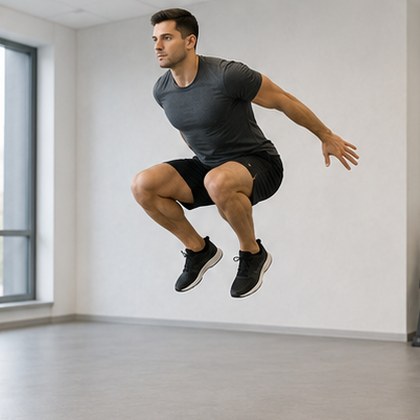 Jump squat
Questions and answers
How many calories does 1 burpee burn, and 10 burpees?
One burpee at a vigorous pace costs 0.5–0.8 kcal at a body weight of 60–80 kg (132–176 lb), calculated at 7.5 METs; ten cost 5–8 kcal. Sports watches in Podstawski's 2019 all-out 3-minute test showed 1.3–1.4 kcal per burpee, but that's a heart-rate estimate at a pace you don't hold in a normal session.
How many burpees should a beginner do a day?
15–20 easier burpees per session in the first week, 3 sets of 5–7, three times a week on alternate days. By week 8 of our plan that's 40–45 full burpees per session. Every day in the first two months isn't a good idea: your wrists and knees need a rest day.
What happens if you do 100 burpees every day for 30 days?
Your endurance and your push-up count go up, and your heart rate during everyday effort drops. Your weight barely changes from the burpees themselves: 100 burpees are 50–80 kcal, which adds up to 1,500–2,400 kcal a month, roughly one day of food. The risk is your knees and wrists with no rest days, so we recommend 100 a day only after the 8-week plan, in 4 sets, with a day off every 5–6 days.
How many burpees can you do in a minute: average and record?
The average young man does about 19 per minute and the average young woman about 16, working from the mean 3-minute results in Podstawski's 2019 standards. "Good" starts at 22 and 20 per minute. The best man in the database did 82 burpees in 3 minutes, about 27 per minute, and the best woman 73, about 24 per minute. We don't quote Guinness records: we don't have a verified primary table to hand.
Can you do burpees without the jump and without the push-up?
Yes, those are steps 1–3 of our plan, and the international standards were collected precisely without the push-up and the jump up. Without the jumps, your arms carry the same load as in the full version, 64% of body weight in the plank, while your knees get none of the impact of up to 3.5 times body weight. For your first weeks, excess weight or bad knees, that's the main version.
Burpees or running: which is better for weight loss?
For the heart they're close: burpee intervals give 77.6% of peak oxygen uptake versus 80.4% for sprints (Gist, 2014). With equal calories, fat comes off equally, and intervals save about 40% of the time (Wewege, 2017). Pick whichever you can do three times a week and keep a calorie deficit; without it, neither works.
Burpees with dumbbells or a kettlebell: worth it?
Only after the full version with a push-up, that is from week 7 of the plan, with 2–5 kg (5–10 lb) dumbbells and no jump. At that point it's a strength exercise of 6–10 reps with rest. Weight doesn't go into Tabata or the 30-day challenge: a tired overhead kettlebell press ends in a shoulder injury.
What can replace burpees if you can't jump or your wrists hurt?
A step-back burpee with hands on a bench: squat, lean, step the feet back, come back, stand up. If your wrists hurt, the sequence "squat → forearm plank → stand up." For your heart rate, stepping mountain climbers, step-ups and rope-less skipping with no feet leaving the floor all work. They put less load on you, but you can do them every day if you like.
The bottom line
- A burpee is a squat, a plank, a push-up and a jump in one movement; it works the legs, glutes, chest, triceps, shoulders and abs, and in intervals your heart rate sits at 85% of max (Gist, 2014).
- Energy cost is 7.5 METs at a vigorous pace and 11 METs in intervals (Compendium, 2024): at 70 kg (154 lb) that's 9 and 13.5 kcal per minute, 100 burpees are 50–80 kcal, and afterburn adds 6–15% (LaForgia, 2006).
- The 3-minute standard for ages 18–25: "average" is 37–60 for women and 47–66 for men (Podstawski, 2019); per minute that's 12–20 and 16–22.
- Start with 3 sets of 5–6 easier burpees every other day; by week 8, 5 × 8–9 full ones; volume per session grows 2.5–2.7 times.
- To make it easier, put your hands on a bench and step instead of jumping: 41% of body weight on the arms instead of 64% (Ebben, 2011), and no 3.5-times-body-weight impact on the knees (Di Pietro, 2024).
- Tabata with burpees is 8 × 20/10 in even rounds twice a week; 4 minutes 4 times a week for 4 weeks gave +8% oxygen uptake and +135% push-ups (McRae, 2012).
- Chest pain, breathlessness out of proportion to the effort, vision going dark, or a joint that hurts for more than 2–3 days: see a doctor.
Checklist: before a set of burpees
- 5-minute warm-up done, wrists and knees loosened with circles.
- Palms strictly under your shoulders, fingers forward.
- Abs braced before the jump into the plank; the plank is a straight line.
- First two weeks: step back instead of jumping.
- Feet come all the way back to your palms, heels down.
- Soft landing: balls of the feet, then heels, knees bent.
- Breathing in rhythm, no holds longer than a second.
- A pace where every rep in the set looks the same.
- Pain in a wrist, knee or lower back ends the set.
- Sets and burpee version logged in your workout diary.
Sources
- Herrmann S.D., Willis E.A., Ainsworth B.E. et al. 2024 Adult Compendium of Physical Activities: A third update of the energy costs of human activities. Journal of Sport and Health Science, 2024. — Energy cost table for 1,114 activities: calisthenics at a moderate pace 3.8 METs (code 02022), at a vigorous pace with burpees 7.5 METs (02020), high-intensity intervals with burpees and Tabata 11 METs (02214), running 8 km/h 8.5 METs (12030), jump rope at a moderate pace 11.8 METs (15551); codes at pacompendium.com.
- Podstawski R., Markowski P., Clark C.C.T., Choszcz D., Ihász F., Stojiljković S., Gronek P. International Standards for the 3-Minute Burpee Test: High-Intensity Motor Performance. Journal of Human Kinetics, 2019. — 9,833 people from four countries, 2004–2018: men averaged 56.7 burpees in 3 minutes, women 48.8; norms for ages 18–25 from "very poor" to "very good"; the test cycle has no push-up and no jump up.
- Podstawski R., Żurek P., Clark C.C.T., Laukkanen J.A., Markowski P., Gronek P. A multi-factorial assessment of the 3-Minute Burpee Test. Journal of Physical Education and Sport, 2019. — 45 women and 51 men: 38.2 and 47.2 burpees in 3 minutes at maximum pace, sports-watch energy expenditure 53.9 and 59.5 kcal, mean heart rate 157 and 171 beats per minute.
- Gist N.H., Freese E.C., Cureton K.J. Comparison of responses to two high-intensity intermittent exercise protocols. Journal of Strength and Conditioning Research, 2014. — 11 students, 4 × 30 seconds all-out: burpees produced 77.6% of peak oxygen uptake and 84.6% of maximum heart rate, cycle sprints 80.4% and 86.8%, no significant difference.
- McRae G., Payne A., Zelt J.G., Scribbans T.D., Jung M.E., Little J.P., Gurd B.J. Extremely low volume, whole-body aerobic-resistance training improves aerobic fitness and muscular endurance in females. Applied Physiology, Nutrition, and Metabolism, 2012. — 22 active women, 4 weeks of 4 sessions: 8 × 20/10 with a single exercise (burpees among them) gave +8% peak oxygen uptake and +135% push-ups; the 30-minute running group gained +7% with no change in muscular endurance.
- Schaun G.Z., Pinto S.S., Silva M.R., Dolinski D.B., Alberton C.L. Whole-Body High-Intensity Interval Training Induce Similar Cardiorespiratory Adaptations Compared With Traditional High-Intensity Interval Training and Moderate-Intensity Continuous Training in Healthy Men. Journal of Strength and Conditioning Research, 2018. — 55 men, 16 weeks of 3 sessions: maximal oxygen uptake rose equally from bodyweight intervals, running intervals and steady running; running performance improved more in the runners.
- Tabata I., Nishimura K., Kouzaki M., Hirai Y., Ogita F., Miyachi M., Yamamoto K. Effects of moderate-intensity endurance and high-intensity intermittent training on anaerobic capacity and VO2max. Medicine & Science in Sports & Exercise, 1996. — The original protocol: 7–8 × 20 seconds at 170% of VO2max with 10 seconds of rest, 5 days a week for 6 weeks, on a cycle ergometer; VO2max +7 ml/kg/min, anaerobic capacity +28%.
- Ebben W.P., Wurm B., VanderZanden T.L., Spadavecchia M.L., Durocher J.J., Bickham C.T., Petushek E.J. Kinetic analysis of several variations of push-ups. Journal of Strength and Conditioning Research, 2011. — 23 people, force plate: the hands carry 64% of body weight in a standard push-up, 49% from the knees, 55% with hands on a 30 cm box, 41% with hands on a 61 cm box.
- Di Pietro A., Di Puccio F. Biomechanical Analysis of the Burpee Push-Up Using Predicted Ground Reaction Forces. ISBS Proceedings Archive, 2024. — Motion capture and predicted ground reaction forces in the burpee with a push-up: the knees are the most loaded joints, up to 3.5 times body weight at landing.
- Mayr Ojeda E., Castro F.A.S., Reich M., Astorino T.A., Benítez-Flores S. Burpee Interval Training Is Associated With a More Favorable Affective Valence and Psychological Response Than Traditional High Intensity Exercise. Perceptual and Motor Skills, 2022. — 18 people: burpee intervals of 10 × 5 s / 35 s were rated 2.9 out of 10 versus 5.4 for cycle sprints; enjoyment and the wish to continue were higher than for steady cardio.
- Pérez-Ifrán P., Magallanes C.A., de S. Castro F.A., Astorino T.A., Benítez-Flores S. Extremely Low-Volume Burpee Interval Training Equivalent to 8 Minutes Per Session Improves Vertical Jump Compared with Sprint Interval Training in Real-World Circumstances. Journal of Strength and Conditioning Research, 2024. — 43 people, 5 training days of 10 × 4 s / 30 s: vertical jump improved only in the burpee group; oxygen uptake, body composition and blood pressure didn't change in 5 days.
- Yamashita Y. The 3-Minute Burpee Test: A Minimalistic Alternative to the Conventional Estimated Oxygen Uptake Test. Cureus, 2023. — 127 young men: an average of 66.8 burpees in 3 minutes, maximum 96; correlation with estimated VO2max from a shuttle run test r = 0.78; incomplete cycles and a plank with the hips piked or sagging weren't counted.
- LaForgia J., Withers R.T., Gore C.J. Effects of exercise intensity and duration on the excess post-exercise oxygen consumption. Journal of Sports Sciences, 2006. — Review: post-exercise afterburn (EPOC) amounts to 6–15% of the energy spent during the session itself, even after hard work.
- Wewege M., van den Berg R., Ward R.E., Keech A. The effects of high-intensity interval training vs. moderate-intensity continuous training on body composition in overweight and obese adults: a systematic review and meta-analysis. Obesity Reviews, 2017. — 13 studies, about 10 weeks: intervals and steady cardio reduce fat mass and waist circumference equally, with intervals taking roughly 40% less time.
- Garber C.E., Blissmer B., Deschenes M.R. et al. American College of Sports Medicine position stand. Quantity and quality of exercise for developing and maintaining cardiorespiratory, musculoskeletal, and neuromotor fitness in apparently healthy adults. Medicine & Science in Sports & Exercise, 2011. — Adults need ≥150 minutes of moderate or ≥75 minutes of vigorous activity a week (≥20 minutes × ≥3 days), or 500–1,000 MET-minutes; resistance training 2–3 days a week.
- Bull F.C., Al-Ansari S.S., Biddle S. et al. World Health Organization 2020 guidelines on physical activity and sedentary behaviour. British Journal of Sports Medicine, 2020. — Adults: 150–300 minutes of moderate or 75–150 minutes of vigorous activity a week, plus strength work for the major muscle groups on at least 2 days.
- Rognmo Ø., Moholdt T., Bakken H. et al. Cardiovascular risk of high- versus moderate-intensity aerobic exercise in coronary heart disease patients. Circulation, 2012. — 4,846 patients with coronary heart disease, 175,820 exercise hours at three cardiac rehabilitation centers: 1 fatal cardiac arrest in 129,456 hours of moderate exercise and 2 non-fatal ones in 46,364 hours of interval training (1 per 23,182 hours), no heart attacks.
- Machado A.F., Evangelista A.L., Miranda J.M.Q., Teixeira C.V.S., Rica R.L., Lopes C.R., Figueira-Júnior A., Baker J.S., Bocalini D.S. Description of training loads using whole-body exercise during high-intensity interval training. Clinics, 2018. — 20 men, 30 minutes of 1:1 all-out intervals with jumping jacks, burpees, mountain climbers and jump squats: an average of 382 movements, blood lactate from 0.98 to 14.1 mmol/L.
- American College of Sports Medicine. Position stand. Progression models in resistance training for healthy adults. Medicine & Science in Sports & Exercise, 2009. — The progression rule: load goes up by 2–10% once the current load can be done for 1–2 reps more than required.
This article is for informational purposes only and is not a substitute for medical advice.