

you can't lose fat from just your belly. In one study, six weeks of ab exercises didn't change waist size or belly skinfold thickness. You lose fat all over, and your belly shrinks along with it.What works: a 300–500 calorie daily deficit, strength training 2–3 times a week, 150 minutes of walking a week and 7+ hours of sleep. Expect 0.4–0.8 inch (1–2 cm) off your waist a month. A healthy waist is less than half your height.
You can't lose belly fat on its own. It comes off only as you lose fat all over your body. Ab exercises strengthen the muscles, but they don't burn the fat on top of them. What works is four things together: a deficit of 300–500 calories a day, full-body strength training 2–3 times a week, about 150 minutes of brisk walking a week and at least 7 hours of sleep a night. A realistic pace is 0.4–0.8 inch (1–2 cm) off your waist in 4 weeks, with a visible difference in 8–12 weeks. What to do: take a minute to check whether it's really fat, measure your waist and start the 12-week plan below.
Is it fat or something else? A one-minute check
Fat under the skin isn't the only thing that makes a belly stick out. Deep fat around the organs, bloating, posture and separated ab muscles after pregnancy can all push it forward. Each one needs a different approach, so go through these six rows first.
| What to check | Probably fat: this plan is for you | Probably something else: where to look |
|---|---|---|
| Pinch the skin beside your belly button | You grab a thick, soft fold. That's fat under the skin | The fold is thin, but your belly is big and firm. It's likely deep fat around the organs. Same plan, but have your doctor check your blood pressure and blood sugar |
| Morning vs. evening | Your belly looks the same all day | Flat in the morning, puffed up by evening. That's bloating |
| Stand with your back against a wall | Nothing changes | When you press your lower back into the wall, your belly clearly flattens. The issue is posture and pelvic tilt |
| After pregnancy | — | Lying down, you lift your head and see a soft groove down the middle of your belly. That may be diastasis recti |
| Waist ÷ height | 0.5 or higher | Under 0.5, but your belly still sticks out. See the bloating and posture rows |
| How your belly changed | It grew slowly, over months and years | It grew within weeks, feels hard or hurts, or comes with shortness of breath or swollen legs. See a doctor, not the gym |
If you matched the right column in the second or third row, start with why your stomach sticks out. If you see the groove after pregnancy, start with diastasis recti exercises. If the last row matches, see a doctor.
Healthy waist size: how to measure it and how many inches is too many
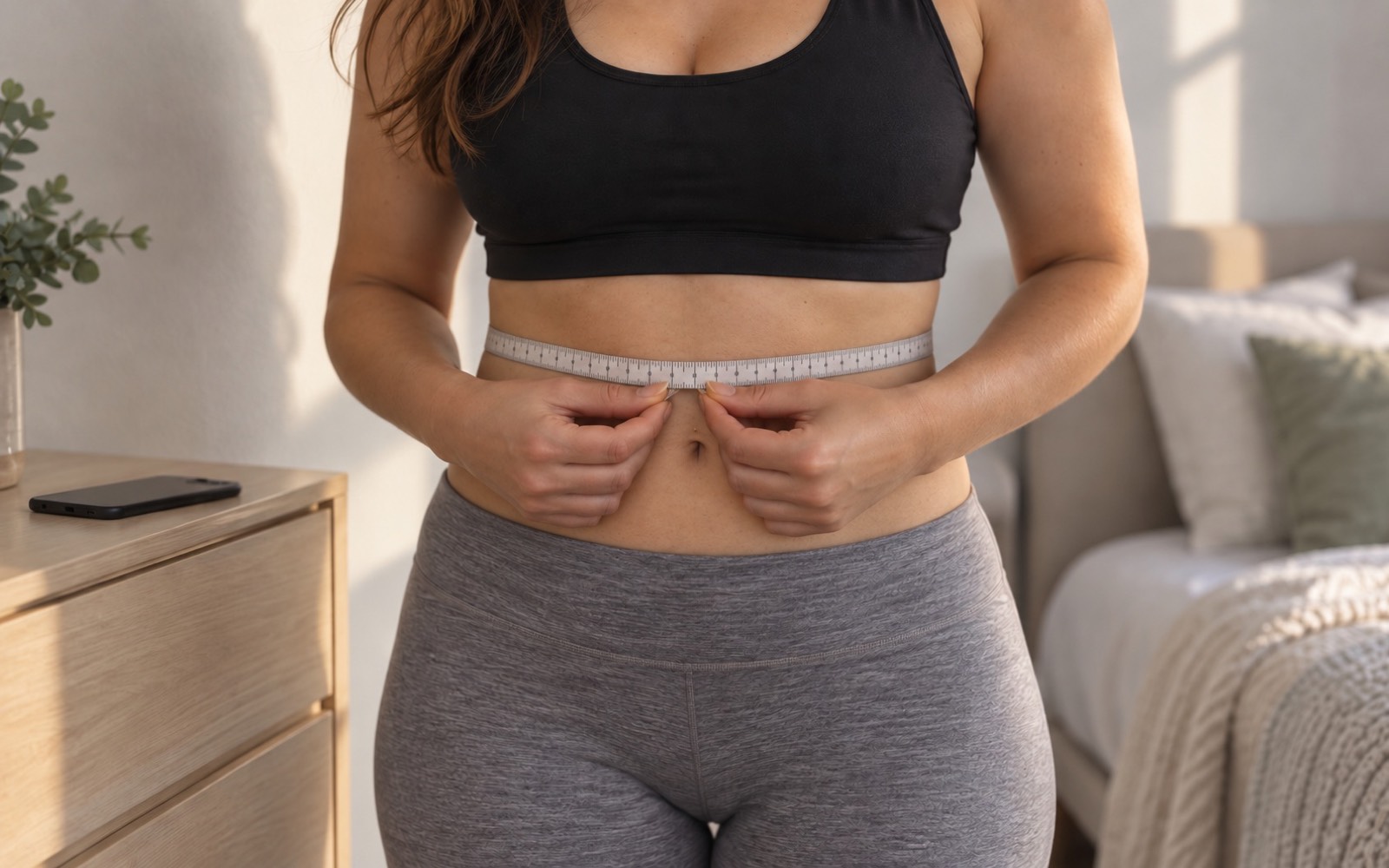
A scale can't tell you where your fat sits. A tape measure can. The UK's National Institute for Health and Care Excellence (NICE) recommends measuring your waist like this:
- Find the bottom of your ribs and the top of your hip bone on your side.
- Wrap the tape around your waist halfway between them. This is usually just above your belly button.
- Don't suck in. Breathe out normally, then read the number.
To track progress, measure on bare skin, in the morning, once a week and at the same spot.
Now divide your waist by your height, using the same units for both. For example, a 38-inch waist and a height of 5'7" (67 inches): 38 ÷ 67 = 0.57.
- 0.40–0.49: no increased health risk.
- 0.50–0.59: increased risk.
- 0.60 and up: high risk.
The risk here means type 2 diabetes, high blood pressure and heart disease. The scale works for men and women with a BMI under 35, including people with a lot of muscle. It's easy to remember: keep your waist under half your height.
There are also cutoffs that don't use height. According to the WHO, a waist over 31.5 inches (80 cm) in women means increased risk, and over 35 inches (88 cm) means high risk. For men, the numbers are 37 inches (94 cm) and 40 inches (102 cm). These cutoffs were set for people of European descent. If your waist-to-height ratio is 0.5 or higher, or your waist is over the WHO cutoff, this plan is for you.
Smart scales with a "visceral fat" reading give only a rough estimate. Watch how the number changes over time, but don't treat it as a diagnosis.
Why belly fat is the last to go
Your belly has two layers of fat. One sits under the skin. The other sits deeper, behind the ab muscles, around the liver and intestines. The deep kind is called visceral fat, and it's worse for your health.
| Fat under the skin (subcutaneous) | Deep fat around the organs (visceral) | |
|---|---|---|
| Where it sits | Right under the skin, you can pinch it | Behind the ab muscles, around the organs |
| How your belly feels | Soft, with a thick fold | Firm, pushes forward, with a thin fold |
| Why it matters | Mostly appearance | Linked to blood pressure, blood sugar, cholesterol and heart disease |
| What shrinks it | A calorie deficit | A deficit and regular exercise, even when your weight doesn't change |
| How to track it | Skinfold, photos | Waist size and waist-to-height ratio |
Fat comes off your whole body, but in a set order, and that order depends on your genes, sex and age. The areas that store the most tend to empty last. For men, that's usually the belly and love handles. For women, it's the lower belly, hips and glutes. That's why your face and arms can look leaner while your belly seems stuck.
You can't choose where the fat comes from. In one study, 11 young adults trained only one leg for 12 weeks: leg presses three times a week, 960–1,200 reps per session. Their total body fat dropped by 5%, but it came off the arms (−10%) and the trunk (−7%). The trained leg didn't lose any.
The good news: deep fat responds to exercise better than you might think. In a review of 117 studies, when people's weight didn't change, exercise still cut their deep fat by 6%, while dieting cut it by only about 1%. That's why a tape measure tells you more about belly fat than a scale.
What causes belly fat: 5 reasons and what to do about each
Usually several causes work together. Find yours.
- Calories. Over months or years, you've eaten a little more than you burn. What to do: log what you normally eat for 3–4 days and see where the extra calories come from.
- Too little movement. A desk job, driving everywhere, few steps. What to do: add 2,000 steps to your daily average and start strength training twice a week.
- Sleep and stress. Poor sleep and stress drive up your appetite: you crave sweets and snack more at night. In a study where people dieted on 5.5 hours of sleep, they were hungrier than when they slept 8.5 hours. What to do: sleep 7+ hours and eat on a regular schedule.
- Age and hormones. You lose muscle as you get older, and your body burns less energy. In women, fat is more likely to settle on the belly during the transition to menopause (source 4). What to do: don't skip strength training after 40. It matters more than it did at 25.
- Genetics. Where you store fat depends a lot on your genes. What to do: accept the order your body goes in and track your waist instead of waiting for your belly to go first.
What shrinks belly fat and what doesn't
Every method below is rated the same way: what it does to belly fat, how much you need and how we know.
| Method | What it does to belly fat | How much | How we know |
|---|---|---|---|
| A moderate calorie deficit | The main lever: shrinks both layers of fat | 300–500 calories a day | 2016 review: dieting reduces both weight and deep fat (source 3) |
| Walking and other cardio | Cuts deep fat even when your weight stays the same | 150+ minutes a week | 2016 review: −6% deep fat without weight loss (source 3) |
| Full-body strength training | Burns energy and protects muscle during a deficit; fat comes off your whole body, including your trunk | 2–3 times a week, 40–45 minutes each | 12 weeks of training one leg: 7% of trunk fat gone, none from the trained leg (source 2) |
| Sleep, 7+ hours | On the same diet, more of the weight you lose comes from fat | Every night | Over 14 days, people lost 1.3 lb (0.6 kg) of fat on 5.5 hours of sleep and 3.1 lb (1.4 kg) on 8.5 hours (source 5) |
| Less alcohol | Fewer extra calories and snacks | The less, the better | A gram of alcohol has 7 calories |
| Crunches and other ab exercises | Strength and endurance go up; waist and skinfold don't change | For strength, yes. For belly fat, no | 6 weeks, 7 exercises, 5 days a week: no change (source 1) |
| Stomach vacuum | Trains a deep core muscle, and your belly may look tighter; doesn't remove fat | Fine as an exercise | Same as with crunches: working a muscle doesn't burn the fat over it (sources 1 and 2) |
| Waist trainers, plastic wrap, body wraps, sauna shorts | Make you sweat out water, which comes back with your next glass; don't touch fat | Not needed | Fat doesn't leave your body as sweat. The drop on the scale is water |
| Fat freezing, other cosmetic procedures and liposuction | Medical procedures that affect only fat under the skin in the treated area | A decision for you and your doctor | Deep fat sits behind the muscles, and nothing from the outside can reach it |
Crunches deserve a closer look. A 2011 study split 24 people into two groups. One group did 7 ab exercises for six weeks: 2 sets of 10 reps, five days a week. The other group didn't train. Everyone kept eating as usual. The ab group's endurance improved: on the final test they did 47 curl-ups, compared with 32 in the other group. But their weight, body fat percentage, waist size and belly skinfold didn't change.
Ab training still matters: a strong core supports your back during squats and rows. Just train it for strength, not fat loss. For the exercises to pick and how many sets to do, see our guide to the best ab exercises.
Diet to lose belly fat: a deficit without starving yourself
Your belly shrinks when you eat a little less than you burn and keep it up for months. You don't need to starve. A harsh deficit is hard to stick with, hunger builds, and one binge can wipe out the whole week.
- Change nothing for the first 3–4 days. Log everything you eat, as usual. This shows you your real numbers.
- Find your maintenance calories. That's how many calories you burn in a day. The formula and a worked example are in how to calculate a calorie deficit.
- Subtract 300–500 calories. For example, if you burn 2,200 calories a day, eat 1,700–1,900.
- Add protein to every meal. Have meat, fish, eggs, Greek yogurt, cottage cheese or beans at breakfast, lunch and dinner.
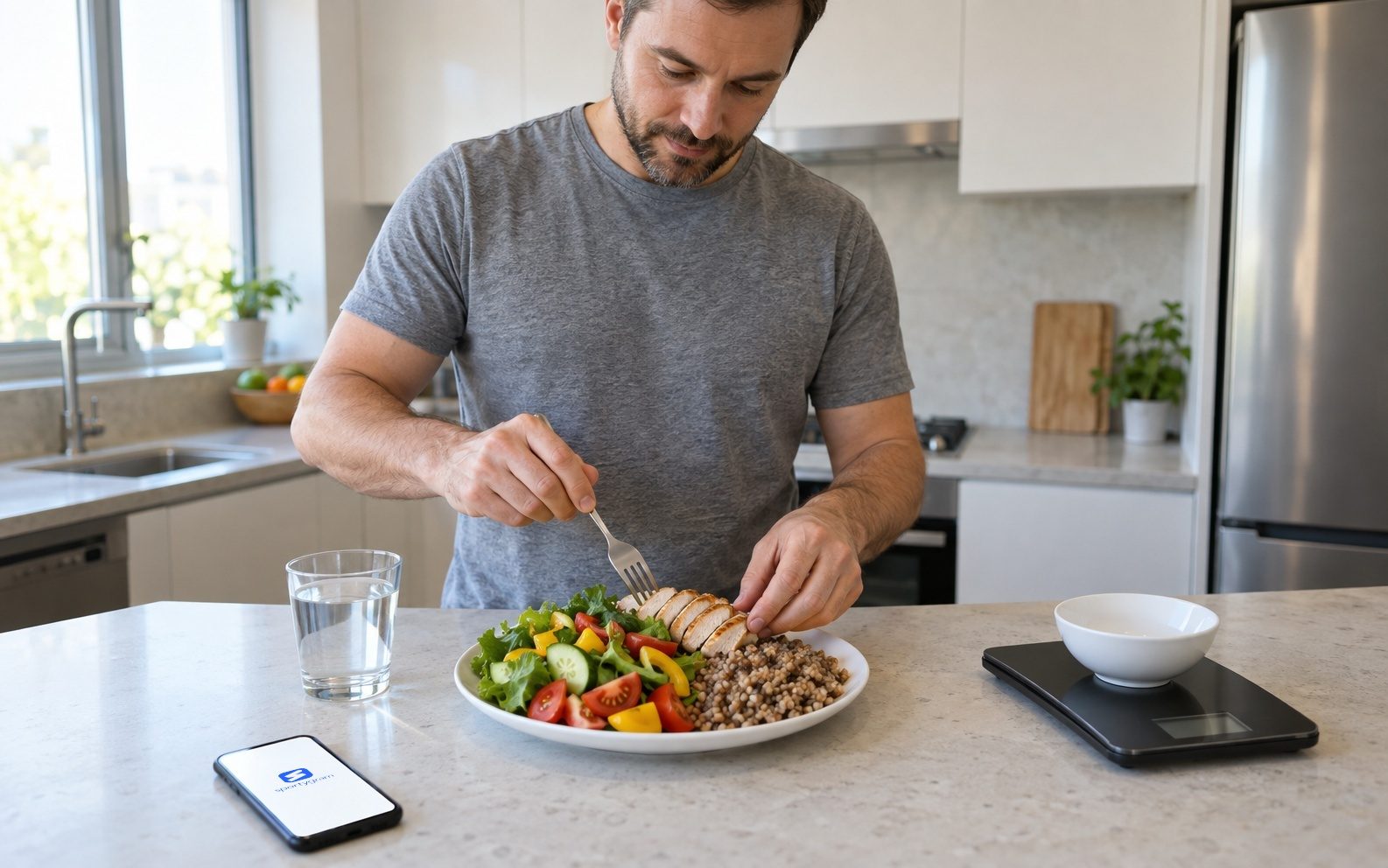
- Fill half your plate with vegetables. They're low in calories and high in fiber, so you stay full longer.
- Weigh your portions for at least the first two weeks. It's easy to guess wrong, especially with oil, sauces and snacks.
About alcohol: a gram of it has 7 calories, and after a drink or two it's harder to say no to snacks. If your belly isn't shrinking and you drink every weekend, start there.
don't cut calories further just because your waist didn't change in a week. Look at the trend over three weeks. If it's flat, check your food log first: did you weigh every portion, and did you log the weekends?
Exercises to lose belly fat: full-body training instead of endless crunches
To lose belly fat, focus on your biggest muscles: legs, glutes, back and chest. These exercises burn more energy than ab work and protect your muscle during a deficit. Below are exercises from our app's library, most with a home version and a dumbbell version, plus walking.
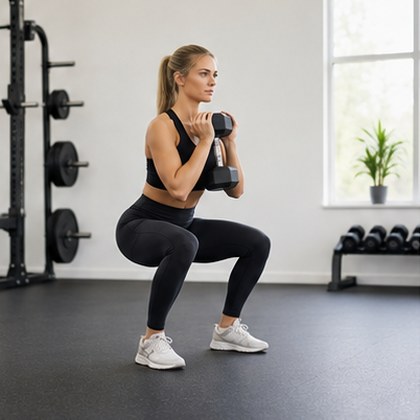
- Legs. At home: bodyweight squats or squats with a loaded backpack. With dumbbells: goblet squats.
- Hamstrings and glutes. At home: glute bridges. With dumbbells: Romanian deadlifts.
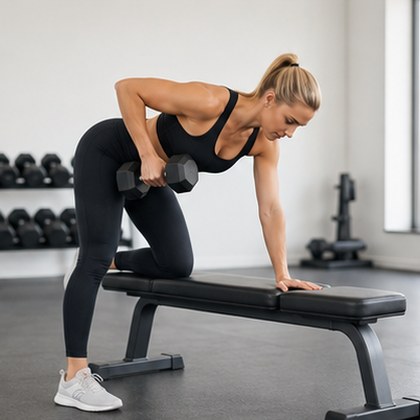
- Back. Bent-over dumbbell rows. At home, use a water bottle or a backpack instead of a dumbbell.
- Chest and arms. At home: knee push-ups or incline push-ups against a sturdy table. With dumbbells: dumbbell bench press.
- Single-leg work. At home: stationary lunges. With dumbbells: step-ups onto a bench.
- Core. Dead bugs and side planks. These are for strength and a stable back, not for burning fat.
- Walking. Brisk walking outside or incline walking on a treadmill, 30–60 minutes. Go at a pace where you can talk but can't sing.
How much: 3 sets of 8–12 reps. On the last set, stop when you have about 2 reps left in the tank. A session takes 40–45 minutes. When 12 reps feel easy, add weight.
Your week could look like this:
- Monday: full-body strength workout.
- Tuesday: brisk walk, 45 minutes.
- Wednesday: full-body strength workout.
- Thursday: brisk walk, 45 minutes.
- Friday: third strength workout or rest.
- Saturday: long walk, 60 minutes.
- Sunday: rest.
That adds up to 150 minutes of walking and 2–3 strength workouts. To add steps without overloading your feet and knees, see walking for weight loss.
 Goblet squat
 Bent-over dumbbell row
How long it takes to lose belly fat: a 12-week plan
In the first 1–2 weeks, the scale drops faster because you lose water along with fat. Then the pace slows, and that's normal. For your waist, expect 0.4–0.8 inch (1–2 cm) off in 4 weeks. The scale may barely move during this time, especially in your first weeks of strength training. You'll usually see a clear difference in the mirror and in photos after 8–12 weeks. That's a guide, not a promise.
Week 0: measurements. Measure your waist. Weigh yourself three mornings in a row and take the average. Take photos in the same pose and the same light. Calculate your maintenance calories.
Weeks 1–2: numbers and steps. For 3–4 days, log your food as usual, with no restrictions. Then eat 300–500 calories below maintenance. Add 2,000 steps to your usual daily count.
Weeks 3–4: strength training. Do two full-body strength workouts a week, 40–45 minutes each. Eat protein at every meal and sleep at least 7 hours. At the end of week 4, measure your waist: aim for 0.4–0.8 inch (1–2 cm) less.
Weeks 5–8: more movement. Do three strength workouts a week, or two strength workouts and 150 minutes of brisk walking. If your waist doesn't change for three weeks in a row, don't cut calories. Check the portions in your food log first.
Weeks 9–12: check your results. Measure your waist and compare your photos with week 0. If hunger and fatigue are piling up, spend a week at maintenance with no deficit. Then keep going.
A week at maintenance isn't a step back. The people who lose belly fat are the ones who stick with a plan for months. An extreme plan started on a Monday rarely lasts to the end of the month.
Belly fat in men, women and after 40
The plan is the same for everyone, but fat builds up in different places and the waist cutoffs are different.
| Men | Women | After 40–50 | |
|---|---|---|---|
| Where fat builds up | More often deep fat: a firm belly that pushes forward, the "beer belly" | More often under the skin: lower belly, hips, glutes | Less muscle, and fat settles on the belly more often; in women, during the transition to menopause |
| Waist cutoff | Over 37 in (94 cm): increased risk; over 40 in (102 cm): high risk | Over 31.5 in (80 cm): increased risk; over 35 in (88 cm): high risk | Same cutoffs; aim for a waist under half your height |
| What goes last | Belly and love handles | Lower belly and hips | Belly |
| What to focus on | Less alcohol, walking, a deficit | Leg and glute strength training, protein, patience with the lower belly | Strength training 2–3 times a week is a must, protein at every meal |
For men: deep fat responds well to walking and a deficit, so your waist can shrink even when the scale barely moves. For women: the lower belly is the body's most stubborn storage zone, and it goes last even when you do everything right. After 40, the plan stays the same, but it works worse without strength training, because it's easy to lose muscle along with fat.
How to track this plan
Each week, you need three things on record: what you ate, what you did in your workouts and your waist size.
- Food. Log everything and compare your total with your calorie target. At a minimum, track calories and protein, and see how much you have left for the day.
- Weight. Weigh yourself in the morning and look at the weekly average, not single days.
- Workouts. Write down your sets, reps and weights so you know when it's time to go heavier.
If you track meals and workouts in the Sportygram app, your calorie target is calculated from your stats and goal. Your workout plan, sets and weights are saved in your workout log, and all 142 exercises in the library come with photos.
To be honest: the app doesn't record waist size yet. Measure it with a tape once a week and jot it down in your phone's notes.
When your belly is a reason to see a doctor
Most of the time, a belly is just fat. But if you notice any of these signs, see a doctor first and the gym second:
- your belly has grown over a few weeks, feels hard or hurts;
- you have shortness of breath or swollen legs;
- your arms and legs are getting thinner while your belly grows, you have purple stretch marks, your face has become round and red, and your blood pressure jumps around;
- your waist is over 35 inches (88 cm) as a woman or over 40 inches (102 cm) as a man, and you haven't had your blood pressure, blood sugar and cholesterol checked in a long time.
Don't put off the first three. For the last one, see your primary care doctor about which tests you need.
FAQ
Can you lose fat from just your belly?
No. Fat comes off your whole body, and the order depends on your genes, sex and age. In the study where people trained one leg, fat came off their arms and trunk but not the trained leg. Crunches work the same way: six weeks of ab exercises shrank neither the waist nor the skinfold. Your belly gets smaller along with your overall body fat when you're in a deficit.
How long does it take to lose belly fat?
In the first week, you mostly lose water and what's in your gut. A 500-calorie daily deficit burns just under a pound (0.45 kg) of fat a week. In a month on a moderate deficit, expect 0.4–0.8 inch (1–2 cm) off your waist. A clear difference in the mirror takes 8–12 weeks. Waist trainers and body wraps promise faster results, but they only push out water.
How do you lose belly fat at home without equipment?
Log your food and keep a deficit of 300–500 calories. Two or three times a week, do five no-equipment exercises: squats, glute bridges, knee push-ups, stationary lunges and dead bugs. Train your back with bent-over rows using water bottles. On the other days, walk briskly for 30–45 minutes. That's enough. You don't need a gym.
How do you lose belly fat and love handles?
Love handles are the same fat under the skin as on your belly, just on the sides of your waist. You can't target them: side bends and torso twists strengthen your oblique muscles, but they don't burn the fat over them. What works is the full plan: a 300–500 calorie deficit, full-body strength training and 150 minutes of walking a week. Love handles shrink along with your waist.
How do women lose lower belly fat?
Lower belly fat is the same fat tissue. In women, it just comes off last. There are no special lower belly exercises that burn fat there: the full plan of a deficit, strength training and walking is what works. If your lower belly sticks out at a normal weight, the cause is more often posture or bloating. After pregnancy, check first whether your ab muscles have separated.
How can men get rid of a hard belly?
A hard "beer belly" with a thin skinfold usually means deep fat around the organs. It shrinks with walking and a moderate deficit, even when the scale moves slowly. Alcohol and poor sleep get in the way. If your waist is over 40 inches (102 cm), see your doctor to get your blood pressure, blood sugar and cholesterol checked, and start the plan now.
What is cortisol belly and how do you get rid of it?
It's a social media term, not a diagnosis. Stress makes weight loss harder mainly through poor sleep, a bigger appetite and evening snacking, so the same plan works, plus 7+ hours of sleep. If your arms and legs get thinner while your belly grows, with purple stretch marks and blood pressure that jumps around, see a doctor. For what actually lowers cortisol, see our look at the cortisol detox.
Do crunches, stomach vacuums and waist trainers work?
Crunches and vacuums strengthen your ab muscles, but they don't burn the fat over them. After a few weeks of vacuums, your belly may look tighter if that deep muscle was weak. Waist trainers, plastic wrap and body wraps make you sweat out water, and it comes back with your next glass. Train your abs for core strength, and lose belly fat with a deficit, full-body strength training and walking.
How do you know if you have visceral fat?
The easiest way is a tape measure. If your waist is more than half your height, or over 31.5 inches (80 cm) for women or 37 inches (94 cm) for men, you likely carry extra belly fat, including the deep kind. Another sign is a firm belly with a thin skinfold. Smart scales only estimate it. A CT or MRI scan measures deep fat precisely, but you don't need one for this plan.
The bottom line
- You can't lose fat from just your belly. You lose fat all over, and your belly shrinks along with it, often last.
- First check that it's fat: bloating, posture and diastasis recti need a different approach. A healthy waist is less than half your height.
- What works is the combination: a 300–500 calorie daily deficit, full-body strength training 2–3 times a week, 150 minutes of walking a week and 7+ hours of sleep.
- Crunches, stomach vacuums, waist trainers and body wraps don't touch belly fat. Train your abs for strength.
- Expect 0.4–0.8 inch (1–2 cm) off your waist a month and a visible difference in 8–12 weeks. Measure your waist once a week and watch the three-week trend.
Checklist: 12 weeks to lose belly fat
- Week 0: measure your waist just above your belly button after a normal exhale, weigh yourself three mornings in a row and take photos in the same pose.
- Use the "is it fat?" table to rule out bloating, posture and diastasis recti.
- Weeks 1–2: log your food as usual for 3–4 days, then eat 300–500 calories below maintenance and add 2,000 steps a day.
- Weeks 3–4: two full-body strength workouts of 40–45 minutes, protein at every meal, 7+ hours of sleep.
- End of week 4: measure your waist and aim for 0.4–0.8 inch (1–2 cm) less.
- Weeks 5–8: three strength workouts, or two strength workouts and 150 minutes of walking. Waist flat for three weeks? Check your portions first.
- Weeks 9–12: final measurements and photos. Tired and hungry? Take a week at maintenance, then keep going.
Sources
- Vispute S. S. et al. The effect of abdominal exercise on abdominal fat. Journal of Strength and Conditioning Research, 2011. — 24 people, six weeks of ab exercises in one of two groups: ab endurance improved (47 curl-ups vs. 32), while body weight, body fat percentage, waist circumference and abdominal skinfold didn't change.
- Ramírez-Campillo R. et al. Regional fat changes induced by localized muscle endurance resistance training. Journal of Strength and Conditioning Research, 2013. — 11 people, 12 weeks of single-leg leg presses: total fat mass fell by 5.1%, and it came off the arms (−10.2%) and trunk (−6.9%), but not the trained leg.
- Verheggen R. J. et al. A systematic review and meta-analysis on the effects of exercise training versus hypocaloric diet: distinct effects on body weight and visceral adipose tissue. Obesity Reviews, 2016. — 117 studies, 4,815 people: both exercise and diet reduce visceral fat; without weight loss, exercise reduced it by 6.1% and diet by 1.1%.
- Marlatt K. L. et al. Racial differences in body composition and cardiometabolic risk during the menopause transition. American Journal of Obstetrics and Gynecology, 2020. — 94 women followed through menopause: in white participants, belly fat rose in the years before menopause (subcutaneous by 19%, visceral by 15%); Black participants already had more belly fat before the transition, and it stayed the same.
- Nedeltcheva A. V. et al. Insufficient sleep undermines dietary efforts to reduce adiposity. Annals of Internal Medicine, 2010. — 10 people, 14 days on the same diet: they lost 0.6 kg of fat on 5.5 hours of sleep and 1.4 kg on 8.5 hours; with less sleep, they lost more fat-free mass (2.4 kg vs. 1.5 kg) and felt hungrier.
- NICE. Overweight and obesity management (NG246): identifying and assessing central adiposity. — How to measure your waist and the waist-to-height ratio scale: 0.4–0.49, 0.5–0.59, 0.6 and up; for adults with a BMI under 35, including people with high muscle mass.
- World Health Organization. Waist circumference and waist-hip ratio: report of a WHO expert consultation. 2008, published 2011. — Waist cutoffs for people of European descent: 80 and 88 cm for women, 94 and 102 cm for men.
This article is for informational purposes only and doesn't replace medical advice. If your belly has grown over a few weeks, feels hard or hurts, or you have shortness of breath or swollen legs, get checked by a doctor instead of following a plan from an article.