

diastasis recti is a separation of the ab muscles along the midline: a gap of two finger-widths or more above, at or below the belly button. In a 2016 Norwegian study by Sperstad and colleagues of 300 women, 60% had it six weeks after their first birth, 45% at six months and 33% at one year. In a 2025 review by de Oliveira and colleagues, exercise brought the muscles closer by 6.8 mm on average, about a quarter of an inch, less than a finger's width, so the goal of the plan is a belly that handles load without a ridge along the middle. The plan has 4 stages, 10–15 minutes 3–4 times a week; crunches come back at stage 4, and you move up after 2 weeks with no ridge and no pain. Kegels won't fix diastasis: in a 2018 trial by Gluppe and colleagues, 4 months of pelvic floor–focused training didn't lower the share of women with it.
Diastasis recti exercises start with a check. Lie on your back with your knees bent and lift your head and shoulders. Then feel the middle of your belly above, at and below your belly button. If two fingers or more fit between the muscles, that's diastasis recti, a separation of the ab muscles along the midline. Among first-time moms, 60% have it 6 weeks after giving birth and a third still have it at one year. Stage one is breathing, heel slides and glute bridges, 10–15 minutes 3–4 times a week. Crunches come back at the last stage, stage four. A bulge near your belly button, pain, or a gap you can still feel 8 weeks after giving birth is a reason to see a doctor.

How to check for diastasis recti at home in 3 minutes
You do the test on the floor. It's the same for women and men.
- Lie on your back, bend your knees and put your feet flat on the floor.
- Place the fingertips of one hand across the middle of your belly, fingers together.
- Breathe out and lift your head and shoulders, like the start of a crunch. Don't hold your breath.
- Feel for the gap between the two ridges of muscle at three points: about 2 inches (4–5 cm) above your belly button, at your belly button and about 2 inches below it.
- Count how many fingers fit at the widest point.
- Check the floor of the gap: do your fingers press into firm tissue or sink into something soft?
Everyone's fingers are a different width. Hold a ruler against two of your fingers once and write down the number. From then on, record the gap in centimeters or inches so you can compare measurements from different months. Repeat the check every 4 weeks.
The floor of the gap is the second sign. In a 2016 study by Lee and Hodges, 26 women with diastasis did a curl-up under ultrasound. The study showed that besides width, how the linea alba (the band of connective tissue between the muscles) tightens under load matters too. A firm floor that springs back under your fingers is a good sign. If your fingers sink into something soft, don't rush to add load.
What the test can't tell you. It can't tell diastasis from a hernia. If you carry extra weight around your belly, the gap is harder to feel. Near a C-section scar, the result isn't reliable.
What your result means: normal, diastasis or hernia
The result of the test tells you where to start; a doctor makes the diagnosis. Ultrasound data from 150 women who have never given birth (Beer et al., 2009) puts the linea alba at up to 2.2 cm (about 7/8 inch) wide above the belly button and up to 1.6 cm (about 5/8 inch) below it, and that's normal. The European Hernia Society's 2021 guidelines define diastasis as a gap wider than 2 cm; 2 cm or less counts as normal. Research studies usually count a gap of two finger-widths or more at any of the three points as diastasis.
| What you feel | What it usually means | What to do |
|---|---|---|
| Gap narrower than two fingers, firm floor | Normal | Train as usual and watch for a ridge during ab exercises |
| Two fingers or more, springy floor, no ridge in daily life | Diastasis, the tissue holds tension | Start the plan at stage 1 or 2, check the gap every 4 weeks |
| Two fingers or more, fingers sink in, a ridge shows up even when you get out of bed or cough | Diastasis, the tissue doesn't handle load well yet | Stage 1, and see an OB-GYN or pelvic floor physical therapist before you progress |
| A round bulge at one spot near the belly button or on the midline, pain | Looks like a hernia | See a surgeon. If the bulge turns hard and painful, or you feel sick or vomit, get emergency care |
If you can still feel the gap 8 weeks after giving birth, tell your doctor. That's the advice from the UK's National Health Service (NHS). There's no single scale for grading diastasis: the European Hernia Society's 2021 guidelines reviewed the existing classifications and found none of them suitable for guiding treatment. That's why this guide sticks to two things: how wide the gap is and how firm its floor feels.
What diastasis recti is and whether it goes away on its own
Your rectus abdominis, the "six-pack" muscle, runs in two strips from your ribs to your pubic bone. Down the middle, a band of dense connective tissue called the linea alba holds them together. During pregnancy your belly grows, the linea alba stretches and the muscles move apart. Your body is making room for the baby. With diastasis, the muscles and tissue stay intact — the gap between them is just wider than usual, which is what sets it apart from a tear or a hernia.
What diastasis recti looks like. When you tense your abs, a lengthwise ridge rises along the middle of your belly. This is often called coning or doming. Your belly may stick out even at a normal weight. If something else is behind it, like bloating or your posture, our guide on why your stomach sticks out will help you figure it out.
Does diastasis recti go away on its own? Often, but not for everyone. A 2016 Norwegian study by Sperstad and colleagues followed 300 women from their first pregnancy to one year after birth. At week 21 of pregnancy, 33% had diastasis. At 6 weeks after birth it was 60%, at six months 45% and at one year 33%. For many women the gap narrows on its own, but one in three still has diastasis a year after giving birth.
Causes of diastasis recti. The main one is pregnancy. In the same study, women who lifted heavy loads 20 times a week or more were about twice as likely to have diastasis. That's why daily life gets its own section below. Men can get diastasis too.
How to tell if an exercise is too much for now: the coning traffic light
The key question in any diastasis recti exercise is whether the middle of your belly bulges. To check, put one hand on your lower belly and the other on your lower ribs. Rate every set with one of three colors.
- Green. Your belly stays flat, your breathing is calm and nothing pulls. Keep going.
- Yellow. A ridge shows up toward the end of the set. Do fewer reps or make the exercise easier: knees closer to your body, foot on the floor, shorter range of motion.
- Red. A ridge from the first rep, pain, leaking urine or heaviness in your lower belly. Drop back a stage. If the pain or leaking doesn't go away, see a doctor.
Red means your deep core muscles can't yet manage the pressure inside your belly. The exercise itself will come back later.
Diastasis recti exercises by stage: a home plan
Aim for 10–15 minutes 3–4 times a week. Short sessions are easier to fit into a day with a baby. This is a guideline. If your doctor gave you a plan, follow it.
The rule for moving up is the same at every stage. You move to the next stage after 2 weeks in a row with green on every exercise, no pain and a measurement no worse than the last one. If a ridge appears at the new stage, go back to the previous one for another week or two.
When to start. You can do the breathing on your back right after birth if nothing hurts. Save the rest for after your postpartum checkup. After a C-section, anything harder than breathing needs your doctor's OK.
Stage 1. Wake up the deep muscles.
- Breathing on your back. Lie on your back with your knees bent. Breathe in so your ribs widen to the sides. On a long exhale, gently draw your lower belly toward your spine. 8–10 breaths.
- Pelvic tilts. On the exhale, press your lower back into the floor. On the inhale, let your pelvis return. 10–12 reps.
- Heel slides. On the exhale, slowly straighten one leg, sliding your heel along the floor. Your belly stays flat and your pelvis doesn't rock. 8–10 reps per leg.
- Glute bridge. On the exhale, draw in your lower belly and lift your hips until your knees, hips and shoulders form a straight line. 2 sets of 10–12. For step-by-step form, see our glute bridge guide.
Stage 2. Hold steady.
- Modified dead bug. Lie on your back with your arms raised and knees bent. Slide one foot forward along the floor while the other stays put. 2 sets of 6–8 per side.
- Bird dog. Get on all fours with a flat back. First extend just an arm or just a leg, then an arm and the opposite leg together. 2 sets of 6–8 per side.
- Side plank from the knees. Rest on your elbow and knee, hips lifted, body straight from head to knees. 3 sets of 15–20 seconds per side.
Stage 3. Add load.
- Full dead bug. Arms up, knees bent and lifted. Slowly lower the opposite arm and leg toward the floor while your lower back stays pressed down. 2 sets of 8 per side.
- Full side plank. Rest on your elbow and feet. 3 sets of 20–30 seconds per side.
- Forearm plank. 3 sets of 15–20 seconds. If a ridge appears, stop and go back to the side plank. Our plank guide shows how to hold your body.
- Bodyweight squats. Breathe out as you stand up. 3 sets of 10–12.
- Single-leg glute bridge. 2 sets of 8 per leg.
Stage 4. Bring back your usual training.
- Short crunches. First draw in your lower belly on the exhale, then lift your head and shoulders. 2 sets of 8–10.
- Reverse crunches. Lie on your back and pull your knees toward your chest so your hips lift slightly off the floor. 2 sets of 8–10.
- Strength training with weights. Breathe out on the effort and don't hold your breath. If a ridge appears, go back to stage 3.
Why you draw in your lower belly before a crunch. In the same 2016 ultrasound study by Lee and Hodges, a regular crunch narrowed the gap but distorted the linea alba. When the women engaged the deep transverse abdominis before lifting, the gap didn't narrow as much, but the linea alba distorted less. The researchers think this helps the two sides of the abdominal wall transfer force better.
Exercises to avoid with diastasis recti, and when to bring them back
These moves are paused for now. Until your deep muscles can manage the pressure, they're the most likely to cause a ridge. The NHS also advises skipping sit-ups, planks and high-impact moves like jumping at first.
| What to pause | Why not yet | When to bring it back |
|---|---|---|
| Crunches, sit-ups, bicycle crunches | Put a lot of pressure on the middle of your belly and quickly cause a ridge | At stage 4, with your lower belly drawn in |
| Straight leg raises, flutter kicks | Long lever; your lower back tends to lift off the floor | Once you can do crunches without a ridge |
| High plank, push-ups | Your belly has to hold up more of your body weight | Briefly at stage 3, after the forearm plank |
| Heavy squats and deadlifts with a held breath | Bearing down spikes the pressure inside your belly | Once you can lift light weights at stage 4 on the exhale with no ridge |
| Deep backbends | Stretch the front of your belly | After stage 3 |
| Jumping | Put heavy impact on your pelvic floor | When there's no leaking and no heaviness in your lower belly |
Jumping and bladder leaks are a separate issue, and pelvic floor exercises address it. In a 2020 review by Bø and Nygaard in Sports Medicine, female athletes had roughly three times the rate of urinary leaking as non-athletes: running and jumping spike the pressure inside your belly and load the pelvic floor.
Crunches, Kegels, vacuums and back pain: what the research says
| What you hear | What the data shows | What it means for you |
|---|---|---|
| "Crunches are off-limits with diastasis" | The American College of Obstetricians and Gynecologists (ACOG) in its 2020 guidance: ab strengthening, including crunches and drawing in the belly, reduces the distance between the muscles. In a 2023 trial by Gluppe and colleagues, 70 women 6–12 months postpartum did head lifts and curl-ups 5 days a week for 12 weeks: the gap didn't widen and ab strength went up. Lee and Hodges, 2016: a crunch without engaging the deep muscle distorts the linea alba | Stage 4, with your lower belly drawn in and a ridge check |
| "Kegels fix diastasis" | In a 2018 trial by Gluppe and colleagues, 175 first-time moms were split into two groups. One did 4 months of training focused on the pelvic floor, the other didn't. At six months and one year, diastasis was just as common in both groups | Pelvic floor training is for leaks. That's a separate job |
| "Exercise will close the gap" | A 2025 review by de Oliveira and colleagues of 34 studies: exercise brings the muscles closer by 6.8 mm on average, with very low certainty in that number | The goal is a belly with no ridge under load |
| "Diastasis causes back pain" | In the Sperstad study, one year after birth lower back and pelvic pain were just as common in women with and without diastasis | If your back hurts, look for another cause |
| "It goes away on its own" or "it never goes away" | Sperstad, 2016: 60% at 6 weeks, 45% at six months, 33% at one year | It often goes away, but one in three still has it at a year. Your measurements will show how it's going for you |
| "Two fingers means 2 cm" | Finger width varies. Beer and colleagues, 2009: in women who haven't given birth, normal is up to 2.2 cm above the belly button and up to 1.6 cm below it | Measure your fingers with a ruler once |
| "A vacuum or a belly binder will pull the muscles together" | A vacuum is a static hold. In the 2025 review by de Oliveira and colleagues, ab exercises with movement narrowed the gap; static holds had no meaningful effect. In a 2025 meta-analysis by Abdullah and colleagues of 13 trials, exercise narrowed the gap below the belly button more than a binder did; above the belly button, there was no difference between the two | Use the vacuum as a skill for engaging the deep muscle, on the exhale and without holding your breath. A binder supports you from the outside — it doesn't do the muscles' work |
If your lower back hurts, don't wait for the gap to close: diastasis isn't necessarily the cause. Start with the beginner routine in our guide to lower back pain exercises. If the pain runs down your leg or lasts for weeks, see a doctor first.
Diastasis in daily life: getting out of bed, lifting your baby, the car seat, coughing
The NHS advises avoiding heavy lifting and straining after birth. Here's what that looks like in an ordinary day.
- Getting out of bed. Don't jerk straight up from your back. Roll onto your side, lower your legs and push up with your arm.
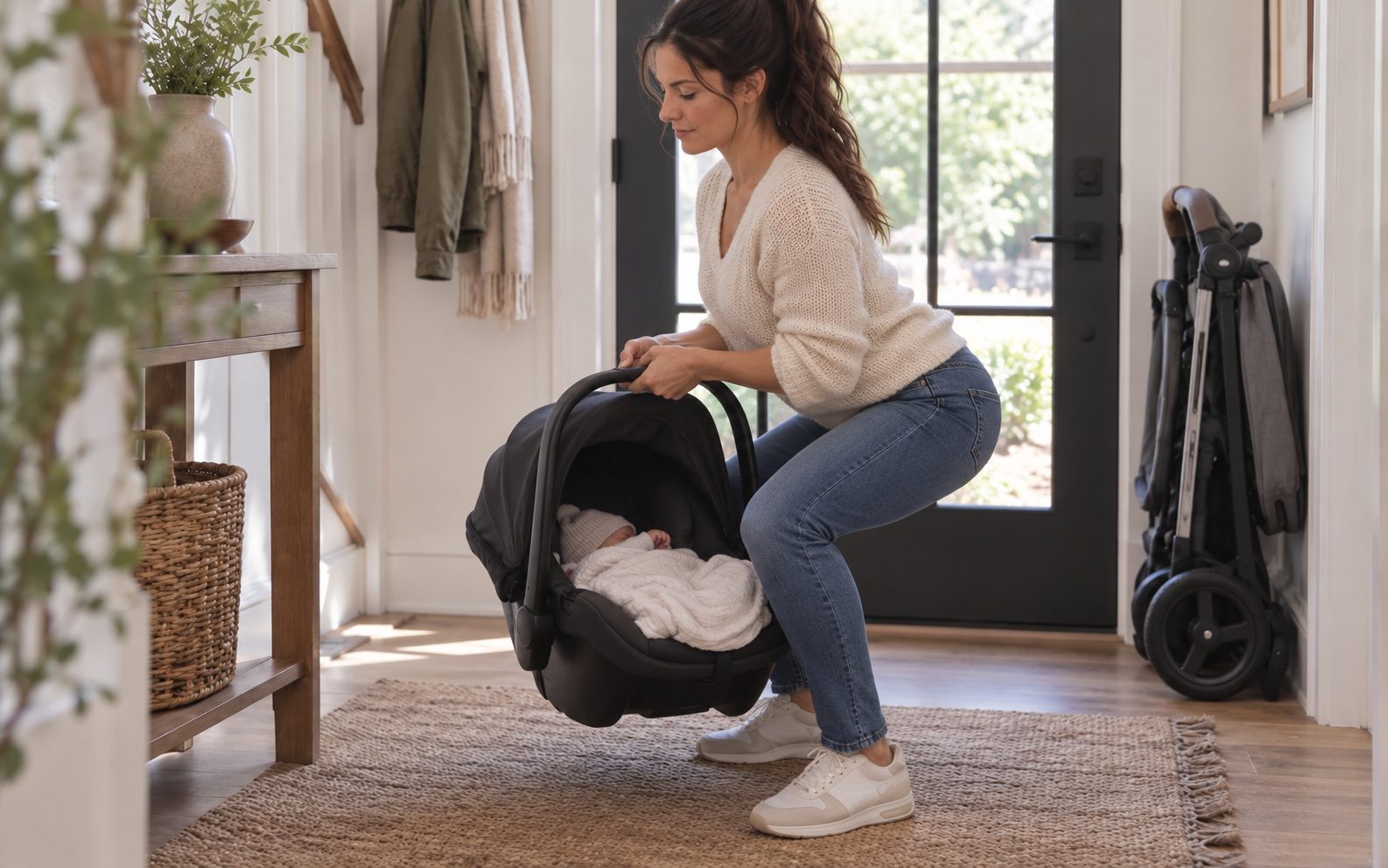
- Lifting your baby or the car seat. Squat down, keep the load close to your body and stand up on the exhale. Don't bend over with straight legs.
- Stroller on the stairs. Carry it with another person or in parts: the baby first, then the stroller.
- Coughing and sneezing. Draw in your lower belly first and turn slightly to the side.
- On the toilet. Don't strain. If constipation keeps coming back, talk to your doctor.
- Holding your baby. Switch arms and don't push your belly forward to rest the baby on it.
breathe out on the effort in every movement: rising from a bridge, getting up off the floor, picking up your baby. It's easier to draw in your lower belly as you exhale, so the middle bulges less.
Diastasis recti in men: exercises and how to tell it from a hernia
Men get diastasis too. There's little research on men, and nearly all the numbers in this article come from women after childbirth. The test and the stages are the same. The difference is where you start.
First, rule out a hernia. A round bulge at one spot at or above the belly button, especially one that shows when you cough or strain, is a reason to see a surgeon before you start the plan.
Second, your waist size. With a large belly, ab exercises alone won't do much. For what actually shrinks your waist, see our guide on how to lose belly fat.
Third, strength training. Do squats, deadlifts and presses with an exhale on the effort and no straining. If a ridge appears at your working weight, go lighter.
When to see a doctor about diastasis recti
Diastasis itself isn't dangerous. But a hernia and pelvic floor problems can cause similar signs.
| Looks like diastasis | Looks like a hernia or something else |
|---|---|
| A lengthwise ridge along the middle of your belly when you tense your abs | A round bulge at one spot, near the belly button or on the midline |
| The gap runs along your belly | The bulge shows even at rest and grows when you cough |
| No pain | Pain or pulling at one spot |
| Your belly sticks out, but you feel fine | Leaking urine, heaviness or a feeling of something dropping in your lower belly |
See a doctor if:
- you can still feel the gap 8 weeks after giving birth;
- there's a bulge at one spot or pain where the gap is;
- leaking urine or heaviness in your lower belly doesn't go away;
- you had a C-section and want to start anything harder than breathing.
Get emergency help if the bulge turns hard and painful, doesn't go back in when you lie down, or comes with nausea or vomiting.
You can start with your OB-GYN, or your primary care doctor if you're a man. They'll refer you to a pelvic floor physical therapist or a surgeon. Surgery is a decision you make with a surgeon. The European Hernia Society's 2021 guidelines say physical therapy may be considered before surgery, and when a hernia sits next to diastasis, the surgical approach is different, so getting checked matters either way.
How to track your progress: a measurement sheet and a workout log
Measuring every 4 weeks shows what you can't see in the mirror. Copy this table into your notes.
| Check | Above belly button, cm | At belly button, cm | Below belly button, cm | Floor: springy or sinks | Ridge: at which stage and when |
|---|---|---|---|---|---|
| 1st | |||||
| 2nd, after 4 weeks | |||||
| 3rd, after 8 weeks |
Keep your stage exercises in a workout log with the days, sets and reps. If you use the Sportygram app, add them to your workout log on set days. In your measurement sheet, note whether a ridge appeared and on which exercise.
A sample stage 3 week:
Monday, Wednesday and Friday: dead bug 2×8 per side, single-leg glute bridge 2×8 per leg, bodyweight squats 3×12.
FAQ
Can diastasis recti be fixed with exercise?
For many women the gap narrows over time, often on its own within the first year. In the 2025 review by de Oliveira and colleagues, exercise brought the muscles closer by 6.8 mm on average, less than a finger's width, and the evidence is weak. So aim for a belly that handles load without a ridge, in daily life and in training. With a hernia or a very wide gap, a surgeon makes the call.
What exercises should you avoid with diastasis recti?
While a ridge still shows up during exercise, pause crunches and sit-ups, straight leg raises, high planks, jumping and heavy lifts with a held breath. It's only a pause. The forearm plank comes back at stage 3 and crunches at stage 4. The rule for moving up is the same: 2 weeks with no ridge and no pain.
Can you do crunches with diastasis recti?
Yes, but in order: deep muscles and holds first, then load. Short crunches come back at stage 4. You draw in your lower belly on the exhale first, then lift your head and shoulders. ACOG's 2020 guidance lists ab exercises, including crunches, among those that reduce the distance between the muscles after birth. In a 2023 trial, 12 weeks of curl-ups in 70 postpartum women didn't widen the gap and raised ab strength. If a ridge appears, take a step back.
Can you do stomach vacuums with diastasis recti?
Yes, if you treat them as a skill: on the exhale, gently draw your lower belly toward your spine, then let go. Do it lying down or on all fours, without holding your breath. It teaches you to engage the deep muscle you'll use in every exercise of the plan. But don't count on vacuums alone: in the 2025 review by de Oliveira and colleagues of 34 studies, static holds had no meaningful effect, while ab exercises with movement did narrow the gap.
When can you start diastasis recti exercises after giving birth?
You can start pelvic floor exercises right after an uncomplicated birth. Calm breathing on your back with your lower belly drawn in is fine too, if nothing hurts. Start the rest of the plan after your postpartum checkup. After a C-section, anything harder than breathing needs your doctor's OK. At the checkup, ask which stage you should start at.
How long does diastasis recti take to heal?
There's no single timeline. In the 2016 study by Sperstad and colleagues, 60% of first-time mothers had diastasis at 6 weeks, 45% at six months and 33% at one year. For many the gap narrows on its own, but one in three still has it at a year. Measuring at three points every 4 weeks will show how it's going for you. If you can still feel the gap at 8 weeks, tell your doctor.
What does diastasis recti look like?
Most often it's a lengthwise ridge along the middle of your belly when you sit up from lying down or tense your abs. At rest, you may feel a soft dip near your belly button. Your belly also sticks out even at a normal weight. A separate round bulge at one spot doesn't look like diastasis: show it to a surgeon.
Does a belly binder help diastasis recti?
A binder supports your belly from the outside, but it doesn't train your muscles for you and won't close the gap by itself. In a 2025 meta-analysis by Abdullah and colleagues of 13 trials, ab exercises narrowed the gap below the belly button more than a binder did. Don't use it instead of the plan: your belly learns to handle load only through exercise, stage by stage. If your doctor recommended a binder after birth or surgery, wear it the way they said.
The bottom line
- Diastasis recti is a gap of two finger-widths or more between your ab muscles. Check it lying down at three points and see whether the floor springs back.
- One year after a first birth, one in three women still has diastasis. The goal of exercise is a belly with no ridge under load.
- The plan has 4 stages, 10–15 minutes 3–4 times a week. Move up after 2 weeks with no ridge and no pain.
- The plank comes back at stage 3, crunches at stage 4.
- See a doctor for a bulge at one spot, pain, leaking, or a gap you can still feel 8 weeks after giving birth.
Checklist: before every diastasis recti workout
- Exhale on the effort in every rep.
- First rep with a hand on your belly: no ridge?
- No holding your breath, no straining.
- No higher stage than last time unless you've had 2 weeks of green.
- Pain, leaking or heaviness in your lower belly: stop and step down a stage.
- Every 4 weeks: measure at three points and write it down.
Sources
- Sperstad J. B., Tennfjord M. K., Hilde G., Ellström-Engh M., Bø K. Diastasis recti abdominis during pregnancy and 12 months after childbirth: prevalence, risk factors and report of lumbopelvic pain. British Journal of Sports Medicine, 2016. — 300 first-time mothers: diastasis in 60% at 6 weeks, 45% at six months and 33% at one year; frequent heavy lifting raised the odds; lower back pain was just as common with and without diastasis.
- Gluppe S. L., Hilde G., Tennfjord M. K., Engh M. E., Bø K. Effect of a Postpartum Training Program on the Prevalence of Diastasis Recti Abdominis in Postpartum Primiparous Women: A Randomized Controlled Trial. Physical Therapy, 2018. — 4 months of training focused on the pelvic floor did not change the share of women with diastasis.
- Lee D., Hodges P. W. Behavior of the Linea Alba During a Curl-up Task in Diastasis Rectus Abdominis: An Observational Study. Journal of Orthopaedic & Sports Physical Therapy, 2016. — A regular crunch narrows the gap but distorts the linea alba; with the transverse abdominis engaged, the linea alba stays flatter.
- de Oliveira L. C. et al. Effects of conservative approaches for treating diastasis recti abdominis in postpartum women: A systematic review and meta-analysis. Medicine, 2025. — 34 studies: exercise brings the muscles closer by 6.8 mm on average, with very low certainty; only ab exercises with movement significantly narrowed the gap.
- American College of Obstetricians and Gynecologists. Physical Activity and Exercise During Pregnancy and the Postpartum Period. Committee Opinion No. 804. Obstetrics & Gynecology, 2020. — Pelvic floor training can start right after birth; ab exercises, including crunches, reduce the distance between the muscles.
- Beer G. M. et al. The normal width of the linea alba in nulliparous women. Clinical Anatomy, 2009. — Normal linea alba width in women who haven't given birth: up to 22 mm above the belly button and up to 16 mm below it.
- NHS. Your post-pregnancy body. 2026. — Self-check; a gap you can still feel at 8 weeks is a reason to see a doctor; at the start, skip sit-ups, planks and jumping, and avoid heavy lifting and straining.
- Gluppe S. B., Ellström Engh M., Bø K. Curl-up exercises improve abdominal muscle strength without worsening inter-recti distance in women with diastasis recti abdominis postpartum: a randomised controlled trial. Journal of Physiotherapy, 2023. — 70 women 6–12 months postpartum, 12 weeks of head lifts and curl-ups 5 days a week: the gap didn't change, and rectus strength and thickness went up.
- Hernández-Granados P., Henriksen N. A., Berrevoet F. et al. European Hernia Society guidelines on management of rectus diastasis. British Journal of Surgery, 2021. — Defines diastasis as a gap wider than 2 cm; found none of the existing classifications suitable for guiding treatment; says physical therapy may be considered before surgery; the surgical approach differs when a hernia sits next to diastasis.
- Abdullah, Rehman K. A., Ahmad B. et al. Comparative Efficacy of Abdominal Exercises and Abdominal Binding on Diastasis Recti Abdominis Reduction in Postpartum Women: A Systematic Review and Meta-Analysis of Randomized Controlled Trials. Physiotherapy Research International, 2025. — 13 randomized trials: exercise narrowed the gap below the belly button more than a binder or no treatment; no difference found above the belly button.
- Bø K., Nygaard I. E. Is Physical Activity Good or Bad for the Female Pelvic Floor? A Narrative Review. Sports Medicine, 2020. — Female athletes had roughly 3 times the rate of urinary leaking as non-athletes; abdominal pressure under load and pelvic floor strength vary from person to person.
This material is for informational purposes only and does not replace medical advice.