

imagine holding in gas. Everything inside lifts up and in, while your belly and glutes stay soft. Squeeze for 3 seconds, relax for 3, repeat 10 times, then do 10 quick squeezes. That's one set, and you need three a day.Do the first week lying down, then move to sitting and standing. Hold each squeeze a little longer every week: 3, 5, 8 and 10 seconds. If you have leaks, give it 3 months without skipping before you judge the results. Pain, heaviness or the feeling of a bulge in your vagina is a reason to see a doctor, not to squeeze harder.
Kegel exercises train your pelvic floor muscles. You squeeze them as if you're holding in pee and gas, hold for a few seconds, then relax completely. Start with 10 squeezes of 3 seconds, three times a day, and build up to 10 seconds over four weeks. UK clinical guidelines from NICE recommend at least 8 squeezes three times a day for at least 3 months. In a Cochrane review, women who leaked when they coughed were 8 times more likely to report being cured after this training than women who didn't train. Below you'll find your first set step by step, a 4-week plan and the signs that mean it's time to see a doctor.
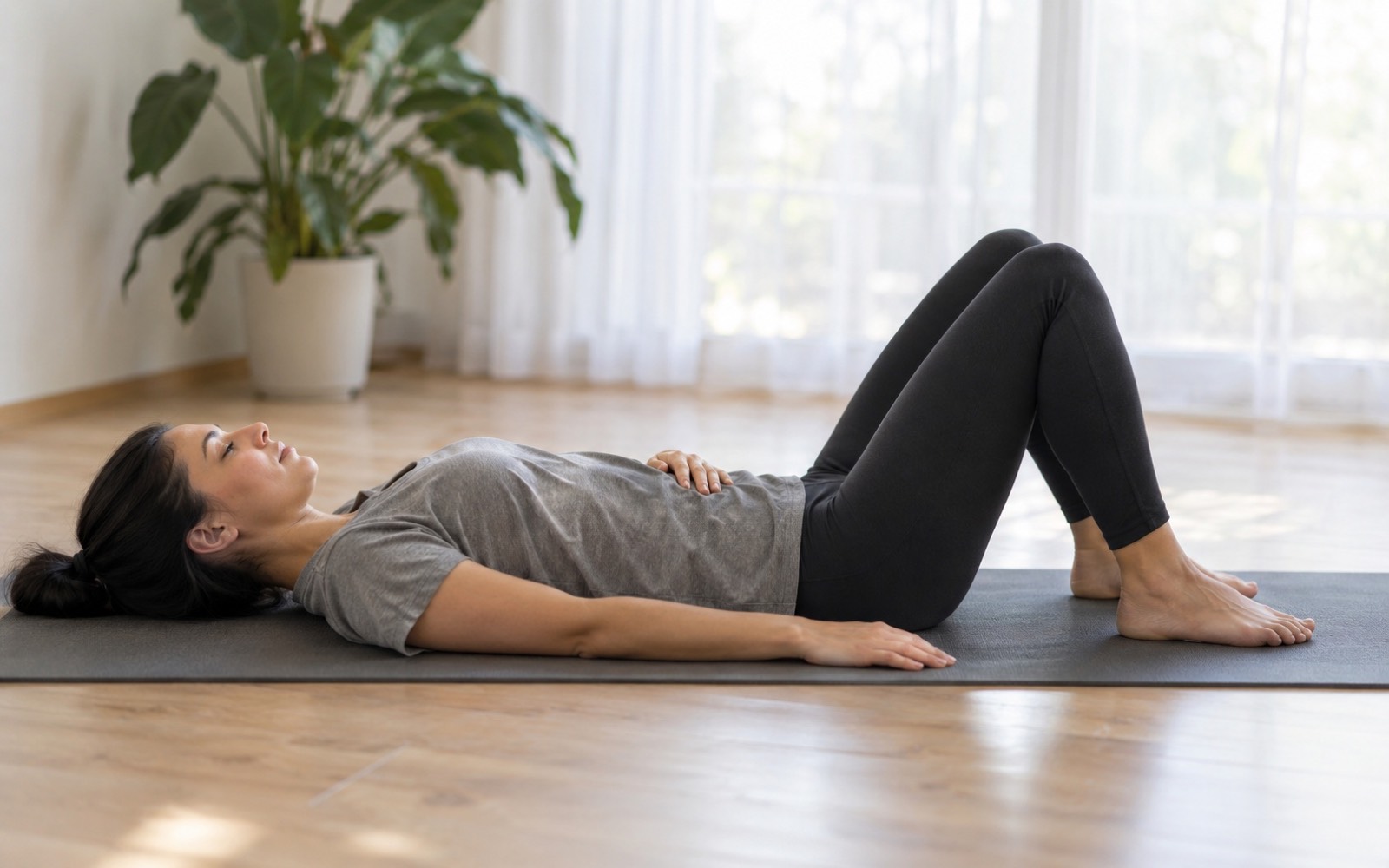
Your first Kegel set, step by step
For your first try, lie on your back with your knees bent and your feet flat on the floor. When you lie down, your muscles don't have to support the weight of your organs, so the squeeze is easier to feel. Put one hand on your lower belly.
- Take a calm breath in.
- As you breathe out, squeeze as if you're holding in pee and gas at the same time. Lift the muscles up and in.
- Hold for 3 seconds. Keep breathing evenly. Your belly stays still under your hand.
- Relax completely for 3 seconds. Feel the muscles gently settle back down.
- Repeat 10 times. That's the slow part of the set.
- Right away, do 10 quick squeezes: squeeze for one second and let go.
At first, a set takes under two minutes. By week 4, it takes about four. Do three sets a day. In the first week, do every set lying down: in bed when you wake up, on the couch in the afternoon and before you fall asleep. If you're pregnant and past 16 weeks, do your sets sitting or lying on your side instead of on your back.
| Stage | Squeeze | Relax | Per set | Sets a day | How to fit it into your day |
|---|---|---|---|---|---|
| Start, week 1 | 3 sec | 3 sec | 10 slow + 10 quick | 3 | lying down: morning, afternoon and before bed |
| Standard, from week 4 | 10 sec | 10 sec | 10 slow + 10 quick | 3 | at meals, while the coffee brews, in traffic |
| Maintenance, after 3 months | 10 sec | 10 sec | 10 slow + 10 quick | 1–2 | at the same time every day |
Don't squeeze as hard as you can. Ten steady squeezes beat three all-out ones.
What your pelvic floor is and why it's worth training
The pelvic floor is a layer of muscle stretched like a hammock from your pubic bone in the front to your tailbone in the back. It supports your bladder, uterus and bowel from below. These muscles help you hold in urine and gas, work together with your diaphragm and deep abdominal muscles, and play a role in your sex life.
The exercises are named after Arnold Kegel, an American gynecologist. In 1948, he described how training these muscles helped women who leaked urine. Since then, the method has been tested in dozens of studies. A 2018 Cochrane review pooled 31 studies with 1,817 women. In the trials that asked women with stress urinary incontinence (leaking when you cough, sneeze or laugh) whether the problem had gone away, 56% of those who trained said yes, compared with 6% of those who didn't. Side effects were rare and mild.
Three signs your pelvic floor has weakened:
- you leak when you cough, sneeze, laugh or jump;
- it's hard to hold in gas or make it to the bathroom in time;
- by evening, you feel heaviness or pressure in your vagina. If you notice this one, see a doctor first, because it can be a sign of pelvic organ prolapse.
Pregnancy and childbirth weaken the pelvic floor: about one in three women leak urine after giving birth. Menopause, a chronic cough, straining from constipation, excess weight and lifting heavy things while holding your breath can weaken it too.
Men can benefit from Kegels too, but their cues and goals are different, so that's a topic for another article.
How to find your pelvic floor muscles
A common reason Kegels "don't work" is squeezing the wrong muscles: glutes, thighs or abs. So find the right ones first. Three cues help.
- Hold in gas. Imagine you need to pass gas in a crowded room and can't. The muscles around your anus lift. That's the back of the hammock.
- Stop the flow. While you pee, try stopping the stream for one second. Do this once, just to learn the feeling. It's a way to find the muscles, not an exercise, so don't make it a habit.
- The elevator. Picture an elevator inside your pelvis rising from the first floor to the third. The muscles move up and in, not down.
A correct squeeze combines the first two cues: in the front, it's like holding in pee, and in the back, like holding in gas. The UK's NHS describes it the same way.
Then check yourself in three ways.
- Hand on your belly. With a correct squeeze, your belly barely moves under your hand. If it sucks in sharply or pushes out, your abs are doing the work, not your pelvic floor.
- Mirror from the side. Stand or sit sideways in front of a mirror and do a few squeezes. Nothing should happen on the outside. Your glutes, belly and shoulders don't move, and your knees don't press together.
- Finger check. With clean hands, insert a finger into your vagina and squeeze. A correct squeeze wraps around your finger and draws it slightly up and in. If your finger gets pushed out, you're bearing down. Doctors and pelvic floor physical therapists do the same check before a treatment program, as the NICE guidelines recommend.
What you should feel: a light lift inside, even breathing and a full release after each squeeze. What you shouldn't feel: pain, pressure pushing down, or tension in your glutes and thighs.
How to do Kegel exercises correctly: slow squeezes, quick squeezes and the elevator
The routine is built on three moves. Slow squeezes teach your muscles to hold for a long time. Quick squeezes teach them to switch on instantly when you cough or sneeze. The elevator teaches you to control how hard you squeeze.
| Exercise | How to do it | How much | Why |
|---|---|---|---|
| Slow squeezes | as you breathe out, lift the muscles up and in, hold while breathing evenly, then relax completely for the same time | 10 reps, 3 to 10 seconds each | so your muscles can support your organs for a long time |
| Quick squeezes | squeeze for 1 second and let go completely right away | 10 reps | so they switch on when you cough or sneeze |
| The elevator | raise the tension in three steps: a little, more, more still; lower it the same way, step by step | 5 reps in week 3, then whenever you like | so you can control the effort |
Three rules turn simple squeezes into real training.
Don't hold your breath. Start each squeeze on an exhale and keep breathing calmly while you hold. If your face turns red and your shoulders creep up, you're holding your breath. For more on how exhaling helps with any effort, see how to breathe during exercise.
Relax all the way. Relaxing is half the exercise. A muscle that never lets go gets tired and starts to ache. Rest between squeezes at least as long as you squeezed. If your squeeze gets weaker toward the end of a set, rest twice as long.
Quality beats numbers. If your muscles give out by rep eight, stop there. Eight good squeezes is exactly the minimum NICE recommends.
tie your sets to things you already do three times a day. The NHS suggests pregnant women do a set at every meal, and that works for everyone. Brushing your teeth, waiting for the coffee to brew or sitting in traffic work too. Nobody can tell you're training.
A 4-week Kegel plan
Your pelvic floor gets stronger the way any muscle does: gradually. Each week, two things change: your body position and how long you hold. Lying down is easiest. Standing is harder, because your muscles also have to hold up the weight of your organs.
| Week | Position | Slow squeezes | Quick | What's new | What you should feel |
|---|---|---|---|---|---|
| 1 | on your back, knees bent | 3 sec squeeze / 3 sec rest × 10 | 10 | find the muscles, hand-on-belly check | a light lift inside, your belly doesn't move |
| 2 | sitting on a chair, back straight | 5 sec / 5 sec × 10 | 10 | sets without a hand on your belly | you find the muscles on the first try |
| 3 | standing | 8 sec / 8 sec × 10 | 10 | three-step elevator × 5 | you can squeeze lighter or harder at will |
| 4 | standing and moving | 10 sec / 10 sec × 10 | 10 | a squeeze on an exhale before a cough, a sneeze or lifting a bag | the squeeze kicks in before the effort, almost on its own |
The main rule of the plan: if you can't feel it, don't move on. If you still have to hunt for the muscles in week two, go back to week one and the finger check. If you still can't feel anything after four weeks, see a gynecologist or a pelvic floor physical therapist.
After four weeks, stay on the standard routine until you reach three months: 10-second squeezes, 10 slow and 10 quick reps, three sets a day. That's the program length NICE recommends for bladder leaks. Then switch to maintenance with 1–2 sets a day. If the exercises helped, don't drop them completely.
You don't need any equipment to do Kegel exercises at home. But if you already have leaks, NICE recommends a program supervised by a specialist who can make sure you're squeezing the right muscles.
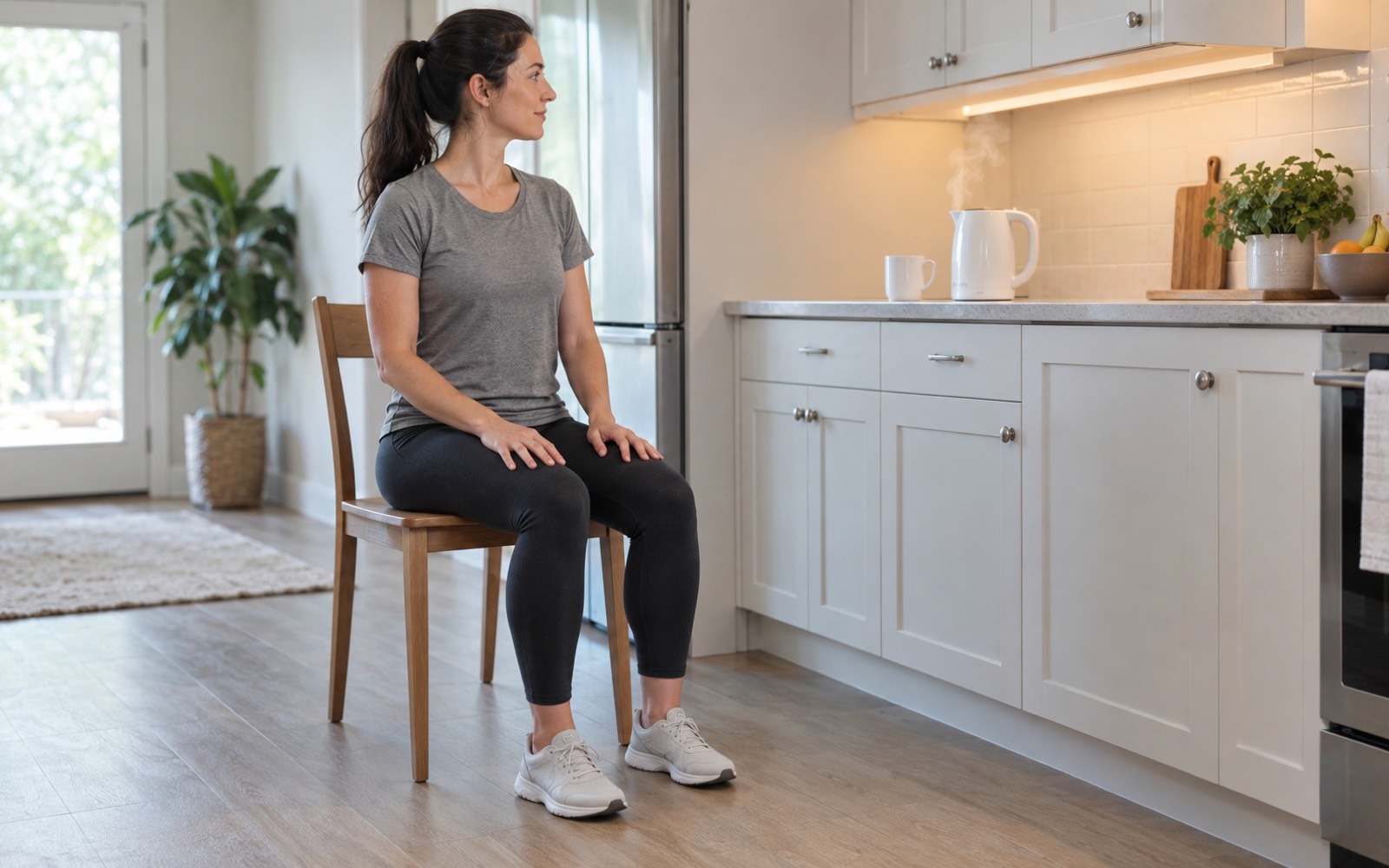
Am I doing Kegels right? A quick check and 6 common mistakes
Check this table in your first week and then once a week. If even one row in the right column sounds like you, go back to section 03 on finding your pelvic floor muscles.
| Right | Wrong |
|---|---|
| the feeling goes up and in | pressure pushes down, like straining |
| your belly stays soft, the hand on it doesn't rise | your belly sucks in sharply or pushes out |
| your glutes and thighs don't move | your glutes clench, your knees press together |
| breathing is even, the squeeze starts on an exhale | you hold your breath, your face turns red |
| the muscles fully let go between reps | the muscles stay tight all the time, with a dragging ache low in your belly by evening |
| nothing shows from the outside | your whole body tenses |
Six mistakes that keep you from getting results:
- Sucking in your belly instead of lifting your pelvic floor. Your abs join in on their own when you squeeze too hard. Cut the effort in half.
- Clenching your glutes and thighs. Check in a mirror and squeeze more lightly.
- Holding your breath. Count each hold out loud. It's hard to hold your breath while you're talking.
- Bearing down. That's the opposite movement, and it pushes on your organs. The finger check shows the direction right away.
- Not relaxing all the way. Your muscles tire, your squeezes get weaker, and a dragging ache can show up.
- Training on your urine stream. Stopping the flow once to find the muscles is fine. As a regular exercise, it does more harm than good.
Another reason for no results is doing sets only now and then. These muscles get stronger only with regular training, which is why NICE recommends three sets every day.
When not to do Kegels and when to see a doctor
Kegel exercises are safe for most women. But in some situations, squeezing won't help or will make things worse.
Don't start Kegels until you talk to a doctor if:
- you have pain in your lower belly, in your perineum or during sex;
- your muscles feel constantly clenched, with a dragging ache low in your belly by evening;
- you have acute inflammation, or bleeding that isn't your period;
- you recently had pelvic surgery or stitches after giving birth, and your doctor hasn't cleared you for exercise yet.
Constant tension and pain can mean your pelvic floor muscles aren't weak but overactive. Then they need relaxation and breathing work, and squeezing can make the pain worse. A gynecologist or a pelvic floor physical therapist can help you figure out what's going on.
See a doctor if:
- after 2–4 weeks, you still can't feel the right muscles;
- after 3 months of regular training, your leaks haven't improved;
- you feel heaviness, pressure or a bulge in your vagina, or see something bulging out;
- the exercises cause pain.
Heaviness and a bulge can be signs of pelvic organ prolapse. Prolapse is more common after 50, and it calls for an exam before you start exercising.
Kegels and your workouts: planks, squats, diastasis recti
Your pelvic floor is the bottom wall of your core. The diaphragm forms the top, your deep abs wrap around the front and sides, and your back muscles support it from behind. When you lift something heavy or hold your breath, the pressure inside your abdomen rises and pushes in every direction, including down. A strong pelvic floor meets that pressure. A weak one gives way, and you leak during a heavy set or a jump.
That gives you a simple rule for any strength workout: exhale, squeeze, move. Breathe out and lift your pelvic floor first, then lift the weight.
- Planks. Before you get into position, breathe out and gently lift your pelvic floor. Keep a light hold and breathe evenly. If you leak or feel pressure pushing down, shorten your hold. Step-by-step technique is in our plank guide.
- Squats, lunges, deadlifts. Lift your pelvic floor on an exhale before you stand up from a squat or pull a weight off the floor. Straining with a held breath drives pressure down. For how to position your back and knees, see our guide to squat technique.
- Jumping, jump rope, trampoline. If you leak when you jump, put jumping on hold. Come back to it once the leaking and the heaviness low in your belly are gone. For prolapse, the NHS advises avoiding activities that put heavy pressure on the pelvic floor, such as heavy lifting and trampolining.
- Diastasis recti after pregnancy. Kegels don't fix separated abdominal muscles. That's a separate problem. Lifting your pelvic floor on an exhale helps there too, but the program is different: see diastasis recti exercises.
- Your belly sticks out even though you're slim. Often it's not fat but how your deep abdominal muscles and your breathing work. We cover all the causes in why your stomach sticks out.
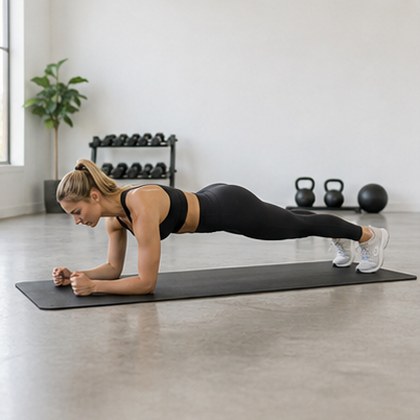 Plank
Plank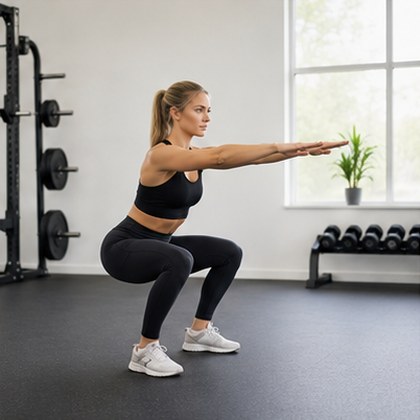 Squat
SquatHow to stick with it: habits, check marks and a realistic timeline
Three sets a day run on habit, not willpower. Results don't come right away, and after two weeks it's easy to let the sets slide. Three things help.
- Anchors. Do each set at the same time every day: after breakfast, after lunch and after dinner.
- Check marks. Mark every day you do all three sets. A growing chain of check marks keeps you from skipping.
- A realistic timeline. Don't judge your progress after a week. Check in after 3 months.
If you track workouts in the Sportygram app, Kegels don't need a slot in your workout plan. Do your three sets on workout days and rest days alike. For more ways to keep going when motivation fades, read how to stay consistent.
FAQ
How many Kegels should you do a day?
Three sets a day, each with 10 slow squeezes and 10 quick ones. UK NICE guidelines set the minimum at 8 squeezes three times a day. The NHS gives pregnant women the same advice: three sets of 8 squeezes, for example one at every meal. More isn't better, because tired muscles squeeze sloppily. Doing them every day matters more.
How long do Kegels take to work?
Finding the muscles and holding a squeeze longer usually gets easier within the first weeks of the plan. Leaking eases later: the NHS warns that it can take a few months to see the benefit, and NICE recommends trying for at least 3 months. For mild prolapse, the course is longer, at least 16 weeks. If the exercises help, don't stop. Switch to maintenance.
Can you do Kegels while pregnant?
Usually, yes. The NHS recommends them for all pregnant women, even those who don't leak. In a Cochrane review, pregnant women without leaks who trained were 62% less likely to leak late in pregnancy. Do your sets sitting or lying on your side: after 16 weeks, avoid lying flat on your back for long. If you're at risk of miscarriage, have pain or your doctor has limited your exercise, ask first.
When can you start Kegels after giving birth?
After a birth without complications, start gentle squeezes as soon as they don't hurt. If you had stitches, a tear or a C-section, ask your doctor at your checkup when you can start. About one in three women leak after giving birth, so there's nothing to be embarrassed about. If your leaks haven't improved after 3 months of training, see a gynecologist or a pelvic floor physical therapist.
Can you do Kegels on your period?
Yes. There's no rule against it, and you can keep your usual routine. These muscles keep working on those days too. If your lower belly hurts a lot, shorten the set or skip a day: a short break won't hurt. If squeezing always makes pain worse, not just during your period, tell your gynecologist. It can be a sign of overactive muscles.
What if you can't feel anything when you squeeze?
Go back to lying down with your knees bent. Breathe out and imagine holding in gas. Do the finger check: your muscles should wrap around your finger and draw it slightly in. Practice this way for a week and don't move ahead in the plan. If you still can't feel anything after 2–4 weeks, see a gynecologist or a pelvic floor physical therapist.
Do you need Kegel balls or a Kegel trainer?
Not to start. All the guidelines are built on plain squeezes, no devices. NICE doesn't recommend electrical stimulation or devices for everyone. They're offered to women who can't squeeze the muscles on their own. Jade eggs and other objects worn for hours aren't needed either. Get the technique down first, then ask a specialist about a trainer.
Do Kegels help with uterine prolapse?
For mild prolapse, they're the first thing to try. NICE recommends at least 16 weeks of supervised training for stage 1 and stage 2 prolapse. If you feel heaviness, pressure or a bulge in your vagina, see a doctor first. Besides exercises, a doctor may suggest a pessary, a removable support device, and more severe prolapse sometimes needs surgery.
The bottom line
- Kegel exercises lift your pelvic floor muscles up and in, like holding in gas, with a full release after each squeeze.
- To start: lie down, squeeze for 3 seconds and rest for 3, do 10 slow and 10 quick reps, three sets a day. Over 4 weeks, build up to 10 seconds and a standing position.
- Your belly, glutes and thighs stay out of it, and you don't hold your breath. Pressure pushing down means you're bearing down.
- For leaks, give it 3 months of daily sets before you judge the results. After that, 1–2 sets a day help you keep them.
- Pain, constant tension, heaviness or a bulge in your vagina means it's time to see a doctor. The same goes if you can't find the muscles within 2–4 weeks.
Checklist: Kegel exercises every day
- Find the muscles lying down: hand on your belly, belly doesn't move.
- Do a set: 10 slow squeezes and 10 quick ones.
- Squeeze on an exhale, without holding your breath.
- Keep your glutes and thighs out of it.
- Relax completely between squeezes.
- Do three sets: morning, afternoon and evening.
- Hold each squeeze as long as this week's plan says: 3, 5, 8 or 10 seconds.
- From week 4: lift your pelvic floor before you cough, sneeze or pick up something heavy.
Sources
- National Institute for Health and Care Excellence. Urinary incontinence and pelvic organ prolapse in women: management (NG123). NICE guideline, 2019. — UK clinical guidelines: a supervised course of at least 3 months, at least 8 squeezes three times a day, a digital check of the squeeze before the course; for stage 1 and 2 prolapse, at least 16 weeks.
- Dumoulin C., Cacciari L. P., Hay-Smith E. J. C. Pelvic floor muscle training versus no treatment, or inactive control treatments, for urinary incontinence in women. Cochrane Database of Systematic Reviews, 2018. — 31 studies, 1,817 women: leaking with coughing stopped in 56% of women after training and in 6% without it; side effects were rare and mild.
- Woodley S. J. et al. Pelvic floor muscle training for preventing and treating urinary and faecal incontinence in antenatal and postnatal women. Cochrane Database of Systematic Reviews, 2020. — 46 studies, 10,832 women: about a third of women leak after giving birth; training during pregnancy lowers the risk of leaking late in pregnancy by 62%.
- NHS. Urinary incontinence: 10 ways to stop leaks. NHS. — Squeeze for 2 to 10 seconds, 10 reps, don't suck in your belly, breathe calmly; it can take a few months to see the benefit.
- NHS. Exercise in pregnancy. NHS. — Pelvic floor exercises are recommended for all pregnant women: three sets of 8 squeezes a day; after 16 weeks, don't lie flat on your back for long.
- NHS. Pelvic organ prolapse. NHS. — Signs of prolapse, treatment with exercises, a pessary and surgery; avoid heavy lifting and trampolining.
This material is for informational purposes and does not replace medical advice.