

a calorie is a unit of energy from food. A gram of protein and a gram of carbs give 4 calories each, a gram of fat gives 9 and a gram of alcohol gives 7. Counting calories means weighing grains dry and meat raw, logging oil and drinks, and looking at your weekly average. Without a scale, your hand does a decent job with food that has a regular shape (80% of estimates land within ±25%), but it does a poor job with rice, mashed potatoes and other food without a clear shape. A food log takes about 23 minutes a day in the first month and about 15 by the sixth. A man with a desk job needs roughly 2,150–2,400 calories a day to maintain his weight, a woman roughly 1,700–1,900, and to lose weight you take 15–20% off that number.
Counting calories means writing down everything you eat and drink in a day and adding up the energy using numbers from labels and a food database. It serves one purpose: finding out how much you really eat. In a 1992 study by Lichtman and colleagues, ten people whose diets "didn't work" underreported what they ate by 47% on average. Two to three weeks of a detailed food log is enough to get started, and in the first month it takes about 23 minutes a day. Below: seven steps from scratch, a raw-to-cooked table showing what a mix-up costs on your plate, what your hand can really do in place of a scale, how to keep a food diary and when it's time to stop counting.
How to count calories: seven steps from scratch
Counting calories comes down to seven actions: find your number, buy a scale, weigh food dry and raw, log it right away, look at the weekly average, weigh yourself once a week, and after two to three weeks switch to eyeballing. You lose weight in an energy deficit, which means eating less than you burn. Counting lets you see that deficit in numbers.
- Find your number. Take the figure from the table in section 03 and, to lose weight, subtract 15–20%.
- Buy a kitchen scale that measures in 1 g steps. In a 2002 study by Champagne and colleagues, even dietitians who weighed all their food for a full week undercounted by 223 calories a day on average, and women without nutrition training undercounted by 429.
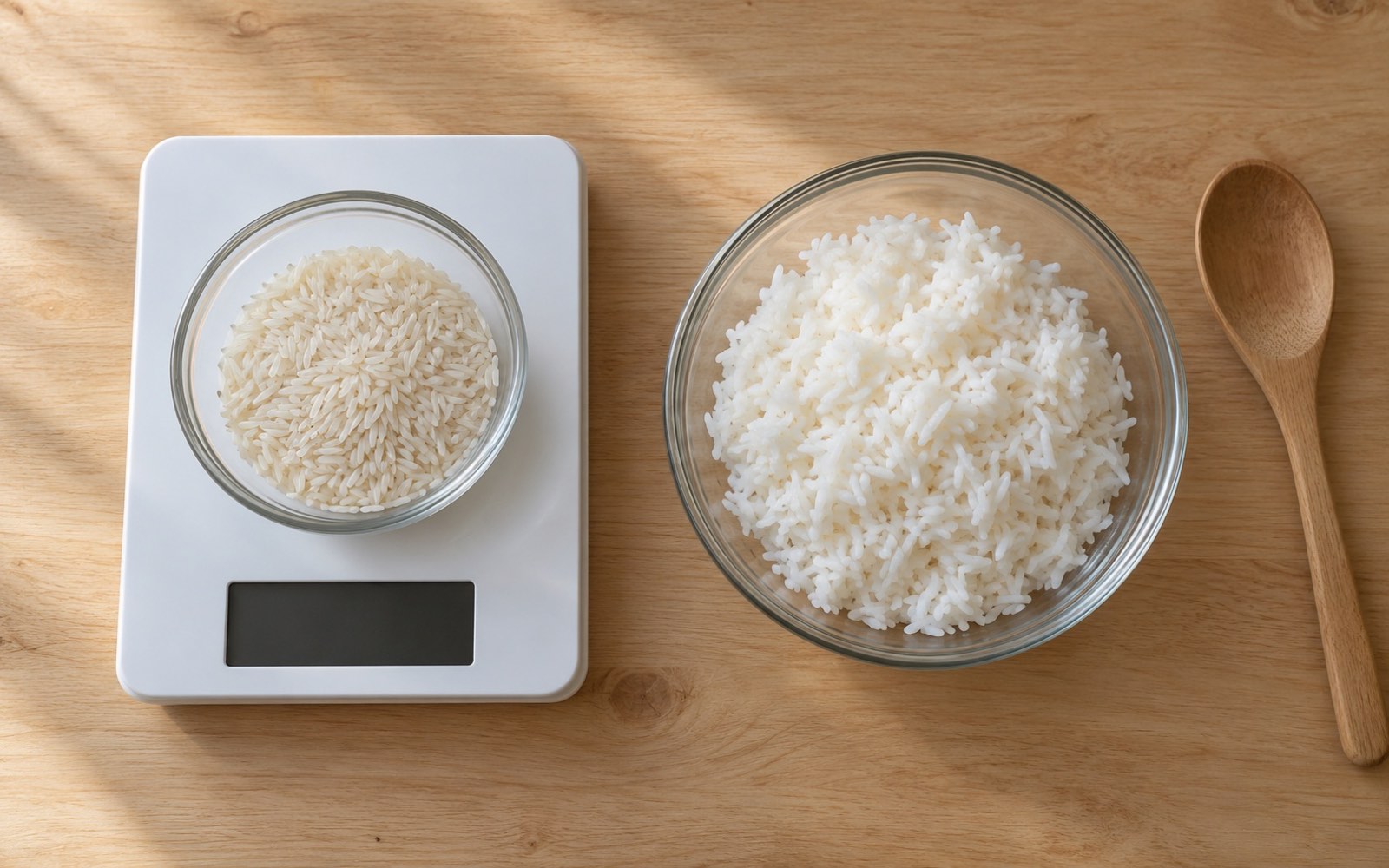
- Weigh food dry and raw. The calories on a bag of rice are for the dry grain, and the calories on a pack of meat are for raw meat. If you can only weigh food after cooking, see section 04.
- Log right after you eat. Oil in the pan, a spoonful of sugar in your coffee, juice and the "tastes" while you cook are the first things you forget a few hours later.
- Look at the weekly average. One day tells you nothing. It's easy to stay on target on weekdays, and then eat a good part of the week's deficit over the weekend.
- Weigh yourself once a week at the same time, in the morning after the bathroom. If your average weight for the week goes down, your number is right. If it hasn't moved for three weeks, see section 07.
- After two to three weeks, switch to eyeballing. By then you know what your 150 g (5.3 oz) of chicken and 60 g (2.1 oz) of dry buckwheat look like. Keep the scale for new foods and for a check every month or two.
What a calorie is and where the numbers on a label come from
The calories on a nutrition label are usually calculated with the Atwater factors: 4 calories per gram of protein, 4 per gram of carbs, 9 per gram of fat and 7 per gram of alcohol. These factors are collected in a 2003 report by the FAO, the food agency of the United Nations. The same report says they are an average. For a typical mixed diet they give about 5% more energy than precise factors for each food would, and for some foods, like green beans, cabbage and lemons, the gap reaches 20–38%.
One note on words. What US and UK labels call "Calories" are kilocalories (kcal). A food "with 200 calories" contains 200 kcal. We use the everyday word "calories" throughout this article.
The second reason not to chase precision is the law. Under FDA rules in the US (21 CFR 101.9), a product counts as misbranded only if it contains 20% or more calories, sugars, fat or sodium than the label says. So a bar labeled "200 calories" can legally contain almost 240.
What this means for you: counting to the nearest hundred calories is precise enough, and chasing single digits makes no sense. A 20% error on one snack bar gets lost in your weekly average. A 400–600 calorie error from mixing up dry and cooked weight doesn't get lost.
How many calories you need a day, so you have something to count
A man with a desk job needs 2,150–2,400 calories a day and a woman 1,700–1,900, and after 45 the number is 100–200 calories lower than at 30–44. These figures come from Russia's national guidelines, MR 2.3.1.0253-21 from Rospotrebnadzor (2021), the country's public health agency. The table shows two activity levels from that document. A physical activity level (PAL) of 1.4 means very light activity and a mostly sitting lifestyle. A PAL of 1.6 means light activity and a job where you move around.
| Age | Men, PAL 1.4 | Men, PAL 1.6 | Women, PAL 1.4 | Women, PAL 1.6 |
|---|---|---|---|---|
| 18–29 | 2,400 | 2,750 | 1,900 | 2,200 |
| 30–44 | 2,300 | 2,650 | 1,800 | 2,100 |
| 45–64 | 2,150 | 2,450 | 1,700 | 1,950 |
For people 65 and older, the guidelines give a single number based on the recommended activity level, a PAL of 1.7: 2,400 calories for men at 65–74 and 2,300 after 75, and 1,900 and 1,800 for women.
What this number is made of. Your body spends energy on three things: your basal metabolic rate, meaning the work of your heart, brain and lungs and keeping your body warm, digesting food, and all the movement in your day, from steps and housework to workouts. According to a 2004 review by Westerterp, digestion takes 5–15% of daily energy expenditure, and protein and alcohol need the most. The PAL in the table shows how many times your total daily expenditure exceeds your basal metabolic rate, which is why people of the same age but with different activity levels get different numbers.
Don't add the calories from your fitness watch to this number. The PAL already includes your usual movement, so if you add the "burned" calories from your watch on top, the same walk or workout gets counted twice. On top of that, watches estimate expenditure roughly. In a 2017 study by Shcherbina and colleagues, 60 people wore seven models of watches and fitness bands, including the Apple Watch and Fitbit, while sitting, walking, running and riding a stationary bike, and their expenditure was measured at the same time through the gases they breathed. Most devices measured heart rate well: six of the seven had a typical error under 5% on the bike. None of the devices estimated energy expenditure with an error under 20%. So the number on your watch is handy for comparing your own workouts with each other, and it's better not to carry it over into your food diary.
This is the number that maintains your weight. To lose weight, you subtract 15–20% from it. A 2011 Norwegian study by Garthe and colleagues shows why not more: athletes who cut their calories by 19% lost 31% of their fat and gained 2.1% lean mass, while those who cut by 30% lost 21% of their fat and gained no lean mass. How to work out your own number with the Mifflin–St Jeor equation, without dropping below your basal metabolic rate, is covered in the article on how to calculate a calorie deficit. Any calculation is a forecast. Your real number shows up after two to three weeks of a food log and weekly weigh-ins: if your weekly average weight hasn't moved, lower your intake by 100–150 calories and watch for another two weeks.
What to weigh: raw or cooked
Weigh rice, pasta, grains and beans dry, weigh meat and poultry raw, and weigh potatoes, eggs and fish whichever way is easier. The reason is simple: when you boil grains, the calories don't go anywhere, only the weight changes. According to USDA data, 100 g (3.5 oz) of dry buckwheat has 346 calories and 100 g of cooked buckwheat has 92. So 100 g of dry grain turns into about 375 g of cooked buckwheat with the same 346 calories. Meat works the other way around. A chicken breast loses water in the oven, and according to the 2012 USDA table of cooking yields, 100 g of raw breast becomes 72 g of roasted breast. That's why 100 g of cooked chicken breast has more calories than 100 g of raw.
We worked out what a mix-up costs on a 200 g (7 oz) serving of cooked food. Calories come from the USDA database (SR Legacy in FoodData Central), and the yield of meat comes from the USDA cooking yields table. We calculated the yield of grains and beans from the ratio of calories in the dry and cooked food, and the rounding is ours.
| Food | Calories per 100 g raw or dry | Calories per 100 g cooked | 100 g raw → g cooked | What to weigh | 200 g (7 oz) cooked serving: actual / if logged as raw | Difference |
|---|---|---|---|---|---|---|
| White rice | 365 | 130 | ≈ 280 g (×2.8) | dry | 260 / 730 | 470 calories |
| Buckwheat groats | 346 | 92 | ≈ 375 g (×3.8) | dry | 184 / 692 | 508 calories |
| Pasta | 371 | 158 | ≈ 235 g (×2.3) | dry | 316 / 742 | 426 calories |
| Rolled oats → oatmeal made with water | 379 | 71 | ≈ 530 g (×5.3) | dry | 142 / 758 | 616 calories |
| Lentils | 352 | 116 | ≈ 300 g (×3) | dry | 232 / 704 | 472 calories |
| Potato, boiled in skin | 77 | 87 | ≈ 90 g, weight barely changes | as is | 174 / 154 | 20 calories, doesn't matter |
| Chicken breast, skinless | 120 | 165 | ≈ 72 g roasted, ≈ 77 g boiled | raw, or cooked weight × 1.4 | 330 / 240 | 90 calories: log cooked as raw and you miss 27% |
| Ground beef 90/10 → pan-fried patty | 176 | 204 | ≈ 77 g (over 22% fat: 69 g) | raw, or cooked weight × 1.3 | 408 / 352 | 56 calories |
| Atlantic salmon | 208 | 206 | calories barely change | whichever is easier | 412 / 416 | 4 calories, doesn't matter |
| Egg, hard-boiled | 143 | 155 | doesn't change | as is | 310 / 286 | 24 calories, doesn't matter |
The rule from the table: weigh grains dry, or divide the weight of the cooked grain by the factor in the fourth column. Weigh meat raw, or multiply the cooked weight by 1.3–1.4 and use the calories for raw meat. Mixing up grains costs you 400–600 calories on a single plate. With chicken the error is smaller, around 90 calories, but if it repeats every day, it adds up to more than 600 calories a week.
If you couldn't weigh the food raw, for example someone else cooked the rice, weigh it cooked and divide by the factor: 300 g (10.6 oz) of cooked rice ÷ 2.8 ≈ 107 g of dry rice ≈ 390 calories.
once, weigh the dry grain for a whole pot and write down how much cooked food came out of it. Your own factor, meaning how many grams of cooked grain you get from 100 g dry, is more accurate than any table. It accounts for your stove, your pot and how soft you like your rice or oatmeal.
How to count calories in a recipe: soup, casseroles, burgers and a family pot
Add up the calories of all the raw ingredients, oil included, weigh the finished dish and divide one by the other. That gives you the calories per 100 g, and from then on you only weigh your own serving.
Example: buckwheat with chicken for four.
- 250 g (8.8 oz) dry buckwheat × 3.46 calories per gram = 865 calories;
- 500 g (1.1 lb) raw chicken breast × 1.2 calories per gram = 600 calories;
- 2 tablespoons of vegetable oil, 27 g × 8.84 calories per gram = 239 calories;
- total: 1,704 calories in the pot.
The finished dish weighs 1,350 g (about 3 lb). Divide 1,704 by 13.5 and you get 126 calories per 100 g. Your plate is 300 g (10.6 oz), so it holds 378 calories. Salt and spices don't count.
Log all the oil you pour in. According to USDA data, a tablespoon of vegetable oil weighs 13.5 g and has about 120 calories, because 100 g of oil has 884. Some oil stays in the pan, but one missed tablespoon a day adds up to more than 800 calories a week.
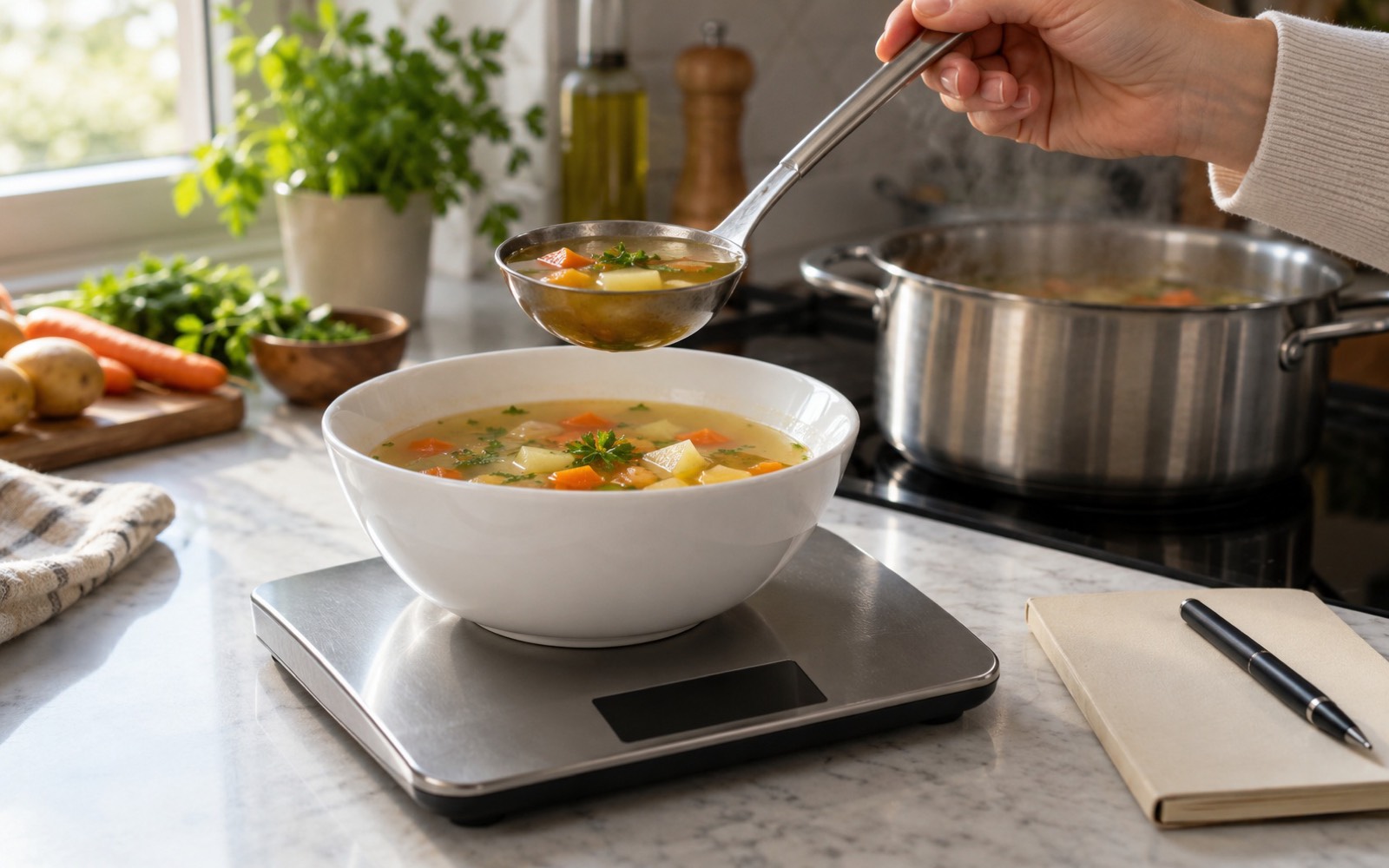
Soup works the same way: divide the total calories of the ingredients by the weight of the finished soup, broth included. A ladle is a handy measure. Weigh how many grams your ladle holds once, and from then on log soup in ladles.
A shared family pot also gets counted once. Save the dish in your food diary as your own recipe with its calories per 100 g, and from then on weigh only your plate. Don't use someone else's "homemade chili" entry from the database: it was made with different oil and different meat.
How to count calories without a food scale: your hand, a cup and the real margin of error
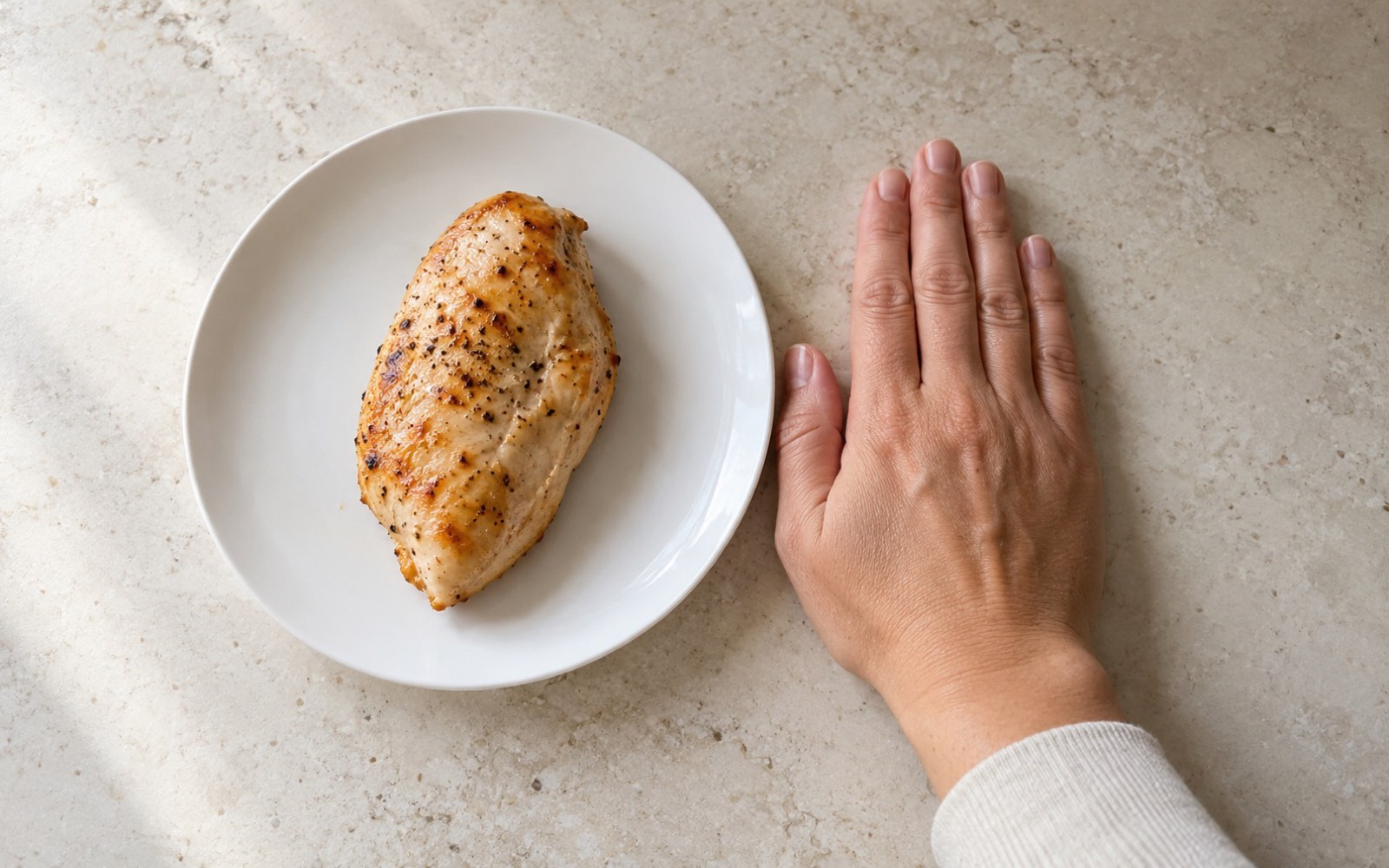
Without a scale you can estimate a serving with your hand, but how accurate that is depends a lot on the food. The popular rule goes like this: your palm is a serving of meat or fish, your fist is a serving of carbs, and the tip of your thumb is a serving of oil or butter. A 2016 study by Gibson and colleagues put it to the test: 67 people estimated 42 pre-weighed servings of food and drinks.
The method that worked best used fingers as a ruler. People measured the length, width and height of a piece of food in finger widths, and the volume was then calculated with a formula. For food with a regular shape, such as a slice of pizza, cake or cheese, a burger patty or a glass of juice, 80% of these estimates landed within ±25% of the true weight, and 13% within ±10%. Measuring cups and spoons on the same foods got only 29% within ±25%. Uneven pieces of chicken, fish or steak were estimated worse, even with fingers.
With food that has no clear shape, the hand did poorly. In the study these were rice, mashed potatoes, breakfast cereal flakes and muffins, each in two serving sizes, and people measured them with their fist. Not one of the eight servings was estimated with the fist to within ±10%, and six out of eight were off by more than 50%, mostly overestimated. For these foods a measuring cup was more accurate than a fist. In the same study the average fist came to 250 ml (about 1 cup), but men's fists were about 100 ml larger than women's. The tip of the thumb is about 5 ml, a teaspoon, even though handouts often equate it to a tablespoon.
What ±25% means in calories: a palm-sized serving of roasted chicken is about 150 g (5.3 oz) and 250 calories, so the error is ±60 calories. Across a 1,800-calorie day, the spread grows to ±450 calories. For weight loss that's a lot, so your hand works best after a stretch with the scale, or as a backup when you travel or eat at a friend's place. Without a scale, measure rice, oatmeal, mashed potatoes and other sides with a cup. Your hand can't see oil, sauces or drinks at all: you can't measure a glass of juice with your palm, so log it from the label.
How to learn: for two weeks, weigh your food and estimate the serving with your hand at the same time, then compare. Your eye gradually calibrates. If you don't have a scale and won't get one, start with the plate method: half the plate vegetables, a quarter protein, a quarter carbs. There are no numbers, but what you eat shifts in the right direction.
Where calories slip through: mistakes behind "I'm counting but not losing weight"
The calories that most often slip through are oil in the pan, drinks, tastes while cooking, weekends and food eaten out. The 1992 study by Lichtman and colleagues looked at ten people with obesity who said they ate under 1,200 calories a day and couldn't lose weight. It turned out they underreported what they ate by 47% on average and overreported their activity by 51%. At the same time, their energy expenditure was within 5% of the predicted value, so their metabolism was normal.
Even an honest food log with a scale loses calories. In the 2002 study by Champagne and colleagues, ten dietitians who weighed their food undercounted by 223 calories a day, and ten women without nutrition training undercounted by 429. Experience nearly halves the error but doesn't remove it. So if you've been counting and your weight hasn't moved for three weeks, look for undercounting first.
What most often doesn't make it into the log:
- oil for frying and in salad: a tablespoon is about 120 calories;
- drinks: juice, sweetened coffee, alcohol at 7 calories per gram;
- tastes while cooking and finishing your kids' leftovers;
- food eaten out: in a 2011 study by Urban and colleagues, 19% of 269 dishes from 42 restaurants had 100 or more calories above the menu figure. How to eat out and keep your deficit is covered in the article on eating out on a diet;
- weekends without logging: two days out of seven is almost 30% of the week.
How accurate each method is:
| Method | Typical error | Where the number comes from |
|---|---|---|
| Scale + label | US law penalizes only if calories are 20% or more above the label | 21 CFR 101.9 |
| Fingers as a ruler, food with a regular shape | 80% of estimates within ±25% | Gibson 2016 |
| Cups and spoons, same foods | 29% of estimates within ±25% | Gibson 2016 |
| Fist for rice, mashed potatoes, cereal | 6 of 8 foods off by more than 50% | Gibson 2016 |
| Eyeballing by people who "eat little and don't lose weight" | underreporting by 47% on average | Lichtman 1992 |
| Food log with weighing | women without training −429 calories a day, dietitians −223 | Champagne 2002 |
| Restaurant menu figure | +10 calories on average, but 19% of dishes +100 calories or more | Urban 2011 |
Food diary and apps: how to keep a log that works
A food diary works when you log right after eating and on most days. In a 2019 study by Harvey and colleagues, 142 people followed an online weight-loss program for six months and kept an electronic food log. Those who lost 10% of their weight or more opened the log 2.7 times a day, and the rest 1.7 times. Logging took 23.2 minutes a day in the first month and 14.6 minutes by the sixth. By month six, 65.5% of participants were still logging.
The second condition is logging on most days. In a 2017 study by Ingels and colleagues, people in a year-long diabetes prevention program were split by the share of days they logged food. Only those who logged on more than 66% of days lost a meaningful amount of weight: about 10 lb (4.5 kg) over the year on average, and their weight went down steadily. For those who logged less often, weight loss stalled around the holidays.
The evidence on apps is more modest than the ads promise. A 2024 Cochrane review by Metzendorf and colleagues pooled 18 studies with 2,703 participants. Where an app was compared with no help or minimal advice, the difference in weight at 12 months was 2.5 kg (5.5 lb) on average, across three studies with 1,044 participants. But the range ran from minus 6.8 to plus 1.7 kg, the authors rated the certainty as low and wrote that an app may make little or no difference to weight. The result comes from the habit of logging on most days. An app helps you log faster.
In a food database, pick the product by its barcode or a standard reference entry. Skip other users' "homemade meatballs": they were fried in different oil.
Our own app, Sportygram, has a food diary with a barcode scanner, a search across about 101,000 foods, and tracking for calories, protein, fat, carbs and water. You can also type what you ate to Alex, the virtual coach, in chat: he suggests an entry, and you confirm it on a card with one tap. The profile calculates a starting calorie target from your stats and goal. The app and Alex work only in Russian.
How long to count calories and how to stop without regaining
Two to three weeks of a detailed food log is enough to learn your portions and your number. In that time you see weekdays, weekends and at least one meal out, so stopping earlier isn't worth it. Keep in mind that in studies, the best results came from people who logged for a long time: in the Ingels study, only those who logged on more than two thirds of days all year lost a meaningful amount. So when you stop counting, keep a check in place: a three-day food log every month or two and a weekly weigh-in.
How to step away from counting. First stop weighing vegetables, a week later stop weighing sides, and a week after that everything else. Keep the bathroom scale: step on it once a week at the same time and watch your 7-day average. If your average weight goes up for three weeks in a row, bring the food log back for two weeks. Reasons your weight can stall even without overeating are collected in the article on the weight loss plateau.
When it's time to stop counting. In a 2017 survey by Levinson and colleagues of 105 people with eating disorders, about 75% had used the MyFitnessPal calorie tracker, and 73% of them felt the app contributed to their disorder. It's a survey and can't separate cause from effect, but the warning signs are worth knowing:
- anxiety when you couldn't log a meal;
- turning down dinner with friends because "you don't know what's in the food";
- guilt over an unplanned 100 calories;
- a habit of "working off" what you ate with exercise;
- thinking about numbers before bed and right after you wake up.
If you notice one of these signs, take a break and switch to the plate method and eyeballing. If you notice several, see a doctor or a therapist who works with eating disorders.
Counting calories for weight loss, for muscle gain and after 40: what changes
The goal changes and the technique stays the same. For weight loss you need minus 15–20% from your maintenance number and enough protein, for muscle gain plus 10–20% above maintenance, and after 40 the same food log with a target 100–200 calories lower.
For weight loss, make protein your first number and calories the second. One number is easier to keep in your head than four, and protein keeps you full longer and helps you hold on to muscle in a deficit. How much you need for your weight and goal is covered in the article on how much protein per day.
For muscle gain, you need the food log for a different reason: without it, it's easy to undereat. A 2019 review by Iraki and colleagues advises beginner and intermediate lifters building muscle with strength training to eat a surplus of about 10–20% above maintenance and gain 0.25–0.5% of body weight a week. You feel like you're eating a lot, yet you don't reach that surplus, and two weeks of logging will show it.
After 40, nothing about counting itself is special. Under the Russian MR 2.3.1.0253-21 guidelines, men aged 30–44 need 100 calories less than at 18–29, and at 45–64 another 150–200 calories less. For women with desk jobs, the target is 1,800 calories at 30–44 and 1,700 at 45–64. By 45 your serving of rice or pasta gets a little smaller, and the scale, dry and raw weights, oil and the weekly average stay the same.
Questions and answers
What is calorie counting, and is it the same as tracking macros?
Calorie counting means logging what you eat and adding up the energy. Tracking macros goes one step further and also counts protein, fat and carbs. The tool for both is a food diary, which on a phone is usually called a calorie tracker. You log the food, and the diary adds up the energy from its database and compares it with your target.
Are the calories on a bag of rice or pasta for dry or cooked?
Dry. 100 g of buckwheat has 346 calories, and after cooking those same 346 calories sit in about 375 g of cooked grain. If you weigh it cooked, divide the weight by 3.8. For rice the factor is 2.8, and for pasta 2.3. It's even more accurate to work out your own factor once: weigh the grain before cooking and the result after.
How many calories should I count for cooking oil?
Count everything you pour in. A tablespoon of vegetable oil weighs about 13.5 g and has about 120 calories, because 100 g of oil has 884. Some oil stays in the pan, but one missed tablespoon a day adds up to more than 800 calories a week.
Can you lose weight without counting calories?
Yes, if you're in a deficit and the plate method, hand portions and habits help you create it. But without a food log it's hard to tell whether the deficit is really there. In the 1992 Lichtman study, people who were sure they ate little underreported what they ate by 47% on average. Two to three weeks of logging answers that question for certain.
How many times a day should I log food, and for how many weeks should I count?
Log right after every meal. In the 2019 Harvey study, people who lost 10% of their weight or more opened their log 2.7 times a day. Count in detail for two to three weeks, then check yourself with a three-day log every month or two and weigh yourself once a week.
How do I count calories at a restaurant with no nutrition info?
Find a similar dish in the database and add a buffer of about 100 calories. In the 2011 Urban study, menu figures matched lab values closely on average, with a difference of 10 calories per dish. But 19% of dishes had 100 or more calories above what was stated, and more often these were dishes that looked light on the menu.
Do I need to count calories in vegetables and greens?
For the first two weeks, yes, so you see the real numbers. After that you can stop weighing cucumbers, cabbage, lettuce and tomatoes: they usually add only a few dozen calories to your day. Always count potatoes, corn, beans and avocado.
How do I count calories when I cook for the whole family from one pot?
Count the whole dish once: divide the total calories of the raw ingredients by the weight of the finished dish, and you get calories per 100 g. Save it as your own recipe in your food diary and from then on weigh only your plate. For soup, weigh how many grams your ladle holds once. Use the calories from your own entry, because the stew in the database was cooked differently.
The bottom line
- The calories on a label are a calculation: 4 per gram of protein and carbs, 9 per gram of fat, 7 per gram of alcohol. In the US a product counts as misbranded only if it has 20% or more calories than stated, so precision to the nearest hundred calories is enough.
- Weigh rice, pasta, grains and beans dry, and meat and poultry raw. Mixing up dry and cooked grain costs 400–600 calories on a single plate.
- Without a scale, fingers used as a ruler give 80% of estimates within ±25% for food with a regular shape. The fist does poorly with rice, mashed potatoes and other food without a clear shape, so use a measuring cup for those.
- A food log takes about 23 minutes a day in the first month and about 15 by the sixth. It works best for people who log on more than two thirds of days and open it 2–3 times a day.
- Count in detail for two to three weeks, then check yourself with a three-day log every month or two and weigh yourself once a week. After 45 your target is 100–200 calories lower, and the technique stays the same.
- Anxiety, guilt and skipping meals with friends because of the numbers are reasons to take a break. If you notice several of these signs, see a specialist in eating disorders.
Checklist: counting calories without mistakes
- Find your number in the table in section 03 and, to lose weight, take off 15–20%.
- Buy a kitchen scale that measures in 1 g steps.
- Weigh rice, pasta, grains and beans dry, and meat and poultry raw.
- Log your oil: a tablespoon is about 120 calories.
- Log your drinks: juice, sweetened coffee, alcohol.
- Count your own recipe once: divide the total calories of the raw ingredients by the weight of the finished dish.
- Watch your 7-day average weight and weigh yourself once a week at the same time.
- After two to three weeks, switch to eyeballing: measure sides with a cup, food with a regular shape with your fingers, and check yourself with the scale every month or two.
- If the numbers make you anxious, take a break and switch to the plate method.
Sources
- FAO. Food energy — methods of analysis and conversion factors. Chapter 3: Calculation of the energy content of foods — energy conversion factors. FAO Food and Nutrition Paper 77, 2003. — General Atwater factors of 4/9/4 calories per gram and 7 calories per gram of alcohol; for a mixed US diet the general factors give about 5% more energy on average than specific ones, and for green beans, cabbage and lemons the gap is 20–38%.
- FDA. 21 CFR § 101.9 — Nutrition labeling of food. Code of Federal Regulations, 2023. — Paragraph (g)(5): a product is misbranded if its calories, sugars, fat or sodium exceed the label value by 20% or more.
- Rospotrebnadzor. MR 2.3.1.0253-21 "Norms of physiological requirements for energy and nutrients for various population groups of the Russian Federation", 2021 (in Russian). — Energy requirements by sex, age and physical activity group; for people over 65, a single figure at a PAL of 1.7; the table in section 03.
- Showell B. A., Williams J. R., Duvall M. et al. USDA Table of Cooking Yields for Meat and Poultry. USDA Agricultural Research Service, 2012. — Cooked weight yield: chicken breast 72% roasted and 77% boiled; pan-fried patty from ground beef under 12% fat 77%, over 22% fat 69%.
- USDA Agricultural Research Service. FoodData Central: SR Legacy, 2018. — Calories in raw and cooked foods for the raw-to-cooked table: rice, buckwheat, pasta, rolled oats, lentils, potato, chicken breast, ground beef, salmon, egg; vegetable oil at 884 calories per 100 g, a tablespoon at 13.5 g.
- Gibson A. A., Hsu M. S. H., Rangan A. M. et al. Accuracy of hands v. household measures as portion size estimation aids. Journal of Nutritional Science, 2016. — 67 people, 42 servings: for food with a regular shape, 80% of finger-ruler estimates within ±25% and 13% within ±10%, 29% with measuring cups; for rice, mashed potatoes, cereal and muffins the fist was less accurate than a cup; the average fist was about 250 ml, the thumb tip about 5 ml.
- Lichtman S. W., Pisarska K., Berman E. R. et al. Discrepancy between self-reported and actual caloric intake and exercise in obese subjects. New England Journal of Medicine, 1992. — Ten "diet-resistant" people underreported intake by 47% on average and overreported activity by 51%; energy expenditure was within 5% of the predicted value.
- Champagne C. M., Bray G. A., Kurtz A. A. et al. Energy intake and energy expenditure: a controlled study comparing dietitians and non-dietitians. Journal of the American Dietetic Association, 2002. — 10 women per group, a seven-day weighed food record against expenditure measured with doubly labeled water: undercounting of 223 calories a day among dietitians and 429 among the others.
- Urban L. E., McCrory M. A., Dallal G. E. et al. Accuracy of stated energy contents of restaurant foods. JAMA, 2011. — 269 dishes from 42 restaurants: +10 calories above the menu figure on average, 19% of dishes 100 or more calories above it; dishes with low stated calories were more often higher than stated.
- Harvey J., Krukowski R., Priest J., West D. Log Often, Lose More: Electronic Dietary Self-Monitoring for Weight Loss. Obesity, 2019. — 142 people, 24 weeks: 23.2 minutes a day on logging in the first month and 14.6 by the sixth; those who lost 10% or more logged in 2.7 times a day versus 1.7; 65.5% were still logging by month six.
- Ingels J. S., Misra R., Stewart J. et al. The Effect of Adherence to Dietary Tracking on Weight Loss: Using HLM to Model Weight Loss over Time. Journal of Diabetes Research, 2017. — A year-long program: only those who logged on more than 66% of days lost a significant amount, 9.99 lb (about 4.5 kg) on average; for the rest, weight loss slowed around the holidays.
- Metzendorf M.-I., Wieland L. S., Richter B. Mobile health (m-health) smartphone interventions for adolescents and adults with overweight or obesity. Cochrane Database of Systematic Reviews, 2024. — 18 studies, 2,703 people: app versus no help, a weight difference at 12 months of −2.5 kg (from −6.8 to +1.7; 3 studies, 1,044 people), low certainty, the effect may be close to zero.
- Levinson C. A., Fewell L., Brosof L. C. My Fitness Pal calorie tracker usage in the eating disorders. Eating Behaviors, 2017. — 105 people with eating disorders: about 75% had used MyFitnessPal, and 73% of them felt the app contributed to their disorder.
- Garthe I., Raastad T., Refsnes P. E. et al. Effect of two different weight-loss rates on body composition and strength and power-related performance in elite athletes. International Journal of Sport Nutrition and Exercise Metabolism, 2011. — 24 athletes doing strength training: a 19% deficit meant −31% fat and +2.1% lean mass; a 30% deficit meant −21% fat and no change in lean mass.
- Iraki J., Fitschen P., Espinar S., Helms E. Nutrition Recommendations for Bodybuilders in the Off-Season: A Narrative Review. Sports, 2019. — For muscle gain in beginner and intermediate lifters, a surplus of about 10–20% and a gain of 0.25–0.5% of body weight a week.
- Westerterp K. R. Diet induced thermogenesis. Nutrition & Metabolism, 2004. — Daily energy expenditure is made up of basal metabolic rate, digesting food and physical activity; digesting a mixed diet takes 5–15% of daily expenditure, more when the diet is high in protein and alcohol.
- Shcherbina A., Mattsson C. M., Waggott D. et al. Accuracy in Wrist-Worn, Sensor-Based Measurements of Heart Rate and Energy Expenditure in a Diverse Cohort. Journal of Personalized Medicine, 2017. — 60 people, seven models of watches and bands against indirect calorimetry: six of the seven had a typical heart rate error under 5% on a stationary bike, and no device estimated energy expenditure with an error under 20%.
This article is for informational purposes only and is not a substitute for medical advice.