

adults need at least 25 g of fiber a day. At 14 g per 1,000 calories, that's about 25 g for women and 38 g for men under 50, and 21 g and 30 g after 50. If you're cutting calories, don't go below 25 g.Beans, lentils, berries, cabbage and broccoli are your best bets: a normal serving packs plenty of fiber for few calories. Add about 5 g a week with simple food swaps, and go easy on beans and raw vegetables before a hard workout.
How much fiber per day do you need? At least 25 grams if you're an adult. That's the minimum set by the World Health Organization (WHO) in its 2023 guidance. For a more precise target, go by calories: 14 g of fiber for every 1,000 calories you eat, the formula behind the US Institute of Medicine's guidelines, which works out to about 25 g for women and 38 g for men under 50. Fiber is the part of plant foods your body can't digest on its own. You get 10 g of it from one serving of cooked lentils or 1 1/4 cups of raspberries, not from a mountain of salad. Add it gradually, about 5 g a week, starting with simple swaps.
How much fiber per day: a target based on your calories
The more you eat, the more fiber you need. That's why the Institute of Medicine's 2005 guidelines keep it simple: 14 g of fiber for every 1,000 calories.
| Your daily calories | By the formula (14 g per 1,000 calories) | What to aim for |
|---|---|---|
| 1,500 (cutting) | 21 g | At least 25 g: that's the WHO minimum, and staying full matters most on a deficit |
| 1,800 | 25 g | 25 g |
| 2,000 | 28 g | 25–30 g |
| 2,200 | 31 g | 30 g |
| 2,500 | 35 g | 30–35 g |
| 3,000 (bulking) | 42 g | 30–35 g is enough: many people simply can't eat more bulky food than that |
The "what to aim for" column is our own call, based on the formula and the WHO minimum. On a deficit, fiber helps you handle hunger. On a bulk, 42 g of fiber means so much food that hitting your calories gets hard.
Don't know your calorie target? Work it out with our calorie calculator and come back to the table.
Fiber intake for women, men, adults over 50 and during pregnancy
If you'd rather skip the math, use the numbers from the 2005 US Dietary Reference Intakes. They're built on the same formula: 14 g multiplied by typical calorie intake at each age.
| Who | Fiber per day |
|---|---|
| Men 19–50 | 38 g |
| Women 19–50 | 25 g |
| Men 51 and older | 30 g |
| Women 51 and older | 21 g |
| Pregnant women | 28 g |
| Breastfeeding women | 29 g |
The number drops after 50 not because fiber matters less, but because people that age eat fewer calories on average.
In 2023, the WHO set its own bar: at least 25 g of fiber a day from regular food for adults and children 10 and older. Children 6–9 need at least 21 g, and children 2–5 need at least 15 g.
Online, you'll see three numbers: 25, 30 and 38 g. They don't contradict each other, they just come from different guidelines. 25 g is the WHO minimum for all adults and the US target for women. 30 g is the official recommendation for adults in the UK. 38 g is the US target for men under 50. Most people fall short of any of these: the NHS says UK adults eat about 20 g a day on average against the 30 g target. So start by getting to 25 g.
How much fiber are you eating now? A 2-minute check
Before you change anything, find out where you're starting from. You don't need a scale: think back to yesterday and add up your servings.
- A serving of beans or lentils (lentils, kidney beans or chickpeas, 100 g cooked, about 1/2 cup): 7–8 g.
- A bowl of oatmeal or other cooked whole grains (oatmeal made from 50 g of oats, about 1/2 cup dry, or 200 g of cooked buckwheat, a generous cup): about 5 g.
- An apple or a pear: 4–6 g. A banana: about 3 g. A cup of raspberries: about 8 g.
- 200 g (7 oz) of cabbage, broccoli or carrots: 4–6 g. The same 200 g of cucumbers and tomatoes: only 1–2 g.
- A slice of rye or whole-wheat bread: about 2 g.
- A handful of nuts (1 oz, 30 g): 3–4 g.
- White bread and white rice: less than 1 g per slice or serving. Meat, fish, eggs, cottage cheese, milk and protein powder: 0.
Under 15 g? Start with the 4-week plan in section 07. Between 15 and 25 g? One or two swaps from that plan will do. Over 25 g? You've already reached the WHO minimum, so check your own number in section 01. If your day is mostly meat, cottage cheese, eggs and white rice or pasta, you're almost certainly under 15 g, even if you eat "clean."
What 10 g of fiber looks like and what it costs in calories
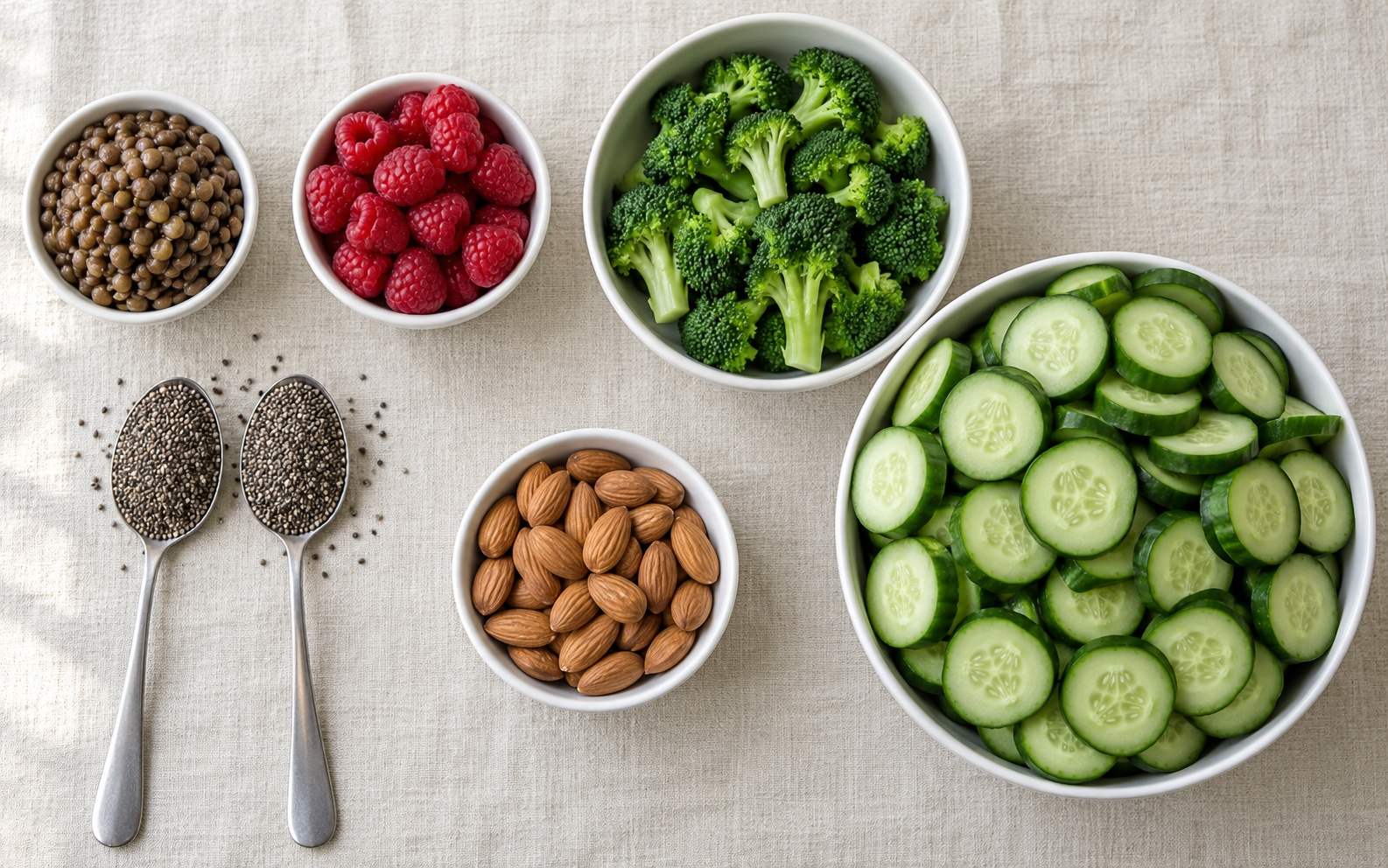
Nobody eats 100 g of chia seeds in one sitting, and grains get cooked before you eat them, so "per 100 g" charts don't tell you much. Here, each food is shown the way it lands on your plate, in the amount that gives you 10 g of fiber.
| Food | Amount for 10 g of fiber | What it looks like | Calories |
|---|---|---|---|
| Lentils, cooked | ≈125 g | 2/3 cup, a side-dish serving | ≈145 |
| Red kidney beans, cooked | ≈135 g | 3/4 cup, a serving in soup or salad | ≈170 |
| Chickpeas, cooked | ≈130 g | 3/4 cup, a side-dish serving | ≈215 |
| Raspberries | ≈155 g | 1 1/4 cups | ≈80 |
| Pear, with skin | ≈320 g | 2 medium pears | ≈185 |
| Apple, with skin | ≈420 g | 2–3 apples | ≈220 |
| Broccoli, cooked | ≈300 g | 2 cups, a big plate | ≈105 |
| Carrots, raw | ≈360 g | 5–6 carrots | ≈150 |
| Cucumbers | ≈2 kg (4.4 lb) | a bucketful of salad | ≈300 |
| Rolled oats (dry) | ≈100 g | 1 1/4 cups dry, 2 bowls of oatmeal | ≈380 |
| Buckwheat, cooked | ≈370 g | about 2 cups, almost 2 bowls | ≈340 |
| Whole-wheat bread | ≈160 g | 5 slices | ≈400, depends on the brand |
| Chia seeds | ≈30 g | 2 heaping tablespoons | ≈145 |
| Almonds | ≈80 g (2.8 oz) | almost 3 handfuls | ≈465 |
| Prunes | ≈140 g | 14–15 prunes | ≈340 |
We calculated the amounts from USDA FoodData Central, the US Department of Agriculture's food composition database. Numbers for a specific package may differ slightly.
Berries, broccoli and cabbage give you 10 g of fiber for the fewest calories. Beans and lentils are right behind, and they bring protein too. Nuts, prunes and bread are good for you, but on a deficit, 10 g of fiber from them costs as much as a whole meal. And you won't hit your target eating cucumbers.
Dry vs. cooked grains: why "10 g of fiber per 100 g" is misleading
Many charts list buckwheat or oats at 10–11 g of fiber per 100 g. That's true, but only for the dry grain. Cooked buckwheat soaks up water and weighs 3–4 times more, and oatmeal usually even more. The amount of fiber stays the same.
- Buckwheat: about 10 g per 100 g of dry groats. A bowl of 200 g of cooked buckwheat has about 5 g.
- Oats: about 10 g per 100 g of dry oats. A bowl of oatmeal made from 50 g of oats (about 1/2 cup dry) has about 5 g.
- Lentils: a bowl of 200 g of cooked lentils (about 1 cup) has about 16 g. This is where the fiber really is.
A bowl of cooked grains gives you about 5 g, not half your daily target.
On a Nutrition Facts label, look for the "Dietary Fiber" line. The number is per serving of the product as it comes in the package, so for grains, oats and pasta, it's for the dry product.
A day of eating: 25 g on a cut and 35 g on a bulk
Two sample days made from everyday food, no supplements.
A 25 g day if you're losing weight:
| Meal | What's on the plate | Fiber |
|---|---|---|
| Breakfast | Oatmeal made from 40 g of oats (1/2 cup dry) and an apple | ≈8 g |
| Lunch | 150 g of cooked buckwheat (about 1 cup), chicken, a slaw from 150 g of fresh cabbage (about 2 cups shredded) | ≈8 g |
| Snack | A pear | ≈5.5 g |
| Dinner | Cottage cheese or fish, a slice of rye bread, 200 g (7 oz) of cucumbers and tomatoes | ≈3.5 g |
| Total | ≈25 g |
A 35 g day if you're building muscle:
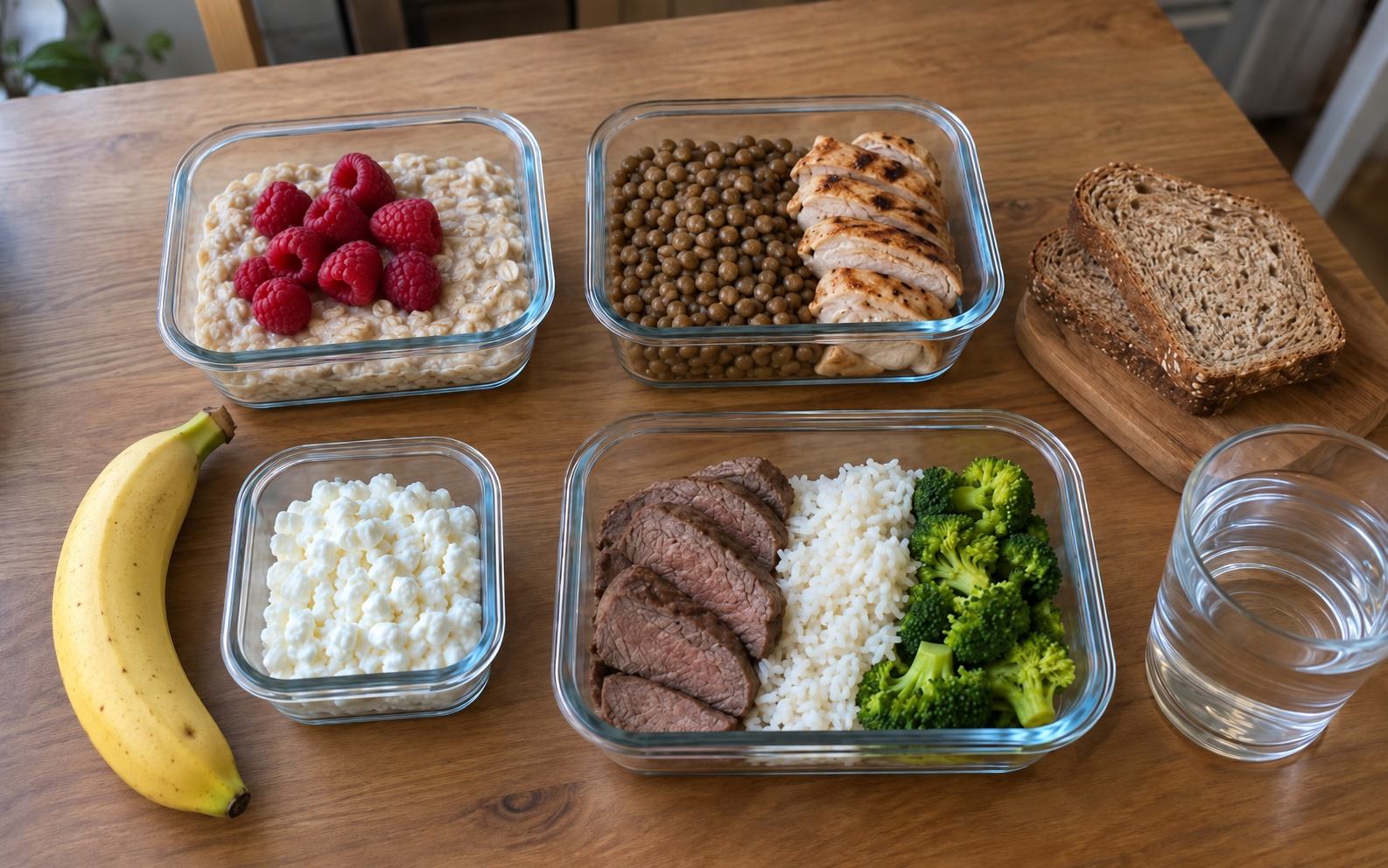
| Meal | What's on the plate | Fiber |
|---|---|---|
| Breakfast | Oatmeal made from 70 g of oats (a scant cup dry) and 100 g of raspberries (3/4 cup) | ≈13.5 g |
| Lunch | 150 g of cooked lentils (3/4 cup), chicken, 2 slices of whole-wheat bread | ≈15.5 g |
| After training | A banana and cottage cheese | ≈3 g |
| Dinner | Beef, white rice, 100 g of broccoli (2/3 cup) | ≈4 g |
| Total | ≈36 g |
Meat, fish and cottage cheese have no fiber, so the plant part of the plate does all the work. On the second day, breakfast and one serving of lentils cover more than half the target. The white rice is there on purpose: a bulk needs calories.
For another sample day, this one at 30 g, see our breakdown of the fibermaxxing trend.
How to eat more fiber without bloating: a 4-week plan
The biggest mistake is ramping up too fast: 15 g yesterday, 40 g today, a bloated stomach tomorrow. Helpful bacteria in your large intestine feed on fiber, and that produces gas. Double your fiber overnight and you get a lot more gas, and your gut needs time to adjust.
So add about 5 g a week. It's a practical guideline, not a number from a study. Swapping one food for another works best, because it adds almost no calories.
| Week | What you change | How much it adds per day |
|---|---|---|
| 1 | White bread for rye or whole-wheat, juice for whole fruit | +5 g |
| 2 | Oatmeal or another whole-grain hot cereal with berries for breakfast | +5 g |
| 3 | Beans or lentils at lunch 3 times a week, 150 g (about 3/4 cup) each time | +5 g on average |
| 4 | 200 g (7 oz) of vegetables with dinner and a spoonful of seeds in your oatmeal or yogurt | +5 g or more |
If you start at 15 g, you'll be at about 35 g by the end of the month. Feeling bloated? Stay on the previous step for another week. Fiber soaks up water, so make sure you drink enough. For how much, see how much water to drink per day.
start with breakfast. Oatmeal made from 50 g of oats (about 1/2 cup dry), a cup of raspberries and a tablespoon of chia seeds give you about 17 g of fiber before lunch. After that, the rest of the day is easy.
What fiber really does: the numbers without the hype
Fiber gets credited with a lot: it "cleanses," "detoxes," "burns fat." Here's what large studies actually show.
| What was studied | How many people and studies | What they found | What it means for you |
|---|---|---|---|
| Fiber and long-term health (Reynolds et al. review in The Lancet, 2019) | 185 long-term observational studies and 58 trials with 4,635 adults | People who ate the most fiber had a 15–30% lower risk of dying from any cause and from heart and blood vessel disease. They also had a lower risk of heart disease, stroke, type 2 diabetes and colon cancer. The risk reduction was greatest at 25–29 g a day, and the authors' dose-response curves suggest even more fiber could help further. In the trials, higher fiber intake meant lower body weight, systolic blood pressure and total cholesterol | 25–30 g a day is a sensible goal. This is a link seen in large groups of people. It's not a guarantee for any one person |
| Fiber and appetite (Wanders et al. review, 2011) | 58 with-fiber vs. without-fiber comparisons on appetite | Thick, viscous fibers (the kind in oats and fruit) reduced appetite in 59% of comparisons, less viscous fibers in 14%. Overall, the effect on daily calories and body weight was small | For staying full, oatmeal and fruit beat powdered bran |
| Fiber and weight loss (Miketinas et al. analysis within the POUNDS Lost trial, 2019) | 345 adults, 6 months on a 750-calorie daily deficit | Fiber was the best predictor of who lost more weight, regardless of calories, protein, fat and carbs. An average increase of 3.7 g a day (from 17.5 to 21.2 g) was linked to an extra 1.4 kg (about 3 lb) lost over 6 months. People who stuck to the diet better ate about 25 g of fiber a day, the rest about 21 g | On a deficit, fiber helps you stick with it. This is an analysis of data within a trial: nobody in it was actually given extra fiber to take |
The authors of the Reynolds review (2019) rated their confidence in the fiber findings as moderate: observational studies show a link but can't prove that fiber itself is the cause.
What fiber doesn't do:
- it doesn't flush out toxins;
- it doesn't "scrub your colon clean";
- it doesn't burn fat; it just helps you feel less hungry;
- it doesn't treat high cholesterol: a 2016 Cochrane review of 23 trials with 1,513 participants found that fiber supplements lowered total cholesterol by an average of 0.23 mmol/L (about 9 mg/dL) and LDL ("bad") cholesterol by 0.14 mmol/L (about 5 mg/dL). That's a real effect, but it doesn't replace treatment your doctor prescribed.
Fiber and training: before a workout, on a high-protein diet, on a cut and on a bulk
Before a hard workout. In your last meal before it, go easy on beans, bran and big servings of raw vegetables. A 2014 review by de Oliveira and colleagues in Sports Medicine links stomach complaints during exercise to fiber, fat, protein and fructose eaten shortly before, and advises against loading up on high-fiber food ahead of competition. There isn't much data on this yet — the authors say so themselves — so treat it as cautious advice. Save the bean salad for lunch after the gym. For what to eat and when, see what to eat before and after a workout.
The chicken, cottage cheese and protein shake diet. When you chase protein, vegetables and grains get pushed off the plate, and chicken, cottage cheese and protein powder have no fiber. That's a common cause of constipation. A simple rule: fill half your plate with plant foods every time you eat protein. Beans and lentils do double duty, giving you both protein and fiber.
Cutting calories. Fiber is one of the easiest ways to feel less hungry without eating more: a big plate of broccoli fills you up for very few calories. In Miketinas's 2019 analysis, people who ate more fiber on a deficit lost more weight. More strategies are in how to deal with hunger on a diet.
Bulking. Here fiber can get in the way: it fills you up fast, which makes it hard to eat the extra calories a bulk needs. At 3,000 calories, 30–35 g is enough. Get the rest from less bulky food: white rice, pasta, nuts, a spoonful of butter or nut butter in your oatmeal. This is our own takeaway from the formula; we didn't find studies that looked directly at fiber during a bulk. For how to gain without extra fat, see our guide to a lean bulk.
Bloated or constipated? 10 minutes of light movement
A 2019 review by Gao and colleagues of 9 trials with 680 people with constipation found that exercise eased their symptoms. In 8 of the 9 trials, people did aerobic exercise: walking, qigong (a gentle Chinese movement practice) or other simple physical activity. The studies had a high risk of bias, but the advice is safe. Pick one of these four exercises from our app's library.
- Stationary bike. 10 minutes at an easy pace where you can still talk comfortably.
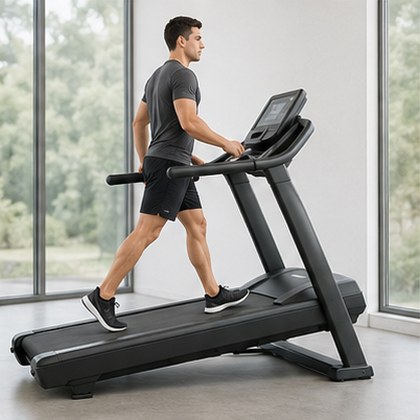
- Incline walking. 10 minutes on a treadmill with a slight incline, if you're at the gym.
- Step-ups on a platform. 5–10 minutes at a relaxed pace. You can do this at home.
- Joint mobility. 5 minutes of circles with your shoulders, hips, knees and ankles. Good for when you don't have a gym or a step.
Keep the movement light. If your stomach isn't just bloated but really hurts, see section 12.
 Incline walking
Bran, psyllium and fiber bars: when they make sense
Bran and psyllium. Bran is the outer layer of the grain. Psyllium husk comes from the seeds of the Plantago ovata plant and is sold as a fiber powder. Both are a backup for when you're traveling and can't get proper meals, not the foundation of your diet. For chronic constipation, psyllium actually works: in a 2022 meta-analysis by van der Schoot and colleagues of 16 trials with 1,251 people on fiber supplements, 66% felt relief versus 41% in the control groups. The effect showed up at doses above 10 g a day and took at least 4 weeks to appear, and gas was more common on supplements. Take the powder with enough water, as the label directs. If you want to use it for constipation, or you take any medication, ask your doctor first: they can help you find the right dose, and powdered fiber can keep medicines from being absorbed properly.
Fiber bars and high-fiber protein products. The fiber in them is usually added during manufacturing: look for inulin (sometimes listed as chicory root fiber) or polydextrose in the ingredients. The label counts it as dietary fiber, but the WHO's 25 g target refers to fiber that occurs naturally in food. So a bar is a top-up, not the foundation. Added fibers give some people gas.
Who should be careful and when to see a doctor
For a healthy person, fiber from food is safe. Here are the exceptions.
- A flare-up of Crohn's disease or ulcerative colitis, a narrowed intestine, or recent bowel surgery. Change your fiber intake only as your doctor directs. Sometimes it's cut back for a while.
- Irritable bowel syndrome (IBS). Which type of fiber matters here. In a 2014 meta-analysis by Moayyedi and colleagues of 14 trials with 906 patients, soluble fiber like psyllium eased IBS symptoms, while bran showed no clear benefit (and no clear harm either). Fiber helps some people and makes bloating worse for others, so work with your doctor to figure out which types and how much suit you.
See your primary care doctor or a gastroenterologist if:
- there's blood in your stool, or your stool turns black;
- constipation or diarrhea lasts for weeks with no clear reason;
- you're losing weight without trying;
- you have severe stomach pain;
- you notice a new change in your bowel habits after 50.
Logging your meals in the app
If you track your meals in the Sportygram app, the food diary counts calories, protein, fat and carbs. There's no separate fiber line yet. Log your day as usual, then check your fiber against the table in section 04.
FAQ
How much fiber per day do women and men need?
Under the Institute of Medicine's US guidelines, women under 50 need about 25 g of fiber a day, and men need about 38 g. After 50, it's 21 g and 30 g, because people that age need fewer calories on average. The WHO sets one bar for all adults: at least 25 g a day. For a more precise number, count 14 g for every 1,000 calories you eat.
How much fiber per day do you need to lose weight?
At least 25 g, even if you eat 1,500 calories and the formula gives you less. On a deficit, fiber keeps you full: bulky, low-calorie food helps you avoid overeating. In Miketinas's 2019 analysis of 345 adults who dieted for 6 months, the ones who ate more fiber lost more weight and stuck to the diet better. Build your meals around beans, lentils, berries, cabbage and broccoli.
Which foods are highest in fiber?
Per 100 g, bran, chia seeds and nuts come out on top. But on a real plate, serving size and calories matter more. Per serving, beans and lentils win: lentils, kidney beans and chickpeas have 7–8 g per 100 g cooked (about 1/2 cup). Per calorie, raspberries, broccoli and cabbage are just as good. Next come pears, apples with the skin and whole grains.
What is the difference between soluble and insoluble fiber?
Soluble fiber thickens in water and turns into a gel. You'll find a lot of it in oats, beans, lentils and fruit. It does more to keep you full — in Wanders's 2011 review, viscous fibers were the ones most likely to reduce appetite — and it helps lower cholesterol: a 2016 Cochrane review found fiber supplements lowered total cholesterol. Insoluble fiber adds bulk and helps keep you regular. It's found in whole grains, bran and vegetable skins. You don't need to track them separately: a variety of plant foods gives you both.
Can you eat too much fiber?
The Institute of Medicine's 2005 guidelines set no upper limit for fiber: there's no evidence that food with a lot of fiber harms healthy adults. In practice, your body tells you when it's too much: bloating, gas, a heavy feeling in your stomach. When that happens, go back to your previous amount and add fiber more slowly. If you have a bowel condition, work out your fiber intake with your doctor.
Why does fiber make you bloated and what can you do?
Almost always, it's because you added too much too fast. Gut bacteria feed on fiber and produce gas, and when your fiber suddenly doubles, so does the gas. Step back to the amount that felt fine. Then add about 5 g a week, drink water and take a 10-minute easy walk after a big meal. Your gut usually adjusts within a few weeks.
Can a fiber supplement replace vegetables and whole grains?
As a backup, yes. As the base of your diet, no. Psyllium or bran can help on a trip when you can't get proper meals. But along with fiber, oatmeal, beans and fruit give you vitamins, protein and volume that fills you up. A powder doesn't. If you want to take it for constipation, or you take medication, ask your doctor first.
Can you get enough fiber from vegetables and salad?
Only if they're the right vegetables. Cucumbers and tomatoes have about 0.5–1.2 g of fiber per 100 g, so a salad of them won't get you there: for 10 g, you'd need to eat 2 kg (4.4 lb) of cucumbers. Cabbage, broccoli and carrots give you more, about 2.5–3.5 g per 100 g. But without beans or lentils, whole grains and fruit, reaching 25 g is hard.
The bottom line
- Adults need at least 25 g of fiber a day. At 14 g per 1,000 calories, that's about 25 g for women and 38 g for men under 50, and 21 g and 30 g after 50.
- On a deficit, don't go below 25 g. On a bulk, 30–35 g is enough; more makes it hard to hit your calories.
- Beans, lentils, berries, cabbage and broccoli are your best fiber sources. "10 g per 100 g" for grains refers to the dry grain.
- Add about 5 g a week through swaps and drink water. Adding too much at once leads to bloating.
- Before a hard workout, eat fewer beans and raw vegetables. Blood in your stool, weeks of constipation or diarrhea, or weight loss for no reason: see a doctor.
Checklist: more fiber in 4 weeks
- Find your number: 14 g for every 1,000 calories, but no less than 25 g.
- Add up yesterday's fiber using the servings list in section 03.
- Week 1: white bread for rye or whole-wheat, juice for whole fruit.
- Week 2: oatmeal or another whole-grain hot cereal with berries for breakfast.
- Week 3: beans or lentils at lunch 3 times a week, 150 g (about 3/4 cup) each time.
- Week 4: 200 g (7 oz) of vegetables with dinner and a spoonful of seeds in your oatmeal or yogurt.
- In the meal before a hard workout: go easy on beans, bran and raw vegetables.
Sources
- World Health Organization. Carbohydrate intake for adults and children: WHO guideline. 2023. — At least 25 g of fiber a day from regular food for adults and children 10 and older, 21 g for children 6–9, 15 g for children 2–5.
- Institute of Medicine. Dietary Reference Intakes for Energy, Carbohydrate, Fiber, Fat, Fatty Acids, Cholesterol, Protein, and Amino Acids. Chapter 7: Dietary, Functional, and Total Fiber. National Academies Press, 2005. — US intakes: 14 g per 1,000 calories; 38 g and 25 g under 50; 30 g and 21 g from age 51; 28 g for pregnant women, 29 g for breastfeeding women; no upper limit set.
- NHS. How to get more fibre into your diet. 2026. — UK target of 30 g a day; UK adults eat about 20 g a day on average.
- U.S. Department of Agriculture, Agricultural Research Service. FoodData Central. 2019. — Food composition database used to calculate the per-serving amounts in section 04.
- Reynolds A. et al. Carbohydrate quality and human health: a series of systematic reviews and meta-analyses. The Lancet, 2019. — 185 observational studies and 58 trials with 4,635 participants: 15–30% lower risks, with the greatest reduction at 25–29 g a day; the authors rated their confidence as moderate.
- Wanders A. J. et al. Effects of dietary fibre on subjective appetite, energy intake and body weight: a systematic review of randomized controlled trials. Obesity Reviews, 2011. — 58 comparisons on appetite: viscous fibers reduced appetite in 59% of comparisons, less viscous fibers in 14%; the effect on calories and weight was small.
- Miketinas D. C. et al. Fiber Intake Predicts Weight Loss and Dietary Adherence in Adults Consuming Calorie-Restricted Diets: The POUNDS Lost Study. Journal of Nutrition, 2019. — 345 adults on a 750-calorie deficit: fiber was the strongest predictor of weight loss; a 3.7 g a day increase was linked to an extra 1.4 kg lost over 6 months.
- Hartley L. et al. Dietary fibre for the primary prevention of cardiovascular disease. Cochrane Database of Systematic Reviews, 2016. — 23 trials, 1,513 participants: more fiber lowered total cholesterol by 0.23 mmol/L and LDL by 0.14 mmol/L; the authors rated the trial quality cautiously.
- de Oliveira E. P., Burini R. C., Jeukendrup A. Gastrointestinal complaints during exercise: prevalence, etiology, and nutritional recommendations. Sports Medicine, 2014. — Fiber, fat, protein and fructose before exercise are linked to stomach complaints during it; data is limited.
- Gao R. et al. Exercise therapy in patients with constipation: a systematic review and meta-analysis of randomized controlled trials. Scandinavian Journal of Gastroenterology, 2019. — 9 trials, 680 people: exercise eased constipation, but the studies had a high risk of bias.
- van der Schoot A. et al. The Effect of Fiber Supplementation on Chronic Constipation in Adults: An Updated Systematic Review and Meta-Analysis of Randomized Controlled Trials. American Journal of Clinical Nutrition, 2022. — 16 trials, 1,251 people: 66% felt relief on fiber supplements versus 41% on control, best with psyllium, effect at doses above 10 g and after 4 weeks; more gas on supplements.
- Moayyedi P. et al. The effect of fiber supplementation on irritable bowel syndrome: a systematic review and meta-analysis. American Journal of Gastroenterology, 2014. — 14 trials, 906 patients: soluble fiber eased IBS symptoms, bran showed no clear benefit.
This material is for informational purposes and does not replace medical advice.