

after a workout, eat about 0.3 g of protein per kilogram of body weight (0.14 g per lb) plus carbs scaled to how hard you trained, within 1–2 hours — for 154 lb (70 kg), that's 21 g of protein, or about 6.7 oz (190 g) of low-fat cottage cheese. Before training, eat a normal meal 1–4 hours out or a snack 15–60 minutes out, and the closer to the start, the less fat and fiber you want. Keep no more than 3–4 hours between the meal before and the meal after. There's no rule that says you can't eat for two hours post-workout — if you're cutting, that meal simply counts toward your daily calories. Training fasted is fine, but over the weeks it doesn't burn more fat than training fed.Example: gym at 7 p.m. — lunch at 2 p.m., yogurt with a banana at 6 p.m., dinner with chicken and rice at 8:30 p.m.
Within an hour or two after a workout, eat 20–40 g of protein and a serving of carbs: a tub of cottage cheese with a banana, eggs with toast, or chicken with rice. Before a workout, a normal meal 1–4 hours out works fine, or a light snack 15–60 minutes out if you're short on time. How soon you need to eat after training depends mostly on how long ago you ate before it: try not to leave more than 3–4 hours between the two meals. Below, you'll find how much protein and carbs you need at your weight, and what to do about fasted training, late dinners, cutting and building muscle.
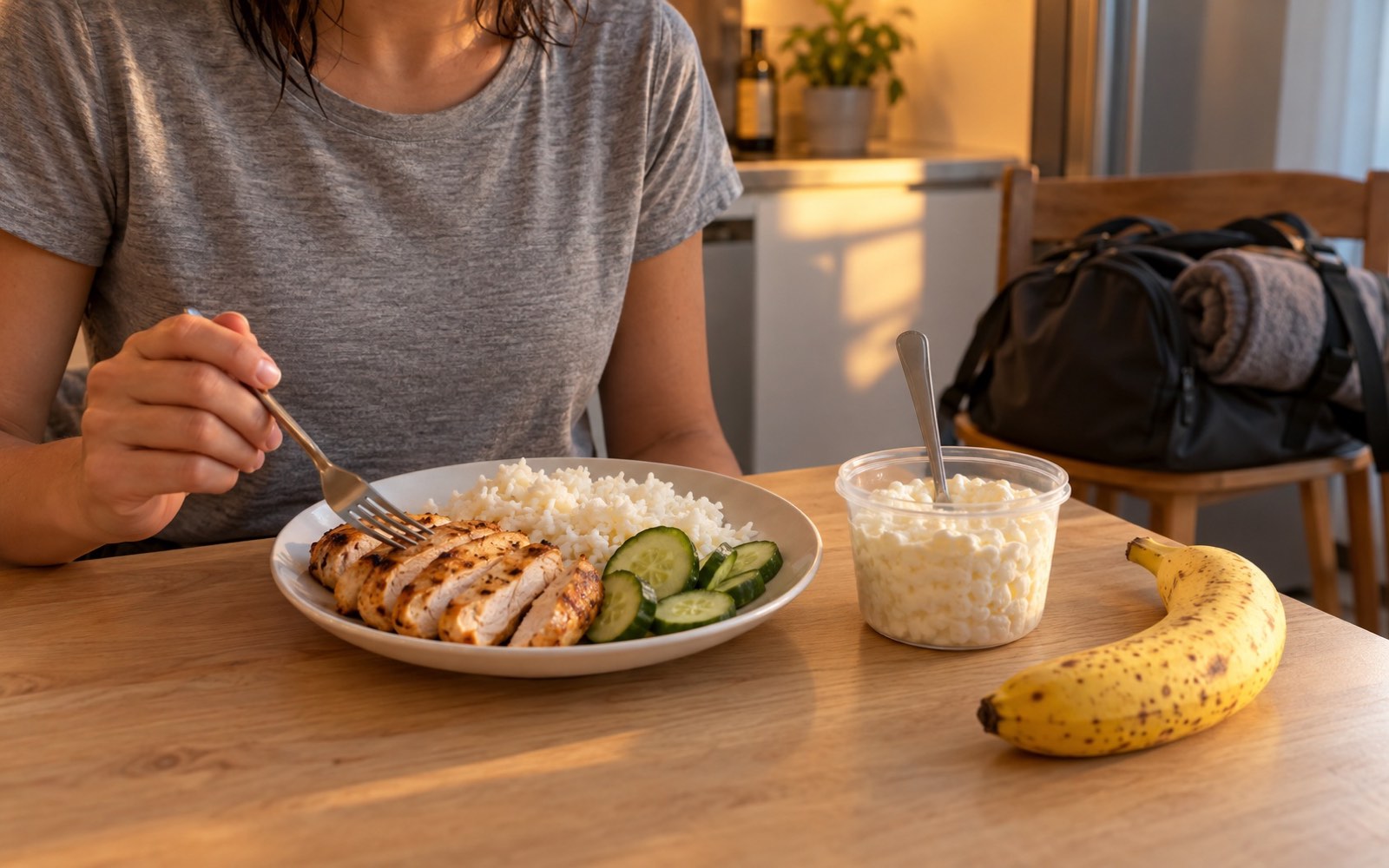
What to eat after a workout: protein and carbs in the first 1–2 hours
Eat 20–40 g of protein plus a serving of carbs within 1–2 hours of finishing your workout. That's what the International Society of Sports Nutrition (ISSN) recommends in its 2017 position stand: 0.25–0.40 g of protein per kilogram of body weight right after training or within two hours. The American College of Sports Medicine (ACSM), in a 2016 position stand, gives a close figure: 0.25–0.3 g/kg — 15–25 g for most people — in the first two hours.
The familiar "20–25 g at a time" figure goes back to a 2009 study by Moore. Six young men drank 0, 5, 10, 20 or 40 g of egg protein after a leg workout. Muscle protein synthesis — the process of building new proteins in your muscles — rose with the dose and maxed out at 20 g. But in a 2016 study by Macnaughton, 30 trained men did a full-body session, and there 40 g of whey raised synthesis more than 20 g did: 0.059 versus 0.049% per hour. The more muscle you worked, the more protein you can use afterward.
We turned those numbers into food. Baked chicken breast has about 31 g of protein per 100 g (3.5 oz) by USDA data, and the same database gives the numbers for bananas, rice, milk, dates and eggs below. Low-fat cottage cheese has about 11 g of protein per 100 g (3.5 oz). Amounts are rounded to the nearest 5 g.
How much protein after a workout: your weight → grams → food
| Your weight | Protein at 0.3 g/kg (0.14 g/lb) | Baked chicken breast | Low-fat cottage cheese | Protein at 0.4 g/kg (0.18 g/lb) | Chicken breast / cottage cheese |
|---|---|---|---|---|---|
| 110 lb (50 kg) | 15 g | 1.8 oz (50 g) | 4.8 oz (135 g) | 20 g | 2.3 oz (65 g) / 6.4 oz (180 g) |
| 132 lb (60 kg) | 18 g | 2.1 oz (60 g) | 5.8 oz (165 g) | 24 g | 2.6 oz (75 g) / 7.8 oz (220 g) |
| 154 lb (70 kg) | 21 g | 2.5 oz (70 g) | 6.7 oz (190 g) | 28 g | 3.2 oz (90 g) / 9 oz (255 g) |
| 176 lb (80 kg) | 24 g | 2.6 oz (75 g) | 7.8 oz (220 g) | 32 g | 3.7 oz (105 g) / 10.2 oz (290 g) |
| 198 lb (90 kg) | 27 g | 3 oz (85 g) | 8.6 oz (245 g) | 36 g | 4.1 oz (115 g) / 11.5 oz (325 g) |
| 220 lb (100 kg) | 30 g | 3.4 oz (95 g) | 9.7 oz (275 g) | 40 g | 4.6 oz (130 g) / 12.9 oz (365 g) |
How to read the table:
- 0.3 g/kg is the amount for one meal. Three or four meals like this over the day add up to your daily target — our how much protein per day article shows how to calculate it.
- The 0.4 g/kg column is the upper end of the ISSN range. It's worth using after 40–50 (section 09) and after a hard full-body session, as in the Macnaughton study.
Scale carbs to the work you did: after an easy hour in the gym, a normal side dish is plenty; after a long session, make the portion bigger. For the whole day, the ACSM suggests 3–5 g of carbs per kilogram (1.4–2.3 g per lb) for light activity and 5–7 g/kg (2.3–3.2 g per lb) for a moderate program of about an hour a day. For 154 lb (70 kg), that's 210–350 g and 350–490 g. A walk or a stretching session doesn't need dedicated recovery food at all.
Ready-to-go options:
- 1 cup (225 g) of low-fat cottage cheese and a banana — about 26 g of protein;
- 3.5 oz (100 g) of baked chicken breast and about 1¼ cups (200 g) of cooked rice — about 36 g of protein and 56 g of carbs;
- a three-egg omelet with a slice of bread — about 20 g of protein;
- 5.3 oz (150 g) of baked chicken breast and about 1½ cups (250 g) of cooked rice — over 45 g of protein and about 70 g of carbs, an option for a bigger person after a hard session.
A normal lunch or dinner after the gym is what "eating after a workout" actually means. What matters most for your muscles is how much protein you get across the whole day. In a 2013 meta-analysis by Schoenfeld, Aragon and Krieger (23 studies, 525 people), daily protein intake was the strongest predictor of muscle growth. Once that was accounted for, the timing of meals around training stopped changing the outcome.
if you can't face a full meal after a hard session, drink a glass of milk or kefir instead. A cup (240 ml) of 1% milk has about 8 g of protein and 12 g of carbs; add a banana and that's roughly 9 g of protein and 39 g of carbs. You can eat a normal dinner an hour or two later.
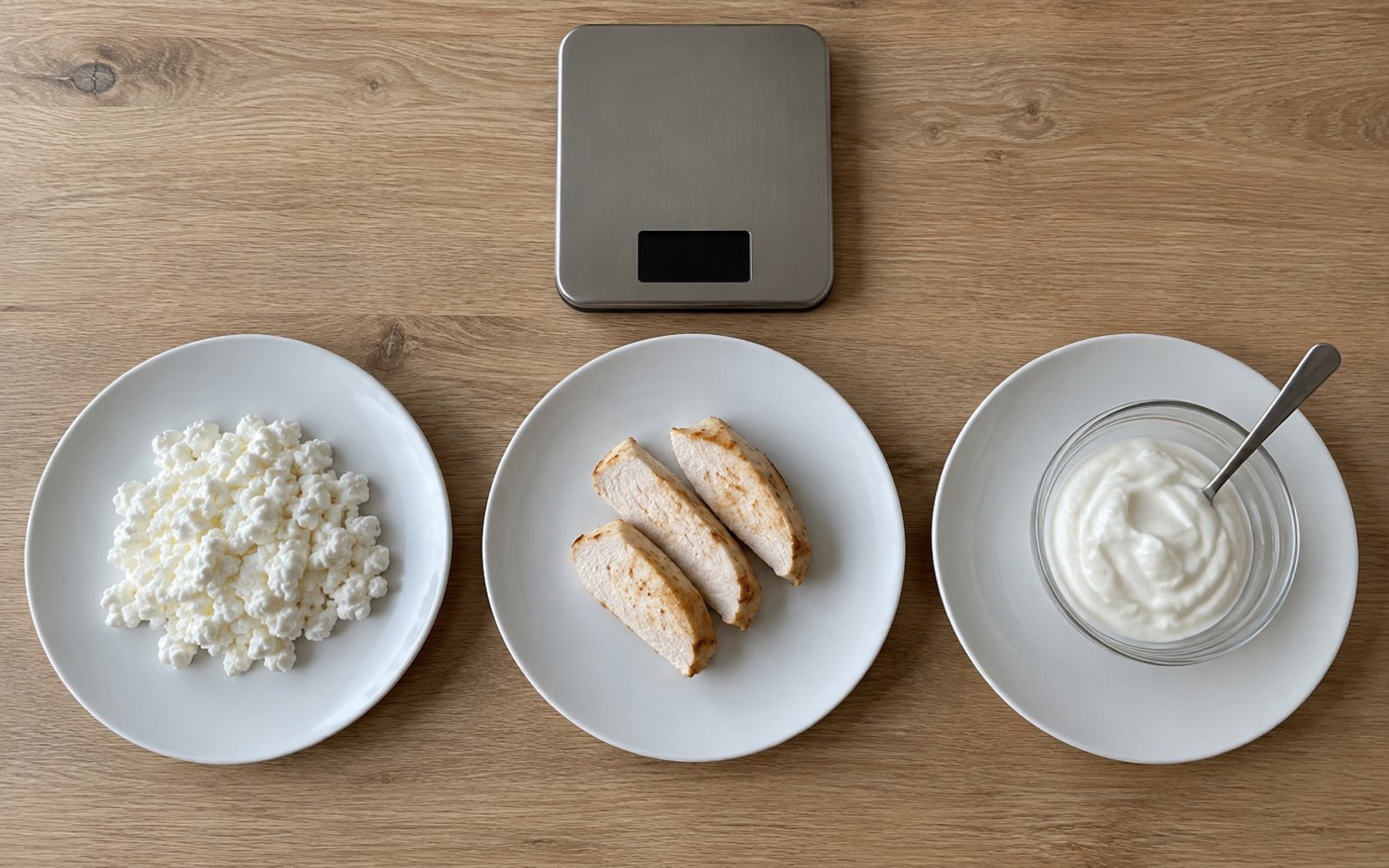
How soon after a workout you can eat, and where the "2-hour rule" myth comes from
You can eat as soon as you want to. Neither the ISSN nor the ACSM sets a rule against eating for two hours after training. The ISSN's 2017 position stand says outright that not eating after exercise offers no benefit for muscle growth or recovery, and recommends eating as soon as possible.
So where does the advice come from? Some gym blogs still suggest that if you're trying to lose weight, you can skip food for a couple of hours after training so your body keeps "burning off" fat. Schubert's 2013 meta-analysis pooled 29 studies and 51 trials: people trained for 30 to 120 minutes, then were offered an all-you-can-eat meal within the next two hours. They ate almost exactly as much as they did after resting, and the calorie deficit created by the workout held up. There's no reason to grit your teeth through hunger.
Timing comes from a rule laid out by Aragon and Schoenfeld in their 2013 review. After a 45–90 minute strength session, don't space the meal before and the meal after more than 3–4 hours apart — or more than 5–6 hours if the earlier meal was a big one with meat and a side. If more than 3–4 hours passed between your last meal and the start of training, eat at least 25 g of protein as soon as you reasonably can afterward. The ISSN's 2017 position stand makes the same point: the size and timing of your pre-workout meal affect how much you need protein afterward. Here's what that looks like for a one-hour session.
How soon to eat after a workout: counting from your last meal
| When you ate before training | Time since that meal by the end of the workout | When to eat after | Example |
|---|---|---|---|
| Fasted, last ate the evening before | 10–14 hours | right away, at least 25 g of protein | a 4-egg omelet with toast, or cottage cheese with a banana |
| Lunch 4–6 hours earlier (lunch at 1 p.m., gym at 6 p.m.) | 5–7 hours | right away; better to snack on protein an hour before the gym | yogurt and a banana beforehand, dinner right after |
| A normal meal 2–3 hours earlier | 3–4 hours | right away or within an hour | your usual dinner |
| A big meal with meat and a side, 2–3 hours earlier | 3–4 hours, window up to 5–6 | within 1–2 hours | dinner on schedule |
| A snack 30–60 minutes before the gym | 1.5–2 hours | within 1.5–2 hours | dinner on schedule |
| 25 g of protein right before training | about 1 hour | within 2 hours, with regular food | dinner on schedule |
You don't have to hit these windows to the minute. Per the ISSN, muscles stay sensitive to protein for at least a day after a strength session, so being an hour late for dinner isn't a problem. The cases worth hurrying for are training fasted, eating a long time before the gym, or having less than 8 hours until your next session (section 10).
The protein and anabolic window: 30 minutes, or a few hours
There's no strict 30-minute window: if you ate 2–3 hours before training, you can comfortably eat within a couple of hours afterward. The "protein" or "anabolic window" is the idea that there's a short window after a workout when protein absolutely has to be eaten, or your muscles won't grow. Research hasn't backed it up.
- In Schoenfeld's 2013 meta-analysis, protein around training showed a small advantage only until total daily protein was taken into account. With daily protein equal, there was no difference in muscle or strength.
- In a 2017 trial by Schoenfeld, 21 trained men drank 25 g of protein either right before or right after training for 10 weeks. Strength and muscle gains came out the same in both groups. The authors write that the window can stretch to several hours, depending on when the person last ate before the gym.
- Wirth's 2020 meta-analysis pooled 65 studies and 2,907 people. Extra protein added an average of 0.62 kg (1.4 lb) of lean mass in adults up to 55, and eating it at any particular time added nothing on top.
That doesn't mean timing is irrelevant. The ISSN's 2017 position stand on protein describes the effect of a workout as long-lasting — at least 24 hours — but fading with time. So a normal dinner an hour or two after the gym beats going hungry until breakfast.
That's also why a protein shake works fine before or after a workout. Whether you need one at all is covered in do you need protein powder.
The "carb window" works the same way. You only need to restock glycogen — the carb stores in your muscles — quickly if your next session is less than 8 hours away (Aragon and Schoenfeld, 2013). If the next workout is tomorrow, the ACSM says you can spread carbs through the day in whatever way is convenient, as long as you hit your daily total.
What to eat before a workout, and how many hours ahead
Have a full meal 1–4 hours before training. If you're short on time, take a small carb-based snack 15–60 minutes out. In its 2016 position stand, the ACSM recommends choosing lower-fat, lower-fiber food the closer you get to the start, so your stomach isn't a problem during the session.
| How long before training | What works | Examples | Better to skip |
|---|---|---|---|
| 3–4 hours | a normal meal: protein, a starch, vegetables | chicken with rice and salad, turkey with pasta | — |
| 1.5–2 hours | a smaller portion, less fat and fiber | an omelet with toast, rice with fish, cottage cheese with berries | fried food, fatty meat, beans, a big bowl of raw vegetables |
| 30–60 minutes | a snack: carbs and a little protein | a banana with drinkable yogurt, toast with honey, kefir | nuts, fatty cheese, a high-fat protein bar |
| 15–30 minutes, if you're hungry | light carbs only | a banana (about 27 g of carbs), a medjool date (about 18 g) | anything heavy |
The hour ranges are a guideline. Everyone's stomach reacts differently, so try any new timing on a regular session first. Before an important session or a competition, don't experiment with food.
Don't be afraid of something sweet before the gym. Per the ISSN's 2017 position stand, the sugar dip some people worry about at the start of exercise is smoothed out by an ordinary warm-up. The same source notes that a snack 15 minutes before the start makes that dip less likely than a snack 75 minutes before. Which carbs to pick, and whether they deserve their bad reputation, is covered in are carbs bad for you.
Before a long workout — longer than an hour — the ACSM recommends 1–4 g of carbs per kilogram of body weight 1–4 hours before the start. We turned the lower end, 1 g/kg (0.45 g per lb), into food. By USDA data, a medium 118 g banana has 26.9 g of carbs and 100 g (3.5 oz) of cooked white rice has 28.2 g.
How many carbs to eat 1–4 hours before a workout longer than an hour: 1 g per kg
| Your weight | Carbs | Bananas | Cooked rice |
|---|---|---|---|
| 110 lb (50 kg) | 50 g | 2 | 6.2 oz (175 g) |
| 132 lb (60 kg) | 60 g | 2 | 7.6 oz (215 g) |
| 154 lb (70 kg) | 70 g | 2.5 | 8.8 oz (250 g) |
| 176 lb (80 kg) | 80 g | 3 | 10.1 oz (285 g) |
| 198 lb (90 kg) | 90 g | 3.5 | 11.3 oz (320 g) |
| 220 lb (100 kg) | 100 g | 3.5–4 | 12.5 oz (355 g) |
This table is for long cardio, team games and hikes. Before a regular one-hour session after a normal meal, that kind of carb-loading isn't necessary. Henselmans' 2022 review pooled 49 studies. Across 19 single-session trials, extra carbs improved strength performance in only six, mostly when they were compared against training fasted or when the session involved more than 10 sets per muscle group. For a session under 45 minutes, you don't need to eat or drink carbs during the workout either (ACSM, 2016).
If you didn't have time to eat, grab a drinkable yogurt, kefir or a banana on the way and have it 30–60 minutes before the gym. Drink water ahead of time too: 5–10 ml per kg of body weight (about 2–4 ml per lb) 2–4 hours out — for 154 lb (70 kg), that's 12–24 fl oz (350–700 ml), per the ACSM's 2016 position stand.
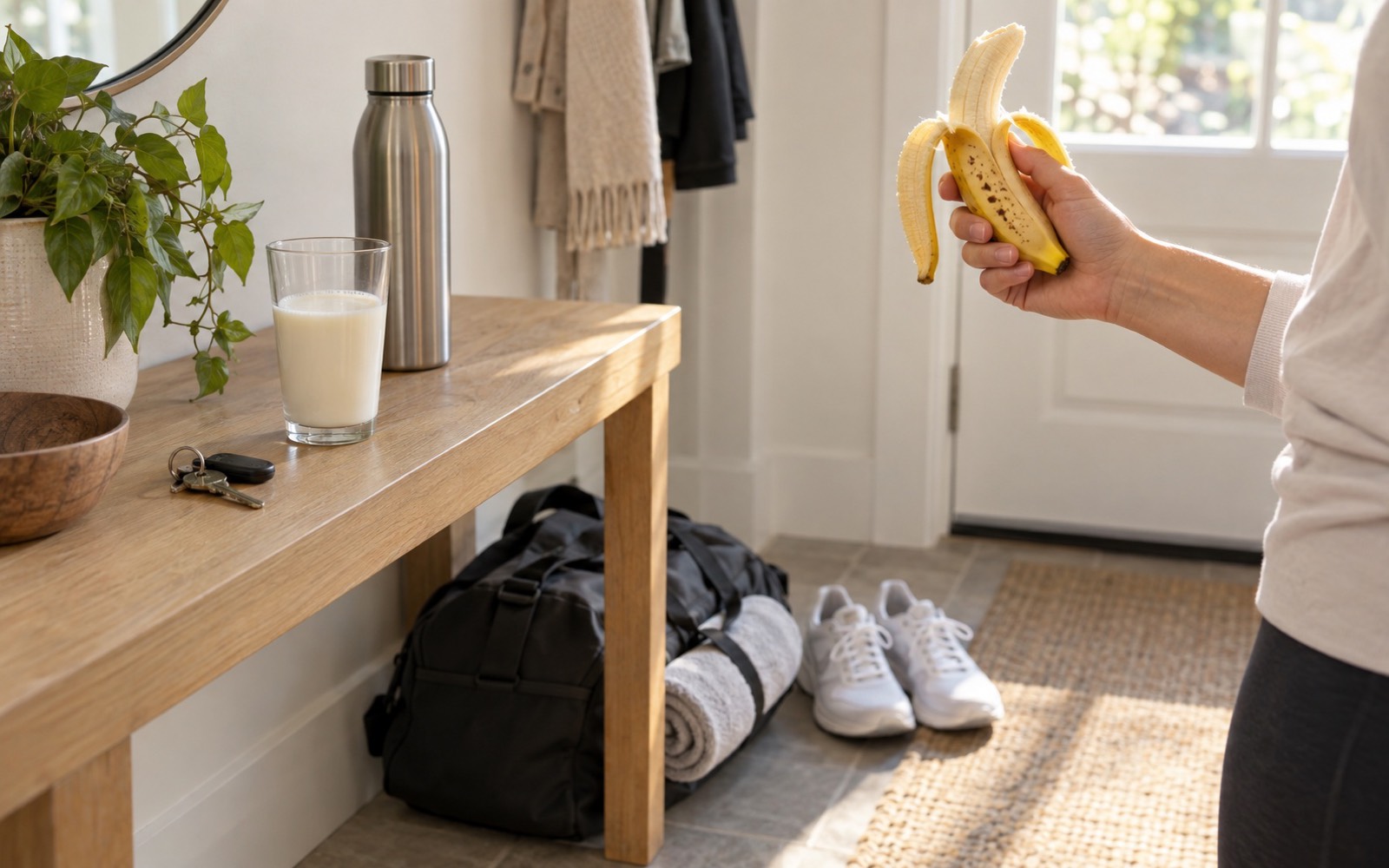
Fasted training in the morning: is it okay, and what to eat after
You can train fasted if it's comfortable for you, but you don't lose more fat over the weeks than you would training after eating. Blood levels of fatty acids are indeed higher after fasted exercise (Aird, 2018), but your overall calorie balance for the day is what actually moves fat stores.
- Hackett and Hagstrom's 2017 meta-analysis (5 studies, 96 people) found no meaningful difference in body weight or fat percentage between fasted and fed training. There isn't much research yet.
- In a 2014 study by Schoenfeld, 20 young women on a calorie deficit did an hour of steady cardio three times a week for 4 weeks. One group drank a 250-kcal shake (40 g of carbs, 20 g of protein) right before training, the other right after. Both groups lost weight and fat, with no difference between them.
Performance is a different story. In Aird's 2018 review (46 studies), eating before exercise improved longer endurance work and made no difference for short sessions. For strength training, Henselmans' 2022 review found something similar: carbs helped mostly when they were compared against a fasted group.
In practice:
- a morning hour in the gym or a short cardio session can be done fasted, or with a banana 15–30 minutes beforehand;
- start a session longer than an hour, a game or a hike fed;
- if you feel dizzy or weak, eat before training — going hungry won't burn any extra fat;
- after fasted training, eat right away, at least 25 g of protein (Aragon and Schoenfeld, 2013) — a four-egg omelet or a tub of cottage cheese with a banana.
If you have diabetes, are pregnant, or have a history of disordered eating, check your eating pattern around workouts with a doctor: on blood-sugar-lowering medication, fasted training can drop your blood sugar sharply. Our best time to work out article covers morning versus evening training.
What to eat after a workout if you're trying to lose weight
Eating after a workout while cutting is fine — that food simply counts toward your daily calorie target. You lose weight because you eat less than you burn over days and weeks. What time you have dinner after the gym doesn't change that balance.
On a deficit, you actually need more protein than usual. The ACSM's 2016 position stand gives 1.2–2.0 g per kilogram a day (0.55–0.9 g per lb) for active people and notes that needs may be higher when you're cutting calories. The ISSN's 2017 position stand on protein says people who lift may need 2.3–3.1 g/kg a day (1.05–1.4 g per lb) on a deficit to hold on to as much muscle as possible. That makes a protein-rich meal after training doubly useful. To stay within your calories, pick options with 20–30 g of protein for under 250 kcal:
- 1 cup (225 g) of low-fat cottage cheese with a handful of berries — about 25 g of protein and roughly 220 kcal;
- 7 oz (200 g) of plain nonfat Greek yogurt and a banana — about 22 g of protein and roughly 220 kcal;
- 3.5 oz (100 g) of baked chicken breast and an oil-free vegetable salad — 31 g of protein and about 190 kcal.
The main trap is "eating back" the calories your watch says you burned. A 2017 study by Shcherbina tested 7 wrist devices and watches on 60 people. Most measured heart rate reasonably well, but no device estimated calorie burn more accurately than a 20% margin of error. If your watch says 600 kcal, the real number can easily be off by 120 kcal in either direction.
The Sportygram food diary logs dinner after the gym as a normal meal and shows how your protein and calories compare to the target from your profile. A store-bought yogurt or cottage cheese tub can be added by scanning its barcode.
Can you eat after a workout in the evening or right before bed
Yes: food after an evening workout doesn't turn into fat by itself, as long as it fits your daily calories. A 2015 review by Kinsey and Ormsby found harm mainly in people who ate most of their food at night, in large, mixed meals. A small snack of around 150 kcal before bed, by their conclusion, doesn't cause harm and may even support muscle protein synthesis. In people with obesity who combined nighttime eating with exercise training, the same review notes, the negative effects appeared to disappear.
Finished at 9 p.m.? Have your normal dinner: fish and potatoes, chicken and rice, or an omelet with vegetables. If it's late and you don't feel like eating much, cottage cheese or yogurt is enough. The ISSN's 2017 position stand notes that 30–40 g of casein — the slow-digesting protein in milk — before bed raises overnight muscle protein synthesis.
A 2012 study by Res shows what that looks like in practice. Sixteen young men trained at 8 p.m. and got 20 g of protein and 60 g of carbs right afterward. Thirty minutes before sleep, one group drank 40 g of casein and the other a protein-free drink. With casein, overnight muscle protein synthesis was about 22% higher, although the difference was borderline in statistical terms. Their whole-body protein balance for the night turned positive, while the group without protein stayed negative. Our cottage cheese before bed article has the math on how much cottage cheese that actually is.
What to eat after a workout to build muscle
To build muscle, eat 0.3–0.4 g of protein per kilogram of body weight after training, spread that across 4 meals a day, and keep a small calorie surplus — eating a bit above your maintenance level. The ISSN recommends 20–40 g of protein every 3–4 hours in its 2017 position stand.
A 2013 study by Areta shows why. Twenty-four trained men got 80 g of whey protein over the 12 hours after a workout, split three different ways. Four servings of 20 g every 3 hours raised muscle protein synthesis 31–48% more than eight servings of 10 g every 90 minutes or two servings of 40 g every 6 hours.
A big dinner after training isn't wasted either. In a 2023 study by Trommelen, 100 g of protein after a workout produced a bigger and longer muscle response — more than 12 hours — than 25 g did.
For 176 lb (80 kg), a day looks like this: eggs and cottage cheese at breakfast, chicken at lunch, yogurt with a banana after the gym, and fish at dinner — four meals of 25–35 g of protein each.
Count carbs toward your overall daily calorie target. The ACSM's benchmark for someone training about an hour a day is 5–7 g per kilogram — for 154 lb (70 kg), that's 350–490 g. Right after training is a convenient time for a big serving of them.
What to eat after a workout for women and after 40
The plan is the same for women, because protein and carbs are calculated by body weight. There are no special "women's" portions: a 132 lb (60 kg) woman and a 132 lb (60 kg) man eat the same 18 g of protein after a workout. Fasted or fed makes no difference either — the 2014 Schoenfeld study from section 05 was done in women who were losing weight.
One difference is water. The ACSM's 2016 position stand notes that women tend to be smaller and sweat less, and are more likely to drink more during exercise than they lose. So there's no need to drink "just in case" — go by the weigh-in from section 10.
After 40–50, aim for the higher end — 0.4 g of protein per kilogram per meal. In a 2015 study by Moore, muscle protein synthesis in men around age 22 peaked at 0.24 g/kg per meal, while in men around age 71 it needed 0.40 g/kg to peak. The study looked at older adults, so treating 40–50 as a cautious guideline makes sense. Use the right-hand columns of the table in section 01: for 154 lb (70 kg), that's 28 g of protein — about 9 oz (255 g) of low-fat cottage cheese, or 3.2 oz (90 g) of chicken breast.
Protein keeps working with age. In Wirth's 2020 meta-analysis, extra protein added an average of 0.46 kg (1 lb) of lean mass in people over 55, again regardless of when they ate it.
Two workouts a day, hot weather and long sessions: when timing really matters
Eating quickly matters when your next session is less than 8 hours away. Then eat carbs right away, at 1–1.2 g per kilogram per hour for the first 4 hours (ACSM, 2016). For 154 lb (70 kg), that's 70–84 g an hour — roughly 2.5–3 bananas or 1½–2 cups (250–300 g) of cooked rice.
A 1988 study by Ivy shows why speed matters here. Twelve cyclists got 2 g of carbs per kilogram either right after 70 minutes of riding or 2 hours later. In those who ate right away, glycogen was stored at 7.7 µmol per gram of muscle per hour over the first two hours; in the delayed group, it was 2.5 — about three times slower. Even once the second group had eaten, their rate was still 45% slower than the first group's in its first two hours.
If you have less than 4 hours to recover, the ISSN's 2017 position stand offers two options: 1.2 g of carbs per kilogram per hour, or 0.8 g/kg of carbs plus 0.2–0.4 g/kg of protein per hour. On a normal schedule, when the next workout is tomorrow or the day after, none of this is necessary.
Water after a hot workout. Weigh yourself before and after training: the difference is almost entirely water. The ACSM's 2016 position stand recommends this way of estimating sweat loss and notes that a fluid deficit of more than 2% of body weight can hurt endurance and thinking, especially in the heat. After training, drink 1.25–1.5 liters for every kilogram you lost (about 19–23 fl oz per pound), along with regular food that has some salt in it. If you weigh more after training than before, you drank more than you sweated out, so drink less next time.
Long endurance sessions — long cardio, cycling, a hike, a tournament — should start fed. According to Aird's 2018 review, that kind of work benefits most from eating beforehand.
Questions and answers
What happens if you don't eat anything after a workout?
If you ate 2–3 hours before the gym, skipping the meal after won't hurt anything. Muscles stay sensitive to protein for at least a day (ISSN, 2017), so your next regular meal will do the job. It's a different story if you trained fasted or your last meal was more than 4 hours earlier: recovery may be slower. In that case, eat 25 g of protein or more as soon as you reasonably can (Aragon and Schoenfeld, 2013).
Banana before a workout: how long before, and why?
Eat it 15–60 minutes before the start. A medium banana has about 27 g of carbs, which give you quick energy without weighing your stomach down. There's no need to fear a sugar crash after a sweet snack: per the ISSN's 2017 position stand, a normal warm-up smooths it out. If you're cutting, a banana is still fine — it simply counts toward your daily calories. After a workout, a banana pairs well with cottage cheese or yogurt, which bring the protein.
Is cottage cheese a good post-workout food?
Yes, and you can eat it right after training. A cup (225 g) of low-fat cottage cheese gives you roughly 25–26 g of protein, which lands close to 0.3–0.4 g per kilogram for someone weighing 130–175 lb (60–80 kg). If you weigh 110–155 lb (50–70 kg), about 4.8–6.7 oz (135–190 g) is enough — see the table in section 01 for exact amounts. What matters for your muscles is total daily protein (Schoenfeld, 2013), so cottage cheese works just as well as a protein shake. In the evening, it also works as a bedtime snack (section 07).
Can you eat sweets after a workout?
Sure, as long as it fits your daily calories. Sweets don't have any special properties right after training; they count the same as at any other time. Fast carbs right after exercise only matter if your next session is less than 8 hours away (ACSM, 2016). If you're cutting, eat your protein from the table in section 01 first and save sweets for whatever calories are left.
What if you don't feel like eating after a workout?
Drink a glass of milk or kefir with a banana — liquids go down more easily. A cup of milk with a banana gives you roughly 9 g of protein and 39 g of carbs. Appetite after exercise varies a lot, and in Schubert's 2013 meta-analysis people ate about as much after training as after resting. Have a proper dinner once you're hungry, ideally within 3–4 hours of your pre-workout meal. If you trained fasted, don't put it off — have at least some yogurt or cottage cheese.
Should you drink a protein shake before or after a workout?
It doesn't matter, so pick whatever is convenient. In Schoenfeld's 2017 trial, 25 g of protein right before or right after training produced the same gains in strength and muscle over 10 weeks. What matters more is how much protein you get over the whole day (Schoenfeld, 2013). A shake is just a convenient source of protein, and cottage cheese, yogurt or milk can stand in for it. Whether you need one at all is covered in the protein powder article linked in section 03.
What should you eat after cardio?
After an easy cardio session under an hour, eat on your usual schedule — no special food needed. After a long or hard one, add more carbs to your next meal: rice, potatoes, pasta or bread. If your next session is less than 8 hours away, eat those carbs right away, at 1–1.2 g per kilogram per hour (ACSM, 2016). Count protein after cardio the same way as after lifting: 0.25–0.3 g per kilogram per meal.
Can you work out right after eating?
After a light snack, you're fine within 30–60 minutes; after a big plate of food, wait 2–3 hours. Fat and fiber stay in the stomach longer, which is why the ACSM's 2016 position stand suggests eating less of them close to the start. A walk or stretching session is barely affected by food either way. If your stomach feels heavy during training, eat earlier or have a smaller portion next time.
The bottom line
- After a workout, eat about 0.3 g of protein per kilogram of body weight (for 154 lb/70 kg, that's 21 g) plus carbs scaled to how hard you trained, within 1–2 hours.
- Before a workout: a meal 1–4 hours out, or a snack 15–60 minutes out — the closer to the start, the less fat and fiber.
- Keep no more than 3–4 hours between the meal before and the meal after. If more time passed, eat 25 g of protein right after training.
- There's no strict 30-minute protein window; being an hour late isn't a problem. Daily protein is what counts for muscle.
- Training fasted is fine, but it doesn't burn more fat overall. Start a session longer than an hour fed.
- There's no "don't eat for 2 hours after a workout" rule: if you're cutting or training in the evening, that food simply counts toward your daily calories.
- Women's portions are calculated by weight, like everyone's. After 40–50, aim for 0.4 g of protein per kilogram per meal.
Checklist: eating on training day
- Check when you last ate. If it's been more than 3–4 hours, snack 30–60 minutes before the gym on yogurt with a banana, kefir, or toast with honey.
- Skip fatty, fried food and a big bowl of vegetables in the hour before training.
- Before a session longer than an hour, eat carbs by the table in section 04.
- After the workout, eat protein by the table in section 01 and carbs scaled to the session.
- Trained fasted? Eat right away, at least 25 g of protein.
- Cutting? Count that meal toward your daily target, and don't eat back the calories your watch estimated.
- Over 40? Aim for 0.4 g of protein per kilogram per meal.
- Two workouts in one day? Eat carbs right away, at 1–1.2 g per kilogram per hour for the first 4 hours.
- Tell your virtual coach Alex in the app's chat what you ate after the gym — he'll add it to your food diary through a confirmation card.
Sources
- Kerksick C. M. et al. International society of sports nutrition position stand: nutrient timing. Journal of the International Society of Sports Nutrition, 2017. — 20–40 g of protein (0.25–0.40 g/kg) every 3–4 hours, protein right after or within 2 hours of training; the size and timing of the pre-workout meal affect how much post-workout protein is needed; muscles stay sensitive to protein for at least a day; with under 4 hours of recovery, 1.2 g/kg of carbs per hour or 0.8 g/kg of carbs with 0.2–0.4 g/kg of protein per hour; a warm-up smooths out the sugar dip at the start of exercise, and a snack 15 minutes out makes it less likely than one 75 minutes out; 30–40 g of casein before bed.
- Thomas D. T., Erdman K. A., Burke L. M. American College of Sports Medicine Joint Position Statement. Nutrition and Athletic Performance. Medicine & Science in Sports & Exercise, 2016. — 1–4 g/kg of carbs 1–4 hours before exercise longer than an hour, less fat, protein and fiber closer to the start, no carbs needed during sessions under 45 minutes; 0.25–0.3 g/kg (15–25 g) of protein in the first 2 hours after; 1–1.2 g/kg of carbs per hour when the gap is under 8 hours; 3–5 g/kg a day for light activity and 5–7 g/kg at about an hour of training; protein 1.2–2.0 g/kg a day, higher when cutting; 5–10 ml/kg of water before, fluid deficits over 2% of body weight hurt performance in the heat, weighing before and after, 1.25–1.5 L per kg lost afterward; women are more likely to overdrink.
- Aragon A. A., Schoenfeld B. J. Nutrient timing revisited: is there a post-exercise anabolic window? Journal of the International Society of Sports Nutrition, 2013. — Space meals before and after a strength session no more than 3–4 hours apart, up to 5–6 after a big meal; at least 25 g of protein right away after a long gap; glycogen only needs to be restocked quickly when the gap is under 8 hours.
- Schoenfeld B. J., Aragon A. A., Krieger J. W. The effect of protein timing on muscle strength and hypertrophy: a meta-analysis. Journal of the International Society of Sports Nutrition, 2013. — 23 studies, 525 people: daily protein intake is the strongest predictor of muscle growth; once accounted for, meal timing doesn't matter.
- Schoenfeld B. J. et al. Pre- versus post-exercise protein intake has similar effects on muscular adaptations. PeerJ, 2017. — 21 trained men, 10 weeks, 25 g of protein before or after training: the same result either way.
- Wirth J., Hillesheim E., Brennan L. The Role of Protein Intake and its Timing on Body Composition and Muscle Function in Healthy Adults: A Systematic Review and Meta-Analysis of Randomized Controlled Trials. The Journal of Nutrition, 2020. — 65 studies, 2,907 people: extra protein added 0.62 kg of lean mass in adults and 0.46 kg in people over 55; timing added no benefit.
- Jäger R. et al. International Society of Sports Nutrition Position Stand: protein and exercise. Journal of the International Society of Sports Nutrition, 2017. — 1.4–2.0 g/kg of protein a day for active people, 2.3–3.1 g/kg on a deficit for resistance-trained people; the effect of a workout lasts at least 24 hours and fades with time.
- Moore D. R. et al. Ingested protein dose response of muscle and albumin protein synthesis after resistance exercise in young men. The American Journal of Clinical Nutrition, 2009. — 6 young men, a leg workout, 0–40 g of egg protein: muscle protein synthesis maxed out at 20 g.
- Macnaughton L. S. et al. The response of muscle protein synthesis following whole-body resistance exercise is greater following 40 g than 20 g of ingested whey protein. Physiological Reports, 2016. — 30 trained men, a full-body workout: synthesis was higher after 40 g of whey than after 20 g (0.059 versus 0.049% per hour).
- Areta J. L. et al. Timing and distribution of protein ingestion during prolonged recovery from resistance exercise alters myofibrillar protein synthesis. The Journal of Physiology, 2013. — 24 trained men, 80 g of protein over 12 hours: 4 servings of 20 g every 3 hours raised synthesis 31–48% more than 8 of 10 g or 2 of 40 g.
- Trommelen J. et al. The anabolic response to protein ingestion during recovery from exercise has no upper limit in magnitude and duration in vivo in humans. Cell Reports Medicine, 2023. — 100 g of protein after a workout produced a bigger and longer (over 12 hours) response than 25 g.
- Schubert M. M. et al. Acute exercise and subsequent energy intake. A meta-analysis. Appetite, 2013. — 29 studies, 51 trials, 30–120 minute sessions, an unrestricted meal 0–2 hours afterward: people didn't eat back what they burned.
- Hackett D., Hagstrom A. D. Effect of Overnight Fasted Exercise on Weight Loss and Body Composition: A Systematic Review and Meta-Analysis. Journal of Functional Morphology and Kinesiology, 2017. — 5 studies, 96 people: the difference in weight and body fat between fasted and fed training is negligible; the data set is small.
- Schoenfeld B. J. et al. Body composition changes associated with fasted versus non-fasted aerobic exercise. Journal of the International Society of Sports Nutrition, 2014. — 20 young women on a deficit, 4 weeks, an hour of steady cardio 3 times a week, a 250-kcal shake before or after: weight and fat dropped equally.
- Aird T. P., Davies R. W., Carson B. P. Effects of fasted vs fed-state exercise on performance and post-exercise metabolism: A systematic review and meta-analysis. Scandinavian Journal of Medicine & Science in Sports, 2018. — 46 studies: eating before exercise helps longer endurance work but not short sessions; fasted exercise raises blood fatty acids afterward.
- Henselmans M. et al. The Effect of Carbohydrate Intake on Strength and Resistance Training Performance: A Systematic Review. Nutrients, 2022. — 49 studies: extra carbs improved single-session strength performance in 6 of 19 trials, mostly against a fasted baseline or with more than 10 sets per muscle group.
- Shcherbina A. et al. Accuracy in Wrist-Worn, Sensor-Based Measurements of Heart Rate and Energy Expenditure in a Diverse Cohort. Journal of Personalized Medicine, 2017. — 7 devices, 60 people: six devices measured heart rate during cycling within a 5% margin, but no device estimated calorie burn within a 20% margin.
- Kinsey A. W., Ormsbee M. J. The Health Impact of Nighttime Eating: Old and New Perspectives. Nutrients, 2015. — Harm from nighttime eating is tied to large, mixed meals; a snack of around 150 kcal before bed doesn't cause harm and may support muscle protein synthesis; combined with exercise training, adverse effects in people with obesity appeared to disappear.
- Res P. T. et al. Protein ingestion before sleep improves postexercise overnight recovery. Medicine & Science in Sports & Exercise, 2012. — 16 young men, training at 8 p.m., 40 g of casein 30 minutes before sleep: overnight muscle protein synthesis about 22% higher (borderline significance), positive protein balance overnight.
- Moore D. R. et al. Protein ingestion to stimulate myofibrillar protein synthesis requires greater relative protein intakes in healthy older versus younger men. The Journals of Gerontology: Series A, 2015. — Peak synthesis per meal: 0.40 g/kg in men around 71 versus 0.24 g/kg in men around 22.
- Ivy J. L. et al. Muscle glycogen synthesis after exercise: effect of time of carbohydrate ingestion. Journal of Applied Physiology, 1988. — 12 cyclists, 2 g/kg of carbs right away or 2 hours later: glycogen storage of 7.7 versus 2.5 µmol/g per hour over the first 2 hours, and the delayed group stayed 45% slower afterward.
- U.S. Department of Agriculture. FoodData Central. USDA Agricultural Research Service, 2019. — Nutrient values for bananas, cooked rice, baked chicken breast, 1% milk, low-fat cottage cheese, nonfat Greek yogurt, medjool dates and eggs.
This article is for informational purposes only and is not a substitute for medical advice.