

an adult needs at least 130 g of carbs a day. Training 3–4 times a week, aim for 3–5 g per kg of body weight (1.4–2.3 g per lb); training about an hour every day, 5–7 g per kg (2.3–3.2 g per lb). The easiest way to count carbs is as the remainder: calories minus protein and fat. Keep free sugars under 10% of calories and eat at least 25 g of fiber a day.Example: a woman weighing 58 kg (128 lb), three workouts a week, losing fat — 1,500 calories, 104 g protein, 46 g fat, about 168 g of carbs.
Carbohydrates are the sugars, starch and fiber in food. Your body turns sugars and starch into glucose for your brain and muscles; fiber is there for your gut. An adult needs at least 130 g of carbs a day: that's the US Institute of Medicine figure for how much glucose the brain needs. If you train 3–4 times a week, the working range is 3–5 g per kg of body weight (1.4–2.3 g per lb), which is 180–300 g at 60 kg (132 lb). On a fat-loss diet it usually works out to 2–3 g per kg if you calculate carbs as what's left after protein and fat. Below: why the numbers online disagree, a worked calculation for four people with three goals, how much food gives you 50 g of carbs, the limits for sugar and fiber, and what happens if you barely eat carbs at all.
How many carbs per day: the short answer
An adult needs at least 130 g of carbohydrate a day, and with 3–4 workouts a week the working range is 3–5 g per kg of body weight. The 130 g figure comes from the US Institute of Medicine's Dietary Reference Intakes of 2002–2005, and it's the same for men and women. It's calculated around the brain, which under normal conditions runs almost entirely on glucose. According to the 2018 review by Murray and Rosenbloom, the brain at rest takes about 60% of all the glucose in your blood. That said, 130 g is a recommended intake, and the body can manage on less. When carbs are scarce, the liver makes glucose from amino acids and glycerol, and on a very low-carb diet the brain partly switches to ketones, which the liver makes from fat.
Beyond that minimum, carbs are for your muscles. Their stored form is called glycogen. The same review puts total glycogen at about 600 g: roughly 500 g in muscle on average (300–700 g depending on the person) and about 80 g in the liver. The liver releases glucose into the blood between meals and overnight; the muscles spend their glycogen during training. The longer and harder you train, the more carbs you need to refill that store.
At 60 kg (132 lb) and three workouts a week, 3–5 g per kg is 180–300 g of carbs a day; at 80 kg (176 lb), it's 240–400 g. Section 03 shows how to narrow that range to fit your goal.
Three numbers worth remembering:
- 130 g a day is the floor for an adult under the US guidelines. On a normal diet, even a fat-loss one, you'll end up eating more.
- 3–5 g per kg (1.4–2.3 g per lb) is the ACSM guide for light training. Three or four one-hour sessions a week average out to about half an hour a day, half the "an hour every day" level, so they usually land here.
- Under 10% of calories is the free-sugar limit from the WHO.
Why the numbers online are so different: percentages, grams and the minimum
The recommendations differ because different organizations calculate them for different purposes: Russia and Europe work in percent of calories, the US adds a minimum in grams, and sports medicine works in grams per kilogram of body weight. Each number answers its own question, so you can't compare them head to head.
| Who | Carb recommendation | What else matters |
|---|---|---|
| Russia, MR 2.3.1.0253-21 from Rospotrebnadzor (2021) | 56–58% of calories: 301–551 g a day for men, 238–435 g for women | based on a diet with 30% fat and 12–14% protein; added sugar under 10%, 5% if overweight; fiber 20–25 g |
| US, Institute of Medicine (2002–2005) | at least 130 g; 45–65% of calories | 175 g in pregnancy, 210 g when breastfeeding; added sugar no more than 25% of calories |
| Europe, EFSA (2010) | 45–60% of calories | fiber 25 g; no sugar limit set, not enough data |
| WHO (2015 and 2023) | no percentage set | free sugars under 10%, ideally under 5%; fiber 25 g and up; vegetables and fruit 400 g (14 oz) a day and up |
| Sports medicine, ACSM (2016) | 3–5 g per kg for light training, 5–7 g for an hour a day, 6–10 g for 1–3 hours, 8–12 g for 4–5 hours and more | calculated from body weight and hours of training |
Why percentages mislead. 55% of 1,500 calories is 206 g of carbs; 55% of 3,000 calories is 412 g. Two "55%" recommendations differ by a factor of two while sounding identical.
Why the Russian numbers look high. A woman aged 18–29 with a desk job gets 1,900 calories under the Russian guidelines: 67 g of protein (14% of calories), 63 g of fat and 266 g of carbs. For people who train, the 2016 ACSM position stand advises more protein, 1.2–2.0 g per kg a day. Protein takes a share of the calories, and the carb share shrinks.
A common mistake. The lines "the WHO recommends 45–65% carbs" and "WHO: a minimum of 130 g" are retellings of the US Institute of Medicine figures. The WHO sets no carb percentage, and its 2023 guideline is about quality: carbs should come first from whole grains, vegetables, fruit and legumes. The often-quoted "minimum of 100 g a day" also doesn't match the US floor of 130 g.
How to calculate your carb intake: calories, protein and fat first, then the remainder
The easiest way to work out carbs is as the remainder: find your calorie target, subtract protein and fat, and divide what's left by 4. A gram of carbs or protein has about 4 calories; a gram of fat has about 9. That's how sports dietitians do it too: in the 2014 review by Helms on bodybuilding contest preparation, calories, protein and fat are set first and carbs get everything else. Protein has its own per-kilogram target, fat has the 20–35% of calories range from the Institute of Medicine, and this order stops either from dropping below what you need.
Example: a woman aged 28, 163 cm (5'4"), 58 kg (128 lb), office job, gym three times a week, wants to lose fat.
- Calories. Resting metabolic rate, meaning what she burns at complete rest, from the 1990 Mifflin-St Jeor equation: 10 × 58 + 6.25 × 163 − 5 × 28 − 161 ≈ 1,298 calories. Multiply by an activity factor of 1.375 for an office job plus three workouts a week: about 1,784 calories. For fat loss, take off 15% and round to 1,500 calories. How to pick the activity factor and the size of the deficit is covered in how to calculate a calorie deficit.
- Protein. 1.8 g × 58 kg ≈ 104 g. In calories, 104 × 4 = 416.
- Fat. 0.8 g × 58 kg ≈ 46 g. In calories, 46 × 9 = 414.
- Carbs. (1,500 − 416 − 414) ÷ 4 ≈ 168 g. That's 2.9 g per kg (1.3 g per lb) and 45% of calories.
We ran the same calculation for four people with three goals each. Everyone gets an activity factor of 1.375; fat-loss calories are 15% below expenditure, muscle-gain calories 10% above; calories are rounded to the nearest 50, protein and fat grams to whole numbers. Protein is 1.8 g per kg for fat loss and 1.6 g per kg for maintenance and gain, inside the ACSM range of 1.2–2.0 g: on reduced calories, the ACSM allows the upper part of that range. Fat is 0.8, 0.9 and 1.0 g per kg, which comes to 26–32% of calories in every case.
Carbs as the remainder: four people, three goals
| Who | Goal | Calories | Protein | Fat | Carbs | g per kg | % of calories |
|---|---|---|---|---|---|---|---|
| Woman, 28, 163 cm (5'4"), 58 kg (128 lb) | Fat loss | 1,500 | 104 g | 46 g | 168 g | 2.9 | 45% |
| Maintenance | 1,800 | 93 g | 52 g | 240 g | 4.1 | 53% | |
| Muscle gain | 1,950 | 93 g | 58 g | 264 g | 4.6 | 54% | |
| Woman, 35, 168 cm (5'6"), 75 kg (165 lb) | Fat loss | 1,700 | 135 g | 60 g | 155 g | 2.1 | 36% |
| Maintenance | 2,000 | 120 g | 68 g | 227 g | 3.0 | 45% | |
| Muscle gain | 2,200 | 120 g | 75 g | 261 g | 3.5 | 48% | |
| Man, 30, 178 cm (5'10"), 75 kg (165 lb) | Fat loss | 2,000 | 135 g | 60 g | 230 g | 3.1 | 46% |
| Maintenance | 2,350 | 120 g | 68 g | 315 g | 4.2 | 54% | |
| Muscle gain | 2,600 | 120 g | 75 g | 361 g | 4.8 | 56% | |
| Man, 40, 180 cm (5'11"), 90 kg (198 lb) | Fat loss | 2,150 | 162 g | 72 g | 214 g | 2.4 | 40% |
| Maintenance | 2,500 | 144 g | 81 g | 299 g | 3.3 | 48% | |
| Muscle gain | 2,750 | 144 g | 90 g | 341 g | 3.8 | 50% |
What the table shows:
- Fat loss lands at 2.1–3.1 g per kg, or 155–230 g a day. Carbs come down on their own along with calories and still stay above the 130 g floor.
- The heavier you are, the fewer grams per kilogram. Protein and fat are calculated from body weight, while calories grow more slowly. The 75 kg woman on fat loss gets 2.1 g per kg; the 58 kg woman gets 2.9 g.
- The results almost match the Russian guidelines. A desk-bound woman aged 18–29 gets 266 g there, and our 28-year-old on maintenance came out at 240 g; a desk-bound man aged 30–44 gets 322 g there, our 30-year-old 315 g. We have slightly fewer carbs because protein takes about 20% of calories in our calculation and 12–14% in the Russian guidelines. The woman also has 100 fewer calories than the guidelines give her.
- Maintenance and muscle gain fall inside the ACSM range of 3–5 g per kg. You don't need a separate "athlete" number for three workouts a week.
You don't have to calculate your calorie target by hand: the profile in the Sportygram app works it out from your stats and goal. From there, protein, fat and carbs follow the steps above.
after 3–4 weeks, compare your average weight for the week with where you started. If you're losing fat and the scale hasn't moved, cut 100–150 calories, and the easiest place to do it is carbs: 100 calories is 25 g of carbs, about one banana or 40 g (1.4 oz) of dry buckwheat. If you're building muscle and the scale hasn't moved, add the same amount.
How many carbs for women and men, over 40 and for teenagers
Per kilogram of body weight, women and men need the same amount; in grams, men need more because they're heavier and burn more energy. The Institute of Medicine minimum of 130 g is the same for both sexes, and the ACSM ranges don't split people by sex either.
The Russian guidelines give grams by sex, age and activity. Here are the figures for people with desk jobs (physical activity level 1.4):
| Age | Women | Men |
|---|---|---|
| 18–29 | 1,900 calories, 266 g carbs | 2,400 calories, 336 g carbs |
| 30–44 | 1,800 calories, 252 g carbs | 2,300 calories, 322 g carbs |
| 45–64 | 1,700 calories, 238 g carbs | 2,150 calories, 301 g carbs |
Over 40 and over 50. Carbs in grams come down along with energy expenditure, while the share of carbs in your calories stays the same. There's no special rule for age. The Mifflin-St Jeor equation already accounts for age, so calculate from your own calories. People who move a lot at work get more under the Russian guidelines: in the heavy manual labor group (construction workers, movers) up to 551 g for men and 435 g for women. The Russian guidelines don't cover athletes separately; for them there are the sports figures from section 02.
Pregnancy and breastfeeding. Under the Institute of Medicine, the minimum is 175 g of carbs a day in pregnancy and 210 g when breastfeeding. That's a reference point. Your diet during this time is worth discussing with your doctor, especially if you have gestational diabetes, the kind that appears during pregnancy.
Teenagers. Under the Russian guidelines, boys aged 11–14 need 363 g of carbs a day and girls 334 g; boys aged 15–17 need 421 g and girls 363 g. A teenager is growing and needs 2,300–2,900 calories a day. Cutting a teenager's carbs for weight loss without medical advice isn't a good idea. A young athlete's diet should be built together with a doctor.
Women who train a lot. If you train almost every day and cut food hard at the same time, keep an eye on your cycle and how you feel. The International Olympic Committee's 2023 consensus statement (Mountjoy and colleagues) describes Relative Energy Deficiency in Sport: there isn't enough food for training and everyday life, and health and performance suffer, in women and in men. The same statement notes growing evidence on the role of low carbohydrate intake specifically. A missed period, constant fatigue and dizziness are reasons to see a doctor, and not to cut food any further.
How many carbs for weight loss and on a cut
On a fat-loss diet, carbs usually work out to 2–3 g per kg of body weight, and you don't need to cut them separately: they come down along with calories. The table in section 03 shows this.
The "low-carb or balanced" question has been studied thoroughly. The 2022 Cochrane review by Naude pooled 61 trials in which 6,925 people with excess weight were randomly assigned to weight-loss diets. Most studies defined low-carb as 50–150 g of carbs a day or under 45% of calories, and balanced as 45–65%. In people without diabetes, the low-carb diets produced 1.07 kg (2.4 lb) more weight loss over 3–8.5 months and 0.93 kg (2 lb) more over 1–2 years. The authors described this as "little to no difference". Diastolic blood pressure and LDL ("bad") cholesterol over 1–2 years were nearly the same too.
In the 2018 DIETFITS trial by Gardner, 609 overweight adults spent a year on a healthy diet that was either lower in fat or lower in carbs. Carbs averaged 48% and 30% of calories. The first group lost 5.3 kg (11.7 lb), the second 6.0 kg (13.2 lb), and the 0.7 kg difference was within random variation. Neither a genetic test nor insulin secretion after a sugar load predicted who would do better on which diet.
The strictest way to compare diets is to feed people measured meals with equal calories. Hall and Guo pooled 32 such studies in 2017. On the diet with less fat and more carbs, people burned 26 more calories a day and lost 16 g more fat a day. The difference was tiny, and it went in favor of carbs.
The takeaway is simple: fat loss runs on a calorie deficit, and you can choose whichever protein-fat-carb split you can keep up for months. If you like oatmeal and bread, keep them and reduce the portions. You don't need to cut carbs below 130 g a day to lose weight. If you want to try low-carb or keto, read our honest review of the keto diet first: the pros, the cons and who it doesn't suit.
Cutting. That's the word for a fat-loss phase where you try to keep as much muscle as possible. The 2014 review by Helms advises losing 0.5–1% of body weight a week, eating 2.3–3.1 g of protein per kg of lean body mass (your weight without the fat), taking 15–30% of calories from fat and giving all the remaining calories to carbs. For a 75 kg (165 lb) man at 15% body fat, that's 0.4–0.75 kg (0.9–1.7 lb) a week and 147–198 g of protein. If he eats 2,000 calories, takes 150 g of protein and 20% of calories from fat, carbs get 250 g. Even on a cut set up this way, carbs come out well above 130 g. How to run the whole phase, from the deficit to training, is in how to cut without losing muscle.
How many carbs to build muscle and for training
To build muscle you usually need 3–5 g of carbs per kg of body weight, and if you train for an hour or more every day, 5–7 g per kg. In the table in section 03, muscle gain came out at 3.5–4.8 g per kg. The 2019 review by Iraki and colleagues on off-season nutrition for bodybuilders advises the same: a calorie surplus of about 10–20%, meaning slightly more food than you burn, protein at 1.6–2.2 g per kg, fat at 0.5–1.5 g per kg, and the remaining calories to carbs so that they come to at least 3–5 g per kg.
The 2016 ACSM position stand calculates carbs from hours of training; all the levels are in the table in section 02. The light level there is described as low-intensity or skill-based work, the moderate level as a program of about an hour a day, and the statement doesn't split people by number of workouts a week. For a 75 kg (165 lb) person, light training means 225–375 g a day, daily sessions of about an hour mean 375–525 g. Three one-hour sessions a week average out to under half an hour a day. So someone who trains three times a week is usually fine at the lower level, and 5–7 g per kg is for people who train every day.
The fear that "without extra carbs you won't have the strength" was tested in the 2022 systematic review by Henselmans of 49 studies. In 19 of them, carbs were changed once: over the day before a session or right before it. In 13 of those, strength and work volume didn't change; in 6 they went up. The benefit showed mainly against training fasted and when a muscle group got more than 10 sets. None of the 7 short studies of 2–7 days found a benefit, and in 15 of the 17 long-term studies there was no difference.
The authors' conclusion: if you've eaten and you do up to 10 sets per muscle group in a session, the amount of carbs barely affects your strength. For a three-day-a-week program at that volume, the normal intake from the table is enough. At high volume, carbs may help. When glycogen had been deliberately depleted beforehand, carbs improved performance in three studies, especially with two sessions a day. Where the control group got the same calories, no difference was found.
When exactly to eat carbs, before training, after or just across the day, is covered in what to eat before and after a workout. If your next session is tomorrow, the ACSM lets you spread carbs across the day however you like, as long as you hit the daily total. Hurrying to eat makes sense when there are fewer than 8 hours between two sessions.

Simple and complex carbs, sugar and fiber: what to choose
For your health, two limits inside your total matter most: free sugars under 10% of calories and fiber at 25 g a day or more. Sorting carbs into fast and slow helps less than it seems.
Simple and complex. This is a split by structure, as defined in the Russian guidelines. Simple carbs are mono- and disaccharides: glucose, fructose, sucrose (table sugar), lactose (milk sugar). Complex carbs are oligo- and polysaccharides, meaning chains of several or many sugar molecules: starch and fiber.
Fast and slow. This is a split by how quickly a food raises your blood sugar, measured by the glycemic index. By the definition in the Russian guidelines, it's a scale from 0 to 100: how much blood sugar rises over 2 hours after 50 g of carbs from a food compared with 50 g of glucose. A complex carb can also be a fast one: the starch in white bread or mashed potatoes raises blood sugar quickly. Why one food's index "floats" is explained in the glycemic index.
Sugar. The WHO's 2015 guideline advises keeping free sugars under 10% of calories, and for extra benefit under 5%, which is about 25 g, or around 6 teaspoons a day. Free sugars are the sugars added to food and drinks, plus honey, syrups and juices. The sugars in whole fruit, vegetables and milk don't count. The Russian guidelines give the same limit and advise people with a BMI of 25 and above to stay within 5%.
In grams it looks like this. At 2,000 calories, 10% is 200 calories, or 50 g of sugar, and a 500 ml (17 fl oz) bottle of cola lists 53 g on the label; the 20 fl oz (591 ml) bottle sold in the US lists 65 g. At 1,500 calories and with excess weight, the 5% limit is about 19 g. The sugar in an apple and in apple juice is similar, but a whole apple's sugar doesn't count toward the WHO limit. Juice counts in full. An apple comes with fiber, you have to chew it, and there's no way to eat it as fast as you can drink a glass of juice.
Fiber. The WHO's 2023 guideline advises adults to eat at least 25 g of naturally occurring fiber and at least 400 g (14 oz) of vegetables and fruit a day. EFSA calls 25 g adequate for normal bowel function, the Russian guidelines say 20–25 g, and the US Dietary Reference Intakes 38 g for men and 25 g for women under 50. In the 2019 series of reviews by Reynolds in The Lancet (185 observational and 58 clinical studies), people who ate the most fiber had a 15–30% lower risk of death from any cause and from heart disease, and lower risks of stroke, type 2 diabetes and colorectal cancer, than those who ate the least. The risk fell most at 25–29 g a day. Clinical trials back this up: with more fiber, people had lower weight, blood pressure and cholesterol. How to hit the target without bloating is covered in how much fiber per day.
Where to get your carbs from:
| What | Examples | How to count it |
|---|---|---|
| Whole grains, legumes, vegetables, whole fruit | buckwheat, oats, brown rice, whole-grain bread, lentils, beans, cabbage, apples, berries | the base: starch and fiber; the WHO advises taking carbs from here first |
| White bread, white rice, potatoes, regular pasta | white loaf, rice for pilaf, mashed potatoes | count toward your total too; get your fiber from vegetables alongside them |
| Sugar, honey, syrups, juices, sugary drinks, sweets | cola, carton juice, cookies | free sugars; keep them under 10% of calories |
check the labels on the drinks you have every day. Carbs per 100 ml multiplied by 5 gives you the sugar in half a liter (17 fl oz). For cola that's 10.6 × 5 = 53 g, more than the daily limit at 2,000 calories.

What it looks like on a plate: 50 g of carbs
50 g of carbs is about 80 g (2.8 oz) of dry buckwheat, two bananas or nearly a whole 500 ml (17 fl oz) bottle of cola, and these portions fill you up very differently. We calculated, from the labels of popular brands and the staple items in our food database, how much food gives you 50 g of carbs. Grains and pasta are listed dry: cooked grains absorb varying amounts of water, and dry ones are easier to weigh.
| Food | Carbs per 100 g (3.5 oz) | Amount for 50 g of carbs |
|---|---|---|
| Sugar | 100 g | 50 g (1.8 oz) |
| Honey | 80 g | 62 g (2.2 oz) |
| Dates | 75 g | 67 g (2.4 oz) |
| Short-grain white rice, dry | 72 g | 69 g (2.4 oz) |
| Spaghetti, dry | 71 g | 70 g (2.5 oz) |
| Buckwheat groats, dry | 64 g | 78 g (2.8 oz) |
| Rolled oats, dry | 62 g | 81 g (2.9 oz) |
| White sliced loaf | 51 g | 98 g (3.5 oz) |
| Borodinsky dark rye bread | 40 g | 125 g (4.4 oz) |
| Banana, flesh | 22.8 g | 219 g (7.7 oz), about two bananas |
| Boiled potatoes, peeled | 20 g | 250 g (8.8 oz) |
| Apple with skin | 13.8 g | 362 g (12.8 oz) |
| Orange juice | 11 g per 100 ml | 455 ml (15 fl oz) |
| Regular cola | 10.6 g per 100 ml | 470 ml (16 fl oz) |
| Milk, 2.5% fat | 4.7 g per 100 ml | about 1.06 l (36 fl oz) |
| Kefir, 1% fat | 4 g per 100 ml | 1.25 l (42 fl oz) |
Look at the potato and cola rows. 250 g (8.8 oz) of potatoes is a full plate of side dish that you eat slowly. The same 50 g of carbs as cola goes down fast and leaves you almost no fuller. On a fat-loss diet, this difference decides whether you go hungry.
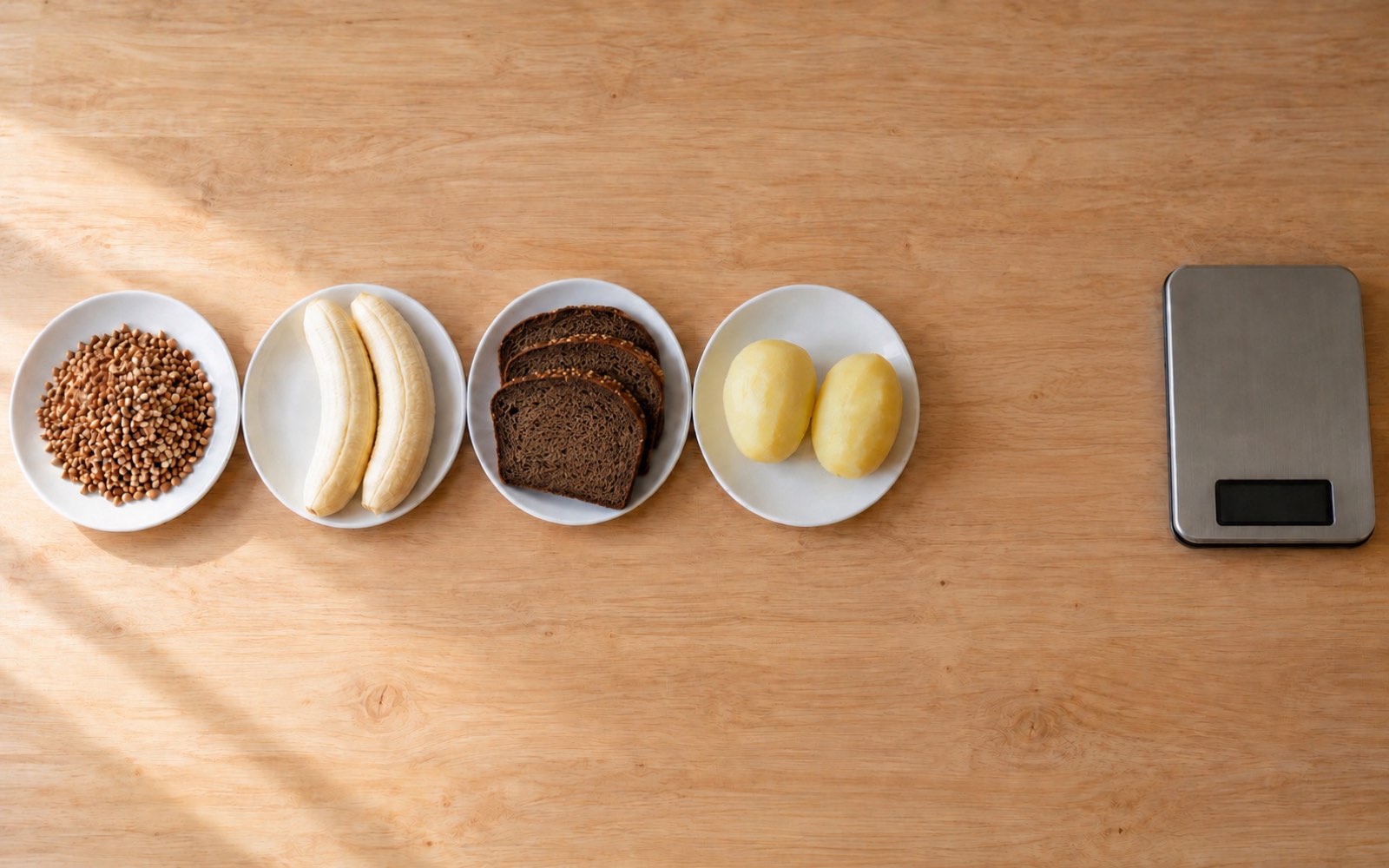
A day at 200 g of carbs might look like this: 80 g (2.8 oz) of dry buckwheat (about 51 g), two bananas (about 50 g), 125 g (4.4 oz) of dark rye bread (50 g) and 250 g (8.8 oz) of boiled potatoes (50 g). That's roughly what the 90 kg (198 lb) man on fat loss gets: 214 g in the table.
A day at 300 g, close to the 75 kg (165 lb) man's maintenance figure of 315 g:
- breakfast: 80 g (2.8 oz) of rolled oats and a banana, about 75 g;
- lunch: 70 g (2.5 oz) of dry rice and 100 g (3.5 oz) of dark rye bread, about 90 g;
- snack: an apple of about 180 g (6.3 oz) and 250 ml (8.5 fl oz) of kefir, about 35 g;
- dinner: 250 g (8.8 oz) of boiled potatoes, 50 g;
- with tea: 30 g (1 oz) of honey, about 24 g;
- one more banana during the day, about 25 g.
If you'd rather not add it up in your head, a food diary with a barcode scanner and a product database does the adding for you. The Sportygram app has both, with a database of about 101,000 products, though its interface is in Russian for now.
Are carbs bad for you, and what happens if you barely eat them
Carbs aren't harmful in themselves: at equal calories, weight comes off the same, and in an experiment where people ate as much as they wanted, they ate 689 fewer calories a day on the high-carb diet.
That experiment by Kevin Hall and colleagues was published in 2021. Twenty adults lived at a US National Institutes of Health clinic and spent two weeks each on two diets with no limits on how much they ate: a plant-based diet of mostly unprocessed foods with 75% of calories from carbs, and an animal-based ketogenic diet with almost no carbs, 10% of calories. On the first diet, people ate 689 fewer calories a day over the two weeks and 544 fewer over the final week. The idea that "carbs spike insulin and make you overeat" didn't hold up here. The study is small and short, so it's best read alongside the large reviews in section 05.
When carbs really do get in the way. Sugary drinks, pastries and sweets deliver a lot of calories and little fullness: a 500 ml (17 fl oz) bottle of cola is 53 g of sugar and more than 200 calories. One bottle a day on top of your normal food quietly adds up. Quality matters too: in the 2019 Reynolds reviews, people who ate more fiber and whole grains had less heart disease and type 2 diabetes. So the more useful question is which foods your carbs come from.
What happens if you barely eat carbs:
- First days: water leaves. According to the 2018 review by Murray and Rosenbloom, every gram of glycogen is stored with at least 3 g of water, and when glycogen is used up, the water leaves in your urine. If half the store goes, about 300 g of glycogen, at least 900 g of water goes with it, and the scale shows more than a kilogram (2.2 lb) lost. After a few days the fast loss stops, and when carbs come back, so does the water.
- First week: how you feel. Bostock and colleagues in 2020 analyzed 448 posts by 300 users of online forums about the so-called "keto flu". People most often wrote about feeling "like having the flu", headache, fatigue, nausea, dizziness and "brain fog". Complaints peaked in the first week, and after four weeks there were few left. These are forum accounts without clinical verification, so they can't tell us how common the complaints are.
- Training. Long, hard sessions run on glycogen, which is why the ACSM ties carb intake to hours of training. Without carbs, intervals and long cardio get harder. An ordinary strength session of up to 10 sets per muscle group, according to the Henselmans review, barely suffers.
- Weight. At the same calories, fat comes off almost the same as on a normal diet: by the Cochrane review, the difference is about a kilogram (2.2 lb) over 1–2 years.
When your doctor should set your carb intake
If you have diabetes, prediabetes or gestational diabetes, or you take blood-sugar-lowering medication, your carb intake is set together with your doctor. Your medication dose is matched to how you normally eat. If you cut or add carbs sharply, blood sugar can go too low or too high, so discuss any big change in your diet with the doctor who manages your diabetes first. The American Diabetes Association's 2019 consensus report (Evert and colleagues) says the same: there is no single ideal carb percentage for everyone with diabetes, the split is tailored to the person, and a sharp drop in carbs lowers blood sugar quickly, so insulin and medication doses have to be adjusted with a doctor.
The numbers in this article are only a reference point in these cases too:
- Pregnancy and breastfeeding. The Institute of Medicine minimum is 175 and 210 g a day, but your eating plan at this time is best built with your doctor.
- A teenager in sport. The guideline figures for teenagers are high, and cutting them for weight without a doctor isn't wise.
- Anxiety around food. If counting grams turns into fear, rules and binges, talk to a specialist. The 2014 Helms review notes separately that in sports where appearance matters, the risk of eating disorders is higher.
- A missed period, fainting, frequent dizziness on top of training and reduced food are reasons to see a doctor before cutting any further.
Questions and answers
Can you eat carbs at night?
Yes. Your weight depends on your calorie balance over the day, and a bowl of oats at 9 p.m. doesn't turn into fat on a schedule. The 2014 Helms review states that meal timing and frequency have little effect on fat loss and muscle retention. If a heavy late dinner keeps you from sleeping, move it earlier or make it smaller. You don't need to take the carbs out of it.
How many carbs a day should a woman eat to lose weight?
By our calculation in section 03, a woman weighing 58–75 kg (128–165 lb) with three workouts a week gets 155–168 g of carbs a day on fat loss, which is 2–3 g per kg (0.9–1.4 g per lb). For a more precise number, start from your calories: subtract protein at 1.6–2.0 g per kg and fat at 0.8–1 g per kg, and divide the remainder by 4. Don't go below 130 g without a doctor.
What is the minimum amount of carbs per day?
For an adult, 130 g a day under the US Institute of Medicine guidelines, a figure based on the brain's glucose needs. The 2022 Cochrane review defined low-carb diets as 50–150 g of carbs a day and very low-carb as under 50 g. Those are diets with their own special rules. Going below 130 g is something to do deliberately, and preferably with a doctor, especially if you have diabetes or take medication.
How many carbs per kg of body weight?
Training 3–4 times a week, aim for 3–5 g per kg (1.4–2.3 g per lb); training about an hour every day, 5–7 g per kg (2.3–3.2 g per lb); training 1–3 hours a day, 6–10 g per kg (2.7–4.5 g per lb). That's the 2016 ACSM position stand. On fat loss, by our calculation, it comes to 2–3 g per kg. Women and men need the same per kilogram: at 65 kg (143 lb) and 3–5 g per kg, that's 195–325 g a day.
What happens if you don't eat carbs for a week or a month?
In the first days, water leaves along with glycogen, and the scale shows a kilogram (2.2 lb) or more lost. In the first week, some people get headaches, fatigue and "brain fog": that's how forum users describe the "keto flu", and by week four the complaints usually ease. Long, hard workouts get harder. Fat, at the same calories, comes off almost the same as on a normal diet.
How do you know if you're not eating enough carbs?
For people who train, the hard work usually goes first: long cardio, intervals and high-volume gym sessions with more than 10 sets per muscle group. In the first days of a sharp cut, headaches and fatigue are common. If you feel dizzy, have fainted or your period has stopped, see a doctor. Cutting food further in that situation isn't an option.
How many carbs are in buckwheat, rice and a banana?
By the labels of popular brands, 100 g (3.5 oz) of dry buckwheat has 64 g of carbs, 100 g of dry short-grain rice 72 g, and 100 g of banana flesh 22.8 g. So 50 g of carbs is 78 g (2.8 oz) of dry buckwheat, 69 g (2.4 oz) of dry rice or about two bananas. Weigh grains dry: cooked grains absorb varying amounts of water, and the numbers per 100 g of cooked porridge vary widely.
What percentage of your calories should come from carbs?
The Russian guidelines say 56–58% of calories, the European ones 45–60%, the US ones 45–65%. But a percentage of different calorie totals gives different grams: 55% of 1,500 calories is 206 g, of 3,000 calories 412 g. That's why it's easier to count grams per kilogram or the remainder after protein and fat. In our calculation for four people, carbs took from 36% of calories on fat loss to 56% on muscle gain.
The bottom line
- An adult needs at least 130 g of carbs a day. Training 3–4 times a week, aim for 3–5 g per kg of body weight (1.4–2.3 g per lb); training about an hour every day, 5–7 g per kg.
- The recommendations differ because Russia and Europe count in percentages, the US adds a minimum in grams, and sports medicine works from body weight and hours of training.
- The easiest way to count carbs is as the remainder: calories minus protein and fat, divided by 4. On fat loss that gives 2–3 g per kg, and there's no need to cut carbs separately.
- At equal calories, a low-carb diet makes about a kilogram (2.2 lb) of difference over 1–2 years. Choose the split you can stick to.
- Keep free sugars under 10% of calories: at 2,000 calories that's 50 g, less than one 500 ml (17 fl oz) bottle of cola. Eat at least 25 g of fiber a day.
- The quick drop on the scale without carbs is water from glycogen, and it comes back with the carbs.
- With diabetes, in pregnancy and for teenagers in sport, carb intake is set with a doctor.
Checklist: how to calculate and keep your carb intake
- Work out your calorie target: resting metabolic rate from the Mifflin-St Jeor equation, an activity factor and your goal (minus 15% for fat loss, plus 10% for muscle gain).
- Subtract protein: 1.6–2.0 g per kg of body weight (0.7–0.9 g per lb), toward the top of the range on fat loss.
- Subtract fat: 0.8–1 g per kg (0.4–0.5 g per lb).
- Divide the remaining calories by 4: that's your carbs in grams.
- Check that it's at least 130 g.
- Check the sugar in your drinks: 10% of calories at 2,000 calories is 50 g.
- Get to 25 g of fiber with grains, legumes, vegetables and whole fruit.
- Weigh grains and pasta dry.
- After 3–4 weeks, compare your weekly average weight and adjust calories by 100–150 through carbs.
Sources
- Rospotrebnadzor. MR 2.3.1.0253-21 "Norms of physiological requirements for energy and nutrients for various population groups of the Russian Federation", 2021. — Carbs at 56–58% of calories, grams by sex, age and activity, figures for teenagers, added sugar limit of 10% (5% at a BMI of 25 and above), fiber 20–25 g, definitions of simple and complex carbs and the glycemic index.
- Institute of Medicine. Dietary Reference Intakes for Energy, Carbohydrate, Fiber, Fat, Fatty Acids, Cholesterol, Protein, and Amino Acids. National Academies Press, 2002/2005. — Minimum of 130 g of carbs (175 g in pregnancy, 210 g when breastfeeding), 45–65% of calories from carbs and 20–35% from fat, fiber 38 and 25 g, added sugar up to 25% of calories.
- World Health Organization. Guideline: Sugars intake for adults and children. WHO, 2015. — Free sugars under 10% of calories, ideally under 5% (about 25 g).
- World Health Organization. Carbohydrate intake for adults and children: WHO guideline. WHO, 2023. — Carbs from whole grains, vegetables, fruit and legumes; 400 g of vegetables and fruit and 25 g of fiber a day or more.
- European Food Safety Authority. EFSA sets European dietary reference values for nutrient intakes. EFSA, 2010. — Carbs at 45–60% of calories, 25 g of fiber, no sugar limit set.
- Thomas D. T., Erdman K. A., Burke L. M. American College of Sports Medicine Joint Position Statement. Nutrition and Athletic Performance. Medicine & Science in Sports & Exercise, 2016. — Carbs at 3–12 g per kg by hours of training, protein 1.2–2.0 g per kg, spreading carbs between sessions.
- Murray B., Rosenbloom C. Fundamentals of glycogen metabolism for coaches and athletes. Nutrition Reviews, 2018. — Glycogen stores in muscle and liver, the brain's share of glucose, at least 3 g of water per gram of glycogen.
- Henselmans M., Bjørnsen T., Hedderman R., Vårvik F. T. The Effect of Carbohydrate Intake on Strength and Resistance Training Performance: A Systematic Review. Nutrients, 2022. — 49 studies: up to 10 sets per muscle group, in a fed person, extra carbs add almost nothing to strength.
- Naude C. E. et al. Low-carbohydrate versus balanced-carbohydrate diets for reducing weight and cardiovascular risk. Cochrane Database of Systematic Reviews, 2022. — 61 trials, 6,925 people: a weight difference of about 1 kg.
- Gardner C. D. et al. Effect of Low-Fat vs Low-Carbohydrate Diet on 12-Month Weight Loss in Overweight Adults and the Association With Genotype Pattern or Insulin Secretion: The DIETFITS Randomized Clinical Trial. JAMA, 2018. — 609 people, one year: −5.3 and −6.0 kg, difference not significant.
- Hall K. D. et al. Effect of a plant-based, low-fat diet versus an animal-based, ketogenic diet on ad libitum energy intake. Nature Medicine, 2021. — On the 75%-carb diet, people ate 689 fewer calories a day than on the ketogenic one.
- Helms E. R., Aragon A. A., Fitschen P. J. Evidence-based recommendations for natural bodybuilding contest preparation: nutrition and supplementation. Journal of the International Society of Sports Nutrition, 2014. — Calories, protein and fat on a cut, carbs as the remainder; meal timing has little effect on fat loss; eating disorder risk.
- Reynolds A. et al. [Carbohydrate quality and human health: a series of systematic reviews and meta-analyses](https://doi.org/10.1016/S0140-6736(18)31809-9). The Lancet, 2019. — 185 observational and 58 clinical studies: the highest fiber intakes carry a 15–30% lower risk of death and several diseases, strongest at 25–29 g a day.
- Bostock E. C. S. et al. Consumer Reports of "Keto Flu" Associated With the Ketogenic Diet. Frontiers in Nutrition, 2020. — 448 posts by 300 forum users: complaints in the first weeks without carbs, peaking in week one; low level of evidence.
- Hall K. D., Guo J. Obesity Energetics: Body Weight Regulation and the Effects of Diet Composition. Gastroenterology, 2017. — 32 controlled-feeding studies at equal calories: on the lower-fat diet, energy expenditure 26 calories a day higher, fat loss 16 g a day greater.
- Iraki J., Fitschen P., Espinar S., Helms E. Nutrition Recommendations for Bodybuilders in the Off-Season: A Narrative Review. Sports, 2019. — For muscle gain: a 10–20% surplus, protein 1.6–2.2 g per kg, fat 0.5–1.5 g per kg, the rest carbs, at least 3–5 g per kg.
- Mountjoy M. et al. 2023 International Olympic Committee's (IOC) consensus statement on Relative Energy Deficiency in Sport (REDs). British Journal of Sports Medicine, 2023. — Relative energy deficiency in women and men; the growing role of low carbohydrate intake.
- Evert A. B. et al. Nutrition Therapy for Adults With Diabetes or Prediabetes: A Consensus Report. Diabetes Care, 2019. — No single ideal carb percentage in diabetes; when carbs go down, insulin and medication doses are adjusted by a doctor.
- Mifflin M. D. et al. A new predictive equation for resting energy expenditure in healthy individuals. The American Journal of Clinical Nutrition, 1990. — The resting metabolic rate equation used for the calories in our calculation table; 498 people.
This article is for informational purposes only and is not a substitute for medical advice.