

sugar cravings usually come from short sleep, long gaps between meals, too little protein, stress and habit, and for women the days before a period. After a short night, people eat on average 385 extra calories a day. The idea that cravings come from a lack of chromium, magnesium or vitamins is not supported by research.What to do: a protein breakfast, 7 or more hours of sleep, one planned sweet portion of about 150 calories and a brisk 15-minute walk when a craving hits. See a doctor if cravings come with thirst, frequent urination, unexplained weight loss, or episodes of shakiness, a racing heart and intense hunger.
You keep craving sweets most often because you're short on sleep, go too long without eating, don't get enough protein, live under stress or have been eating sugar at the same moments for years. For women, the days before a period add to that. Wanting something sweet is ordinary: in a 1991 survey by Weingarten and Elston, 97% of female students and 68% of male students admitted to cravings for specific foods, and chocolate topped the list. Below: the causes with numbers, what your body is really missing, when to see a doctor and a step-by-step plan.
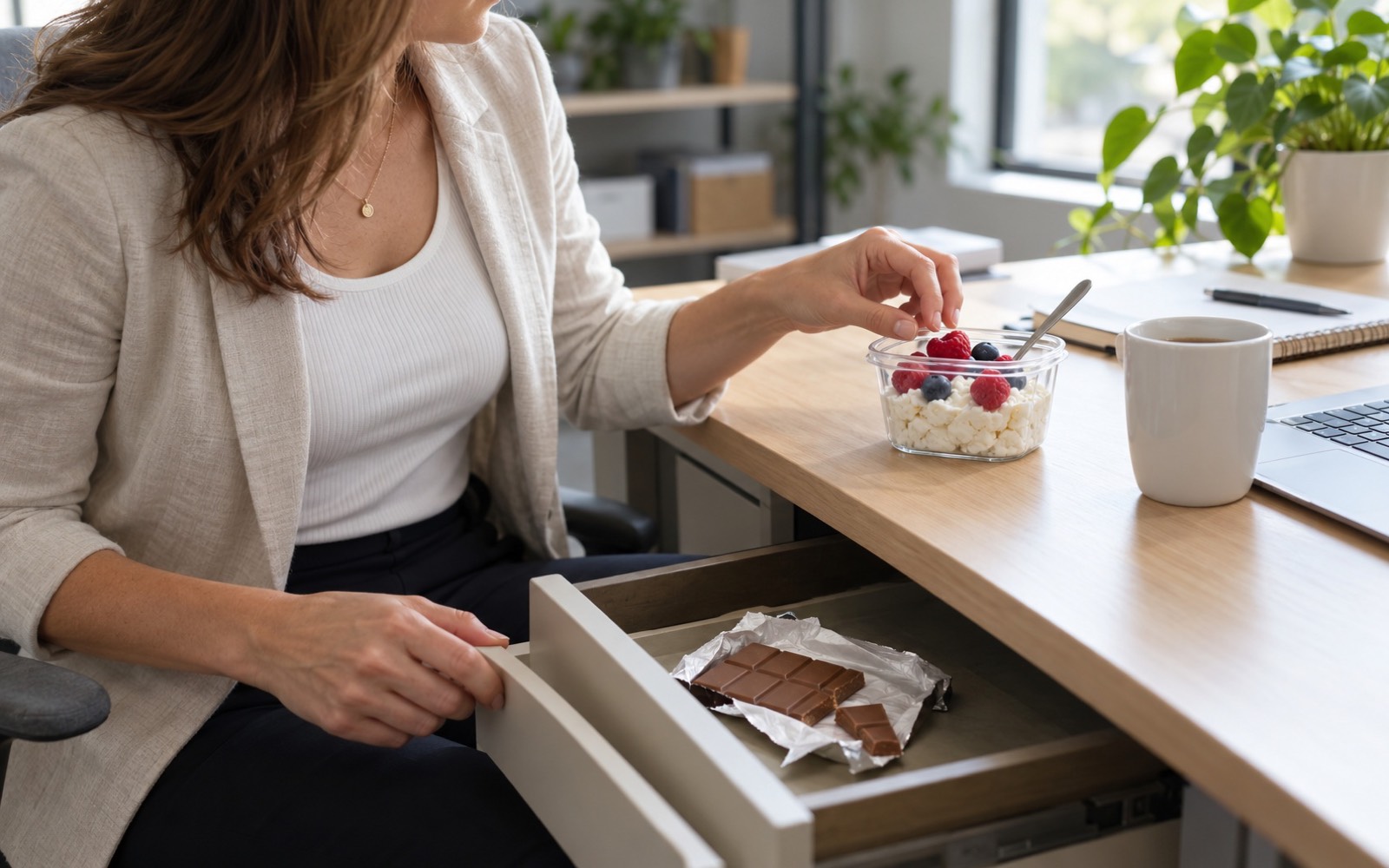
Why am I craving sweets? The short answer
You crave sweets because sugar is fast energy and fast pleasure, and it's the first thing you want when you're short on food, sleep or rest. Your brain is about 2% of your body weight but uses about 20% of your oxygen and calories, according to Raichle and Gusnard's 2002 review. Hill, in a 2007 review, describes a craving as an intense desire for a specific food, tied to pleasure. The idea that "the body lacks a nutrient, so it asks for it" loses out, in his conclusion, to a more complex picture where the main roles belong to learned cues, intrusive thoughts about forbidden food and low mood.
Telling hunger from a craving is simple:
- hunger builds gradually, and you'd eat anything, even plain chicken and rice;
- a craving hits suddenly, you want one specific taste, and ordinary food doesn't close it.
Usually two or three causes work at once: hunger (section 03), short sleep (04), stress (05), habit (06), for women the cycle (07), and more rarely illness (08).
What your body is lacking when you crave sweets
Most often it's lacking food, protein, sleep and rest. The theories about chromium, magnesium and vitamins are popular, but the research doesn't back them up.
| Theory | What's been tested | What to do |
|---|---|---|
| Chromium | not proven essential for humans, no EU requirement | no need for a "chromium test" over cravings |
| Magnesium | in a 1999 review only one possible theory, never tested | check your diet |
| Iron | low iron makes people crave ice and dirt, no link to sweets found | if you feel weak, get a blood count and ferritin |
| Vitamins | the "craving = nutrient gap" theory isn't supported | a "craving-control complex" is unlikely to help |
| Protein | craved foods are twice as calorie-dense as regular food and lower in protein | protein breakfast |
| Calories | a deficit of 12 or more weeks lowers cravings, banning a food is linked to more of it | plan your sweets |
| Sleep | two short nights: appetite for calorie-dense carbs up 33–45% | 7 hours or more |
Chromium. The European Food Safety Authority (EFSA) concluded in 2014 that chromium hasn't been proven essential for humans, that no requirement can be set and that no benefit is seen in healthy people. The Russian guidelines MR 2.3.1.0253-21 do give a figure: 40 mcg a day. In Anton and colleagues' 2008 trial, 42 overweight women with carbohydrate cravings took chromium picolinate or a placebo for 8 weeks. On chromium they ate less, felt less hungry and craved fatty food less, but a drop in sugar cravings isn't among the results. In Docherty and colleagues' 2005 trial of 113 adults with atypical depression, chromium didn't beat placebo on the main measures, and a difference on individual scale items, including carbohydrate craving, showed up only in a secondary analysis. We don't prescribe supplements, so decide on them with your doctor.
Magnesium. Bruinsma and Taren, in a 1999 review, named taste as the main reason for chocolate cravings: fat, sugar, texture, aroma. "Self-medicating" a magnesium shortfall is mentioned there only as a possible theory, and we found no convincing test of it. The same Russian guidelines put the adult requirement at 420 mg a day, and the foods with milligrams per serving are in our magnesium guide.
Iron. Iron deficiency can cause pica, a craving for non-food items like dirt or clay. Borgna-Pignatti and Zanella, in a 2016 review, write that it's most common in pregnant women and in children before their teens, and usually goes away after iron treatment. In Barton and colleagues' 2010 study of 262 adults who needed iron infusions, 45% had pica, and for 87% of them it was a craving to chew ice. Sweets aren't a non-food item, and we found no studies linking sugar cravings to low iron. If you feel weak, get short of breath or crave ice, get a complete blood count and a ferritin test, which shows your iron stores.
Vitamins. Orloff and Hormes, in a 2014 review, examined the "craving = nutrient gap" theory using data on pregnant women and found little support for it. Hill in 2007 reached the same conclusion for cravings in general.
Hunger and a deficit that's too steep
If you go a long time without eating or sit on a harsh diet, you crave the most calorie-dense food, and sweet and fatty things are first in line. Gilhooly and colleagues, in 2007, followed 32 overweight women aged 20–42 through six months of dieting. Even before the diet began, the foods they craved were more than twice as calorie-dense as their usual diet, 3.7 calories per gram versus 1.7, higher in fat and lower in protein and fiber. The more prone a woman was to hunger, the more often cravings struck. And the women who lost the most weight were the ones who kept craving calorie-dense food but gave in to it less often.
When a deficit lasts 12 or more weeks, cravings weaken. Kahathuduwa and colleagues, in 2017, pooled 8 studies in people with obesity where the deficit was held for 12 or more weeks. Food cravings dropped, and cravings for sweets dropped more than for fatty, starchy or fast food. The authors put it down to getting out of the habit. What can strengthen cravings, according to Hill, are diets built on constant restraint and bans on specific foods: trying to give up a food completely is linked to a stronger craving for that very food.
What this means for you: keep the deficit moderate, without hours-long gaps that leave you ready to eat everything in sight by evening. In the Sportygram app (the interface is in Russian), your profile calculates a calorie target from your stats and goal, and the food diary shows how much you've eaten for the day. If your total is regularly well below target and you crave cookies at night, add food during the day first.
Short sleep: the most underrated cause
After short nights, your hunger hormones shift and you crave calorie-dense, carb-heavy food. In Spiegel and colleagues' 2004 experiment, 12 healthy men around 22 years old spent two nights with short sleep and two with long sleep on identical food. After the short nights, leptin, the fullness hormone, fell by 18%, ghrelin, the hunger hormone, rose by 28%, hunger rose by 24%, and appetite for calorie-dense, high-carb food rose by 33–45%.
Al Khatib and colleagues, in 2017, turned that into calories. Their review included 17 studies (496 people), 11 of which had enough data for a meta-analysis: after short sleep, people ate on average 385 more calories a day while burning the same amount. They also ate more fat and less protein. By the median in our food database, 385 calories is about 70 g (2.5 oz) of milk chocolate, more than two-thirds of a large bar, and that's for every day of short sleep.
It works the other way too. In the same group's 2018 pilot study, 42 adults used to sleeping 5–7 hours either got sleep-hygiene advice or carried on as usual for 4 weeks. The advice group spent 55 more minutes in bed, slept 21 minutes longer and, with no dieting at all, ate 9.6 g less free sugar a day, a bit over two teaspoons. In the control group, sugar went up by 0.7 g.
An adult needs 7 or more hours of sleep: that's the 2015 consensus of the American Academy of Sleep Medicine and the Sleep Research Society (Watson and colleagues), which links short sleep to weight gain and diabetes. That's where "I'm always craving sweets and I'm always tired" comes from: plain short sleep is often behind it. If sleepiness and cravings stick around for weeks together with low mood, see section 08. How to get to bed earlier and fall asleep faster is in our sleep hygiene guide.
Stress, fatigue and low mood
Under stress, many people eat more calorie-dense food, including sweets, and for some this link is especially strong. Epel and colleagues, in 2001, put 59 healthy premenopausal women through a stressful day and a calm day in the lab. Those whose cortisol, the stress hormone, responded more strongly to stress ate more calories on the stressful day and ate more sweets on both days. Hill, Conner and colleagues, in a 2022 meta-analysis (54 studies, 119,820 people), showed that stress is linked to more unhealthy food and less healthy food, though the effect is small.
When a craving has already hit, two tricks help, and both have been tested in studies:
- A brisk 15-minute walk. Taylor and Oliver, in 2009, asked 25 chocolate lovers to go without it for three days and compared a day with a brisk 15-minute walk to a day without one. After the walk, chocolate cravings were weaker, and blood pressure rose less in response to stress and to an unwrapped bar. Ledochowski and colleagues repeated the experiment in 2015 with 47 overweight people: cravings for sugary snacks dropped, including under stress and at the sight of sweets.
- 3 minutes of a busy mind. Skorka-Brown and colleagues, in 2015, surveyed 31 students 7 times a day for a week. Those who played Tetris for 3 minutes when a craving struck felt it on average 13.9 points weaker on a 0–100 scale, and it kept working all week. It wasn't just food, either: it worked on cravings for coffee, cigarettes and alcohol. The point is to occupy your eyes and attention, for instance with a simple game on your phone.
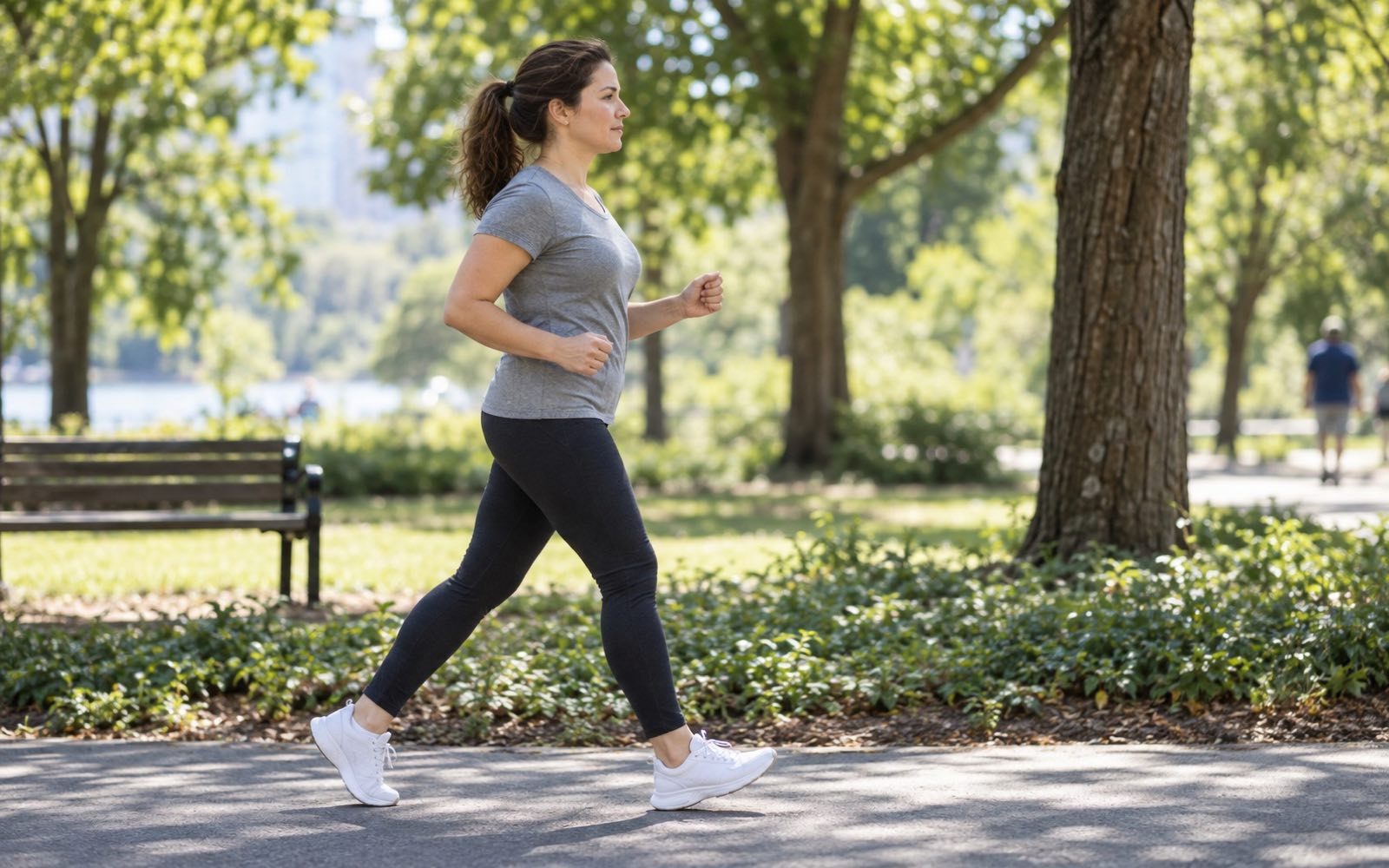
Habit: why you crave sweets after eating, in the evening and at night
If sugar has shown up at the same time for years, your brain starts expecting it on cue: coffee, the end of lunch, a TV show. Hill calls the response to such learned cues one of the main mechanisms of craving. Drink coffee with a cookie at 3 p.m. for five years, and eventually the ritual itself sets off the craving.
After a meal there's also satiety for one taste: once you've had enough of salty and savory food, interest in it drops while interest in sweets stays. Rolls and colleagues described this in 1981 as sensory-specific satiety. And if lunch was small or low in protein, you simply haven't eaten enough.
The moment a craving hits points to the cause:
| When it hits | Likely cause | First step |
|---|---|---|
| In the morning, right after waking | a short night | protein breakfast, bed an hour earlier |
| 1–2 hours after breakfast | too little protein at breakfast | eggs, cottage cheese or yogurt in the morning |
| At 3–4 p.m. | a long gap, the "coffee and cookie" ritual | a snack with protein |
| After lunch or dinner | satiety for one taste, habit | a portion on a plate instead of the package |
| In the evening in front of a screen | not enough food during the day, fatigue | a bigger dinner |
| At night | a small dinner, short sleep, with diabetes low blood sugar | with night sweats and nightmares, see a doctor |
| Before a period | the last days of the cycle (late luteal phase) | about 170 calories added to the plan |
| On a stressful day | the stress response | a brisk 15-minute walk |
| After a workout | energy spent, long since you ate | eat soon after training |
You can see your own pattern in a week of notes. A food diary works for this: after a week you can see which hours sweets show up in and which row of the table to start with.
Sugar cravings in women: before a period, in pregnancy, after 40 and 50
Before a period, appetite and sugar cravings really do rise. In the American BioCycle study (published in 2016), 259 women aged 18–44 were followed for up to two cycles: in the last days before a period, the late luteal phase, their appetite rose and their cravings for chocolate, sweets and salty food grew. Tucker and colleagues, in a 2025 meta-analysis (15 datasets, 330 women of normal weight), calculated that in the second half of the cycle women eat on average 168 more calories a day. That's about 31 g (1.1 oz) of milk chocolate. The number is rough, because the studies were run in different ways. And only 32% of female students in Weingarten's survey linked their cravings to the cycle.
What this means for you: build 150–170 calories into your plan for those days, for instance one portion from the table in section 10. That way the extra appetite doesn't turn into a binge.
In pregnancy, cravings rise too: Orloff and Hormes call it the second such period in a woman's life. Explanations based on hormones and nutrient gaps hold up weakly in their review; cultural and psychological reasons hold up better. Discuss nutrition during pregnancy and breastfeeding with the doctor who's looking after you.
After 40 and 50. Hormes and Rozin, in 2009, compared women before and after menopause. About half of American women get chocolate cravings, and roughly half of those get them before a period. If hormones alone were the reason, cravings would be 38% less common after menopause, but they were only 13.4% less common. The authors conclude that hormones aren't the main cause, so you can work on cravings after 50 the same way as at 30. If your waist grows with age, that's a separate reason to check your blood sugar: by the Russian guidelines MR 2.3.1.0253-21, a waist over 35 in (88 cm) in women and over 40 in (102 cm) in men raises the risk of type 2 diabetes (section 08).
For men. In the same student survey, 68% of men admitted to cravings for specific foods, and the causes in men are the same, just without the cycle. Children and teens whose cravings appear together with thirst, frequent urination or weight loss need to see a pediatrician.
When sugar cravings are a reason to see a doctor
On their own, sugar cravings aren't considered a disease. See your doctor if they appear together with thirst, frequent urination, unexplained weight loss, severe fatigue, or episodes of shakiness, a racing heart and intense hunger.
Diabetes. The World Health Organization, in its 2024 fact sheet, lists the signs: intense thirst, frequent urination, blurred vision, fatigue, unexplained weight loss. Sugar cravings aren't on the list. Type 2 diabetes can show only mild signs for years. In 2022 it affected 14% of adults worldwide.
"Shaky and craving sugar." That's how people describe low blood sugar. The US National Institute of Diabetes and Digestive and Kidney Diseases (NIDDK) lists its signs: shakiness, hunger, fatigue, dizziness, confusion, irritability, a fast or irregular heartbeat, headache. During sleep it's nightmares, sweating through your clothes, and waking up tired and irritable. For many people with diabetes, low blood sugar means below 70 mg/dL, about 3.9 mmol/L. If you're being treated for diabetes, discuss these episodes with your doctor. If you don't have diabetes and the episodes keep coming back, see your primary care doctor.
| What you notice | Who to see | What's usually checked |
|---|---|---|
| Thirst, frequent urination, unexplained weight loss | primary care doctor or endocrinologist | fasting glucose, HbA1c (average blood sugar over three months) |
| Episodes of shakiness, a racing heart and intense hunger | your treating doctor or primary care | blood sugar during an episode, treatment plan |
| Weakness, shortness of breath, craving ice | primary care doctor | complete blood count, ferritin |
| Cravings for weeks together with low mood and sleepiness | primary care doctor or therapist | at the doctor's discretion |
| Binge episodes with loss of control | therapist | eating behavior |
Carb cravings also show up in atypical depression: a person is low and at the same time eats more and sleeps more. On the scale used to assess these patients in Docherty's trial, carbohydrate craving is a separate item. Normal ranges for glucose and HbA1c are covered in insulin resistance explained. Chromium tests, "micronutrient panels" and parasite screening for cravings alone aren't needed: we found no research linking sugar cravings to any of them.
How to stop sugar cravings: a step-by-step plan
Start with what gives the most: eat without long gaps, add protein at breakfast, get enough sleep and keep sweets to one planned portion.
- A week of notes. Write down when you wanted something sweet, where you were, what came right before it and how hungry you were on a scale of 1 to 10.
- A protein breakfast. Leidy and colleagues, in 2013, gave 20 overweight girls around 19 years old who usually skipped breakfast 350-calorie breakfasts: one with 35 g of protein from eggs and beef, the other with 13 g from cereal. After the protein breakfast, fullness was higher, ghrelin was lower, and only that breakfast cut evening snacking on fatty food compared with days without breakfast. 200 g (7 oz) of cottage cheese gives about 32 g of protein by the median in our database.
- No long gaps. Close a big gap between lunch and dinner with a protein snack: cottage cheese, yogurt, kefir, nuts.
- An extra hour of sleep. Set a "time for bed" reminder an hour before your current bedtime. In Al Khatib's experiment, people with sleep advice added almost an hour to their time in bed.
- One portion of about 150 calories. Pick it from the table in section 10 and eat it off a plate after a meal. On a 2,000-calorie diet that's 7.5% of calories.
- When it hits, walk or play first. Walk briskly for 15 minutes or play a simple game for 3 minutes. If you still want it afterward, calmly eat your portion.
- Out of sight. Put the candy dish in a cupboard and leave fruit or cottage cheese where you'd see it.
- Less sugar, but gradually. Wise and colleagues, in 2016, asked participants to replace 40% of their calories from simple sugars with fat, protein and complex carbs for 3 months. By the third month, the same vanilla pudding tasted about 40% sweeter to them than to the control group, and they liked it just as much. The sample was small, 13 people, but the takeaway is clear: your palate adjusts to less sugar in two to three months.
keep a ready-made sweet swap with protein in the fridge: cottage cheese with berries, Greek yogurt with cocoa or a couple of squares of dark chocolate. When a craving hits out of nowhere, grabbing something ready beats cooking.
What not to do:
- A total ban. According to Hill, trying to ban a food is linked to a stronger craving for that very food. According to Westwater and colleagues' 2016 review, addiction-like overeating of sugar in animals shows up when access to it comes and goes. The "ban, then binge" loop in people looks like that, though it hasn't been tested directly.
- Sweeteners in everything. As a transition they're fine. But if you sweeten everything, you get an intensely sweet taste every day, and your palate most likely has nothing to adjust to. What's known about the sweeteners themselves is in are artificial sweeteners bad for you.
- Food as a reward. "I worked out, I earned the cake" turns training into payment for dessert. Reward yourself with a walk, a book or an extra hour of sleep.
How much sugar is OK per day and what fits in 150 calories
The WHO advises keeping added sugar below 10% of calories: on 2,000 calories that's up to 50 g (about 12 teaspoons) a day. In its 2015 guideline, 10% is a strong recommendation, and going down to 5% (about 25 g, or 6 teaspoons) is a conditional one. The Russian guidelines MR 2.3.1.0253-21 set the same 10% ceiling, and 5% for people with excess weight or obesity. The WHO counts as free sugars any sugar added to food and drinks, plus the sugar in honey, syrups and juice. The sugar in fresh fruit and vegetables and the natural sugar in milk don't count. For these targets, a spoonful of honey is the same sugar as table sugar.
We calculated what fits in 150 calories from our food database: 32,238 products from five Russian supermarket chains, nutrition from the labels, the median across 13–430 products per row (4 for bananas), cottage cheese and yogurt without fillings, calculated on 23.09.2026.
| Sweet | Calories per 100 g (3.5 oz) | 150 calories is | Protein, g | Carbs, g |
|---|---|---|---|---|
| Milk chocolate | 548 | 27 g (1 oz), a quarter of a large bar | 2.0 | 14 |
| Dark chocolate 70–85% | 544 | 28 g (1 oz) | 2.4 | 9 |
| Chocolate candies | 539 | 28 g (1 oz) | 1.8 | 14 |
| Hard candy | 380 | 39 g (1.4 oz) | 0 | 37 |
| Zefir (Russian marshmallow) | 330 | 45 g (1.6 oz) | 0.5 | 36 |
| Pastila (fruit paste) | 312 | 48 g (1.7 oz) | 0.5 | 37 |
| Gummy candy | 333 | 45 g (1.6 oz) | 1.3 | 35 |
| Gingerbread | 370 | 41 g (1.4 oz) | 2.2 | 30 |
| Cookies | 460 | 33 g (1.2 oz) | 2.1 | 21 |
| Wafers | 520 | 29 g (1 oz) | 1.9 | 17 |
| Sunflower halva | 542 | 28 g (1 oz) | 3.6 | 12 |
| Ice cream | 244 | 61 g (2.2 oz) | 2.2 | 15 |
| Glazed cheese curd bar | 390 | 38 g (1.3 oz) | 3.1 | 13 |
| Chocolate bar (candy bar) | 497 | 30 g (1.1 oz) | 2.1 | 18 |
| Protein bar | 345 | 44 g (1.6 oz) | 10.9 | 4 |
| Dates | 300 | 50 g (1.8 oz) | 1.2 | 36 |
| Honey | 324 | 46 g (1.6 oz) | 0.4 | 37 |
| Cottage cheese 5% | 121 | 124 g (4.4 oz) | 19.8 | 4 |
| Greek yogurt | 70 | 214 g (7.5 oz) | 16.1 | 9 |
| Banana | 92 | about 160 g (5.6 oz) | 2.1 | 34 |
| Apple | 49 | about 300 g (10.6 oz) | 1.2 | 30 |
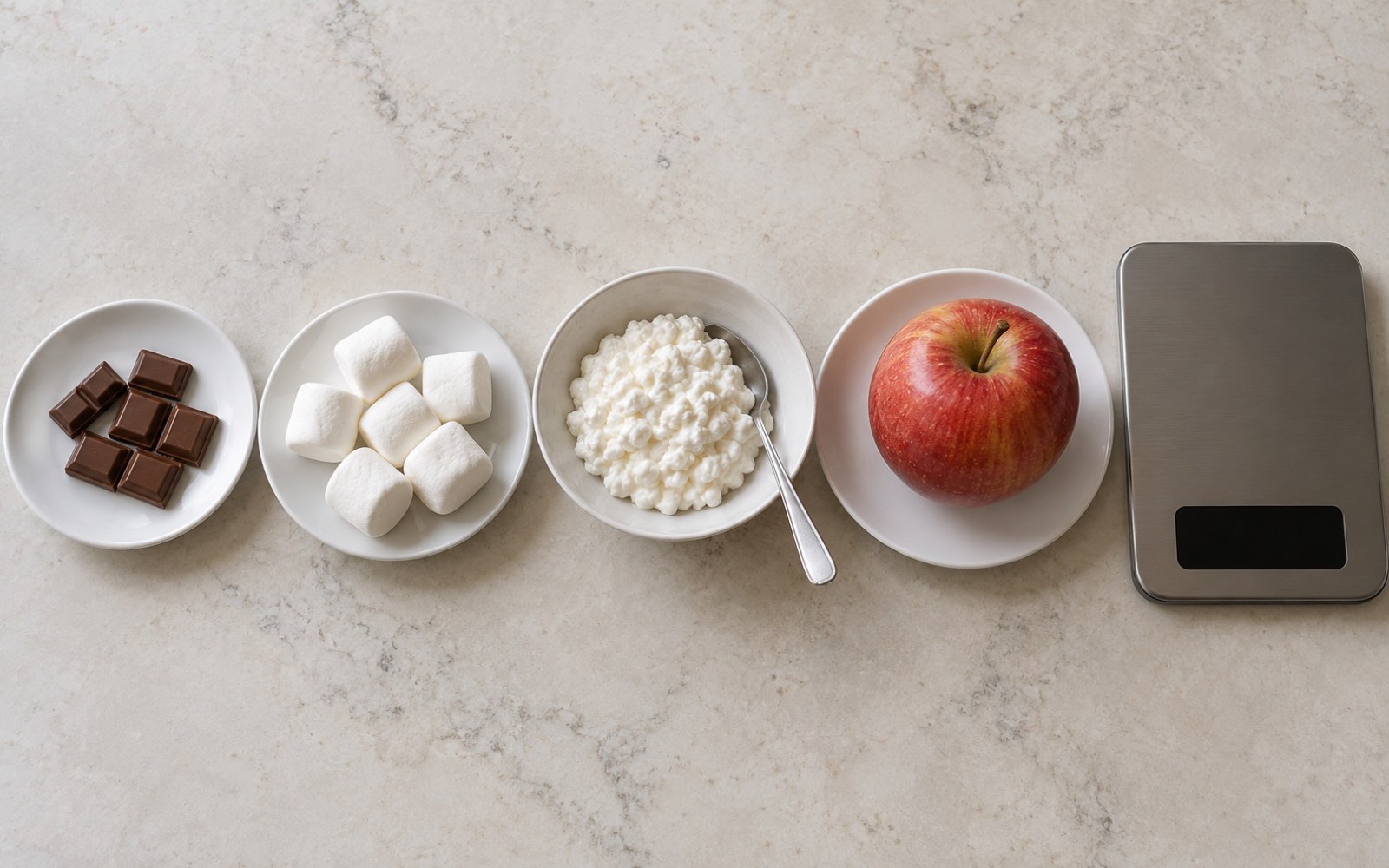
The table shows that 150 calories of chocolate, wafers, halva or a candy bar is a piece of 27–30 g (about 1 oz). You get 45–48 g of zefir, gummies, pastila or honey, but that's 35–37 g of carbs, almost all of it sugar, which is more than the 25 g the WHO considers a good target for the whole day. Classic sweets have 0–4 g of protein per portion, Greek yogurt about 16 g, cottage cheese about 20 g. The apple gives the biggest portion, about 300 g, and the WHO doesn't count the sugar in fresh fruit as free sugar.
Sweet combinations with protein for the same 150 calories:
- cottage cheese 5% 90 g (3.2 oz) and 100 g (3.5 oz) frozen strawberries: 149 calories, 15 g protein;
- Greek yogurt 150 g (5.3 oz) and 10 g dark chocolate: 159 calories, 12 g protein;
- kefir 1% 250 g (8.8 oz), 5 g cocoa and 100 g (3.5 oz) berries: 149 calories, 9.5 g protein;
- dates 20 g and cottage cheese 5% 75 g (2.6 oz): 151 calories, 12.5 g protein;
- apple 150 g (5.3 oz) and 15 g peanut butter: 162 calories, 4 g protein.
Where hidden sugar lives and how to cut it is in how to eat less sugar.
Questions and answers
What vitamin deficiency causes sugar cravings?
Most likely none. No vitamin explains sugar cravings in the research: Hill, in his 2007 review, writes that the "craving as a signal of a nutrient gap" theory loses out to explanations based on learned cues and mood. More often you're short on food, protein and sleep. Details in section 02.
Why do I crave sweets right after eating?
Two things are at work: sensory-specific satiety, which Rolls and colleagues described in 1981, and the habit of a "sweet finish". If lunch was small or low in protein, you also simply haven't eaten enough. A solid lunch with protein and a portion measured out on a plate ahead of time both help.
Why do I crave sugar in the evening and at night?
In the evening it's not enough food during the day, fatigue and the habit of eating in front of a screen; at night it's a dinner that was too small or short sleep. If you have diabetes and you get nightmares, sweat through your clothes or wake up tired and irritable, NIDDK says that can be low blood sugar during sleep. That needs a conversation with your doctor.
Why do I crave sweet and salty food before my period?
In the BioCycle study, in the last days before a period, 259 women had higher appetite and stronger cravings for chocolate, sweets and salty food. According to the 2025 meta-analysis, in the second half of the cycle women eat on average 168 more calories a day. The easiest fix is to build 150–170 calories into your plan for those days ahead of time.
Are sugar cravings a sign of diabetes?
On their own, no: cravings aren't on the WHO's list of diabetes signs. The signs are intense thirst, frequent urination, blurred vision, fatigue and unexplained weight loss. If you have those, see your doctor and get a fasting glucose test and HbA1c.
Is sugar addiction real?
In humans the evidence is thin. Westwater and colleagues, in a 2016 review, write that addiction-like overeating of sugar in animals appears only with intermittent access, when sugar is given and then taken away. In people, the "ban, binge, guilt, new ban" loop looks similar, though it hasn't been tested directly. If binge episodes with loss of control keep happening, it's worth seeing a therapist.
Is it OK to eat something sweet every day?
Yes, as long as added sugar stays below 10% of calories, as the WHO and the Russian guidelines MR 2.3.1.0253-21 advise: on 2,000 calories that's up to 50 g, and by the WHO's conditional recommendation, better under 25 g. A handy measure is one portion of about 150 calories, for example 27 g (1 oz) of milk chocolate or 45 g (1.6 oz) of zefir.
Why do I crave sweets when I quit smoking?
We found no studies specifically on sugar cravings after quitting, but weight gain has been measured precisely. Aubin and colleagues, in a 2012 meta-analysis of 62 studies, showed that people who quit without treatment gain on average 1.1 kg (2.4 lb) in a month, 2.9 kg (6.4 lb) in 3 months and 4.7 kg (10.4 lb) in a year. At the same time, 16% of them lose weight over the year, and 13% gain more than 10 kg (22 lb). Going back to cigarettes over weight isn't the answer; the plan in section 09 helps.
The bottom line
- Most people get cravings for specific foods. Constant sugar cravings usually come from two or three causes.
- Most often you're short on food during the day, protein in the morning and sleep at night. Research doesn't support chromium, magnesium or vitamin shortfalls as a cause of cravings.
- Short sleep adds on average 385 calories a day; in the second half of the cycle women eat 168 more calories.
- A brisk 15-minute walk or 3 minutes of a simple game weakens a craving in the moment.
- A planned portion of about 150 calories a day works better than a total ban.
- Thirst, frequent urination, unexplained weight loss, or episodes of shakiness, a racing heart and intense hunger are a reason to see a doctor.
Checklist: a week against sugar cravings
- For a week, write down when and after what you crave sweets, and find your rows in the table in section 06.
- Start the day with a protein breakfast.
- Put a protein snack where the cookie with your coffee used to be.
- Go to bed an hour earlier so you sleep 7 hours or more.
- Eat one 150-calorie portion of something sweet, off a plate.
- When a craving hits, first walk briskly for 15 minutes or play for 3 minutes.
- Put sweets out of sight and keep cottage cheese with berries in the fridge.
- With thirst, frequent urination, weight loss or shaky episodes, book a doctor's appointment.
Sources
- Weingarten H. P., Elston D. Food cravings in a college population. Appetite, 1991. — Survey of more than 1,000 students: cravings for specific foods in 97% of women and 68% of men; 32% of women linked them to the cycle.
- Raichle M. E., Gusnard D. A. Appraising the brain's energy budget. PNAS, 2002. — The brain: about 2% of body weight and about 20% of oxygen and calories.
- Hill A. J. The psychology of food craving. Proceedings of the Nutrition Society, 2007. — Cravings, cues, bans.
- EFSA NDA Panel. Scientific Opinion on Dietary Reference Values for chromium. EFSA Journal, 2014. — No chromium requirement.
- Anton S. D. et al. Effects of chromium picolinate on food intake and satiety. Diabetes Technology & Therapeutics, 2008. — Chromium in 42 women: less food, hunger and fat craving.
- Docherty J. P. et al. A double-blind, placebo-controlled, exploratory trial of chromium picolinate in atypical depression: effect on carbohydrate craving. Journal of Psychiatric Practice, 2005. — 113 adults: chromium no better than placebo on main measures; carbohydrate craving only in a secondary analysis.
- Bruinsma K., Taren D. L. Chocolate: food or drug? Journal of the American Dietetic Association, 1999. — Where the magnesium theory comes from.
- Borgna-Pignatti C., Zanella S. Pica as a manifestation of iron deficiency. Expert Review of Hematology, 2016. — Iron and ice cravings.
- Barton J. C., Barton J. C., Bertoli L. F. Pica associated with iron deficiency or depletion: clinical and laboratory correlates in 262 non-pregnant adult outpatients. BMC Blood Disorders, 2010. — Pica in 45% of 262 adults with iron deficiency, ice craving in 87% of them.
- Orloff N. C., Hormes J. M. Pickles and ice cream! Food cravings in pregnancy. Frontiers in Psychology, 2014. — Review: hormone and nutrient-gap theories of pregnancy cravings hold up weakly.
- Rospotrebnadzor. MR 2.3.1.0253-21 "Norms of physiological requirements for energy and nutrients for various population groups of the Russian Federation", 2021. — Russian guidelines: added sugar up to 10% of calories (5% with excess weight), chromium 40 mcg, magnesium 420 mg, waist circumference thresholds of 88 cm (35 in) for women and 102 cm (40 in) for men.
- Gilhooly C. H. et al. Food cravings and energy regulation: the characteristics of craved foods and their relationship with eating behaviors and weight change during 6 months of dietary energy restriction. International Journal of Obesity, 2007. — Which foods people crave on a diet.
- Kahathuduwa C. N. et al. Extended calorie restriction suppresses overall and specific food cravings: a systematic review and a meta-analysis. Obesity Reviews, 2017. — Cravings during a long deficit.
- Spiegel K. et al. Sleep curtailment in healthy young men is associated with decreased leptin levels, elevated ghrelin levels, and increased hunger and appetite. Annals of Internal Medicine, 2004. — Leptin and ghrelin.
- Al Khatib H. K. et al. The effects of partial sleep deprivation on energy balance: a systematic review and meta-analysis. European Journal of Clinical Nutrition, 2017. — 17 studies in the review, 11 in the meta-analysis: plus 385 calories a day.
- Al Khatib H. K. et al. Sleep extension is a feasible lifestyle intervention in free-living adults who are habitually short sleepers. American Journal of Clinical Nutrition, 2018. — Minus 9.6 g of sugar.
- Watson N. F. et al. Recommended Amount of Sleep for a Healthy Adult: A Joint Consensus Statement of the American Academy of Sleep Medicine and Sleep Research Society. Journal of Clinical Sleep Medicine, 2015. — 7 hours or more.
- Epel E. et al. Stress may add bite to appetite in women: a laboratory study of stress-induced cortisol and eating behavior. Psychoneuroendocrinology, 2001. — Cortisol and sweets.
- Hill D. et al. Stress and eating behaviours in healthy adults: a systematic review and meta-analysis. Health Psychology Review, 2022. — Stress and food.
- Taylor A. H., Oliver A. J. Acute effects of brisk walking on urges to eat chocolate, affect, and responses to a stressor and chocolate cue. An experimental study. Appetite, 2009. — Walking and chocolate.
- Ledochowski L. et al. Acute effects of brisk walking on sugary snack cravings in overweight people. PLoS One, 2015. — Walking and sugary snacks.
- Skorka-Brown J. et al. Playing Tetris decreases drug and other cravings in real world settings. Addictive Behaviors, 2015. — Minus 13.9 points.
- Rolls B. J. et al. Sensory specific satiety in man. Physiology & Behavior, 1981. — Satiety for one taste.
- Gorczyca A. M. et al. Changes in macronutrient, micronutrient, and food group intakes throughout the menstrual cycle in healthy, premenopausal women. European Journal of Nutrition, 2016. — BioCycle.
- Tucker J. A. L. et al. The Effect of the Menstrual Cycle on Energy Intake: A Systematic Review and Meta-analysis. Nutrition Reviews, 2025. — Plus 168 calories.
- Hormes J. M., Rozin P. Perimenstrual chocolate craving. What happens after menopause? Appetite, 2009. — 13.4% instead of 38%.
- World Health Organization. Diabetes — fact sheet, 2024. — Signs of diabetes.
- NIDDK. Low Blood Glucose (Hypoglycemia). — Low blood sugar in diabetes.
- Leidy H. J. et al. Beneficial effects of a higher-protein breakfast on the appetitive, hormonal, and neural signals controlling energy intake regulation in overweight/obese, "breakfast-skipping", late-adolescent girls. American Journal of Clinical Nutrition, 2013. — 35 g of protein at breakfast: more fullness, lower ghrelin, less evening snacking on fatty food.
- Wise P. M. et al. Reduced dietary intake of simple sugars alters perceived sweet taste intensity but not perceived pleasantness. American Journal of Clinical Nutrition, 2016. — The palate and sugar.
- World Health Organization. Guideline: sugars intake for adults and children, 2015. — 10% and 5% of calories.
- Westwater M. L., Fletcher P. C., Ziauddeen H. Sugar addiction: the state of the science. European Journal of Nutrition, 2016. — Sugar addiction.
- Aubin H.-J. et al. Weight gain in smokers after quitting cigarettes: meta-analysis. BMJ, 2012. — 62 studies: weight gain at 1, 3 and 12 months after quitting.
- Sportygram food database: 32,238 products from five Russian supermarket chains, median nutrition from labels, cottage cheese and yogurt without fillings, calculated 23.09.2026. — The "150 calories" table and the conversion of calories into grams of chocolate.
This article is for informational purposes only and is not a substitute for medical advice.