

insulin resistance is the step before prediabetes — your blood sugar is still normal, but only because your body makes extra insulin. Tests: fasting glucose, hemoglobin A1c, fasting insulin and HOMA-IR. Under WHO and Russian guidelines, normal fasting glucose from a vein is below 6.1 mmol/L (110 mg/dL); under US guidelines, prediabetes starts at 5.6 mmol/L (100 mg/dL). HOMA-IR is not a diagnosis: in a study of 2,459 people, the cutoff came out anywhere from 1.85 to 3.46, depending on how it was calculated. What helps: losing 5–7% of your weight, 150 minutes of activity a week, strength training 2–3 times a week and a 10-minute walk after meals — a similar program cut diabetes risk by 58%. If you're very thirsty, urinating often or losing weight without trying, see your primary care doctor and get your blood sugar checked within a few days.
Insulin resistance means your muscles, liver and fat tissue don't respond well to insulin. Your pancreas has to release more of it to keep your blood sugar in range. It's not diabetes yet: your blood sugar can stay normal for years. You can't feel it, so it takes fasting blood tests to find it, and your doctor should interpret the numbers. What you can do now: lose 5–7% of your body weight, get 150 minutes of activity a week, strength train 2–3 times a week and get enough sleep. In a 2002 study of 3,234 people with elevated blood sugar — the US Diabetes Prevention Program — a similar program cut the risk of type 2 diabetes by 58%.

Insulin resistance in plain English: the key, the lock and extra insulin
After you eat, sugar enters your blood and your pancreas releases insulin. Insulin works like a key. It unlocks the cells of your muscles, liver and fat tissue, and sugar moves inside to be burned for energy or stored. Muscle takes up the most sugar of any tissue: a 2009 review by DeFronzo and Tripathy in Diabetes Care puts muscle's share of insulin-driven glucose uptake at around 80%.
With insulin resistance, the lock sticks. The key is the same, but the door is harder to open. Your pancreas makes up for it by releasing more insulin, so your blood sugar stays normal. This can go on for years without you noticing anything.
Think of it as a four-step scale:
- good sensitivity: your body needs only a little insulin;
- insulin resistance: blood sugar is normal, but insulin is higher than usual;
- prediabetes: the pancreas can no longer fully keep up, and fasting glucose or A1c is above normal;
- type 2 diabetes: blood sugar stays high.
You can move along this scale in both directions. In a 2016 randomized trial by Magkos and colleagues, losing just 5% of body weight improved insulin sensitivity in the liver, muscle and fat tissue. The American Diabetes Association's 2016 position statement on physical activity adds that strength training and aerobic exercise improve how well insulin works even without weight loss. So this is a reason to act.
Insulin resistance symptoms and signs: who should get tested
Insulin resistance has no symptoms of its own: everyone gets sleepy after lunch or craves sweets now and then. Risk factors from the 2026 ADA Standards of Care and Russia's 2023 national diabetes guidelines are a better guide:
- a BMI of 25 or higher;
- a parent, brother or sister with type 2 diabetes;
- blood pressure of 130/80 or higher by US standards, or 140/90 or higher by Russian guidelines, or taking blood pressure medication;
- "good" cholesterol (HDL) of 0.9 mmol/L (35 mg/dL) or lower, or triglycerides above 2.8 mmol/L (250 mg/dL);
- polycystic ovary syndrome (PCOS);
- diabetes during a past pregnancy;
- little physical activity;
- age: US standards advise checking blood sugar in everyone from age 35, and Russian guidelines count age 45 and older as a risk factor.
The ADA rule of thumb: excess weight plus at least one item from this list is a reason to check your blood sugar. If the result is normal, repeat the test at least every 3 years. With prediabetes, repeat it every year.
There's also a visible sign that the standards link directly to insulin resistance: dark, velvety patches of skin on the neck and in the armpits (acanthosis nigricans). If you have patches like these, show them to your doctor. People often ask about soft skin tags on the neck too, but on their own they don't prove anything.
Insulin resistance can also happen at a normal weight: fat can build up around your belly, in your liver and in your muscles. If your weight is normal but your waist keeps growing, that's also a reason to get your blood sugar checked. We explain why belly fat goes last and what to do about it in a separate article.
When to see a doctor right away, and which one
See a primary care doctor within the next few days and get your blood sugar tested if you notice:
- strong thirst and frequent urination;
- weight loss without trying;
- blurry vision.
These can mean your blood sugar is already high, so don't put it off.
Talk to a doctor before you change your diet or exercise if:
- you're pregnant or planning a pregnancy;
- you had diabetes in a past pregnancy;
- your periods have become irregular.
A child or teenager should see a pediatrician or a pediatric endocrinologist: this article is for adults. If you take steroids (glucocorticoids) or other drugs that raise blood sugar, don't stop anything on your own.
Start with your primary care doctor, who can refer you to an endocrinologist. If your periods are irregular, an OB-GYN or an endocrinologist is the right place to go.
Which blood tests to get for insulin resistance and how to prepare
Your doctor decides which tests you need. The list usually includes:
- fasting glucose from a vein;
- hemoglobin A1c: your average blood sugar over about 2–3 months;
- fasting insulin and HOMA-IR, which is calculated from glucose and insulin;
- if your doctor thinks you need them: a lipid panel (cholesterol and triglycerides) and an oral glucose tolerance test, where blood is drawn while you're fasting and again 2 hours after you drink a solution with 75 g of glucose.
How to prepare:
- "Fasting" means 8–14 hours without food. Water is fine.
- Don't get tested while you're acutely sick: infection, injury and severe stress can temporarily raise blood sugar.
- Skip a very hard workout the day before.
- For 3 days before a glucose tolerance test, eat as usual, with at least 150 g of carbs a day. A low-carb diet can skew the result.
- Tell your doctor about your medications: glucocorticoids, thyroid hormones, some diuretics and some blood pressure pills affect blood sugar.
- You don't need to fast for an A1c test, but anemia and iron supplements can affect it.

How to read your lab results: normal ranges for glucose, A1c and HOMA-IR
A US lab report usually says "normal: 70–99 mg/dL." A lab in another country may print "3.9–6.1 mmol/L," which works out to about 70–110 mg/dL. Neither is a mistake. WHO and Russia's national guidelines set impaired fasting glucose at 6.1 mmol/L (110 mg/dL). Since 2003, the American Diabetes Association has started prediabetes at 5.6 mmol/L (100 mg/dL), and it notes that the WHO cutoff is higher. Cutoffs for fingerstick blood are lower than for blood drawn from a vein. Go by the range printed on your own report.
To convert glucose, multiply mmol/L by 18 to get mg/dL.
| On your report | What it is | Cutoffs | What to ask your doctor |
|---|---|---|---|
| Fasting glucose from a vein | Blood sugar after a night without food | WHO and Russia: normal below 6.1 mmol/L (110 mg/dL); 6.1–6.9 (110–125) is impaired fasting glucose; 7.0 (126) or higher is diabetes. US: 5.6–6.9 mmol/L (100–125 mg/dL) is prediabetes | "Which standard does my report use? Do I need a glucose tolerance test?" |
| Fasting glucose from a fingerstick (lab test) | Sugar in whole blood | Russia: normal below 5.6 mmol/L (100 mg/dL); 5.6–6.0 (100–109) is impaired fasting glucose; 6.1 (110) or higher is diabetes | "Should I redo it with blood from a vein?" |
| Hemoglobin A1c, % | Average blood sugar over 2–3 months | Russia: normal up to 6.0%; above 6.0% but below 6.5% isn't a diagnosis on its own, but calls for more glucose testing; 6.5% or higher is diabetes. US: 5.7–6.4% is prediabetes | "When should I retest?" |
| Glucose 2 hours after 75 g of glucose | How your body handles a dose of sugar | Below 7.8 mmol/L (140 mg/dL) is normal; 7.8–11.0 (140–199) is impaired glucose tolerance; 11.1 (200) or higher is diabetes | "Do I need this test?" |
| Fasting insulin | How much insulin it takes to hold your blood sugar | Each lab sets its own range, printed on the report | "My insulin is high but glucose is normal. What does that mean for me?" |
| HOMA-IR | Fasting glucose in mmol/L × fasting insulin in µIU/mL ÷ 22.5 (with glucose in mg/dL, divide by 405) | The lab's cutoff is on the report. In a study of 2,459 adults: 1.85 to 3.46 | "What does my score say together with my waist, blood pressure and cholesterol?" |
| CARO index | Glucose ÷ insulin. The scale runs backward: lower is worse | The lab's cutoff is on the report | Same question as for HOMA-IR |
| Triglycerides and HDL | Blood fats that often change along with insulin sensitivity | Triglycerides above 2.8 mmol/L (250 mg/dL) or HDL of 0.9 mmol/L (35 mg/dL) or lower is a diabetes risk factor | "Does this add up to metabolic syndrome?" |
An example. Glucose is 5.2 mmol/L (about 94 mg/dL) and insulin is 12 µIU/mL. HOMA-IR: 5.2 × 12 ÷ 22.5 = 2.77. On a report with a cutoff of 2.7, that's "above normal." In a 2013 Spanish study by Gayoso-Diz and colleagues of 2,459 adults, the cutoff for metabolic syndrome risk came out at 2.05, and 1.85 for men without diabetes. If "high" means higher than in 90% of people, the cutoff is 3.46. So the same 2.77 can be "high" or "normal," depending on where you draw the line.
The formula itself is an approximation. Matthews and colleagues proposed it in 1985 in Diabetologia as a simple stand-in for a far more complex reference method, and even then the authors flagged its low precision: a coefficient of variation of about 31%.
That's why HOMA-IR is not a diagnosis. Prediabetes and diabetes are diagnosed by glucose, A1c and the glucose tolerance test. HOMA-IR isn't among those criteria. A doctor looks at it together with your waist, blood pressure and blood fats.
What causes insulin resistance
Usually several causes add up:
- excess weight, especially fat around the belly and internal organs;
- little muscle and little movement, so sugar has nowhere to go;
- extra calories day after day, especially from sugary drinks: a 2015 meta-analysis by Imamura and colleagues, pooling 17 cohorts, found each daily serving of a sugar-sweetened drink raised the risk of type 2 diabetes by 18%, and the link held even after adjusting for body weight (13%);
- chronic lack of sleep and stress: a 2022 meta-analysis by Sondrup and colleagues, covering 21 randomized trials, found that restricting sleep lowered insulin sensitivity on both the glucose tolerance test and HOMA-IR;
- age: after 40, you lose muscle unless you strength train;
- polycystic ovary syndrome;
- genetics;
- some medications, such as glucocorticoids.
You can't change your genes or your age. You can start working on the rest this week.
What actually helps with insulin resistance, and what doesn't
The table shows what works, how much you need and how we know.
| Method | What it does | How much | How we know |
|---|---|---|---|
| Weight loss | The main lever: even a 5% loss improves insulin sensitivity in the liver, muscle and fat tissue | 5–7% of your starting weight, no crash diets | Russian national guidelines (source 1), Diabetes Prevention Program (source 3), Magkos 2016 trial (source 12) |
| Movement plus weight loss | Type 2 diabetes risk down by 58% | 150 minutes a week, no more than 2 days in a row without activity | Diabetes Prevention Program (source 3), ADA exercise position statement (source 4) |
| Strength training | Muscles take up sugar with insulin's help: the more muscle, the easier it is | 2–3 times a week, not on back-to-back days | ADA exercise position statement (source 4) |
| Walking after meals | Blood sugar after meals 12% lower, and 22% lower after dinner, than with one 30-minute walk | 10 minutes after each main meal | Reynolds 2016 study of 41 people with type 2 diabetes (source 5) |
| Breaking up sitting | Lower blood sugar after meals | Light activity every 30 minutes | ADA exercise position statement (source 4) |
| Low-carb diet, including keto | Weight loss is about the same as on a balanced diet with the same calorie deficit | Not required: pick the one you can stick with | Naude 2022 Cochrane review of 61 studies (source 13), DIETFITS 2018 study of 609 people (source 6) |
| Metformin | Diabetes risk down by 31%, less than lifestyle changes | Only if your doctor prescribes it | Diabetes Prevention Program (source 3) |
| Fasting and extreme food restriction | Russian national guidelines advise against them | Not needed | Russian national guidelines (source 1) |
| Vitamins and supplements | In diabetes, no proven benefit unless you're deficient | Only for a confirmed deficiency or if your doctor prescribes them | Russian national guidelines (source 1) |
The key number comes from the US Diabetes Prevention Program. For almost 3 years, one group worked on losing 7% of their weight and moving 150 minutes a week, another took metformin, and a third took a placebo. Lifestyle changes cut new cases of diabetes by 58%. The pill cut them by 31%.
After prolonged exercise, your muscles take up sugar faster: by the ADA's 2016 position statement, for about 2 hours even without insulin, and for up to 48 hours with its help. That's why moving a little every day does more than one big workout on the weekend. The easiest step is walking: in a 2016 New Zealand study by Reynolds and colleagues of 41 people with type 2 diabetes, 10 minutes after each meal lowered blood sugar after meals more than 30 minutes at once.
As for diets: in the yearlong 2018 DIETFITS study of 609 adults, people on a low-carb diet lost 6.0 kg (13.2 lb), and people on a lower-fat diet lost 5.3 kg (11.7 lb). A gap that small could be due to chance, and how much insulin people released at the start didn't predict which diet would suit them either. A 2022 Cochrane review by Naude and colleagues pooled 61 trials with 6,925 people, with and without type 2 diabetes: over 1–2 years, low-carb diets, including very strict ones at 50 g of carbs a day or less, lost about 1 kg more than balanced diets in people without diabetes and about 0.3 kg more in people with diabetes, a difference the authors called small to none. So the keto diet is optional: the diet that works is the one that lets you stay in a calorie deficit for months.
start with one habit. For two weeks straight, take a 10-minute walk after dinner. In the Reynolds study, the payoff was biggest after dinner: blood sugar after that meal was 22% lower than with a single 30-minute walk.
Insulin resistance diet: what to eat and a sample day
There's no list of banned foods, just a few rules.
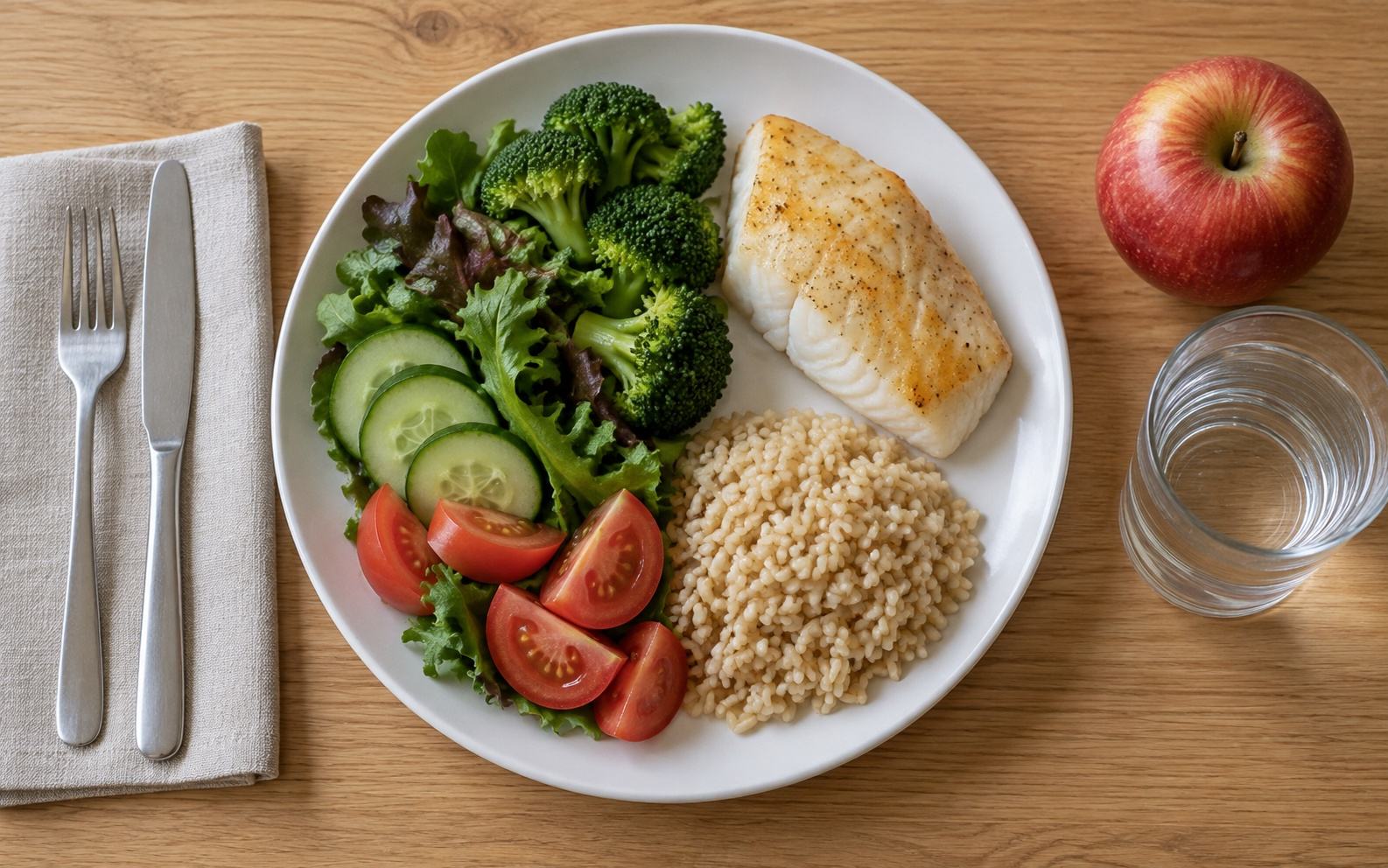
- Your plate: half vegetables, a quarter protein and a quarter grains, bread or potatoes.
- Cut sugary drinks and juice first: they're fast sugar that doesn't fill you up.
- Eat fruit whole. Juice has no fiber, so its sugar hits your blood faster.
- Protein at every meal: cottage cheese or farmer's cheese, eggs, fish, chicken, beans and lentils.
- Whole grains: buckwheat, brown rice, oatmeal. Whether you also need to watch the glycemic index is a separate question.
- Calories decide your weight: start by learning how to calculate a calorie deficit.
Common "can I eat" questions:
- Rice is fine. Brown rice is better because it has more fiber. A portion is a fist-sized scoop of cooked rice.
- Farmer's cheese is fine. 100 g (3.5 oz) of 5% fat farmer's cheese (tvorog) has 16 g of protein and 117 kcal.
- Watermelon is fine. A 300 g portion (about 2 cups diced) has about 80 kcal and 17 g of carbs.
- Sweets are fine, just not every day, and in small portions.
- How many meals a day: there's no strict rule. Three meals, plus a snack if you get hungry in between, is an easy pattern to follow.
A sample day at 1,590 kcal, based on the Sportygram food database:
- Breakfast, 425 kcal. Rolled oats 50 g (dry, about 1/2 cup), 5% farmer's cheese 150 g (5.3 oz), 1 small apple (150 g). Protein 32 g.
- Lunch, 530 kcal. Buckwheat 60 g (dry, about 1/3 cup), chicken breast 150 g (raw, 5.3 oz), broccoli 200 g (7 oz), whole-grain bread 40 g (1 slice). Protein 51 g.
- Snack, 193 kcal. 1% kefir 250 g (about 1 cup), walnuts 15 g (about 0.5 oz). Protein 10 g.
- Dinner, 440 kcal. Cod 200 g (raw, 7 oz), brown rice 50 g (dry, about 1/4 cup), sauerkraut 100 g (about 2/3 cup), olive oil 10 g (about 2 tsp). Protein 39 g.
Daily total: 132 g protein, 44 g fat, 170 g carbs. This is an example: your own calorie target may be different.
Strength training and walking for insulin resistance: a minimum program
The American Diabetes Association's 2016 position statement on physical activity calls for strength training 2–3 times a week, not on back-to-back days: 1–3 sets of 10–15 reps, with the last reps feeling hard. The full version there lists 8–10 exercises, but you can start with six from our app that cover all the major muscles:
- Dumbbell squat. Thighs and glutes; hold the dumbbells at your chest or at your sides.
- Dumbbell Romanian deadlift. Hamstrings and glutes, with a flat back.
- Step-ups onto a box. Thighs and glutes, one leg at a time, which also trains balance.
- Bent-over dumbbell row. Back muscles.
- Push-ups. Chest and arms; do them from your knees for the first few weeks.
- Plank. Core muscles, 3 holds of 20–40 seconds.
No dumbbells? Do bodyweight squats and glute bridges. Every 2–3 weeks, add reps or weight. If you've never done strength training, start with our guide to strength training for beginners.
Walking complements strength training. Aim for 150 minutes of activity a week, with no more than two days in a row off. Short walks after meals make that easy: three 10-minute walks a day add up to 210 minutes a week. If you work at a desk, get up every 30 minutes. In bad weather, take the stairs or walk on a treadmill set to an incline.
Insulin resistance in women: periods, PCOS, pregnancy and after 40
For women, three situations call for a doctor before anything else.
Polycystic ovary syndrome. US standards list PCOS as a diabetes risk factor, so it's worth checking your blood sugar. Irregular periods, excess facial hair, acne and weight gain are reasons to see an OB-GYN or an endocrinologist. Check with your doctor before trying inositol.
Pregnancy. If you're pregnant or planning a pregnancy, a doctor should set your diet and activity. If you had diabetes in a past pregnancy, the advice is to check your blood sugar at least every 3 years for the rest of your life.
After 40. Without strength training, you lose a little muscle every year, and during menopause fat tends to settle around the belly. Russian national guidelines count age 45 and older as a risk factor. That's why after 40, strength training matters even more.
A 12-week plan and when to retest
- Week 0. Weigh yourself three mornings in a row, and measure your waist and blood pressure. Get the labs your doctor orders.
- Weeks 1–2. Swap sugary drinks for water or unsweetened tea. Walk for 10 minutes after dinner. Go to bed 30 minutes earlier.
- Weeks 3–4. Add two strength sessions a week and protein at every meal. Take a walk after lunch too.
- Weeks 5–8. Do 2–3 strength sessions a week and build your walking up to 150 minutes a week. Eat at a modest calorie deficit, with no crash diets.
- Weeks 9–12. Move up to heavier dumbbells. Goal: 5% off your starting weight and a waist an inch or two smaller.
- After 3 months. Retest if your doctor thinks you should. A1c reflects your blood sugar over 2–3 months, so there's little point in retesting it sooner.
If you track the plan in the Sportygram app, your food diary shows your protein and calories against your target, and your workout log shows every exercise with a photo. Put the two strength workouts on Tuesday and Friday, and check them off as you go. Reading lab results and prescribing medication stay with your doctor.
FAQ
How is insulin resistance different from type 2 diabetes?
With insulin resistance, your pancreas keeps up: it releases more insulin, and blood sugar stays normal. When it can't keep up anymore, fasting glucose or A1c rises above normal. That's prediabetes. Type 2 diabetes means fasting glucose from a vein of 7.0 mmol/L (126 mg/dL) or higher, or A1c of 6.5% or higher. A doctor makes the diagnosis based on repeat tests.
Can insulin resistance be cured completely?
You can get a lot of your insulin sensitivity back, especially at an early stage. That takes losing 5–7% of your weight, regular movement, strength training and sleep. But the tendency stays: go back to your old weight and a sedentary life, and your insulin will start rising again. So plan on habits you keep for the long run.
What does a high HOMA-IR mean?
It means that at your glucose level, your body is using more insulin than many people need. But there's no single cutoff: labs set their own, and the 2013 Spanish study by Gayoso-Diz came up with anything from 1.85 to 3.46. One number is not a diagnosis. A doctor looks at HOMA-IR together with glucose, A1c, waist, blood pressure and blood fats, and decides whether you need more tests.
Can you lose weight with insulin resistance without medication?
Yes. You lose weight in a calorie deficit. In a one-year study of 609 adults with excess weight, a low-carb diet and a lower-fat diet gave similar results, and how much insulin people released at the start didn't predict which one would work better. What you need is a moderate deficit without crash diets, protein at every meal, strength training and patience. Medication is a separate decision for your doctor, and you can lose weight without it.
Do I need metformin or inositol?
That's your doctor's call: metformin needs a prescription, and inositol is worth discussing with your doctor first. In the Diabetes Prevention Program, lifestyle changes cut diabetes risk by 58%, and metformin cut it by 31%. If you're prescribed a drug, you still need the diet, strength training and sleep. Inositol mostly comes up with PCOS, where an OB-GYN or endocrinologist can tell you whether it makes sense.
Can thin people and men have insulin resistance?
Yes. At a normal weight, fat can still build up around the belly, in the liver and in muscles, especially if you have little muscle and barely move. Men tend to store fat around the belly, so a growing waist at the same weight is a reason to check your blood sugar. Other risk factors are the same for men and women, except PCOS and diabetes during pregnancy.
The bottom line
- Insulin resistance means your cells respond poorly to insulin, and your blood sugar stays normal only thanks to extra insulin. It's not diabetes yet.
- Tests: fasting glucose from a vein, A1c, fasting insulin and HOMA-IR. Fasting means 8–14 hours without food. Don't get tested while you're sick.
- Normal ranges differ: fasting glucose below 6.1 mmol/L (110 mg/dL) under WHO and Russian guidelines, and below 5.6 mmol/L (100 mg/dL) under US guidelines. HOMA-IR is not a diagnosis, and its cutoffs range from 1.85 to 3.46.
- What helps: losing 5–7% of your weight, 150 minutes of movement a week, strength training 2–3 times a week, walking after meals and sleep. Keto is optional, and crash diets aren't needed.
- Strong thirst, frequent urination or weight loss without trying: see your primary care doctor and get your blood sugar checked within a few days.
Checklist: the first 4 weeks
- Weigh yourself three mornings in a row, and measure your waist and blood pressure.
- Write down your questions for the doctor, and get the labs they order: fasting, and not while you're sick.
- Swap sugary drinks and juice for water or unsweetened tea.
- Walk for 10 minutes after dinner, and after lunch too from week three.
- Go to bed 30 minutes earlier so you get enough sleep.
- From week three, do two strength sessions a week with the six exercises.
- Add protein to every meal and log your food in a food diary.
Sources
- Dedov I. I., Shestakova M. V., Mayorov A. Yu. (eds.) Standards of specialized diabetes care, 11th edition. Diabetes Mellitus, 2023. — Russia's national diabetes guidelines: glucose and A1c cutoffs, how to prepare for tests, risk factors; 5–7% weight loss for prediabetes.
- American Diabetes Association. 2. Diagnosis and Classification of Diabetes: Standards of Care in Diabetes — 2026. Diabetes Care, 2026. — Prediabetes cutoffs, the note on the WHO cutoff, risk factors.
- Knowler W. C. et al. Reduction in the incidence of type 2 diabetes with lifestyle intervention or metformin. New England Journal of Medicine, 2002. — 3,234 people over 2.8 years: lifestyle changes cut new cases of diabetes by 58%, metformin by 31%.
- Colberg S. R. et al. Physical Activity/Exercise and Diabetes: A Position Statement of the American Diabetes Association. Diabetes Care, 2016. — Strength training 2–3 times a week, 150 minutes of activity, breaking up sitting every 30 minutes.
- Reynolds A. N. et al. Advice to walk after meals is more effective for lowering postprandial glycaemia in type 2 diabetes mellitus than advice that does not specify timing. Diabetologia, 2016. — 41 people: with 10-minute walks after meals, blood sugar after meals was 12% lower than with 30 minutes at once.
- Gardner C. D. et al. Effect of Low-Fat vs Low-Carbohydrate Diet on 12-Month Weight Loss in Overweight Adults and the Association With Genotype Pattern or Insulin Secretion: The DIETFITS Randomized Clinical Trial. JAMA, 2018. — 609 adults over one year: 5.3 kg and 6.0 kg lost, a non-significant difference; insulin secretion didn't predict which diet worked better.
- Gayoso-Diz P. et al. Insulin resistance (HOMA-IR) cut-off values and the metabolic syndrome in a general adult population: effect of gender and age: EPIRCE cross-sectional study. BMC Endocrine Disorders, 2013. — 2,459 adults: HOMA-IR cutoffs of 3.46, 2.05 and 1.85, depending on how the cutoff was chosen.
- DeFronzo R. A., Tripathy D. Skeletal muscle insulin resistance is the primary defect in type 2 diabetes. Diabetes Care, 2009. — Skeletal muscle accounts for about 80% of insulin-stimulated glucose uptake.
- Matthews D. R. et al. Homeostasis model assessment: insulin resistance and beta-cell function from fasting plasma glucose and insulin concentrations in man. Diabetologia, 1985. — The original description of HOMA-IR; the authors themselves flagged low precision, with a coefficient of variation of about 31%.
- Imamura F. et al. Consumption of sugar sweetened beverages, artificially sweetened beverages, and fruit juice and incidence of type 2 diabetes: systematic review, meta-analysis, and estimation of population attributable fraction. BMJ, 2015. — 17 cohorts: each daily serving of a sugary drink was linked to an 18% higher risk of type 2 diabetes, 13% after adjusting for body weight.
- Sondrup N. et al. Effects of sleep manipulation on markers of insulin sensitivity: A systematic review and meta-analysis of randomized controlled trials. Sleep Medicine Reviews, 2022. — A meta-analysis of 21 randomized trials: restricting sleep lowers insulin sensitivity on both the glucose tolerance test and HOMA-IR.
- Magkos F. et al. Effects of Moderate and Subsequent Progressive Weight Loss on Metabolic Function and Adipose Tissue Biology in Humans with Obesity. Cell Metabolism, 2016. — A randomized trial: a 5% weight loss improved insulin sensitivity in fat tissue, the liver and muscle.
- Naude C. E. et al. Low-carbohydrate versus balanced-carbohydrate diets for reducing weight and cardiovascular risk. Cochrane Database of Systematic Reviews, 2022. — 61 trials, 6,925 people: the weight difference between low-carb and balanced diets over 1–2 years was about 1 kg in people without diabetes and about 0.3 kg in people with type 2 diabetes, which the authors judged small to none.
This article is for informational purposes only and does not replace medical advice.