

elbows shoulder-width apart, upper arms fixed and tilted back toward your head by 10–15°, and the bar travels behind your head to about the crown. In Maeo's 2023 study, the triceps grew 1.4 times more when the arm was raised overhead: +19.9% in volume versus +13.9% with the arm at the side over 12 weeks, even though the working weight overhead was 34–39% lighter. Bench press alone isn't enough for the triceps: in Brandão's 2020 study, the group that only benched didn't reach significant triceps growth, and its long head grew noticeably less than in the groups that did skull crushers.Starting point: 3 kg (6.5 lb) dumbbells for women and 6 kg (13 lb) for men, 3 sets of 10, twice a week, with 2–3 reps left in the tank. Over our 8-week plan, training volume per session grows by 75–100%.
A skull crusher is a triceps extension done lying on a bench: you bend and straighten your elbows with a weight while your upper arm, the part of your arm between your shoulder and your elbow, stays still. You hold a bar or dumbbells above you, bend your elbows, lower the weight behind your head, and straighten your arms again. The main work falls on your triceps, the muscle on the back of your upper arm. The same movement can be done lying, seated or standing, and the three versions differ in where your upper arm sits relative to your body. That angle decides which part of the triceps gets stretched more and grows faster. A beginner is fine with 3 sets of 10–12 reps twice a week. Start with dumbbells: 3 kg (6.5 lb) in each hand or one 6 kg (13 lb) dumbbell for women, 6 kg (13 lb) in each hand or one 12 kg (26.5 lb) dumbbell for men. Men can usually move to an EZ bar after about six weeks.
What skull crushers are and why they're called that
A skull crusher is an isolation exercise for the triceps: only one joint moves, the elbow, while your shoulders and torso just hold their position. Its formal name is the lying triceps extension. The nickname comes from the path of the bar, which comes down toward your head, and one careless rep with a heavy bar explains the rest. When you do the same movement seated or standing with the weight behind your head and your arm raised, it's called an overhead triceps extension.
You'll also hear the name French press. In English-speaking gyms it most often means the seated or standing overhead extension, sometimes with an EZ bar. In Russian and Eastern European gyms, "French press" covers all three versions, and people tell them apart by body position: lying, seated or standing. In this article, "skull crusher" means the lying version, and "overhead extension" means the seated or standing one.
The word "press" in "French press" is loose. In a bench press or an overhead press you push the weight away from you with your whole arm, and your chest, shoulders and triceps all work together. In a triceps extension only your forearm moves, and your upper arm stays put. That's why the weights here are several times lighter than on the bench press, and that's normal: the triceps has its own separate job.
Why "French". There's no documented answer. Gyms trade three stories: the exercise came from a French weightlifting school; it was named after French wrestling, where strong triceps help with pushing; or it comes from bodybuilder Frank Zane, with "French" as a garbled "Frank Zane" exercise. None of them has any documents behind it, so treat them as locker-room legends. The origin of the name has no effect on technique.
Muscles worked in skull crushers
Skull crushers and overhead extensions train the triceps, the three-headed muscle on the back of the upper arm, while every other muscle involved just holds you in position.
The triceps has three heads, and each attaches in its own place. The long head starts on the shoulder blade, so it crosses two joints, the shoulder and the elbow. The lateral (outer) and medial (inner) heads start on the upper arm bone and act only on the elbow. Because of this, the position of your upper arm changes which head is stretched more and which one does most of the work.
| Muscle | What it does in the exercise | Where you feel it |
|---|---|---|
| Long head of the triceps | straightens the elbow and also pulls the upper arm back; most stretched when your arm is raised overhead | back of the upper arm near the armpit; in overhead extensions, almost down to the shoulder blade |
| Lateral (outer) head | straightens the elbow; most noticeable when the arm is at your side | outer side of the upper arm, the "horseshoe" above the elbow |
| Medial (inner) head | straightens the elbow at any weight; takes on more of the force overhead | deep above the elbow, on the inner side |
| Anconeus | a small muscle right at the elbow that helps straighten it and stabilizes the joint | just behind the elbow, on the outer side |
| Forearm muscles | hold the bar or dumbbell | hands and forearms, if your grip is narrow or the bar is straight |
| Front delts and chest | hold the upper arm in place so it doesn't drift toward your head | front of the shoulder, if the weight is too heavy |
| Abs and spinal erectors | hold your torso, especially standing | stomach and lower back in the standing version |
The three heads work differently. In Kholinne's 2018 study, 10 healthy people (8 men and 2 women) straightened their elbow with the upper arm raised at different angles: 0°, 45°, 90°, 135° and 180°. Electromyography, a recording of the electrical activity of muscles, plus a computer model showed that with the arm at the side, at 0°, the long head produced the most force and activity. With the upper arm raised to 90° or higher, the medial head produced more force. 90° is your arm held straight out in front of you, as in a lying skull crusher, and 180° is your arm overhead, as in the seated version. For you, this means a cable pushdown, where your arm is at your side, and skull crushers, where your upper arm is raised, load the triceps heads differently, and it's worth keeping both in your program.
The long head pulls on the shoulder. In 2011, Landin and Thompson stimulated the triceps with electrodes in 18 people on a dynamometer and measured how hard the muscle pulled the upper arm back. The main factor turned out to be the shoulder angle: as the upper arm moved from 0° to 80° of elevation, the shoulder extension torque rose significantly, most likely because the muscle's lever arm got longer. The practical takeaway: the long head doesn't just straighten the elbow, it also pulls the upper arm down toward your torso. When you get tired during lying skull crushers, your elbows start drifting toward your feet on the way up, and the bar travels toward your chest. At that moment your shoulder is extending, your lats step in to help, and the triceps' job at the elbow gets easier. The exercise turns into a mix of an extension and a pullover, so you have to keep your upper arm in place on purpose. Landin's 2018 review of triceps function says that the medial head takes part in every elbow extension, while the long and lateral heads join in when the elbow extends against resistance.
What makes it grow. In 2023, Maeo and colleagues tested how arm position affects growth. 21 adults did cable triceps extensions for 12 weeks: one arm worked overhead and the other worked at the side, in a neutral position. They used 70% of their max, 10 reps, 5 sets, twice a week, and the load went up by 5% of max after each session, with no sets taken to failure. Muscle volume was measured with MRI. The long head grew by 28.5% overhead versus 19.6% at the side, 1.5 times more. The lateral and medial heads together grew by 14.6% versus 10.5%. The whole triceps grew by 19.9% versus 13.9%, 1.4 times more. At the same time, the working weights and max for the overhead arm were 34–39% lower, and both arms gained the same amount of strength, 62–71%. A caveat: this study used cables, not a barbell or dumbbells, and it didn't compare lying skull crushers with overhead extensions directly. Most likely the mechanics are the same with free weights, because the long head is more stretched with your arm overhead.
Put this next to Kholinne's data and you get an interesting picture: overhead, the medial head produces more force, but the long head grows more. How active a head is during a movement doesn't tell you directly how much it will grow. According to Maeo, for long-head growth it matters more that the muscle works in a stretched position.
Lying, seated or standing: how the variations differ and which to pick
The variations differ in upper-arm position: lying down, your arm points up from your chest, which is about 90° of elevation relative to your torso, while in seated and standing overhead extensions it's raised close to 180°. That angle decides how stretched the long head of the triceps is. The lateral and medial heads attach only to the upper arm bone, so their stretch depends only on how far your elbow bends, and it's the same in every version.
| Variation | Upper-arm position | What's stretched more | What studies showed | Who it's for |
|---|---|---|---|---|
| Lying, bar to forehead (classic skull crusher) | about 90° to the torso, arm vertical | long head moderately stretched | ACE 2011: 62% of the activation of diamond push-ups; Brandão 2020 (lying barbell extension): long head grows more than from bench press | shorter range, the hardest point falls at the bottom; we don't recommend it for beginners |
| Lying, bar behind the head, upper arm tilted back 10–15° | 100–105° | long head a little more | not studied separately; ACSM 2026: full range of motion builds more strength | the go-to gym version |
| Seated or standing overhead, barbell or dumbbell | 170–180° | long head fully stretched | Maeo 2023 (cables): +28.5% long head versus +19.6% with the arm at the side, whole triceps 1.4 times more; ACE 2011: 76%; Kholinne 2018: more force from the medial head overhead | anyone who wants growth with lighter weights; needs shoulder mobility |
| Cable overhead extension, rope | 170–180° | long head | the exercise from Maeo's 2023 study | a gym swap for the dumbbell |
| Cable pushdown, straight bar or rope | at your side | lateral and medial heads | Maeo 2023: the "neutral" arm grew 1.4 times less; ACE 2011: rope 74%, straight bar 67% | extra volume, sensitive elbows |
Which to pick. For a beginner: lying dumbbell skull crushers with the dumbbells going behind your head. Your shoulders are in a comfortable position, the range is easy to control, and dumbbells are easier to match to your strength. After a month to a month and a half, add the seated overhead extension with one dumbbell: it stretches the long head the most. In Maeo's study, the overhead arm grew more than the arm at the side, with less weight. It hasn't been compared with the lying version directly, so it's best to do both. The standing overhead version is for people whose abs can hold their torso without arching; if your lower back feels tight after a standing set, sit on a bench with a back support.
Bar to the forehead or behind your head is a separate question, and we recommend behind the head. There are no comparison studies here; this conclusion comes from simple mechanics. The weight loads your elbow the most when your forearm is horizontal. With a vertical upper arm, that happens right at the bottom, at your forehead, where your elbow is bent the most, and the range is short. When your upper arm is tilted back toward your head by 10–15°, the heaviest moment passes earlier, on the way down. The bar goes past the top of your head, the range is longer, the long head is more stretched, and at the bottom the load on your elbow is already smaller. The test is simple: do one set of each with a light weight and notice where your elbow burns and where your triceps does.
Barbell skull crushers: step-by-step form
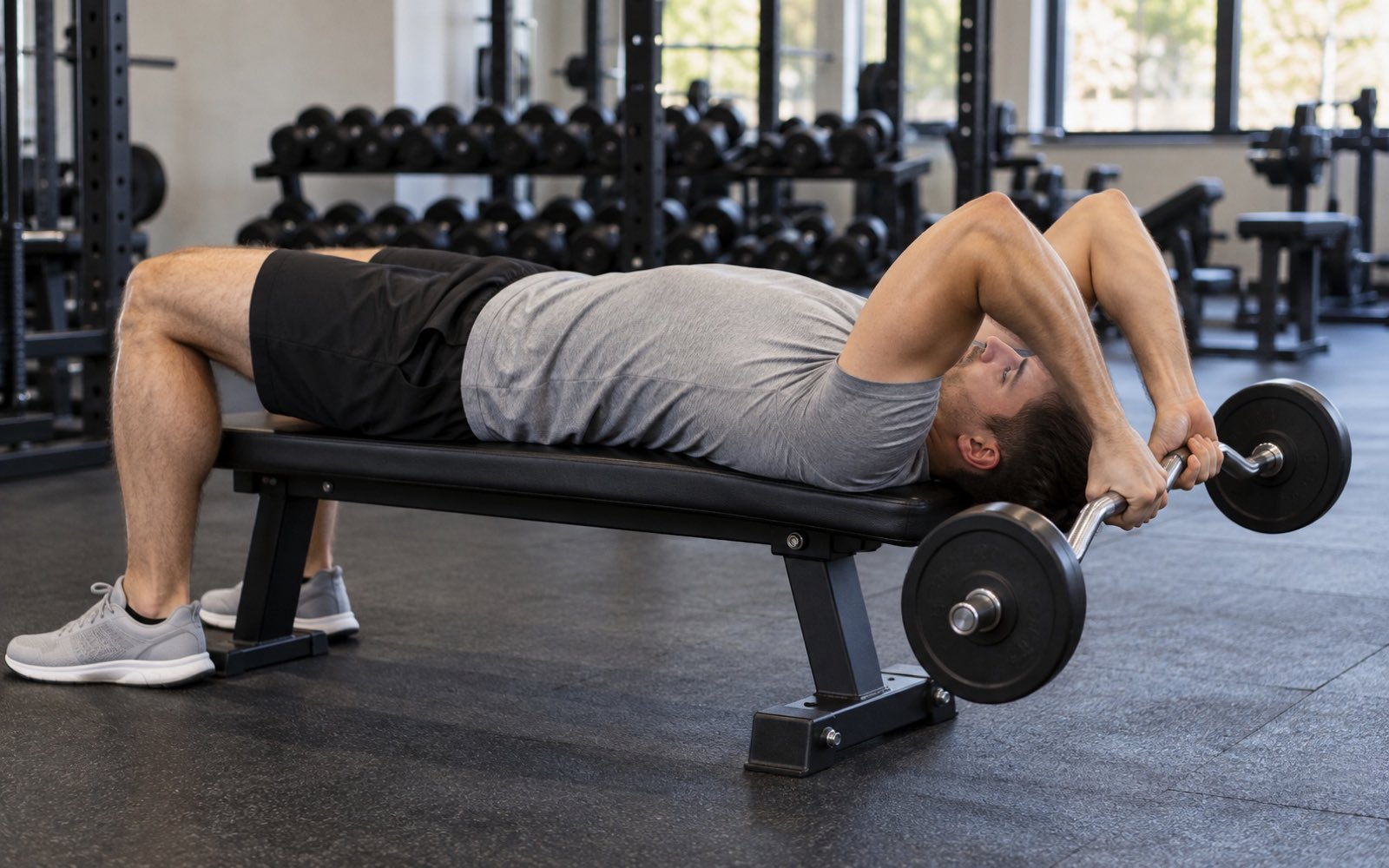
Lie on a bench, take an EZ bar with a narrow grip, raise it over your chest, tilt your upper arms back toward your head by 10–15°, and lower the bar behind your head by bending only your elbows, then straighten your arms. Step by step:
- Bench and bar. A flat bench, feet planted firmly on the floor. Use an EZ bar with curved handles: your wrists sit at a natural angle on it. Until you have a training partner, start with dumbbells or ask someone to hand you the bar. Taking it off rack hooks behind your head is awkward: your elbows and shoulders are in a weak position at that moment, and you don't have the weight under control yet.
- Grip. Overhand, palms on the inner bends of the EZ bar, 25–30 cm (10–12 in) between your hands. Narrower, and your wrists get tired; wider, and your elbows flare out.
- Starting position. Arms straight, bar over your chest or slightly higher. Tilt your upper arms back toward your head by 10–15° so the bar ends up over the line of your forehead. This is your starting point, and the elbow-to-shoulder line doesn't move from here on.
- Elbows. Shoulder-width apart, pointing at the ceiling. Don't pinch them in or flare them out.
- Lowering. Bend your elbows and lower the bar behind your head over 2 seconds. The bar passes over your forehead and heads toward the crown of your head. Your upper arms stay put.
- Bottom position. The bar is level with the crown of your head or a little lower, forearms slightly below parallel to the floor. Your triceps is strongly stretched. Don't drop the weight: this is where your elbows are loaded the most.
- Lifting. Straighten your elbows over 1–2 seconds, bringing the bar back to the starting point above your forehead. Your shoulder doesn't take part: if the bar has drifted toward your chest, your elbows moved toward your feet and your lats helped out.
- Top position. Arms almost straight, without locking out your elbows. One second, and on to the next rep.
- Breathing. Breathe in on the way down, breathe out as you straighten your arms. Don't hold your breath with a light weight.
A tempo of 2 seconds down and 1–2 up fits the moderate speed from the 2009 ACSM position stand: 1–2 seconds to lift and 1–2 to lower.
Straight bar or EZ bar. A straight bar forces your palms to face strictly up, and for many people that strains the wrists and the inner side of the elbow. An EZ bar solves this. If your gym doesn't have one, take dumbbells rather than putting up with a straight bar.
Incline and decline skull crushers. On a bench with a slight decline, where your head is lower than your hips, your upper arm tilts even further back toward your head, and the long head is stretched more. On an incline bench, with your head higher, your upper arm moves toward vertical, and the exercise gets closer to the bar-to-forehead version. A beginner doesn't need either: a flat bench is enough for a long time.
for your first two weeks, film yourself from the side with your phone propped against the rack. Watch just one thing: the line from your elbow to your shoulder shouldn't move in the frame for the whole set. If on your last reps your elbows travel behind your head on the way down and drift toward your feet on the way up, the weight is too heavy, so take off 20–30%. The second test: after the set, ask yourself where it burns. If it's the back of your upper arm, everything is right. If it's your elbow or the front of your shoulder, check the mistakes table in section 08.
Dumbbell skull crushers: two dumbbells, one dumbbell, on the floor
With dumbbells the form is the same, except your palms face each other in a neutral grip, and the dumbbells go behind your head on either side of it.
Two dumbbells. Lie on the bench with the dumbbells over your chest, palms facing each other. Tilt your upper arms back toward your head by 10–15°, elbows shoulder-width apart. Lower the dumbbells behind your head, toward your ears, over 2 seconds, and straighten your arms over 1–2. The neutral grip takes stress off your wrists and the inner side of your elbow, which makes this the best start for a beginner. Another plus of dumbbells is that each arm works on its own, so the weaker side can't hide behind the stronger one. The downside: neighboring dumbbells usually differ by 1 kg (about 2 lb), and at 3 kg (6.5 lb) that's an instant +33%, so reps go up faster than weight. The 8-week plan shows how to handle that.
One dumbbell with both hands. Hold the dumbbell by its top plate, with your palms cupped under it and your thumbs wrapped around the handle. The dumbbell is over your chest, elbows narrow, shoulder-width or closer. Lower it behind your head and straighten your arms. This version is handy when you don't have a pair of dumbbells at the right weight but do have one heavier one.
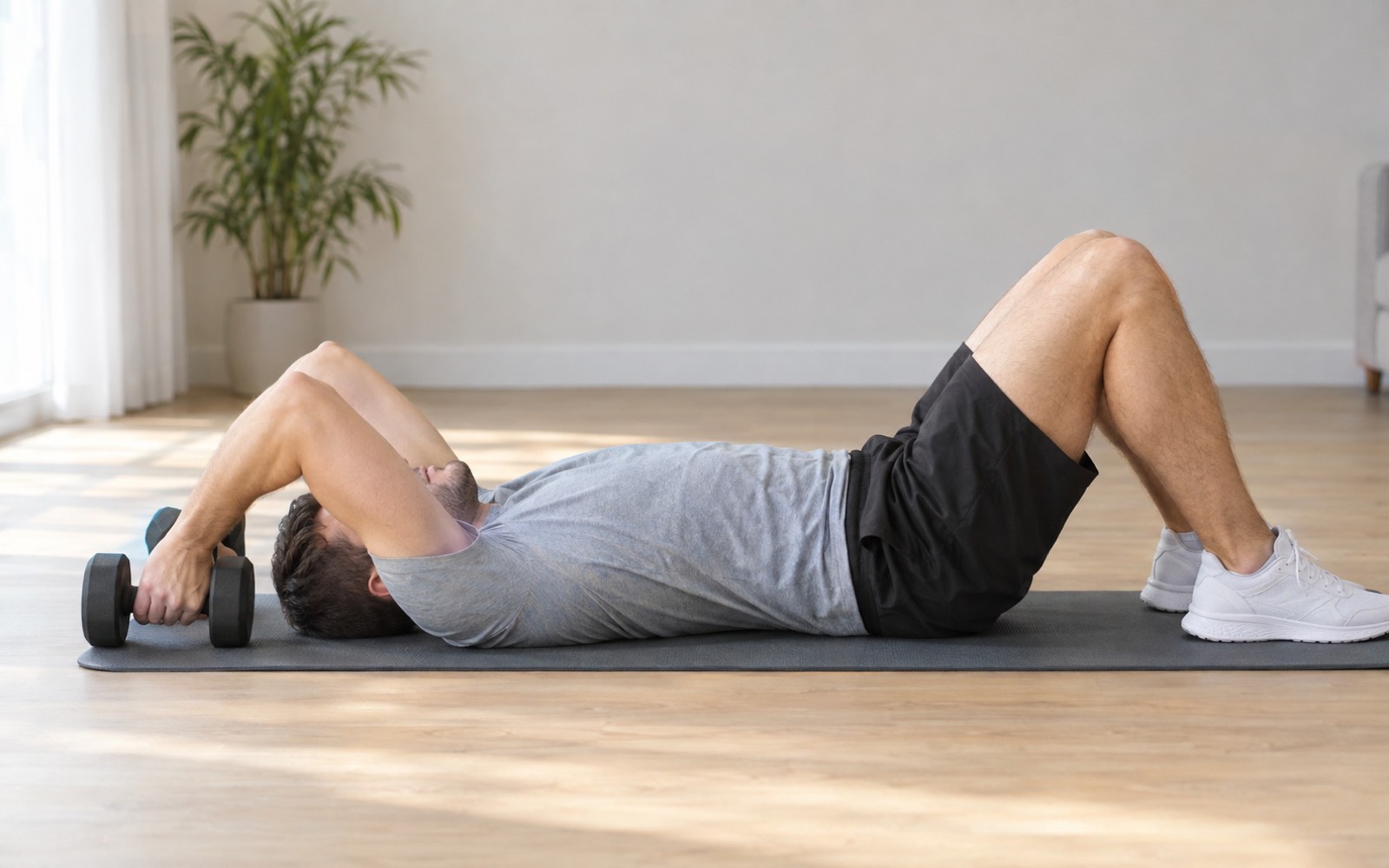
On the floor. At home there's often no bench, so people do dumbbell skull crushers lying on a mat. Knees bent, feet on the floor, lower back pressed down. Lower the dumbbells until your upper arms or elbows touch the floor. The floor limits your range, and that's more of a plus: the bottom position, where the elbow is loaded the most, is cut off. The downside is that your triceps doesn't get a full stretch. For your first month at home it's a great option; after that, move to the seated overhead dumbbell extension, which has a full range.
One arm, lying. A dumbbell in one hand, with your other hand supporting the working upper arm from below so it doesn't move. Lower the dumbbell toward the opposite shoulder or behind your head. This version is for people whose arms differ noticeably in strength.
Overhead triceps extension, seated and standing: one dumbbell, two, a barbell, one arm
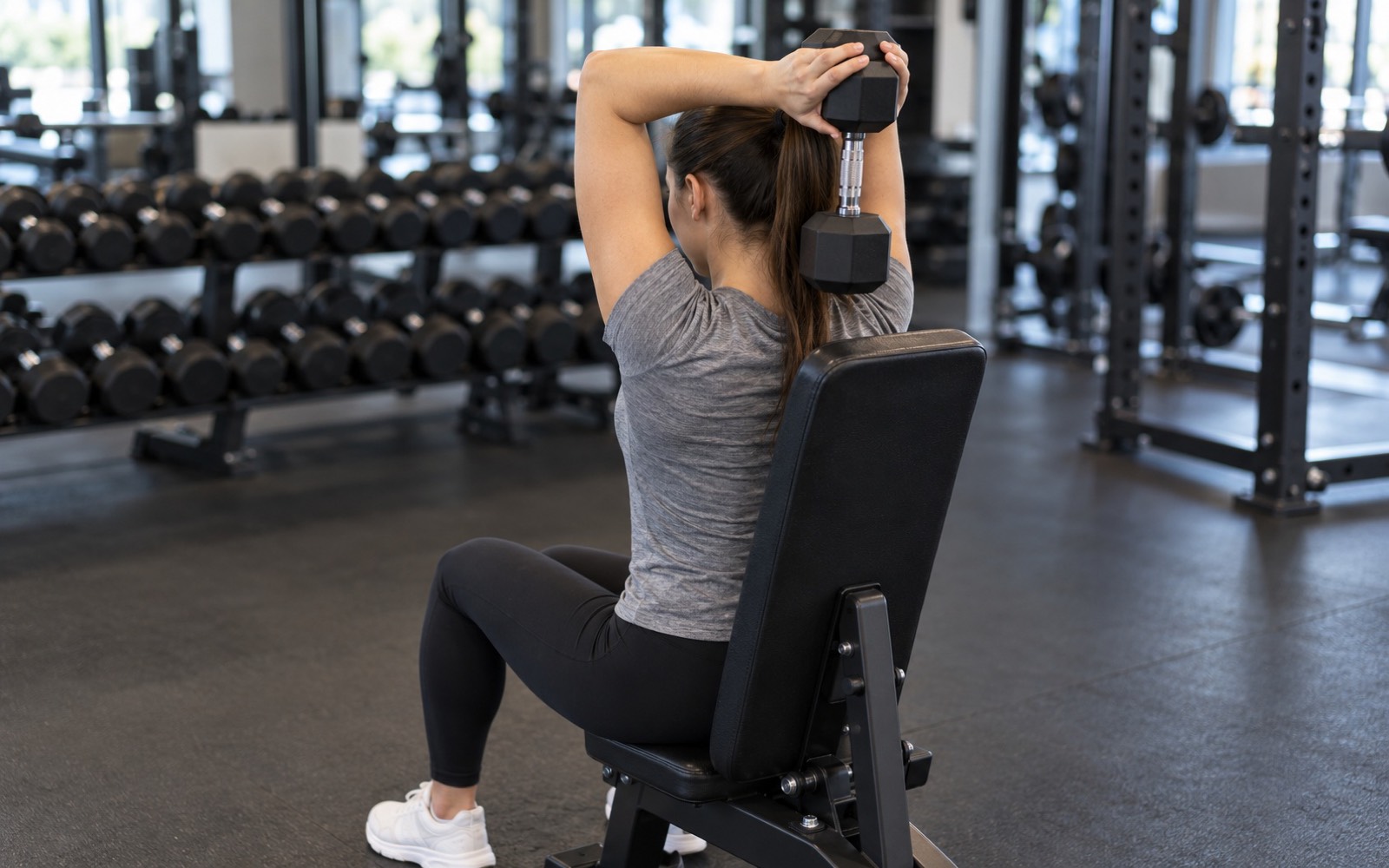
In an overhead extension you raise the weight above you, your upper arms are nearly vertical, your elbows point at the ceiling, and you lower the weight behind your head by bending only your elbows.
This is the version that, in Maeo's 2023 study, produced 1.4 times more growth of the whole triceps and 1.5 times more growth of the long head than training with the arm at your side. That study used cables, but the upper arm was in the same overhead position.
The condition: shoulder mobility. Raise both arms overhead and look at yourself sideways in a mirror. If your arms are vertical and your lower back hasn't arched, the overhead version suits you. If your arms drift forward and your back arches, start with the lying version and add stretches for your lats and chest: until your upper arm can get vertical, the overhead load will go into your lower back and shoulder joint.
Seated, one dumbbell. Sit on a bench with a back support, back pressed against it, feet on the floor. Hold the dumbbell with both hands by the top plate, palms cupped, and raise it overhead. Your elbows point forward and up, shoulder-width or closer, and your upper arms are by your ears. Lower the dumbbell behind your head over 2 seconds until your forearms touch your biceps or stop just short. Straighten your arms over 1–2 seconds. Keep your elbows from flaring: if they've drifted out to the sides, the weight is too heavy. A 6 kg (13 lb) dumbbell suits women, 12 kg (26.5 lb) suits men.
Seated, two dumbbells. A dumbbell in each hand, neutral grip, same technique. This version is harder on the shoulders: two dumbbells overhead are harder to hold in a narrow position.
Seated, barbell. An EZ bar with a narrow grip, 25–30 cm (10–12 in), overhead. Lower it behind your head with narrow elbows. This version is for people who've outgrown a single heavy dumbbell. With a bar it's especially important not to lower it onto your neck and not to let it drop.
Standing. Same technique as seated, but your abs and glutes hold your torso. Stand with your feet hip-width apart, knees soft, stomach tight, ribs down. If your lower back feels tight after a standing set, you're arching under the weight: sit on a bench with a back support or go lighter. With back pain or a herniated disc, it's better to skip the standing version entirely.
One arm. A dumbbell in one hand overhead, palm facing forward. Support the working upper arm with your free hand, from below or near the elbow, so it doesn't drift. Lower the dumbbell behind your head toward the opposite shoulder blade. This version evens out strength between your arms; the weights are small: 2–4 kg (4.5–9 lb) for women, 4–8 kg (9–17.5 lb) for men.
Cable, Smith machine and band variations: substitutes at the gym and at home
You can replace skull crushers with any elbow extension where your upper arm stays still: a cable overhead extension, a cable pushdown, a seated overhead extension in a Smith machine, a band extension, and at home, close-grip push-ups and bench dips.
Cable overhead extension. Attach a rope to a low or mid pulley, stand facing away from the machine, hands behind your head, elbows by your ears. Extend your arms forward and up. This is the version Maeo used in 2023 to get +28.5% long-head volume. A cable pulls more smoothly than a dumbbell, and elbows usually like that better.
Cable pushdown. A rope or straight bar on a high pulley, elbows tucked against your sides, extend your arms down. Your upper arm is at your side, which in Maeo's study is the "neutral" position, where growth was 1.4 times smaller. In the 2011 ACE study, the rope produced 74% of the activation of diamond push-ups, and the straight bar 67%. Pushdowns are good in two cases: as extra volume after skull crushers, and as a replacement when your elbows are sensitive, because on a cable machine the weight is easy to change in small steps.
In a Smith machine. Only seated overhead: the bar travels straight up and down, and lying down it can't follow an arc behind your head. Sit with a back support, bar overhead, lower it behind your head. The upside is that the bar can't fall and you can hook it at any height.
With a resistance band. Stand on the middle of the band, take the ends in your hands and raise them overhead, as with a dumbbell. Lower your hands behind your head and straighten your arms. Resistance grows toward the top, so at the bottom, where the elbow is loaded the most, a band is gentler than a dumbbell. It's a good choice for your elbows after a break.
How to build your triceps at home without a barbell. A home triceps routine comes together from four exercises:
- A seated or standing overhead dumbbell extension is the main one. The technique is in section 06, and its place in a full-body home program is in our guide to a dumbbell workout at home, where the overhead dumbbell extension is already part of the routine with weights.
- Close-grip push-ups. Hands under your chest, elbows along your sides. In the 2011 ACE study, diamond push-ups, with your hands together under your chest forming a triangle, produced the highest triceps activation of the eight exercises tested. If you're starting from zero, you learn them with the same progression as regular push-ups, starting against a wall and then a chair, and that progression is laid out in push-ups for beginners.
- Bench dips off a chair. Back to the chair, hands on the edge of the seat, legs straight out. Bend your elbows to lower your hips, then straighten them. Your elbows point back, toward the chair. If you feel a pull in the front of your shoulder, don't go lower than a right angle at the elbow.
- Band overhead extension, from this section.
Parallel bar dips are another exercise in this group: in the ACE study they produced 87% activation, on par with kickbacks. Don't start them before you've learned the technique: your shoulders are vulnerable at the bottom. How to learn them without overloading your shoulders is covered in our guide to dips.
Two sessions a week with 3 sets of overhead dumbbell extensions plus 2 sets of close-grip push-ups add up to 10 sets for your triceps per week. According to the 2026 ACSM position stand, muscles grow better from 10 sets a week.
Mistakes: where you feel it → what to fix
A well-done skull crusher feels like a burn and a stretch in the back of your upper arm; if your elbow burns, or you feel it in the front of your shoulder, your wrists or your lower back, your technique has drifted.
| Where you feel it | What's wrong | What to fix |
|---|---|---|
| Back of the elbow, in the tendon, during the set or the next day | weight too heavy; bar to the forehead with a vertical upper arm; no warm-up | weight −30%, bar behind the head, 2 warm-up sets of 15 reps with half the weight |
| Front of the shoulder | elbows travel far behind your head on the way down, upper arm tilted back more than 10–15°; not enough shoulder mobility for the overhead version | lock the elbow-to-shoulder line, film yourself from the side, go lighter; with poor mobility, do it lying |
| Wrists | straight bar instead of EZ; grip narrower than 25 cm (10 in) | EZ bar or dumbbells with a neutral grip, 25–30 cm (10–12 in) grip |
| Lower back | arching while standing; feet up on the bench; hips lifted off the bench while lying | seated with a back support instead of standing, feet on the floor, lower back pressed down |
| Forehead, fear of dropping the bar | bar goes to the forehead; no one to hand you the bar | bar behind the head, dumbbells instead of a barbell, a partner to hand it off |
| You don't feel your triceps | elbows flare out, upper arms move, bar drifts toward your chest on the way up | elbows shoulder-width apart, upper arms still, less weight, 2 seconds down |
| Neck | head hanging off the end of the bench, or you're watching the bar | lie so your head rests on the bench, eyes on the ceiling |
| Hands give out before your triceps | one-dumbbell version too heavy; cupped grip without thumbs around the handle | two dumbbells instead of one, thumbs wrapped around the handle |
Why skull crushers hurt your elbows. There are usually three reasons. The first is weight: the triceps is a small muscle, but people want to add weight as fast as on the bench press. The second is lowering the bar to your forehead with a vertical upper arm: the hardest point for your elbow falls at the bottom, where the joint is bent the most. The third is starting without a warm-up, when your first rep is already at your working weight. Keogh and Winwood's 2017 review of injuries in weight-training sports found that the elbow is among the five most common injury sites, and that the most common types of injury are muscle strains, tendinitis and ligament sprains. Tendinitis is irritation and inflammation of a tendon, usually linked to overload. So elbow pain after skull crushers most often means the load is too much, but only a doctor can name the exact cause.
What to do: two weeks without skull crushers, light cable pushdowns for 15 reps, then come back with dumbbells at 30% less weight than before, bar or dumbbells behind your head only. If the pain lasts longer than 2–3 weeks, or you have any of the symptoms from section 11, see a doctor.
How much weight to use: an 8-week plan for women and men
Women should start with 3 kg (6.5 lb) dumbbells and men with 6 kg (13 lb), doing 3 sets of 10 reps with 2–3 reps left in the tank, adding reps first and weight second.
The rule for adding weight comes from the 2009 ACSM position stand: a beginner needs a weight they can lift for 8–12 reps, and once they can do 1–2 reps more than the target, the weight goes up by 2–10%.
Dumbbell jumps. For triceps, this rule runs into the size of the jumps between dumbbells. Neighboring dumbbells usually differ by 1 kg (about 2 lb), and going from 3 kg to 4 kg (6.5 to 9 lb) is an instant +33%, three times the upper limit in the ACSM guidance. Dumbbells in pounds usually step up by 2.5–5 lb at light weights, so the jump is similar or bigger. That's why in the women's plan reps climb to 15 before the dumbbell changes, and after the change the reps drop back to 10. For men starting at 6 kg (13 lb), a 1 kg step is +17%, and reps climb to 12. An EZ bar lets you take smaller steps: two 1.25 kg (2.75 lb) plates add 2.5 kg (5.5 lb), which at 17.5 kg (38.5 lb) is +14%; 0.5 kg (1.1 lb) plates add 6%, and that already fits the ACSM rule.
Volume is the amount of work per session: sets × reps × total weight. For example, 3 sets × 10 reps × (2 × 3 kg) = 180 kg (397 lb). It shows whether the load is growing even while the weight on the dumbbells stays the same.
Women: lying skull crushers with two dumbbells, neutral grip, dumbbells behind the head. Two sessions a week, 3 working sets.
| Week | Weight and scheme | Volume | What changed |
|---|---|---|---|
| 1 | 2 × 3 kg (6.5 lb), 3 × 10 | 180 kg (397 lb) | start |
| 2 | 2 × 3 kg (6.5 lb), 3 × 12 | 216 kg (476 lb) | +2 reps |
| 3 | 2 × 3 kg (6.5 lb), 3 × 15 | 270 kg (595 lb) | +3 reps |
| 4 | 2 × 4 kg (9 lb), 3 × 10 | 240 kg (529 lb) | weight +33%, reps drop back |
| 5 | 2 × 4 kg (9 lb), 3 × 12 | 288 kg (635 lb) | +2 reps |
| 6 | 2 × 4 kg (9 lb), 3 × 15 | 360 kg (794 lb) | +3 reps |
| 7 | 2 × 5 kg (11 lb), 3 × 10 | 300 kg (661 lb) | weight +25% |
| 8 | 2 × 5 kg (11 lb), 3 × 12 | 360 kg (794 lb) | +2 reps |
Volume grew from 180 to 360 kg (397 to 794 lb), by 100%. If you have only one dumbbell at home, do the seated overhead extension with both hands: 6 kg (13 lb) 3 × 10 (180 kg) → 3 × 12 (216) → 7 kg (15.5 lb) 3 × 10 (210, weight +17%) → 3 × 12 (252) → 8 kg (17.5 lb) 3 × 10 (240, +14%) → 3 × 12 (288) → 9 kg (20 lb) 3 × 10 (270, +12.5%) → 3 × 12 (324). That's 80% growth.
Men: lying skull crushers with two dumbbells, switching to an EZ bar in week 7.
| Week | Weight and scheme | Volume | What changed |
|---|---|---|---|
| 1 | 2 × 6 kg (13 lb), 3 × 10 | 360 kg (794 lb) | start |
| 2 | 2 × 6 kg (13 lb), 3 × 12 | 432 kg (952 lb) | +2 reps |
| 3 | 2 × 7 kg (15.5 lb), 3 × 10 | 420 kg (926 lb) | weight +17% |
| 4 | 2 × 7 kg (15.5 lb), 3 × 12 | 504 kg (1,111 lb) | +2 reps |
| 5 | 2 × 8 kg (17.5 lb), 3 × 10 | 480 kg (1,058 lb) | weight +14% |
| 6 | 2 × 8 kg (17.5 lb), 3 × 12 | 576 kg (1,270 lb) | +2 reps |
| 7 | EZ bar 17.5 kg (38.5 lb), 3 × 10 | 525 kg (1,157 lb) | switch to the bar, +9% over the pair of dumbbells |
| 8 | EZ bar 17.5 kg (38.5 lb), 3 × 12 | 630 kg (1,389 lb) | +2 reps |
Volume grew from 360 to 630 kg (794 to 1,389 lb), by 75%. EZ bars weigh different amounts in different gyms, so count the actual weight: bar plus plates. Without a barbell, in weeks 7 and 8 you can use 2 × 9 kg (20 lb) and 2 × 10 kg (22 lb) dumbbells for 3 × 10 (volume 540 and 600 kg, or 1,190 and 1,323 lb). For the seated overhead extension with one dumbbell: 12 → 14 → 16 kg (26.5 → 31 → 35 lb) over the same 8 weeks.
In the weeks when the weight changes, volume drops, and that's by design: you do fewer reps, then volume climbs again as the reps come back. This is a rough trajectory: some people will get through it in 6 weeks, others will need 10. The weight goes up only when every set is done with still upper arms and 2–3 reps in reserve. If your elbow hurts, the weight doesn't go up at all until the pain is gone. What to do once the 8 weeks are over is covered in our guide to progressive overload.
How many sets, reps and sessions per week; where it goes in your workout
A beginner is fine with 3 sets of 8–12 reps twice a week, with 2–3 minutes of rest between sets and 2–3 reps left in the tank.
Reps. 8–12 is the range ACSM called the working range for beginners in 2009. The limits aren't strict: in Schoenfeld's 2017 meta-analysis of 21 studies, light loads (up to 60% of max) and heavy loads (over 60%) built muscle equally when sets were taken to failure, while maximal strength was higher with heavy loads. For your triceps, this means both 8 and 15 reps work. Choose the weight based on your elbows: if 8 reps with a heavy dumbbell bother the joint, do 12–15 with a lighter one, and your growth won't suffer.
Rest. In 2009, ACSM recommended 1–2 minutes for muscle growth, and that's the lower bound. In Schoenfeld's 2016 study, 21 trained men trained three times a week for 8 weeks, doing 3 sets of 8–12 reps in 7 exercises, with either 1 or 3 minutes of rest. Strength grew more with 3 minutes, and triceps thickness showed a trend in favor of longer rest: p = 0.06, meaning the difference nearly reached statistical significance. Rest 2–3 minutes. Short rest for the sake of the burn doesn't help: in this study, the gains were smaller with one minute of rest.
Weekly volume. According to the 2026 ACSM position stand, which pulls together 137 systematic reviews and more than 30,000 participants, muscles grow better from 10 or more sets a week. 3 sets of skull crushers twice a week is 6 sets for the triceps. Make up the other 4 with cable extensions, close-grip bench press or dips. Count indirect work too: the bench press and overhead press also load the triceps.
Frequency. Twice a week. According to ACSM 2026, strength grows better from two or more sessions a week, while muscle growth depends on the total number of sets. So twice a week is enough for a beginner; the key is to get your sets in.
Where it goes in your workout. ACSM advised in 2009 that multi-joint exercises come before single-joint ones. So skull crushers go after the bench press, overhead press or dips, toward the end of your workout. The exception is a period when your triceps is lagging: then skull crushers can go first. In Brandão's 2020 study, the group that did skull crushers before the bench press made significant gains both in triceps size and in bench press strength.
Do you need skull crushers if you bench press. Yes, for the long head. In 2020, Brandão and colleagues split 43 young men into four groups: bench press followed by lying barbell triceps extensions, the same pair in reverse order, bench press only, and triceps extensions only. After 10 weeks, triceps cross-sectional area grew significantly in all the groups that did triceps extensions, while in the bench-press-only group the gain didn't reach significance, although the direct difference between groups in overall triceps size wasn't significant either. By head: the lateral head grew more where there was bench press, the long head grew more where there were skull crushers, and the medial head grew equally everywhere. Elbow extension strength increased significantly only in the groups that did skull crushers. The takeaway: the bench press grows the lateral head more, skull crushers grow the long head more, and together they load the triceps more fully. Close-grip bench press technique, the nearest exercise with the same goal, is covered in our guide to bench press form.
Skull crushers or close-grip bench press. They're different exercises with different jobs. In Saeterbakken's 2021 study, 28 men bench pressed with a narrow, medium and wide grip at a weight they could lift for 6 reps. With a wide grip, electromyography showed lower triceps activity than with a medium or narrow grip, and the narrow grip reduced the weight they could lift for 6 reps, in both beginners and experienced lifters. The close-grip press is a multi-joint movement where the chest and front delts help the triceps; a skull crusher is an isolation exercise where nothing can help. In a program they complement each other: the close-grip press gives heavy multi-joint work, and skull crushers fill in the long head.
The Sportygram app (go.sportygram.com; the interface and the coach are in Russian for now) includes two variations: lying barbell skull crushers and the overhead dumbbell extension, each with technique photos for men and women. You can ask the virtual coach, Alex, in chat to add skull crushers to Wednesday's workout; he shows a confirmation card, and once you confirm, the exercise appears in that day's plan. You log sets and weight in the workout diary, and the weight history shows when it's time to add more.
Who should be careful with skull crushers, and when to see a doctor
For a healthy person, skull crushers are fine at any age, but with sore elbows, limited shoulder mobility, carpal tunnel syndrome or back pain, the variation and the weight need to be chosen individually, sometimes with a doctor.
- Epicondylitis and elbow tendinitis, also known as tennis elbow and golfer's elbow: pain on the outer or inner side of the elbow when gripping and straightening the arm. While it hurts, put skull crushers on hold. Once it settles, come back through light cable pushdowns, then dumbbells with a neutral grip, going behind your head. Drop the straight bar.
- Shoulders without overhead mobility. If your arm can't get vertical without your lower back arching, do the lying version only. The overhead version will come back as your mobility improves.
- Wrists: carpal tunnel syndrome, wrist pain. Only an EZ bar or dumbbells with a neutral grip; if your fingers go numb during a set, stop.
- Joint hypermobility. Don't lock your elbows out hard at the top: finish each rep just short of full extension.
- Lower back: herniated disc, pain. Skip the standing version, and do the seated one only with a back support. Lying down, keep your feet on the floor and your lower back pressed down.
- Over 40 and over 60. Age by itself doesn't rule out skull crushers. With joint disease, high blood pressure, or after shoulder or elbow surgery, agree on your program with a doctor and start with dumbbells on the floor.
How risky is it. Keogh and Winwood's 2017 review of 20 injury studies in weight-training athletes found that bodybuilding, where triceps extensions are a staple, had the lowest injury rate among these sports: 0.12–0.7 injuries per athlete per year, or 0.24–1 injury per 1,000 hours of training. The authors conclude that weight-training sports overall cause fewer injuries than common team sports. The scariest injury, a triceps tendon rupture, is rare. In Dunn's 2017 systematic review of 262 patients from 40 papers, the average age at rupture was 45.6 years, and the most common associated factors were kidney disease, at 10%, and anabolic steroid use, at 7%. After surgery, 89% returned to their previous level of activity. So if you have kidney disease or take hormonal drugs, pay closer attention to any pain at the back of your elbow.
When to see a doctor. Book an appointment if something clicked in your elbow during a set and your arm is now weak when you straighten it; if there's swelling or bruising at the back of your elbow; if elbow pain doesn't go away after 2–3 days of rest, or comes back every session for longer than 2–3 weeks; if your fingers or hand go numb; or if your shoulder hurts at night after overhead extensions. A doctor makes the diagnosis and prescribes treatment; until your appointment, rest and keep load off your elbow.
Questions and answers
Should the bar go to your forehead or behind your head?
Behind your head. When your upper arm is tilted back toward your head by 10–15°, the bar passes over your forehead and travels to the crown of your head: the range is longer, the long head is more stretched, and your elbow is loaded more gently at the bottom. The bar-to-forehead version with a vertical upper arm has a short range, and the hardest point for your elbow falls at the bottom. No studies have compared the two directly, but the 2026 ACSM position stand notes that a full range of motion builds more strength.
Which is better: skull crushers or overhead triceps extensions?
These two variations haven't been compared directly for muscle growth. In Maeo's 2023 study, the triceps of the arm trained overhead grew 1.4 times more than the arm trained at the side, with a working weight 34–39% lighter. Lying down, your upper arm is raised about 90°, an in-between position, and the long head is less stretched than overhead. On the other hand, the lying version is easier on the shoulders and easier for a beginner, because the range is easy to control. Do both: lying for the first six weeks, then alternate between sessions.
Why do skull crushers hurt my elbows?
Because of the weight, the bar going to your forehead, or skipping the warm-up. According to Keogh and Winwood's 2017 review, the elbow is among the five most common injury sites in strength athletes, and tendinitis, inflammation of a tendon, is one of the most common injury types. Take off 30% of the weight, use dumbbells with a neutral grip instead of a straight bar, lower behind your head, and do two warm-up sets of 15 reps with half the weight before your working sets. If the pain doesn't go away within 2–3 weeks, see a doctor.
What weight should a woman or a beginner start with?
For women: 3 kg (6.5 lb) dumbbells in each hand, or one 6 kg (13 lb) dumbbell for the seated overhead extension, 3 sets of 10 reps. In our plan, by week 7 that becomes 2 × 5 kg (11 lb), or 9 kg (20 lb) with one dumbbell. For men: 6 kg (13 lb) in each hand or one 12 kg (26.5 lb) dumbbell, moving to a 17.5 kg (38.5 lb) EZ bar by week 7. Add weight when every set is done with still upper arms and 2–3 reps in reserve.
How many sets and reps should you do, and how often per week?
3 sets of 8–12 reps twice a week, with 2–3 minutes of rest between sets. According to Schoenfeld's 2017 meta-analysis, when sets are taken to failure, 12–15 reps with a light weight build muscle just as well as 8 with a heavy one, so choose the weight based on how your elbows feel. For growth, ACSM in 2026 recommends 10 or more sets per muscle per week: to your 6 sets of skull crushers, add 4 sets of cable extensions, close-grip bench press or dips.
Do I need skull crushers if I bench press?
Yes. In Brandão's 2020 study, 43 men trained for 10 weeks, and in the group that did only the bench press, triceps growth didn't reach significance. The long head grew more where skull crushers were in the program, and the lateral head grew more where the bench press was. Together the two exercises load the triceps more fully.
What's a good skull crusher alternative at home?
A seated overhead dumbbell extension, a band overhead extension with the band under your feet, close-grip push-ups, and bench dips off a chair. At the gym: cable overhead extensions, close-grip bench press and dips. All of them work the triceps, but the long head gets the most stretch in the versions where your arm is overhead.
Are skull crushers and the French press the same thing?
Almost. A skull crusher is the lying version, where the bar comes down toward your forehead with a vertical upper arm. In English-speaking gyms, the French press usually means the seated or standing overhead extension, while in Eastern Europe the name covers all three versions. The technique and the rule about keeping your upper arm still are the same for every variation; only the position of your upper arm and the point where the weight goes are different.
The bottom line
- Skull crushers and overhead extensions are elbow extensions with a weight while your upper arm stays still; the triceps works, and everything else holds position.
- Elbows shoulder-width apart, upper arms tilted back toward your head by 10–15°, bar behind your head to the crown, tempo 2 seconds down and 1–2 up.
- With the arm overhead, the triceps grew 1.4 times more than with the arm at the side, with 34–39% less weight (Maeo, 2023); lying is easier on the shoulders and better for a start, so do both.
- Bench press alone isn't enough for the triceps: the long head grew more in the people who did skull crushers (Brandão, 2020).
- Start with 3 kg (6.5 lb) dumbbells for women and 6 kg (13 lb) for men, 3 × 10 twice a week; reps climb first, then weight; over 8 weeks, volume grows by 75–100%.
- Aim for 10 or more sets for the triceps per week, together with cable work, close-grip press or dips (ACSM, 2026); rest 2–3 minutes (Schoenfeld, 2016).
- Elbow hurts? Weight −30%, dumbbells instead of a straight bar, behind your head, warm up. A click, weakness, swelling or numbness: see a doctor.
Checklist: before a set of skull crushers
- Two warm-up sets of 15 reps with half the weight.
- An EZ bar or dumbbells with a neutral grip, grip 25–30 cm (10–12 in) wide.
- Upper arms tilted back toward your head by 10–15° and still for the whole set.
- Elbows shoulder-width apart, pointing at the ceiling.
- Bar behind your head, to the crown, 2 seconds down.
- At the top, elbows almost straight, no hard lockout.
- Seated, back against the support; standing, abs braced, no arch.
- The weight leaves 2–3 reps in reserve, and it's logged in your diary.
Sources
- Maeo S., Wu Y., Huang M., Sakurai H., Kusagawa Y., Sugiyama T., Kanehisa H., Isaka T. Triceps brachii hypertrophy is substantially greater after elbow extension training performed in the overhead versus neutral arm position. European Journal of Sport Science, 2023. — 21 adults, 12 weeks of cable elbow extensions, one arm overhead and the other at the side, 70% of max, 5 × 10, twice a week, volume measured by MRI: long head +28.5% versus +19.6%, lateral and medial heads +14.6% versus +10.5%, whole triceps +19.9% versus +13.9%; working weights and max overhead were 34–39% lower, and strength gains were the same in both arms, 62–71%.
- Brandão L., de Salles Painelli V., Lasevicius T., Silva-Batista C., Brendon H., Schoenfeld B.J., Aihara A.Y., Cardoso F.N., de Almeida Peres B., Teixeira E.L. Varying the Order of Combinations of Single- and Multi-Joint Exercises Differentially Affects Resistance Training Adaptations. Journal of Strength and Conditioning Research, 2020. — 43 young men, 4 groups, 10 weeks: triceps cross-sectional area grew significantly in every group with lying barbell triceps extensions, the bench-press-only gain was not significant, with no between-group difference for the whole triceps; the lateral head grew more with bench press, the long head with triceps extensions, the medial head equally; elbow extension strength increased only in the groups with triceps extensions.
- Kholinne E., Zulkarnain R.F., Sun Y.C., Lim S., Chun J.M., Jeon I.H. The different role of each head of the triceps brachii muscle in elbow extension. Acta Orthopaedica et Traumatologica Turcica, 2018. — 10 healthy people (8 men, 2 women), elbow extension with the upper arm raised to 0°, 45°, 90°, 135° and 180°, electromyography and an OpenSim model: at 0° the long head produced more force and activity, at 90°, 135° and 180° the medial head produced more force.
- Landin D., Thompson M. The shoulder extension function of the triceps brachii. Journal of Electromyography and Kinesiology, 2011. — 18 people, the triceps stimulated with electrodes on a Biodex dynamometer: shoulder angle was the main factor, and shoulder extension torque rose significantly as the upper arm moved from 0° to 80°, probably because the lever arm lengthened.
- Landin D., Thompson M., Jackson M. Functions of the Triceps Brachii in Humans: A Review. Journal of Clinical Medicine Research, 2018. — A review of triceps function: the medial head takes part in every elbow extension, the long and lateral heads join in during extension against resistance; the long head crosses two joints and also extends the shoulder.
- Boehler B., Porcari J.P., Kline D., Hendrix C.R., Foster C. ACE Study Identifies Best Triceps Exercises. American Council on Exercise, 2011. — 15 women aged 20–24 with strength-training experience, electromyography of the long and lateral heads in 8 exercises; as a percentage of diamond push-ups: kickbacks and dips about 87, overhead extension 76 (long head 81, lateral 72), rope pushdown 74, straight-bar pushdown 67, lying barbell triceps extension 62 (long head 70, lateral 55), close-grip bench press 62. A study commissioned by ACE and run at the University of Wisconsin–La Crosse, not peer-reviewed in a journal; activation does not equal growth.
- Saeterbakken A.H., Stien N., Pedersen H., Solstad T.E.J., Cumming K.T., Andersen V. The Effect of Grip Width on Muscle Strength and Electromyographic Activity in Bench Press among Novice- and Resistance-Trained Men. International Journal of Environmental Research and Public Health, 2021. — 28 men, bench press for 6 reps with a narrow, medium and wide grip: the wide grip gave the triceps less work than the medium and narrow grips; the narrow grip reduced the 6-rep weight in both novices and trained lifters.
- Schoenfeld B.J., Grgic J., Ogborn D., Krieger J.W. Strength and Hypertrophy Adaptations Between Low- vs. High-Load Resistance Training: A Systematic Review and Meta-analysis. Journal of Strength and Conditioning Research, 2017. — 21 studies, light (up to 60% of max) and heavy (over 60%) loads taken to failure: muscle growth was the same, maximal strength was higher with heavy loads.
- Schoenfeld B.J., Pope Z.K., Benik F.M. et al. Longer Interset Rest Periods Enhance Muscle Strength and Hypertrophy in Resistance-Trained Men. Journal of Strength and Conditioning Research, 2016. — 21 trained men, 8 weeks, 3 sessions a week, 7 exercises for 3 × 8–12 reps, 1 or 3 minutes of rest: strength was higher with 3 minutes, triceps thickness showed a trend in favor of 3 minutes, p = 0.06.
- American College of Sports Medicine. Progression models in resistance training for healthy adults. Medicine & Science in Sports & Exercise, 2009. — Beginners should use a load allowing 8–12 reps, 2–3 sessions a week, a moderate tempo of 1–2 seconds up and down, and add 2–10% once 1–2 extra reps are achievable; 1–2 minutes of rest for hypertrophy; multi-joint exercises before single-joint ones.
- Currier B.S., D'Souza A.C., Singh M.A.F. et al. American College of Sports Medicine Position Stand. Resistance Training Prescription for Muscle Function, Hypertrophy, and Physical Performance in Healthy Adults: An Overview of Reviews. Medicine & Science in Sports & Exercise, 2026. — An overview of 137 systematic reviews with more than 30,000 participants: 10 or more sets a week for muscle growth; for strength, 2 or more sessions a week, full range of motion and loads of 80% of max or more; training to failure, equipment type and set structure showed no consistent difference.
- Keogh J.W.L., Winwood P.W. The Epidemiology of Injuries Across the Weight-Training Sports. Sports Medicine, 2017. — A systematic review of 20 studies of competitive athletes: bodybuilding had 0.12–0.7 injuries per athlete per year and 0.24–1 per 1,000 hours, the lowest rate among weight-training sports; weight-training sports overall had fewer injuries than team sports; the most common sites were the shoulder, lower back, knee, elbow and wrist; the most common types were muscle strains, tendinitis and ligament sprains.
- Dunn J.C., Kusnezov N., Fares A., Rubin S., Orr J., Friedman D., Kilcoyne K. Triceps Tendon Ruptures: A Systematic Review. Hand, 2017. — 262 surgically treated patients from 40 papers: average age at triceps tendon rupture 45.6 years; the most common associated factors were kidney disease, 10%, and anabolic steroids, 7%; 89% returned to their previous level of activity after surgery.
This article is for informational purposes only and is not a substitute for medical advice.