

an extra 3,000 steps, which is about half an hour of walking, adds around 100 calories a day for a person weighing 154 lb (70 kg). A kilogram of muscle (2.2 lb) burns only about 13 calories a day at rest, but people who lift weights had a resting metabolic rate 96 calories a day higher on average in a 2020 meta-analysis by MacKenzie-Shalders. Digesting protein costs 20–30% of its calories, carbs 5–10%, fat up to 3%.Coffee, hot peppers and ice water add 10–20 calories a day each, green tea barely shows on the scale (Cochrane, 2012), and eating six small meals changes nothing at all. Adjusted for body composition, daily energy expenditure is stable from 20 to 60 and starts to decline at around 63 (Pontzer, 2021).
Metabolism is all the energy your body spends in a day: on keeping your organs running, on digesting food and on movement. You can boost it, within reason. By our math, steps, strength training and protein together add roughly 200–400 calories a day to your burn. Coffee, hot peppers and ice water in normal amounts give 10–20 calories each, and green tea in studies of 12 weeks or longer had almost no effect on weight. Below: how much each method gives a 40-year-old woman and a 40-year-old man, what changes with age and on a diet, and when a slow metabolism is worth checking with a doctor.

Can you boost your metabolism, and by how much
Yes, you can boost your metabolism, but the gain is measured in tens and hundreds of calories a day, and almost all of it comes from movement, muscle and protein.
Metabolism, in simple terms, is everything your body spends energy on over 24 hours. It's split into three parts:
- Basal metabolic rate (also called resting metabolic rate) is the energy your heart, brain, liver and kidneys use, plus what it takes to hold your body temperature, all while you're at rest. This is the biggest part. Russia's national nutrition guidelines (MR 2.3.1.0253-21) put the daily burn of a person with a desk job at 1.4 times their basal rate, which means the basal rate is about 70% of everything you spend.
- Digesting food. On a typical mixed diet this takes about 10% of your daily burn, or 5–15% according to Westerterp's 2004 review.
- Movement: workouts, steps, housework, even shifting in your chair. This is the most flexible part of your burn.
The main thing your burn depends on is body size, and especially lean mass: muscle, organs, bone. Pontzer and colleagues measured energy expenditure in 6,421 people from 29 countries in a 2021 study, using the doubly labeled water method, which tracks what you spend over many days of ordinary life. Lean mass explained 83% of the difference in daily burn between people. That's why a big person burns more than a small one, and a man burns more than a woman on average: men carry more muscle.
Your basal rate barely responds to direct "boosting." What you can do is move more, keep or build muscle and change what's on your plate. How all three parts of your burn fit together is covered in your daily burn is not the number on your watch.
What boosts your metabolism the most: every method in calories
Steps and strength training raise your burn the most: for a 40-year-old woman weighing 154 lb (70 kg) that's about 100 and 75 calories a day, for a man weighing 187 lb (85 kg) about 120 and 90.
We ran the numbers for two 40-year-olds with desk jobs. The woman: 5'5" (165 cm), 154 lb (70 kg), basal rate 1,370 calories by the Mifflin-St Jeor equation, daily burn with the 1.4 sedentary multiplier from Russia's guidelines around 1,920 calories. The man: 5'11" (180 cm), 187 lb (85 kg), basal rate 1,780 calories, daily burn around 2,490. The "On the scale" column uses the rule from Hall and colleagues, 2011: every 24 calories a day of steady difference eventually works out to about 1 kg (2.2 lb) of body weight, roughly 11 calories per pound. Half of that change comes in about a year, nearly all of it within 3 years.
| Method | Woman, 154 lb (70 kg), calories a day | Man, 187 lb (85 kg), calories a day | On the scale, woman | Where the number comes from |
|---|---|---|---|---|
| +3,000 steps a day (30 minutes of walking at 2.8–3.4 mph / 4.5–5.5 km/h) | about 100 | about 120 | up to 9 lb (4 kg) over 3 years | 3.8 MET; Marshall 2009, Compendium 2024 |
| 3 strength sessions a week, 60 minutes each | about 75, heavy lifting up to 150 | about 90, heavy up to 180 | about 6.6 lb (3 kg) | 3.5 MET, heavy 6 MET; Compendium 2024 |
| "Afterburn" from those sessions | 4–11 | 5–14 | under 1 lb (0.5 kg) | 6–15% of the workout's cost, little data for lifting; LaForgia 2006 |
| Higher resting rate in people who lift | 96 on average (45 to 147) | same | about 9 lb (4 kg) | MacKenzie-Shalders 2020 |
| +1 kg (2.2 lb) of muscle | 13 | 13 | about 1 lb (0.5 kg) | Wang 2010 |
| Protein at 30% of calories instead of 15% (+72 g and +93 g of protein) | 30–70 | 40–95 | 2–7 lb (1–3 kg) | Westerterp 2004 |
| 2 cups of filter coffee (180–200 mg caffeine) | about 20 | about 20 | about 1.8 lb (0.8 kg) in theory | Hursel 2011, EFSA 2015 |
| Green tea catechins with caffeine, in capsules | about 90 in a metabolic chamber | about 115 in a chamber | −0.04 kg (1.4 oz) over 12 weeks outside Japan | Hursel 2011, Cochrane 2012 |
| Hot peppers in normal food | about 10 (shift in energy balance) | about 10 | about 0.9 lb (0.4 kg) in theory | Ludy 2012 |
| 2 liters (68 oz) of ice water a day | about 10 | about 13 | about 0.9 lb (0.4 kg) in theory | Brown 2006 |
| 6 meals instead of 2–3 | 0 | 0 | 0 | Bellisle 1997, Taylor & Garrow 2001 |
| Breakfast instead of fasting until lunch | 0 | 0 | 0 | Chowdhury 2016 |
| Sleeping 1.2 hours longer | same burn, 270 fewer calories eaten | same | weight went down in the trial | Tasali 2022 |
| End of a crash diet (1,000 calories a day for 8 weeks) | −92, a month later −38, a year later about 0 (−7, not significant) | same | — | Martins 2020 |
| Every kilogram (2.2 lb) of muscle lost | −13 | −13 | +1 lb (0.5 kg) | Wang 2010 |
Here's how we calculated walking and lifting: (MET − 1) × body weight in kg × hours. A MET is a unit where 1 equals your burn sitting at rest, so we subtract the 1: your body would have spent that much on the couch anyway. For protein we took an extra 15% of calories and the difference in digestion cost: 20–30% for protein versus 5–10% for carbs.
Three caveats about the table:
- These are ceilings. At very high activity levels your body starts economizing on other expenses and total burn plateaus. More on that in the section on steps.
- Hall's rule was derived for adults with excess weight and for changes in food intake. Applied to an increase in burn, it gives a rough estimate, the right order of magnitude.
- For your own weight, calculate it like this: half an hour of walking costs roughly 1.4 calories per kilogram of body weight, or about 0.65 calories per pound. For protein, take 15% of your daily calories and multiply by 0.10–0.25.
start with the lever that's easiest to keep up every single day. For most people that's steps: 3,000 steps is two 15-minute walks, say to the train station and back, or after lunch and after dinner. Add strength training as the next step, once the walks have become a habit.
Strength training and muscle: what each kilogram gives you
A kilogram of muscle burns about 13 calories a day at rest (roughly 6 calories per pound), so muscle boosts your metabolism mainly through the training it lets you do.
Wang and colleagues checked organ-by-organ calculations against MRI scans of 131 adults in 2010. Skeletal muscle burns about 13 calories per kilogram per day at rest, fat 4.5, the liver 200, the brain 240, the heart and kidneys 440 each. The popular claim that "a pound of muscle burns 50 calories a day" is roughly 8 times higher than what was measured.
So where do the 96 calories in the table come from? In the 2020 meta-analysis by MacKenzie-Shalders and colleagues (18 studies), resistance training raised resting metabolic rate by 96 calories a day on average compared with people who didn't train, with a range of 45 to 147 calories. Aerobic training had no significant effect. The authors don't explain the gap with the "13 calories per kg" figure. Our best guess is that after lifting, muscle repairs and rebuilds itself, and that takes energy too. The studies in the review were also designed in different ways, and the authors themselves write about a high risk of bias. People over 65 and postmenopausal women were not included.
How much muscle you can realistically gain was shown in a 2022 meta-analysis by Lopez and colleagues (114 studies, 4,184 people with excess weight). Strength training without a diet added 0.8 kg (1.8 lb) of lean mass on average. In a calorie deficit, lifting preserved muscle: lean mass hardly changed. Fat loss, meanwhile, was 5.3 kg (11.7 lb) greater than in the groups with no training and no diet. The effect was the same for men and women and at any age.
For you, this means three things. Muscle raises your resting rate a little and lets you burn more during the workouts themselves. Lifting keeps your muscle from leaving along with the fat on a diet. Every kilogram of muscle you lose takes those same 13 calories a day with it, which is why strength training matters most when you're dieting. The WHO's 2020 guidelines recommend that adults do strength exercises for all major muscle groups on 2 or more days a week. You can start at home: squats, lunges, push-ups against a table, band rows. Why muscle disappears with age if you don't load it is explained in sarcopenia: why muscle disappears after 30.
Steps and everyday movement: the most flexible lever
The part of your burn that changes most over a day is movement outside of workouts: 3,000 steps in half an hour add about 100 calories for a woman weighing 154 lb (70 kg).
Marshall and colleagues measured 97 adults in 2009 and found that moderate walking is about 100 steps a minute, so 3,000 steps in 30 minutes. According to the 2024 Compendium of Physical Activities (Herrmann and colleagues), walking at 2.8–3.4 mph (4.5–5.5 km/h) costs 3.8 MET, brisk walking at 3.5–3.9 mph (5.6–6.3 km/h) costs 4.8 MET, and climbing stairs costs 6.8 MET.
Everyday movement, known as NEAT (non-exercise activity thermogenesis), matters more than it seems. In 1999, Levine and colleagues overfed 16 people without excess weight by 1,000 calories a day for 8 weeks. Two thirds of the rise in energy expenditure came from everyday activity: walking, fidgeting, holding posture, daily chores. Differences in that activity explained a tenfold difference in how much fat different people gained.
In 2005 the same group recorded the posture of 10 lean people and 10 people with mild obesity every half second for 10 days. The people with obesity sat about 2 hours a day longer. Had they moved like the lean group, they would have burned roughly 350 more calories a day. So the friend who "eats anything and never gains weight" may simply move more: she stands up more often, walks more, sits less.
There is a ceiling, though. In Pontzer's 2016 study of 332 adults from five countries, daily burn rose with activity among sedentary and moderately active people. In the most active 40% of participants it stopped rising: the body adapts and economizes elsewhere. So going from a sedentary life to daily walks gives a noticeable gain. Hours of cardio every day adds less than a calculator promises.
How to add steps without a separate workout: get off one stop early, take the stairs for at least 3–4 floors, take phone calls on foot, walk 10–15 minutes after lunch and dinner. More ideas in NEAT: how to burn more calories without working out.

Which foods boost metabolism: why protein is the main one
Among ordinary foods, protein raises your burn the most: digesting it costs 20–30% of its calories, carbs 5–10%, fat 0–3% (Westerterp, 2004).
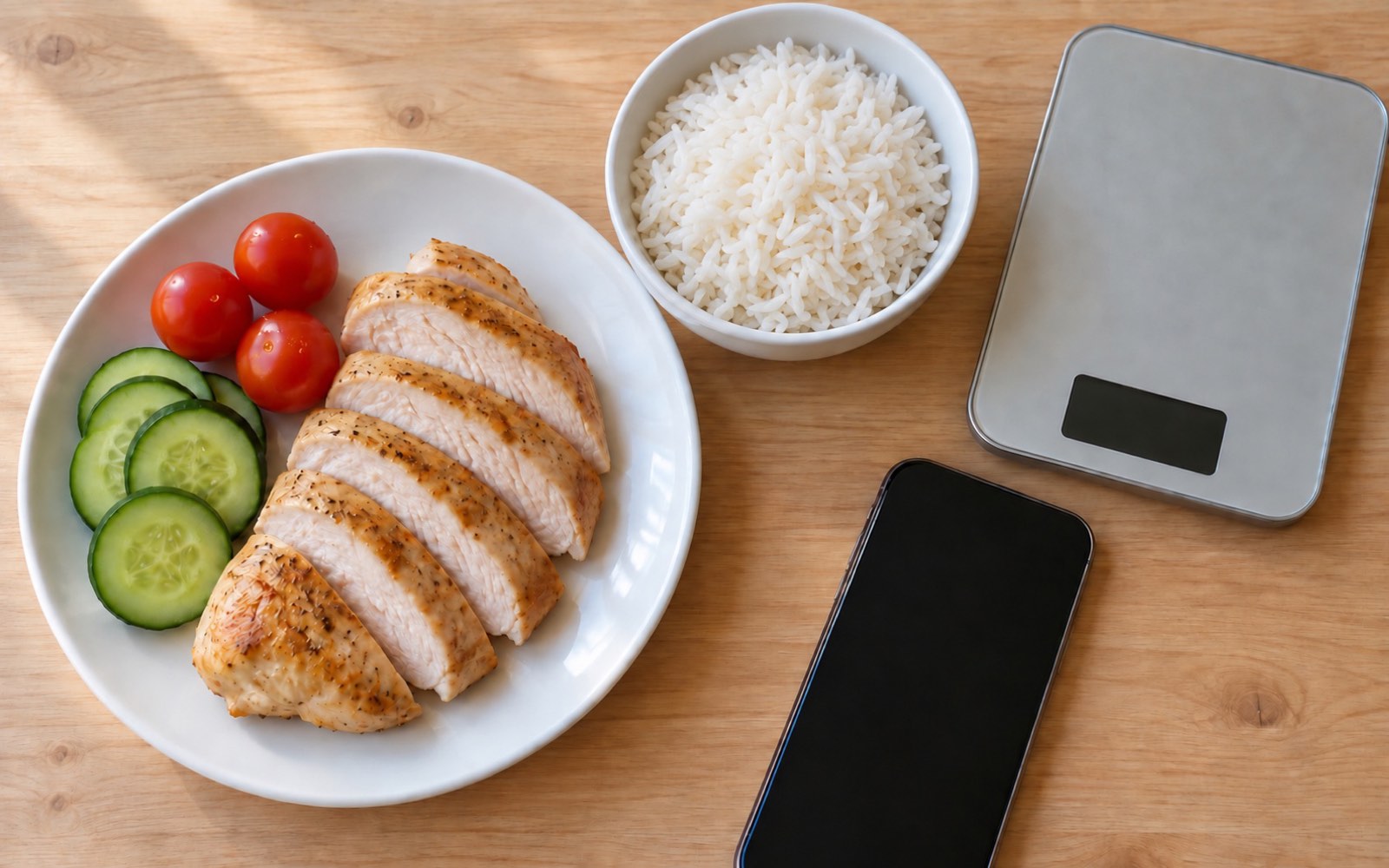
Take our woman with a burn of 1,920 calories. Say she raises protein from 15% to 30% of her calories. That's 288 extra calories from protein, or about 72 g (a gram of protein has 4 calories), roughly 300 g (10.5 oz) of raw chicken breast. She takes those calories away from carbs and fat, and digestion now costs 30–70 more calories a day. For the man with a burn of 2,490, the increase is about 93 g of protein and 40–95 calories.
On its own, that's a modest lever. Protein does far more on a diet. In a 2012 meta-analysis by Wycherley and colleagues (24 studies, 1,063 people, 12 weeks on average), diets with the same calories but higher versus standard protein were compared. On the high-protein diet people lost 0.79 kg (1.7 lb) more weight and 0.87 kg (1.9 lb) more fat, kept 0.43 kg (0.9 lb) more lean mass, and their resting metabolic rate dropped less: a difference of about 142 calories a day.
How much protein you need if you train was calculated in a 2018 meta-analysis by Morton and colleagues (49 studies, 1,863 people). Protein combined with lifting added muscle, but once total daily protein passed 1.62 g per kilogram of body weight (about 0.73 g per pound), there was no further gain. For a woman weighing 154 lb (70 kg) that's about 113 g, for a man weighing 187 lb (85 kg) about 138 g. In older people, the effect of extra protein in that analysis was weaker.
Kefir, sauerkraut, ginger and grapefruit are also often called "metabolism boosters." We found no studies in our selection where they noticeably raised energy expenditure. How to hit your protein target with everyday food is laid out in how much protein per day.
Does sleep affect metabolism and weight loss
Sleep barely changes your energy expenditure itself. But when you're short on sleep while dieting, you lose less fat and more lean mass, which includes muscle, and you feel hungrier.
In 2010, Nedeltcheva and colleagues put 10 adults with excess weight on the same moderate diet for two separate two-week periods. In one period they were allowed 8.5 hours in bed, in the other 5.5. With short sleep, the share of fat in the weight lost was 55% smaller: 0.6 kg (1.3 lb) of fat instead of 1.4 kg (3.1 lb). Lean mass loss was 60% greater: 2.4 kg (5.3 lb) instead of 1.5 kg (3.3 lb). Hunger was stronger too.
Tasali and colleagues tested the reverse in 2022 on 80 adults aged 21–40 with excess weight who slept less than 6.5 hours. They were helped to extend their sleep by 1.2 hours on average, and they started eating 270 fewer calories a day. No diet was prescribed. Their burn stayed the same, so their weight went down.
If you're losing weight, short sleep can eat part of your result: more lean mass goes, and holding your calories gets harder. The American Academy of Sleep Medicine and the Sleep Research Society, in a 2015 joint statement (Watson and colleagues), recommend that adults regularly sleep 7 hours or more. Regularly sleeping less than 7 hours is linked to weight gain, diabetes and high blood pressure.
Do green tea, coffee, water, hot peppers and small frequent meals boost metabolism
Coffee, hot peppers and ice water add about 10–20 calories a day to your burn. Green tea catechins in capsules do more in a metabolic chamber, but it's almost invisible on the scale. Frequent meals and breakfast don't change your metabolism at all.
| What's promised | What the measurements showed | Source |
|---|---|---|
| Eating 5–6 small meals a day "revs up" your metabolism | daily burn is the same with frequent and infrequent meals | Bellisle 1997; Taylor & Garrow 2001 |
| Breakfast "kickstarts" your metabolism | resting rate with and without breakfast is almost identical, and so is weight | Chowdhury 2016 |
| Green tea burns fat | burn rises in a chamber, no difference on the scale after 12 weeks | Hursel 2011; Cochrane 2012 |
| Coffee speeds up your metabolism | caffeine raises burn a little, and the gain grows with the dose | Hursel 2011 |
| Hot peppers and ginger fire up your metabolism | capsaicin only registers at high doses; we found no data on ginger | Ludy 2012 |
| Water boosts metabolism by 30% | room-temperature water didn't change burn, ice water gave a small gain | Boschmann 2003; Brown 2006 |
| "Fat-burning" pills | caffeine, catechins and capsaicin have been studied; we found no noticeable effect for the rest | Hursel 2011; Cochrane 2012; Ludy 2012 |
Green tea. In the 2011 meta-analysis by Hursel and colleagues (6 papers, 18 conditions, measured in metabolic chambers), catechins combined with caffeine raised daily burn by 4.7%, caffeine alone by 4.8%. On the scale, that doesn't show. The 2012 Cochrane review by Jurgens and colleagues collected studies of 12 weeks or longer: outside Japan (6 studies, 532 people) the difference in weight was 0.04 kg, about 1.4 oz, so effectively none. The Japanese studies looked better, but the authors couldn't pool them. For ordinary brewed tea there is no separate calorie figure.
Coffee. By the same Hursel paper, the gain grows with the dose: roughly 0.44 kJ for every milligram of caffeine. A 7 oz (200 ml) cup of filter coffee has about 90 mg of caffeine (EFSA, 2015), so two cups are 180–200 mg, or about 20 calories a day. The safe limit for healthy adults, according to the European food safety regulator EFSA, is up to 400 mg of caffeine a day and up to 200 mg in one sitting; during pregnancy, up to 200 mg a day.
Hot peppers and ginger. In 2012, Ludy and colleagues pooled studies of capsaicin, the compound that makes peppers burn. Across all doses combined, capsaicin did not significantly change energy expenditure. A gain appeared only at high doses, 135–150 mg of pure capsaicin in capsules. For doses you'd actually enjoy in a meal, the authors estimate the shift in energy balance at about 10 calories a day. We found no separate data on ginger and energy expenditure in our selection.
Water. The claim that "water boosts metabolism by 30%" comes from a 2003 experiment by Boschmann and colleagues on 14 people of normal weight: after 17 oz (500 ml) of water, burn rose by 30%, peaking at 30–40 minutes. In total that's about 24 calories, and 40% of it went to warming the water up to body temperature. Brown and colleagues re-ran the experiment in 2006: room-temperature water didn't change burn at all, and ice water (37 °F / 3 °C) raised it by 4.5% over an hour. Even 2 liters (68 oz) of ice water a day is about 10–13 calories.
Small frequent meals and breakfast. A 1997 review by Bellisle and colleagues pooled measurements from metabolic chambers and doubly labeled water: daily burn is the same whether you eat often and little or rarely and a lot. In a 2001 experiment (Taylor and Garrow), 10 women with excess weight spent 10.00 MJ a day in a chamber calorimeter on six meals and 9.96 MJ on two. That's about 2,390 and 2,380 calories, and the difference isn't significant. The cost of digestion depends mostly on how much and what you ate over the day (Westerterp, 2004). Breakfast is the same story: in 2016, Chowdhury and colleagues had 23 adults with obesity either eat breakfast or fast until noon for 6 weeks, and resting metabolic rate didn't change by more than 8 calories a day in either group. Eat on whatever schedule suits you.
Pills. Caffeine, catechins and capsaicin are the best-studied over-the-counter "boosters," and they give tens of calories a day. For other supplements we found no studies where they noticeably raised energy expenditure for any length of time. Medications that affect weight and hormones are prescribed only by a doctor.
Does metabolism slow down after 30, 40 and 50, and how a woman can boost it after 40
Adjusted for body composition, daily energy expenditure barely changes from 20 to 60 and starts declining at around 63, by 0.7% a year.
That's the main finding of Pontzer and colleagues' 2021 study: 6,421 measurements of daily burn by the doubly labeled water method in people from 8 days to 95 years old, from 29 countries, 64% of them women. In adults from 20 to 60, expenditure adjusted for lean mass and fat was stable, even during pregnancy. After 63 it declines by about 0.7% a year, and in people over 90 it's about 26% lower than in midlife. For our woman with a burn of around 1,920 calories, 0.7% is roughly 13 calories a year. After adjusting for body composition, sex had no effect on burn. For basal metabolic rate alone, the same paper found an earlier turning point, around 46, but measurements between 45 and 65 were sparse, and the authors call that estimate imprecise.
So why do formulas and dietary guidelines say your metabolism drops every year? Compare the figures for a woman who is 5'5" (165 cm) and 154 lb (70 kg). The Russian guideline averages are calculated for people with a BMI of 20–25, so they run lower than the formula for our woman with a BMI around 26.
| Age | Mifflin-St Jeor equation, same body, calories | Average basal rate for women, Russia's MR 2.3.1.0253-21, calories | Pontzer 2021: burn adjusted for body composition |
|---|---|---|---|
| 25 | 1,445 | 1,337–1,392 (age 18–29) | 100% |
| 35 | 1,395 | 1,269–1,338 (age 30–44) | 100% |
| 45 | 1,345 | 1,166–1,259 (age 45–64) | 100% |
| 55 | 1,295 | 1,166–1,259 (age 45–64) | 100% |
| 65 | 1,245 | 1,091–1,136 (age 65–74) | about −1.4% |
| 75 | 1,195 | 1,045 and below (75+) | about −8% |
For a man who is 5'11" (180 cm) and 187 lb (85 kg), the formula gives 1,855 calories at 25 and 1,605 at 75. The Russian averages run from 1,692–1,746 calories at 18–29 to 1,362 and below after 75.
Mifflin and colleagues derived their equation in 1990 from measurements of 498 people aged 19 to 78. It only knows your weight, height and age, and it subtracts 5 calories for every year. It can't see body composition, even though the best single predictor of metabolic rate in that same study was lean mass. Russia's 2021 guidelines calculate basal rate with the same equation for a "standard adult" of each age. Pontzer and colleagues write that the drop in burn in older people coincides with a loss of lean mass and activity. A linear formula spreads that drop across every year in a row, which is why it "ages" you by 5 calories a year from age 20. If you keep your muscle, age takes almost nothing away until 60. So if your weight has crept up after 30 or 40, check your steps, your lifting and your plate first.
What changes during menopause
Lovejoy and colleagues followed 156 middle-aged women for 4 years in a 2008 study. Physical activity declined starting about 2 years before menopause and stayed low afterward. Energy expenditure during sleep fell by 7.9% in women who entered menopause and by 5.3% in the rest. Their fat oxidation dropped by 32%. Visceral fat, the kind that sits around the organs, increased. The authors write that without lifestyle changes, menopause predisposes women to weight gain. The levers are the same as for everyone: movement, muscle, protein and sleep.
How to boost your metabolism as a woman after 40 and after 50
- Strength training 2–3 times a week for all major muscle groups. The WHO recommends at least 2 days, and after 65, balance and strength exercises on 3 or more days a week.
- Steps: 3,000 on top of your usual count, about 100 calories a day.
- Protein at every meal; with lifting, up to 1.6 g per kg of body weight (Morton, 2018), about 110 g at 154 lb (70 kg).
- Sleep 7 hours or more.
- Calories by age. Russia's MR 2.3.1.0253-21 guidelines put the daily energy need of a woman aged 45–64 with a desk job at 1,700 calories, 200 less than at 18–29. That figure is calculated for an average person who has less muscle and moves less with each passing year. If your muscle and activity are intact, your real need may be higher. The most accurate way to find it is a food log and your weight over 2–3 weeks.
For men after 40 the levers are the same; the difference in numbers comes mainly from body size and muscle mass. After 60 the decline in burn is real, so lifting and protein matter especially at that age to hold on to muscle.
Does metabolism slow down on a diet, and how to fix it after weight loss
On a crash diet your burn really does drop more than the math predicts, but it's temporary: a year after the weight loss, the difference has almost disappeared.
When you lose weight, your burn falls for an obvious reason: your body is smaller, and it takes less energy to run and move it. On top of that there can be an extra drop called metabolic adaptation: a fall in metabolic rate beyond what your new weight and body composition predict.
In 2020, Martins and colleagues put 71 people with obesity on 1,000 calories a day for 8 weeks; they lost 14 kg (31 lb) on average. At the end of the diet, resting metabolic rate was 92 calories below the predicted value, after 4 weeks on maintenance calories 38 below, and a year later 7 below, within the margin of error. In the 45 people who could be measured at every time point the picture was the same: 107 calories at the end of the diet, and no adaptation left a year later. It didn't predict who would regain the weight. The authors conclude that it exists while a person is in a calorie deficit and goes away once weight stabilizes.
The extreme case is contestants from the TV show "The Biggest Loser." Fothergill and colleagues tracked down 14 of them 6 years later in a 2016 study. Over 30 weeks on the show they had lost 58 kg (128 lb) on average, then regained 41 kg (90 lb), and their resting metabolic rate was still 499 calories below predicted. That was extreme weight loss, nearly 2 kg (4.4 lb) a week for 30 weeks straight, and it can't be compared with a normal diet.
What reduces the drop in burn:
- Coming out of the deficit. Adaptation lasts as long as you eat below your needs: in the Martins trial, 4 weeks on maintenance calories cut it from 92 to 38 calories. So once the diet is done, return to your maintenance calories on time instead of dragging the deficit out for months.
- Protein. On a high-protein diet, metabolic rate falls about 142 calories less (Wycherley, 2012).
- Strength training. In a deficit it preserves lean mass (Lopez, 2022).
- Sleep. On 5.5 hours of sleep, 60% more lean mass is lost than on 8.5 hours (Nedeltcheva, 2010).
Fixing your metabolism after weight loss means getting your muscle and movement back. We don't know of any special "reset" protocols backed by data. If your weight has stalled after a diet even though you're still eating less, go through the list of causes in weight loss plateau: 10 reasons the scale won't move.
Slow metabolism: signs, and when to see a doctor
A slow metabolism as an individual trait does exist: among people with the same weight, body composition, sex and age, daily burn can differ by more than 20% in either direction (Pontzer, 2021). But a sudden slowdown together with fatigue, feeling cold and weight gain is a reason to check your thyroid.
Is a slow metabolism good or bad? On its own, it isn't a disease. That person simply needs less food to hold the same weight.
How to tell if you have a slow metabolism. Not by how you feel: tiredness, cold hands and extra weight have a dozen possible causes each. It's more reliable to calculate your actual burn. For 2–3 weeks, log everything you eat and drink, including cooking oil and snacks, and weigh yourself every morning. If your weekly average weight isn't changing, your burn is roughly equal to your average daily calories over those weeks. Then compare that number with the formula estimate.
The Sportygram food diary at go.sportygram.com is built for this, with calorie and macro tracking, a barcode scanner, a search across roughly 101,000 foods and a profile that calculates your calorie target, so your real number sits right next to the formula one; note that the app's interface is currently in Russian. If your real burn is well below the estimate and you also have the signs listed below, show your log to a doctor.
When to see a doctor. A slow metabolism can be a sign of hypothyroidism, a condition in which the thyroid gland produces too little hormone. According to the US National Institute of Diabetes and Digestive and Kidney Diseases (NIDDK), nearly 5 out of 100 Americans aged 12 and older have hypothyroidism, most often in a mild form. It is far more common in women and in people over 60. Symptoms alone aren't enough for a diagnosis: a doctor orders a blood test for thyroid hormones and, if needed, other tests. See your primary care doctor or an endocrinologist if you notice the signs the NIDDK lists:
- your weight is going up;
- you're constantly cold and get tired quickly;
- your skin has become dry, your hair thinner, and your muscles and joints ache;
- your menstrual cycle has become irregular;
- your pulse has slowed and your mood is low.
Treatment for hypothyroidism is chosen by a doctor. Steps, lifting, protein and sleep help with it too, but they don't replace treatment.
Questions and answers
Can you boost your metabolism with pills?
The best-studied options are caffeine and green tea catechins. In a metabolic chamber they add 4.7–4.8% to daily burn (Hursel, 2011), but on the scale the difference after 12 weeks outside Japan was 0.04 kg, about 1.4 oz (Cochrane, 2012). For other "fat burners" we found no studies showing a noticeable, lasting effect. Medications that affect weight and hormones are chosen only by a doctor.
Does drinking water boost your metabolism?
Room-temperature water doesn't change your burn; ice water adds 4.5% to resting metabolic rate for about an hour (Brown, 2006). The "plus 30%" figure from Boschmann's 2003 experiment on 14 people wasn't confirmed when it was re-tested. Even 2 liters (68 oz) of ice water a day is 10–13 calories.
How many steps a day do you need to boost your metabolism?
Every 3,000 steps in half an hour add about 100 calories for a person weighing 154 lb (70 kg) (Marshall, 2009; Compendium, 2024). If you're at 4,000 steps a day now, 7,000 will already give a noticeable gain. At very high activity levels the gain fades, because the body starts economizing on other expenses (Pontzer, 2016).
Is it true that metabolism slows down before your period?
If anything, the opposite: in a 2020 meta-analysis by Benton and colleagues (26 studies, 318 women), resting metabolic rate in the second half of the cycle, before the period, was slightly higher than in the first half. In studies published after 2000, the difference is smaller and borderline significant. Cravings on those days don't mean your metabolism has slowed down.
Is metabolism different in women and men?
On average, women's basal metabolic rate is 15% lower, as Russia's MR 2.3.1.0253-21 guidelines state. Almost all of that comes down to smaller body size and less muscle: with the same body composition, sex had no effect on burn (Pontzer, 2021). So a woman boosts her metabolism the same way: lifting, steps, protein, sleep.
How do you boost your metabolism after losing weight?
The slowdown after a diet is mostly temporary. In Martins and colleagues' 2020 trial, adaptation shrank from 92 calories at the end of the diet to 7 calories a year later, which is within the margin of error. Strength training (it brings the muscle back), protein and movement help restore your burn. There are no special "reset" protocols backed by data.
Does breakfast or eating 5–6 times a day boost your metabolism?
No. Daily burn is the same with frequent and infrequent meals (Bellisle, 1997; Taylor and Garrow, 2001), and resting metabolic rate didn't change by more than 8 calories over 6 weeks with or without breakfast (Chowdhury, 2016). Choose whatever rhythm suits you.
How do you boost your metabolism with hypothyroidism?
Treatment from an endocrinologist comes first: thyroid hormones control how your body spends energy (NIDDK). Once a doctor has settled your treatment, the same levers as for everyone else apply: steps, lifting, protein and sleep. They help, but they don't replace treatment.
The bottom line
- Steps and strength training raise your burn the most: an extra 3,000 steps is about 100 calories a day, three strength sessions a week average 75 to 180 calories a day.
- A kilogram of muscle burns about 13 calories a day at rest (about 6 per pound), but people who lift have a resting rate 96 calories higher on average.
- Digesting protein costs 20–30% of its calories. Coffee, peppers and ice water give 10–20 calories a day, small frequent meals give 0.
- Adjusted for body composition, daily burn is stable from 20 to 60 (Pontzer, 2021). If your weight is rising in your 40s or 50s, check your steps, lifting and calories first.
- A crash diet slows your metabolism temporarily: a year later the difference has almost disappeared.
- A sudden slowdown together with fatigue, feeling cold and weight gain is a reason to get your thyroid hormones tested.
Checklist: how to boost your metabolism in 4 weeks
- Add 3,000 steps a day to your usual count: for example, two 15-minute walks.
- Do strength training 2–3 times a week for all major muscle groups.
- Eat protein at every meal; with lifting, up to 1.6 g per kg of body weight (0.73 g per pound).
- Sleep 7 hours or more.
- Keep a moderate calorie deficit, without 1,000-calorie-a-day diets.
- Drink coffee and tea for the taste: they barely affect your metabolism.
- Compare your weekly average weight with the previous week's.
- If you're tired, cold and gaining weight for no obvious reason, get your thyroid hormones tested.
Sources
- Rospotrebnadzor. MR 2.3.1.0253-21 "Norms of physiological requirements for energy and nutrients for various population groups of the Russian Federation", 2021. — Basal rate by the Mifflin-St Jeor equation, averages by age, energy requirements.
- Westerterp K. R. Diet induced thermogenesis. Nutrition & Metabolism, 2004. — Digestion is about 10% of expenditure; 20–30% of calories for protein.
- Pontzer H. et al. Daily energy expenditure through the human life course. Science, 2021. — Expenditure is stable from 20 to 60, then −0.7% a year from 63.
- Hall K. D. et al. Quantification of the effect of energy imbalance on bodyweight. The Lancet, 2011. — 24 calories a day work out to about 1 kg of body weight.
- Marshall S. J. et al. Translating physical activity recommendations into a pedometer-based step goal: 3000 steps in 30 minutes. American Journal of Preventive Medicine, 2009. — Moderate walking is about 100 steps a minute.
- Herrmann S. D. et al. 2024 Adult Compendium of Physical Activities: A third update of the energy costs of human activities. Journal of Sport and Health Science, 2024. — MET costs of walking, stairs and strength training.
- LaForgia J., Withers R. T., Gore C. J. Effects of exercise intensity and duration on the excess post-exercise oxygen consumption. Journal of Sports Sciences, 2006. — Afterburn is 6–15% of the workout's cost; its role in weight loss isn't established.
- MacKenzie-Shalders K. et al. The effect of exercise interventions on resting metabolic rate: A systematic review and meta-analysis. Journal of Sports Sciences, 2020. — Resistance training: +96 calories to resting metabolic rate.
- Wang Z. et al. Specific metabolic rates of major organs and tissues across adulthood: evaluation by mechanistic model of resting energy expenditure. American Journal of Clinical Nutrition, 2010. — Muscle at rest: 13 calories per kg a day.
- Hursel R. et al. The effects of catechin rich teas and caffeine on energy expenditure and fat oxidation: a meta-analysis. Obesity Reviews, 2011. — In chambers, catechins with caffeine +4.7% to daily burn, caffeine +4.8%, 0.44 kJ per mg of caffeine.
- EFSA. Caffeine, 2015. — Up to 400 mg of caffeine a day is safe; a cup of filter coffee has about 90 mg.
- Jurgens T. M. et al. Green tea for weight loss and weight maintenance in overweight or obese adults. Cochrane Database of Systematic Reviews, 2012. — Outside Japan, the weight difference was −0.04 kg.
- Ludy M. J., Moore G. E., Mattes R. D. The effects of capsaicin and capsiate on energy balance: critical review and meta-analyses of studies in humans. Chemical Senses, 2012. — Overall, capsaicin didn't significantly change expenditure; at edible doses, about 10 calories a day in energy balance.
- Brown C. M., Dulloo A. G., Montani J. P. Water-induced thermogenesis reconsidered: the effects of osmolality and water temperature on energy expenditure after drinking. Journal of Clinical Endocrinology & Metabolism, 2006. — Ice water: +4.5% for an hour; warm water: 0.
- Bellisle F., McDevitt R., Prentice A. M. Meal frequency and energy balance. British Journal of Nutrition, 1997. — The number of meals doesn't change daily expenditure.
- Taylor M. A., Garrow J. S. Compared with nibbling, neither gorging nor a morning fast affect short-term energy balance in obese patients in a chamber calorimeter. International Journal of Obesity, 2001. — 6 meals versus 2: 10.00 and 9.96 MJ.
- Chowdhury E. A. et al. The causal role of breakfast in energy balance and health: a randomized controlled trial in obese adults. American Journal of Clinical Nutrition, 2016. — Breakfast didn't change resting metabolic rate.
- Tasali E. et al. Effect of Sleep Extension on Objectively Assessed Energy Intake Among Adults With Overweight in Real-life Settings: A Randomized Clinical Trial. JAMA Internal Medicine, 2022. — +1.2 hours of sleep, 270 fewer calories eaten.
- Martins C. et al. Metabolic adaptation is an illusion, only present when participants are in negative energy balance. American Journal of Clinical Nutrition, 2020. — Adaptation of −92 calories after the diet, −38 after 4 weeks and −7 a year later, not significant.
- Pontzer H. et al. Constrained Total Energy Expenditure and Metabolic Adaptation to Physical Activity in Adult Humans. Current Biology, 2016. — In the most active people, expenditure plateaus.
- Lopez P. et al. Resistance training effectiveness on body composition and body weight outcomes in individuals with overweight and obesity across the lifespan: A systematic review and meta-analysis. Obesity Reviews, 2022. — Resistance training: +0.8 kg of lean mass; in a deficit, lean mass is preserved.
- Bull F. C. et al. World Health Organization 2020 guidelines on physical activity and sedentary behaviour. British Journal of Sports Medicine, 2020. — Strength training on 2 or more days a week; after 65, balance and strength on 3 or more days.
- Levine J. A., Eberhardt N. L., Jensen M. D. Role of nonexercise activity thermogenesis in resistance to fat gain in humans. Science, 1999. — Two thirds of the rise in expenditure during overfeeding came from everyday activity.
- Levine J. A. et al. Interindividual variation in posture allocation: possible role in human obesity. Science, 2005. — 2 hours of sitting a day is about 350 calories.
- Wycherley T. P. et al. Effects of energy-restricted high-protein, low-fat compared with standard-protein, low-fat diets: a meta-analysis of randomized controlled trials. American Journal of Clinical Nutrition, 2012. — A high-protein diet preserved muscle and metabolic rate.
- Morton R. W. et al. A systematic review, meta-analysis and meta-regression of the effect of protein supplementation on resistance training-induced gains in muscle mass and strength in healthy adults. British Journal of Sports Medicine, 2018. — No benefit above 1.62 g of protein per kg.
- Nedeltcheva A. V. et al. Insufficient sleep undermines dietary efforts to reduce adiposity. Annals of Internal Medicine, 2010. — With short sleep on a diet, less fat and more lean mass is lost.
- Watson N. F. et al. Recommended Amount of Sleep for a Healthy Adult: A Joint Consensus Statement of the American Academy of Sleep Medicine and Sleep Research Society. Journal of Clinical Sleep Medicine, 2015. — Adults need 7 hours of sleep or more.
- Boschmann M. et al. Water-induced thermogenesis. Journal of Clinical Endocrinology & Metabolism, 2003. — 500 ml of water: +30% to expenditure, about 24 calories.
- Mifflin M. D. et al. A new predictive equation for resting energy expenditure in healthy individuals. American Journal of Clinical Nutrition, 1990. — 498 people aged 19–78; minus 5 calories for every year of age.
- Lovejoy J. C. et al. Increased visceral fat and decreased energy expenditure during the menopausal transition. International Journal of Obesity, 2008. — During menopause, activity and sleeping energy expenditure fall.
- Fothergill E. et al. Persistent metabolic adaptation 6 years after "The Biggest Loser" competition. Obesity, 2016. — 6 years later, metabolic rate was 499 calories below predicted.
- National Institute of Diabetes and Digestive and Kidney Diseases. Hypothyroidism (Underactive Thyroid). — Signs of hypothyroidism and diagnosis.
- Benton M. J., Hutchins A. M., Dawes J. J. Effect of menstrual cycle on resting metabolism: A systematic review and meta-analysis. PLoS One, 2020. — Resting metabolic rate is slightly higher before the period.
This article is for informational purposes only and is not a substitute for medical advice.