

in McKenzie's 2022 measurements, the triceps registered 0.83 mV in bench dips versus 1.04 mV on parallel bars, roughly a quarter less. At the same time, in the 2011 ACE study on women, the bench gave the triceps 87% of the top exercise, tied with the dumbbell kickback and well above the lying triceps extension at 62%. The weak point is the shoulder: when nobody limits the depth, the shoulder in a bench dip goes into extension at 101% of its own maximum (McKenzie, 2022). So the shoulder sets the depth: elbow to 90°, upper arm no lower than the elbow, hips at the bench.Start with bent knees, 3 sets of 8 twice a week, with 2–3 reps left in the tank. Move up a step once 3 × 12 are clean. After the bench with a weight on your lap come parallel bar dips.
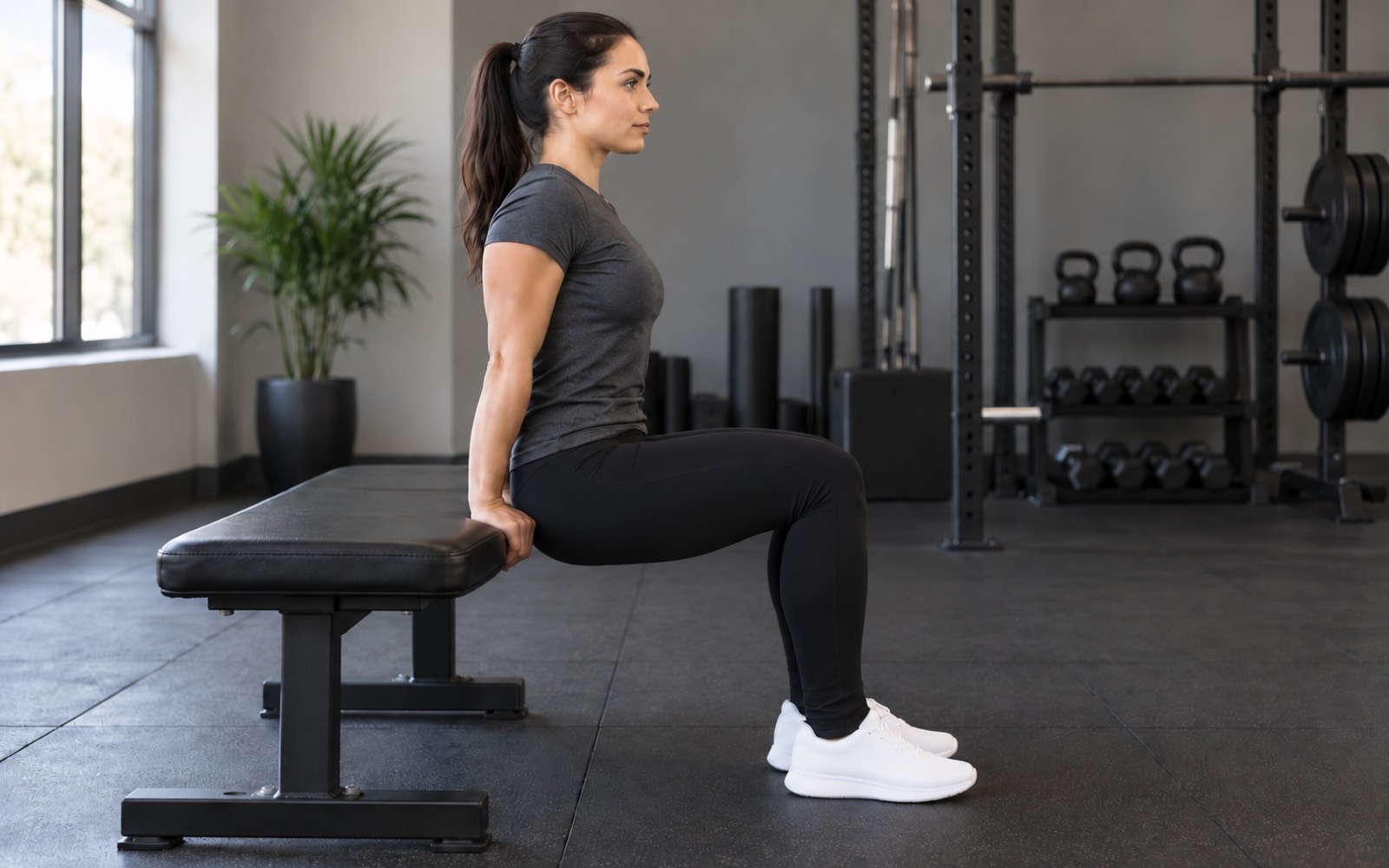
Bench dips are an elbow bend and extension with your hands behind you. Your palms rest on the edge of a bench or a chair, your hips hang just in front of it, and your feet stay on the floor. You lower your hips by bending your elbows to a right angle, then press yourself back up. The triceps do most of the work, and the front delts and upper chest help. Two settings decide whether your shoulder stays healthy: keep your hips right at the edge of the bench, and stop at a right angle in the elbow so your upper arm never drops below your elbow. A beginner is fine with 3 sets of 8–12 reps twice a week, starting with bent knees. Below: which muscles work and how hard, where to put your hands and feet, how to make it easier or harder, an 8-week plan, the mistakes you can feel, and the numbers behind why this exercise hurts shoulders and how to avoid that.
What bench dips are and what they do for you
Bench dips are a bodyweight triceps exercise: you support yourself on your hands behind your back and lower your hips by bending your elbows. In a push-up you face the floor; here you face the ceiling and the support is behind you, which is why some people call them reverse dips or seated dips. In gyms you'll also hear tricep dips, tricep dips on a bench, and chair dips when the support is a chair. On fitness sites they're sometimes listed as "dips on a bench" to tell them apart from parallel bar dips.
What they give you. First, triceps work without any equipment: all you need is a bench, a chair or the edge of a couch. Second, a step toward parallel bar dips, which not everyone can do with their full body weight right away. Third, strength that shows up on the barbell. In Kotarsky's 2018 study, 23 moderately trained men did progressive bodyweight push-ups 3 times a week for 4 weeks, and their bench press max rose significantly, the same as in the group that bench pressed the whole time. Those were push-ups, and bench dips weren't measured there, but the principle carries over: a bodyweight exercise works like a strength exercise when the steps keep getting harder.
Under "dips" people often mean four different movements. Here's how to tell them apart:
| What people call it | What it actually is | What works | Where we cover it |
|---|---|---|---|
| Bench dips, chair dips, tricep dips on a bench, seated dips | hands on a support behind you, hips in the air, elbows bend and extend | triceps, front delt, upper chest | this article |
| Floor dips, crab dips | the same thing with your hands on the floor behind you and your hips lifted slightly | triceps, less: the range of motion is shorter | the easiest version, section 05 |
| Reverse-grip push-ups | regular push-ups with your fingers turned toward your feet | chest and triceps, with a lot of load on the wrists and forearms | a different exercise; regular push-up form is in our guide to push-ups for beginners |
| Tricep dips on parallel bars, bar dips | regular parallel bar dips, where the grip is always the same | triceps, lower chest | a separate article on how to do dips |
The exercise has a bad reputation among doctors and coaches who work with shoulders, and in section 10 you'll see that the reputation rests on real numbers. There you'll also find our answer on how to do bench dips so your shoulder keeps a margin of safety.
Bench dips muscles worked
Bench dips work the triceps first, with the front delt and the upper part of the chest helping to press your body back up.
| Muscle | What it does | Where you feel it |
|---|---|---|
| Triceps, all three heads | extends the elbow on the way up and brakes the bend on the way down; the long head also keeps the upper arm from drifting back | back of the upper arm, from the elbow to the armpit |
| Anterior deltoid | lifts your torso at the start of the press, while the elbow is still bent | front of the shoulder, near the collarbone |
| Pectoralis major, clavicular part | helps the delt in the lower half of the movement | upper chest, closer to the shoulder |
| Serratus anterior and lower trapezius | keep your shoulder blade pressed to your ribs so your shoulders don't rise toward your ears | side of the ribcage under the armpit, and between the shoulder blades |
| Abs and hip flexors | hold your hips in the air when your legs are straight | stomach and the front of the thigh near the groin |
| Forearm muscles | keep your hand on the support | wrists and forearms |
How hard the triceps work. In 2022, McKenzie and colleagues compared three kinds of dips in 13 experienced men with an average of 4.2 years of training: bench dips, parallel bar dips and ring dips. Electrical activity was measured in 9 muscles, and the movement was recorded with 3D cameras. The triceps registered 0.83 mV on the bench, 1.04 mV on parallel bars and 1.05 mV on rings. The gap between bench and bars is about 25%. What this means for you: the bench loads the triceps less than the bars, and that's good for a starting point, because your feet on the floor take part of your weight.
Is it a real exercise or just a warm-up? A real exercise. In a 2011 study by the American Council on Exercise (ACE), run by Boehler and Porcari, 15 women aged 20–24 with strength training experience did 8 triceps exercises, and muscle activity was counted as a percentage of triangle push-ups with a narrow hand position. Bench dips from a low bench scored 87%, the long head 87% and the lateral head 88%; the protocol used straight legs with heels on the floor. The dumbbell kickback scored the same. Overhead extensions scored 76%, rope pushdowns 74%, and lying triceps extensions and the close-grip bench press 62% each. So bench dips with your own body weight load the triceps harder than a barbell skull crusher.
Why the long head in particular. The triceps has three heads, and the long head is the only one that attaches to the shoulder blade, which means it crosses the shoulder joint. In 2011, Landin and Thompson stimulated the triceps with electrodes in 18 people and showed that this muscle extends the shoulder as well as the elbow, pulling the arm back, and that this torque rose significantly as the shoulder angle went from 0° to 80°. In a bench dip the upper arm travels back exactly like that, so the triceps work across two joints at once, and after a set you feel it behind the elbow and at the back of the shoulder near the armpit. Kholinne and colleagues added a detail in 2018: with the arm hanging by your side, the long head produces significantly more force than the other two, and with the arm raised the medial head takes over. In bench dips the arm is down and pulled back, which is long-head territory.
How hard the chest works. In the same 2022 study by McKenzie, the pectoralis major was weaker on the bench than on bars and rings, and so were the anterior deltoid, serratus anterior, upper trapezius and latissimus: six muscles out of nine worked significantly less on the bench than on parallel bars. The chest is a helper here, and bench dips won't build it.
How to do bench dips: step-by-step form
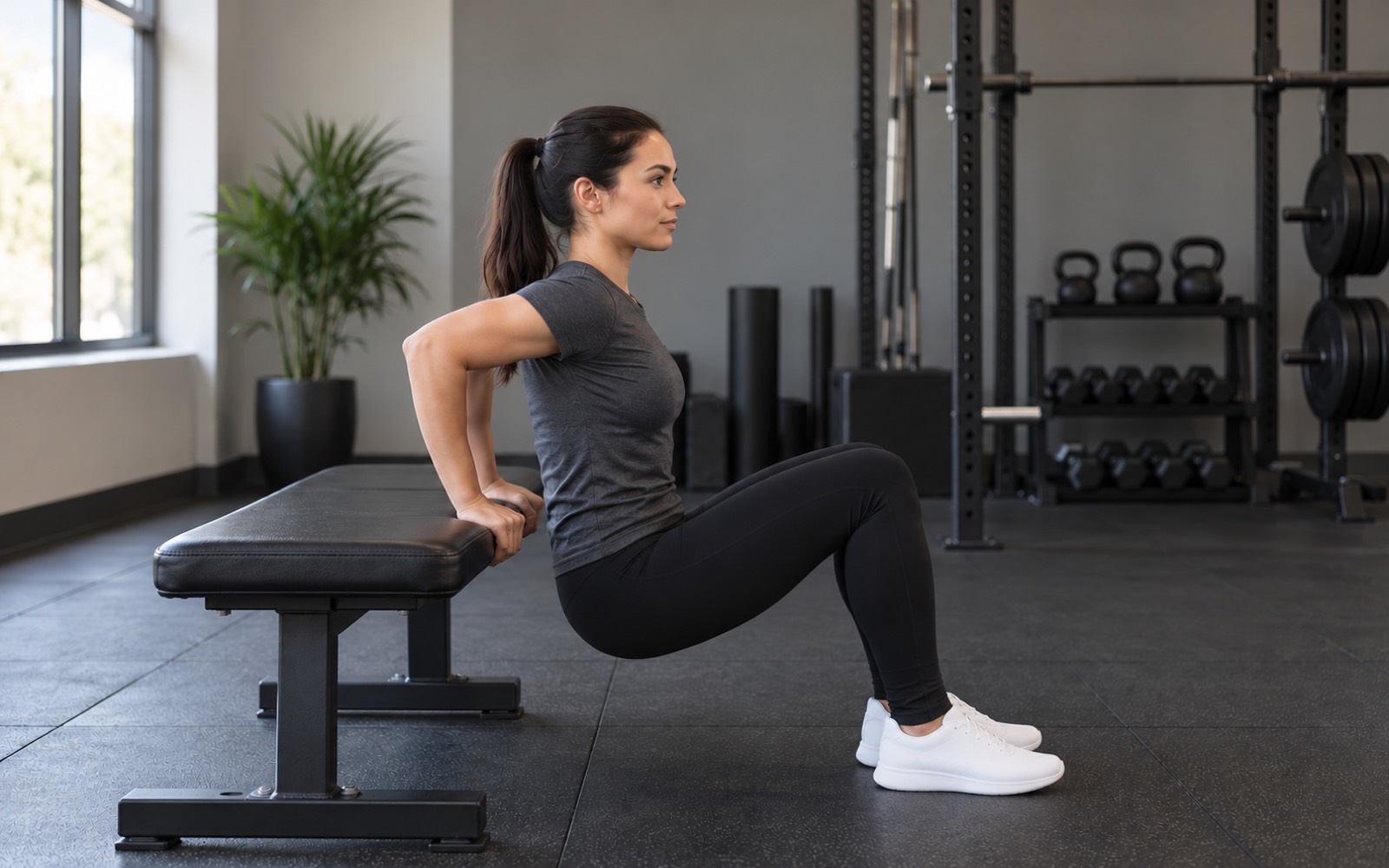
Sit on the edge of a bench, place your palms by your hips, slide your hips an inch or two off the edge, lower yourself by bending your elbows straight back to a right angle, then press back up. Step by step:
- The support. A bench about knee height, 40–45 cm (16–18 in), with a firm edge. The height of the support doesn't change the angle at your shoulder; the elbow angle sets that. It does change the load: the higher the support with bent knees, the more weight stays on your legs and the easier it is on your arms.
- Hands. Sit on the edge and put your palms on either side of your hips, the heel of the hand on the edge, fingers pointing forward or slightly out. Hands hip-width apart or a little wider.
- Hips. Slide your hips forward off the edge by 2–5 cm (1–2 in), just enough so your glutes don't brush the bench on the way down. No further: the farther your hips are from the support, the harder it pulls on the front of your shoulder.
- Feet. On the first step, knees bent at 90°, feet under your knees. How to change the leg position as you get stronger is covered in section 06.
- Shoulder blades. Pull your shoulders down away from your ears and squeeze your shoulder blades back, chest forward. That puts the shoulder joint in its strongest position. Look straight ahead, neck long.
- Lowering. Bend your elbows straight back, along your torso, taking 2–3 seconds. Your body travels straight down, close to the bench.
- The bottom. Elbow bent to 90°, upper arm parallel to the floor and no lower than the elbow. This cue comes from the 2011 ACE protocol: the participants were asked to lower until the upper arm was parallel to the floor. Pause for a count of one.
- Pressing up. Press yourself up in about 1 second using only your arms. Your feet just stand there; they don't push. At the top your arms are straight, but don't slam the elbows into lockout.
- Breathing. Inhale on the way down, exhale on the way up. With bent knees you can breathe normally; with a weight on your lap, keep your stomach tight at the bottom.
The 2009 position stand from the American College of Sports Medicine (ACSM) recommends a slow or moderate tempo for beginners, and moderate there means 1–2 seconds up and the same down. We stretch the lowering a little, to 2–3 seconds, and section 06 shows why.
Hand position, feet and depth: where to put your hands and how low to go
Place your hands hip-width apart with fingers pointing forward or slightly out, keep your hips at the edge, and go down to a right angle at the elbow so that your upper arm never drops below your elbow.
Hand width. There's no need to go wider than your shoulders. When your hands are far apart, your elbows flare out, the load leaves the triceps, and the inside of the elbow starts to ache. Narrower than your hips is awkward too: your palms bump into your thighs. Hip width, or one palm wider, is the working range.
Fingers. Usually forward. If that pulls on the front of your shoulder, turn your fingers slightly out, 20–30°: the shoulder rotates outward a little in that position, and many people find it more comfortable. This is a coaching trick with no measurements behind it, so go by feel.
Wrists. Rest on the heel of your hand. Fingers hanging off the edge and a wrist bent back give you wrist pain by the second week. If the bench edge is thin or your wrists have a history of injury, put push-up handles or two heavy dumbbells on the bench and hold them like handles: your wrist stays straight.
Feet. Leg position changes the load more than anything else. Knees bent, feet under your knees: easiest. Legs straight, heels on the floor, toes pulled up: harder. Feet on a second bench: harder still. These are all steps of the same exercise, laid out in section 06.
Depth. The main question with this exercise. Everyone knows the "no deeper than 90°" rule, but few explain why. On parallel bars, Çınarlı and colleagues in 2021 measured the triceps and chest in 10 men at elbow bends of 75°, 85° and 95°: during the pause at the bottom, the triceps were significantly more active at 75°, the shallowest of the three positions, and the chest didn't change with depth. This hasn't been repeated on the bench, but the argument carries over: below a right angle, the triceps gain nothing. The shoulder, on the other hand, gets a lot. In McKenzie's 2022 study, the participants chose their own depth, and at the bottom of a bench dip their shoulder went back 88° on average, which is 101% of their own tested maximum. When nobody stops them, people sink past their own limit. On parallel bars the same figure was 88%, on rings 69%.
Hence the rule: the shoulder sets the depth. The elbow reaches 90°, and the upper arm stays parallel to the floor or higher. If at 90° in the elbow your upper arm is already below your elbow, your forearm isn't vertical: your hips have drifted away from the edge, or your torso has leaned back.
measure your limit once so you know where it is. In McKenzie's study, maximum shoulder extension was tested like this: hands on a support at hip height, feet on the floor, lower as far as you can and hold for 3 seconds. Do it once, slowly, with no reps, and remember what the front of your shoulder feels like at the very bottom. Your working depth in bench dips should be well above that point. Then film yourself from the side on your phone during a set: at the bottom, the upper arm is horizontal, the forearm vertical, the elbow at 90°. If your upper arm is below your elbow on the video, stop earlier.
Chair dips, couch dips and floor dips: bench dips at home
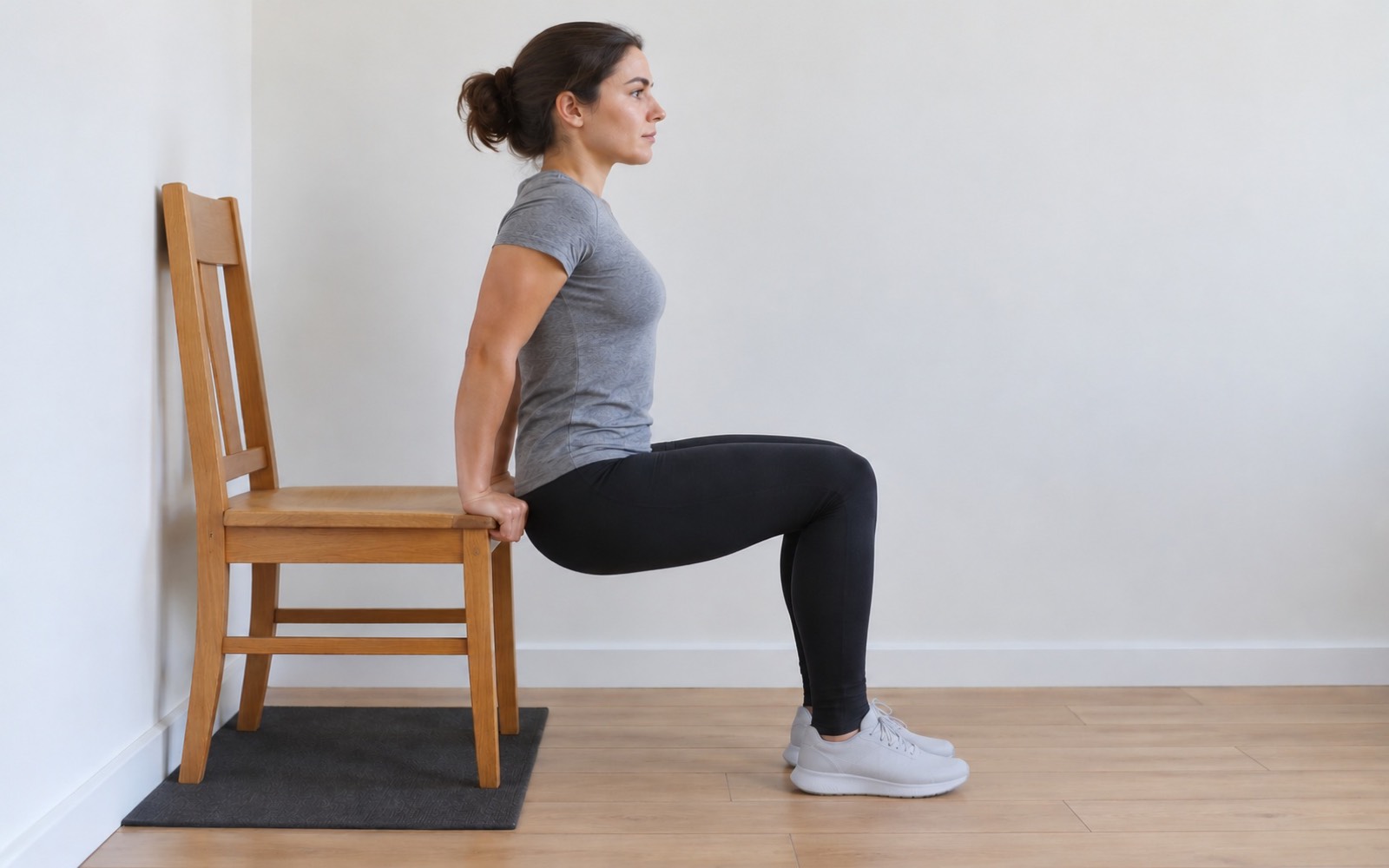
At home, any stable object about knee height with a firm edge will do: a chair, the edge of a couch, a bed with a solid frame, a low cabinet or a step.
On a chair. The most common home version, and it has one problem: the chair is light and slides. Put it with its back against a wall and on a mat, so the rear legs press into the wall. A stool with a narrow seat won't work: your hands end up pressed together and your elbows flare out. A soft seat is bad too: your palms sink in and your wrist bends. You need a firm edge and a seat at least as wide as your hips. If the chair still wobbles, switch to the couch.
On a couch or a bed. The edge of a couch is usually lower than a chair, 35–40 cm (14–16 in), which is a bit harder on your arms, but the couch is heavy and doesn't go anywhere. Check that the edge is firm: a soft armrest or a mattress that sinks under your palm will bend your wrist. Many people find the couch more comfortable than a chair.
Two chairs. People set these up to put their feet on the second chair, as in step 3. Both chairs must be heavy and stand on a mat. You don't hang between the chairs like on parallel bars: hands on the first chair, feet resting on the second.
Floor dips, the "crab." Sit on the floor, hands behind you with fingers forward, knees bent, feet flat. Lift your hips 5–10 cm (2–4 in) off the floor and bend your elbows until your hips almost touch the floor. The range of motion here is shorter than from a bench, so the triceps do less work, but the shoulder barely travels back. This is the gentlest version: for your first week, for a shoulder that once hurt, for people carrying a lot of extra weight. Reverse-grip push-ups from the table in section 01 are a different exercise.
On a table or a windowsill. The higher the support with bent knees, the more weight stays on your legs and the less lands on your arms. A support of 75–90 cm (30–35 in) is step 0 in our plan, for anyone who can't get 8 reps off a chair.
What not to do at home. Don't put your feet on something higher than your hands: your hips drop below your hands, and your shoulder sinks at the bottom. Don't do bench dips off a stability ball or a narrow stool: a wobbly support doesn't make the exercise harder, it only makes it riskier for your wrists and shoulder.
How to make bench dips harder or easier: from bent knees to weight on your lap
You change the load in bench dips with your leg position and with weight on your lap, and we lay that out as five steps that follow one after another.
- Step 0. Hands on a high support, a table or windowsill at 75–90 cm (30–35 in), knees bent, feet under your knees. For anyone who can't get 8 reps on step 1.
- Step 1. A bench or chair about 45 cm (18 in) high, knees bent at 90°, feet under your knees, hips at the edge. The starting point for most people.
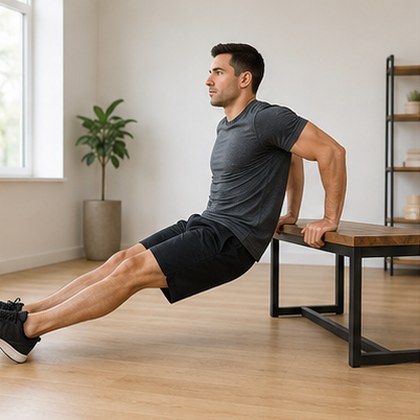
- Step 2. Legs straight, heels on the floor, toes pulled up. More weight lands on your arms, because less stays on your legs.
- Step 3. Feet on a second bench or chair of the same height, legs straight. Your body hangs between two supports.
- Step 4. Step 3 plus a plate or dumbbell on your lap: 5 kg (11 lb) for women, 10 kg (22 lb) for men, then 2.5–5 kg (5.5–11 lb) at a time. At home, a backpack with books or bottles: a 1.5-liter (50 oz) bottle weighs about 1.5 kg (3.3 lb).
Nobody has measured what percentage of body weight lands on your arms at each step: that figure exists only for push-ups, about 64% in Ebben's 2011 study. We won't make up percentages, so the steps are described as "easier" and "harder."
| What you change | For the triceps | For the shoulder | When |
|---|---|---|---|
| Bent knees → straight legs | harder: more weight on your arms | no change, as long as your hips stay at the edge | moving from step 1 to step 2 |
| Feet elevated | harder; hips can drop below your hands | riskier: it's easy to sink past 90° at the bottom, so let the shoulder set the depth | step 3 |
| Weight on your lap | harder, in 2.5–5 kg (5.5–11 lb) jumps | presses you down at the bottom, only after a clean step 3 | step 4 |
| Hips farther from the bench | almost nothing | more stretch on the front of the shoulder | never: this is a mistake |
| Past 90° at the elbow | adds nothing: on parallel bars the triceps were more active during the pause at 75° than at 95° (Çınarlı, 2021) | 101% of your own maximum extension (McKenzie, 2022) | never |
| 3-second lowering | harder, from the work on the way down | gentler: no collapse at the bottom | from week one |
| 1–2 second pause at the bottom, above 90° | harder | tolerable, as long as the upper arm isn't below the elbow | step 2 and up |
About elevating your feet. It's the most popular way to make the exercise harder and the sneakiest one for your shoulder. When your feet rest on a second bench, your body hangs between the supports, and at the bottom your hips can drop below the level of your hands. Then the shoulder travels farther back than on steps 1 and 2 at the same elbow angle. The rule for step 3: the second support is no higher than the first, your hips go straight down along the front bench, and in your first session you film yourself from the side and check where your shoulder is.
How to load the weight. Put the plate or dumbbell on the upper part of your thighs, close to your hips: on your knees it slides off and presses on the kneecaps. It's easier when someone hands you the plate after you're already in the starting position. At home, wear the backpack on your front, straps over your shoulders, and it sits on your lap by itself.
A free way to make it harder. The 2026 ACSM position stand, which pooled 137 systematic reviews, names overload during the lowering phase as one of the conditions for muscle growth. On the bench this costs nothing: take 3 seconds to lower instead of one, and the set gets noticeably harder with no added weight. A 1–2 second pause at the bottom works the same way, but only above 90°, otherwise it turns into a stretch for the ligaments of your shoulder.
When to move to parallel bars. When step 4 with 10 kg (22 lb) on your lap gives you 3 × 12 with reps to spare. On the bars, the triceps work about 25% harder, 1.04 mV versus 0.83 mV (McKenzie, 2022), and the shoulder travels back less, 88% versus 101%. How to get your first dip from zero, how much counterweight to set on the assisted machine, and how to add weight with a belt are covered in our guide to how to do dips.
 Bench dip, step 2
An 8-week plan for women and men
Women should start at step 1, with bent knees, and men at step 2, with straight legs, 3 sets of 8, adding reps first and then moving up a step.
The progression rule comes from the 2009 ACSM position stand: a beginner needs a load that allows 8–12 reps, and once you can do 1–2 reps more than planned, the load goes up. With a barbell it goes up by 2–10%; here, instead of kilograms, the step changes and reps drop back to 8. Two sessions a week, 3 working sets, 2–3 reps left before failure, 2–3 seconds down and 1 second up, 1.5–2 minutes of rest between sets.
Day-one test. Do step 1 for 8 reps. If you had reps to spare and your shoulder didn't sink, that's your start. If 12 or more came easily, start at step 2. The table has men starting there, but sex has nothing to do with it; the test decides: a woman who can do push-ups from the floor also starts at step 2. If you couldn't get 8, do step 0 for two weeks.
| Week | Women | Reps per session | Men | Reps per session | What changed |
|---|---|---|---|---|---|
| 1 | step 1, 3 × 8 | 24 | step 2, 3 × 8 | 24 | starting point |
| 2 | step 1, 3 × 10 | 30 | step 2, 3 × 10 | 30 | +2 reps per set |
| 3 | step 1, 3 × 12 | 36 | step 2, 3 × 12 | 36 | +2 reps |
| 4 | step 2, 3 × 8 | 24 | step 3, 3 × 8 | 24 | one step up, back to 8 |
| 5 | step 2, 3 × 10 | 30 | step 3, 3 × 10 | 30 | +2 reps |
| 6 | step 2, 3 × 12 | 36 | step 3, 3 × 12 | 36 | +2 reps |
| 7 | step 3, 3 × 8 | 24 | step 4 (10 kg / 22 lb), 3 × 8 | 24 | one step up, back to 8 |
| 8 | step 3, 3 × 10 | 30 | step 4 (10 kg / 22 lb), 3 × 10 | 30 | +2 reps |
Within each step, the volume per session grows from 24 to 36 reps, that is by 50%, and the step itself changes twice over the 8 weeks. There's no tonnage here like in our barbell plans: the weight on your arms depends on where your legs and hips are, and nobody has measured it as a percentage of body weight for bench dips, so we count reps and steps.
This is a typical path, and there's no fixed standard. The step goes up only when, in all three sets, your upper arm never dropped below your elbow, your hips stayed at the edge, and you had 2–3 reps left. If in week 3 the twelve reps come with your shoulder sinking, stay on that step another week. If the front of your shoulder hurts, drop one step down for two weeks.
At home. Step 3 is feet on a second chair or on a couch of the same height. Step 4 is a backpack with books on your lap: four 1.5-liter bottles give you 6 kg (13 lb), eight give you 12 kg (26 lb).
What's next. After step 4 with 10 kg (22 lb) for 3 × 12, parallel bars, where the load grows with a dip belt. How adding load works in general once the first eight weeks are over and you've run out of reps and steps is covered in our guide to progressive overload.
In the Sportygram app (go.sportygram.com; the interface and the coach are in Russian), bench dips are among the 142 exercises with technique photos, in both the men's and women's sets. You can ask the virtual coach, Alex, in chat to add bench dips to Tuesday's workout; he shows a confirmation card, and once you confirm, the exercise appears in that day's plan. You log your sets and reps in the workout diary, and the history shows when three sets of 12 have come twice in a row and it's time to move up a step.
How many reps, sets and times a week, and where to put them in your workout
A beginner is fine with 3 sets of 8–12 reps twice a week, with 2–3 reps left before failure, after presses and before isolation exercises for the triceps.
Reps. 8–12 is the range from the 2009 ACSM position stand for beginners. But with body weight you often get more, and that's fine. Schoenfeld's 2017 meta-analysis of 21 studies showed that when sets are taken to failure, muscles grow the same from light loads up to 60% of max and from heavy ones. For bench dips this means 15–20 reps on step 1 grow the triceps as well as 8 reps with a plate, as long as the last reps are hard. Easy, fast 20 reps after which you feel nothing don't count: see section 09, the last row of the mistakes table.
Failure. You don't need to reach it. Grgic's 2022 meta-analysis of 15 studies found no significant difference in strength or growth between sets to failure and sets stopped short, with only a small edge for failure in trained people. On the bench, failure is riskier than in most exercises: the last rep that "won't go" ends with your shoulder collapsing down, into that very end-range extension from section 04. So 2–3 reps in reserve here also protects the joint.
Rest. 1.5–2 minutes. In Schoenfeld's 2016 experiment, 21 trained men did 3 × 8–12 for 8 weeks, one group resting 1 minute and the other 3. The three-minute rest gave more strength and more growth in thigh thickness, and the triceps trended the same way. Resting "30 seconds so it burns" gets in the way of doing the planned reps at a normal depth.
Frequency. Twice a week. In Schoenfeld's 2016 meta-analysis on training frequency, muscles that were loaded more often grew more: an effect size of 0.49 versus 0.30, and at the same weekly volume, two sessions gave more than one. There's no need to do bench dips every day: that also means stretching the front capsule of the shoulder daily with no time to recover, more on that in section 10.
Triceps volume. According to the 2026 ACSM position stand, muscles grow more with 10 or more sets per muscle per week. 3 sets twice a week is 6 sets, and you need 4 more. The best partner is the overhead extension, and section 11 explains why. The same ACSM position found no consistent difference between free weights, machines and other equipment, so body weight or a cable makes no difference for growth.
Where in the workout. ACSM in 2009 recommends putting multi-joint exercises before single-joint ones. Bench dips work through the elbow and the shoulder, so their place is after the bench press or push-ups and before skull crushers or rope pushdowns. In a bodyweight arm workout they can go first.
Mistakes: where you feel it → what to fix
Correct bench dips feel like fatigue down the back of your upper arm, from the elbow to the armpit; if you feel a pull at the front of your shoulder, inside the elbow or in your wrist, the form has drifted.
| Where you feel it | What's wrong | The fix |
|---|---|---|
| Front of the shoulder at the bottom, a pull or a click | you went past 90° and the upper arm dropped below the elbow; or your hips drifted from the bench and the arm "hangs" behind you | stop at 90°, hips 2–5 cm (1–2 in) from the edge, film yourself from the side; one step down for 2 weeks |
| Top or front of the shoulder on the way up | shoulder blades rose toward your ears, shoulders rolled forward | shoulder blades down and back before the first rep, chest forward, neck long |
| Inside of the elbow | elbows flaring out, hands wider than your shoulders | elbows back along your torso, hands hip-width or a little wider |
| Wrist | fingers hanging off the edge, wrist bent back, weight on the fingers | heel of the hand on the edge, fingers forward or slightly out; push-up handles or dumbbells as grips; swap a narrow chair |
| Traps and neck | shoulders raised, chin pressed to chest or tilted up | look ahead, shoulders away from your ears |
| Lower back, a downward pull | hips sank down and forward, stomach relaxed, feet on a support higher than your hands | abs tight, hips travel straight down along the bench, second support no higher than the first |
| Only the shoulders, triceps silent | torso leaning forward, elbows out, short range of motion | torso upright, elbows back, lower to 90° |
| You feel nothing, the reps are easy | a 10 cm (4 in) range of motion and a fast tempo | 2–3 seconds down, a pause, a full 90°; then the next step |
| The chair slides or wobbles | light support on a smooth floor | back against a wall, on a mat; couch or bed edge if the chair is light |
Sore the next day: muscle or joint. A dull, spread-out ache down the back of the upper arm that gets worse when you straighten your arm and goes away in 2–3 days is soreness, the usual muscle pain after an unfamiliar load. Any new exercise gives you that, especially with slow lowering. Pain in one spot at the front of the shoulder, clicking, pain when raising your arm overhead or at night when lying on that side, is the joint. That kind of pain says the depth was too much and the step needs to come down, and if it doesn't go away in a few days, see section 10.
Why bench dips hurt your shoulders, and who should avoid them
The shoulder hurts after bench dips mainly because of depth: at the bottom, your arm travels farther back than in any other triceps exercise, and the front of the joint gets stretched under load.
The numbers behind the bad reputation. In McKenzie's 2022 study, the participants did bench dips the way they were used to, with no instructions about depth. At the bottom, their shoulder extended to 88°, which was 101% of the maximum measured separately for each of them; on parallel bars the shoulder reached 88% of maximum, on rings 69%. The authors say it plainly: that much extension loads the front capsule of the joint, the inferior glenohumeral ligament can lengthen irreversibly, and the triceps can be trained with other exercises that don't load end-range extension, so they don't recommend keeping bench dips in regular programs. Our answer is this: the 101% came from self-selected depth, when nobody stopped people at a right angle, and the shoulder-set depth from section 04 removes exactly that part. But if your shoulder already hurts or has ever dislocated, replace the bench; the list of substitutes is in section 11.
Why "a bit deeper" adds up. In 2000, Pollock and colleagues stretched the inferior glenohumeral ligament of 33 cadaver shoulders in the lab, in cycles below the rupture point. After one cycle the ligament lengthened by 4.6%, after 10 cycles by 6.5%, after 100 by 7.1%, and over an hour it barely returned to its original length. The authors call this a mechanism of acquired shoulder instability in young athletes in overhead sports. That was an experiment on specimens, not on living people, but the mechanism is clear: the ligament doesn't tear, it slowly stretches, and every extra inch of depth adds to that account. This is the study McKenzie's team leans on when explaining what's wrong with 101%.
How common this is. In Bernstorff's 2023 survey of 1,387 gym-goers, 732 people, or 53.1%, felt pain during training. Among the most pain-prone of 49 exercises were the squat, the deadlift, the bench press and triceps dips, and the most common pain site was the shoulder, followed by the lower back and knees. People who wrote their own programs reported pain more often. The survey didn't specify bench or bars, but exercises where the shoulder travels back under body weight land on the complaint list every time. In Kolber's 2010 review, the shoulder complex accounted for up to 36% of documented injuries and disorders from strength training, and the authors name muscle imbalance around the joint and technique as the main causes.
About instability. In 2013, Kolber and colleagues compared 123 men who trained with weights at least twice a week with 36 who didn't train. The lifters significantly more often had excess forward mobility of the shoulder and positive tests for anterior instability. Signs of instability most often went together with behind-the-neck pulldowns and behind-the-neck presses, and among those who trained the external rotators of the shoulder separately, the signs were found less often. That's a correlation, and the study doesn't prove cause, and bench dips weren't studied separately there. There's still a practical takeaway: before your sets on the bench, do 2 sets of 15 external rotations with a band, elbow pinned to your side, hand turning outward. Two minutes, and it works exactly the muscles that hold the front of the shoulder.
Who should be careful.
- A past dislocation or subluxation, or a diagnosis of instability. Replace the bench with narrow push-ups or the close-grip bench press, where your shoulder blades rest on a support. Come back only with a doctor's clearance, starting with the crab.
- Joint hypermobility. If your elbows and knees hyperextend, your shoulder most likely goes past normal too. Stop short of 90° at the elbow, and film yourself from the side every time.
- Pain at the front of the shoulder right now, past impingement or bursitis. The cause first, the exercise later. How to tell that kind of pain from soreness is covered in our guide to shoulder pain from lifting.
- An elbow after inflammation, "tennis elbow." Supporting yourself on straight arms can flare it up. Start with the crab and a short range of motion.
- Wrists after injury or with pain. Only with handles, dumbbells or push-up bars, wrist straight.
- Pregnancy. Discuss an exercise with your hands behind you and a braced core with the doctor managing your pregnancy; many people replace it with wall push-ups.
- A lot of extra weight. There's a lot of load on your arms even with bent knees: start at step 0 off a table or with the crab, and your wrists need handles.
- After 40 and after 60. Strength exercise is safe for healthy adults of any age: in the 2026 ACSM position stand, an analysis of more than 38,000 people found no increase in the risk of serious adverse events. Start at step 0–1 and watch the depth especially closely; shoulder mobility changes over the years.
When to see a doctor. A click with sharp pain at the bottom. Pain that shoots down the arm, or numb fingers. A feeling that the shoulder is "popping out." Pain at the front of the shoulder that doesn't go away after 2–3 days of rest or wakes you at night. With any of these signs, there's no need to "work through" the shoulder at your next session.
Bench dips vs. parallel bar dips, push-ups and skull crushers: which to choose
Bench dips are the bodyweight starting point for the triceps; parallel bar dips are a quarter harder and gentler on the shoulder; narrow push-ups and the close-grip bench press help when the front of your shoulder hurts; the overhead extension is the mandatory partner to the bench.
| Exercise | Triceps | Shoulder at the bottom | What you need | Who it's for |
|---|---|---|---|---|
| Bench dips | 0.83 mV (McKenzie, 2022); 87% of triangle push-ups in women (ACE, 2011) | 101% of your own extension at self-selected depth | a bench or chair | a bodyweight start, depth set by the shoulder |
| Parallel bar dips | 1.04 mV, about 25% more than the bench | 88% | parallel bars or an assisted machine | the next step |
| Ring dips | 1.05 mV | 69%, the freest of all | rings and experience | experienced lifters |
| Triangle (narrow) push-ups | 100%, the reference point in ACE | moderate; in a regular push-up the hands carry about 64% of body weight (Ebben, 2011) | the floor | at home, and when the front of the shoulder hurts |
| Overhead extension | 76% (ACE, 2011); the long head grows 1.5 times more than with the arm by your side (Maeo, 2023) | the arm is raised, no extension back | a dumbbell or cable | the partner to the bench |
| Rope pushdown | 74% | shoulder blades stay put | a cable machine | topping up volume |
| Close-grip bench press, lying triceps extension | 62% and 62% | shoulder blades lie on the bench | a barbell | instead of the bench when the front of the shoulder hurts |
The numbers in the table come from different studies: millivolts in McKenzie, percentages of another exercise in ACE, percentages of body weight in Ebben, percentage growth in muscle volume in Maeo. You can't add them into one ranking, but they show the direction.
Bench or bars. Bars, if you can already do them. The triceps work about 25% harder on them, 1.04 versus 0.83 mV, and the shoulder extends less, 88% versus 101% (McKenzie, 2022). The authors call parallel bars the appropriate next step after the bench. The bench is the road to the bars, and once step 4 with weight is done, there's no reason to stay on it.
Why the bench needs an overhead partner. In bench dips the arm is down and pulled back, and the long head of the triceps, which attaches to the shoulder blade, works in a shortened position. In 2023, Maeo and colleagues trained 21 adults for 12 weeks, one arm with overhead extensions and the other with extensions with the arm by the side, 5 sets of 10 twice a week. The long head grew by 28.5% versus 19.6%, one and a half times more where it was stretched overhead, even though the overhead loads were 34–39% lower. That was measured on a cable, but the mechanical conclusion is simple: the bench gives the long head work in a short position, the overhead extension in a long one, and together they cover the whole muscle. Form for overhead extensions with a dumbbell, a barbell and a cable is in our guide to skull crushers and overhead extensions.
What to do instead if the front of your shoulder hurts. Narrow push-ups from the floor, the reference point in the ACE study at 100%. The close-grip bench press, 62%, but your shoulder blades lie on the bench and the shoulder doesn't travel back. Rope pushdowns, 74%, shoulder blades stay put. Overhead extensions, 76%, with the arm raised. Come back to the bench once the pain is gone, through the crab and step 0, with a short range of motion.
For women. The 2011 ACE study was done specifically on women, and the bench was one of the two best triceps exercises there. There's no need to worry about big arms: in Maeo's 2023 study, 12 weeks of targeted triceps training on a cable grew the muscle by 13.9–19.9% in volume, and around the arm that's a matter of a centimeter or two. From body weight on a bench twice a week the gain will be smaller. Start with bent knees, 3 × 8.
Questions and answers
What muscles do bench dips work?
Mainly the triceps: in McKenzie's 2022 measurements they registered 0.83 mV on the bench, and in the 2011 ACE study on women, bench dips from a low bench gave them 87% of the top triceps exercise. The front delt and upper chest help, the serratus anterior and lower trapezius hold the shoulder blade, and the abs hold the hips in the air. The chest works less on the bench than on parallel bars or rings, so you won't build it with this exercise.
Is there a difference between bench dips and chair dips?
Not for the muscles; the difference is stability and height. A chair is lighter and narrower, so put it with its back against a wall on a mat, the edge must be firm, and the seat at least as wide as your hips. Knee height, 40–45 cm (16–18 in); the higher the support, the more weight stays on your legs and the easier it is, while the shoulder angle doesn't depend on height, the elbow sets it. You don't hang between two chairs like on parallel bars: hands on one, feet on the floor or on the other.
How many reps and sets should a beginner do?
3 sets of 8–12 reps twice a week, with 2–3 reps left before failure, as the 2009 ACSM position stand recommends and Grgic's 2022 meta-analysis on failure confirms. If you get 15–20 reps with body weight, that works too: according to Schoenfeld's 2017 meta-analysis, muscles grow the same from light and heavy loads when the end of the set is hard. Once 3 × 12 come clean with reps to spare, move up a step and start again from 8.
Why does the front of my shoulder hurt after bench dips?
Depth. At self-selected depth, the shoulder on the bench goes into extension at 101% of its own maximum (McKenzie, 2022), and the ligament at the front of the joint lengthens by 4.6–7.1% from repeated stretching and barely recovers within an hour (Pollock, 2000). Fix it like this: elbow to 90°, upper arm no lower than the elbow, hips 2–5 cm (1–2 in) from the edge, side-view video. Pain with a click, pain shooting down the arm, or pain that doesn't go away in 2–3 days is a reason to see a doctor before your next session.
Can women do bench dips, and will they make my arms big?
Yes, and the 2011 ACE study, where the bench made the top two triceps exercises, was done specifically on women. Your arms won't get big: in Maeo's 2023 study, 12 weeks of targeted cable training grew the triceps by 14–20% in volume; around the arm that's a centimeter or two. From body weight on a bench the gain will be smaller. Start with bent knees, 3 × 8, twice a week.
What is the difference between bench dips and parallel bar dips?
On parallel bars your whole body weight is on your arms, the triceps work about a quarter harder, 1.04 versus 0.83 mV, and the shoulder extends less, 88% versus 101% (McKenzie, 2022). On the bench part of your weight rests on your feet, so it's easier and good for starting out, but the shoulder travels farther back. The bench is a step toward the bars: move on after step 4, once 3 × 12 with 10 kg (22 lb) on your lap come with reps to spare.
Can you do bench dips every day?
There's no point. Two sessions a week grow muscle better than one (Schoenfeld, 2016), and seven means stretching the front of the shoulder every day with no time to recover. The growth target for the triceps is 10 or more sets a week across all exercises (ACSM, 2026): 6 sets of bench dips plus 4 sets of overhead extensions or pushdowns.
What can I do instead of bench dips if my shoulder hurts?
Narrow push-ups from the floor, the reference point in ACE at 100%. The close-grip bench press, 62%, where your shoulder blades lie on the bench. Rope pushdowns, 74%. Overhead extensions, 76%, where the arm is raised and the long head grows 1.5 times more than with the arm by your side (Maeo, 2023). Come back to the bench once the pain is gone, from a high support and a short range of motion.
The bottom line
- Bench dips are an elbow bend and extension with your hands behind you on a bench or chair, hips in the air, feet on the floor. The main muscle is the triceps; the front delt and upper chest help.
- The triceps register 0.83 mV on the bench versus 1.04 mV on parallel bars (McKenzie, 2022); in women, the bench gives 87% of the top triceps exercise, above the lying triceps extension at 62% (ACE, 2011).
- The weak point is the shoulder: at self-selected depth it goes into extension at 101% of its own maximum (McKenzie, 2022), and the ligament at the front lengthens by 4.6–7.1% from repeated stretching (Pollock, 2000). So: elbow to 90°, upper arm no lower than the elbow, hips at the bench.
- Hands hip-width apart, heel of the hand on the edge, fingers forward or slightly out, elbows back along your torso, shoulder blades down.
- Steps: bent knees → straight legs → feet on a second support → weight on your lap → parallel bars. Move up once 3 × 12 come with 2–3 reps to spare.
- 3 sets of 8–12 twice a week, 1.5–2 minutes of rest, no failure; top up to 10 triceps sets a week with overhead extensions (ACSM, 2026; Maeo, 2023).
- A click with pain, pain down the arm, numb fingers, or pain lasting more than 2–3 days: see a doctor.
Checklist: before a set of bench dips
- The support is stable, knee height, firm edge, chair back against a wall.
- Heel of the hand on the edge, fingers forward or slightly out.
- Hands hip-width apart or a little wider.
- Hips 2–5 cm (1–2 in) from the edge, no farther.
- Shoulder blades down and back, chest forward, neck long.
- Elbows travel back along your torso.
- At the bottom: elbow at 90°, upper arm no lower than the elbow.
- 2–3 seconds down, 1 second up.
- 2–3 reps left in reserve at the end of the set.
- Step, sets and reps logged in your diary.
Sources
- McKenzie A., Crowley-McHattan Z., Meir R., Whitting J., Volschenk W. Bench, Bar, and Ring Dips: Do Kinematics and Muscle Activity Differ?. International Journal of Environmental Research and Public Health, 2022. — 13 experienced men, self-selected technique, 3D motion capture and electromyography of 9 muscles: triceps 0.83 mV on the bench, 1.04 mV on parallel bars, 1.05 mV on rings; six of nine muscles significantly less active on the bench than on bars; shoulder extension at the bottom of a bench dip 88°, or 101% of the participants' own maximum, 88% on bars, 69% on rings; the authors link end-range extension to load on the anterior capsule, advise against bench dips in regular programs and call parallel bars the next step after them.
- Boehler B., Porcari J.P., Kline D., Hendrix C.R., Foster C. ACE Study Identifies Best Triceps Exercises. American Council on Exercise, 2011. — 15 women aged 20–24, 8 exercises, triceps activity as a percentage of triangle push-ups: bench dips from a low bench 87% (long head 87, lateral 88), dumbbell kickback 87, overhead extension 76, rope pushdown 74, bar pushdown 67, lying triceps extension 62, close-grip bench press 62; the protocol lowered to "upper arms parallel to the floor."
- Çınarlı F.S., Kafkas M.E., Soylu A.R., Yılmaz N. Effect of elbow angle on triceps brachii and pectoralis major muscle activity during parallel bar dip. Kinesiologia Slovenica, 2021. — 10 men, parallel bars, elbow bend of 75°, 85° and 95°: during the pause at the bottom, the triceps were significantly more active at 75°, and the pectoralis major didn't change with the angle.
- Pollock R.G., Wang V.M., Bucchieri J.S., Cohen N.P., Huang C.Y., Pawluk R.J., Flatow E.L., Bigliani L.U., Mow V.C. Effects of repetitive subfailure strains on the mechanical behavior of the inferior glenohumeral ligament. Journal of Shoulder and Elbow Surgery, 2000. — 33 cadaver shoulders: after stretch cycles below the rupture point, the inferior glenohumeral ligament lengthened by 4.6% (1 cycle), 6.5% (10 cycles) and 7.1% (100 cycles), with minimal recovery of length within an hour; the authors describe a mechanism of acquired shoulder instability in young athletes in overhead sports.
- Kholinne E., Zulkarnain R.F., Sun Y.C., Lim S., Chun J.M., Jeon I.H. The different role of each head of the triceps brachii muscle in elbow extension. Acta Orthopaedica et Traumatologica Turcica, 2018. — 10 people, elbow extension with the shoulder raised from 0° to 180°: with the arm by the side, the long head produces significantly more force and activity than the lateral and medial heads; at 90° and above, the medial head takes over.
- Landin D., Thompson M. The shoulder extension function of the triceps brachii. Journal of Electromyography and Kinesiology, 2011. — 18 people, electrical stimulation of the triceps on a dynamometer: the triceps extend the shoulder as well as the elbow, and shoulder extension torque rises significantly as the shoulder angle goes from 0° to 80°.
- Maeo S., Wu Y., Huang M., Sakurai H., Kusagawa Y., Sugiyama T., Kanehisa H., Isaka T. Triceps brachii hypertrophy is substantially greater after elbow extension training performed in the overhead versus neutral arm position. European Journal of Sport Science, 2023. — 21 adults, 12 weeks, one arm overhead and the other by the side, 5 × 10 twice a week: long head +28.5% versus +19.6%, whole triceps +19.9% versus +13.9%, overhead loads 34–39% lower.
- American College of Sports Medicine. Progression models in resistance training for healthy adults. Medicine & Science in Sports & Exercise, 2009. — Beginners: a load allowing 8–12 reps, 2–3 sessions a week, slow or moderate tempo, moderate meaning 1–2 seconds per phase; increase the load once 1–2 reps more than planned are achievable; multi-joint exercises before single-joint ones; 1–2 minutes of rest for muscle growth.
- Currier B.S., D'Souza A.C., Singh M.A.F. et al. American College of Sports Medicine Position Stand. Resistance Training Prescription for Muscle Function, Hypertrophy, and Physical Performance in Healthy Adults: An Overview of Reviews. Medicine & Science in Sports & Exercise, 2026. — 137 systematic reviews, more than 30,000 participants: for muscle growth, 10 or more sets per muscle per week and overload during the lowering phase; equipment type and training to failure gave no consistent difference; resistance training is safe for healthy adults of any age, with no increase in serious adverse events across more than 38,000 people.
- Schoenfeld B.J., Grgic J., Ogborn D., Krieger J.W. Strength and Hypertrophy Adaptations Between Low- vs. High-Load Resistance Training: A Systematic Review and Meta-analysis. Journal of Strength and Conditioning Research, 2017. — 21 studies, sets to failure: muscle growth is the same at loads up to 60% and above 60% of max; maximal strength grows more from heavy loads.
- Grgic J., Schoenfeld B.J., Orazem J., Sabol F. Effects of resistance training performed to repetition failure or non-failure on muscular strength and hypertrophy: a systematic review and meta-analysis. Journal of Sport and Health Science, 2022. — 15 studies: no significant difference in strength or muscle growth between training to failure and stopping short, with a small edge for failure in growth among trained people.
- Schoenfeld B.J., Pope Z.K., Benik F.M. et al. Longer Interset Rest Periods Enhance Muscle Strength and Hypertrophy in Resistance-Trained Men. Journal of Strength and Conditioning Research, 2016. — 21 trained men, 8 weeks, 3 × 8–12: 3 minutes of rest gave more strength and thigh muscle thickness than 1 minute, with the triceps trending the same way.
- Schoenfeld B.J., Ogborn D., Krieger J.W. Effects of Resistance Training Frequency on Measures of Muscle Hypertrophy: A Systematic Review and Meta-Analysis. Sports Medicine, 2016. — 10 studies: muscles trained more often grow more, effect size 0.49 versus 0.30; at equal volume, two sessions a week beat one.
- Kolber M.J., Beekhuizen K.S., Cheng M.S., Hellman M.A. Shoulder injuries attributed to resistance training: a brief review. Journal of Strength and Conditioning Research, 2010. — Up to 36% of documented injuries and disorders from strength training involve the shoulder complex; risk factors are muscle imbalance and technique.
- Kolber M.J., Corrao M., Hanney W.J. Characteristics of anterior shoulder instability and hyperlaxity in the weight-training population. Journal of Strength and Conditioning Research, 2013. — 123 men training with weights at least twice a week and 36 non-lifters: lifters significantly more often had excess forward shoulder mobility and positive instability tests; signs of instability were linked to behind-the-neck pulldowns and presses, and external rotator exercises to a lower rate of those signs.
- Bernstorff M.A., Schumann N., Finke A., Schildhauer T.A., Königshausen M. Popular Gym Fitness Sport: An Analysis of 1387 Recreational Athletes Regarding Prone to Pain Exercises and the Corresponding Localisations. Sports, 2023. — Survey of 1,387 gym-goers, 49 exercises: 732 people (53.1%) felt pain during training; among the most pain-prone exercises were the squat, deadlift, bench press and triceps dips; the most common site was the shoulder; people who wrote their own programs reported pain more often.
- Ebben W.P., Wurm B., VanderZanden T.L., Spadavecchia M.L., Durocher J.J., Bickham C.T., Petushek E.J. Kinetic analysis of several variations of push-ups. Journal of Strength and Conditioning Research, 2011. — 23 people, 6 push-up variations on a force plate: in a regular push-up the hands carry about 64% of body weight; elevating the feet increases the load, elevating the hands or kneeling reduces it; no difference between sexes.
- Kotarsky C.J., Christensen B.K., Miller J.S., Hackney K.J. Effect of Progressive Calisthenic Push-up Training on Muscle Strength and Thickness. Journal of Strength and Conditioning Research, 2018. — 23 moderately trained men, 4 weeks of 3 sessions: bench press max rose significantly in both the progressive bodyweight push-up group and the bench press group.
This article is for informational purposes only and is not a substitute for medical advice.